Deckard’s Front Door Key

I’m sorry. I could have sworn in advance that this would be a very quick post. One or two paragraphs.

  • Narrator
  • It wasn’t.

Exiting his building’s elevator, Deckard nervously pulls a key to his apartment from his wallet. The key is similar to a credit card. He inserts one end into a horizontal slot above the doorknob, and it quickly *beeps*, approving the key. He withdraws the key and opens the door.

The interaction…

…is fine, mostly. This is like a regular key, i.e. a physical token that is presented to the door to be read, and access granted or denied. If the interaction took longer than 0.1 second it would be important to indicate that the system was processing input, but it happens nearly instantaneously in the scene.

A complete review would need to evaluate other use cases.

  • How does it help users recover when the card is inserted incorrectly?
  • How does it reject a user when it is not the right key or the key has degraded too far to be read?

But of what we do see: the affordance is clear, being associated with the doorknob. The constraints help him know the card goes in lengthwise. The arrows help indicate which way is up and the proper orientation of the card. It could be worse.

A better interaction might arguably be no interaction, where he can just approach the door, and a key in his pocket is passively read, and he can just walk through. It would still need a second factor for additional security, and thinking through the exception use cases; but even if we nailed it, the new scene wouldn’t give him something to nervously fumble because Rachel is there, unnerving him. That’s a really charming character moment, so let’s give it a pass for the movie.

Accessibility

A small LED would help it be more accessible to deaf users to know if the key has been accepted or rejected.

The printing

The key has some printing on it. It includes the set of five arrows pointing the direction the key must be inserted. Better would be a key that either used physical constraints to make it impossible to insert the card incorrectly or to build the technology such that it could be read in any way it is inserted.

The rest of the card has numerals printed in MICR and words printed in a derived-from-MICR font like Data70. (MICR proper just has numerals.) MICR was designed such that the blobs on the letterforms, printed in magnetic ink, would be more easily detectible by a magnetic reader. It was seen as “computery” in the 1970s and 1980s (maybe still to some degree today) but does not make a lot of sense here when that part of the card is not available to the reader.

Privacy

Also on the key is his name, R. DECKARD. This might be useful to return the key to its rightful owner, but like the elevator passphrase, it needlessly shares personally identifiable information of its owner. A thief who found this key could do some social hacking with the name and gain access to his apartment. There is another possible solution for getting the key back to him if lost, discussed below.

The numbers underneath his name are hard to read, but a close read of the still frame and correlation across various prop recreations seem to agree it reads

015 91077
VP45 66-4020

While most of this looks like nonsense, the five-digit number in the upper right is obviously a ZIP code, which resolves to Arcadia, California, which is a city in Los Angeles county, where Blade Runner is meant to take place.

Though a ZIP code describes quite a large area, between this and the surname, it’s providing a potential identity thief too much.

Return if found?

There are also some Japanese characters and numbers on the graphic beneath his thumb. It’s impossible to read in the screen grab.

If I was consulting on this, I’d recommend—after removing the ZIP code—that this be how to return they key if it is found, so that it could be forwarded, by the company, to the owner. All the company would have to do is cross-reference the GUID on the key to the owner. It would be a nice nod to the larger world.

(Repeated for easy reference.)

The holes

You can see there are also holes punched in the card. (re: the light dots in the shadow in the above still.) They must not be used in this interaction because his thumb is covering so much of them. They might provide an additional layer of data, like the early mechanical key card systems. This doesn’t satisfy either of the other aspects of multifactor authentication, though, since it’s still part of the same physical token.

This…this is altered.

I like to think this is evidence that this card works something like a Multipass from The Fifth Element, providing identity for a wide variety of services which may have different types of readers. We just don’t see it in the film.

Security

Which brings us, as so many things do in sci-fi interfaces, back to multi-factor authentication. The door would be more secure if it required two of the three factors. (Thank you Seth Rosenblatt and Jason Cipriani for this well-worded rule-of-thumb)

  • Knowledge (something the user and only the user knows)
  • Possession (something the user and only the user has)
  • Inherence (something the user and only the user is)

The key counts as a possession factor. Given the scene just before in the elevator, the second factor could be another voiceprint for inherence. It might be funny to have him say the same phrase I suggested in that post, “Have you considered life in the offworld colonies?” with more contempt or even embarrassment that he has to say something that demeaning in front of Rachel.

Now, I’d guess most people in the audience secure their own homes simply with a key. More security is available to anyone with the money, but economics and the added steps for daily usage prevent us from adopting more. So, adding second factor, while more secure, might read to the audience as an indicator of wealth, paranoia, or of living in a surveillance state, none of which would really fit Blade Runner or Deckard. But I would be remiss if I didn’t mention it.

8 Reasons The Voight-Kampff Machine is shit (and a redesign to fix it)

Distinguishing replicants from humans is a tricky business. Since they are indistinguishable biologically, it requires an empathy test, during which the subject hears empathy-eliciting scenarios and watched carefully for telltale signs such as, “capillary dilation—the so-called blush response…fluctuation of the pupil…involuntary dilation of the iris.” To aid the blade runner in this examination, they use a portable machine called the Voight-Kampff machine, named, presumably, for its inventors.

The device is the size of a thick laptop computer, and rests flat on the table between the blade runner and subject. When the blade runner prepares the machine for the test, they turn it on, and a small adjustable armature rises from the machine, the end of which is an intricate piece of hardware, housing a powerful camera, glowing red.

The blade runner trains this camera on one of the subject’s eyes. Then, while reading from the playbook book of scenarios, they keep watch on a large monitor, which shows an magnified image of the subject’s eye. (Ostensibly, anyway. More on this below.) A small bellows on the subject’s side of the machine raises and lowers. On the blade runner’s side of the machine, a row of lights reflect the volume of the subject’s speech. Three square, white buttons sit to the right of the main monitor. In Leon’s test we see Holden press the leftmost of the three, and the iris in the monitor becomes brighter, illuminated from some unseen light source. The purpose of the other two square buttons is unknown. Two smaller monochrome monitors sit to the left of the main monitor, showing moving but otherwise inscrutable forms of information.

In theory, the system allows the blade runner to more easily watch for the minute telltale changes in the eye and blush response, while keeping a comfortable social distance from the subject. Substandard responses reveal a lack of empathy and thereby a high probability that the subject is a replicant. Simple! But on review, it’s shit. I know this is going to upset fans, so let me enumerate the reasons, and then propose a better solution.

-2. Wouldn’t a genetic test make more sense?

If the replicants are genetically engineered for short lives, wouldn’t a genetic test make more sense? Take a drop of blood and look for markers of incredibly short telomeres or something.

-1. Wouldn’t an fMRI make more sense?

An fMRI would reveal empathic responses in the inferior frontal gyrus, or cognitive responses in the ventromedial prefrontal gyrus. (The brain structures responsible for these responses.) Certinaly more expensive, but more certain.

0. Wouldn’t a metal detector make more sense?

If you are testing employees to detect which ones are the murdery ones and which ones aren’t, you might want to test whether they are bringing a tool of murder with them. Because once they’re found out, they might want to murder you. This scene should be rewritten such that Leon leaps across the desk and strangles Holden, IMHO. It would make him, and other blade runners, seem much more feral and unpredictable.

(OK, those aren’t interface issues but seriously wtf. Onward.)

1. Labels, people

Controls needs labels. Especially when the buttons have no natural affordance and the costs of experimentation to discover the function are high. Remembering the functions of unlabeled controls adds to the cognitive load for a user who should be focusing on the person across the table. At least an illuminated button helps signal the state, so that, at least, is something.

 2. It should be less intimidating

The physical design is quite intimidating: The way it puts a barrier in between the blade runner and subject. The fact that all the displays point away from the subject. The weird intricacy of the camera, its ominous HAL-like red glow. Regular readers may note that the eyepiece is red-on-black and pointy. That is to say, it is aposematic. That is to say, it looks evil. That is to say, intimidating.

I’m no emotion-scientist, but I’m pretty sure that if you’re testing for empathy, you don’t want to complicate things by introducing intimidation into the equation. Yes, yes, yes, the machine works by making the subject feel like they have to defend themselves from the accusations in the ethical dilemmas, but that stress should come from the content, not the machine.

2a. Holden should be less intimidating and not tip his hand

While we’re on this point, let me add that Holden should be less intimidating, too. When Holden tells Leon that a tortoise and a turtle are the same thing, (Narrator: They aren’t) he happens to glance down at the machine. At that moment, Leon says, “I’ve never seen a turtle,” a light shines on the pupil and the iris contracts. Holden sees this and then gets all “ok, replicant” and becomes hostile toward Leon.

In case it needs saying: If you are trying to tell whether the person across from you is a murderous replicant, and you suddenly think the answer is yes, you do not tip your hand and let them know what you know. Because they will no longer have a reason to hide their murderyness. Because they will murder you, and then escape, to murder again. That’s like, blade runner 101, HOLDEN.

3. It should display history 

The glance moment points out another flaw in the interface. Holden happens to be looking down at the machine at that moment. If he wasn’t paying attention, he would have missed the signal. The machine needs to display the interview over time, and draw his attention to troublesome moments. That way, when his attention returns to the machine, he can see that something important happened, even if it’s not happening now, and tell at a glance what the thing was.

4. It should track the subject’s eyes

Holden asks Leon to stay very still. But people are bound to involuntarily move as their attention drifts to the content of the empathy dilemmas. Are we going to add noncompliance-guilt to the list of emotional complications? Use visual recognition algorithms and high-resolution cameras to just track the subject’s eyes no matter how they shift in their seat.

5. Really? A bellows?

The bellows doesn’t make much sense either. I don’t believe it could, at the distance it sits from the subject, help detect “capillary dilation” or “ophthalmological measurements”. But it’s certainly creepy and Terry Gilliam-esque. It adds to the pointless intimidation.

6. It should show the actual subject’s eye

The eye color that appears on the monitor (hazel) matches neither Leon’s (a striking blue) or Rachel’s (a rich brown). Hat tip to Typeset in the Future for this observation. His is a great review.

7. It should visualize things in ways that make it easy to detect differences in key measurements

Even if the inky, dancing black blob is meant to convey some sort of information, the shape is too organic for anyone to make meaningful readings from it. Like seriously, what is this meant to convey?

The spectrograph to the left looks a little more convincing, but it still requires the blade runner to do all the work of recognizing when things are out of expected ranges.

8. The machine should, you know, help them

The machine asks its blade runner to do a lot of work to use it. This is visual work and memory work and even work estimating when things are out of norms. But this is all something the machine could help them with. Fortunately, this is a tractable problem, using the mighty powers of logic and design.

Pupillary diameter

People are notoriously bad at estimating the sizes of things by sight. Computers, however, are good at it. Help the blade runner by providing a measurement of the thing they are watching for: pupillary diameter. (n.b. The script speaks of both iris constriction and pupillary diameter, but these are the same thing.) Keep it convincing and looking cool by having this be an overlay on the live video of the subject’s eye.

So now there’s some precision to work with. But as noted above, we don’t want to burden the user’s memory with having to remember stuff, and we don’t want them to just be glued to the screen, hoping they don’t miss something important. People are terrible at vigilance tasks. Computers are great at them. The machine should track and display the information from the whole session.

Note that the display illustrates radius, but displays diameter. That buys some efficiencies in the final interface.

Now, with the data-over-time, the user can glance to see what’s been happening and a precise comparison of that measurement over time. But, tracking in detail, we quickly run out of screen real estate. So let’s break the display into increments with differing scales.

There may be more useful increments, but microseconds and seconds feel pretty convincing, with the leftmost column compressing gradually over time to show everything from the beginning of the interview. Now the user has a whole picture to look at. But this still burdens them into noticing when these measurements are out of normal human ranges. So, let’s plot the threshold, and note when measurements fall outside of that. In this case, it feels right that replicants display less that normal pupillary dilation, so it’s a lower-boundary threshold. The interface should highlight when the measurement dips below this.

Blush

I think that covers everything for the pupillary diameter. The other measurement mentioned in the dialogue is capillary dilation of the face, or the “so-called blush response.” As we did for pupillary diameter, let’s also show a measurement of the subject’s skin temperature over time as a line chart. (You might think skin color is a more natural measurement, but for replicants with a darker skin tone than our two pasty examples Leon and Rachel, temperature via infrared is a more reliable metric.) For visual interest, let’s show thumbnails from the video. We can augment the image with degree-of-blush. Reduce the image to high contrast grayscale, use visual recognition to isolate the face, and then provide an overlay to the face that illustrates the degree of blush.

But again, we’re not just looking for blush changes. No, we’re looking for blush compared to human norms for the test. It would look different if we were looking for more blushing in our subject than humans, but since the replicants are less empathetic than humans, we would want to compare and highlight measurements below a threshold. In the thumbnails, the background can be colored to show the median for expected norms, to make comparisons to the face easy. (Shown in the drawing to the right, below.) If the face looks too pale compared to the norm, that’s an indication that we might be looking at a replicant. Or a psychopath.

So now we have solid displays that help the blade runner detect pupillary diameter and blush over time. But it’s not that any diameter changes or blushing is bad. The idea is to detect whether the subject has less of a reaction than norms to what the blade runner is saying. The display should be annotating what the blade runner has said at each moment in time. And since human psychology is a complex thing, it should also track video of the blade runner’s expressions as well, since, as we see above, not all blade runners are able to maintain a poker face. HOLDEN.

Anyway, we can use the same thumbnail display of the face, without augmentation. Below that we can display the waveform (because they look cool), and speech-to-text the words that are being spoken. To ensure that the blade runner’s administration of the text is not unduly influencing the results, let’s add an overlay to the ideal intonation targets. Despite evidence in the film, let’s presume Holden is a trained professional, and he does not stray from those targets, so let’s skip designing the highlight and recourse-for-infraction for now.

Finally, since they’re working from a structured script, we can provide a “chapter” marker at the bottom for easy reference later.

Now we can put it all together, and it looks like this. One last thing we can do to help the blade runner is to highlight when all the signals indicate replicant-ness at once. This signal can’t be too much, or replicants being tested would know from the light on the blade runner’s face when their jig is up, and try to flee. Or murder. HOLDEN.

For this comp, I added a gray overlay to the column where pupillary and blush responses both indicated trouble. A visual designer would find some more elegant treatment.

If we were redesigning this from scratch, we could specify a wide display to accomodate this width. But if we are trying to squeeze this display into the existing prop from the movie, here’s how we could do it.

Note the added labels for the white squares. I picked some labels that would make sense in the context. “Calibrate” and “record” should be obvious. The idea behind “mark” is an easy button for the blade runner to press when they see something that looks weird, like when doctors manually annotate cardiograph output.

Lying to Leon

There’s one more thing we can add to the machine that would help out, and that’s a display for the subject. Recall the machine is meant to test for replicant-ness, which happens to equate to murdery-ness. A positive result from the machine needs to be handled carefully so what happens to Holden in the movie doesn’t happen. I mentioned making the positive-overlay subtle above, but we can also make a placebo display on the subject’s side of the interface.

The visual hierarchy of this should make the subject feel like its purpose is to help them, but the real purpose is to make them think that everything’s fine. Given the script, I’d say a teleprompt of the empathy dilemma should take up the majority of this display. Oh, they think, this is to help me understand what’s being said, like a closed caption. Below the teleprompt, at a much smaller scale, a bar at the bottom is the real point.

On the left of this bar, a live waveform of the audio in the room helps the subject know that the machine is testing things live. In the middle, we can put one of those bouncy fuiget displays that clutters so many sci-fi interfaces. It’s there to be inscrutable, but convince the subject that the machine is really sophisticated. (Hey, a diegetic fuiget!) Lastly—and this is the important part—An area shows that everything is “within range.” This tells the subject that they can be at ease. This is good for the human subject, because they know they’re innocent. And if it’s a replicant subject, this false comfort protects the blade runner from sudden murder. This test might flicker or change occasionally to something ambiguous like “at range,” to convey that it is responding to real world input, but it would never change to something incriminating.

This way, once the blade runner has the data to confirm that the subject is a replicant, they can continue to the end of the module as if everything was normal, thank the replicant for their time, and let them leave the room believing they passed the test. Then the results can be sent to the precinct and authorizations returned so retirement can be planned with the added benefit of the element of surprise.

OK

Look, I’m sad about this, too. The Voight-Kampff machine is cool. It fits very well within the art direction of the Blade Runner universe. This coolness burned the machine into my memory when I saw this film the first dozen times, but despite that, it just doesn’t stand up to inspection. It’s not hopeless, but does need a lot of thinkwork and design to make it really fit to task, and convincing to us in the audience.

Snitch phone

If you’re reading these chronologically, let me note here that I had to skip Bea Arthur’s marvelous turn as Ackmena, as she tends the bar and rebuffs the amorous petitions of the lovelorn, hole-in-the-head Krelman, before singing her frustrated patrons out of the bar when a curfew is announced. To find the next interface of note, we have to forward to when…

Han and Chewie arrive, only to find a Stormtrooper menacing Lumpy. Han knocks the blaster out of his hand, and when the Stormtrooper dives to retrieve it, he falls through the bannister of the tree house and to his death.

SWHS_generalalert-09.png
Why aren’t these in any way affiiiiixxxxxxeeeeeeed?

Han enters the home and wishes everyone a Happy Life Day. Then he bugs out.

SWHS_generalalert-12.png
But I still have to return for the insane closing number. Hold me.

Then Saun Dann returns to the home just before a general alert comes over the family Imperial Issue Media Console.

SWHS_generalalert-07.png

This is a General Alert. Calling Officer B4711. Officer B4711. We are unable to reach you on your comlink. Is there a problem. [sic] You are instructed to turn on your comlink immediately.

Dann tells the family he can handle it. He walks to the TV and pulls a card out of his wallet. He inserts it into the console, mashes a few buttons and turns his attention to the screen. After a moment of op-art static, General Alert person appears. He says, “We have two way communication, traitor Saun Dann. Is this a report about the missing trooper?”

Dann (like so many rebels) lies, saying the stormtrooper robbed the house and fled for the hills. GA says, “Very well, we’ll send out a search party.” Sean thanks him and the exchange is over. Sean hits a button, pulls his card out of the console, and returns it to his wallet.

Sadly I must bypass the plot questions about the body of the Stormtrooper that is still lying in the forest floor beneath them that will surely be found, or that GA will eventually not find B4711 in the forest and return demanding answers, or why everyone is acting like welp that’s fixed. For this blog is about interfaces.

Whether the card was meant as identification or payment, the interaction is pretty decent. Saun has no trouble fitting it in the slot, and apparently he has no trouble recalling the number to dial the Empire. The same guy in the message answers the call quickly. After the exchange, it’s quick to wrap up. Pull out card, and call is over. Seriously, that’s as short and simple as we could make it.

What was the card for?

If it was payment, we would expect some charges to appear during and after the fact, so let’s just presume it was an identification card for the Empire to track. Since the Empire is evil, they might hide or not provide feedback that the caller has been identified. So it’s not diegetically surprising to note that there’s none.

For all the interfaces that are utter crap in this show, this one actually passes muster. It tempts me to establish some sort of law—that the more mundane interfaces in a show will always be the more believable ones. I’ll think on that. It would need a name.

rat-prompt.png

If I was to add any improvement, it would be to not burden the citizen’s memory with remembering the general alert or how to act on it. What if you’d just caught the end of it? Rather than burdening memory, the Empire could add a crawl to the feed, that persistently repeats the call to action including contact information. Persuasively, it would be an annoyance that would cause citizens watching TV to really want B4711 to hurry up and turn his damn comlink on, or for someone to rat him out.

There are probably some fascist tactics for incentivizing either the Stormtrooper or a snitch’s compliance, but I’m not a fascist, so let’s not go there.

Instead let’s rejoice that there is but one more interface to review, and we can stop with the Star Wars Holiday Special.

Restraining Order

After Joe confronts Beth and she calls for help, Joe is taken to a police station where in addition to the block, he now has a GPS-informed restraining order against him.

Black_Mirror_thumbprint.png

To confirm the order, Joe has to sign is name to a paper and then press his thumbprints into rectangles along the bottom. The design of the form is well done, with a clearly indicated spot for his signature, and large touch areas in which he might place his thumbs for his thumbprints to be read.

A scary thing in the interface is that the text of what he’s signing is still appearing while he’s providing his thumbprints. Of course the page could be on a loop that erases and redisplays the text repeatedly for emphasis. But, if it was really downloading and displaying it for the first time to draw his attention, then he has provided his signature and thumbprints too early. He doesn’t yet know what he’s signing.

thumbprint.gif

Government agencies work like this all the time and citizens comply because they have no choice. But ideally, if he tried to sign or place his thumbprints before seeing all the text of what he’s signing, it would be better for the interface to reject his signature with a note that he needs to finish reading the text before he can confirm he has read and understands it. Otherwise, if the data shows that he authenticated it before the text appeared, I’d say he had a pretty good case to challenge the order in court.

Staff of the Living Tribunal

This staff appears to be made of wood and is approximately a meter long when in its normal form. When activated by Mordo it has several powers. With a strong pull on both ends, the staff expands into a jointed energy nunchaku. It can also extend to an even greater length like a bullwhip. When it impacts a solid object such as a floor, it seems to release a crack of loud energy. Too bad we only ever see it in demo mode.

How might this work as technology?

The staff is composed of concentric rings within rings of material similar to a collapsing travel cup. This allows the device to expand and contract in length. The handle would likely contain the artificial intelligence and a power source that activates when Mordo gives it a gestural command, or if we’re thinking far future, a mental one. There might also be an additional control for energy discharge.

In the movie, sadly, Mordo does not use the Staff to its best effect, especially when Kaecilius returns to the New York sanctum. Mordo could easily disrupt the spell being cast by the disciples using the staff like a whip, but instead he leaps off the balcony to physically attack them. Dude, you’re the franchise’s next Big Bad? But let’s put down the character’s missteps to look at the interface.

Mode switching and inline meta-signals

Any time you design a thing with modes, you have to design the state changes between those modes. Let’s look at how Mordo moves between staff, nunchaku, and whip in this short demonstration scene.

To go from staff to nunchaku, Mordo pulls it apart. It’s now in a dangerous state, so is there any authentication or safety switch here? It could be there, but all passive via contact sensors, which would be the best so it could be activated in a hurry. The film doesn’t give us any clue, really, so that’s an open question.

How does it know to go from nunchaku to whip? It sure would be crappy to bet on a disabling thwack against your opponent only to find it lazily draping over a shoulder instead. (Pere Perez might have advanced ideas, given his ideas on light saber tactics.) Again, this state change could be passive, detecting in real time the subtle gestural differences in a distal snap, which a bullwhip would need, and lateral force, which sets the nunchaku spinning, and adjust between the two accordingly. Gestural and predictive technologies are not particularly cinegenic, so let’s give it the benefit of the doubt and say that’s what’s happening.

A last mode is After Mordo cracks it against the ground, it retracts back to Staff form. This is the hardest one to buy. Certainly it’s a most dramatic ending for Mordo’s demonstration. But does it snap back automatically after it strikes a surface? Automation is not always the answer. Deliberate control would mean Mordo doesn’t have to waste time undoing unwanted automatic actions.

Critical systems must be extremely confident in their interpretations before automation is the right choice.

It might be that this particular gesture is a retraction signal, but how the Staff distinguishes this from a mid-combat strike is tricky. It would have to have sophisticated situational awareness to know the difference, and it doesn’t display this. Better backworlding would point at some subtle gestural signal from Mordo. A double-tightening of his grip, maybe. Or even a double-slight-release of his grip, since that’s something he’s quite unlikely to do in combat.

This is a broad pattern for designers to remember. Inline control signals should be simple-to-provide, but unlikely to occur in literal use. Imagine if the Winter Soldier’s Trigger Phrase wasn’t “Longing, rusted, 17, daybreak, furnace, 9, benign, homecoming, 1, freight car” but instead was the word “the.” He’d be berserking every few seconds. Unworkable. So, if you were designing the Staff’s retraction command gesture, you’d have to pick something he could remember and perform easily, and that would be difficult to accidentally provide.

If Mordo has the staff in the next film, I hope the control modes are clearer and of course well-designed.

Green Laser Scan

In a very brief scene, Theo walks through a security arch on his way into the Ministry of Energy. After waiting in queue, he walks towards a rectangular archway. At his approach, two horizontal green laser lines scan him from head to toe. Theo passes through the arch with no trouble.

childrenofmen-002

Though the archway is quite similar to metal detection technology used in airports today, the addition of the lasers hints at additional data being gathered, such as surface mapping for a face-matching algorithm.

We know that security mostly cares about what’s hidden under clothes or within bodies and bags, rather than confirming the surface that security guards can see, so it’s not likely to be an actual technological requirement of the scan. Rather it is a visual reminder to participants and onlookers that the scan is in progress, and moreover that this the Ministry is a secured space.

Though we could argue that the signal could be made more visible, laser light is very eye catching and human eyes are most sensitive at 555nm, and this bright green is the closest to the 808 diode laser at 532nm. So for being an economic, but eye catching signal, this green laser is a perfect choice.

Video call

After ditching Chewie, Boba Fett heads to a public video phone to make a quick report to his boss who turns out to be…Darth Vader (this was a time long before the Expanded Universe/Legends, so there was really only one villain to choose from).

To make the call, he approaches an alcove off an alley. The alcove has a screen with an orange bezel, and a small panel below it with a 12-key number panel to the left, a speaker, and a vertical slot. Below that is a set of three phone books. For our young readers, phone books are an ancient technology in which telephone numbers were printed in massive books, and copies kept at every public phone for reference by a caller.

faithful-wookiee-video-call-04
faithful-wookiee-video-call-05

To make the call, Fett removes a card from his belt and inserts it. We see a close up of his face for about a second after this, during which time we cannot see if he is taking any further action, but he appears to be waiting and not moving. We hear a few random noises and see some random patterns until Darth Vader comes into view. Fett reports, “I have made contact with the Rebels, and all is proceeding according as you wish, Darth Vader.” We don’t see the interaction from Vader’s side.

faithful-wookiee-video-call-06

Doorknob-simple workflow

A nice feature is that the workflow could barely be simpler. Once Fett inserts the card, the phone is activated, recipient specified, and payment taken care of. Fett has only to wait for Vader to pick up. To make this work, we have to presume that this is a special card, good only for calling Vader at no charge. It’s a nice interaction. Presuming the call is not, you know, top secret. Which, if it needs saying, it is.

The Force is not with this security

As this blog must routinely point out, the system seems to be missing multifactor authentication. The card counts as one factor, that is, something Fett possesses. There should be at least one more. A card can be stolen, so let’s instead focus on something he is and something he knows. Using just the equipment in the scene, the Empire could monitor all the video phones where it knows Fett to be. With face recognition or, more appropriately given his helmet, voice print, it could recognize him for one factor, and then ask him for a password. Two factors. No card. Even more simple and more secure.

But the security problems go beyond the authentication problems that might have some unfortunate pickpocket face to face with the galaxy’s most impulsive Force-choker. During Fett’s call, back on the Falcon, R2D2 is casually trying to find Chewbacca and Fett on the viewscreen and he happens—literally happens—across the transmission between Fett and Vader, with Vader saying, “Good work, but I want them alive. Now that you’ve got their trust, they may take you to their new base.” Fett replies, “This time we’ll get them all.” Vader ends the call saying, “I see why they call you the best bounty hunter in the galaxy.”

Note that the call is public. R2 doesn’t suspect Imperial malfeasance at this point. He’s just checking public video feeds to see if he can find out where Chewie is.

Note also that there isn’t a lick of encryption.

Note finally that the feed we see isn’t even a just a transmission signal. If it was, we’d see the call from one side or the other, in which we’d see either Fett or Vader. But in the clip we see the video switch between them to focus on the active speaker, so either R2 is doing some sweet just-in-time editing, or the signal is actually formatted especially for some third party to eavesdrop on.

So 👏 why👏 the👏 eff 👏  are top secret Imperial transmissions being made on insecure party lines? Heads up, Star Wars fans. We didn’t really need Rogue One. The Rebellion could have come across the plans to the Death Star just channel-flipping from the comfort some nearby couch.

Airport Security

After fleeing the Yakuza in the hotel, Johnny arrives in the Free City of Newark, and has to go through immigration control. This process appears to be entirely automated, starting with an electronic passport reader.

jm-9-customs-b

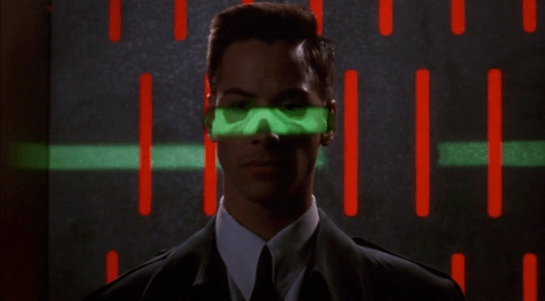
After that there is a security scanner, which is reminiscent of HAL from the film 2001: A Space Odyssey.

jm-9-customs-f

The green light runs over Johnny from top to bottom.

jm-9-customs-c

Looking at the picture, we can see that this green light is somehow making Johnny’s skeleton visible. It would be possible, by having an X-ray imaging system running at the same time and then re-projecting the X-ray image back onto the body, but why? Since there don’t appear to be any actual human beings on duty, I can only suggest that it is meant to look intimidating and impressive to encourage obedience. In the film Johnny appears to be alone and cannot see this himself, but it would be much more common for there to be multiple passengers, so each could watch the others being scanned.

There is also a screen showing another scan, a blurry body image, and text appearing on the right side. A voice repeats the text content. For the first time we see a blue background, the most common color for futuristic film interfaces.

jm-9-customs-d

The scanner detects Johnny’s implant, but whatever secrecy measures are present cause the system to decide that it is a registered dyslexia aid. The popup alert below includes the registration issuer and a domain name, so perhaps this is online verification over the Internet. Presumably Johnny can see this screen himself, if he cares.

jm-9-customs-e

The voiceover helpfully informs Johnny that there is “synaptic seepage”, and he should seek medical attention within 24 hours. This shows quite high level decision making by the system and an offer of assistance. Johnny says “thanks” in reply, an anthropomorphic response to this seemingly intelligent machine.

However, there seems to be a more detailed explanation in smaller text on the right of the display, and this isn’t announced. It’s not clear in this scene whether Johnny can see this display or not, but even if he could it would be difficult to read. Perhaps this is a legacy system from the days when airport security had actual staff.

Next

At this point Johnny leaves the airport, riding in a taxi from the airport. It is a good time for the first review of a group of related interfaces, which will be the next series of posts.

FTL – Activation

The Battlestar Galactica has at least two Faster-than-Light engines (which might be easier to think of as teleportation engines), activated during a complex sequence. The sequence involves:

  1. An explicit, direct command from Commander Adama
  2. Complex calculations on dedicated computers
  3. Double-checking by a large portion of the CIC staff
  4. and finally, a dedicated key and button to initiate the actual jump

Making an FTL jump is not a standard procedure for the Galactica, and it is implied that it has been decades since the ship carried out an actual jump.  This is because of the danger in landing off-course, the difficulty in the calculations, and wear on what is likely a very expensive component.  We see that many civilian ships do not have FTL capability.

image09

The FTL engine allows the Galactica to instantly travel between one point in the star system, and another point in the star system.  Dense books of pre-made calculations are kept in the Galactica’s CIC to enter into the ship’s FTL computers.

Multiple teams each begin separate calculations, using the Galactica’s FTL computers as giant calculators for their hand-written/typed equations.  The teams then cross-check their answers against each other, using a senior officer (in this case, Lt. Gaeta) as the final confirmation.

image06

Once all teams agree on an FTL jump coordinate, the information is plugged into a separate system to “spool up” the FTL drive.

Lt. Gaeta then pulls out a special key that fits into a dedicated slot in the FTL system in the CIC.  The key has two cylindrical pins that each glow a distinct blue, and are each different lengths.  The handle of the key has a matching shape on the console as well, so that the key can only fit in one way.

Once the key is inserted, Lt. Gaeta turns the key and announces that the FTL drive is active.  Commander Adama then gives the order to jump, and Lt. Gaeta pushes a separate button (which has until now been inactive) that jumps the Galactica to the coordinates entered.

After the Galactica finishes its FTL Jump, Commander Adama asks for confirmation that they have arrived successfully at their destination.  Lt. Gaeta runs across the CIC to a navigation console and checks the screen there for the ship’s location.  From the information on that screen, Lt. Gaeta confirms that the Galactica has re-entered real space at exactly the place they were intended to be. (Or might report an error, but we never see this.)

The entire CIC lets out a breath of relief and begins clapping in celebration.  Lt. Gaeta congratulates his navigation team for their work, and the CIC slowly resumes their task of running the ship.  The CIC crew is clearly unnerved by the jump, and everyone is thankful when they arrive safely at their destination.

The Current Position Screen

image05

image07

image08

This is the screen that Lt. Gaeta uses to confirm that they have successfully landed at their current target: geosynchronous orbit above their target body of mass.  He does not visibly use any of the controls on the console.  The screen autonomously zooms in on the ‘X’ marker, then displays a large, red, blinking triangle with “BSG 75” written above it (The Battlestar Galactica’s registry code).  The red ‘X’ is written inside a large sphere, which appears to be the object the Galactica was attempting to jump to.

All of the lines on this graph describe arcs, and appear to be orbital paths.  The Galactica is marked as being directly on one of these arcs.  Dotted arcs connect many other objects on the screen to each other.  These have no clear purpose or legend.

At the bottom center of the screen are the words “Waypoint Time”, “Waypoint Distance”, and “T.O.T.”  Above those words is a small label: “Synthetic Gravity Field 74.56”.  To the left of those words is an area of data that has been boxed off with the label “Optic Nav System Control.”

More text to the top left lists out information in a table format, but is unreadable to the viewer due to the resolution of the screens in the CIC.  The two rows of data beside the labels do not have column headers or unit indicators.

Thumbpay

Biff(2015) pays for his taxi ride to the McFly household with his thumbprint. When the ride ends, a synthesized voice gives the price “one-seven-four-point-five-zero.” The taxi driver presents him with a book-sized device with the price at the top on a red 7-segment LED display. Biff presses his thumb on a reader at the bottom that glows white as it scans. When the payment is verified, the thumbprint reader and the price go dark as a sound plays like a register.

BttF_105

For due diligence, let me restate: multimodal biometric or multifactor authentication is more secure.