You’re the only one who can stop him

Superhero shows are a weird subgenre of sci-fi. The super-powers and how the superheroes use them in pursuit of their world-saving goals are often the point, and so often skimp on the sci part of sci-fi. The Amazon original The Boys is no different, where the core novum is a chemical (compound V) that gives people superpowers.

I love the show. Though it’s definitely for adults with its violence and psychopathy and depravity, I think it’s closer to what would happen if humans had superhuman powers in a world of late-stage capitalism, enshittification of everything, and wannabe fascists. I’ve been a fan since it first aired. (And can’t wait to dive into the comics after the show wraps.)

Be forewarned—massive spoilers ahead. (The graphic shows the Millennium Falcon sporting a massive spoiler.)

It hasn’t really had many interfaces of note across the series. And the one I’m going to talk about in this post isn’t a “big” interface. But it was bad, so I’m coming out of my hiatus to talk about it, and then to make an appeal similar to what I did when I reviewed Idiocracy in 2019.


A screen shot from the scene with Grace leaning down to talk to Ryan while Butcher looks on in the background.

In the Season 4 finale—hastily renamed “Season 4 Finale” instead of “Assassination Run” after the alleged July 13 assassination attempt of Donald Trump—co-founders of The Boys, Grace Mallory and Butcher, invite the young supe Ryan to an underground bunker with three goals in mind.

  1. Give him some time with Butcher who, as a kind of stepfather to Ryan, wants to see him before he dies. (Butcher is dying from a “sentient tumor” that developed from his overuse of “Temp V”.)
  2. Convince Ryan to turn against his father, Homelander.
  3. Entrap Ryan if he refuses.

It’s this last goal that involves the interface, because sure enough, Ryan is highly conflicted at the idea of killing his father after Butcher explains “You’re the only one who can stop him.”

“You’re the only one who can stop him.” —Butcher

As Ryan tries to leave to think things through, Grace blocks his way, saying “You can’t leave.” Ryan uses his super vision to observe that the walls of the room they’re in are 6 feet thick. Grace tries to explain, “This is the CIA Hazlet Safehouse, designed to hold people like you. I could seal us in here, flood the room with halothene, and we’d all take a nice, long nap.” As Ryan gets more agitated and threatens to leave anyway, she reaches out to a big, red momentary button mounted to the concrete wall beside her, presumably to release the aerosolized anesthesia.

A screen shot from the scene showing Grace’s hand on the junction box on which the big button sits, her index finger reaching up towards it.
Let’s get this party started.

And that’s it. That’s the interface. Because in a show that is very compellingly written, this is bad design.

It’s obvious

Being a big, red panic button, it might as well have a spotlight on it and a neon sign blinking “Press here to suppress.” Any supe worth their salt will recognize it as a threat and seek to disable it. I trust it would have a Normally Closed circuit, so that ripping the button out of the wall or severing the conduit would trip it, but a supe with Ryan or Homelander’s x-ray vision could just follow the circuit back to discover the nature of the halothane system and work from there. Much better is a system that wouldn’t call attention to itself.

It’s hard to get to

It’s hard to tell the complete room layout from the scene. It looks half hospital recovery room, half storage room, and I suspect is a converted supe prison cell (with windows, though?) The button appears to be just inside…the bathroom? Out of sight of the main part of the room, sure, so kind of hidden unless the supe needs to ever pee, but also harder to get to. A single button at around elbow-height works when a near-average-height person is upright and able to reach out to press it. But if you’ve just been knocked down, or had your arm laser-severed, or I don’t know, been body slammed across the room away from that button, you’re screwed. Even a ceiling-to-floor crash bar doesn’t work because it still requires your being within arms reach of that one spot. Better is a system that does not depend on where anyone is in the room for activation.

It works at human response speed

This is world with fast and mind-control supes. It doesn’t make sense to rely on human response times to activate it. Better is a semi-automated system that monitors everything and can respond in microseconds when data trends suspiciously.

Between its being obvious, hard to get to, and requiring manual activation I think nearly every single supe in the show would find it trivial to stop that button from being pressed if they wanted.

The scene could have been written more smartly—without sacrificing the efficiency of the beat—with something like this…

  • Grace
  • This is the CIA Hazlet Safehouse, designed to hold people like you. If you try to leave…
  • Cut to an arc shot of a supe-monitoring display. On the side, a live transcript of the conversation types out Grace’s words as she speaks them. In the center, infrared video of them in the room with overlays for each of them labeled SUPE or human, live vital signs, and a line showing their AI-predicted movements.
  • Grace (voiceover)
  • …or any of our vital signs crash…
  • Cut back to the actors
  • Grace
  • …the room is flooded with halothane and we all take a nice, long nap.
  • Zoom in to Ryan’s face as his eyes dart around and his breathing intensifies.
  • Cut to interface reading “escape prediction” and a number rising to 75, 80, 85. At 90 it turns red and a soft alarm goes off.
  • Cut to an extreme close up of Ryan’s ear to show he hears this alarm.

This isn’t obvious to the supe, works faster than a human could, and doesn’t rely on a human being in a specific spot.

Now instead of this, we could have Ryan brag about what a bad-ass he is and escape before the system can react, but this moment is constructed in the original to show that Ryan isn’t just an arrogant mini-Homelander. He’s a conflicted adolescent with an adolescent’s poor impulse control, and he panicked seeing her reach for the button. Having an alarm sets that same stage for him to panic. Note that I don’t think it’s good design for a system to tip its hand before it enacts control measures—as this does with the alarm—but it would be more forgivable than the dumb button, which just paints the CIA as incompetent and undermines the diegesis.


A screen shot from the episode, showing Homelander looking at a wad of his graying pubic hair in his hand, because he’s seriously fucked up.

OK, that said, this next bit goes out to my fellow Americans:

One of the reasons I have wanted to talk about this show is not just the fascism of the villains, but how it illustrates the corrupting effect of power, and that’s directly related to the coming American election.

With Biden dropping out of the race yesterday, and the Democratic National Convention a month away, I can’t yet formally lean on the merits of the Democratic candidate to make a case for weeks to come. (Though, go go go, Kamala!) But the case against the Republican party almost makes itself.

What we are facing as a nation with this election is existential. The Supreme Court has outrageously ruled that a president is unaccountable for his actions while in office. A dictator’s wet dream. And Trump has declared publicly that he will be a dictator “on day one,” but it’s easy to see that he means “as of day one”. What malignant narcissist willingly gives up power once he has it? His many ties to the wretched Heritage Foundation and its deeply, deeply disturbing Project 2025 (see this video and this one where he directly praises this group and their plan) tell us that if he is elected and his cronies have their way, we fall towards an extremist religious-nationalism that puts The Boys to shame and spells the end of the ideals and institutions that were the reason the United States was invented in the first place. The American Experiment is on the brink.

But to quote the ACLU, despair and resignation are not a strategy. We have to America-up and enact a strategy. Please, please…

Expose the Extremism

Get familiar with the extremist plans (the Christianization and militarization of public school, cutting overtime protections for 4.3 million people, banning labor unions, privatizing Medicare, replacing a million experts with loyalist lackies, putting the DOJ under presidential control, close NOAA and end free weather reports, categorizing LGBTQ+ folks as pederasts and instating a death penalty for it, trying to pass a constitutional amendment to make abortion illegal, and much more) and share those often and loudly on your social media platforms of choice. Especially reach out to anyone on the fence, in a swing state (Arizona, Georgia, Michigan, Pennsylvania, and Wisconsin), or who thinks they should just sit this one out because the (current) candidates are so old or not doing enough of what they want. We cannot afford “protest votes.”

Volunteer

If you don’t have money to spare (and with the current income inequality plaguing the nation that’s likely to be most of us) you can donate time and effort. If you’re in a solidly-colored state, you can join texting and letter-writing campaigns to those in swing states. If you’re in a swing state (Arizona, Georgia, Michigan, Pennsylvania, and Wisconsin), you can help canvas directly to voters still deciding. (How they’re still undecided is utterly alien to me, but here we are.) Here are just a few places you can opt to volunteer.

Donate

If you do have money to spare, spare it. Give to progressive and Democratic causes that will use that buying power to get ads, get the word out, and support the vote. Dig deep because I know we’ve heard it before, but this one is critical

Vote

Most importantly, have a plan to vote. Register if you’re not. If you are, double-check your voter registration status because they are purged just before elections, often bumping democrats for the most trivial of reasons. Vote by mail if you are overseas or if getting time off on the day of might be a problem. Find your polling location. Make a plan with others to go vote together. Charge your phone and bring water in case there are long lines. (And many bastards have worked very hard to ensure there will be long lines.) Get calendar reminders for voting deadlines sent directly to you.

If everyone gets out there and activates the vote, we can avoid giving the absolutely wrong people the power they should not have. You’re the only one who can stop him.

8 Reasons The Voight-Kampff Machine is shit (and a redesign to fix it)

Distinguishing replicants from humans is a tricky business. Since they are indistinguishable biologically, it requires an empathy test, during which the subject hears empathy-eliciting scenarios and watched carefully for telltale signs such as, “capillary dilation—the so-called blush response…fluctuation of the pupil…involuntary dilation of the iris.” To aid the blade runner in this examination, they use a portable machine called the Voight-Kampff machine, named, presumably, for its inventors.

The device is the size of a thick laptop computer, and rests flat on the table between the blade runner and subject. When the blade runner prepares the machine for the test, they turn it on, and a small adjustable armature rises from the machine, the end of which is an intricate piece of hardware, housing a powerful camera, glowing red.

The blade runner trains this camera on one of the subject’s eyes. Then, while reading from the playbook book of scenarios, they keep watch on a large monitor, which shows an magnified image of the subject’s eye. (Ostensibly, anyway. More on this below.) A small bellows on the subject’s side of the machine raises and lowers. On the blade runner’s side of the machine, a row of lights reflect the volume of the subject’s speech. Three square, white buttons sit to the right of the main monitor. In Leon’s test we see Holden press the leftmost of the three, and the iris in the monitor becomes brighter, illuminated from some unseen light source. The purpose of the other two square buttons is unknown. Two smaller monochrome monitors sit to the left of the main monitor, showing moving but otherwise inscrutable forms of information.

In theory, the system allows the blade runner to more easily watch for the minute telltale changes in the eye and blush response, while keeping a comfortable social distance from the subject. Substandard responses reveal a lack of empathy and thereby a high probability that the subject is a replicant. Simple! But on review, it’s shit. I know this is going to upset fans, so let me enumerate the reasons, and then propose a better solution.

-2. Wouldn’t a genetic test make more sense?

If the replicants are genetically engineered for short lives, wouldn’t a genetic test make more sense? Take a drop of blood and look for markers of incredibly short telomeres or something.

-1. Wouldn’t an fMRI make more sense?

An fMRI would reveal empathic responses in the inferior frontal gyrus, or cognitive responses in the ventromedial prefrontal gyrus. (The brain structures responsible for these responses.) Certinaly more expensive, but more certain.

0. Wouldn’t a metal detector make more sense?

If you are testing employees to detect which ones are the murdery ones and which ones aren’t, you might want to test whether they are bringing a tool of murder with them. Because once they’re found out, they might want to murder you. This scene should be rewritten such that Leon leaps across the desk and strangles Holden, IMHO. It would make him, and other blade runners, seem much more feral and unpredictable.

(OK, those aren’t interface issues but seriously wtf. Onward.)

1. Labels, people

Controls needs labels. Especially when the buttons have no natural affordance and the costs of experimentation to discover the function are high. Remembering the functions of unlabeled controls adds to the cognitive load for a user who should be focusing on the person across the table. At least an illuminated button helps signal the state, so that, at least, is something.

 2. It should be less intimidating

The physical design is quite intimidating: The way it puts a barrier in between the blade runner and subject. The fact that all the displays point away from the subject. The weird intricacy of the camera, its ominous HAL-like red glow. Regular readers may note that the eyepiece is red-on-black and pointy. That is to say, it is aposematic. That is to say, it looks evil. That is to say, intimidating.

I’m no emotion-scientist, but I’m pretty sure that if you’re testing for empathy, you don’t want to complicate things by introducing intimidation into the equation. Yes, yes, yes, the machine works by making the subject feel like they have to defend themselves from the accusations in the ethical dilemmas, but that stress should come from the content, not the machine.

2a. Holden should be less intimidating and not tip his hand

While we’re on this point, let me add that Holden should be less intimidating, too. When Holden tells Leon that a tortoise and a turtle are the same thing, (Narrator: They aren’t) he happens to glance down at the machine. At that moment, Leon says, “I’ve never seen a turtle,” a light shines on the pupil and the iris contracts. Holden sees this and then gets all “ok, replicant” and becomes hostile toward Leon.

In case it needs saying: If you are trying to tell whether the person across from you is a murderous replicant, and you suddenly think the answer is yes, you do not tip your hand and let them know what you know. Because they will no longer have a reason to hide their murderyness. Because they will murder you, and then escape, to murder again. That’s like, blade runner 101, HOLDEN.

3. It should display history 

The glance moment points out another flaw in the interface. Holden happens to be looking down at the machine at that moment. If he wasn’t paying attention, he would have missed the signal. The machine needs to display the interview over time, and draw his attention to troublesome moments. That way, when his attention returns to the machine, he can see that something important happened, even if it’s not happening now, and tell at a glance what the thing was.

4. It should track the subject’s eyes

Holden asks Leon to stay very still. But people are bound to involuntarily move as their attention drifts to the content of the empathy dilemmas. Are we going to add noncompliance-guilt to the list of emotional complications? Use visual recognition algorithms and high-resolution cameras to just track the subject’s eyes no matter how they shift in their seat.

5. Really? A bellows?

The bellows doesn’t make much sense either. I don’t believe it could, at the distance it sits from the subject, help detect “capillary dilation” or “ophthalmological measurements”. But it’s certainly creepy and Terry Gilliam-esque. It adds to the pointless intimidation.

6. It should show the actual subject’s eye

The eye color that appears on the monitor (hazel) matches neither Leon’s (a striking blue) or Rachel’s (a rich brown). Hat tip to Typeset in the Future for this observation. His is a great review.

7. It should visualize things in ways that make it easy to detect differences in key measurements

Even if the inky, dancing black blob is meant to convey some sort of information, the shape is too organic for anyone to make meaningful readings from it. Like seriously, what is this meant to convey?

The spectrograph to the left looks a little more convincing, but it still requires the blade runner to do all the work of recognizing when things are out of expected ranges.

8. The machine should, you know, help them

The machine asks its blade runner to do a lot of work to use it. This is visual work and memory work and even work estimating when things are out of norms. But this is all something the machine could help them with. Fortunately, this is a tractable problem, using the mighty powers of logic and design.

Pupillary diameter

People are notoriously bad at estimating the sizes of things by sight. Computers, however, are good at it. Help the blade runner by providing a measurement of the thing they are watching for: pupillary diameter. (n.b. The script speaks of both iris constriction and pupillary diameter, but these are the same thing.) Keep it convincing and looking cool by having this be an overlay on the live video of the subject’s eye.

So now there’s some precision to work with. But as noted above, we don’t want to burden the user’s memory with having to remember stuff, and we don’t want them to just be glued to the screen, hoping they don’t miss something important. People are terrible at vigilance tasks. Computers are great at them. The machine should track and display the information from the whole session.

Note that the display illustrates radius, but displays diameter. That buys some efficiencies in the final interface.

Now, with the data-over-time, the user can glance to see what’s been happening and a precise comparison of that measurement over time. But, tracking in detail, we quickly run out of screen real estate. So let’s break the display into increments with differing scales.

There may be more useful increments, but microseconds and seconds feel pretty convincing, with the leftmost column compressing gradually over time to show everything from the beginning of the interview. Now the user has a whole picture to look at. But this still burdens them into noticing when these measurements are out of normal human ranges. So, let’s plot the threshold, and note when measurements fall outside of that. In this case, it feels right that replicants display less that normal pupillary dilation, so it’s a lower-boundary threshold. The interface should highlight when the measurement dips below this.

Blush

I think that covers everything for the pupillary diameter. The other measurement mentioned in the dialogue is capillary dilation of the face, or the “so-called blush response.” As we did for pupillary diameter, let’s also show a measurement of the subject’s skin temperature over time as a line chart. (You might think skin color is a more natural measurement, but for replicants with a darker skin tone than our two pasty examples Leon and Rachel, temperature via infrared is a more reliable metric.) For visual interest, let’s show thumbnails from the video. We can augment the image with degree-of-blush. Reduce the image to high contrast grayscale, use visual recognition to isolate the face, and then provide an overlay to the face that illustrates the degree of blush.

But again, we’re not just looking for blush changes. No, we’re looking for blush compared to human norms for the test. It would look different if we were looking for more blushing in our subject than humans, but since the replicants are less empathetic than humans, we would want to compare and highlight measurements below a threshold. In the thumbnails, the background can be colored to show the median for expected norms, to make comparisons to the face easy. (Shown in the drawing to the right, below.) If the face looks too pale compared to the norm, that’s an indication that we might be looking at a replicant. Or a psychopath.

So now we have solid displays that help the blade runner detect pupillary diameter and blush over time. But it’s not that any diameter changes or blushing is bad. The idea is to detect whether the subject has less of a reaction than norms to what the blade runner is saying. The display should be annotating what the blade runner has said at each moment in time. And since human psychology is a complex thing, it should also track video of the blade runner’s expressions as well, since, as we see above, not all blade runners are able to maintain a poker face. HOLDEN.

Anyway, we can use the same thumbnail display of the face, without augmentation. Below that we can display the waveform (because they look cool), and speech-to-text the words that are being spoken. To ensure that the blade runner’s administration of the text is not unduly influencing the results, let’s add an overlay to the ideal intonation targets. Despite evidence in the film, let’s presume Holden is a trained professional, and he does not stray from those targets, so let’s skip designing the highlight and recourse-for-infraction for now.

Finally, since they’re working from a structured script, we can provide a “chapter” marker at the bottom for easy reference later.

Now we can put it all together, and it looks like this. One last thing we can do to help the blade runner is to highlight when all the signals indicate replicant-ness at once. This signal can’t be too much, or replicants being tested would know from the light on the blade runner’s face when their jig is up, and try to flee. Or murder. HOLDEN.

For this comp, I added a gray overlay to the column where pupillary and blush responses both indicated trouble. A visual designer would find some more elegant treatment.

If we were redesigning this from scratch, we could specify a wide display to accomodate this width. But if we are trying to squeeze this display into the existing prop from the movie, here’s how we could do it.

Note the added labels for the white squares. I picked some labels that would make sense in the context. “Calibrate” and “record” should be obvious. The idea behind “mark” is an easy button for the blade runner to press when they see something that looks weird, like when doctors manually annotate cardiograph output.

Lying to Leon

There’s one more thing we can add to the machine that would help out, and that’s a display for the subject. Recall the machine is meant to test for replicant-ness, which happens to equate to murdery-ness. A positive result from the machine needs to be handled carefully so what happens to Holden in the movie doesn’t happen. I mentioned making the positive-overlay subtle above, but we can also make a placebo display on the subject’s side of the interface.

The visual hierarchy of this should make the subject feel like its purpose is to help them, but the real purpose is to make them think that everything’s fine. Given the script, I’d say a teleprompt of the empathy dilemma should take up the majority of this display. Oh, they think, this is to help me understand what’s being said, like a closed caption. Below the teleprompt, at a much smaller scale, a bar at the bottom is the real point.

On the left of this bar, a live waveform of the audio in the room helps the subject know that the machine is testing things live. In the middle, we can put one of those bouncy fuiget displays that clutters so many sci-fi interfaces. It’s there to be inscrutable, but convince the subject that the machine is really sophisticated. (Hey, a diegetic fuiget!) Lastly—and this is the important part—An area shows that everything is “within range.” This tells the subject that they can be at ease. This is good for the human subject, because they know they’re innocent. And if it’s a replicant subject, this false comfort protects the blade runner from sudden murder. This test might flicker or change occasionally to something ambiguous like “at range,” to convey that it is responding to real world input, but it would never change to something incriminating.

This way, once the blade runner has the data to confirm that the subject is a replicant, they can continue to the end of the module as if everything was normal, thank the replicant for their time, and let them leave the room believing they passed the test. Then the results can be sent to the precinct and authorizations returned so retirement can be planned with the added benefit of the element of surprise.

OK

Look, I’m sad about this, too. The Voight-Kampff machine is cool. It fits very well within the art direction of the Blade Runner universe. This coolness burned the machine into my memory when I saw this film the first dozen times, but despite that, it just doesn’t stand up to inspection. It’s not hopeless, but does need a lot of thinkwork and design to make it really fit to task, and convincing to us in the audience.

Mission slot

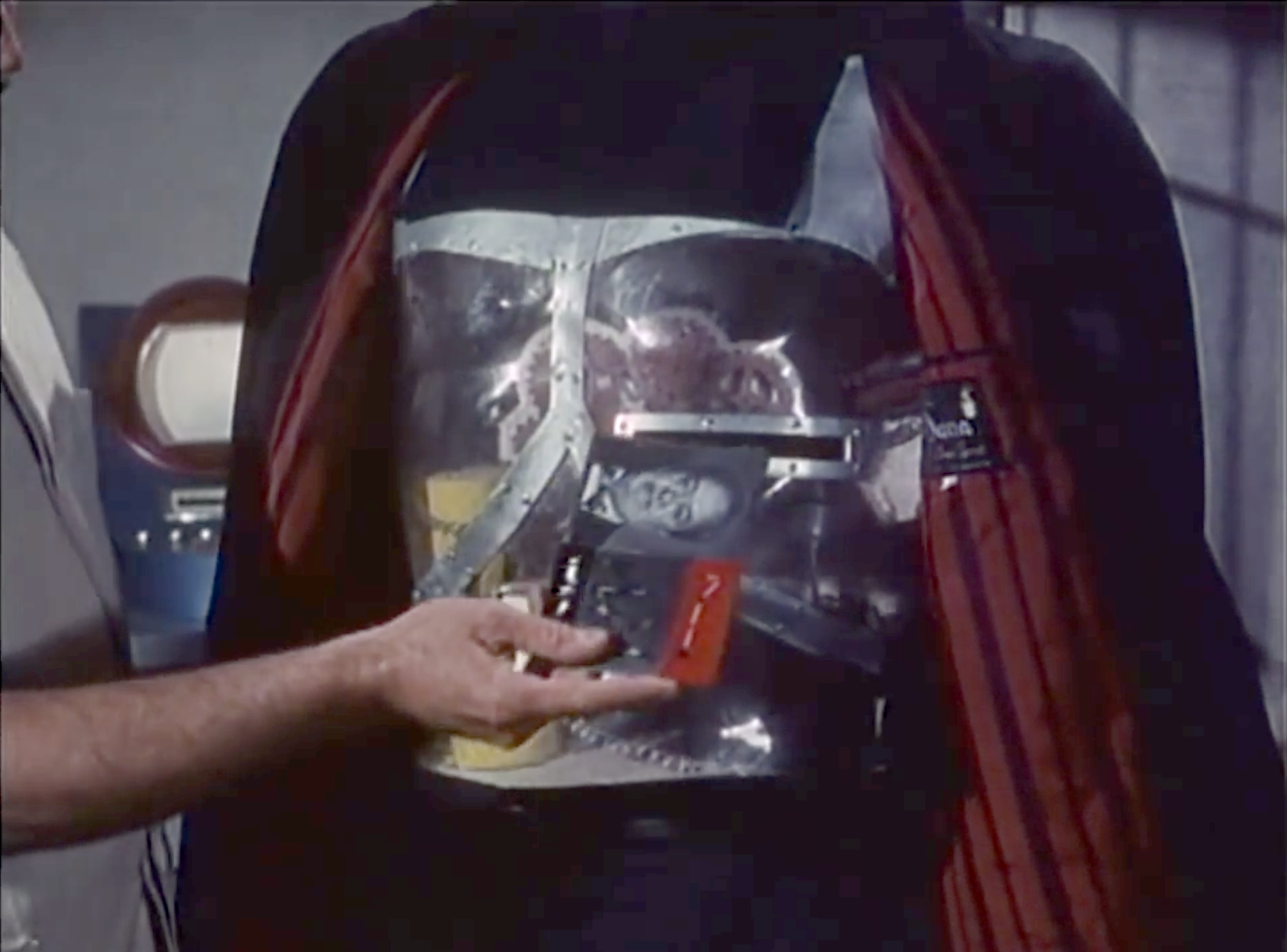
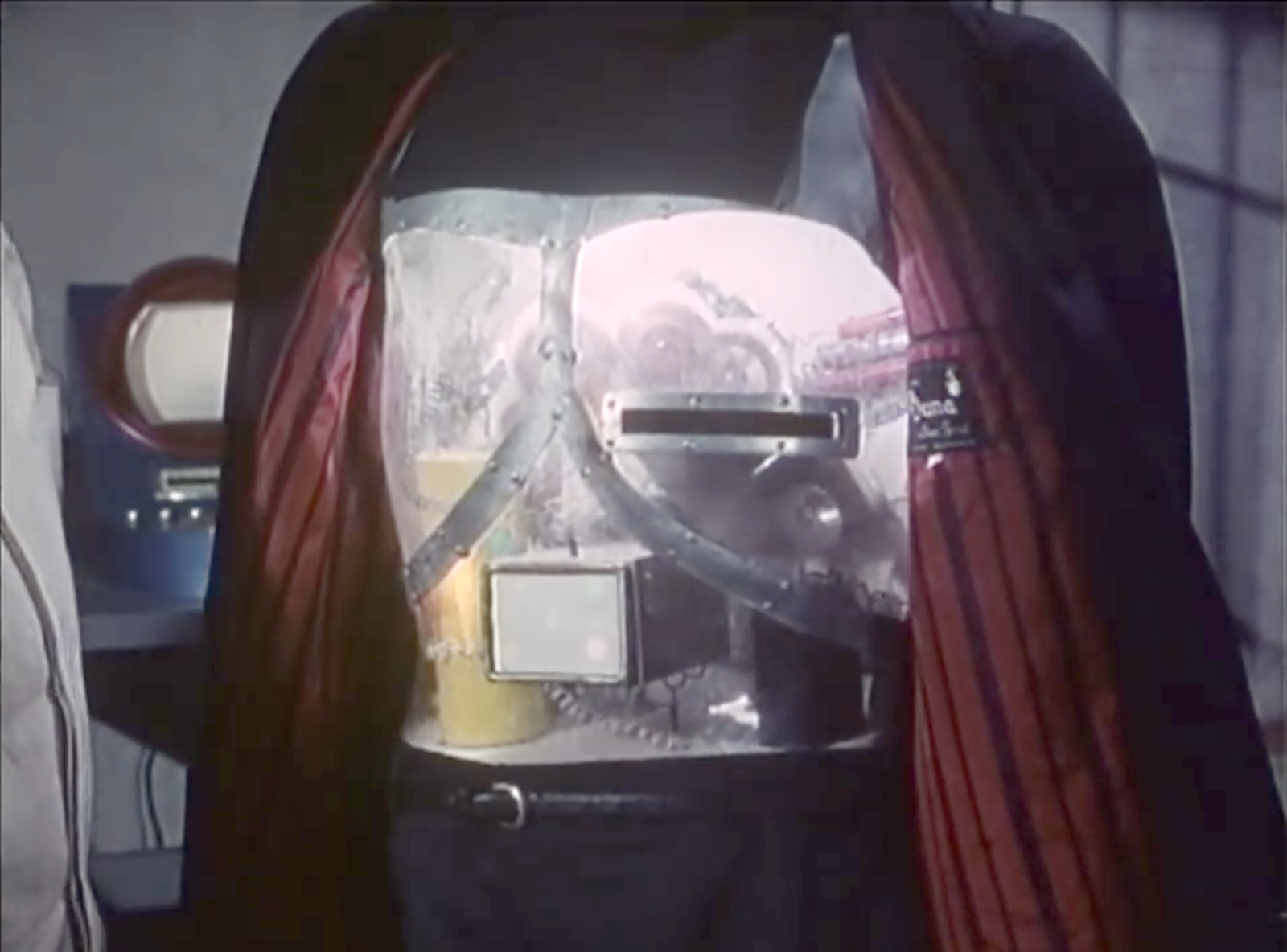
To provide the Victim Cards to the Robot Asesino, Orlak inserts it into an open slot in the robot’s chest, which then illuminates, confirming that the instructions have been received.

There is, I must admit, a sort of lovely, morbid poetry to a cardiogram being inserted into a slot where the robot heart would be to give the robot instructions to end the beating of the human heart described in the cardiogram. And we don’t see a lot of poetry in sci-fi interface designs. So, props for that.

The illumination is a nice bit of feedback, but I think it could convey the information in more useful and cinegenic ways.

In this new scenario…

  • Orlak has the robot pull back its coat
  • The chamfered slot is illuminated, signaling “card goes here.”
  • As Orlak inserts the target card, the slot light dims as the chest-cavity light brightens, signaling “I have the card.”
  • After a moment, the chest-cavity light turns blood red, signaling confirmation of the victim and the new dastardly mission.

When the robot returns to Orlak after completing a mission, the red light would dim as the slot light illuminates again, signaling that it is ready for its next mission.

These changes improve the interface by first drawing the user’s locus of attention exactly where it needs to go, and then distinguishing the internal system states as they happen. It would also work for the audience, who understands by association that red means danger.

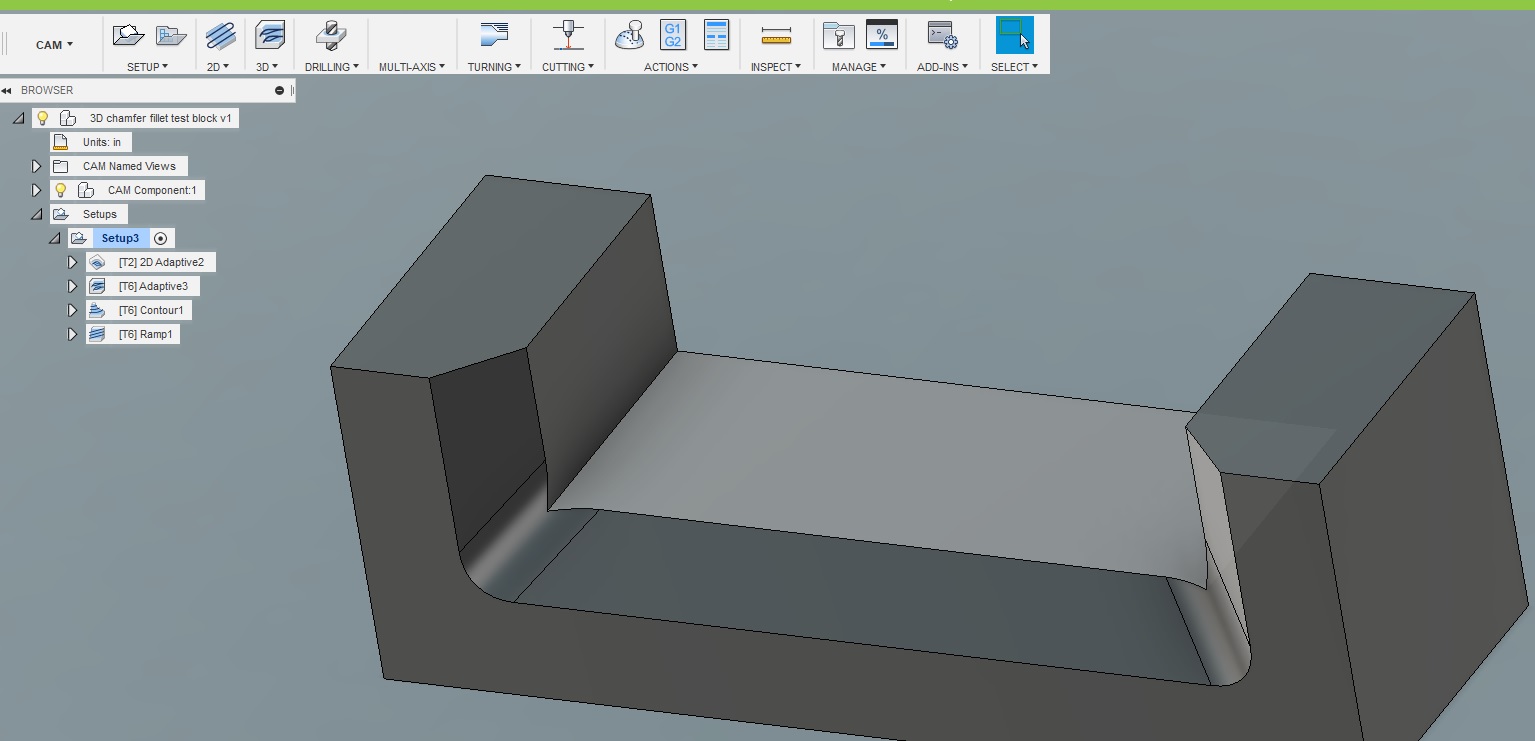
The shape of the slot is pretty good for its base usability. It has clear affordances with its placement, orientation, and metallic lining. There’s plenty of room to insert the target card. It might benefit from a fillet or chamfer for the slot, to help avoid accidentally crumpling the paper cards when they are aimed poorly.

In addition to the tactical questions of illumination and shape of the slot, I have a few strategic questions.

  • There is no authorization in evidence. Can just anyone specify a target? Why doesn’t Gaby use her luchadora powers to Spin-A-Roonie a target card with Orlak’s face on it and let the robot save the day? Maybe the robot has a whitelist of heartbeats, and would fight to resist anyone else, but that’s just me making stuff up.
  • Also I’m not sure why the card stays in the robot. That leaves a discoverable paper trail of its crimes, perfect for a Scooby to hand over to the federales. Maybe the robot has some incinerator or shredder inside? If not, it would be better from Orlak’s perspective to design it as an insert-and-hold slot, which would in turn require a redesign of the card to have some obvious spot to hold it, and a bump-in on the slot to make way for fingers. Then he could remove the incriminating evidence and destroy it himself and not worry whether the robot’s paper shredder was working or not.
  • Another problem is that, since the robot doesn’t talk, it would be difficult to find out who its current target is at any given time. Since anyone can supply a target, Orlak can’t just rely on his memory to be certain. If the card was going to stay inside, it would be better to have it displayed so it’s easy to check.
  • How would Orlak cancel a target?
  • It is unclear how Orlak specifies whether the target is to be kidnapped or killed even though some are kidnapped and some are killed.
  • It’s also unclear about how Orlak might rescind or change an order once given.
  • It is also unclear how the assassin finds its target. Does it have internal maps with addresses? Or does it have unbelievably good hearing that can listen to every sound nearby, isolate the particular heartbeat in question, and just head in that direction, destroying any walls it encounters? Or can it reasonably navigate human cities and interiors to maintain its disguise? Because that would be some amazing technology for 1969. This last is admittedly not an interface question, but a backworlding question for believability.

So there’s a lot missing from the interface.

It’s the robot assassin designer’s job to not just tick a box to tell themselves that they have provided feedback, but to push through the scenarios of use to understand in detail how to convey to the evil scientist what’s happening with his murderous intent.

The Time Masheen

Chris: Diorama rides like The Time Masheen seen at the end of Idiocracy aren’t interactive in a strict sense, but since it’s a favorite moment and works for riders abstractly as an interface to the vast domain of knowledge that is history, I asked the awesome Cynthia Sharpe to provide some opinions. Cynthia works as the Principal, Cultural Attractions and Research at Thinkwell Group, and so has a much more learned opinion than mine. We totally crazily co-wrote this in a 24-hour long frenzy of geekdom. Note that these opinions are her own, and not necessarily shared by Thinkwell Group (hey team!).

I usually try to post reviews of interfaces in the order they appear in the film. But Cynthia wants to make a hard core shout out to Sharice Davids and that would work best sooner rather than later, so we’re doing this NOW. omg. It’s almost like this post TRAVELED IN TIME.

***

IDIOCRACY-time-masheen01

Though the actual payoff is maybe a minute long, the whole The Time Masheen conceit and reveal in Idiocracy is one of my favorite “it’s turtles all the day down” moments of total ur-nerdery. A shitty ride, wrong history, awful exhibit design, Godwin-ing itself from the get-go. Pure poetry. As someone who works in both theme parks and museums, let’s have fun unpacking this, shall we?

Idiocracy_time-masheen02
Welcome my son. Welcome to the (Time) Masheen. 🎵 Where have you been? 🎶

The ride itself

The entry to The Time Masheen is most assuredly not Disney-esque in design or form. It’s garish, cheap, a visual cross of a 60s-era game show sign and the ride at the strange pop-up carnival that makes you think twice about its safety record. The ride vehicle—with our three, uh, heroes, jammed in it—is classic and old school (think Doom Buggies from Haunted Mansion but…sadder). But these are mere appetizers before the actual experience of the ride in all its majesty: dioramas with breathless voice-over featuring Charlie Chaplin as the leader of the Nazi Party in 1939, and the UN, which “un-nazied the world.” And T-rexes.

Idiocracy_time-masheen04

It’s played for laughs—how moronic do people need to be in order to believe this stuff?—but in form and content, it’s actually pretty believable. The Carousel of Progress and It’s a Small World, both iconic Disney experiences, first debuted at the 1964 World’s Fair. When we look at the Carousel of Progress from 50 years in the future, it seems almost as dorky and unbelievable as The Time Masheen. These two real-world rides are not conceptual one-offs, either: when you get right down to it, the ride experience of Spaceship Earth at Epcot is remarkably similar: you proceed through multiple scenes, as “history” is dully (Dame Judi Dench can do only so much) dictated to you.

But whose history? Who’s telling this? This issue of voice and narrative control is not unique to theme parks. Museums have a far longer, bigger, and more powerful history in controlling historical narrative than two-bit carney rides or even lovely immersive experiences like the best of the theme parks.

disney-propagandist
Pictured: Propagandist?

Narrative or Discourse?

It’s only in the recent past that museums to any significant extent have embraced the idea of visitors actually bringing something to the table and participating. Think of the museums of your youth: You and your school group probably dutifully shuffled past rows of taxidermied animals, dioramas, or stultifying art with label copy that told you what to make of it.

Even the best science museums of a few decades ago had interactivity that wasn’t really collaborative—push a button, turn a crank. In most cases, museums were about a one-way transmission of information: They knew the Truth, and your job as visitor was to absorb it, pretty much in the order they dictated. Kind of like listening to an album in the 70s. And just like sitting there and learning that Charlie Chaplin led the Nazi Party in Germany.

Nowadays, more and more museums are actively designing experiences that visitors can participate in and derive meaning from, and also providing avenues for visitors to co-create the experience. They can contribute to art installations, collect data in citizen science experiments, record their own stories, and more – all hail the new museum order. But for a really long time, museums were one-way streets of content delivery and curation, believed by the public to be accurate and true simply because they’re museums. You know. Perfect for communicating systemically biased narratives.

Fake History

The oldest known museum was founded in 530 BCE by Princess Ennigaldi of the Neo-Babylonian empire, complete with object labels and interpretation. The artifacts, their organization, and interpretation reveal the museum as a narrative: A history of the region and the importance of her familial dynasty.

Benin_03
The British Museum used to label this a “trophy” rather than the much more accurate “loot.” Photo: British Museum, London © Michel Wal, 2009

This use of a museum as a means to establish, communicate, or assert power and validity wasn’t a one-time-only thing. Particularly from the 15th to 19th century, a wide swath of rulers established museums based on their private or national collections of loot. Many of these early museums weren’t public—a purposeful display of control and power. Moreover, when you get down to it, the stuff and stories in a museum are a way of saying ‘look how awesome I am/we are, I/we could buy/steal/smuggle/claim all this stuff. Rulership is our right and destiny.’ Inherent in that is an othering, diminishing, and marginalizing of those cultures that stuff was taken from, and the dissemination of a very specific point of view. History is told by the victors, and museums are a key part of that.

We’re not free of it today. Art and history museums around the world are currently wrestling with this legacy, as they confront ‘decolonizing’ not just their collections, but the way they interpret them and whose voices they center. The old label copy on the Benin bronzes (see above) in the British Museum was some of the most jaw-dropping colonialist pablum around, and generations of school children, tourists, and museum members read and nodded and internalized the implication that the British had every right to take what they wanted by force and subjugate the Edo people (there’s a reason ‘that scene’ in Black Panther was a super-thinly-veiled reference to the British Museum.)

Black-Panther
Seriously, my biggest problem with this scene BY FAR is that any curator would take a latte on the exhibit floor

Until recently, museums specialized in barely-questioned mythologizing, in creating and perpetuating narratives of the conquerors about the conquered (see: American-flag emblazoned T-rexes defeating the Nazis!) This isn’t the province solely of history and art museums. For entirely too long a delightfully cringe-inducing paean to the glories of pesticides and herbicides and how they transformed their state’s agriculture endured as a 1950s-hued diorama in a major American natural history museum, as an example—corporate money shapes the stories we tell in museums, too, and that has really impacted science museums, visitors, and cultures for the worse.

IDIOCRACY-time-masheen03
Not pictured, I guess: the Soviet Union Estemmenosuchus, the United Kingdom Iguanodon, and the China Caudipteryx.

Avoiding Idiocracy

So what’s the point of The Time Masheen, since it really doesn’t work and was full of, you know, lies? Compare it to the story told in Spaceship Earth at Epcot; the moments selected (Chaplin, the U.N.) are elevated to moments of history as powerful and crucial as the invention of papyrus, the printing press, and the computer. At its core, it’s about consolidating power, inventing and reinforcing a narrative that elevates and celebrates the ruling class, in this case, the Idiocracy—even if that narrative was made decades, even centuries, prior and is now just mindlessly being parroted. Other moments in the film point to a desire to maintain the status quo, i.e., the power balance, and narratives like The Time Masheen support that status quo. No one in Idiocracy says ‘wait a minute’ and holds the creators of The Time Masheen, much less the government itself, accountable for this insane, incorrect history which apparently is being cheerfully promulgated. It begs the question—if one pauses to reflect on admittedly one minute in the entire movie—who is responsible for combating this kind of misinformation? What about when the misinformation is in a museum and not a movie?

Museums

I get it. When I go to a museum, a movie, a theme park, I (generally speaking) want to have a good time. I do not want to have to drag a soapbox with me. But who’s responsible for correcting bad content? I’d argue that while obviously, the museum bears the bulk of the burden (…it’s their museum after all), we have a responsibility to hold them accountable and also help them. These are places in and of our communities: we are stakeholders. Museum staff, with few exceptions, are stretched thin. They don’t have time, dollars, or people power to redo every shitty exhibit from years and years ago. But many are trying. There’s a shift towards re-centering marginalized voices, ceding authority and examining old narratives when redoing old exhibits or developing new ones. It’s not universal by far, but it is happening. (If you’d like to know more about this, an example of this is happening right now, at MASS Action. See How MASS Action could transform museums like Mia for more info.)

But just as we see media outlets giving oxygen to white supremacists out of some notion of ‘fairness’, for a long while many museums engaged in a sort of ‘everyone is entitled to their own view’. Creationists came in and disparaged exhibits that even mentioned evolution, or offered their own guided tours through natural history museums through an anti-evolution lens (and in fact, they still do this at several museums). Some museum boards are scared to engage with these visitors, leaving their staffs to do the best they can with an angry guest.

Idiocracy_time-masheen05
Pictured: Historically speaking, NOT Nikki Haley.

Multiply this across numerous hot topics – global warming, vaccination, fracking, alternative energy, civil rights, racism. Pretty much think of every eyeroll-inducing-bad-science-revisionist-history bullshit that your Great-Aunt Patty reposts breathlessly on Facebook and will inevitably raise over gravy at Thanksgiving, there’s a museum somewhere which has tried to do an exhibit on it and caught hell—from extremists on either end, from donors, from board members concerned about blowback. Uncritical eyes don’t just give your favorite history museum shit for reframing the narrative to include authentic voices of African Americans or your science museum grief for daring to assert global climate change is real: they co-created the fake news crisis.

We must stand up. We must hold not just museums, but also news media and popular media accountable when they perpetuate racist, heteronormative, ableist, or sexist narratives. We also have to help them stand up to blowback. When it comes to museums, visit. Visit. Get their visitorship numbers up. Write polite letters when you see something wrong, or ask a floor staffer who you can talk to. Help them fundraise if you can. Find out how you can help them secure better local and state support – yeah, maybe show up at that city council meeting where they’re debating supporting your local museum or send a letter detailing the value you see the museum bringing to your community. If they add in a gender-neutral bathroom, write a letter or email thanking them (yes they track that stuff). Volunteer if you can. Confront museums when they are failing their duties, but also do your part to help combat the creeping tide of idiocracy lapping at our cultural centers.

EDITOR’S INTERJECTION: This is where it becomes expressly an issue for interaction design. We can make it easy for visitors to find and use these feedback channels. We can make it easy for museum staff to understand and discuss the feedback. —Chris

Idiocracy_crossover
I smell crossover!

Theme Parks

Theme Parks are different in terms of how you engage with them. But when the clamoring gets loud enough and the threat to the bottom line dire, hey guess what! Change can happen! So rather than just instagramming ‘omg so sexist’ something offensive at a theme park, write a letter. Make a blog post. Blah blah parable of a pebble and an avalanche. But the inverse is true: when a theme park or brand does something respectful or inclusive, heap praise on them and vote with your dollar. You want to know why Doc McStuffins persists? Because, in part, Disney moved a half billion dollars of product in the first year of the show. Consumers were and are hungry for an inclusive, representational hero character that’s not blonde and has STEM-related career aspirations: Disney was rewarded handsomely for centering a young African-American girl – and the show now has an interracial lesbian mom couple. (Which of course got protested all to heck, making it that much more important to write into Disney and thank them for their inclusive representation, lest they get browbeaten into a retreat.)

Crisis Time

We are in a crisis where a large swath of our society is absolutely unable to assess sources and validity of content, doesn’t understand basic science or stats, or even that correlation is not causation (and I’m not saying this is just on one side of the political spectrum—far from it). Museums, as they plan for the future, are asking themselves and each other what they can do to improve critical thinking skills, historical understanding, and science literacy. As Daniel Patrick Moynihan said, “Everyone is entitled to his own opinion, but not his own facts.” Many museums kinda failed at that for a damn long time, with their roots in structures of systemic bias and racism, and their fear of confrontation with angry donors and visitors (read: jeopardizing funding and support). Theme parks presented a sanitized and beautiful take on the world, but for whom? (The history of racism and exclusion in theme and amusement parks is long and painful. For a light and happy read, see Victoria Wolcott’s book Race, Riots, and Rollercoasters: The Struggle Over Segregated Recreation in America.) Theme parks aren’t about critical thinking and inspiring guests to engage with science or history, but they are about crafting narratives around heroes, ideal worlds, aspirational goals. And when they aren’t inclusive or perpetuate harmful stereotypes, they’re harmful to society. They lull us into complacency.

wench-auction

When we – the collective we, as voters, media, museum designers, or theme park designers – don’t call out what’s factually incorrect or morally repugnant (see also: Walt Disney World’s rework of the Pirates of the Caribbean ride to remove the “Wench Auction,” depicting the literal sale of captured and, in some cases, weeping women as wives) and push back against these narratives of jingoistic power, we’re contributing to our own Idiocracy. Just without the glorious, cheese-tastic Time Masheen.

Bonus Track: Fighting Kansan Idiocracy

I live in KS-03 district, the land of Representative Kevin Yoder. To say he’s gone hard right-wing and aligns himself with 45 is an understatement. Sharice Davids is the Democratic challenger: she’s Native American (Ho-Chunk Nation), a former MMA fighter (no really), a Cornell University-trained lawyer, and an out and proud lesbian. Yup.

SHarice-Davids-714x476.jpg

So in honor of her epic KS-03 battle, I’d love it if you:

  • Live here, vote for her.
  • Find out how to help disenfranchised voters get to the polls in November. I guarantee you there’s a boots on the ground group where you are working on this. Contact local campaigns and ask who’s organizing; if you have a local NAACP group they may be working on this too. KS-03 is comprised of very wealthy Kansas suburbs and parts of Kansas City, KS- which is 40% minority and way, way less wealthy. Want to know why Kris Kobach has fought so hard to disenfranchise poorer voters and people of color? This district right here is a prime reason. If we succeed in getting out more of the vote in KCK, it’ll hurt Yoder. We see this happening across the country in district after district. Help get voters to the polls.
  • Phone bank for a candidate. In a ‘safe’ district where your candidate doesn’t need your help? Phone bank long distance. Check out MobilizeAmerica to make calls for Sharice.
  • Or hey. Throw some $$ her way.

Chris: I just did. Thank you, Sharice, and thank you, Cynthia.

Carl’s Junior

In addition to its registers, OmniBro also makes fast-food vending machines. The one we see in the film is free-standing kiosk with five main panels, one for each of the angry star’s severed arms. A nice touch that flies by in the edit is that the roof of the kiosk is a giant star, but one of the arms has broken and fallen onto a car. Its owners have clearly just abandoned it, and things have been like this long enough for the car to rust.

Idiocracy_omnibro09.png

A description

Each panel in the kiosk has:

  • A small screen and two speakers just above eye level
  • Two protruding, horizontal slots of unknown purpose
  • A metallic nozzle
  • A red laser barcode scanner
  • A 3×4 panel of icons (similar in style to what’s seen in the St. God’s interfaces) in the lower left. Sadly we don’t see these buttons in use.

But for the sake of completeness, the icons are, in western reading order:

  • No money, do not enter symbol, question
  • Taco, plus, fries
  • Burger, pizza, sundae
  • Asterisk, up-down, eye

The bottom has an illuminated dispenser port.

Idiocracy_omnibro20

In use

Joe approaches the kiosk and, hungry, watches to figure out how people get food. He hears a transaction in progress, with the kiosk telling the customer, “Enjoy your EXTRA BIG ASS FRIES.” She complains, saying, “You didn’t give me no fries. I got an empty box.”

She reaches inside the food port to see if it just got stuck, and tinto the take-out port and fishes inside to see if it just got stuck. The kiosk asks her, “Would you like another EXTRA BIG ASS FRIES?” She replies loudly into the speaker, “I said I didn’t get any.” The kiosk ignores her and continues, “Your account has been charged. Your balance is zero. Please come back when you afford to make a purchase.” The screen shows her balance as a big dollar sign with a crossout circle over it.

Frustrated, she bangs the panel, and a warning screen pops up, reading, “WARNING: Carl’s Junior frowns upon vandalism.”

Idiocracy_omnibro27
She hits it again, saying, “Come on! My kids’re starving!” (Way to take it super dark, there, Judge.) Another screen reads, “Please step back.”

Idiocracy_omnibro28

A mist sprays from the panel into her face as the voice says, “This should help you calm down. Please come back when you can afford to make a purchase! Your kids are starving. Carl’s Junior believes no child should go hungry. You are an unfit mother. Your children will be placed in the custody of Carl’s Junior.”

She stumbles away, and the kiosk wraps up the whole interaction with the tagline, “Carl’s Junior: Fuck you. I’m eating!” (This treatment of brands, it should be noted, is why the film never got broad release. See the New York Times article, or, if you can’t get past the paywall, the Mental Floss listicle, number seven.)

Joe approaches the kiosk and sticks a hand up the port. The kiosk recognizes the newcomer and says, “Welcome to Carl’s Junior. Would you like to try our EXTRA BIG ASS TACO, now with more MOLECULES?” Then the cops arrive to arrest the mom.


Critique

Now, I don’t think Judge is saying that automation is stupid. (There are few automated technologies in the film that work just fine.) I think he’s noting that poorly designed—and inhumanely designed—systems are stupid. It’s a reminder for all of us to consider the use cases where things go awry, and design for graceful degradation. (Noting the horrible pun so implied.) If we don’t, people can lose money. People can go hungry. The design matters.

Idiocracy_omnibro29
Spoiler alert: If you’re worried about the mom, the police arrive in the next beat and arrest him , so at least she’s not arrested.

I have questions

The interface inputs raise a lot of questions that are just unanswerable. Are there only four things on the menu? Why are they distributed amongst other categories of icons? Is “plus” the only customization? Does that mean another of the same thing I just ordered, or a larger size? What have I ordered already? How much is my current total? Do I have enough to pay for what I have ordered? There all sorts of purchase path best practice standards being violated or unaddressed by the scene. Of course. It’s not a demo. A lot of sci-fi scenes involve technology breaking down.

Graceful degradation

Just to make sure I’m covering the bases, here, let me note what I hope is obvious. No automation system/narrow AI is perfect. Designers and product owners must presume that there will be times when the system fails—and the system itself does not know about it. The kiosk thinks it has delivered EXTRA BIG ASS FRIES, but it’s wrong. It’s delivered an empty box. It still charged her, so it’s robbed her.

We should always be testing, finding, and repairing these failure points in the things we help make. But we should also design an easy recourse for when the automation fails and doesn’t know. This could be a human attendant (or even a button that connects to a remote human operator who could check the video feed) to see that the woman is telling the truth, mark that panel as broken and use overrides to get her EXTRA BIG ASS FRIES from one of the functioning panels or refund her money to, I guess, go get a tub of Flaturin instead? (The terrible nutrition of Idiocracy is yet another layer for some speculative scifinutrition blog to critique.)

Idiocracy_omnibro25

Again, privacy. Again, respectfulness.

The financial circumstances of a customer are not the business of any other customer. The announcement and unmistakable graphic could be an embarrassment. Adding the disingenuous 🙁 emoji when it was the damned machine’s fault only adds insult to injury. We have to make sure and not get cute when users are faced with genuine problems.

Benefit of the doubt

Anther layer of the stupid here is that OmniBro has the sensors to detect frustrated customers. (Maybe it’s a motion sensor in the panel or dispense port. Possibly emotion detectors in the voice input.) But what it does with that information is revolting. Instead of presuming that the machine has made some irritating mistake, it presumes a hostile customer, and not only gasses her into a stupor while it calls the cops, it is somehow granted the authority to take her children as indentured servants for the problems it helped cause. If you have a reasonable customer base, it’s better for the customer experience, for the brand, and the society in which it operates to give the customers the benefit of the doubt rather than the presumption of guilt.

Prevention > remedy

Another failure of the kiosk is that it discovers that she has no money only after it believes it has dispensed EXTRA BIG ASS FRIES. As we see elsewhere in the film, the OmniBro scanners work accurately at a huge distance even while the user is moving along at car speeds. It should be able to read customers in advance to know that they have no ability to pay for food. It should prevent problems rather than try (and, as it does here, fail) to remedy them. At the most self-serving level, this helps avoid the potential loss or theft of food.

At a collective level, a humane society would still find some way to not let her starve. Maybe it could automatically deduct from a basic income. Maybe it could provide information on where a free meal is available. Maybe it could just give her the food and assign a caseworker to help her out. But the citizens of Idiocracy abide a system where, instead, children can be taken away from their mothers and turned into indentured servants because of a kiosk error. It’s one thing for the corporations and politicians to be idiots. It’s another for all the citizens to be complicit in that, too.

Idiocracy_omnibro30

Fighting American Idiocracy

Since we’re on the topic of separating families: Since the fascist, racist “zero-tolerance” policy was enacted as a desperate attempt to do something in light of his failed and ridiculous border wall promise, around 3000 kids were horrifically and forcibly separated from their families. Most have been reunited, but as of August there were at least 500 children still detained, despite the efforts of many dedicated resisters. The 500 include, according to the WaPo article linked below, 22 kids under 5. I can’t imagine the permanent emotional trauma it would be for them to be ripped from their families. The Trump administration chose to pursue scapegoating to rile a desperate, racist base. The government had no reunification system. The Trump administration ignored Judge Sabraw’s court-ordered deadline to reunite these families. The GOP largely backed him on this. They are monsters. Vote them out. Early voting is open in many states. Do it now so you don’t miss your chance.

ACLU.png

St. God’s: Insurance Slot Machine

The other depressing thing besides the FloorMaster that Joe sees as he walks through St. God’s lobby is the insurance slot machines.

Idiocracy_triage01

He sees a man with a blank expression and a bleeding head wound above his left eye, who stands a bank of slot machines. The backglass of each has diagonal logos advertising BLAKDIX capsules (n.b. the wallpaper advertises BONERAX), telling players they can play while they wait, and that they can WIN FREE MEDICAL CARE. The reel strips don’t show bells or fruit, but rather, pills. The blood from the head wound shines in the lights.

Idiocracy_triage02
This is the future that the GoP and insurance companies want.

Games and games of chance don’t obey standard usability principles. The point of them is that you don’t know if you’ll get what you want. So a regular analysis won’t do.

Slot machines are fairly standardized, and the only things these particular ones seem to be missing is a paytable. If you don’t know your slot machine lingo, that’s an information table, presented on the backglass, explaining what combinations of symbols pay out and how much. Three z-packs? Congratulations! You don’t have to die of sepsis today! No player should put money in a slot machine without knowing what the payout might be. And these machines don’t have them. In the real world, this wouldn’t fly. But in Idiocracy, it’s perfect. Let me explain. Of course it’s going to get political fast.

The shock of this half-a-second beat comes from the immediate recognition that the man is bleeding, and the half-a-second later realization that he’s standing at a slot machine to try and resolve his problem. Why isn’t he getting care? Why does he accept this? Why would anyone? This is stupid, you think. And you’re right. It’s stupid and inhumane that the richest country in the world would not use some of its wealth to take care of its citizens. Yet 44 million Americans have no insurance and another 38 million have inadequate insurance. That means nearly one-third of Americans are just hoping that they don’t get sick. If they do, they risk either getting that help and going bankrupt, or living in pain, getting worse…maybe dying. Also, you know, their kids.

No one wants to get sick. So in our system, we have the uninsured gambling with their lives.

This isn’t just how it has to be. Thirty-two of the thirty-three developed nations have universal health care, with the United States being the only exception. There’s an idiotic idea that America somehow gets great medical care in exchange for this, but that’s just a self-serving lie. The Commonwealth Fund did an extensive comparison of the healthcare in 11 developed nations, and the U.S. fared the worst. And individually, we pay about twice as much per capita than other developed nations. So our system is the most expensive, AND the worst, AND abandons ⅓ of our citizens to rolls of the healthcare dice. How can it be this way? Who is in favor of this? Healthcare for profit, of course, and that’s a GoP speciality.

We know that Democrats lead the way on healthcare reform. The Affordable Care Act was remarkable for how far it got with Obama facing a historically obstructionist Republican Congress, and the GoP has been trying to undo it since. Insurance companies know that the GoP is their friend. In 2012, the insurance industry donated nearly $55 million to parties and candidates and 68% went to Republicans. They know.

Which brings up back to the slot machines. People who stand at a machine that looks like it might give them healthcare (gosh, it looks like a slot machine. It must pay eventually, right?), without any indication that it actually will, are idiots, and any system that allows this is an Idiocracy.

We have one tool to combat making this image any more of a reality, and it’s a vote.

Fighting Idiocracy

Voter suppression tactics (undertaken in the bad-faith argument against voter fraud) include closing polling places near traditionally Democrat strongholds. What can you do?

Drive them yourself

If you have seats to spare make a broadcast on social media channels. Or offer to people who may face transportation challenges.

Join Find a volunteer driver group

Carpool the Vote seems dedicated to this cause, but is currently not accepting any more sign ups, but it would be worth checking in on the site to see if they open up again. I couldn’t find an alternate system, but if anyone knows it, speak up in the comments.

Share information about discounted and free ride-shares

Lyft is offering 50% off rides to and from polling locations on election day. Unfortunately I can’t find a way to donate to Lyft so they can make it free, so I will note that Uber—though a company with a much worse track record as a corporate citizen than Lyft—has promised free rides. (People have to have the latest version of the app, so also encourage them to update it.) Get that word out to people who can use it. Post on neighborhood Facebook groups, Slack, and NextDoor channels.

uber-drive-the-vote.png

Get people to the polls so they exercise their right to vote.

Galactica’s Wayfinding

image05

The Battlestar Galactica is a twisting and interlocking series of large hallways that provide walking access to all parts of the ship.  The hallways are poorly labeled, and are almost impossible for someone without experience to navigate. Seriously, look at these images and see if you can tell where you are, or where you’re supposed to head to find…well, anything.

image03

Billy (a young political assistant steeped in modern technology) finds this out after losing the rest of his tour group.

The hallways lack even the most basic signage that we expect in our commercial towers and office buildings.  We see no indication of what deck a given corridor is on, what bulkhead a certain intersection is located at, or any obvious markings on doorways.

We do see small, cryptic alphanumerics near door handles:

image02

Based off of current day examples, the alphanumeric would mark the bulkhead the door was at, the level it was on, and which section it was in.  This would let anyone who knew the system figure out where they were on the ship.

Labeling doors like this led to Billy accidentally entering a bathroom without any clue what was behind the door.

Effective Wayfinding

People moving through labyrinthian spaces need to know two things from their environment: Where they are, how to get wherever they are going.  Presumably, the Galactica has such a cryptic system because it was an active warship and didn’t want an enemy boarding team to find a “This way to the CIC!” sign.

With its transition to a museum, the Galactica should have had more effective signage added.  In her introduction, Laura Roslin said she wanted to put in a fully networked system of digital signage, but this would likely be overkill for the situation.  

Given its purpose as a warship, the Galactica should have been built with major corridors, minor corridors, and maintenance access.  Good signage could direct people to the major corridors from anywhere in the ship, and then only the major corridors would need specific signage to get visitors to other sections of the ship.  Supplemental signage could provide direct line navigation to interesting points such as the CIC.

Cryptic labeling is fine for a highly trained workforce, but is inadequate for the majority of visiting users.

The Groomer

The groomer is a device for sale at the Wookie Planet Trading Post C by local proprietor Saun Dann. (It was named long before the evil pederast sense came to common use.) It looks like a dust brush with an OXO designed, black, easy-grip handle, with a handful of small silver pushbuttons on one side (maybe…three?), and a handful of black buttons on the other (again, maybe three). It’s kind of hard to call it exactly, since this is lower-res than a recompressed I Can Haz Cheezburger jpg.

SWHS-groomer-02

Let’s hear Saun describe it to the vaguely menacing Imperial shopper in his store.

Besides shaving and hair trimming, it’s guaranteed to lift stains off clothing, faces, and hands. Cleans teeth, fingers and toenails, washes eyes, pierces ears, calculates, modulates, syncopates life rhythms, and can repeat the Imperial Penal Code—all 17 volumes— in half the time of the old XP-21. Just the thing to keep you squeaky clean.

There are so many, many problems with this thing. On every level it’s wretched.

There are lots of product definition problems, of course, (e.g. worse feature bloat than iTunes) but these are issues for scifiproductdesign.com.

And there’s way too much ambiguity in the description, too. For instance, does it (calculate like a calculator), (modulate like a scientific calculator) and (syncopate life rhythms like a metronome)? Or does it (calculate life rhythms) and (modulate life rhythms) and (syncopate life rhythms)? What would any of that mean? Filed for scifiproductmanuals.com.

And is the Imperial Code thing supposed to be a joke? At first you think it’s a dig at this cog of the executive branch for some oppressive legislation enacted by the fascist political regime that gave him his license to menace, haha classic Saun Dann, but then he follows it with an actual performance metric comparison to a prior product version, which is named by model number. So it’s meant to be real? Scificomedywriting.com is still up for grabs, variety show writers from the 70s.

But for the interface questions…where to begin? How do the paucity of controls map to functions? Why are they undifferentiated? Where are the shaving bits? Why are the push controls covering the grip handle?

Which takes us to the darkest aspect of the product: as a single throwaway mention, hidden amongst distraction text, Saun says that it can pierce. Note that with the very poorly placed controls, there are no easy gaurds against accidental activation. It’s almost like it was meant to be a terribly designed, dangerous thing, as liable to leave a gaping hole in your tongue as prepare you for a visit to a dentist.

Because of its terrible industrial design, pointless features, and lawsuit-ready interface, I posit that this object is not something Saun has out to sell to beloved Wookie regulars. It’s something like a Chinese Finger Trap. Cruel shoes. A violent-joke product, only to be brought out when Imperial shoppers patronize the store, in the hopes that they would waste their time on pseudoscience, be forced to confront their own bureaucracy, and ultimately, accidentally pierce themselves in unspeakable places.

Way to subvert, shopkeep.

SWHS-groomer-01

Imperial-issue Media Console

SWHS-mediaconsole-01

When she wonders about Chewbacca’s whereabouts, Malla first turns to the Imperial-issue Media Console. The device sits in the living space, and consists of a personal console and a large wall display. The wall display mirrors the CRT on the console. The console has a QWERTY keyboard, four dials, two gauges, a sliding card reader, a few red and green lights on the side, and a row of randomly-blinking white lights along the front.

SWHS-mediaconsole-02

Public Service Requests

As Malla approaches it, it is displaying an 8-bit kaleidoscope pattern and playing a standard-issue “electronics” sound. Malla presses a handful of buttons—here it’s important to note the difficulty of knowing what is being pressed when the hand we’re watching is covered in a mop—and then moves through a confusing workflow, where…

  1. She presses five buttons
  2. She waits a few seconds
  3. As she is pressing four more buttons…
  4. …the screen displays a 22-character string (a password? A channel designation?) ↑***3-   ↓3&39÷   ↑%63&-:::↓
  5. A screen flashes YOU HAVE REACHED TRAFFIC CONTROL in black letters on a yellow background
  6. She presses a few more buttons, and another 23-character string appears on screen ↑***3-   XOXOO   OXOOX   XOOXO-↑ (Note that the first six characters are identical to the first six characters of the prior code. What’s that mean? And what’s with all the Xs and Os? Kisses and hugs? A binary? I checked. It seems meaningless.)
  7. An op-art psychedelic screen of orange waves on black for a few seconds
  8. A screen flashes NO STARSHIPS IN AREA
  9. Malla punches the air in frustration.

So the first string is, what, a channel? And how do the five buttons she pressed map to that 22 character string? A macro? Why drop to a semi-binary for one command? And are the hugs-and-kisses an instruction? Is that how you write Shyriiwook? Why would it be Latin letters and Unicode characters rather than, say, Aurebesh? Who designed this command language? This orthography? This interface? Maybe it was what this guy was assigned to do after he was relieved of duty.

Video calls

When technology fails to find her sweetheart, Malla turns to her social network. She first uses her Illegal Rebel Comms device to talk to Luke and R2-D2 (next post), and afterwards, returns to the Media Console, which is back to its crappy TSR-80 BASIC-coded screen saver mode.

  1. She taps a few keys (a macro?)
  2. A new code appears: ↑***C-   ↓&&&0-   446B°-   TP%C
  3. The display reads: SUB TERMINAL 4468 (or 446E or maybe 446B. It’s a square font and Malla’s hairy arm is in the way.)
  4. She presses a few more keys
  5. The screen displays STAND BY for a few seconds
  6. Then the word CONNECT flashes a few times
  7. She presses a single button
  8. TRADING POST WOOKIE PLANET C flashes
  9. A live camera feed displays of the trading post

So it’s actually nice to see the first 5 characters of the string be different since this is a different mode: public function (↑***3-) versus video phone (↑***C-). It made me wonder if the codes were some sort of four part IP address, but then I saw the traffic control command is only three lines, so it’s not a consistent enough pattern. So I was hoping to find some secret awesomeness, but no.

Here’s the flow chart as completed by the demoted Stormtrooper designer (translated from the Aurebesh).

Imperial-Workflow
SWHS-mediaconsole-21.jpg

Public Addresses

Not only is the interaction terrible, but it’s not really your device anyway. The Empire can take control of these screens for government business, like paging errant Stormtroopers. In these cases, an alarm sounds in the house, and then the Empire Video Feed comes online. No bizarre character strings. No flashing text. No arbitrary key presses.

SWHS-mediaconsole-21

After all that, an Easy Mode

As if that wasn’t enough, the thing works differently later in the show. After he returns to the tree house, Saun uses the system to call the Imperial Officer to cover Han and Chewie’s murderous tracks with a lie. To make the call, all Saun has to do is insert an identification card, press the same key on the keyboard six times, and with no weird codes or substation identification interstitials, he is connected immediately to the Imperial officer. After the officer terminates their call, Saun presses another button a few times and removes his card. That’s it. It was almost easy.

SWHS-mediaconsole-22

This tells us that the system can work fairly simply. If you’re calling the Empire. Or if you’re high enough social status and have the card to prove it. This technology just sucks. Maybe this is why the rebellion started.

Velociraptor Lock

The velociraptor pen is a concrete pit, topped with high-powered electric fences.  There are two ways into the pen: a hole at the top of the pen for feeding, and a large armored door at ground level for moving ‘raptors in and out. This armored door has the first interface seen in the film, the velociraptor lock.

JurassicPark_velociraptorlock03

 Velociraptors are brought from breeding grounds within the park to a secure facility in a large, heavily armored crate. Large, colored-light indicators beside the door indicate whether the armored cages are properly aligned with the door.  The light itself goes from red when the cage is being moved, to yellow when the cage is properly aligned and getting close to the door, to green when the cage is properly aligned and snug against the concrete walls of the velociraptor pen.  There is also a loud ‘clang’ as the light turns to green.  It isn’t clear if this is an audio indicator from the pen itself, the cage hitting the concrete wall, or locks slamming into place; but if that audio cue wasn’t there, you’d want something like it since the price for getting that wrong is quite high.

The complete interface consists of four parts (kind of, read on): The lights, the door, the lock, and the safety. More on each below.

1. The Deceiving Lights

The lights are the most obvious part of the system (aside from the cage and pen).  Everyone who is watching the cage also has a clear view of the lights – there is an identical set on the other side of the cage for the other half of the safety/moving crew.

sidelights

2. The Door

The Velociraptor pen’s door is perfectly shaped to accept the heavily armored cage, and is equipped with a rail system to keep the cage aligned properly with the door.  Though it takes eight workers to move the cage, they appear to be able to push the cage reasonably easily. When the light turns green, the workers move back to allow the gate to be manually raised on the cage, letting the caged velociraptor escape into the pen.

3. The “Lock”

JurassicPark_velociraptorlock01
Or, lack thereof…

Every indication (the lineup of the cage, the green lights, and the heavy metallic ‘clang’) gives the feeling of a secure mating between the cage and the pen.  All of the workers relax, as if they’re sure they’re as safe as they can be. But you can be certain, this is a false sense of security.

As soon as the velociraptor decides to test the lock, it is able to push the cage away from the pen wall.  The light near the door instantly changes from green back to red.

Narratively, this underscores some of the risks of the park, i.e. that it’s cheaply engineered despite appearances, and extra-diegetically sets the audience on edge since it’s not sure what it can trust. But, for us in the real world, given the many indications that the system was safe, it should have actually been safe.

4. The Safety

When the clever velociraptor knocks the cage back, a worker falls in and becomes an unscheduled snack. Attendant workers try to help using…

The Cattle Prods

When the gate master falls and gets snatched by the velociraptor in the cage, workers immediately rush in and start hitting her with cattle prods.  There are at least six prods being used, possibly more.

Since this is the first line of backup defense, the cattleprods should have been iterated until they actually deterred the ‘raptors.  Clearly, effort went into making the perimeter defenses secure against the larger dinosaurs. The same effort should have gone into making the cattle prods effective against velociraptors.

Design for Success

The Velociraptor pen door seems custom-designed for serious failure: No hard locks to keep the cage in place, horrible sight-lines, and manual controls in places that make it dangerous for workers. Even the solid feedback system only adds to the danger. It lulls the workers into thinking the system is safe.

Most, if not all, of these issues would be solved by a simple physical locking device on the cage. Something to hold the cage in place while the doors are open would maintain a secure pen and keep everyone outside safe. It would also eliminate the need for most of the support crew, who only end up getting in each other’s way.

To add to the safety, the park designers should have paid more attention to where people would be standing during the transfer process.  The armed guards (theoretically there to be a second line of defense), are placed in such a way that only a few of them are able to effectively fire.  Other guards on scene would have to fire past their fellow guards.

Presumably, this is why the armed guards don’t actually fire at the ‘raptor when Muldoon shouts to “Shoot her! Shooooooot her!!”

JurassicPark_velociraptorlock4

Keep the feedback…

The feedback systems of the cage are remarkably successful, for a placebo. The lights, sounds, and placement keep the workers and audience calm right up until things go horribly wrong.  With the addition of Muldoon’s organizational skill and animal handling skills, the feedback system is worth taking notes on.

…but make it mean something

The velociraptor pen was designed to tell the workers what state it was in, but not to actually keep them safe.  Muldoon’s precautions try to make up for the system’s failures, but only add to the problems as the workers trip over each other.