Communications with Sally

image01

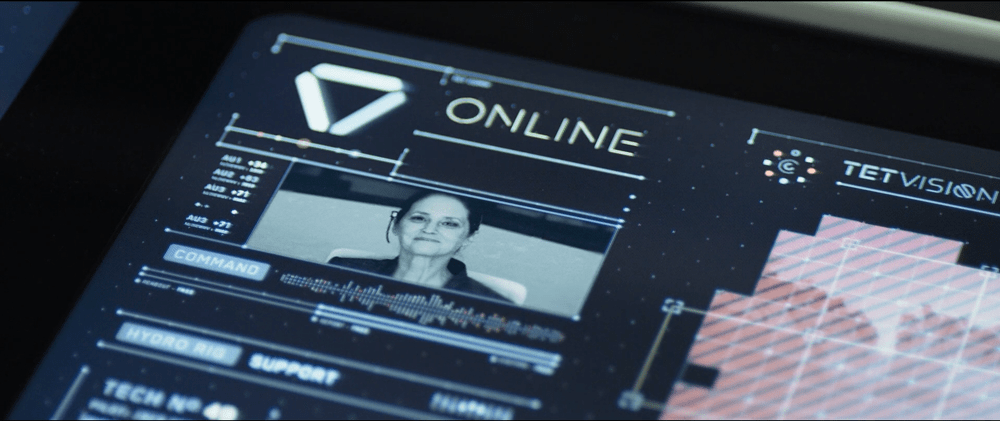
While Vika and Jack are conducting their missions on the ground, Sally is their main point of contact in orbital TET command. Vika and Sally communicate through a video feed located in the top left corner of the TETVision screen. There is no camera visible in the film, but it is made obvious that Sally can see Vika and at one point Jack as well.
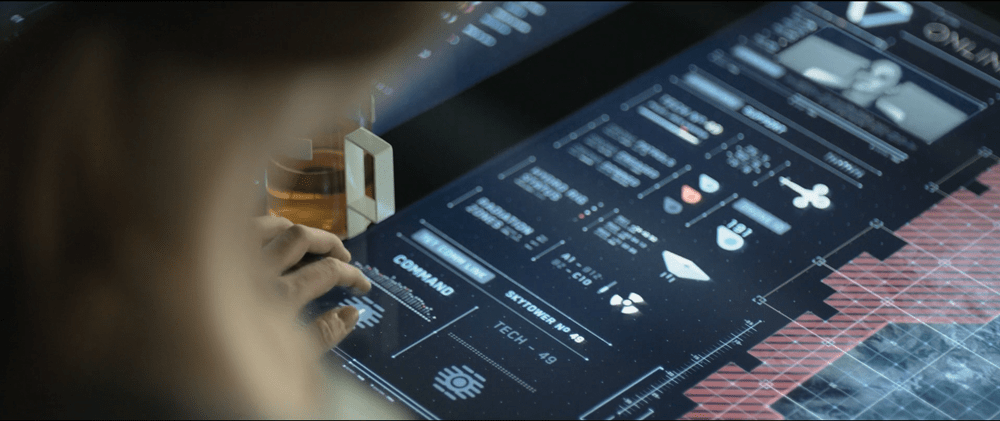
image00

The controls for the communications feed are located in the bottom left corner of the TETVision screen. There are only two controls, one for command and one for Jack. The interaction is pretty standard—tap to enable, tap again to disable. It can be assumed that conferencing is possible, although certain scenes in the film indicate that this has never taken place.
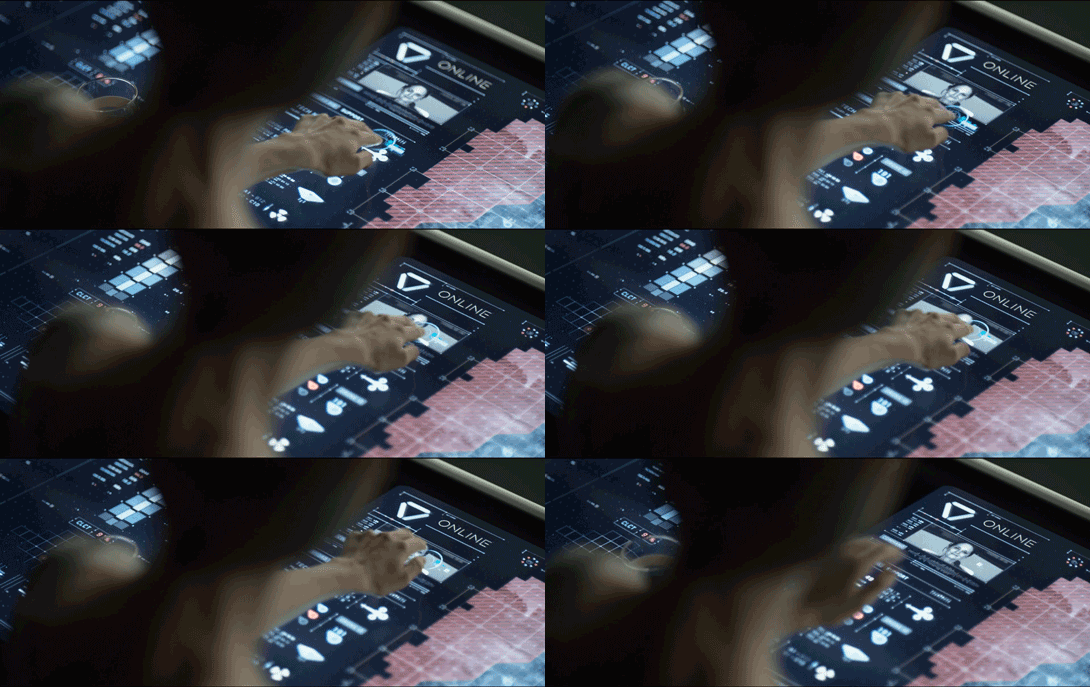
image02

Upon first connecting with Sally each morning, Vika uploads data to the TET by using a two-finger gesture to drag the information up to Sally’s video display. There is no footage showing where she taps to begin the gesture, but it seems to originate at the hydro-rig symbol since Vika is discussing hydro-rig support as she interacts with the screen.

Same interaction for different functions

When Vika sends the hydro-rig coordinates to Jack in the Bubbleship, she is using the exact same interaction as she uses here to send the hydro-rig status data to the TET. When she uses the two-finger gesture to drag from the hydro-rig symbol to the Bubbleship, GPS coordinates are being sent. When she uses the same gesture to drag from the hydro-rig symbol to Sally’s video feed, it sends data on the hydro-rig status. How does the system know what data to send when?

It’s possible that this is another instance of agentive tech in which the system determines what data to send based on where the gesture ends. However, as mentioned in another post, it would be better to use consistent interactions for similar tasks by using the two-finger gesture to upload data to the TET and to use the one-finger gesture for sending coordinates directly with the map interface.

Or better yet, auto-upload the data to the TET upon connection and make it fully agentive. Not great for our heroes’ sense of control, but from the TET’s perspective…

TET communications status
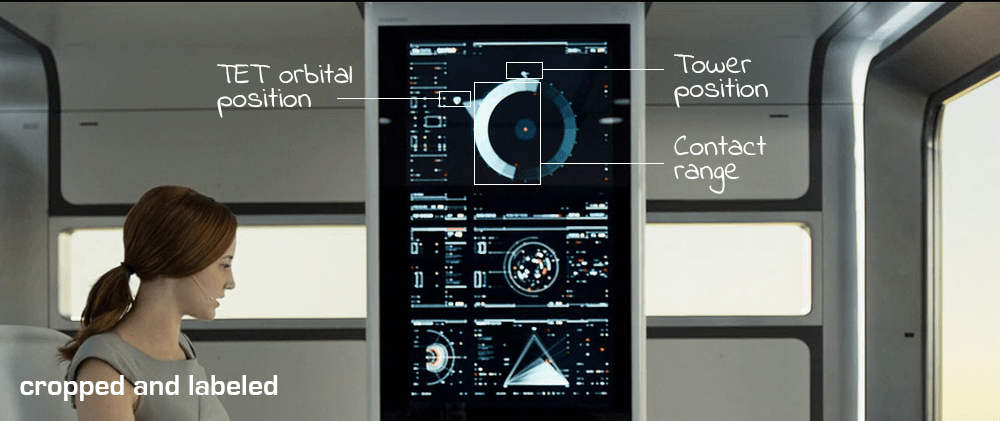
image03

Since Vika relies heavily on the TET’s surveillance and communications capabilities, it is important for her to know when the TET is going to be within contact range. The TET system status feed, which is the screen at the top of the upright section of the desk, monitors the TET’s orbital position in relation to the tower.

As labeled in the image above, the tower position is indicated by an icon located at the top of the circle (the earth) and remains stationary as the TET icon rotates, representing the real-time orbital position. The lighter blue gradient area of the monitor indicates the TET’s range of communications. The darker area indicates when the TET is outside of contact range.

No thinking required

This is one of the simplest interfaces in the film. The visualization of data is very easy to understand and allows for a quick glimpse of all of the information Vika needs without having to think about it. The gradients represent the strength of the signal – the more solid light blue seen directly under the TET symbol indicates a full-strength signal while the darker gradients represent a weaker signal.

One of the main tenets of user experience design is to create technology that would allow anyone, regardless of their technical background, to quickly and easily use the interface with as little mental processing power as possible. Make the design obvious and self-explanatory with no training required.

Don’t make the user have to think about it.

Hydro-rig Monitoring

image00

As a part of their morning routine, Jack makes the rounds in his Bubbleship to provide a visual confirmation that the hydro-rigs are operating properly. In order to send the hydro-rig coordinates to the Bubbleship, Vika:

  1. Holds with two fingers on the hydro-rig symbol on the left-hand side panel of the TETVision feed
  2. A summary of coordinates is displayed around the touchpoint (hydro-rig symbol)
  3. Drags the data up to the Bubbleship symbol on the side panel

Inconsistent interactions

When Vika sends the drone coordinates, she interacts directly with the map and uses only one finger. Why is the interaction for sending hydro-rig coordinates different than the interaction for sending drone coordinates?

image01

Perhaps Vika uses a different interaction here because she is sending the coordinates for all three rigs at the same time. However, since the three rigs are all in the same general location, that doesn’t really seem necessary.

It would be better to maintain a consistent interaction for the same function—in this case sending coordinates. This would leave the side panel with a more consistent interaction for uploading larger amounts of data to the TET, which will be covered in a separate post.

image02

The hydro-rig status feed on the left of the desk display is broken up into two sections. The main section consists of a diagram showing the resource collection status for each rig. The lower section of the feed indicates the grid position of each rig along with some additional data elements that are too blurry to make out.

Don’t forget the main objective

After the scavs take out one of the hydro-rigs in a gigantic show of fireworks, there is no noticeable change in the hydro-rig status feed. Where is the alert messaging stating that one of the rigs is offline? At the very least there should be an alert message similar to the red offline messaging displayed on the drone status feed. However, the screen appears to be unchanging throughout the film.

The main objective of Jack and Vika’s team is to keep the rigs safe. That’s why they are on earth and that is why the desktop with all of its fabulous capabilities was created. Don’t forget the main purpose of the design.

image03

At least there is a modest indication of a greyed-out symbol on the TETVision feed that indicates the rig is down—albeit very modest. There is not much of a clear visual distinction between the online and offline rigs. The colors are so similar, that a person who is colorblind may not even notice the difference.

image04

Made using tools at http://www.etre.com/tools/colourblindsimulator/

In this case, it’s likely that the TET selected teams who met fitness prerequisites, but it’s a good reminder for those of us doing real-world design for the general population: Don’t forget about accessibility in design. Following accessibility standards in design ensures that as many people as possible are able to use the interface.

Consistency is key

Overall, the system mostly does what it is supposed to do, but doesn’t seem to have been as well thought out or as consistent in design as the other systems in the film. Consistency should be maintained unless there’s a damned good reason not to, whether it’s with interactions or UI messaging.

Users tend to be more comfortable and confident when working with an interface that has consistent patterns. If a user expects a gesture or command to behave a certain way and it does, this consistency in design provides a more efficient workflow by enabling users to confidently interact with technology, without having to remember arcane details about what does what when.

Drone Status Feed

Oblivion-Desktop-Overview-002
Oblivion-Desktop-DroneMonitor-001


As Vika is looking at the radar and verifying visuals on the dispatched drones with Jack, the symbols for drones 166 and 172 begin flashing red. An alert begins sounding, indicating that the two drones are down.

Oblivion-Desktop-DroneCoordinates

Vika wants to send Jack to drone 166 first. To do this she sends Jack the drone coordinates by pressing and holding the drone symbol for 166 at which time data coordinates are displayed. She then drags the data coordinates with one finger to the Bubbleship symbol and releases. The coordinates immediately display on Jack’s HUD as a target area showing the direction he needs to go.

Simple interactions

Overall, the sequence of interactions for this type of situation is pretty simple and well thought out. Sending coordinates is as simple as:

  1. Tap and hold on the symbol of the target (in this case the drone) using one finger
  2. A summary of coordinates data is displayed around the touchpoint (drone symbol)
  3. Drag data over to the symbol of the receiver (in this case the Bubbleship)

Then on Jack’s side, the position of the coordinates target on his HUD adjusts as he flies toward the drone. Can’t really get much simpler than that.

However…

When Vika initially powers up the desktop, the drone status feed already shows drones 166 and 172 down. This is fine, except the alert sound and blinking icons on the TETVision don’t occur until Jack has already reached the hydro-rigs. This is quite a significant time lag between the drone status feed and the TETVision feed. It would be understandable if there was a slight delay in the alert sound upon startup. An immediate alert sound would likely mean there is something wrong with the TETVision system itself. That said, the TETVision drone icons should at the very least already be blinking red on load.

Monitoring drone 166

Oblivion-Desktop-DroneMonitor-005

As Jack is repairing drone 166, Vika watches the drone status feed on her desktop. The drone status feed is a dedicated screen to the right of the TETVision feed.

Oblivion-Desktop-DroneMonitor-000

It is divided into two main sections, the drone diagnostic matrix to the left and the drone deployment table to the right.

The dispatched drone table lists all drones currently working the security perimeter and lists an overview of information including drone ID, a diagram and operational status. The drone diagnostic matrix shows data such as fuel status and drone positioning along the perimeter as well as a larger detailed diagram of the selected drone.

Oblivion-Desktop-DroneMonitor

By looking at the live diagnostics diagram, Vika is able to immediately tell Jack that the central core is off alignment. As soon as Jack finishes repairing the central core, the diagram updates that the core is back in alignment and an alert sound pings.

How does the feed know which drone to focus on?

Since there is no direct interaction with this monitor shown in the film, it is assumed to be an informational display. So, how does the feed know which drone to focus on for diagnostics?

One possibility could be that Jack transmits data from the ground through his mobile drone programmer handset, which is covered in another post. However, a great opportunity for an example of agentive tech would be that when Vika sends the drone coordinates to the Bubbleship, the drone status feed automatically focuses on that one for diagnostics.

Clear messaging in real-time…almost

Overall, the messaging for drone status feed is clear and simple. As seen in the drone deployment table, the dataset for operational drones includes the drone ID number and a rotating view of the drone schematic. If the drone is down, the ID number fades and the drone schematic is replaced with a flashing red message stating that the drone is offline. Yet, when the drone is repaired, the display immediately updates to show that everything is operational again.

This is one of the basic fundamentals of good user interface design. Don’t let the UI get in the way and distract the user.

Keep it simple.

Vika’s Desktop

Oblivion-Desktop-Overview

As Jack begins his preflight check in the Bubbleship, Vika touches the center of the glass surface to power up the desktop that keeps her in contact with Sally on the TET and allows her to assist and monitor Jack as he repairs the drones on the ground.

The interface components

Oblivion-Desktop-Overview-000

The desktop is broken up into five main screens. The central screen is the TETVision map, which is a radar map used for communications, and monitors the Bubbleship, drones, and scav activity.

To the left of the TETVision map is a Hydro-rig status feed that keeps Vika informed of the water collection progress. Then on the right of the map is the drone status feed, which provides drone vital statistics, deployment and fuel status.

Oblivion-Desktop-Overview-000b

The upright section of the desktop contains two screens. The top screen is the TET system status feed, which monitors the TET’s orbit, and communications status. The second screen monitors the weather systems and wind velocity vectors, which would have an affect on the Bubbleship and drone flight safety.

Quick power-up

Powering on the desktop is virtually instantaneous and is as simple as touching the center of the table. One possible explanation for the speed is that the desktop goes into sleep mode and is in an always-on state. There are a couple of scenes in the film when the TET is able to access the desktop remotely that would support this assumption.

A possible method of power-down would be to tap and hold for a determined period of time. Sadly, there is no film footage that shows Vika shutting down the system.

Multiple versus single user

Oblivion-Desktop-Overview-003

The scale of this desktop is a bit large for a single user who needs to access life-saving information quickly. The display size and setup in the film is generally used for collaborative space so that multiple people can comfortably view and manipulate the data at the same time.

This large scale causes Vika to constantly lean over the table to see information for various reasons including glare, reach and angle of the displays. This could be stressful on the body when interacting with the desktop over long periods of time each day.

A better solution

Vika is only shown interacting with the TETVision map and not with any of the other feeds. If the map is the only screen that is interactive, a more ergonomic setup could be utilized to minimize glare and reach. This would allow Vika to see the vital information at a glance and still enable her to comfortably interact with the TETVision map.

Oblivion-Desktop-Overview-Ergonomics

Don’t forget the user’s needs

Overall, Vika’s desktop is a beautiful piece of technology that performs its function very well. However, in a real-world situation, it is important to remember that Vika will be using this equipment for possibly long periods of time and needs quick access to vital information. Having to roll back and forth between screens during an emergency situation could mean the difference between life and death for Jack while out in the field.

Bubbleship Comms

image01

Jack communicates with Vika via the HUD in the Bubbleship, and a small earbud that provides two-way audio.

He talks normally to Vika, who responds in kind. There is no visible confirmation of his connection to Vika, and no obvious way for him to send information back other than the sound of his voice.

As shown during the lightning strike sequence, Jack’s earbud is connected directly to the Bubbleship. All of his audio and telemetry requires the Bubbleship to connect with Vika’s control tower. When the Bubbleship’s power goes out, Jack’s communication is cut too.

Eye in the Sky

Vika has complete control over the communications in the Bubbleship. She is able to see Jack’s video, hear his audio, and send him mission updates whenever she so chooses. Jack only has control over his connection to Vika by going places where the direct comms can’t reach.

Given the post apocalyptic wasteland they inhabit and the strength of other systems Jack uses, Jack should always have a communication link back to Vika. Current infrastructure, like the Drones or the TET when it is overhead, should act as a repeater system for Jack’s earbud.

A handful of orbiting drones and a satellite radio phone attached to Jack’s belt could easily provide near 100% uptime in communications and give a backup to systems like the Bubbleship. Judging by Jack’s reaction during the lightning strike, power failures in the Bubbleship happen often enough for him to have a routine for them.

Jack should also have an easy way to pause or mute communications. When he is in a stressful situation, he may not want the distraction of audio. The audio might also leak from the earphone in quiet places, leaving him vulnerable to Scav ambush.

Any two-way communication system should have equal control for equal parties.

Electronic Shielding

Ideally, comm failures should never happen in the first place. Modern aircraft are well shielded against lightning strikes, and do not fall from the sky (a Guardian post indicates that each commercial aircraft is hit, on average, once per year). The Bubbleship should be at least as well shielded as a modern commercial aircraft, and be able to maintain contact with its control tower during routine thunderstorms.

image00

Advances in technology should not forget basic safety techniques from the generation of technology it is replacing.

The Bubbleship Cockpit

image01

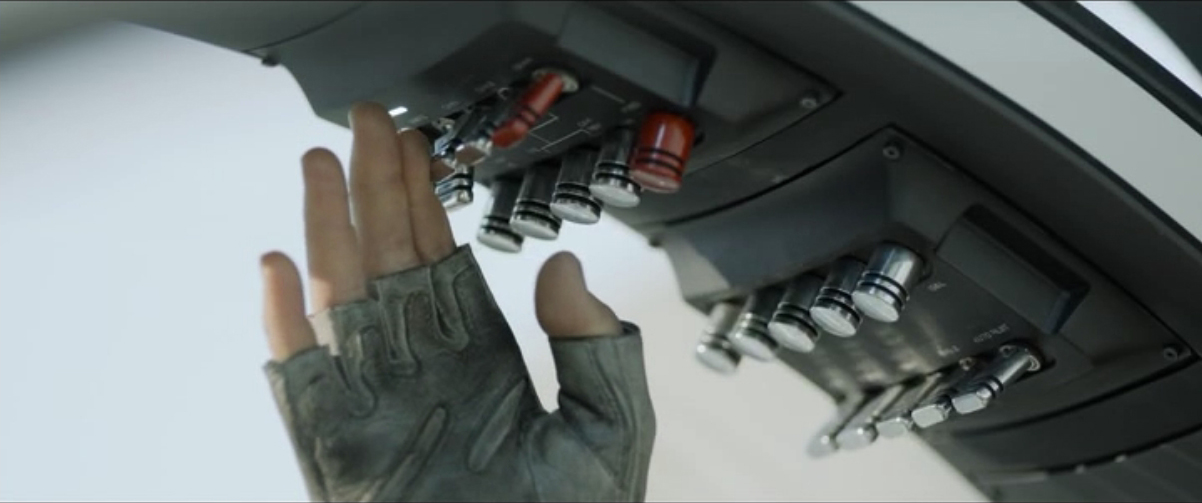
Jack’s main vehicle in the post-war Earth is the Bubbleship craft. It is a two seat combination of helicopter and light jet. The center joystick controls most flight controls, while a left-hand throttle takes the place of a helicopter’s thrust selector. A series of switches above Jack’s seat provide basic power and start-up commands to the Bubbleship’s systems.

image05

Jack first provides voice authentication to the Bubbleship (the same code used to confirm his identity to the Drones), then he moves to activate the switches above his head.

image06

The switches are large, all move the same direction for startup, and are labeled. Two of the controls are color coded red, and Jack switches the red control last. We never see the round knobs in use. They could be circuit breakers for the major systems. All are positioned nicely to prevent accidental use. Overall, it is setup almost exactly like a modern-day helicopter, with two distinct additions: Cockpit-wide HUD, and Swivel Controls. While not technical, the cockpit also has a little Elvis bobblehead—whose name is Bob—that keeps Jack company.

image02

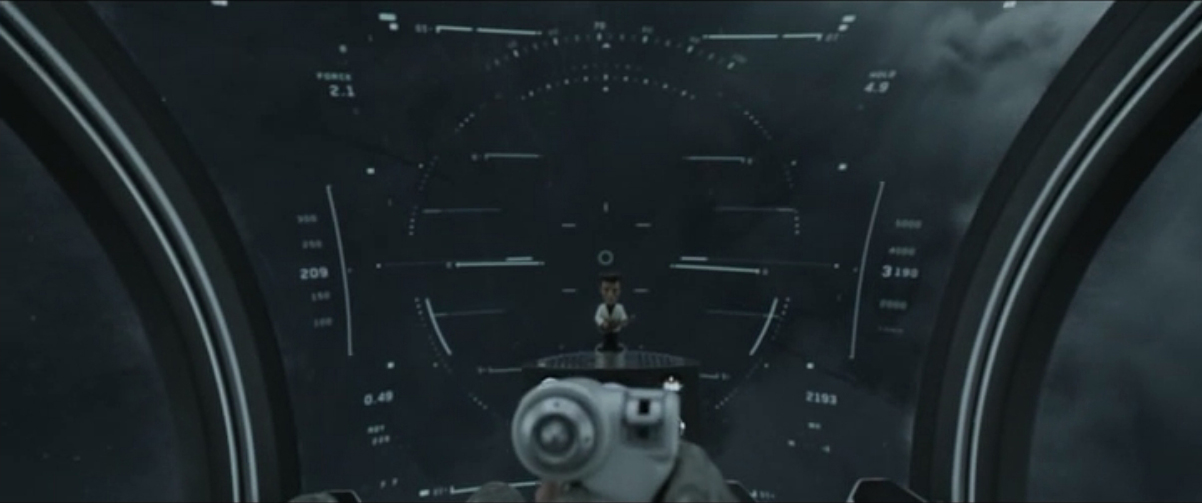
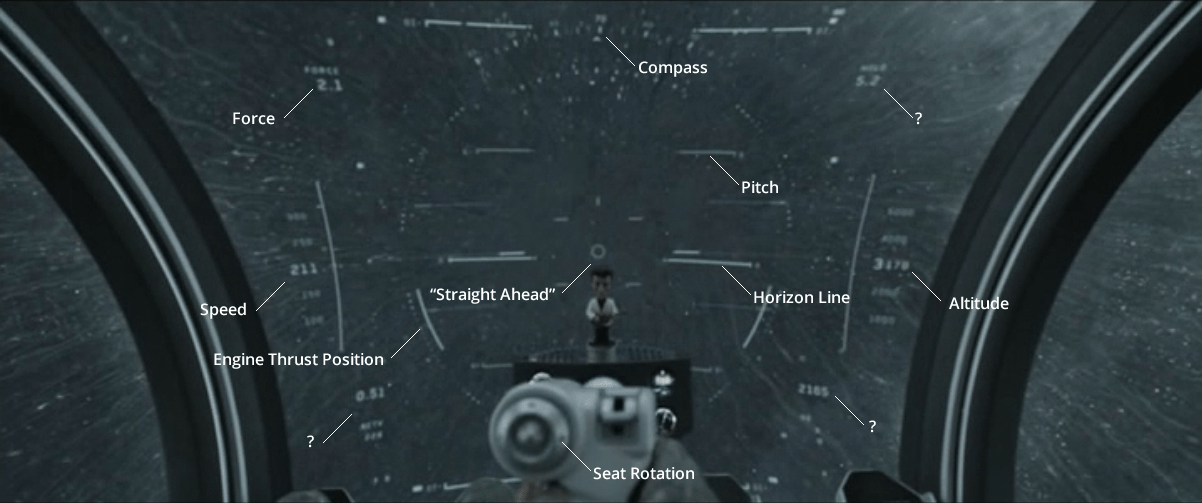
The main HUD provides standard information that Jack needs to pilot, even in zero visibility. It displays thrust output of his engines, an artificial horizon, altitude, and other indicators (shown in the above image and labeled in the image below).

image04

The HUD is displayed on the front glass, and is tied to the Bubbleship’s main power. When the power goes out, the HUD goes out. It is not wired to a separate backup circuit. Fortunately, Jack has a physical gimbal that remains operational even when the power is out.

image03

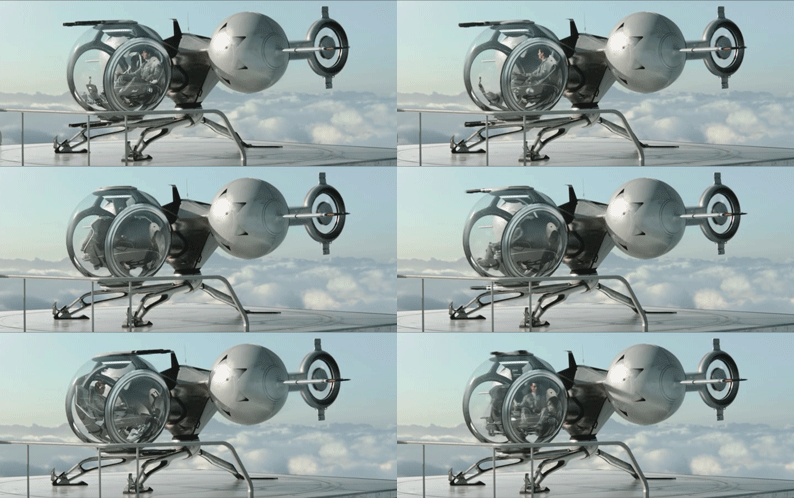
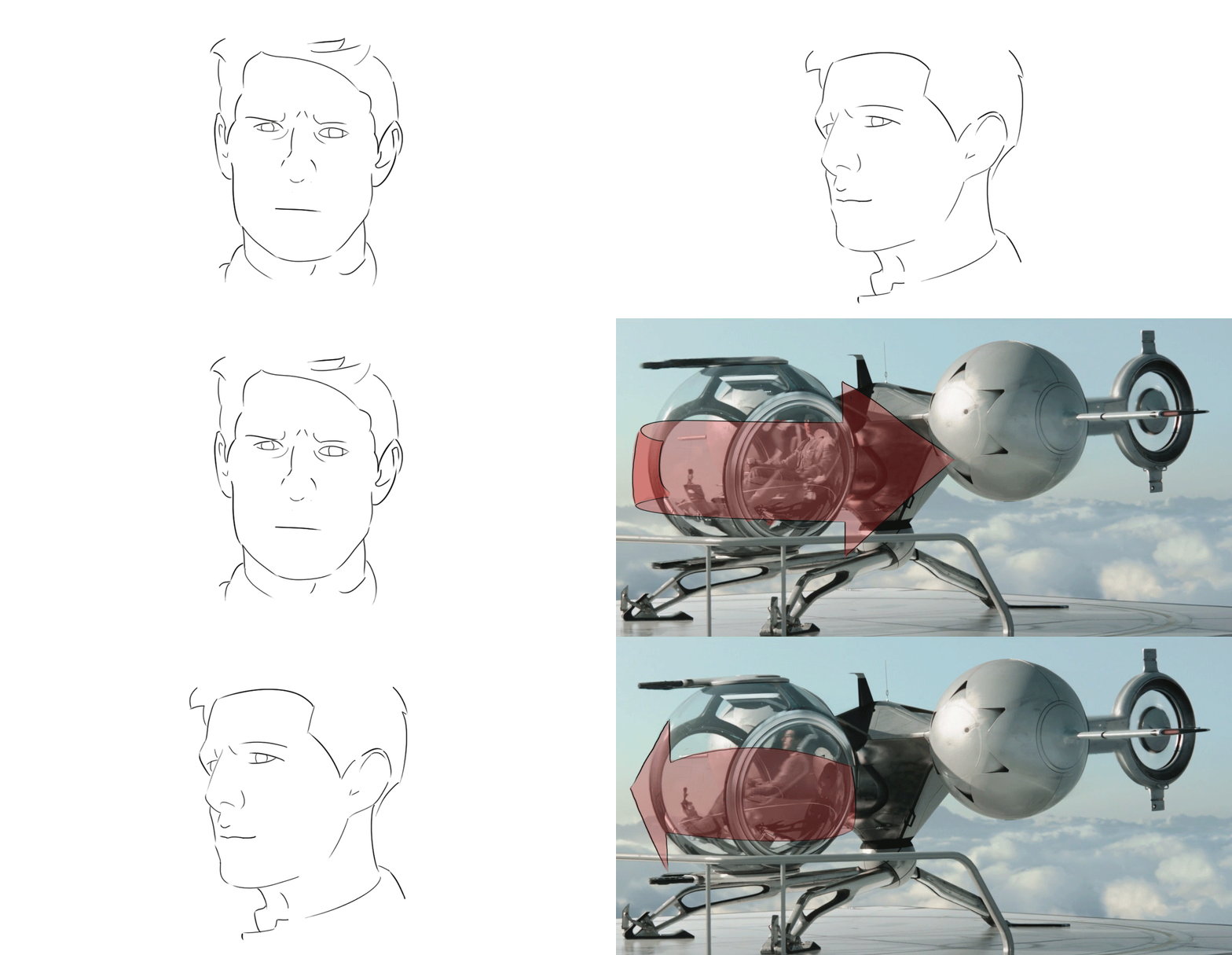
Another major addition is the swivel seating. Using a dedicated control on his joystick, Jack can move his seat around to get a better view as he is flying, without redirecting the Bubbleship in that direction.

image07

It is not clear based on the evidence shown whether Jack has set seat positions (one click per a certain degree of rotation), or whether he is able to hold down the control and rotate the seat based on the click duration. Jack is very familiar with this interface and piloting scheme. Even in an emergency situation when the Bubbleship’s power goes out and he loses control, Jack does not panic and goes through his emergency checklist. We see later that the Bubbleship does have an eject system (a large red handle in the top of the command pod), that detaches the entire passenger compartment and deploys a parachute. Jack decides that he does not need this rescue system and can pilot his way to safety.

Click-to-swivel

We see that Jack is often the only person in the Bubbleship, and that he often uses the seat swivel to get a better view of what he needs to survey. Piloting is a high-concentration activity, with a large amount of muscle memory training. A pilot can be expected to know how his (or her) craft will react to specific inputs at specific times. Moving around the seat allows Jack a better view of his surroundings, but could interrupt the muscle memory he uses for his daily piloting and emergency maneuvering. Given the muscle memory requirement, Jack is probably able to control the swivel based on a number of clicks, not a duration. Specific swivel points has several advantages:

  • The pilot can memorize control relationships for each swivel spot
  • Jack can click the position he wants, then forget about that control while he continues piloting
  • Less cognitive load to learn and operate
  • Automatic Swivel

Click-to-swivel has advantages, but it is not the most advantageous control scheme for the level of technology shown. We know that Jack has destinations in mind when he is traveling, or Vika has given him a waypoint. We also know that the Drones have a low level intelligence capable of free flight and complicated maneuvers. Jack could easily activate an autopilot mode (straight and level, emergency maneuvers, return to base, go to the secret cabin), then he could ‘free swivel’. This free swivel movement would be based on his eyes and head movement, with the seat merely following where Jack wants to look. Otherwise, the Bubbleship could follow his head movements for regular flight inputs, augmented by the control stick inputs.

image00

The Bubbleship would need some intelligence then to know the difference between when Jack actually wants to go somewhere, and when he is merely looking at his dashboard. Artificial intelligence is a given here. A good method would be focus tracking. When the Bubbleship tracks Jack’s focal point, it would know whether he’s looking at a spot on the horizon, or whether he’s looking at a point inside the cockpit. It would also be an effective way to focus the Bubbleship’s weapons pod for convergence—the guns would always meet at the point Jack was focused on, instead of firing wildly based on his joystick inputs.

Highly Refined

Modern day flight controls are highly refined tools with a well practiced group of users and a solid history of training programs. It makes sense to pull from this history when designing for a new flight machine, especially when its controls map so well to modern day equipment. The largest improvements can come from automation, especially when there is a solidly tested machine intelligence able to augment pilot intentions (see: the Drone, to be published later). By taking away the monotonous tasks from the pilot, and allowing them to focus on the difficult decisions, a machine can make the pilot’s life easier and safer.

Breakfast Sand Table

A woman in a modern kitchen holding a piece of food while looking at a countertop, with a man in a black shirt leaning on the counter beside her, both engaged in conversation.

While eating breakfast, Vika views the overnight surveillance via a touchscreen interface that is inset into the top of a white table.

Which touch tech?

Anyone interested in the touch technology should take note: Vika places her coffee cup and breakfast plate directly on the surface, which indicates that it utilizes capacitive touch technology with a glass top. Placing dishes on a resistive touchscreen, which is made of layers of plastic and glass would have interfered with the interactions and would be less durable as a tabletop.

Jack joins her at the table and leans on the surface with his hand and later with his forearm, which supports the idea that the area surrounding the viewport is not touch-enabled. If it were, it would need to incorporate palm-rejection technology in order for his arm to not interfere with Vika’s interactions.

The interface components

Oblivion-Desktop-Sandtable-001

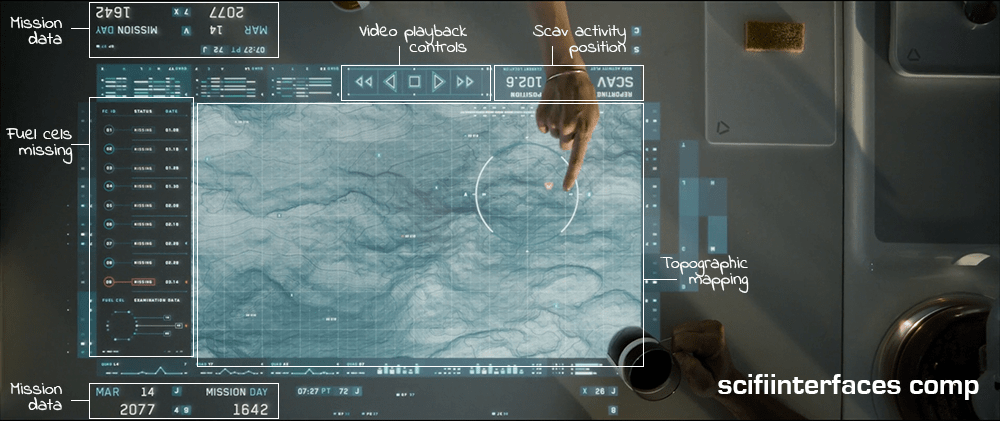
The main viewing area is a hybrid of satellite imagery and topographic mapping, surrounded in the interface by surveillance data and video playback controls. A message next to the video playback controls reports the current location of the scav activity.

To the left of the map is a list of fuel cells that have been stolen by the scavs along with the dates they went missing. The last one on the list is flashing red to draw their attention—a new one has gone missing.

Some elements, such as the current date and number of days into the mission face out at the top and the bottom to allow both Vika and Jack to view the data from either side.

A hand points at a futuristic digital map displayed on a transparent screen, showing a detailed terrain with lines and contours, alongside various mission data indicators and a date label.

The interface is responsive to touch gestures. Vika circles an area on the map and the icon indicating unusual activity turns red. She taps the icon and a video feed begins playing. Jack zooms in on the video feed by using a five-finger multi-touch “spread” gesture.

Why is the vital information facing Jack when Vika is the one using the interface?

It’s interesting to note that the the most vital information such as the list of missing drones, video playback and the topographic shaded relief are seen from Jack’s view. This causes Vika to have to process the information and videos upside-down—even though the playback controls face her.

This can be particularly problematic with the topographic shaded relief. Shaded relief simulates the shadow cast by the sun on the surface. Viewing this relief upside-down can cause a perception illusion that results in confusion on what is a crater and what is a hill.

Better: Lenticular display

A better solution would be to utilize a lenticular interactive display. Lenticular displays are made by placing a transparent film containing tiny ridges over an image that is made up of two or more images sectioned into bands and displayed in alternating lines. The ridges in the film cause the eye to focus on one set of lines in order to come out with a cohesive image.

Then, as in the illustration below, Vika would only see the view illustrated by the white lines and Jack would only see the view illustrated by the black lines.

Diagram illustrating the concept of lenticular film and interlaced images with labeled sections showcasing different views.

Utilizing a lenticular display would solve the issue of the shaded relief perception illusion and allow Jack and Vika to each read the information and watch the video from their own perspective at the same time.

The thing that gets a little tricky about utilizing a lenticular display for this solution is the fact that it is a touch screen. The elements that are being interacted with need to be in the same position for both Jack and Vika in order for the computer to know what is being manipulated. This can be solved by flipping the individual elements such as the shaded relief on the topography and the activity icons, words, etc., while keeping them in the same location on the interface.

Smart video recording and playback

So, how did the TET know where to start the video recording and playback? Given that the other interfaces in the film have the capability to detect motion, it is likely that the video recording was automatically triggered by the scavs when they moved in to attack the drone.

Unfortunately, there is no screentime granted to the use of the actual video playback controls, but assuming they are as smart as the rest of the interfaces in the film, it is safe to expect these controls to be more useful than simply sequencing through the scenes. The interface would probably allow Vika to scrub through a grid of thumbnails to quickly find any scenes of interest.

Why circle and tap to play?

The activity alert icon on the map was static white until Vika circled an area surrounding it. Only then did it start flashing red. Other interfaces on Vika’s main desktop provide immediate feedback with an audible alert and a flashing red symbol. Why would this one require the extra effort of circling the area? It would seem simpler to flash red from the beginning and allow Vika to immediately tap on the symbol for video playback.

It is possible that she is circling the area that she wants the TET feed to focus on, but if the TET has the capability to detect the activity to begin with, it should automatically know where to focus.

Another possibility is that she is used to getting multiple alerts every morning and the circle gesture could be for playing all of the surveillance videos at the same time instead of having to tap on each one to play. If that is the case, then she may be using the circle gesture through muscle memory since people tend to use repetitive gestures without thinking about it even if there is a simpler gesture available. If a gesture isn’t used very often, users tend to forget about it.

Overall, this is a nice system that effectively allows Jack and Vika to get a quick overview of the events of the previous night and gives them a heads-up as to what is in store for them that day.

Introducing Aleatha Singleton

Hi there. Tell us a bit about yourself. What’s your name, where are you from, how do you spend your time?

Hi. I’m Aleatha Singleton, hailing from Houston, Texas. I’ve been a UX Designer for over 15 years. I enjoy solving problems and making things that are easy and fun to use whether they’re digital or analog.

aleatha

When I’m not at work, I like to read, study the Japanese culture, and teach myself new things such as designing and building furniture or making udon noodles from scratch.

I’ve always been a big fan of sci-fi interfaces and technology, especially when the concepts become reality. It’s always fun and exciting to see how ideas that seemed so impossible only a couple of decades ago are being prototyped and developed in labs around the world, such as holodecks, 3D volumetric interfaces, neural scanners, etc., etc.

In the future, I would like to be a part of cutting edge innovation and ideation—thinking about how technology could improve lives—and then build it and make it real.

What are some of your favorite sci-fi interfaces (Other than in Oblivion)? (And, of course, why?)

Psycho-Pass-Hue-545

Psycho-Pass: This futuristic, high-tech society is dictated by the Sybil system, which is a fully integrated system of technology including wearables, cameras and sensors that are placed throughout the country.

Sybil analyzes a person’s psychological state and dictates career and other choices in life. The lower rankings result in blue collar work while higher rankings provide better opportunities and choices. People with mental states that are considered by the system to be unstable are institutionalized and are locked away from society for the rest of their lives.

Most people blindly follow Sybil, resulting in a society that accepts things without question in the fear that thinking differently will result in the system considering them to be at risk.

“What needs to be done is done by those capable of doing it. Such is the grace bestowed upon mankind by Sybil”

This system shows that there are a lot of social ramifications and ethical questions that designers and society should consider when creating and utilizing technology. It can be terrifying if used improperly, but can make society a better place if used conscientiously and ethically.

Gargantia-Translator-545

Gargantia on the Verdurous Planet: Ledo is shipwrecked and stranded on a “primitive” planet when his AI automated mobile suit gets sucked into a wormhole during an intense battle. While he is still learning the language, he uses a floating translation display with accompanying audio that helps him communicate with the people on the planet. It’s a great implementation since he can take the time to read body language and expressions instead of having to keep his head down, staring at a screen.

IronMan-Table-Prototype-545

I’m fascinated with the interfaces and technology from the Iron Man and Avengers universe, especially how Tony Stark works across multiple channels—both physical and digital—that flow seamlessly together. For example, he can easily switch a file from a phone to a monitor, to a computer, to a table with 3D volumetric projection for instant prototyping and virtual testing.

Why did you decide to participate in the group review of Oblivion for your first scifiinterfaces review?

I’ve been doing personal observations of sci-fi interfaces and technology in movies, TV shows, books and Japanese anime for a few years now in order to study how they influence society for better or worse. I was considering starting my own blog when I saw the call for nerdsourcing volunteers and decided to take the leap.

What was your biggest surprise when doing the review?

It is really easy to get into the nitty gritty details of the designs. I like building things and seeing ideas come to life, so I catch myself trying to figure out details of the interactions so I can make it real.

A one finger swipe from here to here does this…a two finger swipe from here to here does that…if this, then this, otherwise that…like I was getting ready to write design annotations.

It took longer to write the articles, so I had to stop myself and step back to look at the overall experience.

What else are you working on? (Alternately: What other awesomeness should we know about you?)

I take Japanese language classes at the local Japan America Society. A lot of my time is spent immersing myself in the language through textbooks, reading Japanese language manga and light novels and watching anime in Japanese with and without the subtitles.

My next project for scifiinterfaces.com will be an anime interface. Please look forward to it.
楽しみにして下さい。

Home 49

A futuristic spacecraft flying near a large, elevated structure above the clouds, surrounded by a dramatic sky.

Home 49 is a connected system that provides for the daily needs of Jack and Vika. It handles everything from morning breakfast, to video storage of previous missions, to maintenance of drones, to Jack’s personal weapons. The Home acts as both a residence and a watchtower, and is built on a slim stilt that reaches from ground level to above the cloud layer. This isolates Home 49 from the ground.

A woman in a sleek, modern kitchen standing by a counter with dishes, against a backdrop of a sunset and futuristic decor.

Inside, the home pod is broken down into ‘functional’ spaces. These include the kitchen, bedroom, bathroom, armory, and maintenance shop. It is connected to the exterior doors, windows, observation platform, landing pad, and pool.

The entire facility is a prefabricated structure (or at least a set-plan concept), and we see a nearly identical facility in Area 52. Cosmetic differences and changes to color scheme suggest a modicum of customization for each instance of the team.

The Breakfast console interface is multimodal, changing as Vika’s tasks change. Its contents are heavily mediated by Sally is an intermediary agent during most of Vika’s console tasks, though her perspective and information seems limited to that received from the drones or from Vika.

A person's hand interacting with a futuristic touchscreen interface displaying maps and data in a spacecraft setting.

The Breakfast console seems to scale with the task, and is capable of highlighting particular subtasks in progress, while displaying a wealth of peripheral or supplemental data.

An Efficient Home

Diagram of a futuristic flying vehicle with labeled sections including Control Tower, Kitchen, Lounge/Dining Room, Pool, Balcony, Lounge, Bedroom, Landing Pad, and Support Stalk.

Home 49 appears to suit Jack and Vika’s needs perfectly. We never see them in need of information, or struggling to complete a task. Vika is able to quickly get to the information she is looking for, and controls always appear to be at a comfortable height.

A scene depicting two individuals in a futuristic setting, engaged in conversation near a large glass panel that reflects the sky.

A close-up of a hand pointing at two illuminated control buttons on a sleek, modern interface. The top button displays a lock symbol, while the bottom button features a triangle shape.

Special mention here goes to the door control, which requires almost no effort to activate. Opening the door is a generic gesture of touching the left hand pane of glass (from the inside, not the outside). Less used controls are etched into the glass on the right.

The only thing that would make the control easier would be to make it constantly visible. The button is in a logical spot and is used every day, so there is little likelihood of the users forgetting how to open the door. Etching a control for opening the door would provide an added level of comfort and reminder for the crew.

With invisible controls, even with constant use, there is a chance of accidentally hitting the wrong button.

In this case, an automatic door like at a grocery store would be a serious security and safety concern for the TET. Making an automatic door secure would require a complete redesign of the lock controls and the procedure for entering the home.

A woman walking on a balcony with a drink in her hand, overlooking a sunset.

Considering how high up the home is, accidentally opening the door when Vika is merely looking to select an option would be a dangerous issue in high winds. Thankfully, the home has extensive balconies which would mitigate an accidental door opening.

A person walking through a futuristic, dimly lit room with high-tech storage and equipment in the background.

When working on the drone, Jack always appears to have the needed tools at hand and within easy reach. His Armory is always ready, and his weapons are always prepared for a mission.

The Tet’s Hidden Goals

As revealed later, this home also serves the Tet’s goals perfectly. Home 49 is a confined space that is well above a height where Vika would feel any connection to the ground (either emotionally or physically). The home is wired with several sensors and cameras to watch over the two occupants.

Everything inside is crafted to appear human. The language, interactions, and accessories all reinforce memories of life before the War. This reinforcement hides the Tet’s alien technology under a layer of familiarity, and Jack never questions that he isn’t working on Human built machines.

Everything but the door

The only interface in Home 49 that can be found lacking is the main door control. It is invisible until pressed, and only works from the inside. We see elsewhere that the Drones have built in voice recognition, and only respond to their proper maintenance crew. This system could be implemented on the door to prevent unwanted entry by other maintenance crews.

A tense moment between two characters in a futuristic setting, with one person dressed in a sleek outfit and the other in a light dress. They are interacting in a well-lit space featuring large windows and an ocean view.

Failing that, better labels on the control when the door is inactive would provide better touch targets and easier use after a long day fixing Drones.

Otherwise, we see that the home serves Jack and Vika’s (and the Tet’s) needs well. Though, if the Tet really wanted to keep the team inside, it would have a way to remotely lock the doors. Considering how bad a fire hazard locked doors would be, I’m glad that the Tet overlooked that small feature.

Lessons:

  1. Don’t prevent evacuations in the event of an emergency
  2. Give your users a way to be alone when they want
  3. Every-day tasks should be easiest and most seamless

The Oblivion will be nerdsourced

The review of Oblivion will not go down as almost all of the others have, i.e., as a single author working his way through all interfaces in a given film. This review is distributed amongst several authors. How did this come about?

In April of 2014 I posted a call for readers of the site to band together to make reviewing a movie a little less onerous along with a poll to see which movie we should review. That movie is Oblivion, and the reviews will be going live over the next weeks.

Since this review will involve multiple people, keep an eye on the site for biography posts introducing each of the new authors before their first post goes live. Maybe you’ll be inspired to join the next “nerdsourcing” experiment.