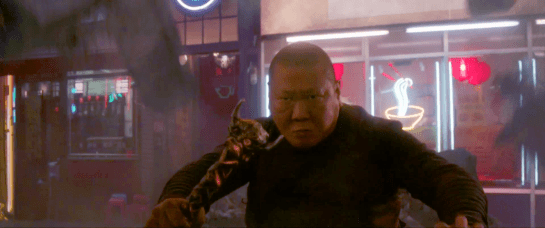
Report Card: Doctor Strange

Read all Doctor Strange reviews in chronological order.

Chris: I really enjoyed Doctor Strange. Sure, it’s blockbuster squarely in origin story formula, but the trippiness, action, special effects, and performances made it fun. And the introduction of the new overlapping rulespace of magic makes it a great addition to the Marvel Cinematic Universe. And hey, another Infinity Stone! It’s well-connected to the other films.

Scout: Doctor Strange is another delightful film that further rounds out the Marvel universe. It remained faithful (enough) to the comics that I loved growing up and the casting of Benedict Cumberbatch was spot-on perfect, much as Robert Downey Jr. was for Tony Stark. It is a joyful and at times psychedelic ride that I’m eager to take again. “The Infinity Wars” will be very interesting indeed.

But, as usual, this site is not about the movie but the interfaces, and for that we turn to the three criteria for evaluating movies here on scifiinterfaces.com.

  1. How believable are the interfaces? (To keep you immersed.)
  2. How well do the interfaces inform the narrative of the story? (To tell a good story.)
  3. How well do the interfaces equip the characters to achieve their goals? (To be a good model for real-world design?)
Report-Card-Doctor-Strange

Sci: B- (3 of 4) How believable are the interfaces?

Magic might be a tricky question for narrative believability, as by definition it is a breaking of some set of rules. It’s tempting laziness to patch every hole we find by proclaiming “it’s magic!” and move on. But in most modern stories, magic does have narrative rules; what it’s breaking is known laws of physics or the capabilities of known technology, but still consistent within the world. Oh, hey, kind of like a regular sci-fi story.

The artifacts mostly score quite well for believability. The Boots, the Staff, and the Bands are constrained in what they do, so no surprise there. Even the Cloak is a believable intelligent agent acting for Strange. Its flight-granting and ability to pull in any spatial direction arbitrarily don’t quite jive, but they don’t contradict each other, just raise questions that aren’t answered in the movie itself.

But, the Sling Rings are a trainwreck in terms of usability and believability. With that and the Eye missing some key variables that simply must be specified for it to do what we see it doing, it breaks the diegesis, taking us out of the movie.

Fi: A (4 of 4) How well do the interfaces inform the narrative of the story?

None of these are tacked-on gee-whiz.

  • Since Strange is occupying an office (Master) that is part of a venerated and peacekeeping secret organization (the Masters of Mysticism) we would expect it to have some tools in place to help the infantry and the boss.
  • That the powerful artifacts choose their masters helps establish Strange as unique and worthy.
  • The Eye is core to the plot, and the film uses it to convey how much of a talent and rulebreaking maverick Strange is.
  • The Staff helps us see Mordo’s militancy, threat, and lawful neutral-ness.
  • The laugh-out-loud comedy of the Cloak comes from its earnestly trying to help, its constraints, and how Strange is really, really new to this job.
  • Even the dumb Sling Ring helps show Strange’s learning and confidence, and set up how Strange gets stabbed and yadda yadda yadda begins his reconciliation with Dr. Palmer.
Cloak-of-Levitation-pulling
Once more, because it was so damned funny.

All great narrative uses of the “tech” in the film.

Interfaces: C+ (2 of 4)
How well do the interfaces equip the characters to achieve their goals?

The Boots do. The Cloak totally does. The “AR” surgical assistant does. (And it’s not even an artifact.) If we ever get to technologies that would enable such things, these would be fine models for real world equivalents. (With the long note about general intelligence needing language for strategic discussions with humans.)

DoctorStrange_AR_ER_assistant-05

That aside, the Sling Ring services a damned useful purpose, but its design is a serious impediment to its utility, and all the Masters of the Mystic Arts uses it. The Staff kind of helps its user, i.e. Mordo, but you have to credit it with a great deal of contextual intelligence or some super-subtle control mechanism.  The Bands are so clunky that they’re only useful in the exact context in which they are used. And the Eye, with its missing controls, missing displays, and dangerously ambiguous modes, is a universe-crashing temporal crisis just waiting to happen. This is where the artifacts suffer the most. For that, it gets the biggest hit.

Final Grade B- (9 of 12), Must-see.

Definitely see it. It’s got some obvious misses, but a lot of inventive, interesting stuff, and some that are truly cutting edge concepts. In a hat tip to Arthur C. Clarke’s famous third law, I suppose this is “sufficiently advanced technology.

IMDB: https://www.imdb.com/title/tt1211837/Currently streaming on:

Sling Ring

A sling ring opens magical portals of varying sizes between two locations. A sorcerer imagines the destination, concentrates, holds the hand wearing the ring upright and with the other gesticulates in a circle, and the portal opens with a burst of yellow sparks around the edges of the portal.

Sling-Ring.gif

How might this function as technology

It can’t.

Teleportation, even given cutting-edge concepts of quantum entanglement, is limited to bits of information. All the writing on this topic that I can find online says that physical portals require too much energy. So we have to write the totality of this device off as a narrative conceit.

We can imagine the input working, though, as a reading-from-the-brain interface that matches a sorcerer’s mental image of a location to a physical location in the world. As if you were able to upload an image and have a search engine identify its location. That said, reading-from-the-brain has edge cases to consider.

  • What if the envisioned place is only imaginary?
  • What if the sorcerer only has the vaguest memory of it? Or just a name?
  • What if the picture is clear but the place no longer exists? (Like, say, Sokovia.)

Perhaps of course the portal just never opens, but how does the sorcerer know that’s the cause of the malfunction? Perhaps a glowing 404 would help the more modern sorcerers understand.

Strange_404.png
@scifiinterfaces has you covered, Steven.

The gestural component

The circular gesture is the mechanism for initiating the portal, an active meditation that likely makes concentrating on the location easier. If we had to compliment one thing, it’s that the gesture is well mapped to the shape of the portal, and having a gesture-concentration requirement ensures that portals aren’t just popping up at whim around Kamar-taj anytime someone wearing a ring remembers a place.

OK. That done, we’re at the end of the compliments. Because otherwise, it’s just dumb.

No, really. Dumb.

The physical design of the Sling Ring is dumb. Like Dumb and Dumber dumb. There are plenty of examples of objects or interfaces in movies that only exist because a writer was lazy, but the SlingRing™ deserves a special award category unto itself.

  • First off they aren’t rings, they are more like a set of brass knuckles as designed by a 10 year old who’s never seen a brass knuckle.
  • It restricts the movement of two fingers on the user’s hand which seem to be critical to casting all other spells in the film.
  • It makes any kind of physical combat with that hand significantly more difficult which, curiously, is something sorcerers seem to do a lot of. Punching someone while wearing a sling ring would likely break a finger or three.
  • It’s interesting to note that the sentience that makes other relics special may also be their security. However, any sorcerer can apparently pick up any sling ring and use it. Have you ever been bowling? The first 5 minutes of any trip to a bowling alley is trying to find the right sized ball. So unless there’s someone making bespoke sling rings for new magicians, there’s going to be a lot of poorly sized sling rings out there. This might explain why Strange’s ring is loose enough that it can easily fall off or be pulled off, which is inconvenient at best when fighting another sorcerer.

Redesigning this device as a single ring, or a glove or a wristband, or a necklace, or a tiara or a codpiece…frankly just about anything would be better than this tragically flawed artifact and would likely solve all of the above problems.

casting-spell.gif
Hang on, let me remove my not-sling-not-ring first.

And what the heck does sling even mean in this context?

The Crimson Bands of Cyttorak

Dr. Strange uses the Crimson Bands of Cyttorak to immobilize Kaecilius while they are fighting in the New York Sanctum.

The bands are a flexible torso shaped device, that look like a bunch of metal ribs attached to a spine. We do not actually know whether this relic has “chosen” Strange or if it simply functions for anyone who wields it correctly. But given its immense power, it definitely qualifies as a relic and opens up the conversation about whether some relics are simply masterless.

Crimson-bands-of-Cyttorak-03.png

On the name

Discussing the bands is made semantically difficult for two reasons. The first is that “they” are multiple bands joined together by a single “spine” and handled in combat like a single thing. So it needn’t be plural “Bands.” That’s like calling a shoe the Running Laces of Reebok. It is an it not a they. Also it is not Crimson (even in the comic books, most folks would call them pink.) They are not actually named in the film, but authoritative source material indicates that is what these are. So forgive the weirdness, but this post will discuss the bands as a single thing. An it.

So where did it get its plural name? Comic book fans have already noted: In the books, the Crimson Bands of Cyttorak are actually a spell for binding. They are—no surprise—glowing crimson bands of energy, and used by many spellcasters, not just Strange. Here they are in The Uncanny X-Men, cast by the Scarlet Witch and subsequently smashed by Magik.

uncannyx190-3.jpg

Since these are in fact, multiples, its plural there makes sense. Its reimagining as a single thing for the Marvel Cinematic Universe is what has us speaking of it in the singular.

Operation

The operation of the device seems to be very simple. Upon impact with a person, the bands quickly twist and clamp to immobilize the limbs, arms, head, and torso of the person. It also covers their mouth so no spells can be cast (or instructions given to minions).

How might this work as technology?

The Crimson Bands are  robotic device composed of a self-powered collection of electromagnetic metal hinges and locks, with bands that are interwoven with muscle wire to adjust to a person’s body.

En route to a collision with a humanoid body, the microcomputer scans the surface area of the person using LIDAR to create a surface mapping and body model. This allows the Bands to adjust itself midair to achieve the proper orientation. Then the primary mechanical controller snaps each band shut in sequence beginning with the torso and expanding to the extremities. As each section finds purchase, it tightens, adjusting and locking in place. The sequence takes only a few seconds and leaves the victim in a rigid kneeling position where they are immobilized to prevent any kind of action or spellcasting. The bands that cover the mouth can be removed independently to allow interrogation.

Crimson-Bands-of-Cyttorak-throw.gif

What works well

  • It’s non-lethal, but still neutralizes a very powerful enemy.
  • It does not require a great deal of precision. Toss it roughly toward the enemy, and it will do its best to compensate for your imprecision. “Close enough” counts in horseshoes, hand grenades, earthquakes, and the Crimson Bands.
  • It probably works on a variety of humanoid body shapes and sizes.
  • The ability to remove the mouth band is useful for interrogation.

Improvements: Provide a keyhole

We never see an obvious release mechanism, but there is one, as Strange discovers when Kaecilius has been freed when Strange returns to the Sanctum. We can’t exactly critique what we don’t see, but we can discuss the affordance of the function. Should it be obvious? Probably but not too obvious, less a zealot run up and quickly figure out how to free their boss. But there should be some sort of “keyhole”  that will help Strange know that he needs some sort of “key” to release his prisoner and not leave him in a stress position indefinitely. So there should be the equivalent of a keyhole on the bands. And hopefully one the Cloak can explain, or Strange can figure out.

Improvements: Miniaturize

While highly effective, this artifact is not particularly useful unless you happen to be in a fight while standing next to it. It’s simply too large and bulky to carry around. So, if it could be miniaturized, it would prove more generally useful. Or maybe, since this occurs in a world with magical flight and teleportation, they could be summonable.

Crimson-bands-of-Cyttorak-14.png

Improvements: Authorization

It seems that the Cloak isn’t authorized to use this artifact. (Why else waste all that time trying to pull Strange to it?) Authorizing the Cloak would mean additional agentive controls for dealing with, you know, groups of zealots. We also don’t know if it has a “whitelist” of people it should not immobilize, but that would be useful to prevent it being turned against its owner.

Improvements: Nonhumanoid

The overall shape of the bands are humanoid, indicating that they would not likely function on anything other than a being with the standard humanoid legs, arms, head, mouth, and torso. This fortunately covers most of the characters in the Marvel Universe, but there are a handful of exceptions. If it had a more micro-component based design, it might be able to reconfigure itself to help with non-humanoid malefactors as well.

Then we’d have to come up with some other mechanism to account for scaling to Rhunian, Celestial, or Faltine-sized things.

Dormammu.png

Vaulting Boots of Valtor

Mordo wears the Vaulting Boots of Valtor throughout the movie and first demonstrates their use to Dr. Strange when they are sparring. The Boots allow the user to walk, run, or jump on air as if it were solid ground.

Boots-of-Valtor-Vaulting.gif

When activated, the sole of each boot creates a circular field of force in anticipation of a footfall in midair, as if creating free-floating stepping stones.

How might this work as tech?

The main interaction design challenge is how the wearer indicates where he wants a stepping-stone to appear. The best solution is to let Mordo’s footfall location and motion inform the boots when and where he expects there to be a solid surface. (Anyone who has stumbled while misjudging the height or location of a step on a stairway knows how differently you treat a step where you expect there to be solid footing.)

If this were a technological device, sensors within the boots would retain a detailed history of the wearer’s stride for all possible speeds and distances of movement. The boots would detect muscle tension and flexion combined with the owner’s direction and velocity to accurately predict the placement of each step and then insert an appropriately elevated and angled stepping stone. The boots would know the difference between each of these styles of movement, walking, running, and sprinting and behave accordingly.

As a result, Mordo could always remain upright and stable regardless of his intended direction or how high he had climbed. And while Mordo may be a sorcerer with exceptional physical training, he isn’t superhuman. With the power of the boots he is only able to run and step as high as he could normally if for example he was taking a set of stairs two or three at a time.

As a magical device, the intelligence imbued in the boots is limited to the awareness of the intent of the sorcerer and knows where to place each force-field stepping-stone.

Vaulting-boots-of-valtor-07-levels.png

The glowing bits

As each step lands, the placement of the boot results in a brief energy discharge in the shape of a brilliant glowing gold circle. Is this a bug in combat, or a feature? The blog has before called out how glowing bits on a warrior make them an easier target, but it’s worth noting that Mordo’s feet are actually on individual stepping stones for less than a half a second. He leaves them behind as he goes. If someone targeted the circles themselves, they’d mostly be targeting where he was rather than where he is, so I’d count it as a distracting feature. As long as he wasn’t being targeted with a long-distance area-of-effect weapon.

Activation?

When describing them to Strange, Mordo demonstrates the effect with a subtle kick. It’s not clear if he’s activating the boots or just demonstrating that they have inherent magical powers.

BootTap.gif

These boots are awesome. They would require a lot of practice to get used to, but after some tumbles a user could always acquire the high ground on an opponent and they would never need a ladder to change a light bulb. What’s not known is what would happen if the user tried to do parkour style moves where a step would be perpendicular to the ground. Could Mordo walk on walls or the ceiling of a room?

More!

It would be cool to know more about these boots. Could Mordo climb to a given height and then just stand there or is each step is  a limited duration effect?  Could the boots be used offensively as a kind of boot sized force field? In a fight, Mordor could lash out with a sidekick/step that stops an onrushing attacker not unlike hitting a brick wall.

Since he’s heavily set up to the Big Bad in the sequel, we’ll likely see more of these relics, and get some more of the questions answered.

Staff of the Living Tribunal

This staff appears to be made of wood and is approximately a meter long when in its normal form. When activated by Mordo it has several powers. With a strong pull on both ends, the staff expands into a jointed energy nunchaku. It can also extend to an even greater length like a bullwhip. When it impacts a solid object such as a floor, it seems to release a crack of loud energy. Too bad we only ever see it in demo mode.

How might this work as technology?

The staff is composed of concentric rings within rings of material similar to a collapsing travel cup. This allows the device to expand and contract in length. The handle would likely contain the artificial intelligence and a power source that activates when Mordo gives it a gestural command, or if we’re thinking far future, a mental one. There might also be an additional control for energy discharge.

In the movie, sadly, Mordo does not use the Staff to its best effect, especially when Kaecilius returns to the New York sanctum. Mordo could easily disrupt the spell being cast by the disciples using the staff like a whip, but instead he leaps off the balcony to physically attack them. Dude, you’re the franchise’s next Big Bad? But let’s put down the character’s missteps to look at the interface.

Mode switching and inline meta-signals

Any time you design a thing with modes, you have to design the state changes between those modes. Let’s look at how Mordo moves between staff, nunchaku, and whip in this short demonstration scene.

To go from staff to nunchaku, Mordo pulls it apart. It’s now in a dangerous state, so is there any authentication or safety switch here? It could be there, but all passive via contact sensors, which would be the best so it could be activated in a hurry. The film doesn’t give us any clue, really, so that’s an open question.

How does it know to go from nunchaku to whip? It sure would be crappy to bet on a disabling thwack against your opponent only to find it lazily draping over a shoulder instead. (Pere Perez might have advanced ideas, given his ideas on light saber tactics.) Again, this state change could be passive, detecting in real time the subtle gestural differences in a distal snap, which a bullwhip would need, and lateral force, which sets the nunchaku spinning, and adjust between the two accordingly. Gestural and predictive technologies are not particularly cinegenic, so let’s give it the benefit of the doubt and say that’s what’s happening.

A last mode is After Mordo cracks it against the ground, it retracts back to Staff form. This is the hardest one to buy. Certainly it’s a most dramatic ending for Mordo’s demonstration. But does it snap back automatically after it strikes a surface? Automation is not always the answer. Deliberate control would mean Mordo doesn’t have to waste time undoing unwanted automatic actions.

Critical systems must be extremely confident in their interpretations before automation is the right choice.

It might be that this particular gesture is a retraction signal, but how the Staff distinguishes this from a mid-combat strike is tricky. It would have to have sophisticated situational awareness to know the difference, and it doesn’t display this. Better backworlding would point at some subtle gestural signal from Mordo. A double-tightening of his grip, maybe. Or even a double-slight-release of his grip, since that’s something he’s quite unlikely to do in combat.

This is a broad pattern for designers to remember. Inline control signals should be simple-to-provide, but unlikely to occur in literal use. Imagine if the Winter Soldier’s Trigger Phrase wasn’t “Longing, rusted, 17, daybreak, furnace, 9, benign, homecoming, 1, freight car” but instead was the word “the.” He’d be berserking every few seconds. Unworkable. So, if you were designing the Staff’s retraction command gesture, you’d have to pick something he could remember and perform easily, and that would be difficult to accidentally provide.

If Mordo has the staff in the next film, I hope the control modes are clearer and of course well-designed.

Named relics in Doctor Strange

Any sufficiently advanced technology is indistinguishable from magic.”

You’ve no doubt opened up this review of Doctor Strange thinking “What sci-fi interfaces are in this movie? I don’t recall any.” And you’re right. There aren’t any. (Maybe the car, the hospital, but they’re not very sci-fi.) We’re going to take Clarke’s quote above and apply the same types of rigorous assessment to the magical interfaces and devices in the movie that we would for any sci-fi blockbuster.

Dr. Strange opens up a new chapter in the Marvel Cinematic Universe by introducing the concept of magic on Earth, that is both discoverable and learnable by humans. And here we thought it was just a something wielded by Loki and other Asgardians.

In Doctor Strange, Mordo informs Strange that magical relics exist and can be used by sorcerers. He explains that these relics have more power than people could possibly manage, and that many relics “choose their owner.” This is reminiscent of the wands in the Harry Potter books. Magical coincidence?

relics

Subsequently in the movie we are introduced to a few named relics, such as…

  • The Eye of Agamoto
  • The Staff of the Living Tribunal
  • The Vaulting Boots of Valtor
  • The Cloak of Levitation
  • The Crimson Bands of Cyttorak

…(this last one, while not named specifically in the movie, is named in supporting materials). There are definitely other relics that the sorcerers arm themselves with. For example, in the Hong Kong scene Wong wields the Wand of Watoomb but it is not mentioned by name and he never uses it. Since we don’t see these relics in use we won’t review them.

WandofWatoon.png

Choosing an Owner

The implications of what Mordo tells Strange is profound because it means magical relics possess some kind of intelligence. That’s a weighty word, so In order to back this up, we need a common definition in place. Let’s ask Merriam-Webster.

Intelligence

a (1) :  the ability to learn or understand or to deal with new or trying situations :  reason; also :  the skilled use of reason (2) :  the ability to apply knowledge to manipulate one’s environment or to think abstractly as measured by objective criteria (as tests)

That gives us the foundation that we need. In order to choose their owner, these relics require a theory of mind, an ability to detect and perceive the individuals they meet, and they must possess a reasoning mechanism to decide that an individual is worthy or useful to them. That seems to satisfy both senses of that definition. For our purposes we’re going to think of this in terms of an artificial intelligence and review these relics as if they were a form of advanced technology. Thanks, Mr. Clarke.

We should take care, though. There are some narrative trappings for magic that can trip us up. Magic, for instance, doesn’t typically run out in these relics, but if they were technological, we would have to deal with issues of power, batteries or recharging. So for all their instructive power, we would have to deal with even greater complexity if they were real technology.

The AIs/Intelligences appear to vary in capabilities from narrow to general and are focused on their own specific purposes and “hardware.” In use, they primarily respond to the intentions and actions of the user. None of the objects seem to be able to speak directly, although the Cloak provides rudimentary directional guidance and responds to speech and emotions, so the connection varies from communication via touch to some form of remote telepathy.

Cloak-of-Levitation-01.png

Distance constraints

The initial awareness and selection by an relic for a sorcerer seems limited in range to a few meters. It’s almost like they need to meet their humans socially to determine if they are a match. But once  an relic chooses a sorcerer, their interactions can occur more remotely. The Cloak, as we’ll see in that write-up, flies to save Strange from a fall and it fights for him in the Sanctum while he seeks medical attention across town at the hospital.

What’s the platform?

One question the diligent backworlder might seek to answer is how all of these unique relics—created as they were across different millennia, and realities and by different sources/sorcerers/beings—wound up with similar intelligence and imprinting features. The movie itself doesn’t provide an answer, so we’ll leave it to speculation, but it does imply some sort of shared provenance/source material/code base/relic-maker convention.

Ok. So we’re set with some understanding of how these things work and what they have in common. Next let’s dig into the big billowy one that should have gotten supporting actor credit in the film.