Fritzes 2026 Best Believable

The Fritzes award honors the best interfaces in a full-length motion picture in the past year. Interfaces play a special role in our movie-going experience, and are a craft all their own that does not otherwise receive focused recognition.

Today we’ll be covering Best Believable. These movies’ interfaces adhere to solid computer-human-interaction principles and believable interactions. They engage us in the story world by being convincing.

The 2026 Award goes to: The Running Man

This second adaptation of Stephen King’s novel knocks it out of the park for the plot-central interfaces: The runner cuff and R-Cam box, the hideous sousveillance phone app for “fans”, the service design of the “free-v” show, and the in-home snitch interfaces. They lean towards narrative (missing a few things real-world counterparts would need), but all help articulate this dystopian world and the circumstances that drive the action. Moreover, I feel quite certain not making good real-world models of these horrible things is the right thing to do, especially given *gestures vaguely at the kakistocracy*.

On top of that it also has lots of awesome everyday interfaces, and it takes a level of commitment on the part of the filmmakers to go that deep in the worldbuilding. There’s a videophone interface with shades of Blade Runner. There’s a mailbox that signals its readiness and lifts off immediately after receiving a letter. (Though I would have flipped those red and green colors, so red meant “don’t put mail in here” and green meant “ready to receive”, but my invitation was lost in the mail.) The fare interfaces in the taxi. The self-driving interface of the citizen car. The piloting interfaces aboard the network plane. It’s all uncluttered, straightforward, and believable. Really well done, really well presented, and that’s hard to do in intense-action movies.

Also check out: War of the Worlds (2025) 

It got universally panned. Fair enough, neither ubiquitous government surveillance nor the current DHS bears valorization. (Also the virus-but-its-digital twist was already done), but I am impressed that this take on the classic Wells story is told almost entirely through interfaces, and each of them is detailed and mostly-realistic. The editing around the interface can be dizzying, and I wondered why William Radford had to do so much digital hunting at the beginning when an assistant should have been guiding his attention. But it’s impressive to bring that tale to life mostly through this unsung medium.

Also check out: Companion

With soft echoes of the interfaces in Westworld (2016), the interfaces in Companion control android and gynoid companions. (Yes, that term is deliberately coy.) They are clean and simple, which underscores the robots’ horror that they are under that much control by their owners.

My hackles are raised from “Intelligence” being a single slider. Intelligence is much more complicated than that, and this notion that it’s a single scalar variable has done a lot of damage over time. Even if they’d had a little expando control, it would have pointed at the idea that we’re looking at a simplification. Also I wish they’d provided a live preview of the eye color, because even with its intended use—of an owner controlling their companion’s eye color—this control has them glancing up to see the effect and then back down again to adjust, which is not a satisfying feedback loop. I use this very control as an example of a “plan” assistant in my new book. Hey, all of Hollywood: Buy it!

Next up: The Best Narrative interfaces from 2025

Named relics in Doctor Strange

Any sufficiently advanced technology is indistinguishable from magic.”

You’ve no doubt opened up this review of Doctor Strange thinking “What sci-fi interfaces are in this movie? I don’t recall any.” And you’re right. There aren’t any. (Maybe the car, the hospital, but they’re not very sci-fi.) We’re going to take Clarke’s quote above and apply the same types of rigorous assessment to the magical interfaces and devices in the movie that we would for any sci-fi blockbuster.

Dr. Strange opens up a new chapter in the Marvel Cinematic Universe by introducing the concept of magic on Earth, that is both discoverable and learnable by humans. And here we thought it was just a something wielded by Loki and other Asgardians.

In Doctor Strange, Mordo informs Strange that magical relics exist and can be used by sorcerers. He explains that these relics have more power than people could possibly manage, and that many relics “choose their owner.” This is reminiscent of the wands in the Harry Potter books. Magical coincidence?

relics

Subsequently in the movie we are introduced to a few named relics, such as…

  • The Eye of Agamoto
  • The Staff of the Living Tribunal
  • The Vaulting Boots of Valtor
  • The Cloak of Levitation
  • The Crimson Bands of Cyttorak

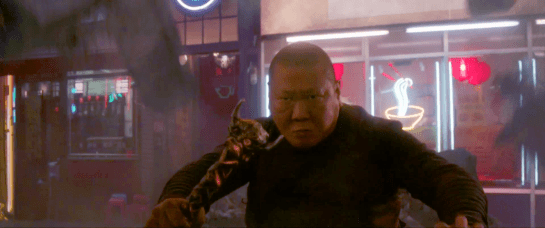
…(this last one, while not named specifically in the movie, is named in supporting materials). There are definitely other relics that the sorcerers arm themselves with. For example, in the Hong Kong scene Wong wields the Wand of Watoomb but it is not mentioned by name and he never uses it. Since we don’t see these relics in use we won’t review them.

WandofWatoon.png

Choosing an Owner

The implications of what Mordo tells Strange is profound because it means magical relics possess some kind of intelligence. That’s a weighty word, so In order to back this up, we need a common definition in place. Let’s ask Merriam-Webster.

Intelligence

a (1) :  the ability to learn or understand or to deal with new or trying situations :  reason; also :  the skilled use of reason (2) :  the ability to apply knowledge to manipulate one’s environment or to think abstractly as measured by objective criteria (as tests)

That gives us the foundation that we need. In order to choose their owner, these relics require a theory of mind, an ability to detect and perceive the individuals they meet, and they must possess a reasoning mechanism to decide that an individual is worthy or useful to them. That seems to satisfy both senses of that definition. For our purposes we’re going to think of this in terms of an artificial intelligence and review these relics as if they were a form of advanced technology. Thanks, Mr. Clarke.

We should take care, though. There are some narrative trappings for magic that can trip us up. Magic, for instance, doesn’t typically run out in these relics, but if they were technological, we would have to deal with issues of power, batteries or recharging. So for all their instructive power, we would have to deal with even greater complexity if they were real technology.

The AIs/Intelligences appear to vary in capabilities from narrow to general and are focused on their own specific purposes and “hardware.” In use, they primarily respond to the intentions and actions of the user. None of the objects seem to be able to speak directly, although the Cloak provides rudimentary directional guidance and responds to speech and emotions, so the connection varies from communication via touch to some form of remote telepathy.

Cloak-of-Levitation-01.png

Distance constraints

The initial awareness and selection by an relic for a sorcerer seems limited in range to a few meters. It’s almost like they need to meet their humans socially to determine if they are a match. But once  an relic chooses a sorcerer, their interactions can occur more remotely. The Cloak, as we’ll see in that write-up, flies to save Strange from a fall and it fights for him in the Sanctum while he seeks medical attention across town at the hospital.

What’s the platform?

One question the diligent backworlder might seek to answer is how all of these unique relics—created as they were across different millennia, and realities and by different sources/sorcerers/beings—wound up with similar intelligence and imprinting features. The movie itself doesn’t provide an answer, so we’ll leave it to speculation, but it does imply some sort of shared provenance/source material/code base/relic-maker convention.

Ok. So we’re set with some understanding of how these things work and what they have in common. Next let’s dig into the big billowy one that should have gotten supporting actor credit in the film.