The Fritzes are annual awards recognizing excellence in the design of speculative interfaces in feature-length science fiction films. Every year, scifiinterfaces.com surveys the year’s sci-fi output, analyzes the interactive technology on screen, and names the films that did it best.
At one time I had plans to offer a physical award (and even had a design, see below) and a potential sponsor, i.e. Intel, but when that didn’t come through, I dropped that notion. The awards are virtual until I get an actual sponsor, or I become independently wealthy, or both.

The award is not about which film was the most entertaining, or which had the shiniest CGI. Sometimes I award a movie whose plot or themes I dislike. Sometimes I pan the interfaces in deeply beloved films. It focuses specifically on interfaces as a craft—how well the screens, controls, augmented reality, and speculative technologies in a film serve their users, support the story, and advance the art of showing us futures worth thinking about.
Why they exist
Sci-fi cinema has always been one of the most fertile grounds for imagining what human–computer interaction could become. What the role of technology in human lives might be and its effects; awesome or terrifying. The gestures in Minority Report, the superintelligence in Colossus: The Forbin Project, the HUD in Iron Man—these images shape what designers, engineers, and the public believe is possible. They influence real products. They set expectations.
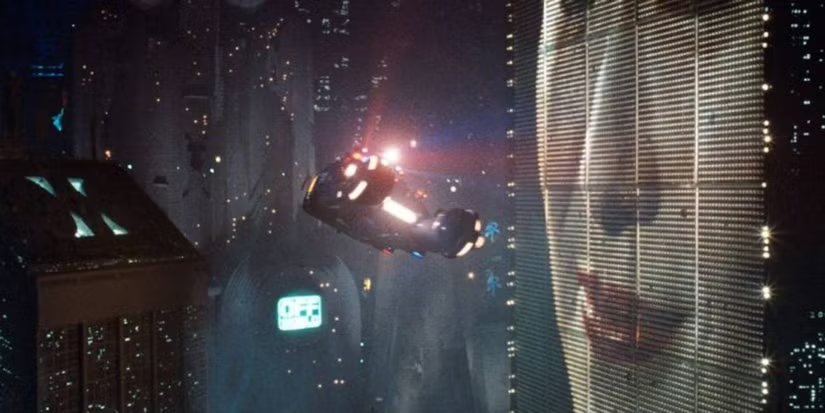
And yet no major awards body gives this craft a moment of recognition. The Academy, the BAFTAs, the Saturns; none of them have a category for interface design. The work is invisible to the ceremonies, folded into visual effects at best, ignored entirely at worst.
The Fritzes exist to correct that. They are a focused, opinionated, one-person effort to notice, name, and celebrate the designers who do this work well. And, by way of contrast, to mark where the field still has room to grow.
Where the name is from
The Fritzes award is named for Fritz Lang, since he was was the first filmmaker to put realistic interfaces in a sci-fi film, specifically his 1927 film Metropolis. (It was the first film I officially reviewed on the blog, because respect the OG.) Lang was grappling with the larger role of technology in society, and his interfaces are wonderfully evocative and illustrative. Naming the awards after him honors his pioneering spirit and craft. Plus there’s a fun irony of “being on the fritz” being slang for broken technology.

How they’re enumerated
This is a tricky one, and my apologies for it. I consider the movies across individual calendar years, so begin formal analysis at the beginning of the following year. But like the Oscars, I don’t want people thinking coming to those pages thinking they’re looking at last years’ award, so it’s named for the current year. Therefore, the 2014 Fritzes are for interfaces in films from 2013, and so on.
Award categories
Three main awards are given annually.
Best Believable
These movies’ interfaces adhere to solid CHI principles and believable interactions. They engage us in the story world by being convincing.
Best Narrative
These movies’ interfaces blow us away with evocative visuals and the richness of their future vision. They engross us in the story world by being spectacular.
Best Interfaces
The movies nominated for Best Interfaces manage the extraordinary challenge of being believable and helping to paint a picture of the world of the story. They advance the state of the art in telling stories with speculative technology. This is the “top” award.
Idiosyncratic awards
Each year I also look at the collection of examples and see if any interface, film, or trend warrants a special call-out or award. There is no predicting these. I might not grant the same award ever again, or I might adopt it as a category for a few years. It’s just…what’s interesting and awesome and timely. I’ve given awards and shout-outs to low-fi interfaces,
Write ups, images, supercuts, and clips
In the beginning I took pains to announce candidates for awards in their own posts, and then announce the winners in their own posts. That wound up being a lot of work for not a lot of payout. A few years I did them all in one post. That felt too small. Nowadays I try to do a number of posts for the winners.
I always do screen caps showing some of the interfaces in question. In the past I’ve done supercuts and illustrative clips or included trailers for the films. But YouTube being YouTube and IP lawyers being IP lawyers, I’ve gotten take-down notices and had to remove those videos. That was a lot of work lost. I might try it again someday, but it’s safest to stick to images. At least until I have a lawyer dedicated to fighting the takedowns and arguing that this is all Fair Use.
How I judge
At the very beginning I tried to mimic the process of The Academy of Motion Picture Arts and Sciences: I contacted people in the profession, got them to watch the movies, and nagged them for votes. But those folks are very busy and it was like herding flerkens. So rather than put myself through that, I decided to just do it myself. I watch films throughout the year and keep notes. At the end of the year I review the whole set again, and compare each against the other until I understand the merits and misses of each. Then I publish when life gives me the time. (This is all, as it always has been, in my spare time.) Generally speaking, I do around the time of the Oscars, but rarely simultaneously.
Philosophically I adhere to New Criticism principles described at length here. Otherwise the only formal criterion I feel I need to share is that in order to evaluate an interface, it needs to be shown being used. That unfortunately leaves a lot of awesome-looking things out of the running, but sometimes I do shouts-out to them anyway. It’s my thing. I can do what I want.
Past awards
You can see all posts via the The Fritzes tag. Links to the winner recaps by year are listed below. If you see one missing, let me know. This list isn’t automated, and I suspect as the years roll on I’ll sometimes forget.
Happy Fritzing. And remember, stop watching sci-fi. Start using it.