Sci-fi Spacesuits: Biological needs

Spacesuits must support the biological functioning of the astronaut. There are probably damned fine psychological reasons to not show astronauts their own biometric data while on stressful extravehicular missions, but there is the issue of comfort. Even if temperature, pressure, humidity, and oxygen levels are kept within safe ranges by automatic features of the suit, there is still a need for comfort and control inside of that range. If the suit is to be warn a long time, there must be some accommodation for food, water, urination, and defecation. Additionally, the medical and psychological status of the wearer should be monitored to warn of stress states and emergencies.

Unfortunately, the survey doesn’t reveal any interfaces being used to control temperature, pressure, or oxygen levels. There are some for low oxygen level warnings and testing conditions outside the suit, but these are more outputs than interfaces where interactions take place.

There are also no nods to toilet necessities, though in fairness Hollywood eschews this topic a lot.

The one example of sustenance seen in the survey appears in Sunshine, we see Captain Kaneda take a sip from his drinking tube while performing a dangerous repair of the solar shields. This is the only food or drink seen in the survey, and it is a simple mechanical interface, held in place by material strength in such a way that he needs only to tilt his head to take a drink.

Similarly, in Sunshine, when Capa and Kaneda perform EVA to repair broken solar shields, Cassie tells Capa to relax because he is using up too much oxygen. We see a brief view of her bank of screens that include his biometrics.

Remote monitoring of people in spacesuits is common enough to be a trope, but has been discussed already in the Medical chapter in Make It So, for more on biometrics in sci-fi.

Crowe’s medical monitor in Aliens (1986).

There are some non-interface biological signals for observers. In the movie Alien, as the landing party investigates the xenomorph eggs, we can see that the suit outgases something like steam—slower than exhalations, but regular. Though not presented as such, the suit certainly confirms for any onlooker that the wearer is breathing and the suit functioning.

Given that sci-fi technology glows, it is no surprise to see that lots and lots of spacesuits have glowing bits on the exterior. Though nothing yet in the survey tells us what these lights might be for, it stands to reason that one purpose might be as a simple and immediate line-of-sight status indicator. When things are glowing steadily, it means the life support functions are working smoothly. A blinking red alert on the surface of a spacesuit could draw attention to the individual with the problem, and make finding them easier.

Emergency deployment

One nifty thing that sci-fi can do (but we can’t yet in the real world) is deploy biology-protecting tech at the touch of a button. We see this in the Marvel Cinematic Universe with Starlord’s helmet.

If such tech was available, you’d imagine that it would have some smart sensors to know when it must automatically deploy (sudden loss of oxygen or dangerous impurities in the air), but we don’t see it. But given this speculative tech, one can imagine it working for a whole spacesuit and not just a helmet. It might speed up scenes like this.

What do we see in the real world?

Are there real-world controls that sci-fi is missing? Let’s turn to NASA’s space suits to compare.

The Primary Life-Support System (PLSS) is the complex spacesuit subsystem that provides the life support to the astronaut, and biomedical telemetry back to control. Its main components are the closed-loop oxygen-ventilation system for cycling and recycling oxygen, the moisture (sweat and breath) removal system, and the feedwater system for cooling.

The only “biology” controls that the spacewalker has for these systems are a few on the Display and Control Module (DCM) on the front of the suit. They are the cooling control valve, the oxygen actuator slider, and the fan switch. Only the first is explicitly to control comfort. Other systems, such as pressure, are designed to maintain ideal conditions automatically. Other controls are used for contingency systems for when the automatic systems fail.

Hey, isn’t the text on this thing backwards? Yes, because astronauts can’t look down from inside their helmets, and must view these controls via a wrist mirror. More on this later.

The suit is insulated thoroughly enough that the astronaut’s own body heats the interior, even in complete shade. Because the astronaut’s body constantly adds heat, the suit must be cooled. To do this, the suit cycles water through a Liquid Cooling and Ventilation Garment, which has a fine network of tubes held closely to the astronaut’s skin. Water flows through these tubes and past a sublimator that cools the water with exposure to space. The astronaut can increase or decrease the speed of this flow and thereby the amount to which his body is cooled, by the cooling control valve, a recessed radial valve with fixed positions between 0 (the hottest) and 10 (the coolest), located on the front of the Display Control Module.

The spacewalker does not have EVA access to her biometric data. Sensors measure oxygen consumption and electrocardiograph data and broadcast it to the Mission Control surgeon, who monitors it on her behalf. So whatever the reason is, if it’s good enough for NASA, it’s good enough for the movies.


Back to sci-fi

So, we do see temperature and pressure controls on suits in the real world, which underscores their absence in sci-fi. But, if there hasn’t been any narrative or plot reason for such things to appear in a story, we should not expect them.

The Fermi Paradox and Sci-fi

In the prior post we introduced the Fermi paradox—or Fermi question—before an overview of the many hypotheses that try to answer the question, and ended noting that we must consider what we are to do, given the possibilities. In this post I’m going to share which of those hypotheses that screen-based sci-fi has chosen to tell stories about.

First we should note that screen sci-fi (this is, recall, a blog that concerns itself with sci-fi in movies and television), since the very, very beginning, has embraced questionably imperialist thrills. In Le Voyage dans la Lune, George Melies’ professor-astronomers encounter a “primitive” alien culture on Earth’s moon when they land there, replete with costumes, dances, and violent responses to accidental manslaughter. Hey, we get it, aliens are part of why audiences and writers are in it: As a thin metaphor for speculative human cultures that bring our own into relief. So, many properties are unconcerned with the *yawn* boring question of the Fermi paradox, instead imagining a diegesis with a whole smörgåsbord of alien civilizations that are explicitly engaged with humans, at times killing, trading, or kissing us, depending on which story you ask.

image.png

But some screen sci-fi does occasionally concern itself with the Fermi question.

Which are we telling stories about?

Screen sci-fi is a vast library, and more is being produced all the time, so it’s hard to give an exact breakdown, but if Drake can do it for Fermi’s question, we can at least ballpark it, too. To do this, I took a look at every sci-fi in the survey that produced Make It So and has been extended here on scifiinterfaces.com, and I tallied the breakdown between aliens, no aliens, and silent aliens. Here’s the Google Sheet with the data. And here’s what we see.

image

No aliens is the clear majority of stories! This is kind of surprising for me, since when I think of sci-fi my brain pops bug eyes and tentacles alongside blasters and spaceships. But it also makes sense because a lot of sci-fi is near future or focused on the human condition.

Some notes about these numbers.

I counted all the episodes or movies that exist in a single diegesis as one. So the two single largest properties in the sci-fi universe, Star Trek and Star Wars, only count once each. That seems unfair, since we’ve spent lots more total minutes of our lives with C3PO and the Enterprise crews than we have with Barbarella. This results in low-seeming numbers. There’s only 53 diegeses at the time of this writing even though it spans thousands of hours of shows. But all that said, this is ballpark problem, meant to tally rationales across diegeses, so we’ll deal with numbers that skew differently than our instincts would suggest. Someone else with a bigger budget of time or money can try and get exhaustive with the number, attempt to normalize for total minutes of media produced, and again for number of alien species referenced at their leisure, and then again for how popular the particular show was. Those numbers may be different.

image.png

Additionally the categorizations can be ambiguous. Should Star Trek go in “Silent Aliens” because of the Prime Directive, or under “Aliens” since the show has lots and lots and lots of aliens? Since the Fermi question seeks to answer why Silent Aliens are silent in our real world now, I opted for Silent Aliens, but that’s an arguable choice. Should The Martian count as “Life is Rare” since it’s competence porn that underscores how fragile life is? Should Deep Impact show that life is rare even though they never talk about aliens? It’s questionable to categorize something on a strong implication, but I did it where I felt the connection was strong. Additionally I may have ranked something as “no reason” because I missed an explanatory line of dialog somewhere. Please let me know if I missed something major or got something wrong in the comments.

All that said, let’s look back and see how those broad numbers break down when we look at individual Fermi hypotheses. First, we should omit shows with aliens. They categorically exclude themselves. Aliens is an obvious example. Also, let’s exclude shows that are utterly unconcerened with the question of aliens, e.g. Logan’s Run, (or those that never bother to provide an explanation as to why aliens may have been silent for so long, e.g. The Fifth Element.) We also have to dismiss the other show in the survey that shows a long-dead species but does not investigate why, Total Recall (1990). Aaaaand holy cow, that takes us down to only 8 shows that give some explanation for the historical absence or silence of aliens. Since that number is so low, I’ll list the shows explicitly to the right of their numbers. I’ll leave the numbers as percentages for consistency when I get to increase the data set.

No Aliens

8% Life is rare: Battlestar Galactica (2004)
25% Life doesn’t last (Natural disasters): Deep Impact, The CoreArmaggedon
8% Life doesn’t last (Technology will destroy us): Forbidden Planet

Silent Aliens

8% Superpredators: Oblivion
0% Information is dangerous
33% Prime directive: The Day the Earth Stood Still, 2001: A Space Odyssey, Mission to Mars, Star Trek
0% Isolationism
0% Zoo
0% Planetarium
0% Lighthouse hello
0% Still ringing
8% Hicksville: The Hitchhiker’s Guide to the Galaxy
0% Too distributed
0% Tech mismatch
0% Inconceivability
0% Too expensive
8% Cloaked: Men in Black

(*2% lost to rounding)

It’s at this point that some readers are sharpening their keyboards to inform me of the shows I’ve missed, and that’s great. I would rather have had the data before, but I’m just a guy and nothing motivates geeks like an incorrect pop culture data set. We can run these numbers again when more come in and see what changes.

image.png

In the meantime, the first thing we note is that of those that concern themselves with the question of Silent Aliens, most use some version of the prime directive.

Respectively, they say we have to do A Thing before they’ll contact us.

  • Mature ethically
  • Mature technologically by finding the big obelisk on the moon (and then the matching one around Jupiter)
  • Mature technologically by mastering faster-than-light travel
  • Find the explanatory kiosk/transportation station on Mars

It’s easy to understand why Prime Directives would be attractive as narrative rationales. It explains why things are so silent now, and puts the onus on us as a species to achieve The Thing, to do good, to improve. They are inspirational and encourage us to commit to space travel.

The second thing to note, is that those that concern themselves with the notion that Life Doesn’t Last err toward disaster porn, which is attractive because such films are tried and true formulas. The dog gets saved along with the planet, that one person died, there’s a ticker tape parade after they land, and the love interests reconcile. Some are ridiculous. Some are competent. None stand out to me as particularly memorable or life changing. I can’t think of one that illustrates how it is inevitable.

So prime directives and disaster porn are the main answers we see in sci-fi. Are those the right ones? I’ll discuss that in the next post. Stay Tuned.

Fifth Element tees

overview

Major thanks to everyone who came out and joined me for the first ever scifiinterfaces.com movie night at The New Parkway in Oakland! It was a sold-out show, and while there were a few glitches, folks are telling me they had a great time and are looking forward to the next one. There will be a more detailed report once the pre-show video comes out. But in the meantime, this: If you didn’t win the trivia contest or weren’t able to attend, you can still get your hands on the “movie night” t-shirts I debuted there.

Allshirts

Head on over to the spreadshirt shop. It’s ugly (with the default CSS). It doesn’t have a custom URL or anything. It only has 5 products at the moment. But hey, that’s all part of the charm if you’d like to wear your sci-fi interface nerdiness with pride.

http://26253.spreadshirt.com/

P.S. I have no idea why the women’s KEEP CLEAR tee is not appearing in orange since I designed it like the Men’s tee, but I have a request with Spreadshirt now. Hopefully it’ll be fixed soon.

Berlin?

I’m thinking the Bay Area has an appetite for maybe two movie nights a year (let me know if I’m wrong) but I’d also love to try this in Berlin. Do you (or someone you know) know of a cinema in Berlin like the New Parkway that might be interested in my replicating this there?

Report Card: The Fifth Element

Report-Card-5E

In full disclosure, The Fifth Element may be one of my favorite sci-fi films of all time. So I had to be extra vigilant about the reviews so as not to come off as a fanboy. Even with all that due diligence, Besson’s movie fared really well on a close examination of its interfaces.

Sci: A- (4 of 4)
How believable are the interfaces?

I’m giving the Ultimate Weapon a giant pass, since it’s the MacGuffin and more mystical than scientific. Other than that, there’s only three bits that really made me roll my eyes.

  1. The sleep regulator
  2. The nucleolab
  3. The Eeepholes.

That’s so few—out of dozens and dozens of interfaces—that it makes for a very believable technological universe in which the story can play out.

Fi: A (4 of 4)

How well do the interfaces inform the narrative of the story?

The technology brilliantly brings this world to life. Korben’s taxi and apartment interfaces (the cigarette dispenser, the nanny state slideaway bed, the pneumatic mail by which he’s fired) help us understand the dire circumstances in which he begins the story. The police interfaces (lockdown tools, compliance circles, on-car displays) tell of a police state that has gone off the deep end. Zorg’s little vacuum robots, weapons, and bombs, tell of a corporatist who’s lost his soul.

Interfaces: A (4 of 4)
How well do the interfaces equip the characters to achieve their goals?

Again, brilliantly. There are some missteps: The roach cam might have triggered less of a disgust reaction. Rhod’s rod might have been a little more performative. The police lights kind of work against their intentions. Whoever designed those evacuation beacons needs to be jailed for gross negligence. And the 5E-opedia could have been actually encyclopedic rather than random.

But there’s so much awesomeness to balance it out. The makeup tech fits fashionistas. The military communications fits soliders. The second bomb fits Mangalores. And of course the Ultimate Weapon fits multiple races across eons with its brilliant affordances and constraints.

For the sheer number of interfaces and the thought given to the aesthetic and interaction details, I’m proud that The Fifth Element has scored top marks, and just squeaked past another favorite, The Cabin in the Woods, for the top spot on the site so far. Here’s hoping more movies and television shows bring to life such a well-designed, personal vision of speculative technology, and grand adventures taking place amongst it.

Final Grade A (12 of 12), BLOCKBUSTER

Related lessons from the book

  • Lots of these interfaces could use a dose of lower case (Otherwise, AVOID ALL CAPS, page 34) but help confirm that Sans-Serif is the Typeface of the Future (page 37).
  • Korben’s alarm clock Uses Sound for Urgent Attention (page 208).
  • Korben’s taxi might have avoided pissing him off, Zorg’s desk might have saved its owner from a cherry, and Ruby’s staff might have allowed him to perform his playbacks had each Handled Emotional Inputs (page 214)
  • The multipass should have Required multifactor authentication (page 118)
  • The 5E-opedia could have Added Meaning to Information Through Organization (page 239) rather than use an alphabetical list.

New lessons

  • The military headsets remind us to Signal Dual-Presence, and additionally to Avoid Pushing into Wearables.
  • Korben’s alarm clock reminds us that Pain is an (Anti-)Affordance.
  • The Modoshawan flight controls want us to Map the Inputs to the Outputs.
  • The Mondoshawan un-disguising taught us to Use the Available Body Part in designing gestures.
  • The yellow circle compliance technique implies that we should Make Crisis Instructions Simple, Simple, Simple.
  • The terrible police chest lights should get agentive and Adjust Like a Good Valet.
  • The Ultimate Weapon reminds us to Keep Objects Orientationless if at all possible.

IMDB: https://www.imdb.com/title/tt0119116/Currently streaming on:

The Ultimate Weapon

TheFifthElement-UWeapon-002

The most interesting interface in the film belongs to the Ultimate Weapon, because it raises such unusual challenges to interface design.

The Design Challenge

According to the movie, the Ultimate Evil arrives every 5000 years, and this is the only time the weapon needs to be fired. (Its prior firing would be around 2737 B.C.E., and if it was on Earth before then, in prehistory.) Its designers must ensure that it will be usable to users separated by around 250 (human) generations. Given such an expanse of time, how can a designer ensure that any necessary inputs will be available between potential uses? What materials will survive that long to ensure structural and functional viability? What written instructions can survive the vast changes in language and cultural contexts? How can you ensure that spoken instructions or principles will be passed down accurately from generation to generation? Presuming some lossy transmission, what clues can you give in the interface itself as to the intended use?

Mondoshawan physiology

Fortunately, the Mondoshawan physiology is not a substantial problem. In their suits they are still similarly-sized, bilateral, upright bipeds with a head where sensory organs are clustered at the top, and, emerging from the tops of their torsos, prehensile arms at the end of which are manipulator digits. This solves a great deal of what could be difficult interspecies issues. Imagine, for contrast, trying to design an interface usable by intelligent versions of both butterflies and cephalopods. Not easy. But an interface for two humanoid species: Much less difficult.

How to ensure the interface material lasts?

Certainly, the system must maintain some physical integrity over time. Passing over the creative license of “advanced alien technologies,” we see that the material for the weapon is quite-long lasting, i.e. stone and in the case of the key, metal. Additionally, the weapon is kept in a temple in the desert, a non-volatile environment suited to preserving such materials.

TheFifthElement-temple

There are materials for the stones that could last longer and be more resistant to damage, like metal or industrial ceramics, but we do not know anything about the provenance of the weapon, and whether such materials were available.

How to hide the weapon from malefactors?

In the words of Cornelius, an evil person could stand on the platform and activate the weapon to “turn light to dark.” No one wants that to happen. The Mondoshawans hide the weapon in the Egyptian temple, and take pains to carefully conceal the presence of the door to the weapon room and its keyhole. Ordinarily Mondoshawans keep the key to the door of the room which houses the weapon to themselves offworld, but when they take the stones for protection, they leave the key with a member of a sect that worships the weapon, ensuring that the key is passed down through the generations along with the weapon’s instructions.

How to ensure the instructions persist?

Even with durable materials, if the use of the weapon isn’’t so completely intuitive as to be automatic, the instructions on how to activate it must endure transmission through time, across the lives of generations of people (and Mondoshawans). In this case, the instruction set is fairly simple; one must have access to “the” five elements for the weapon to work. Four are the familiar classical alchemical elements of earth, air, fire, and water. These are represented in the movie by four patterns of lines. The lines have subtle variations that reflect physical properties of that element. Earth was flat horizontal lines. Water was wavy horizontal lines at the base. Air was wavy horizontal lines at the top. Fire was vertical wavy lines.

The simplicity, replicability, and memetic nature of this part of the instruction set is demonstrated as we see the symbol repeated in a number of places: on the walls of the pyramid, on the sides of the stones, on the pedestals to which each stone fits, on Cornelius’’ belt buckle, and as a mark on Leeloo’’s skin. Had these symbols been more complex in nature, there would have been more risk that they would have shifted and evolved, like language does, beyond recognition and therefore use as a clue to the weapon’s function.

The instructions are also kept alive through the ages via myth and religious fervor. The characters Cornelius and David belong to a sect devoted to the Ultimate Weapon. This is clever cultural design. Humans have historically demonstrated a desire to worship, and the Mondoshawans have taken advantage of this, providing the Ultimate Weapon a group of people wholly dedicated to its preservation regardless of whether or not their generation is the one to see it fire. The rites, rituals, and artifacts of this religion that act as a backup for the instructions on firing the Ultimate Weapon, as we see when Cornelius tries to explain it all to the President.

The transmission media of memes and religious fervor are not—as we see in the film—perfect. Language and culture are lossy media. But they do get the characters close enough so that they can figure out the rest on their own.

How to make sure it can be figured out?

The weapon is initialized by placing the sacred stones on the proper pedestals. But which stones go on which pedestal? Fortunately, anyone with a visual or tactile sense can match the right stone to the right pedestal by matching the pattern. Furthermore, since the stones and their fitting are almost triangular, it is easy to tell how they should be seated. See the pilot of Sci-Fi University for more about these affordances and constraints.

SciFiU-5E-title

The main challenge within this part of the bigger challenge is the spans of time involved. Given 5,000 years between firings, entire cultures, countries, technologies, and languages come and go in that time. How many people alive now are fluent in languages from 5 millennia past? You have to use mechanisms that don’t depend on culture, technology, or language. Physical affordances and constraints are a fine tool for these reasons.

How to let users know they’re on the right track?

When a little bit of the required element is provided to the placed stones, there is immediate feedback as small rectangles open just a bit near the tops. It is this partway state that indicates to the protagonists that, even though they haven’t completely supplied enough material, they are on the right track. This clue gives them enough of a signal that they continue trying to deduce control of the interface.

TheFifthElement-progress-01

What activation materials to use?

The stones require some small amount of each element to be supplied to their topmost surface to become active. For three of the four (earth, air, water), these elements are in abundance here on Earth.

To consider the fourth, fire, takes us to strategic questions about the design.

Why this design?

It’s possible that the design of the weapon is constrained by some unknown cosmogenic power source in the stones. <handwaving>It’s mystical physics that requires that there be 4 stones and 4 pillars and smooches in the center.</handwaving> But it is of course of more use to us to imagine that it wasn’t, but some deliberate design. Which leads me to ask why wasn’t it a single big button? Well, I can see five effects this particular design has.

1. It allows you to disable the weapon

A major part of the plot involves the fact that the stones—keys to operating the machine—have been removed from Earth to keep them safe. This proves to be a major complication and a minor mystery to the protagonists, but is in fact one of main features of the weapon. Much of it is architectural and would be very difficult to move. By adding activation keys, the Mondoshawans ensured that they could disable it if necessary.

2. It tests for environmental stewardship

If three of the activation elements were not available: earth, air, and water, it would raise serious issues about the human caretakers of the planet. Do they stand on a scorched earth? Is their air ruined? Have they let the water of Earth, like what happened on Mars, evaporate into space? Any of these scenarios raise serious doubts about whether life on the planet is worth saving. Or is there to save.

3. It tests for cultural stewardship

Unlike the other elements, fire isn’t as abundant. In pre-cultural Earth, it was an accident of geothermal activity and lightning. To be able to control it to a level that it can be applied to the stone speaks of a fundamental level of cultural and technological advancement. If humans have not kept stewardship of their culture well enough to be able to control fire, it again raises the question of whether they are worth saving.

The key to the weapon room similarly tests for cultural stewardship. It looks like a fragile thing, made of thin perforated metal. Having a reverant group treat it as a holy artifact ensures that it will not get crushed or rusted, and in the process lose access to the room that contains the weapon.

4. It tests for basic intelligence

The affordances and constraints that help the characters position the stones correctly require a level of basic, intelligence as individuals. Can they do pattern matching? Do they understand simple physics? This isn’t the strongest of tests, but I’m pretty had humans devolved to primates by this point or distracted by constant war, they’d have been screwed.

5. It tests for a capacity for love

The “fifth element” (ignoring wu xing and similar actual 5-element philosophies) in this case is love. In the film Korben must overcome his reticence to confess his love for Leeloo. When he does, she realizes that humanity—including its capacity for war—are worth saving, and the weapon fires. Love is a big word of course, so it’s not clear whether familial, friendly, platonic, or even purely sexual love would suffice, but perhaps it doesn’t matter. The designers wanted to make sure that humanity still has some capacity for feeling intense care toward another. If not, why bother saving them?

It’s made a bit dubious because it’s specifically for the love of an “ultimate warrior,” a “perfect being.” Leeloo looks very much like a very fit, pretty example of one of a human, who has shown very human capacities for joy, pain, fear, delight, &c. It’s not that hard of a test for Korben to love her, except, to overcome his own sense of awkwardness and humility and openness to rejection (in front of a small crowd, no less.) If she had looked like a Mangalore it would have been a more difficult—and more telling—test of the capacity for altruistic love, but perhaps that’s not the point.

These five effects seem like pretty good reasons to design the interface to this weapon in this particular way. In total, they test to make sure there’s a humanity there worth saving. And fortunately for humanity in 2263, Korben (and the culture that produced him) prove just enough of a match.

TheFifthElement-UWeapon-008

As if that wasn’t enough, bear with me for just two more bits of nerdery about the weapon. These are a bit extraneous to the interface, but derived from study of the interface, and so may be of note to readers.

1. We can’t ignore the fact that the Ultimate Evil plummets toward the Earth in a straight line. A straight line, that is, that puts it directly in the path of the ultimate weapon, which fires a perfectly straight line. And recall that the weapon is on a planet that’s orbiting around a star, and precessing its rotational axis. This is too slim a chance to be coincidence. It stands to reason that this is not, as Cornelius says, a sentient evil bent on ending “all life” (which would just veer a few degrees out of the way to safety), but part of the same system as the weapon, designed to identify and tempt the worst of people, i.e. Zorg, and try and thwart these aspects of humanity that are ultimately tested. If that’s the case, and the Mondoshawans installed the weapon, did they, by extension, install the Ultimate Evil as well? Is this some sort of “invisible fence” meant to keep humanity in check, and destroy it if it ever evolves for the worse?

2. Many of these same issues have been addressed in the real world by the designers of containers of radioactive waste (the danger of which persists between 10,000 and 1,000,000 years) and, more positively, the the Long Now Foundation working on its main project, the Millennium Clock. For those unfamiliar with this project, it is a prospective, large-scale clock that once built, will chime every thousand years. The clock mechanism and function is intended to last for 10,000 years. The Long Now foundation is faced with similar long-term design challenges and have come to some similar conclusions as the designers for the film. The clock will be made of Bronze Age materials and technology, and it will be situated in the desert. The clock will largely be self-maintaining, but the Foundation is also developing a Rosetta Wheel containing many, many examples of existing human language, useful for decoding written instructions. The idea itself has many elements that ensure its persistence as a meme, being simple, distinct, and a powerful embodiment of an important message about the value of long-term thinking. The Long Now Foundation was begun in 01996, the year prior to the release of The Fifth Element. I am a huge fan of the Foundation and its initiatives, and I encourage readers to read further to learn more.

Sci-fi University Pilot

How do you ensure that a complicated weapon can be fired by people hundreds or even thousands of years in the future?

Sci-fi University critically examines interfaces in sci-fi that illustrate core design concepts. In this six-minute pilot episode, Christopher discusses how the Ultimate Weapon Against Evil brilliantly and subtly embodies the design concepts of affordances and constraints.

This is a pilot, to see if folks like the format. So please leave your thoughts in the comments, and if enough folks dig it—and if I run across other interfaces that bear such explication—I’ll do more sometime in the future. If you’d like to view it at a larger size, check it out on YouTube. Happy viewing!

Mangalore Bomb

TheFifthElement-MangaloreBomb-005

Sadly for Zorg, just after he deactivates his bomb, a fallen Mangalore warrior remotely activates his own bomb in Plavalaguna’s suite. The remote control is made from a combination lock. The Mangalore twists the dial to the right numbers, and on reaching the last number, a red LED lights in the center. In the diva’s suite, the box that secretly housed the bomb opens, and the bomb rises like a small metallic ziggurat, accentuated in places with red LEDs. A red, 7-segment countdown timer begins ticking down its final 5 seconds.

Aggression

Mangalores are warlike, as in they really like war. They breathe war. They sleep war. They eat war for breakfast, then poop war, then root around in their couches for war scraps and snack on that. The detonation device isn’t very sophisticated, and that’s just fine by Mangalores. If a Mangalore declared a Design major instead of War in college, they’d have been killed on the spot. This device is perfect for a species that just wants to grab something cheap and convenient, make a few modifications, and get to the boom.

We don’t see a deactivation mechanism. And while you can imagine that a nice safety would be to deactivate if the dial drifted more than, say, 5 clicks from the final activation number, Mangalores wouldn’t have it. They’d “liberate” your mother’s homeland merely for having suggesting it.

If I had to improve it in any way, it’s that it places a burden on memory, and there’s not a lot of indication that Mangalores excel in the thinking skills department, c.f. warlike. Do they have the capacity to memorize a series of numbers in order? And it is easy to recall the series in the middle of a war zone? If not, what would be better? They have their weapons with them nearly at all times, so how about a little glowing, red button on the forestock?

Ha. Joke’s on you, Mangalores. As we know from earlier in the movie, you couldn’t resist pressing it, long before you made it to ocean liners. I think if you’re that warlike and stupid, this would be best for everyone.

TheFifthElement-MangaloreBomb-007

Fhloston evacuation

TheFifthElement-FhlostonEvacuation-001

When Fhloston Paradise’s bomb alarms finally go off (a full 15:06 after Zorg’s bomb actually starts. WTH, Fhloston?) four shipwide systems help evacuate the ship.

First, a klaxon is heard on a public address system across the ship. A recorded female voice calmly announces that…

This is a type A alert. For security reasons the hotel must be evacuated. Please proceed calmly to the lifeboats located in the main hallways.

This voice continues to speak a warning countdown, repeating the remaining time every minute, and then when there’s less than a minute at 15 second intervals, and each of the last 10 seconds.

Second, in the main hallway, small, rows of red beacon lights emerge out of the floor and begin flashing and blinking. They repeatedly flash in order to point the direction of the lifeboats.

TheFifthElement-FhlostonEvacuation-003

Third, in the main hallway large arrows on the floor and “LIFEBOAT” lettering illuminate green to point travelers towards ingress points for individual lifeboats.

TheFifthElement-FhlostonEvacuation-007 TheFifthElement-FhlostonEvacuation-009

Fourth, the lifeboats themselves eject from the ship to get the passengers far from danger.

TheFifthElement-FhlostonEvacuation-010

Awesome

  • The voice warning is a trope, but a trope for a reason. For visually impaired guests and people whose attention is focused on, you know, escape, the audio will still help them keep tabs on the time they have left.
  • The racing lights provide a nice directionality (a similar interface would have helped Prometheus).
  • The arrows and beacons require no language skills to comprehend.

Awful

  • The voice warning and the “LIFEBOAT” signs do require language to comprehend. They couldn’t have used Running Man?
  • You know when’s a crappy time to add trip hazards to the floor? When a herd of panicked humans are going to be running over it. Seriously. There is no excuse for this.
  • The beacons and the arrows should be the same color. Green is the ISO standard for exit, so while we’re moving the beacon lights to the ceiling where they belong, we can swap them out for some #33cc00 beacons.
  • The green arrows at first seem badly placed as it’s difficult to see when there’s a crowd of people, but then you realize that when the room is empty, people will see and follow them. People in a crowd will just follow whatever direction the horde is currently going, and seeing the arrows is unnecessary. But in a light crowd, people will get a glimpse of the arrow and become stressed out over an occluded, potentially life-saving signal or worse, get trampled to death trying to stop and read it to make sure everyone is going the right way, so ultimately awful. Put that up on the ceiling or high on the walls, too. Because people genuinely panic.

TheFifthElement-FhlostonEvacuation-006

Zorg bomb

TheFifthElement-ZorgBomb-001

When Zorg believes he has recovered the sacred stones, he affixes a bomb to the door of Plavalaguna’s suite. The bomb is a little larger than a credit card, with a slot at the top for a key card to be dropped in. The front of the bomb houses all the buttons and lights. The bottom and top edges are rounded back.

The interface for the bomb is quite simple. Zorg presses three large, transparent buttons along the top in order from left to right to activate the bomb. These buttons glow bright red during the countdown. Below these buttons, four red LEDs blink in succession counting off quarter seconds. At the bottom of the display a 4-character, 7-segment timer counts down from the time set: 20 minutes. The device audibly ticks off each second as it passes.

timebomb

Activation

An (adhesive? magnetic?) backing lets Zorg simply place the bomb on the wall to affix it there. Zorg presses the three large buttons in order from left to right to activate it and start the countdown.

Activation analysis

The bomber is after simple activation, but also wants very much to avoid accidental activation. Pressing the buttons in order might happen accidentally, for example from a tire or foot rolling across it. Better would be to have the activation code something much less likely to happen accidentally, like 1-3-2 or 2-3-1.

There’s also a question of whether a bomber would put giant glowing lights, reflective yellow tape, or an audible tick on the bomb (LEDs, if you didn’t know, don’t come with a ticking sound built in.) Each of these draws attention to the bomb, giving helpless victims time to evacuate, alert the authorities, or inform any explosive ordnance disposal personnel that happen to be wandering by. Yes, Zorg wants the bomb to explode, but only after a certain time, so he can get away. He should affix the bomb in some hidden place and design it with a less attention-getting display to suit his fiendish goals.

TheFifthElement-ZorgBomb-003

Deactivation

Once Zorg realizes that the box he stole was empty, he returns to the Fhloston Paradise liner to look for the stones. His first task is to deactivate the bomb. To do this he pulls out a keycard, and gingerly holds it above the bomb. His caution and nervousness implies that it has a jostle-sensitive anti-handling sensors, and that if he bumped it, it would go off. Fortunately for him, he manages to slip the card in without jostling the bomb, and sure enough, it stops with five seconds to go.

TheFifthElement-ZorgBomb-006

Deactivation analysis

The keycard is a mostly-smart deactivation strategy. As we can see, Zorg is quite nervous during the deactivation, and in such high-stress times, it’s better to rely on an object than a stressed villain’s memory for something like a password. The card is thin like a credit card and can fit in a wallet, so it’s easy to carry around. There’s a risk that the card could be misplaced, but the importance of the key will ensure that Zorg will keep track of it. There’s a risk it could be ruined and become useless, but we can presume Zorg made it with tough, ruggedized materials.

The problem with the shape is one of orientation. There are four ways a card can be oriented to a slot, and looking at the card, there is no clear indication of the correct one. The copper circuitry printed on both sides is asymmetrical, so it’s at least possible to tell the current orientation. Perhaps this is the “password” that the system requires, and the random stranger picking it up only has a one in four chance of getting it right.
Fortunately for Zorg, he remembers the correct orientation, and is able to stop the bomb.

TheFifthElement-ZorgBomb-007

Or, this bomb, anyway.

Helmsman’s HUD

TheFifthElement-helmsman-001

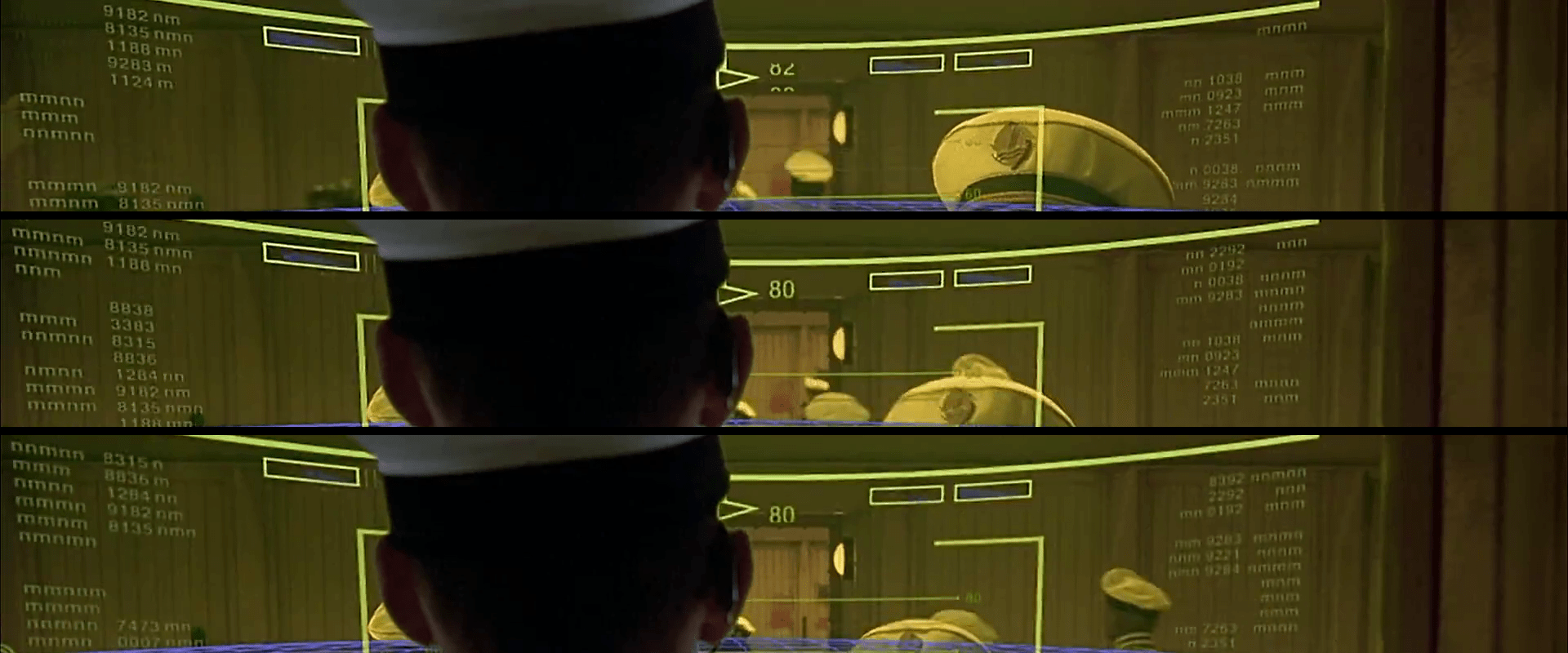
Aboard the Fhloston Paradise luxury liner, we are treated to a quick view of the ship’’s wheel. The helmsman stands before the wheel, in the middle of a ceiling-mounted translucent yellow cylinder that drops just below shoulder level. This surface acts as heads-up display that is visible only from the inside.

TheFifthElement-helmsman-002

The content of the display is a 3-D, featureless, blue graticule with an overlay featuring target brackets, various numeric data strangely labeled with various numbers of ““m””s and “n”s, and a green, faint outline of a railing, as if the helmsman was looking out from a Lawnmower Man interpretation of an Age of Sail wheelbridge. At the top of the display are three yellow-outline rectangles with no content. In the center-top of his view is a compass readout, with a rolling counter display that appears to show bearing.

In practice, the Captain calmly gives an order to a barker, who confirms with a, “Yes, sir” before walking to the edge of the cylinder and shouting the same order, “HELM ONE OH EIGHT!” To confirm that he heard the message, the helmsman repeats the order back and turns the wheel. The helmsman wears a headset that amplifies his spoken confirmation back to everyone on the bridge.

Sometimes a Human is the Best Interface

The Captain doesn’t want to shout or wear a headset. He’s a gentleman. But if the helmsman is going to be trapped in the yellow cone of silence, there must be an intermediary to convey the commands and ensure that they’re carried out. Even if technology could solve it better, I have the sense that navies are places where traditions are carried on for the sake of tradition, so the human aspect of this interaction doesn’t bother me too much. It does add a layer of intermediation where data can go wrong, but the barker and the helmsman each repeat the command loudly, so the Captain can hear and error-check that way.

Long live the HUD

On the plus side, showing the graticule grants a sense of speed and (kind-of) bearing that would be much more difficult to do on the surface on all-water planet like Fhloston Paradise. So that’s nice.

But that information would be even more useful if it was backed up by some other contextual information like the clouds, the position of the sun, or, say, anything else on the surface of the planet toward which they might be barreling. A simple highly-transparent live feed of a camera from somewhere would have been more useful.

helmsman

And of course I can’t let the silly nonsense data on the edges just go. Shipmen love their sea-salted jargon, but they also love effectiveness, and there is no sense to labeling one variable “nm” and the next “nmn,” much less a whole screen of them. They would be difficult to distinguish at the very least. Certainly there’s no use to having two variables labeled just “m” with no other contextualizers. Even if it was better labeled, presenting this information as an undifferentiated wall of data isn’t helpful. Better would be to turn some of these into differentiable graphics that help the helmsman see the information and not have to read it. In any case, the arbitrary blinking on and off of data just needs to stop. It’s a pointless distraction unless there is some monitoring data that is trending poorly and needs attention.

Sometimes an AI is the Best (Secret) Interface

Finally, if you obsess over editing details (and you are reading this blog…) you’ll note that the bearing indicator at the top begins to change before the helmsman moves the wheel. It even moves before the helmsman repeats the order. It even begins before the the barker shouts the orders. (Reminiscent of the chem department flub from Cabin I covered earlier.) It looks like the HUD designers wanted movement and mistimed it before the events in the scene.

But we don’t have to leave it there. We’ve already noted that seamen love standing on tradition. What if this whole interface was vestigial? If the ship has a low-level AI that listens to the captain, it wouldn’t need to wait for any of the subsequent human processes: the barker, the helmsman repeat, or the wheel turning. Each of these acts to confirm the command, but the ship can go from the first order when it has a high degree of confidence. This would also excuse the nmnmmnonsense we see on the HUD. The display might have degraded to displaying noise, but no one needs to fix it because the ship runs just fine without it.

Thinking that the Fhloston Paradise might have been a bioship only makes its destruction from a Zorg Mangalore Zorg bomb only makes its destruction much more tragic, but also more heroic as it died saving the people it had been programmed to serve all along.

tellherkorben