Sleep regulator

TheFifthElement-redmike-003

To make your flight as short as possible, our flight attendants are switching on the sleep regulator, which will regulate your sleeping during the flight.

First, props to screenwriters Luc Besson & Robert Mark Kamen for absolutely nailing annoying airline doublespeak. “Regulate your sleeping” means “knock you unconscious,” and even when Korben raises a finger to interject, the flight attendant ignores him and presses a button to begin “regulating his sleep.”

Given that ignoring passenger interruptions is standard operating procedure, it’s a nice design feature that the berths are horizontal and less than a meter tall. Even if a passenger was somehow all the way at the top of the berth, the fall to the cushy flooring would likely do them no harm.

TheFifthElement-sleepregulator-003

The panel has four rounded rectangles: One for each person who might be in the berth? On approach, an amber, underlit toggle button is already on. She presses an adjacent toggle button, which glows yellow, and Korben passes out immediately. Three pairs of steady lights illuminate on the right side of the panel, one pair yellow, the other two red, but it is not clear what these indicate.

On arrival to the planet Fhloston Paradise, the attendants press the yeloow buttons and the passengers awake immediately.

Analysis

Let me be blunt. The panel is a pretty crap interface, with no labeling to indicate what the buttons mean and no security to prevent mischievous passengers from messing with other passengers. (Imagine the poor kid trapped inside and subject to the button flicking of a sibling.) There’s no clear medical monitoring on the outside, which you’d think would be vital with any interface that affects biology like this. Even if a centralized station had the monitoring details elsewhere on the ship, anyone passing by should get some indication of what’s happening.

Admittedly, this is an interface with complex attention-getting needs. The attendants need to know that the regulator is working, and that bears a light. But the attendants also need to know when something is medically trending poorly or just plain failing, and that also bears a light. It would be important to clearly distinguish these signals, since confusing one for the other could be deadly.

Better would have been a well labeled system-is-operating signal facing the attendant when she is standing at the panel, and another well-labeled, blinking, loud, system-needs-attention signal that can be seen down either end of the hallway. Let us pray that they never, ever remake this film, but if there’s a directors cut, this interface could use a makeover.

Red mics

TheFifthElement-redmike-001

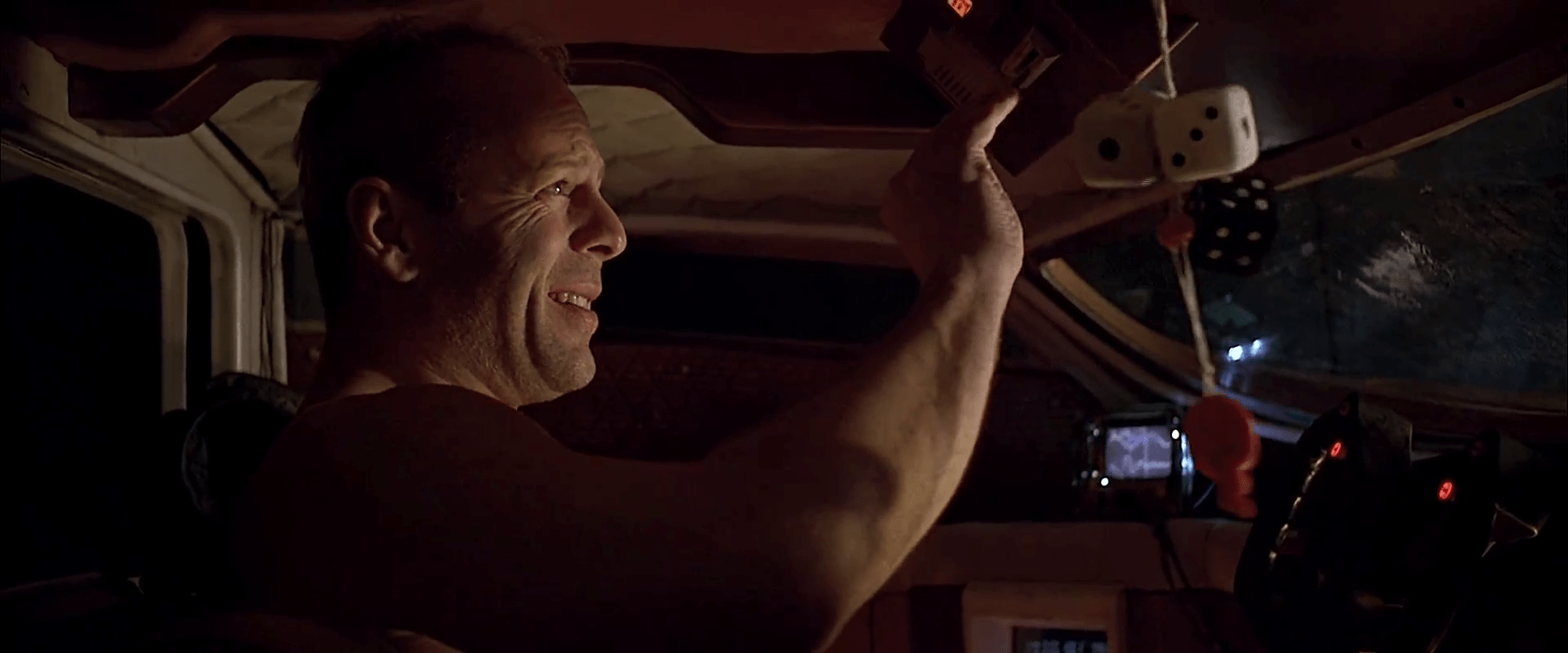
We saw in an earlier post how the military uses communication headsets with red LEDs in the tips of the antennas that provide a social signal about the attention of its wearer. On board the spaceship to Fhloston Paradise, the same technique is used to signal functioning microphones.

TheFifthElement-redmike-002

TheFifthElement-redmike-003

The simple status signal of glowing signals to the speaker that the device is on and that their voice is being broadcast, listened to, or might be overheard.

These are two binary states: microphone recording/not, light on/off. and the relationship could be swapped such that the light illuminates when the device is not recording. But since the consequences for accidentally broadcasting the wrong thing are dire, it makes sense to associate the attention-getting signal with the costly state that requires attention and care.

The red appears elsewhere as a signal for microphone or antenna, even when it’s not glowing. We see it on Korben’s wireless phone at home, Zorg’s assistant’s headset, on Korben’s room phone aboard the Fhloston Paradise, on the handheld mic aboard Zorg’s ship, and on the President’s wireless phone. We can presume it’s a signal common pattern across all the commucication technology of this world. The commonality helps signal to anyone familiar with it the purpose of an otherwise unmarked and miniaturized component.

Rhod’s rod

TheFifthElement-Rhod-011

One of the most delightfully flamboyant characters in sci-fi is the radio star in The Fifth Element, Ruby Rhod. He wears a headpiece to hear his producers as well as to record his own voice. But to capture the voices of others, he has a technological staff that he carries.

Function

The handle of the device has a microphone built into it. Because of the length of the staff, his reach to potential interviewees is extended. The literal in-your-face nature of the microphone matches Ruby’s in-your-face show.

TheFifthElement-Rhod-004

To let interviewees know when they’re being recorded, a red light in the handle illuminates. This also lets others nearby know that the interviewee is “on air” and not to interrupt.

Ruby also has a single switch on the handle. It’s a small silver toggle. It’s likely that he can set this switch to function as he likes. The one time we see it in action, he has set it to play back an “audio cut,” (the sound clips morning radio talk show hosts insert into their programs) in this case an intimate recording of the Princess of Kodar Japhet. He flips the toggle to play the cut, and flips it back when it’s done.

Here, a different input would have worked better. The toggle switch is too easy to bump and kind of ruins the design of the handle. Better would be a billet button. This sort of momentary button sits flush with a bezel, which prevents accidental activation from, say, a finger laying across it, or resting the button against a flat surface. If Ruby wants the recorded sound to play out completely, and the button press only starts or stops the playback, it would be good to know the state of the playback, and using a billet button with a LED ring would be best.

We also know that Ruby is a performer. He would be happier if he had more than a play button, but a way to express himself. His hand is already in a grip to hold the staff, so the control should fit that—If you could outfit the billet button with directional pressure sensitivity, he could assign each direction to a control. So, for instance, while he was pressing the button, the audio would play, and the harder he pressed up, the volume for each echo would increase. Or pressing down could lower the sample in tone, etc. This would allow him to not just play the audio cut, but perform it.

Fashion

To work as a device that the character would want to carry, it has to match his sense of style. I mean this first in a general sense, and the device does that, with its handle of ornately carved silver. Ruby’s necklaces, bracelets, and rings are all silver, and they work together. The staff also works in his hand like a drum major’s baton, augmenting his larger-than-life presence with an attention-commanding object.

It has to fit his daily fashion as well, and the staff does that, too. The shaft can change appearance. I don’t know if it’s an e-ink-type surface, replaceable staves, or fabric sleeves that change out, but when Ruby’s in leopard print, the staff is in leopard print, too. When Ruby’s decked out in rose-adorned tuxedo black, the staff matches.

TheFifthElement-Rhod-002

TheFifthElement-Rhod-006

Though this is more a portable than a wearable technology, the fact that it can change to match the personal style of the wearer makes it not only functional, but since it fits his persona, desirable as well.

Fuel cell

fifthelement-233

Just before the spaceship takes off for Fhloston Paradise, the audience gets to see the manual interface that the airport employees use to refuel the ship. On the tarmac beneath the spaceship, the ground crewman plugs in a portable control box to the underside of the plane, and presses a button to open a hatch in the ground, from which a new, glowing green radioactive fuel cell emerges.

One of the crewmen grabs it by its circular handles at the end, removes it from the hatch, and sets it on the ground.

He then uses the plugged-in control box to open a compartment on the underside of the spaceship, from which one of the ground crew removes the spent fuel cell by hand, and inserts it into the still-open hatch.

Finally they pick up the full fuel cell and insert it into the compartment on the plane.

fifthelement-237

This scene is there to set up how Cornelius stows away on the craft, but also serves as a cinematic pun when it crosscuts to a scene inside the ship (but which must be seen rather than read to appreciate.) For such a “throwaway” technology, it’s handled really well.

  • The ground affords natural shielding from any collection of radioactive fuel cells.
  • Being circular, the cells and the handles to manipulate the cells are orientation-less.
  • There are familiar black-and-yellow-stripe warnings on the walls of the hatch and the revealed sides of the spaceship compartment. These warnings are only visible when it’s relevant.
  • The radioactivity trefoil symbol has the same colors and appears on the fuel cell, the hatch, and the compartment.
  • Having a portable and wired control box means that it’s not readily available for any passing hackers.
  • The transparent container lets the material act as an additional warning to observers: There is danger here.
  • The transparent container lets the fuel itself tell the ground crew which cell is spent and which one is full.

All told, short of making it automated, this is how it should work.

fifthelement-238

Multipass

TheFifthElement-multipass

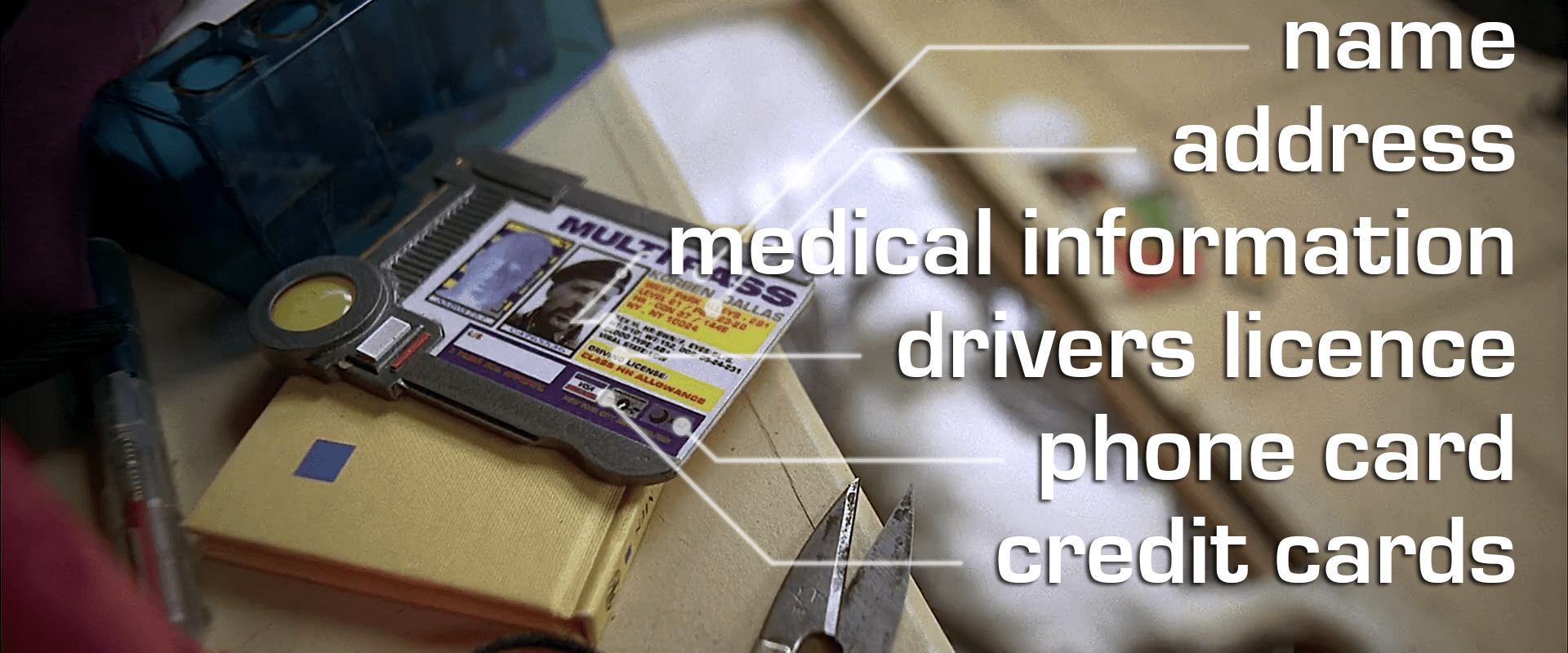
The multipass is the all-purpose card of 2263. It’s a driver’s license, work authorization record, proof of identity, emergency medical information, phone card, plus all your credit cards in one. There is a white rectangle and yellowish, rounded-bevel shape on the lower left, each of which may be a button, but that we don’t see in use.

Often just showing it is enough for a human’s satisfaction, but sometimes it must be read by a machine. To do this, the holder inserts it into a slot, where the machine verifies its authenticity and registers the user locally. In Korben’s taxi, he has to leave it in as he operates the vehicle. At the Fhloston Paradise check-in booth, travelers dip it in and out of the reader.

TheFifthElement-multipass-014TheFifthElement-multipass-008

TheFifthElement-multipass-009

The act of inserting the card to authenticate may seem a bit old-fashioned in the days of RFID and read-at-a-distance technology, but it’s also nice to see that whatever agency was able to get the various corporations and government agencies to cooperate has also got privacy in mind. If it needs to be dipped to be read, maybe it can’t be read at a distance. That means the holder has more control over when and how it’s accessed.

As far as convenience, hot damn. It’s practically a wallet in and of itself. But there are security concerns to having all of this in one place. There are many cards that work like this in the world. Bus passes, skeeball tickets, gift cards. They’re generally low-cost. If you steal or forge Korben Dallas’ multipass, though, do you suddenly have his charge accounts, his taxi, and his phone card all at once? Seems high-cost, especially since the one forgery we see in the movie actually works.

This returns us, as so many things do, to multifactor authentication. This security philosophy requires that the user presents three factors: something they have, something they are, and something they know. The multipass covers only the first two.

  • The multipass itself is the thing they have.
  • The picture is something they are, i.e., what they look like.
  • It could be improved by requiring something they know, like a PIN or a password.

We don’t know what kind of power Cornelius’ order wielded in the world, but since it wasn’t enough to sway the president or purchase tickets to Paradise, let’s presume it wouldn’t have been enough to uncover Korben’s password, and in that case, the PIN would have foiled the attempted forgery.

TheFifthElement-multipass-002

Slow Police

TheFifthElement-slowpolice-001

Wrapping up our week of The Fifth Element police interfaces…

When the police chase Korben into the permanent fog bank at street level of the city, the exciting car chase must stop. They must slow down and undergo a careful search. The front of the car has an LED scrolling sign between its beacon lights that cuts back and forth between displaying “SLOW” and “POLICE.”

TheFifthElement-slowpolice-003

TheFifthElement-slowpolice-002

From a citizen standpoint, having such text can certainly make the police’s circumstances and desires quite clear. Then again, language can be quite ambiguous. What would you do if you saw a police car that read, “CELLAR DOOR” as it passed? How are you meant to comply?

Though we never actually see the sign change to display any other text, the fact that it’s LED implies that it can and does. Sure, I get the movie’s joke of the police calling themselves “slow,” but there are lots of interaction questions left unanswered. Can the officers in the car change the sign? If so, how? Does the passenger have a keyboard? Or is it voice command? If there’s a control available to the driver, how is it made safe, and not as deadly as a driver trying to compose a text message today? And to what degree can the message be changed? Can they create anything, or do they select from a commissioner-approved menu of options? Or can they not control it at all—is the sign completely controlled from dispatch, or from some context-aware algorithm?

The film gives no clues, so it’s left as an exercise for the design viewer. Which, sometimes, is just the way I like it.

Scrolling-police-sign

Yellow circles everywhere

TheFifthElement-Fhlostoncircles-001

Korben (and his poor neighbor) aren’t the only ones to deal with the yellow circles. Apparently they appear everywhere.

When Right Arm fails to convince the counter staff for Fhloston Paradise that he is Korben Dallas. Knowing that he works for a sociopathic killer, he gets upset. As the doors to gate 18 close behind her, the ticket taker smiles and says, “Sorry, sir, boarding is finished!” and the platform on which she stands lowers her out of sight. At the same time a pane of glass with the familiar two yellow circles rises up. In his frustration, Right Arm shouts, “I don’t believe this!” and pounds the glass(?) around the booth.

TheFifthElement-Fhlostoncircles-006

Instantly, a whooping warning is heard, and three columns of computer-controlled guns drop from the ceiling, clacking into place as if they were being armed. Two columns are behind him and one directly in front, each with two guns, pointing a total of six automatic weapons at him. Red LEDs blink on the column in front near a camera and a voice sternly warns him, “This is not an exercise. This is a police control. Put your hands in the yellow circles…”

The scene is played for laughs, as an example of an inappropriately harsh reaction to an expression of frustration. But the design of the system is worth noting. The compliance technique is designed to be easy to communicate and comprehend. The recorded voice could have said something like “stand in a spread-eagle position against the glass” but that is too wordy and leaves lots to interpretation. Giving the user very basic signals, i.e. yellow circles, and a very unambiguous task, i.e. putting your hands in the circles, is as clear as it could be. (Though I’m not sure what would happen if you were someone with only one hand, or no hands, or a prosthetic hand.)

The red lights, stern recorded audio, mechanical sounds, and whooping sound all let Right Arm know the gravity of the situation he’s in. Even the fact that they drop and swivel toward him give him the clear signal that if he tried to run, these weapons could track him. The sound appears behind him first, causing him to swivel, where he’s met with the four menacing barrels. He is first disoriented and then cowed.

TheFifthElement-Fhlostoncircles-010

Sure, I’d really hate to live in such an oppressive police state where expressing frustration in public is met with possible death from a robot, but looking at it purely from the perspective of the signals and instructions, it’s well done.

Eepholes

TheFifthElement-police-027

Please forgive the title. It’s a portmanteau of “e” and “peepholes” that was too goofy to resist and not part of the official Fifth Element canon.

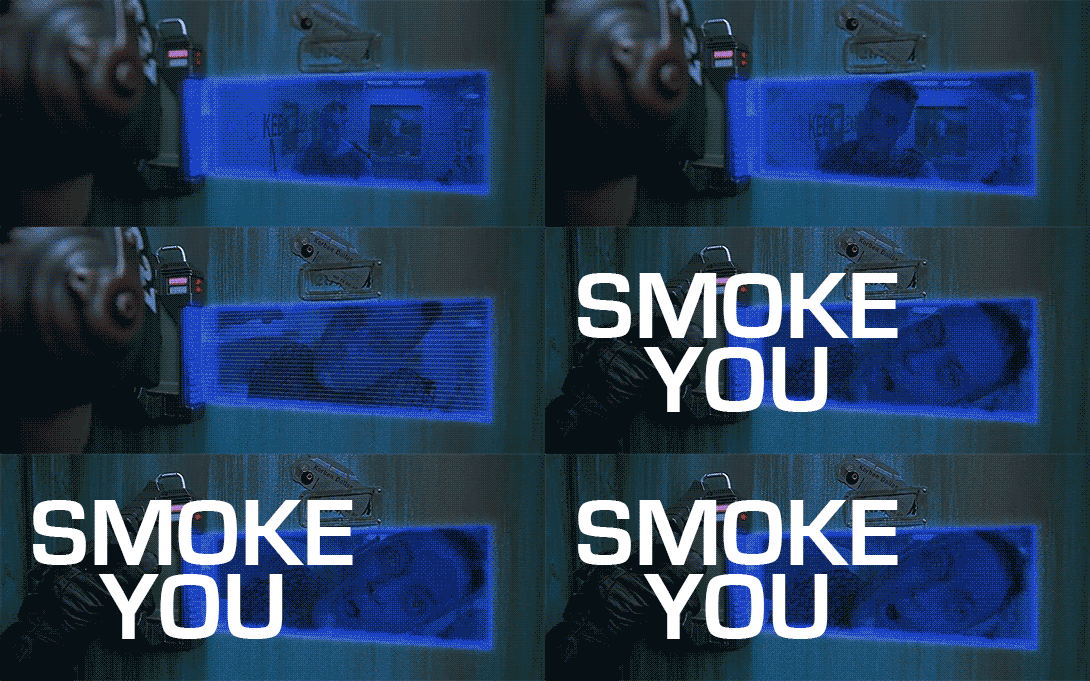
When the police have an apartment in lockdown, they have a special tool to evaluate individual citizens in their apartments. It’s an electronic peephole that allows them to see and communicate with the citizen inside their apartment. To use it, a police officer places a handheld device shaped something like an iron up to the door near eye height. Pressing a button at the thumb switches a status light from green to red and opens an electronic “hole” in the door, through which the officer can see, but out of which the citizen cannot.

TheFifthElement-police-029

While the eephole is activated, the intercom between the yellow circles in which the citizen has placed his or her hands glows orange, letting them know that the call is active. Then the officer can freely interrogate the citizen.

Officer: Sir, are you classified as human?
Korben: Negative. I am a meat popsicle.

Analysis

How the device works is something of a mystery, but we have to take its results at face value. We’re concerned about the interaction, and that works OK. The device has a single handle and flat plate that fits against the door readily. The thumb button is placed so it’s easy to activate while holding it up with one hand. The fact that it’s portable rather than embedded in the door means that it can be taken away by the police after their business is done, rather than leaving it there to be hacked.

If I had to make any improvements, I would hope to make the device stick to the door so the officer could have both hands ready for his weapon should he need it, or feel more free to dodge out of the way. I would also omit any of the many glowing lights that appear extraneous, at least to what we see in this scene. I might also provide some output to the officer that the interaction is under warrant, or maybe even that it’s being being recorded, to remind them not to abuse this breach of privacy. Clearly it causes stress among the citizens subject to it.

smokeyou

Apartment Lockdown

TheFifthElement-police-016

Zorg issues orders to the police to arrest Korben Dallas. A squad of 8 officers arrive to his apartment block. They know what apartment number he’s supposed to be in, but Korben’s number has been removed by Cornelius, and the neighbor has blacked his out.

TheFifthElement-police-024

To authorize the lockdown, the squad leader opens a police box mounted on the wall in the hallway by placing the top edge of a transparent warrant into a slot on its side. The box verifies the warrant and slides open. The squad leader presses a red button within.

TheFifthElement-police-022

During lockdown a klaxon sounds, red beacon lights descend from the hallway ceiling, and a loud, clear voiceover is heard in the hallway and in the apartments themselves.

THIS IS A POLICE PATROL. THIS IS NOT AN EXERCISE…THIS IS A POLICE PATROL. THIS IS NOT AN EXERCISE. CAN YOU PLEASE SPREAD YOUR LEGS AND PLACE YOUR HANDS IN THE YELLOW CIRCLES.

TheFifthElement-police-026

The circles in question are painted at chest height on the walls inside of each apartment, a little wider than shoulder width. There is a small intercom interface mounted in the wall directly between the yellow circles. The police use different interfaces for peering inside apartments and this intercom for communicating with citizens, but these will be discussed separately in the next post.

Analysis

There are a few sets of users for this particular set of interfaces: The police, Zorg, and Korben. To evaluate the system, we need to look at each user independently.

  1. For the police, this interface seems to work well. Since the lockdown is part of the infrastructure, they don’t have to bring anything but their standard gear and the warrant. They save energy and the tedium of alerting the citizens and issuing standard compliance instructions. In a fully networked world, you might think to simply have him or her authorize themselves using biometrics, but in keeping with the principles of multifactor authentication, you might require the officer to carry something anyway. Since you’d want a physical warrant for a poor or luddite citizen to be able to see and verify, it’s going to be there, might as well use it.
  2. For Zorg and issuing authorities like him, he kind-of wants to minimize danger to his people and certainly his equipment, which this helps do. He also wants to cover his ass from citizen lawsuits, and having the traceability of the warrant-scan means he will have a record that due process has been followed. As we’ll see tomorrow, ultimately he doesn’t get what he needs, but as far as this lockdown interface, it seems like it would work just fine.
  3. For the citizen Korben, the interface provides a clear signal and easy-to-follow instructions, so the proximal part “works.” What doesn’t work is that the whole system is horribly demeaning, authoritarian, and—fully risking Godwin’s Law, here—fascist.

Security is almost always at odds with usability, and this interface proves no different. To improve the experience for the good citizen, you might want to provide some warning, some ability to finish what they’re doing, or some less demeaning way to show that they are cooperating. But any concessions made for the good citizens will be taken advantage of by the bad ones, and so I don’t know that design can really fix that tension.

P.S. As of this writing my Minority Report review is not posted, but readers interested to compare and contrast a similar scene done with more seriousness some 5 years later should check it out.