Perimeter Fences

Jurassic_Park_Perimeter_Fences01

Each of the dinosaur paddocks in Jurassic Park is surrounded by a large electric fence on a dedicated power circuit that is controlled from the Central Control Room. The fences have regular signage warning of danger…

Jurassic_Park_Perimeter_Fences04

…and large lamps at the top of many towers with amber and blue lights indicating the status of the fence.

Jurassic_Park_Perimeter_Fences02

When the power is active, both lights are lit. When Dr. Saddler is rebooting the system, the blue light turns on first, with a loud, deep klaxon, meant to signal a “system active, but power is not feeding to the fence yet” status. Although the transition isn’t shown, presumably the amber light turns on as soon as power flows into the fence.

Even though Dr. Grant and the kids weren’t introduced to the light system when they arrived on the island, they were suitably worried when the klaxon sounded and the blue light began blinking. This had the advantage of warning them that the fence was about to activate, but the disadvantage that it set off such a strong fear response in Timmy that he froze in place while still on the fence. Drama is good for an audience, bad for Timmy.

Fence Activation

Jurassic_Park_Perimeter_Fences05

We see in Nedry’s escape scene that he shuts off the power because the main gates out of Jurassic Park cannot be opened while the power is active. However, in the intro scene (pictured above) we see that the gate can be opened without shutting off power to the entire fence system. This implies that Jurassic Park has fairly detailed control over various parts of the fence system. This is confirmed when we get a glimpse of labels on a circuit board later in the film:

Jurassic_Park_Perimeter_Fences03

The good

  • The major systems are each on dedicated circuits that are individually controlled. That’s useful for managing complex scenarios in the park.
  • Automated alert systems are quickly understandable. That’s useful for keeping employees and visitors safe.
  • “Blue” and “Orange” are colors that are easily differentiable even with color-blind users. It’s a good choice for alerts.
  • There is an unmistakable and unavoidable audio backup to the visual signal.

The deadly

Let’s not forget that this is a system with potentially deadly consequences. It’s worth making sure it does its job of keeping the bad thing controlled, while not frying people.

“Danger” signage on the T-rex pen is too high for good viewing. A person would interact with the fence closer to the concrete barrier, and would almost certainly not look up. Better is to repeat the signage frequently, repeatedly along its length, and at several heights.

The light system is a 4-bit signal. It takes some interpretation. “Wait. What did blinking blue and off orange mean?” That’s pretty poor for emergency situations, where a few seconds of delay can mean the difference between safety and becoming a jurassic kebab.
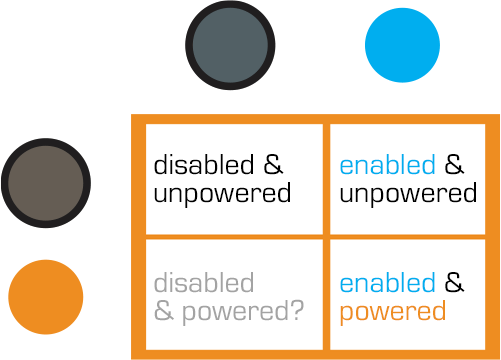
lights

Better would be an unmistakable binary signal. Light on = power on. Light off = power off. Make it a big, blood-colored red. That’s much simpler and doesn’t require referencing a manual. Color blind folks won’t need to distinguish light colors at all, they can just see the on-or-off.

What about powering up? That blinking is clearly meaningful, but it’s still more ambiguous than it needs to be.

Ideally you’d have some sort of human-detection system so that the fence itself keeps humans safe, but if that’s not doable or reliable, you’d need some other warning signal. I think there are three ways we can convey that shit is getting real…

Visual

I’d recommend a progress bar, like the Eko traffic light concept by Damjan Stanković. Surround the red light with the progress bar, combining with audible and tactile signals, as below. Put these in the pillars that support the cables, and either near or around the hole through which the cables pass, so it’s clear that these lights have something to do with these cables.

traffic-light-progress-bar-500x371
Side note: I think this is a problematic as a stop light, but quite brilliant as a general time-bound event signal.

Audible

You need the audible warning to catch attention regardless of whether or not a person is looking in the direction of the light. The klaxon is awesome at getting attention and signalling dangers. But again, it’s an ambiguous as The Robot shouting, “Danger, Will Robinson!” If we modified it so that the sound started low and raised in pitch, it would help convey that something is coming on line. You could just use a “blinking” Shepard Tone.

Tactile

And of course, there’s the power itself. It shouldn’t just come on all at once. We should raise the power level over some span of time, so Timmy starts feeling greater and greater discomfort and he has a building pressure to get off the fence, rather than being thrown back immediately. Even a blind, deaf, or panicked person wouldn’t be able to ignore it and be forced to take action without the risk of blunt force electrocution.

Fhloston evacuation

TheFifthElement-FhlostonEvacuation-001

When Fhloston Paradise’s bomb alarms finally go off (a full 15:06 after Zorg’s bomb actually starts. WTH, Fhloston?) four shipwide systems help evacuate the ship.

First, a klaxon is heard on a public address system across the ship. A recorded female voice calmly announces that…

This is a type A alert. For security reasons the hotel must be evacuated. Please proceed calmly to the lifeboats located in the main hallways.

This voice continues to speak a warning countdown, repeating the remaining time every minute, and then when there’s less than a minute at 15 second intervals, and each of the last 10 seconds.

Second, in the main hallway, small, rows of red beacon lights emerge out of the floor and begin flashing and blinking. They repeatedly flash in order to point the direction of the lifeboats.

TheFifthElement-FhlostonEvacuation-003

Third, in the main hallway large arrows on the floor and “LIFEBOAT” lettering illuminate green to point travelers towards ingress points for individual lifeboats.

TheFifthElement-FhlostonEvacuation-007 TheFifthElement-FhlostonEvacuation-009

Fourth, the lifeboats themselves eject from the ship to get the passengers far from danger.

TheFifthElement-FhlostonEvacuation-010

Awesome

  • The voice warning is a trope, but a trope for a reason. For visually impaired guests and people whose attention is focused on, you know, escape, the audio will still help them keep tabs on the time they have left.
  • The racing lights provide a nice directionality (a similar interface would have helped Prometheus).
  • The arrows and beacons require no language skills to comprehend.

Awful

  • The voice warning and the “LIFEBOAT” signs do require language to comprehend. They couldn’t have used Running Man?
  • You know when’s a crappy time to add trip hazards to the floor? When a herd of panicked humans are going to be running over it. Seriously. There is no excuse for this.
  • The beacons and the arrows should be the same color. Green is the ISO standard for exit, so while we’re moving the beacon lights to the ceiling where they belong, we can swap them out for some #33cc00 beacons.
  • The green arrows at first seem badly placed as it’s difficult to see when there’s a crowd of people, but then you realize that when the room is empty, people will see and follow them. People in a crowd will just follow whatever direction the horde is currently going, and seeing the arrows is unnecessary. But in a light crowd, people will get a glimpse of the arrow and become stressed out over an occluded, potentially life-saving signal or worse, get trampled to death trying to stop and read it to make sure everyone is going the right way, so ultimately awful. Put that up on the ceiling or high on the walls, too. Because people genuinely panic.

TheFifthElement-FhlostonEvacuation-006

Apartment Lockdown

TheFifthElement-police-016

Zorg issues orders to the police to arrest Korben Dallas. A squad of 8 officers arrive to his apartment block. They know what apartment number he’s supposed to be in, but Korben’s number has been removed by Cornelius, and the neighbor has blacked his out.

TheFifthElement-police-024

To authorize the lockdown, the squad leader opens a police box mounted on the wall in the hallway by placing the top edge of a transparent warrant into a slot on its side. The box verifies the warrant and slides open. The squad leader presses a red button within.

TheFifthElement-police-022

During lockdown a klaxon sounds, red beacon lights descend from the hallway ceiling, and a loud, clear voiceover is heard in the hallway and in the apartments themselves.

THIS IS A POLICE PATROL. THIS IS NOT AN EXERCISE…THIS IS A POLICE PATROL. THIS IS NOT AN EXERCISE. CAN YOU PLEASE SPREAD YOUR LEGS AND PLACE YOUR HANDS IN THE YELLOW CIRCLES.

TheFifthElement-police-026

The circles in question are painted at chest height on the walls inside of each apartment, a little wider than shoulder width. There is a small intercom interface mounted in the wall directly between the yellow circles. The police use different interfaces for peering inside apartments and this intercom for communicating with citizens, but these will be discussed separately in the next post.

Analysis

There are a few sets of users for this particular set of interfaces: The police, Zorg, and Korben. To evaluate the system, we need to look at each user independently.

  1. For the police, this interface seems to work well. Since the lockdown is part of the infrastructure, they don’t have to bring anything but their standard gear and the warrant. They save energy and the tedium of alerting the citizens and issuing standard compliance instructions. In a fully networked world, you might think to simply have him or her authorize themselves using biometrics, but in keeping with the principles of multifactor authentication, you might require the officer to carry something anyway. Since you’d want a physical warrant for a poor or luddite citizen to be able to see and verify, it’s going to be there, might as well use it.
  2. For Zorg and issuing authorities like him, he kind-of wants to minimize danger to his people and certainly his equipment, which this helps do. He also wants to cover his ass from citizen lawsuits, and having the traceability of the warrant-scan means he will have a record that due process has been followed. As we’ll see tomorrow, ultimately he doesn’t get what he needs, but as far as this lockdown interface, it seems like it would work just fine.
  3. For the citizen Korben, the interface provides a clear signal and easy-to-follow instructions, so the proximal part “works.” What doesn’t work is that the whole system is horribly demeaning, authoritarian, and—fully risking Godwin’s Law, here—fascist.

Security is almost always at odds with usability, and this interface proves no different. To improve the experience for the good citizen, you might want to provide some warning, some ability to finish what they’re doing, or some less demeaning way to show that they are cooperating. But any concessions made for the good citizens will be taken advantage of by the bad ones, and so I don’t know that design can really fix that tension.

P.S. As of this writing my Minority Report review is not posted, but readers interested to compare and contrast a similar scene done with more seriousness some 5 years later should check it out.