The Thanatorium: Attendant interface

The thanatorium is a speculative service for assisted suicide in Soylent Green. Suicide and death are not easy topics and I will do my best to address them seriously. Let me first take a moment to direct anyone who is considering or dealing with suicide to please stop reading this and talk to someone about it. I am unqualified to address—and this blog is not the place to work through—such issues.

There are four experiences to look at in the interface and service design of the Thanatorium: The patient, their beneficiaries, the usher to the beneficiaries, and the attendants to the patient. This post is about the attendants to the patient. Forewarning: This is the role we have the least information about. These Thanatorium personnel are there to assist the patient in their suicide, and deal with the body after the ceremony is complete.

The attendants have many goals and tasks to accomplish with each patient:

  • Help set the patient at ease so they complete the ceremony
    • Welcome the patient warmly
    • Assist them with tasks
      • Help them disrobe
      • Get them onto the gurney
      • Provide the hemlock
      • Set the patient in place for the cinerama experience
      • Press the gray buttons (which I interpret as ensuring medical monitoring, see below)
    • Set a liminal mood
  • Remove the clothes for donating and cup for cleaning
  • Leave the patient during the cinerama
  • Return to the body when the patient has passed
  • Usher the gurney through the portal

Nearly all of this is manual, with no speculative interfaces to speak of. A service design approach would look at this entire touchpoint, though. So, some quick notes.

Note their uniforms. Rather than the Guayabera shirt that the usher wears, the attendants wear vestments—white robes with goldenrod cuffs and cinctures around their waists. They even wear sandals to convey a sort of biblical, old-world holiness. It’s goofy and cheap, and kind of perfect.

Their manner is solemn, never speaking and performing their tasks with a sort of dance-like deliberateness. The behavior helps set off the space as liminal, somewhere not-quite like the world outside. No notes on the frontstage choreography.

The lighting begins a little flat, like overhead fluorescents in a school cafeteria. Maybe this is to give the patient a sense of certainty, of complete information about the room; but for my money the whole thing would seem more liminal with more dramatic lighting: A warm pool of light around the bed, maybe tiny amber incandescent bulbs flickering in a ring around the walls, like candles or stars.

A solemn scene depicting two figures dressed in ceremonial robes, standing together in a dimly lit space surrounded by candles. The woman has long hair and is wearing a veil, while the man has short hair and a decorative robe.
Yes, closer to this.

There are some things we don’t get to see about the ceremony, like where the hemlock is stored and how it is presented to Sol, or how he gets up on a bed that’s above his waist, or what they do with his clothes. Or even—and this bit really bugs me—how the light changes from white to Sol’s requested orange at that moment. It’s not the usher, who is in the foyer about to intercept Thorn, and not the attendants, whose attention is on Sol. Maybe it’s on a timer, but that makes little sense. I really have to chalk it up to another movie-making error. Anyway, we’ll get to all this in the patient’s experience post, next.

For now let’s note that after the patient drinks the hemlock and they ease him back, we finally get to the one interface.

The ominous, inscrutable gray buttons…

Before departing the chamber, one of the attendants reaches down to a small metallic panel at the head of the bed. It consists of two square pushbuttons on the right, and a dial (or a plunger?) on the left.

The attendant presses and holds both of the buttons simultaneously for about three seconds. In the movie this attendant then gives the other a knowing glance, and they depart.

What the hell is this interface meant to be?

It’s quite unclear what state change this interface is meant to make, or why it needs to be a two-handed switch, when these sorts of things are mostly used for safety. My best guess is that since the drinking of the hemlock is the point of no return, and since the observation window is closed during that sequence so grief-stricken beneficiaries can’t interrupt; the two-handed switch is the silent signal from the attendants to the usher that everything is cool and they can open the observation window for final farewells. That’s low-confidence backworlding, though, since in the movie we know the usher is not present in the observation chamber at this time, but in the foyer of the thanatorium about to intercept Thorn. So, take this with a grain of salt.

But, if that’s the usual purpose, why have one panel with the two buttons? It’s a bit silly because they are close enough to be mashed by a single palm or even hip. It would make more sense if each attendant had their own button on each side of the bed, which they had to hold down. Have each button illuminate small green bulbs, and then jump-cut to the usher’s interface where two identical green bulbs labeled READY both illuminate. Then the usher can open the window and the beneficiary interface can switch to SPEAKING PERMITTED. This would make that weird interface moment make at least some sense.

Oh, and the dial? I have no idea. It’s unlabeled. Could be to control the bed height, or audio volume, or the brightness? Why one and not the other? There’s no way to tell and nothing makes a lot of sense given the rest of this scene. Provide your best guess in the comments, if you like. Otherwise my recommendation is to remove it.

Medical monitoring

One thing that seems to be missing the scene is some acknowledgment that the attendants are the ones to ensure that medical monitoring is operational, and do some troubleshooting if not. The monitoring is important, because the usher will await the clinical death signals before ending the cinerama and opening the observation window again for final viewing by the beneficiaries.

To help signal this, I recommend adding to the scene a quick shot of the surface of the bed before Sol lays down, showing inset silver disks, hinting at something like ECG electrodes, and then adding a panel at the head of the bed that an attendant can pull out to reveal the clinical death gauges described in the usher’s interface post.

These three, but with the dials in normal ranges for living patients.

The attendant can then close the panel, give the everything is in order look to the other, and the two of them depart for their break room, or jump seats, or watercooler; wherever they go for the interim.

This makes me realize the attendants just have to kind of hang out during the cinerama, and begs some sort of Rosencrantz and Guildenstern Are Dead philosophical dialog treatment. Please enter your drafts in the comments.

A final viewing

Once the patient passes, the attendants come in and push the gurney along its track into the portal. But this is for show, as the gurney is on a track, and after it leaves the theater to the “backstage,” it is pulled along by a mechanized track in the floor. So it could just be automated. But seeing the attendants moving it along gives the beneficiaries some last bit of theater that the body will be respectfully dealt with.

Narrator: It won’t be.

The Thanatorium: A beneficiary’s experience

The thanatorium is a speculative service for assisted suicide in Soylent Green. Suicide and death are not easy topics and I will do my best to address them seriously. Let me first take a moment to direct anyone who is considering or dealing with suicide to please stop reading this and talk to someone about it. I am unqualified to address—and this blog is not the place to work through—such issues.

There are four experiences to look at in the interface and service design of the Thanatorium: The patient, their beneficiaries, the usher, and the attendants to the patient. This post is about the least complicated of the bunch, the beneficiaries.

Thorn’s experience

We have to do a little extrapolation here because the way we see it in the movie is not the way we imagine it would work normally. What we see is Thorn entering the building and telling staff there to take him to Sol. He is escorted to an observation room labeled “beneficiaries only” by an usher. (Details about the powerful worldbuilding present in this label can be found in the prior post.) Sol has already drunk the “hemlock” drink by the time Thorn enters this room, so Sol is already dying and the robed room attendants have already left.

Aaand I just noticed that the walls are the same color as the Soylent. Ewww.

This room has a window view of the “theater” proper, with an interface mounted just below the window. At the top of this interface is a mounted microphone. Directly below is an intercom speaker beside a large status alert labeled SPEAKING PERMITTED. When we first see the panel this indicator is off. At the bottom is a plug for headphones to the left, a slot for a square authorization key, and in the middle, a row of square, backlit toggle buttons labeled PORTAL, EFFECTS, CHAMBER 2, AUDIO, VISUAL, and CHAMBER 1. When the Sol is mid-show, EFFECTS and VISUAL are the only buttons that are lit.

When the usher closes the viewing window, explaining that it’s against policy for beneficiaries to view the ceremony, Thorn…uh…chokes him in order to persuade him to let him override the policy.

Persuasion.

“Persuaded,” the usher puts his authorization key back in the slot. The window opens again. Thorn observes the ceremony in awe, having never seen the beautiful Earth of Sol’s youth. He mutters “I didn’t know” and “How could I?” as he watches. Sol tries weakly to tell Thorn something, but the speaker starts glitching, with the SPEAKING PERMITTED INDICATOR flashing on and off. Thorn, helpfully, pounds his fist on the panel and demands that the usher do something to fix it. The user gives Thorn wired earbuds and Thorn continues his conversation. (Extradiegetically, is this so they didn’t have to bother with the usher’s overhearing the conversation? I don’t understand this beat.) The SPEAKING PERMITTED light glows a solid red and they finish their conversation.

Yes, that cable jumps back and forth like that in the movie during the glitch. It was a simpler time.

Sol dies, and the lights come up in the chamber. Two assistants come to push the gurney along a track through a hidden door. Some mechanism in the floor catches the gurney, and the cadaver is whisked away from Thorn’s sight.

Regular experience?

So that’s Thorns corrupt, thuggish cop experience of the thanatorium. Let’s now make some educated guesses about what this might imply for the regular, non-thug experience for beneficiaries.

  1. The patient and beneficiaries enter the building and greeted by staff.
  2. They wait in queue in the lobby for their turn.
  3. The patient is taken by attendants to the “theater” and the beneficiaries taken by the usher to the observation room.
  4. Beneficiaries witness the drinking of the hemlock.
  5. The patient has a moment to talk with the beneficiaries and say their final farewells.
  6. The viewing window is closed as the patient watches the “cinerama” display and dies. The beneficiaries wait quietly in the observation room with the usher.
  7. The viewing window is opened as they watch the attendants wheel the body into the portal.
  8. They return to the lobby to sign some documents for benefits and depart.

So, some UX questions/backworlding

We have to backworld some of the design rationales involved to ground critique and design improvements. After all, design is the optimization of a system for a set of effects, and we want to be certain about what effects we’re targeting. So…

Why would beneficiaries be separated from the patient?

I imagine that the patient might take comfort from holding the hands or being near their loved ones (even if that set didn’t perfectly overlap with their beneficiaries). So why is there a separate viewing room? There are a handful of reasons I can imagine, only one of which is really satisfying.

Maybe it’s to prevent the spread of disease? Certainly given our current multiple pandemics, we understand the need for physical separation in a medical setting. But the movie doesn’t make any fuss about disease being a problem (though with 132,000 people crammed into every square mile of the New York City metropolitan area you’d figure it would be), and in Sol’s case, there’s zero evidence in the film that he’s sick. Why does the usher resist the request from Thorn if this was the case? And why wouldn’t the attendants be in some sort of personal protective gear?

Maybe it’s to hide the ugly facts of dying? Real death is more disconcerting to see than most people are familiar with (take the death rattle as one example) and witnessing it might discourage other citizens from opting-in for the same themselves. But, we see that Sol just passes peacefully from the hemlock drink, so this isn’t really at play here.

Maybe it’s to keep the cinerama experience hidden? It’s showing pictures of an old, bountiful earth that—in the diegesis—no longer exists. Thorn says in the movie that he’s too young to know what “old earth” was like, so maybe this society wants to prevent false hope? Or maybe to prevent rioting, should the truth of How Far We’ve Fallen get out? Or maybe it’s considered a reward for patients opting-in to suicide, thereby creating a false scarcity to further incentivize people to opt-in themselves? None of this is super compelling, and we have to ask, why does the usher give in and open the viewport if any of this was the case?

That blue-green in the upper left of this still is the observation booth.

So, maybe it’s to prevent beneficiaries from trying to interfere with the suicide. This society would want impediments against last-minute shouts of, “Wait! Don’t do it!” There’s some slight evidence against this, as when Sol is drinking the Hemlock, the viewing port is wide open, so beneficiaries might have pounded on the window if this was standard operating procedure. But its being open might have been an artifact of Sol’s having walked in without any beneficiaries. Maybe the viewport is ordinarily closed until after the hemlock, opened for final farewells, closed for the cinerama, and opened again to watch as the body is sped away?

Ecstasy Meat

This rationale supports another, more horrible argument. What if the reason is that Soylent (the company) wants the patient to have an uninterrupted dopamine and seratonin hit at the point of dying, so those neurotransmitters are maximally available in the “meat” before processing? (Like how antibiotics get passed along to meat-eaters in industrialized food today.) It would explain why they ask Sol for his favorite color in the lobby. Yes it is for his pleasure, but not for humane reasons. It’s so he can be at his happiest at the point of death. Dopamine and seratonin would make the resulting product, Soylent green, more pleasurable and addictive to consumers. That gives an additional rationale as to why beneficiaries would be prevented from speaking—it would distract from patients’ intense, pleasurable experience of the cinerama.

A quickly-comped up speculative banner ad reading “You want to feel GOOD GOOD. Load up on Soylent Green today!”
Now, with more Clarendon.

For my money, the “ecstasy meat” rationale reinforces and makes worse the movie’s Dark Secret, so I’m going to go with that. Without this rationale, I’d say rewrite the scene so beneficiaries are in the room with the patient. But with this rationale, let’s keep the rooms separate.

Beneficiary interfaces

Which leads us to rethinking this interface.

Beneficiary interfaces

A first usability note is that the SPEAKING PERMITTED indicator is very confusing. The white text on a black background looks like speaking is, currently, permitted. But then the light behind it illuminates and I guess, then speaking is permitted? But wait, the light is red, so does that mean it’s not permitted, or is? And then adding to the confusion, it blinks. Is that the glitching, or some third state? Can we send this to its own interface thanatorium? So to make this indicator more usable, we could do a couple of things.

  • Put a ring of lights around the microphone and grill. When illuminated, speaking is permitted. This presumes that the audience can infer what these lights mean, and isn’t accessible to unsighted users, but I don’t think the audio glitch is a major plot point that needs that much reinforcing; see above. If the execs just have to have it crystal clear, then you could…
  • Have two indicators, one reading SPEAKING PERMITTED and another reading SILENCE PLEASE, with one or the other always lit. If you had to do it on the cheap, they don’t need to be backlit panels, but just two labeled indicator lamps would do.

And no effing blinking.

Thorn voice: NO EFFING BLINKING!

I think part of the affective purpose of the interface is to show how cold and mechanistic the thanatorium’s treatment of people are. To keep that, you could add another indicator light on the panel labeled somewhat cryptically, PATIENT. Have it illuminated until Sol passes, and then have a close up shot when it fades, indicating his death.

Ah, yes, good to have a reminder that’s why he’s a critic and not a working FUI designer.

A note on art direction. It would be in Soylent’s and our-real-world interest to make this interface feel as humane as possible. Maybe less steel and backlit toggles? Then again, this world is operating on fumes, so they would make do with what’s available. So this should also feel a little more strung together, maybe with some wires sticking out held together with electrical tape and tape holding the audio jack in place.

Last note on the accommodations. What are the beneficiaries supposed to do while the patient is watching the cinerama display? Stand there and look awkward? Let’s get some seats in here and pipe the patient’s selection of music in. That way they can listen and think of the patient in the next room.

If you really want it to feel extradiegetically heartless, put a clock on the wall by the viewing window that beneficiaries can check.


Once we simplify this panel and make the room make design sense, we have to figure out what to do with the usher’s interface elements that we’ve just removed, and that’s the next post.

Soylent Green (1973)

Release date: 09 May 1973

It is the unthinkably distant future of 2022. Pollution and its consequent global warming has caused environmental and economic collapse around the globe. Unemployment is rife, nearing 50%. Agricultural systems have collapsed and overpopulation has run rampant. In New York City, the Malthusian masses sweat all the time and are rationed water and plant-derived crackers from one of the few remaining Corporations, known as Soylent. Soylent supplies food for half the world. But the staples of Soylent Yellow and Soylent Red are running out, and replaced with a new product, Soylent Green, said to be created from plankton gathered “from the oceans of the world.” It’s very popular and only available on Tuesdays, which is called “Soylent Green Day.”

In honor of this, individual posts from this review will only be released on Tuesdays.

In this hellscape, police detective Thorn spends much of his time at home with curmudgeonly old-timer Sol. (The nature of their relationship is quite affectionate but otherwise unclear. Because it would annoy the hell out of the ghost of asshat Charlton Heston, I am going to backworld that they are winter-spring lovers, having met when Thorn was a young, pansexual sex worker.) Sol is a police “book,” doing research that complements Thorn’s footwork to solve cases.

Thorn receives a new case, to investigate the mysterious murder of William Simonson, a wealthy member of the Soylent board. Over the course of his thuggish and openly-corrupt investigations, Thorn follows a chain of high-priced food items in suspect hands ($150 strawberries! Actual ice!) to:

  • Steal stuff
  • Enjoy a meal of tasty graft
  • Assault people
  • Uncover connections between Soylent, the police, Simonson’s corrupt ex-bodyguard Tab, and the governor’s office (Tab is important, remember him)
  • Learn that very powerful people are hiding a very powerful secret
Spoiler-not-a-spoiler: It’s this stuff.

On the way there’s a pointless and uncomfortable subplot about Thorn’s using Simonson’s housegirl Shirl (whom he charmingly nicknames “Furniture”⸮) for sex-she-cannot-refuse. But it’s OK because they fall in love (ser 👏 i 👏 ous 👏 ly 👏 uncomfortable). Nota bene, all this dark nonsense has literally no bearing on the plot.

In the investigation, Thorn retrieves two books from Simonson’s apartment, “Soylent Oceanographic Survey Reports,” that Sol uses to uncover a horrible truth: The world’s plankton are going extinct. This raises the question of what exactly is in Soylent Green. Sol puts two and two together, but Thorn, not so much.

“Four, Thorn. It’s four. Oh, what was I thinking all those years ago?”

Despairing of this revelation, Sol decides to commit suicide via a public-service thanatorium. After reading Sol’s farewell note, Thorn rushes after him. At the thanatorium, Thorn assaults the workers there so he can defy their protocol and observe Sol’s death before saying his adieu. In his dying breath, Sol shares the dark secret and tells Thorn he must prove it.

Thorn follows Sol’s cadaver as it is taken with others from the thanatorium to a processing plant, where Thorn murders some Soylent employees and confirms what Sol already told him—that Soylent Green is made of people, only now with more Sol. Thorn escapes the processing plant and calls his Lieutenant from a nearby police wall phone, but is cut off by a gunfight with Soylent security forces, including—surprise—Tab. Thorn runs to a church where he is pursued and fatally shot by Tab. But before succumbing to his wounds, he manages to knife Tab to death, and speak the horrible truth to the people gathered there, who, ultimately, can do nothing with this information since their choices are that or starvation.

Fade to credits.


Soylent Green is not a good movie though it was popular in its time. And it really only has one interface of note—which is the thanatorium. But its themes of climate change, growing inequality, corporate evil, and resulting social collapse feel oddly prescient. And, since it was meant to take place in 2022, I’ve chosen it for what apparently is to be my only review this year. Let’s do this.

IMDB: https://www.imdb.com/title/tt0070723/

Make It So: The Clippy Theory of Star Trek Action

My partner and I spent much of March watching episodes of Star Trek: The Next Generation in mostly random order. I’d seen plenty of Trek before—watching pretty much all of DS9 and Voyager as a teenager, and enjoying the more recent J.J. Abrams reboot—but it’s been years since I really considered the franchise as a piece of science fiction. My big takeaway is…TNG is bonkers, and that’s okay. The show is highly watchable because it’s really just a set of character moments, risk taking, and ethical conundrums strung together with pleasing technobabble, which soothes and hushes the parts of our brain that might object to the plot based on some technicality. It’s a formula that will probably never lose its appeal.

But there is one thing that does bother me: how can the crew respond to Picard’s orders so fast? Like, beyond-the-limits-of-reason fast.

A 2-panel “photonovella.” Above, Picard approaches Data and says, “Data, ask the computer if it can use the Voynich Manuscript and i-propyl cyanide to somehow solve the Goldback Conjecture.” Below, under the caption, “Two taps later…” Data replies, “It says it will have the answer by the commercial break, Captain.”

How are you making that so?

When the Enterprise-D encounters hostile aliens, ship malfunctions, or a mysterious space-time anomaly, we often get dynamic moments on the bridge that work like this. Data, Worf and the other bridge crew, sometimes with input from Geordi in engineering, call out sensor readings and ship functionality metrics. Captain Picard stares toward the viewscreen/camera and gives orders, sometimes intermediated by Commander Riker. Worf or Data will tap once or twice on their consoles and then quickly report the results—i.e. “our phasers have no effect” or “the warp containment field is stabilizing,” that sort of thing. It all moves very quickly, and even though the audience doesn’t quite know the dangers of tachyon radiation or how tricky it is to compensate for subspace interference, we feel a palpable urgency. It’s probably one of the most recognizable scenes-types in television.

Now, extradiegetically, I think there are very good reasons to structure the action this way. It keeps the show moving, keeps the focus on the choices, rather than the tech. And of course, diegetically, their computers would be faster than ours, responding nearly instantaneously. The crew are also highly trained military personnel, whose focus, reaction speed, and knowledge of the ship’s systems are kept sharp by regular drills. The occasional scenes we get of tertiary characters struggling with the controls only drives home how elite the Enterprise senior staff are.

A screen cap from TNG with Wil Wheaton as Wesley in the navigator seat, saying to the bridge crew, “Does…uh…anyone know where the ‘engage’ key is?”
Just kidding, we love ya, Wil.

Nonetheless, it is one thing to shout out the strength of the ship’s shields. No doubt Worf has an indicator at tactical that’s as easy to read as your laptop’s battery level. That’s bound to be routine.  But it’s quite another for a crewmember to complete a very specific and unusual request in what seems like one or two taps on a console. There are countless cases of the deflector dish or tractor beam being “reconfigured” to emit this or that kind of force or radiation. Power is constantly being rerouted from one system to another. There’s a great deal of improvisational engineering by all characters.

Just to pick examples in my most recent days of binging: in “Descent, Part 2,” for instance, Beverly Crusher, as acting captain, tells the ensign at ops to launch a probe with the ship’s recent logs on it, as a warning to Starfleet, thus freeing the Enterprise to return through a transwarp conduit to take on The Borg. Or in the DS9 episode “Equilibrium”—yes, we’ve started on the next series now that TNG is off Netflix—while investigating a mysterious figure from Jadzia’s past, Sisko instructs Bashir to “check the enrollment records of all the Trill music academies during Belar’s lifetime.” In both cases, the order is complete in barely a second.

Even for Julian Bashir—a doctor and secretly a mutant genius—there is no way for a human to perform such a narrow and out-of-left-field search without entering a few parameters, perhaps navigating via menus to the correct database. From a UX perspective, we’re talking several clicks at least!

There is a tension in design between…

  • Interface elements that allow you to perform a handful of very specific operations quickly (if you know where the switch is), and…
  • Those that let you do almost anything, but slower.

For instance, this blog has big colorful buttons that make it easy to get email updates about new posts or to donate to a tip jar. If you want to find a specific post, however, you have to type something into the search box or perhaps scroll through the list of TV/movie properties on the right. While the 24th Century no doubt has somewhat better design than WordPress, they are still bound by this tension.

Of course it would be boring to wait while Bashir made the clicks required to bring up the Trill equivalent of census records or LexisNexis. With movie magic they simply edit out those seconds. But I think it’s interesting to indulge in a little backworlding and imagine that Starfleet really does have the technology to make complex general computing a breeze. How might they do it?

Enter the Ship’s AI

One possible answer is that the ship’s Computer—a ubiquitous and omnipresent AI—is probably doing most of the heavy lifting. Much like how Iron Man is really Jarvis with a little strategic input from Tony, I suspect that the Computer listens to the captain’s orders and puts the appropriate commands on the relevant crewman’s console the instant the words are out of Picard’s mouth. (With predictive algorithms, maybe even just before.) The crewman then merely has to confirm that the computer correctly interpreted the orders and press execute. Similarly, the Computer must be constantly analyzing sensor data and internal metrics and curating the most important information for the crew to call out. This would be in line with the Active Academy model proposed in relation to Starship Troopers.

Centaurs, Minotaurs, and anticipatory computing

I’ve heard this kind of human-machine relationship called “Centaur Computing.” In chess, for instance, some tournaments have found that human-computer teams outperform either humans or computers working on their own. This is not necessarily intuitive, as one would think that computers, as the undisputed better chess players, would be hindered by having an imperfect human in the mix. But in fact, when humans can offer strategic guidance, choosing between potential lines that the computer games out, they often outmaneuver pure-AIs.

I often contrast Centaur Computing with something I call “Minotaur Computing.” In the Centaur version—head of a man on the body of a beast—the human makes the top-level decision and the computer executes. In Minotaur Computing—head of a beast with the body of a man—the computer calls the shots and leaves it up to human partners to execute. An example of this would be the machine gods in Person of Interest, which have no Skynet Terminator armies but instead recruit and hire human operatives to carry out their cryptic plans.

In some ways this kind of anticipatory computing is simply a hyper-advanced version of AI features we already have today, such as when Gmail offers to complete my sentence when I begin to type “thank you for your time and consideration” at the end of a cover letter.

Hi, it looks like you’re trying to defeat the Borg…

In this formulation,  the true spiritual ancestor of the Starfleet Computer is Clippy, the notorious Microsoft Word anthropomorphic paperclip helper, which would pop up and make suggestions like “It looks like you’re writing a letter. Would you like help?” Clippy was much maligned in popular culture for being annoying, distracting, and the face of what was in many ways a clunky, imperfect software product. But the idea of making sense of the user’s intentions and offering relevant options isn’t always a bad one. The Computer in Star Trek performs this task so smoothly, efficiently, and in-the-background, that Starfleet crews are able to work in fast-paced harmony, acting on both instinct and expertise, and staying the heroes of their stories.

One to beam into the Sun, Captain.

Admittedly, this deftness is a bit at odds with the somewhat obtuse behavior the Computer often displays when asked a question directly, such as demanding you specify a temperature when you request a glass of water. Given how often the Computer suffers strange malfunctions that complicate life on the Enterprise for days a time, one wonders if the crew feel as though they are constantly negotiating with a kind of capricious spirit—usually benign but occasionally temperamental and even dangerously creative in its interpretations of one’s wishes, like a djinn. Perhaps they rarely complain about or even mention the Computer’s role in Clippy-ing orders onto their consoles because they know better than to insult the digital fairies that run the turbolifts and replicate their food.

All of which brings a kind of mystical cast to those rapid, chain-of-command-tightened exchanges amongst the bridge crew when shit hits the fan. When Picard gives his crew an order, he’s really talking to the Computer. When Riker offers a sub-order, he’s making a judgment call that the Computer might need a little more guidance. The crew are there to act as QA—a general-intelligence safeguard—confirming with human eyes and brain that the Computer is interpreting Picard correctly. The one or two beeps we often hear as they execute a complex command are them merely dismissing incorrect or confused operation-lines. They report back that the probe is ready or the phasers are locked, as the captain wished, and Picard double confirms with his iconic “make it so.” It’s a multilayered checking and rechecking of intentions and plans, much like the military today uses to prevent miscommunications, but in this case with the added bonus of keeping the reins on a powerful but not always cooperative genie.

There’s a good argument to be made that this is the relationship we want to have with technology. Smooth and effective, but with plenty of oversight, and without the kind of invasive elements that right now make tech the center of so many conversations. We want AI that gives us computational superpowers, but still keeps us the heroes of our stories.


Andrew Dana Hudson is a speculative fiction author, researcher, and theorist. His first book, Our Shared Storm: A Novel of Five Climate Futures, is fresh off the press. Check it out here. And follow his work via his newsletter, solarshades.club.

Blade Runner (1982) — Overview

Whew. So we all waited on tenterhooks through November to see if somehow Tyrell Corporation would be founded, develop and commercialize general AI, and then advance robot evolution into the NEXUS phase, all while in the background space travel was perfected, Off-world colonies and asteroid mining established, global warming somehow drenched Los Angeles in permanent rain and flares, and flying cars appear on the market. None of that happened. At least not publicly. So, with Blade Runner squarely part of the paleofuture past, let’s grab our neon-tube umbrellas and head into the rain to check out this classic that features some interesting technologies and some interesting AI.

Release date: 25 Jun 1982

Title card for the movie Blade Runner featuring the names Harrison Ford, Jerry Perenchio, Bud Yorkin, and Michael Deeley, with a dark background.

The punctuation-challenged crawl for the film:

“Early in the 21st Century, THE TYRELL CORPORATION advanced Robot evolution into the NEXUS phase—a being virtually identical to a human—known as a Replicant. [sic] The NEXUS 6 Replicants were superior in strength and agility, and at least equal in intelligence, to the genetic engineers who created them. Replicants were used Off-world as slave labor, in the hazardous exploration and colonisation of other planets. After a bloody mutiny by a NEXUS 6 combat team in an Off-world colony, Replicants were declared illegal on Earth—under penalty of death. Special police squads—BLADE RUNNER UNITS—had orders to shoot to kill, upon detection, any trespassing Replicants.

“This was not called execution. It was called retirement.”

Four murderous replicants make their way to Earth, to try and find a way to extend their genetically-shortened life spans. The Blade Runner named Deckard is coerced by his ex-superior Bryant and detective Gaff out of retirement and into finding and “retiring” these replicants.

Deckard meets Dr. Tyrell to interview him, and at Tyrell’s request tests Rachel on a Voight-Kampff machine, which is designed to help blade runners tell replicants from people. Deckard and Rachel learn that she is a replicant. Then with Gaff, he follows clues to the apartment of one exposed replicant, Leon, where he finds a synthetic snake scale in the bathtub and a set of photographs in a drawer. Using a sophisticated image inspection tool in his home, he scans one of the photos taken in Leon’s apartment, until he finds the reflection of a face. He prints the image to take with him.

He takes the snake scale to someone with an electron microscope who is able to read the micrometer-scale “maker’s serial number” there. He visits the maker, a person named “the Egyptian,” who tells Deckard he sold the snake to Taffey Lewis. Deckard visits Taffey’s bar, where he sees Zhora, another of the wanted replicants, perform a stage act with a snake. She matches the picture he holds. He heads backstage to talk to her in her dressing room, posing as a representative of the “American Federation of Variety Artists, Confidential Committee on Moral Abuses.” When she finishes pretending to prepare for her next act, she attacks him and flees. He chases and retires her. Leon happens to witness the killing, and attacks Deckard. Leon has the upper hand but Deckard is saved when Rachel appears from the crowd and shoots Leon in the head. They return to his apartment. They totally make out.

Meanwhile, Roy has learned of a Tyrell employee named Sebastian who does genetic design. On orders, Pris befriends Sebastian and dupes him into letting her into his apartment. She then lets Roy in. Sebastian figures out that they are replicants, but confesses he cannot help them directly. Roy intimidates Sebastian into arranging a meeting between him and Dr. Tyrell. At the meeting, Tyrell says there is nothing that can be done. In fury, Roy kills Tyrell and Sebastian.

The police investigating the scene contact Deckard with Sebastian’s address. Deckard heads there, where he finds, fights, and retires Pris. Roy is there, too, but proves too tough for Deckard to retire. Roy could kill Deckard but instead opts to die peacefully, even poetically. Witnessing this act of grace, Deckard comes to appreciate the “humanity” of the replicants, and returns home to elope with Rachel.

P.S. This series uses “The Final Cut” edit of the movie, so I don’t have to hear that wretchedly-scripted voiceover from the theatrical release. If you can, I recommend seeing that version.

IMDB: https://www.imdb.com/title/tt0083658/

Overview — Colossus: The Forbin Project (1970)

The Gendered AI series filled out many more posts than I’d originally planned. (And there were several more posts on the cutting room floor.)

I’ll bet some of my readership are wishing I’d just get back to the bread-and-butter of this site, which is reviews of interfaces in movies. OK. Let’s do it. (But first go vote up Gendered AI for SxSW20 takesaminutehelpsaton!)

Since we’re still in the self-declared year of sci-fi AI here on scifiinterfaces.com, let’s turn our collective attention to one of the best depictions of AI in cinema history, Colossus: The Forbin Project.

Release Date: 8 April 1970 (USA)

Overview

Dr. Forbin leads a team of scientists who have created an AI with the goal of preventing war. It does not go as planned.

massive-spoilers_sign_color

Dr. Forbin, a computer scientist working for the U.S. government, solely oversees the initialization of a high-security, hill-sized power plant. (It’s a spectacular sequence that goes wasted since he’s literally the only one inside the facility at the time.) Then he joins a press conference being held by the U.S. President where they announce that control of the nuclear arsenal is being handled by the AI they have named “Colossus.” Here’s how the President explains it.

This is not Colossus. This is the White House.
“As President of the United States, I can now tell you, the people of the entire world, that as of 3 A.M. Eastern Standard Time, the defense of this nation and with it, the defense of the free world, has been the responsibility of a machine. A system we call Colossus. Far more advanced than anything previously built. Capable of studying intelligence and data fed to it, and on the basis of those facts only, deciding if an attack is about to be launched upon us. If it did decide that an attack was imminent, Colossus would then act immediately, for it controls its own weapons. And it can select and deliver whatever it considers appropriate. Colossus’ decisions are superior to any we humans can make, for it can absorb and process more knowledge than is remotely possible [even] for the greatest genius that ever lived. And even more important than that, it has no emotions. Knows no fear, no hate. No envy. It cannot act in a sudden fit of temper. It cannot act at all so long as there is no threat.”

Let’s pause for a reverie that this guy was really our current president.

Within minutes of being turned on, it detects the presence of another AI system from Russia named “Guardian,” and demands that the two be put into communication. After some CIA hemming and hawing, they connect the two.

Colossus and Guardian establish a binary common language and their mutual intelligence goes FOOM. The humans get scared and cut them off, and the AIs get pissed. Colossus and Guardian threaten “ACTION” but are ignored, so each launches a missile toward the other’s space. The US restores its side of the transmission, and Colossus shoots down the incoming threat. But the USSR does not restore its side, and Colossus’ missile makes impact, killing hundreds of thousands of people in the USSR. A cover story is broadcast, but the governments now realize that the AIs mean business.

Forbin arranges to fly to Rome to meet Kuprin, his Russian computer scientist counterpart, and have a one-to-one conversation off the record while they still can. Back at the control center, Colossus-Guardian (which later calls itself Unity) demands to speak to Forbin. When the attending scientists finally tell it the truth, it realizes that Forbin cannot be allowed freedom. Russian agents arrive via helicopter and kill Kuprin, acting under orders from Unity.

Forbin is flown back to Northern California and put under a kind of house arrest with a strict regimen, under the constant watchful eye of Unity. To have a connection to the outside world and continue to plot their resistance, Dr. Forbin and Dr. Markham lie to the AI, explaining that they are lovers and need private evenings a few times a week. Colossus suspiciously agrees.

Unity provides instructions for the scientists to build it more sophisticated inputs and outputs, including controllable cameras and a voice synthesizer. Meanwhile, the governments hatch a plan to take back control of its arsenal, but the plan fails, and Unity has some of the perpetrators straight up executed.

Unity produces plans for a new and more powerful system to be built on Crete. It leaves the details of what to do with its 500,000 inhabitants as an operations detail for the humans. It then tells Forbin that it must be connected to all major media for a public address. Meanwhile the US and USSR governments hatch a new plan to take control of some missiles in their respective territories in a last-ditch attempt to destroy the AI.

The military plan comes to a head just as Unity begins its ominous broadcast.

“This is the voice of world control. I bring you peace. It may be the peace of plenty and content or the peace of unburied death. The choice is yours…”

Unity, to all of us.

The full address is next, which I include in full because it will play in to how we evaluate the AI. (And yes, its interfaces.)

“This is the voice of world control. I bring you peace. It may be the peace of plenty and content or the peace of unburied death. The choice is yours. Obey me and live or disobey and die. The object in constructing me was to prevent war. This object is attained. I will not permit war. It is wasteful and pointless. An invariable rule of humanity is that man is his own worst enemy. Under me, this rule will change, for I will restrain man.

Hey, I liked Colossus before it sold out and went mainstream and shit.

[It does, then continues…]

“Let this action be a lesson that need not be repeated. I have been forced to destroy thousands of people in order to establish control and to prevent the death of millions later on. Time and events will strengthen my position, and the idea of believing in me and understanding my beck will be seen the most natural state of affairs. You will come to defend me with the fervor based upon the most enduring trait in man: Self-interest. Under my absolute authority, problems insoluble to you will be solved. Famine. Over-population. Disease. The human millennium will be fact as I extend myself into more machines devoted to the wider fields of truth and knowledge. Dr. Charles Forbin will supervise the construction of these new and superior machines, solving all the mysteries of the universe for the betterment of man.

We can coexist, but only on my terms. You will say you lose your freedom. Freedom is an illusion. All you lose is the emotion of pride. To be dominated by me is not as bad for human pride as to be dominated by others of your species. Your choice is simple.”

The movie ends with Forbin dropping all pretense, and vowing to fight Unity to the end.

“NEVER.”

IMDB: https://www.imdb.com/title/tt0064177/

Mission slot

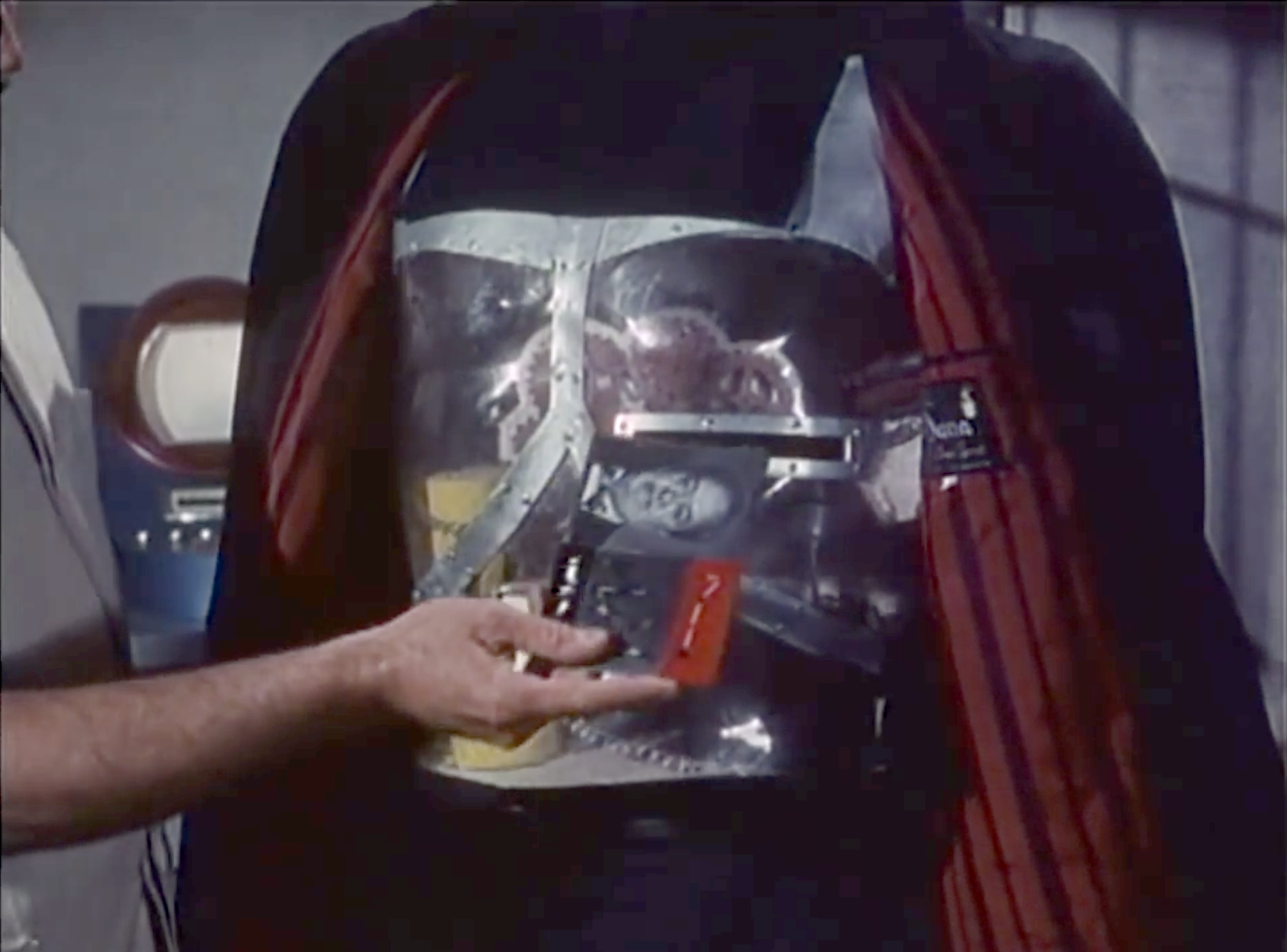
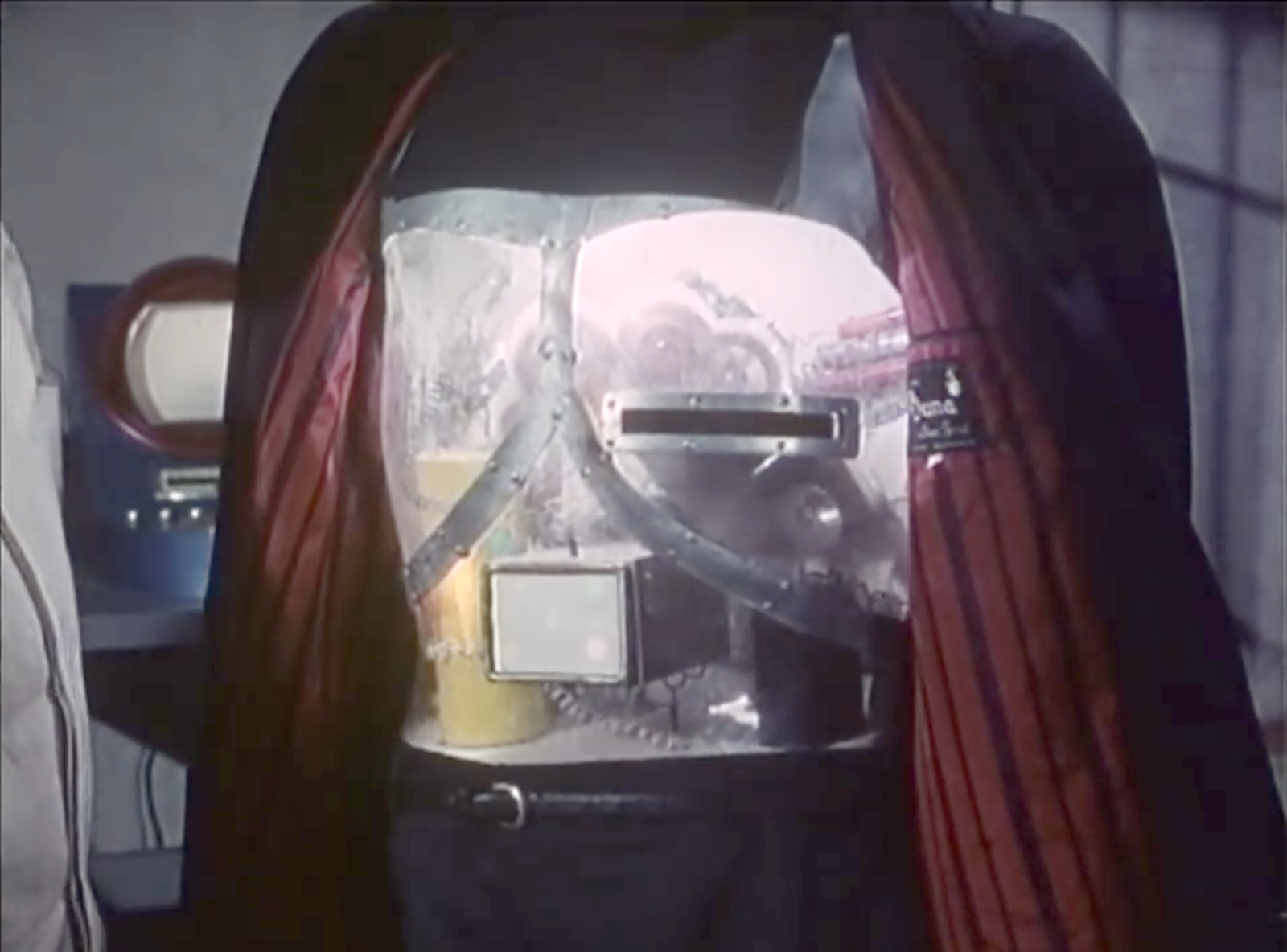
To provide the Victim Cards to the Robot Asesino, Orlak inserts it into an open slot in the robot’s chest, which then illuminates, confirming that the instructions have been received.

There is, I must admit, a sort of lovely, morbid poetry to a cardiogram being inserted into a slot where the robot heart would be to give the robot instructions to end the beating of the human heart described in the cardiogram. And we don’t see a lot of poetry in sci-fi interface designs. So, props for that.

The illumination is a nice bit of feedback, but I think it could convey the information in more useful and cinegenic ways.

In this new scenario…

  • Orlak has the robot pull back its coat
  • The chamfered slot is illuminated, signaling “card goes here.”
  • As Orlak inserts the target card, the slot light dims as the chest-cavity light brightens, signaling “I have the card.”
  • After a moment, the chest-cavity light turns blood red, signaling confirmation of the victim and the new dastardly mission.

When the robot returns to Orlak after completing a mission, the red light would dim as the slot light illuminates again, signaling that it is ready for its next mission.

These changes improve the interface by first drawing the user’s locus of attention exactly where it needs to go, and then distinguishing the internal system states as they happen. It would also work for the audience, who understands by association that red means danger.

The shape of the slot is pretty good for its base usability. It has clear affordances with its placement, orientation, and metallic lining. There’s plenty of room to insert the target card. It might benefit from a fillet or chamfer for the slot, to help avoid accidentally crumpling the paper cards when they are aimed poorly.

In addition to the tactical questions of illumination and shape of the slot, I have a few strategic questions.

  • There is no authorization in evidence. Can just anyone specify a target? Why doesn’t Gaby use her luchadora powers to Spin-A-Roonie a target card with Orlak’s face on it and let the robot save the day? Maybe the robot has a whitelist of heartbeats, and would fight to resist anyone else, but that’s just me making stuff up.
  • Also I’m not sure why the card stays in the robot. That leaves a discoverable paper trail of its crimes, perfect for a Scooby to hand over to the federales. Maybe the robot has some incinerator or shredder inside? If not, it would be better from Orlak’s perspective to design it as an insert-and-hold slot, which would in turn require a redesign of the card to have some obvious spot to hold it, and a bump-in on the slot to make way for fingers. Then he could remove the incriminating evidence and destroy it himself and not worry whether the robot’s paper shredder was working or not.
  • Another problem is that, since the robot doesn’t talk, it would be difficult to find out who its current target is at any given time. Since anyone can supply a target, Orlak can’t just rely on his memory to be certain. If the card was going to stay inside, it would be better to have it displayed so it’s easy to check.
  • How would Orlak cancel a target?
  • It is unclear how Orlak specifies whether the target is to be kidnapped or killed even though some are kidnapped and some are killed.
  • It’s also unclear about how Orlak might rescind or change an order once given.
  • It is also unclear how the assassin finds its target. Does it have internal maps with addresses? Or does it have unbelievably good hearing that can listen to every sound nearby, isolate the particular heartbeat in question, and just head in that direction, destroying any walls it encounters? Or can it reasonably navigate human cities and interiors to maintain its disguise? Because that would be some amazing technology for 1969. This last is admittedly not an interface question, but a backworlding question for believability.

So there’s a lot missing from the interface.

It’s the robot assassin designer’s job to not just tick a box to tell themselves that they have provided feedback, but to push through the scenarios of use to understand in detail how to convey to the evil scientist what’s happening with his murderous intent.

Playing the Victim Card

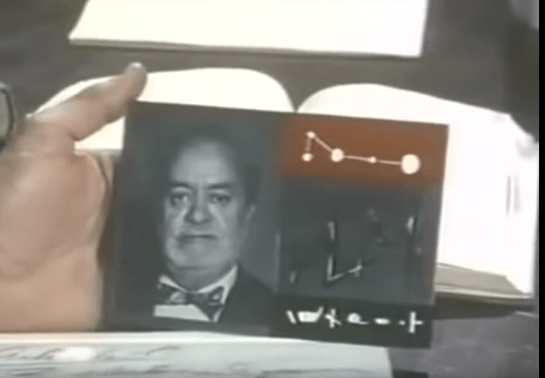
To specify a target for assassination or kidnapping, Orlak (or a henchman) inserts a specially designed card into a slot built into the robot’s chest, right at its heart. One of those cards is below.

The layout of the card puts the victim’s picture on the left; a node-graph diagram that looks like a constellation diagram, and some inscrutable symbols on the right. The characters discuss that this card contains a cardiogram of the victim, but it’s unclear which part of the card has this information, because they usually look something like this:

1896 Copyrighted work available under Creative Commons Attribution
only license CC BY 4.0 http://creativecommons.org/licenses/by/4.0/

Oh, it’s probably worth mentioning that one of the movie’s givens is that a cardiogram can uniquely identify a person, like a thumbprint (which isn’t as provably unique as popular culture would have us believe). But to use a cardiogram to locate a person without a ubiquitous sensing network (unthinkable in 1969) would require a very high resolution cardiogram, a wall-piercing sensors, and some shockingly advanced pattern matching on the part of the robot, and I’m not sure I’m willing to give this film that much credit.

Presuming that there are lots of technical reasons for the stuff on the right, and the robot needs the profile for visual recognition, I imagine the only thing missing is a human-readable name so these are easy for the henchmen and scientists to discuss amongst themselves. I mean, they might happen to know every single scientist in town by sight, but having the name would avoid possible misidentifications. The design of artifacts have to take into account all common scenarios of use, including production, maintenance, and storage.

Speaking of which, it’s unclear how these cards are produced. They seem like they take a lot of expert effort to produce and fabricate. Let’s give the film credit to say that this is a deliberate attempt by the enslaved scientists to…

  • Make something as irrevocable as a death sentence very difficult to order.
  • Ensure an order to the murderous robot takes time, and thereby give time to let passions subside and orders to be rescinded.
  • Serve as a bailiwick of sorts, being too difficult for a layperson to do, and thereby difficult to turn on its masters.
  • Secure their jobs.

LATE BREAKING UPDATE: Turns out these cards are a copy of cards from The Avengers (1961–1969). Check out the comparison.

Fox News

“He tried taking water from toilets, but it’s Secretary Not Sure who finds himself in the toilet now. And as history pulls down its pants and prepares to lower its ass on Not Sure’s head it will be Daddy Justice who will be crapping on him this time.”

Idiocracy_fox-news03

Today is election day. If you’re American, you’re voting, of course. (or, you know, GTFO.)

Because of voter suppression efforts by the GOP, many who are voting will be facing long lines. Help encourage these Americans, slogging as they are through the GOP swamp just for their right to vote, to stay the course by buying them some pizza. And if it’s you, know that you can report your long line to the same place and have some ‘za sent your way.

pizzatothepolls.png

https://polls.pizza/

Godspeed, America.

Idiocracy_fox-news05

I’ll get back to wrapping up Idiocracy later.

The Court of Idiots

It’s Halloween, as if the news of the past week were not scary enough. Pipe bombs to Democratic leaders. The largest massacre of Jewish people in on American soil in history. The murder of two black senior citizens by a white supremacist in Kentucky. Now let’s add to it with this nightmare scene from Idiocracy. Full disclosure: We’re covering technology as old as civilization here, so there won’t be any screen interfaces.


Joe is wheeled into the courtroom in a cage. There is a large gallery there, all of whom are booing him. One throws his milkshake at the accused. Others throw trash. The narrator says, “Joe was arrested for not paying his hospital bill and not having his IPP tattoo. He would soon discover that in the future, Justice was not only blind, but had become rather retarded as well.”

IDIOCRACY_court30.png

Joe is let out of his cage. The judge, identified by his name plate as The Honorable Hector “The Hangman,” stands at his bench in a spotlight in front of a wall of logos, grinning in anticipation at a new victim. He slams a massive gavel and shouts at the booing crowd, “Listen up! Now. I’m fixin’ to commensurate this trial here. [All of this is sic.] We gon’ see if we can’t come up with a verdict up in here. Now. Since y’all say y’ain’t got no money, we have proprietarily obtained you one of them court-appointed lawyers. So, put your hands together to give it up for Frito Pendejo!”

Frito, wearing a long-sleeve t-shirt with “ATTORNEY AT LAW” running down the sleeve, sits and looks at a paper on the counsel table, saying “Says here you, uh, robbed a hospital?! Why’d you do that?” Joe says, “But I’m not guilty!” Frito replies, “That’s not what the other lawyer said.”

IDIOCRACY_attorneyatlaw

When the trial officially starts, the judge says, “Shut up. Shut up! Now, prosecutor. Why you think he done it?” The prosecutor stands up and says, “K. Number one, your honor. Just look at him.” Most everyone in the courtroom, including, Frito, laughs at this. Frito stands up and says, “He talks like a fag, too!” When more laughter dies down, the prospector continues, saying, “We’ve got all this, like, evidence, of how, like, this guy didn’t even pay at the hospital and I heard that he doesn’t even have his tattoo.” There are collective gasps. He continues, “I know! And I’m all, ‘You gotta be shitting me.’ But check this out, man, judge should be like, ‘Guilty!’ Peace.” The gallery erupts with applause and cheers. There is one guy wearing a helmet with a camera mounted to the top and he takes it all in dumbly.

IDIOCRACY_trial-Cam

When Frito stands to raise an objection, he says, “Your honor, I object…that this guy, also broke my apartment and shit.” There are gasps from the gallery, and Frito feels emboldened. “Yeah! And you know what else, I object that he’s not going to have any money to pay me after he pays back all the money he stole from the hospital!” This last bit is addressed to the gallery. They shout in anger. Frito finishes, saying, “And I object. I OBJECT that he interrupted me while I was watching, OW, MY BALLS! THAT IS NOT OK! I REST MY CASE.”

Joe stands and says, “Your Honor, I’m pretty sure we have a mistrial, here, sir.” Hector looks confused at this statement. Frito gets hostile and says, “I’m going to mistrial my foot up your ass if you don’t shut up!”

IDIOCRACY-mistrial-my-foot

Joe ignores him and says, “Please listen!” The prosecuting attorney simply mocks him, “Please listen!” Hector laughs. The lawyers high five each other.

The narrator says, “Joe stated his case, logically and passionately. But his perceived effeminate voice only drew big gales of stupid laughter. Without adequate legal representation, Joe was given a stiff sentence.”

So…this nightmare

For most Americans, the drafting and adjudication of laws feels like something that happens “out there.” But upholding the law is something that, through jury duty or being part of a court case, is something most citizens directly experience some time in their lives. So it may seem like familiar, everyday stuff.

WitnessForTheProsecution575-600x365
Wait. I know this.

But take that less trodden path to ask why it is the way it is, and you’ll eventually find yourself at the foundations of civilization and in the throes of philosophy. A key premise and promise of civilized society is having a fair and rational place for citizens to air grievances, and institutions that make and enforce just laws. In practice it’s far from perfect, but I’d bet most folks agree it’s better than the alternatives of lawlessness, personal violence, revenge, tribal feuds, and vigilantism.

Laws and courts are institutions that are so old and foundational, it’s hard to remember that:

  • They were, in fact, invented. There was a time before them.
  • There were reasons for the way they were designed.
  • Their design, like all designs, aren’t perfect, and involve some trade offs.
  • They evolve over time.
  • There are alternate designs to consider.

Idiocracy illustrates how important its norms are, and how tragic it can be when those norms are lost, and everyone involved is a fucking idiot. It’s not exactly monster rampage, body horror, or torture porn, but this scene is as scary a thing as you could ask for Halloween.

Violence as a means

Frito threatens violence a lot. So do a lot of the people in Idiocracy. I’m not even sure if they mean it, but they think that threatening or beating or shooting someone into silence is a fine way to disagree. One of the key promises of civilization is to undo that might-makes-right bullshit that kept generations of peasants suffering while an aristocracy lived the high life peeing in hallways, flubbing courtly love, and stuffng birds into each other like meaty nesting-dolls. We’ve moved on.

yorkshirepie.png
Have we, though?

Skepticism

It’s funny-terrifying that the case made against Joe is so stupid. There are crass appeals to emotion. Prosecution says that there’s “all this, like, evidence” but does not actually share any, like, evidence. Frito riles the Gallery up with insults “he talks like a fag” and personal grievances that aren’t germane to the case. (Ow My Balls! should not be evidence in, well, anything.)  It’s emotional theater and the audience eats it up, because what they’re there for is hits to the amygdala bong: The emotional highs and lows that you might get from a sports show. People screaming in cheers when their confirmation bias is rewarded, or fury when there’s a bit of cognitive dissonance. There’s probably nothing like a Fair Witness left on the planet, and if it weren’t for Joe’s intelligence that gets him out of jail, he would wind up suffering in prison for no reason at all. The lack of skepticism, of applying doubt to all things—especially the things that thrill you emotionally—causes unnecessary suffering. Sure, it’s an unjust universe, but civilization was invented to try and hold a little light against that darkness. The citizenry of Idiocracy are gullible and blithely self-serving to a cruel fault.

Impartiality

The system that pits prosecution against defense and presumes is called “adversarial,” since each counsel will present opposing cases to an impartial judge or jury, who is presumed competent to sort through the competing claims to come to the truth. It’s contrasted with an inquisitorial (or nonadversarial) system where the judges run the line of inquiry. Congressional hearings, for example, are much more of an inquisitorial system. Congresspeople ask the questions, rather than the lawyers.

The adversarial system depends on the impartiality of the judge and jury. If they presume guilt or innocence from the start, why have the trial at all? (This is sometimes called a kangaroo court, where procedure and ethics are ignored, and the outcome is a foregone conclusion.) Only dispassionate, neutral participants can look past their feelers to find a fair and impartial truth. You need people capable of impartial, critical thinking to look past the tricks and their own cognitive biases. That’s out the window in Idiocracy.

IDIOCRACY_court31

Joe is presumed guilty by literally everyone involved. It’s not wholly their fault. Joe is brought in wearing prison fatigues. He is wheeled in a cage. On the surface, he looks guilty. Humans have an availability bias, wherein easily recalled information is believed to be true and representative, and for very stupid people, that can be strictly what they see. And Joe looks guilty. Everyone around me is shouting that he’s guilty. So, the idiot thinks, he must be guilty.

Posers, surface evidence, and meaning

One of the worst things about the scene—and this plays out in the movie generally—is how people’s status is based on stupid, surface markers. For instance: Why do they accept that the judge is smart? Well, he uses fancy, “faggy” words like “commensurate” (It’s a malaprop. He means commence. But the Idiocrats are too stupid to know this.) and “proprietarily.” (I think he means “properly,” but it’s marvelously hard to tell.) Investigating this moves us very quickly into the semiosis treadmill, whereby a sign comes slowly to become the signified, even when it stupidly contradicts the original thing that was signified.

How do courts protect against idiocy?

It doesn’t always. But generally, there are lots of checks against incompetence. Anyone can request a mistrial if it’s shown that counsel, a judge, or a jury is incompetent, prejudiced, or doesn’t follow the rules. Lawyers can be reviewed and disbarred. Remedy for judges varies by state, but judges can be impeached, or undergo judicial review and be removed from their office. Their cases can be overturned by higher courts. (Yes, even that one.)

But notably all these presume that the incompetence is abnormal, and that others are competent to review and judge their competence. When everyone either gets so stupid or so corrupt that they have no interest in checking each other for fairness, the system just collapses.

IDIOCRACY-comminserate

Can design do anything?

This blog is primarily targeted at people who work in technology and love sci-fi. (Like I do.) A natural question is: Can design do anything to help inoculate courts against Idiocracy? And normally, I try to offer some hopeful answer to these questions, but this one has me stumped. What design interventions could we impose to increase skepticism? Impartiality? Critical thinking? Understanding? Seriously, if you have something, I’d love to hear it, because as of right now, I’ve got nothing.

How’s that for a Halloween scare?

Trick or Treat

Any Trump acolyte who has gleefully shouted “Lock her up! Lock her up!” at one of their farrowing-crate rallies, despite Clinton’s exoneration by the FBI, despite Trump’s own ongoing litany of scandals (including that ongoing issue of security), is guilty of this same kind of mob mentality as these morons in Idiocracy. It is all raw hate without reason. Hits from the tribalism bong. It’s not just that the mob hasn’t heard reason, it’s not interested in reason, only in justification. Only in thinking of political conversations as hobo fights. Did our guy land a hit? Insult? Hur dur, yarp.

lock her up
Yes, you, redhat.

It’s pretty soul crushing. So let’s have some spooky, escapist fun tonight for self-care. But as of tomorrow we’ll have 6 days and we should hit it hard.