Who did it better? Victim card edition.

Let’s cut to the chase. Las Luchadoras is a wholesale rip-off of Cybernauts, from the 1961–1969 British TV series The Avengers, specifically the episode “Return of the Cybernauts” from 1967. Thanks to readers Xavier Mouton-Dubosc @dascritch and Roger Long @evil_potato for drawing my attention to the complete ripoffery.

Dust off your stereoscopes for this one.

Compare freely…

  • Bad robot is silver-faced, wears a black trench coat, does not speak, wears black sunglasses, and a black hat.
  • Bad robot is given instructions via a graphically-designed card inserted into a machine slot.
  • Bad robot smashes through walls to gain access to victims who stand there in horror rather than, say, running from the slow-walking golem.
  • When bad robot kills, it does so with karate chops.
  • Bad human captures scientists and forces them to provide engineering specs to fulfill his evil ambitions.
  • Bad human forces scientists to build a wrist-wearable mind-control device, for use on Team Good. (One’s a bracelet. The other is a watch.) The main target for mind-control is a woman.
  • Bad human has plans to use the mind-controlled person to fight the rest of Team Good.
  • The day is saved (spoiler? I guess?) by pulling the mind-control device from the victim and putting it on the robot, which instead of granting the bad human more control of the robot, causes it to go berserk.

It’s like René Cardona saw “Return of the Cybernauts” on TV, loved it, and thought there is only one thing that could make this better: Lady. Wrestlers. So he added luchadoras and hoped BBC Four wouldn’t notice. He just wanted to make the world better, y’all.

If you think I’m exaggerating, here are a few side by side shots.

I guess we can give credit to Cardona’s selection of a Bolero hat instead of that tired Fedora thing? SciFiFashionChoices.com
A split image featuring two scenes: on the left, characters from 'The Avengers' (1967) in a futuristic setting, with a woman in a red outfit and a man in a suit; on the right, characters from 'Luchadoras...' (1969) dressed in silver and white, in a laboratory environment.
I like the implication in Luchadoras that audiences wouldn’t trust that these men were engineers unless they were in medical scrubs. (?) Way to trust your audience, Cardona.

The main differences from the technology point of view is that in “The Cybernauts” (the first episode from The Avengers to feature the robots, when the series was still shot in black and white), the robots didn’t track their victims by heartbeat. The robots followed a radio signal emitted from a pen that was gifted to the victim. In “The Return of the Cybernauts,” they’d gotten an upgrade, and did their tracking via sensors that were all on board.

A man in a black coat and hat sits in a chair, wearing sunglasses and gloves, against a plain background.
10 FOLLOW PEN / 20 GOTO 10

Additionally, in The Avengers, the victim card is inserted into an angled control panel attached to a wall-sized computer. In Luchadoras, the card is inserted into a slot built into the Robot Asesino. (The next post.) Otherwise, the steps of interaction are the same.

A display card showing a black and white photo of a man in a suit, with identifying information and a graphical representation of data, including a heartbeat line and braille.

Which brings us to the Victim Cards

Behold them, side-by-side.

A split image featuring a portrait of a man from 'The Avengers' (1967) on the left and a man holding a photo from 'Luchadoras...' (1969) on the right, both accompanied by abstract graphics and data.

It’s easier to tally the differences than the similarities, because they are quite alike.

  • Avengers’ cards are affixed to transparent plastic. Luchadoras’ cards are a thick paper.
  • Avengers’ has its elements separated by light blue rule lines. Luchadoras’ has no borders.
  • Avengers’ has a numeric unique identifier in the lower left.
  • Avengers’ top graphic looks like black computer-readable shapes on a white background. (Though it was almost certainly graphic tape.) Luchadoras’ looks like a white star chart on a red background.
  • Avengers’ middle graphic is clearly a cardiogram (even if cardiograms are continuous not plotted points). Luchadoras’ is hard to read because of the crappy transfer, but nothing like a cardiogram.
  • Avengers’ lower graphic looks something like white braille pips on a red background. Luchadoras’ is weird white glyphs on a black background.

So…Who did it better?

Let’s not use the low resolution of this transfer against Luchadores. And we won’t use the lack of trippy face-stabilizing algorithms in the transfer of The Avengers against it.

Production

The bits on The Avengers’ card are clearly pasted there. The corners are curling up! But the plastic card feels solid and monumental. Luchadoras’ card seems like it was printed the way we see it! Using a color printer today, this would be a no big deal. But back in 1969 this was quite an achievement. Luchadoras wins.

A profile image of a man in a bow tie displayed alongside a graph and numerical data, suggesting a medical or identification context.

Graphics

Avengers top graphic is perfect. Like an early version of OCR. It’s very convincingly an instruction for a computer: precise and high contrast. Sadly the cardiogram is a little off, since even if it was plotted points, those points would be evenly spaced, and having the irregular plots on graph paper only highlights the unevenness. The braille-like bits at the bottom are, again, very convincingly an instruction for a 1960s computer to easily read.

Luchadores’ is just…nonsensical. A star chart? Hieroglyphs? “Cardiogram” lines that go backwards and cross back over themselves?

Avengers wins, leaving us with a need for a tie-breaker.

Diegetic usability

This is the main measure, and I’m just being coy for leaving it to the last. The purpose of the card is for henchmen and bad guys to provide programs for a robot assassin.Luchadoras’ space-filling layout and production quality make it look more in-line with modern design sensibilities on the surface, the actual content of those graphics are just 4th-wall-destroyingly awful.

Plus, since, the Avengers’ has the unique ID that makes it easy to for the humans to talk about with each other,…

“Get me the Peel card!”
“Uh, which is that?”
“The only person presenting as a woman?”
“Wut?”
“1252.”
“Oh, Hahaha. Got it.

A close-up of a card featuring a black and white photo of a woman with long hair, alongside various graphs and printed patterns.

…it wins.

If you’re going to copy, Luchadoras, seek to deeply understand the thing you’re copying first.


For more Who Did it Better, see the tag. Right now there’s only the fingernail-o-matics from The Fifth Element and Total Recall, but I’ll tag future things with that same tag.
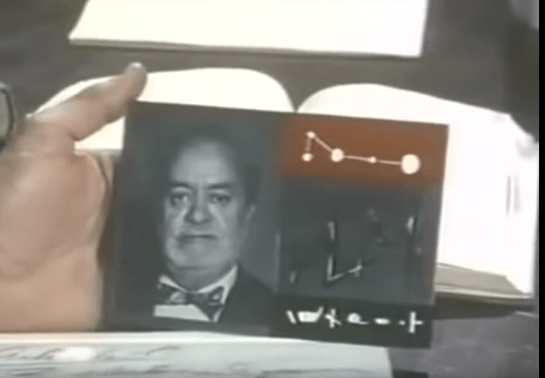
Playing the Victim Card

To specify a target for assassination or kidnapping, Orlak (or a henchman) inserts a specially designed card into a slot built into the robot’s chest, right at its heart. One of those cards is below.

The layout of the card puts the victim’s picture on the left; a node-graph diagram that looks like a constellation diagram, and some inscrutable symbols on the right. The characters discuss that this card contains a cardiogram of the victim, but it’s unclear which part of the card has this information, because they usually look something like this:

1896 Copyrighted work available under Creative Commons Attribution
only license CC BY 4.0 http://creativecommons.org/licenses/by/4.0/

Oh, it’s probably worth mentioning that one of the movie’s givens is that a cardiogram can uniquely identify a person, like a thumbprint (which isn’t as provably unique as popular culture would have us believe). But to use a cardiogram to locate a person without a ubiquitous sensing network (unthinkable in 1969) would require a very high resolution cardiogram, a wall-piercing sensors, and some shockingly advanced pattern matching on the part of the robot, and I’m not sure I’m willing to give this film that much credit.

Presuming that there are lots of technical reasons for the stuff on the right, and the robot needs the profile for visual recognition, I imagine the only thing missing is a human-readable name so these are easy for the henchmen and scientists to discuss amongst themselves. I mean, they might happen to know every single scientist in town by sight, but having the name would avoid possible misidentifications. The design of artifacts have to take into account all common scenarios of use, including production, maintenance, and storage.

Speaking of which, it’s unclear how these cards are produced. They seem like they take a lot of expert effort to produce and fabricate. Let’s give the film credit to say that this is a deliberate attempt by the enslaved scientists to…

  • Make something as irrevocable as a death sentence very difficult to order.
  • Ensure an order to the murderous robot takes time, and thereby give time to let passions subside and orders to be rescinded.
  • Serve as a bailiwick of sorts, being too difficult for a layperson to do, and thereby difficult to turn on its masters.
  • Secure their jobs.

LATE BREAKING UPDATE: Turns out these cards are a copy of cards from The Avengers (1961–1969). Check out the comparison.

Drone Programmer

A close-up of a hand wearing a glove holding a futuristic device with a screen displaying a holographic globe and various data interfaces.

One notable hybrid interface device, with both physical and digital aspects, is the Drone Programmer. It is used to encode key tasks or functions into the drone. Note that it is seen only briefly—so we’re going off very little information. It facilitates a crucial low-level reprogramming of Drone 172.

This device is a handheld item, grasped on the left, approximately 3 times as wide as it is tall. Several physical buttons are present, but are unused in the film: aside from grasping, all interaction is done through use of a small touchscreen with enough sensitivity to capture fingertip taps on very small elements.

Jack uses the Programmer while the drone is disabled. When he pulls the cord out of the drone, the drone restarts and immediately begins to try and move/understand its surroundings.

A person stands facing a large, futuristic robotic head with multiple cameras and sensors, while two armed figures are positioned nearby in a dimly lit environment.
When Drone 172 is released from the Programmer cable, it is in a docile and inert state…
A person standing in front of a large, futuristic robotic machine with glowing lights and mechanical arms, set in a dimly lit environment.
…but it quickly becomes aware, its failsafes shut down and its onboard programming taking over.

From this we understand that drones are controlled via internal software; this is the only time we see them programmed or their behavior otherwise influenced by a human. This reprogramming requires an external device wired into the drone in direct physical proximity, which suggests an otherwise high level of autonomy for each drone.

(Narrative implications) Following Orders

The Drone Programmer, and the way it interacts with Drone 172, suggests useful information about the Drones’ default states—namely, that their default state is autonomous, aggressive, and proactive, depending upon their orders and programming.

Drone 172 does not attack at this stage, and we have seen through Jack’s eyes on the screen that this is due to an overriding primary objective, implanted directly into the Drone’s firmware / low level programming: Rendezvous with the Tet.

Low Level Controller: Handle With Care

A gloved hand holding a futuristic device with a digital screen displaying various readings and graphs.

Its suggestion of a provisional or failsafe role is reinforced by warning text above the display, (legible at high resolution,) reflective of its power: “Electric Hazard Do Not Touch Terminals on Both Lines at Same Time: Lead Ends May Be Energized…

Between this and the sparks ignited when the cable is detached from the Drone, one gets the sense of a device somewhere between a terminal and a jumper cable. Potent, hazardous, direct.

A close-up image of a hand holding a wire while interacting with the interior of a mechanical object.
A close-up of a male astronaut in a futuristic suit, focused on a mechanical device above him, set in a dimly lit environment with sparks and steam.

Jack is clearly at ease with the Programmer and its usage from repair sessions at home and in the field. This ease suggests either that his training (or memory replacement) is thorough, or that such low level work is needed frequently enough to be quite familiar.

The latter explanation, along with the Programmer’s nature as a physical device requiring direct proximity, would reinforce the interpretation that Tet places a remarkable amount of trust in instances of the human Maintenance team, and that the equipment in question is nearly symbiotic with the Team(s) in its need for frequent recovery.

Thus through this one seemingly incidental device, and its low level role in the chain of command, we can deduce that the combination of Drones and Team(s) is much more effective than either could be individually. Jack was reprogrammed by his time spent in curious wandering, crossed with the opportunity presented by the book quotation mentioned as a trigger. In the case of Jack, the book and its couplet is the low-level reprogramming device, shocking in its directness.

Dialogue within the film reinforces the analogy directly: We learn during this sequence that the first invasion phase entailed many instances of a short-lived (non-learning) Jack as soldier. We also learn that phase two is this symbiotic maintenance arrangement between human and machine. When it is suggested that Drone 172 is the weapon, Jack corrects that it is he himself—its user and maintainer—who is the weapon. Without his role as user and maintainer, the machine would ultimately be a neutralized mechanical husk.

Lessons:

  1. Low level interfaces suggest fundamental programming and activity.
    (NOTE: Compare to interfaces such as the Nostromo Self Destruct pulls in Alien, etc.)
  2. Use of low level interfaces suggests familiarity and/or “grace under pressure”, as well as systemic trust in the user.
  3. Low level interfaces suggest a deep symbiosis between the user and the machine, to the point of interdependence.
    (NOTE: Compare to failsafe systems and manual overrides in aeronautics and (a few realistic moments in) space films such as Sunshine. In an alternate universe, I have the time to cover/analyse Sunshine to uncover this very dynamic…)
  4. Bonus Lesson (Oblivion-centric): By analogy, in highly technological or post-apocalyptic settings, books are, for humans, a low level interface, forcing the user to slow down and absorb sometimes startling, unexpected, or course-changing information.