St. God’s: Healthmaster Inferno

After Joe goes through triage, he is directed to the “diagnosis area to the right.” He waits in a short queue, and then enters the diagnosis bay.

The attendant wears a SMARTSPEEK that says, “Your illness is very important to us. Welcome to the Healthmaster Inferno.”

The attendant, DR. JAGGER, holds three small metal probes, and hands each one to him in turn saying, “Uh, this one goes in your mouth. This one goes in your ear. And this one goes up your butt.” (Dark side observation about the St. God’s: Apparently what it takes to become a doctor in Idiocracy is an ability to actually speak to patients and not just let the SMARTSPEEK do all the talking.)

Joe puts one in his mouth and is getting ready to insert the rest, when a quiet beeping causes the attendant to pause and correct himself. “Shit. Hang on a second.” He takes the mouth one back and hands him another one. “This one…No.” He gathers them together, and unable to tell them apart, he shuffles them trying to figure it out, saying “This one. This one goes in your mouth.” Joe reluctantly puts the offered probe into his mouth and continues.

The diagnosis is instant (and almost certainly UNKNOWN). SMARTSPEEK says, “Thank you for waiting. Dr. Lexus will be with you shortly.”

Idiocracy_diagnosis01

The probes

The probes are rounded, metal cylinders, maybe a decimeter in length. They look like 3.6mm audio plugs with the tips ground off. The interface-slash-body-horror joke is that we in the audience know that you shouldn’t cross-contaminate between those orifices in a single person, much less between multiple people, and the probes look identical. (Not only that, but they aren’t cleaned or used with a sterile disposable sheath, etc.) So Joe’s not sure what he’s about to have to put in his mouth, and DR. JAGGER is too dumb to know or care.

IDIOCRACY_diagnostic-and-carwash-ref.jpg

The bay

Modeled on car wash aethetics, the bay is a molded-plastic arch, about 4 meters to a side. The inside has a bunch of janky and unsanitary looking medical probes and tools. Around the entrance of the bay are an array of backlit signs, clockwise from 7 o’ clock:

  • Form one line | Do not push
  • (Two right-facing arrows, one blue, one orange)
  • (A stop sign)
  • (A hepatitis readout, from Hepatitis A to Hepatitis F, which does not exist.)
  • Tumor | E-Coli | Just gas | Tapeworm | Unknown
  • Gout | Lice | Leprosy | Malaria
  • (Three left-facing arrows, orange, blue, and magenta)
  • (The comp created for the movie tells…) Be probe ready | Thank you!

Theoretically, the lights help patients understand what to do and what their diagnosis is. But the instruction panels don’t seem to change, and once the patient is inside the bay, they can no longer see the diagnosis panels. The people in the queue and the lobby, however, can. So not only does it rob the patients of any bodily privacy (as they’re having to ram a probe up their rears), but it also robs them of any privacy about their diagnosis. HIPPA and GDPR are rolling around in their then-500 year old graves.

Hygiene

A better solution would of course focus on hygiene first, offering a disposable sheath for the probes. They should still be sterilized between patients.

Idiocracy_diagnosis05
Because this is such as visceral reminder, I’m nominating this as the top anti-example of affordances and constraints for new designers.

Better affordances

Second would be changing the design of the probes such that they were easy to distinguish between them. Color, shape, and labeling are initial ideas.

Better constraints

Third would be to constrain the probes so that…

  • The butt probe can’t reach up beyond the butt (maybe tying the cable to the floor? Though that means it’s likely to drop to the ground, which is clearly not sterile in this place, so maybe tying it the wall and having it klaxon loudly if it’s above butt height.)
  • The mouth probe can’t reach below the head (maybe tying the cable to the ceiling)
  • The ear probe should be smaller and ear-shaped rather than some huge eardrum-piercing thing.

And while modesty is clearly not an issue for people of Idiocracy, convention, modesty, and the law require us in our day to make this a LOT more private.

Prevention > remedy

Note that there is an error beep when Joe puts the wrong probe in his butt. Like many errors, by that time it is too late. It makes engineering sense for the machine to complain when there is a problem. It makes people sense to constrain so that errors are not possible, or at the very least, put the alarm where it will dissuade from error.

Also, can we turn the volume up on those quiet beeps to, say, 80 decibels? I think everyone’s interested in more of an alarm than a whisper for this.

Idiocracy_diagnosis06

A hidden, eviscerating joke

In addition to the base comedy—of treating diagnosis like a carwash, the interaction design of the missing affordances and constraints, and the poop humor of sticking a butt probe in your mouth—there is yet another layer of stupid evident here. Many of the diseases listed on the “proscenium” of the bay are ones that can be caused by, yep, ingesting feces. (Hepatitis A, Hepatitis E, tapeworm, E. “boli.”) Enjoy the full, appetizing list on Wikipedia. It’s a whole other layer of funny, and hearkens back to stories of when late-1800s doctors took umbrage at Ignaz Semmelweis’ suggestions that they wash their hands. (*huffgrumble* But we’re gentlemen! *monocle pop*) This is that special kind of stupid when people are the cause of their own problems, and refuse to believe it because they are either proud…or idiots.

But of course, we’re so much wiser today. People are never, say, duped into voting for some sense of tribal identity despite mountains of evidence that they are voting against their community, or even their own self-interest.

Fighting the unsanitary butt plugs of the Idiocracy

“Action by action, day by day, group by group, Indivisibles are remaking our democracy. They make calls. They show up. They speak with their neighbors. They organize. And through that work, they’ve built hundreds of mini-movements in support of their local values. And now, after practice, training, and repetition, they’ve built lasting power on their home turf and a massive, collective political muscle ready to be exercised each and every day in every corner of the country.”

cropped-Indivisible_Favicon.png

Donate or join the phone bankers at Indivisible to talk people into voting, and perhaps some sanity into Idiocrats. Indivisible’s mission is “to cultivate and lift up a grassroots movement of local groups to defeat the Trump agenda, elect progressive leaders, and realize bold progressive policies.”

St. God’s: Insurance Slot Machine

The other depressing thing besides the FloorMaster that Joe sees as he walks through St. God’s lobby is the insurance slot machines.

Idiocracy_triage01

He sees a man with a blank expression and a bleeding head wound above his left eye, who stands a bank of slot machines. The backglass of each has diagonal logos advertising BLAKDIX capsules (n.b. the wallpaper advertises BONERAX), telling players they can play while they wait, and that they can WIN FREE MEDICAL CARE. The reel strips don’t show bells or fruit, but rather, pills. The blood from the head wound shines in the lights.

Idiocracy_triage02
This is the future that the GoP and insurance companies want.

Games and games of chance don’t obey standard usability principles. The point of them is that you don’t know if you’ll get what you want. So a regular analysis won’t do.

Slot machines are fairly standardized, and the only things these particular ones seem to be missing is a paytable. If you don’t know your slot machine lingo, that’s an information table, presented on the backglass, explaining what combinations of symbols pay out and how much. Three z-packs? Congratulations! You don’t have to die of sepsis today! No player should put money in a slot machine without knowing what the payout might be. And these machines don’t have them. In the real world, this wouldn’t fly. But in Idiocracy, it’s perfect. Let me explain. Of course it’s going to get political fast.

The shock of this half-a-second beat comes from the immediate recognition that the man is bleeding, and the half-a-second later realization that he’s standing at a slot machine to try and resolve his problem. Why isn’t he getting care? Why does he accept this? Why would anyone? This is stupid, you think. And you’re right. It’s stupid and inhumane that the richest country in the world would not use some of its wealth to take care of its citizens. Yet 44 million Americans have no insurance and another 38 million have inadequate insurance. That means nearly one-third of Americans are just hoping that they don’t get sick. If they do, they risk either getting that help and going bankrupt, or living in pain, getting worse…maybe dying. Also, you know, their kids.

No one wants to get sick. So in our system, we have the uninsured gambling with their lives.

This isn’t just how it has to be. Thirty-two of the thirty-three developed nations have universal health care, with the United States being the only exception. There’s an idiotic idea that America somehow gets great medical care in exchange for this, but that’s just a self-serving lie. The Commonwealth Fund did an extensive comparison of the healthcare in 11 developed nations, and the U.S. fared the worst. And individually, we pay about twice as much per capita than other developed nations. So our system is the most expensive, AND the worst, AND abandons ⅓ of our citizens to rolls of the healthcare dice. How can it be this way? Who is in favor of this? Healthcare for profit, of course, and that’s a GoP speciality.

We know that Democrats lead the way on healthcare reform. The Affordable Care Act was remarkable for how far it got with Obama facing a historically obstructionist Republican Congress, and the GoP has been trying to undo it since. Insurance companies know that the GoP is their friend. In 2012, the insurance industry donated nearly $55 million to parties and candidates and 68% went to Republicans. They know.

Which brings up back to the slot machines. People who stand at a machine that looks like it might give them healthcare (gosh, it looks like a slot machine. It must pay eventually, right?), without any indication that it actually will, are idiots, and any system that allows this is an Idiocracy.

We have one tool to combat making this image any more of a reality, and it’s a vote.

Fighting Idiocracy

Voter suppression tactics (undertaken in the bad-faith argument against voter fraud) include closing polling places near traditionally Democrat strongholds. What can you do?

Drive them yourself

If you have seats to spare make a broadcast on social media channels. Or offer to people who may face transportation challenges.

Join Find a volunteer driver group

Carpool the Vote seems dedicated to this cause, but is currently not accepting any more sign ups, but it would be worth checking in on the site to see if they open up again. I couldn’t find an alternate system, but if anyone knows it, speak up in the comments.

Share information about discounted and free ride-shares

Lyft is offering 50% off rides to and from polling locations on election day. Unfortunately I can’t find a way to donate to Lyft so they can make it free, so I will note that Uber—though a company with a much worse track record as a corporate citizen than Lyft—has promised free rides. (People have to have the latest version of the app, so also encourage them to update it.) Get that word out to people who can use it. Post on neighborhood Facebook groups, Slack, and NextDoor channels.

uber-drive-the-vote.png

Get people to the polls so they exercise their right to vote.

Pregnancy Test

Another incidental interface is the pregnancy test that Joe finds in the garbage. We don’t see how the test is taken, which would be critical when considering its design. But we do see the results display in the orange light of Joe and Beth’s kitchen. It’s a cartoon baby with a rattle, swaying back and forth.

pregnancy.gif

Sure it’s cute, but let’s note that the news of a pregnancy is not always good news. If the pregnancy is not welcome, the “Lucky you!” graphic is just going to rip her heart out. Much better is an unambiguous but neutral signal.

That said, Black Mirror is all about ripping our hearts out, so the cuteness of this interface is quite fitting to the world in which this appears. Narratively, it’s instantly recognizable as a pregnancy test, even to audience members who are unfamiliar with such products. It also sets up the following scene where Joe is super happy for the news, but Beth is upset that he’s seen it. So, while it’s awful for the real world; for the show, this is perfect.

Black_Mirror_Pregnancy_Test.png

Airport Security

After fleeing the Yakuza in the hotel, Johnny arrives in the Free City of Newark, and has to go through immigration control. This process appears to be entirely automated, starting with an electronic passport reader.

jm-9-customs-b

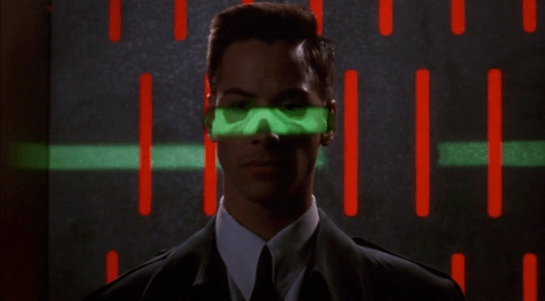
After that there is a security scanner, which is reminiscent of HAL from the film 2001: A Space Odyssey.

jm-9-customs-f

The green light runs over Johnny from top to bottom.

jm-9-customs-c

Looking at the picture, we can see that this green light is somehow making Johnny’s skeleton visible. It would be possible, by having an X-ray imaging system running at the same time and then re-projecting the X-ray image back onto the body, but why? Since there don’t appear to be any actual human beings on duty, I can only suggest that it is meant to look intimidating and impressive to encourage obedience. In the film Johnny appears to be alone and cannot see this himself, but it would be much more common for there to be multiple passengers, so each could watch the others being scanned.

There is also a screen showing another scan, a blurry body image, and text appearing on the right side. A voice repeats the text content. For the first time we see a blue background, the most common color for futuristic film interfaces.

jm-9-customs-d

The scanner detects Johnny’s implant, but whatever secrecy measures are present cause the system to decide that it is a registered dyslexia aid. The popup alert below includes the registration issuer and a domain name, so perhaps this is online verification over the Internet. Presumably Johnny can see this screen himself, if he cares.

jm-9-customs-e

The voiceover helpfully informs Johnny that there is “synaptic seepage”, and he should seek medical attention within 24 hours. This shows quite high level decision making by the system and an offer of assistance. Johnny says “thanks” in reply, an anthropomorphic response to this seemingly intelligent machine.

However, there seems to be a more detailed explanation in smaller text on the right of the display, and this isn’t announced. It’s not clear in this scene whether Johnny can see this display or not, but even if he could it would be difficult to read. Perhaps this is a legacy system from the days when airport security had actual staff.

Next

At this point Johnny leaves the airport, riding in a taxi from the airport. It is a good time for the first review of a group of related interfaces, which will be the next series of posts.

The Memory Doubler

In Beijing, Johnny steps into a hotel lift and pulls a small package out his pocket. He unwraps it to reveal the “Pemex MemDoubler”.

jm-4-memdoubler-a

Johnny extends the cable from the device and plugs it into the implant in his head. The socket glows red once the connection is made.

jm-4-memdoubler-b-adjusted
jm-4-memdoubler-c-adjusted

Analysis: The jack

The jack looks like an audio plug, and like most audio plugs is round and has no coronal-orientation requirement. It also has a bulbous rather than pointed tip. Both of these are good design, as Johnny can’t see the socket directly and while accidentally poking yourself with a headphone style point is unlikely to be harmful, it would certainly be irritating.

The socket’s glow would be a useful indicator that the thing is working, but Johnny can’t see it! Probably these sockets and jacks are produced and used for other devices as well, as red status lights are common in this world.

There are easier and more convenient fictional brain plug interfaces, such as the neck plugs previously discussed on this website for Ghost In The Shell. But Johnny doesn’t want his implant to be too obvious, so this not so convenient plug may be a deliberate choice. Perhaps he tells inquisitive people that it’s for his Walkman.

Analysis: The device

The product name got a few chuckles from audiences in the 1990s, as the name is similar to a common classic Macintosh extension at the time, the Connectix RAM Doubler. This applied in-memory lossless data compression techniques to allow more or larger programs to run within the existing RAM.

The MemDoubler is apparently a software or firmware updater, modifying Johnny’s implant to use brain tissue twice as efficiently as before. It has voice output, again a slightly artificial sounding but not unpleasant voice. This announces that Johnny’s current capacity is 80 gigabytes. As the update is applied, a glowing progress bar gradually fills until the voice announces the new capacity of 160G.

jm-4-memdoubler-d

(Going from 80G to 160G seems quaint today. But we should remember that the value of a mnemonic courier is secrecy, not quantity.)

Why does the MemDoubler need voice output? For such a simple task, the progress bar and a three digit numeric counter would seem adequate. But if there are complications—which for something wired into the brain might have an all too literal meaning for “fatal error”—a voice announcement would be able to include much more detail about the problem, or even alert bystanders if Johnny is rendered unconscious by the problem. (Given how current software installers operate, Johnny is fortunate that the MemDoubler did not insist on reciting the entire end user license agreement and warranty before the update could start.) Maybe the visual should be the default (to respect his professional need for secrecy), and the voice announcement adopted in an alert mode.

It’s also interesting that Johnny installs this immediately before he needs it, in the lift that is taking him to the hotel room where he will receive the data to be stored. Suppose someone else had been in the lift with him? In this world of routine body implants doubling your memory is probably not a crime, but at the time of writing diabetics will inject themselves in private even though that is harmless and necessary. Perhaps body-connected technology will be common enough in 2021 that public operation is considered normal, just as we have become accustomed to mobile phone conversations being carried out in public.

Healing chamber

StarshipTroopers-tank-02

After Johnny was mistakenly reported as killed, the next time we see him he is in a healing chamber, submerged in green-underlit translucent fluid, resting on form-fitting clear plastic supports. He breathes through a tube, and a pair of small robot arms work busily to regenerate the damaged tissue in his leg.

StarshipTroopers-tank-01

The main reason to discuss this chamber on a blog about interfaces is the material choice of the outside of the chamber. By being surrounded completely in a transparent material (glass? plexiglass? transparent aluminum?), it means that physicians can keep an eye on progress, and he can have visual interactions with visitors, as we see when Dizzy and Ace visit to share with him his mistaken death certificate (and for Dizzy to leave him a kiss.) Additionally it gives Johnny something to look at during the long hours of recuperation.

I’m not sure why the green light is necessary. The scene implies that it could serve some part in the healing process, but if not, I wonder if an amber light might signal a more human, nurturing warmth to Johnny and visitors. Narratively, you’d want to avoid anything too yellow or run the risk of the audience’s first interpretations drifting too far to the Andres-Serrano-esque.

StarshipTroopers-tank-04_gold

Four a day

An electronic quit smoking device displaying refill options, a countdown timer, and various indicators.

After Korben’s alarm clock starts the music and lights the lights, it also drops his daily allotment of cigarettes into place inside vertical glass tubes in a small dispensary mounted on the wall. Each tube has a purple number printed across the top, reinforcing the limit. A robotic voice tells reminds him to only have “four. a. day.”

fifthelement-4aday

The dispensary is loaded with warnings to get him to quit. Across the top we read 4™ REFILLS. Just below that is a white imperative, QUIT SMOKING. To the right another legend reinforces the principles spoken aloud, 4™ A DAY. A legend across the bottom, written in glittery red capitals reminds him that, TO QUIT IS MY GOAL. Behind the glass tubes is something like a Surgeon General’s warning about the dangers of smoking.

On the right is a small LCD panel with a mysterious readout at the top of 1:::1…1..1, a counter in the middle reading 00:04 (it looks like just after midnight in military time, but we know from his alarm clock it’s just after 02:00), and a temperature readout that confirms the temperature that the clock displays, 27.5° C. Below this panel is a small set of four buttons: two horizontal ones that sandwich two triangular ones pointing in opposite directions. Korben presses the lowest button to pick up the first cigarette, and the #1 cylinder of glass slides up. A smaller “vase” of glass holds the cigarette upright for Korben to grab.

A shirtless man talking on a phone while pointing at a control panel on the wall.

The LCD panel

The top readout is a mystery, and the middle might be a counter of number of cigarettes remaining for the day or in the refill, but why it’s in 24-hour notation is another mystery. The temperature doesn’t make much sense here. Better might be the variable information that the addicted smoker really wants: How soon until I can get my next fix. A clock showing that time would be useful, and give the smoker something to fixate on instead of the cravings. A countdown clock might be information that the smoker wants, but it would focus his attention on the device rather than on his willpower.

To quit is my goal

Really, it’s beyond the scope of this blog post to try and state the authoritative psychology of quitting smoking, but it does seem like this device accomplishes one common strategy well, which is reminding smokers of their goal. There it is, in glittery red, in a first-person voice.

But it doesn’t do everything well. Another strategy to quit is for smokers to have reminders of the negative consequences of continuing to smoke, and the device only kind of does this with the warning label. The fact that it’s behind the glass tubes is nice since to get at the cigarettes the smoker wants, he is faced with that text. But, it’s only text, and easy to simply not read. The fact that the cylindrical glass distorts the text makes willful ignoring even easier, since it hinders readability. Better would be a visceral, instantly-recognizable image, like Australia mandated on their cigarette packaging in 2011. The disturbing nature of these images would be enhanced by the cylinder’s distortions.

Cigarette warning packaging highlighting the effects of smoking, including blindness, mouth and throat cancer, and the dangers of secondhand smoke to children.

On the other hand, one strategy is to eliminate the triggers that remind a smoker about cigarettes, and this dispensary does exactly the opposite. By being prominently displayed on the wall, being associated with waking up, and having the word “smoking” appear in high-contrast capital letters at eye level, it pretty much acts as a trigger to remind Korben about smoking. Better might be a hideaway dispensary, similar to his bed, refrigerator, or shower in the apartment, which hide themselves away when not in use.

Surgeon General’s Warning

The other problem is habituation. After repeated exposure to this device on a daily basis, Korben will begin to disregard the signal. A more persuasive system would change, such that the consequences and goals are kept fresh on Korben’s mind. To make sure it hits home at the right time, I would get rid of the extraneous buttons and have one “time-release” button, that requires him to press and hold it for a few seconds to get at the cigarette. During this enforced moment of boredom, the device can flash a new message and dissuasive image, giving Korben a moment to consider this and whether he really wants to keep pressing the button for his cigarette. The LCD panel would need to display these instructions first, and then switch to showing the time at which the next cigarette will be available.

A device displaying the message 'SMOKING CAUSES BLINDNESS' with a digital screen indicating daily goals beside a series of tubes visible in the front.