Airport Security

After fleeing the Yakuza in the hotel, Johnny arrives in the Free City of Newark, and has to go through immigration control. This process appears to be entirely automated, starting with an electronic passport reader.

jm-9-customs-b

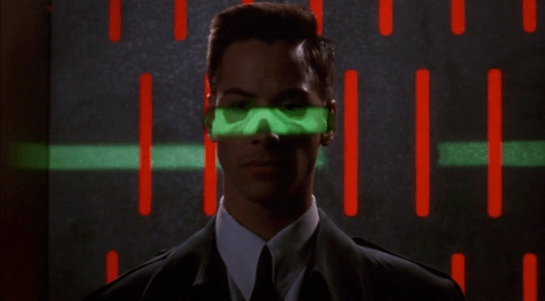
After that there is a security scanner, which is reminiscent of HAL from the film 2001: A Space Odyssey.

jm-9-customs-f

The green light runs over Johnny from top to bottom.
jm-9-customs-c

Looking at the picture, we can see that this green light is somehow making Johnny’s skeleton visible. It would be possible, by having an X-ray imaging system running at the same time and then re-projecting the X-ray image back onto the body, but why? Since there don’t appear to be any actual human beings on duty, I can only suggest that it is meant to look intimidating and impressive to encourage obedience. In the film Johnny appears to be alone and cannot see this himself, but it would be much more common for there to be multiple passengers, so each could watch the others being scanned.

There is also a screen showing another scan, a blurry body image, and text appearing on the right side. A voice repeats the text content. For the first time we see a blue background, the most common color for futuristic film interfaces.

jm-9-customs-d

The scanner detects Johnny’s implant, but whatever secrecy measures are present cause the system to decide that it is a registered dyslexia aid. The popup alert below includes the registration issuer and a domain name, so perhaps this is online verification over the Internet. Presumably Johnny can see this screen himself, if he cares.

jm-9-customs-e

The voiceover helpfully informs Johnny that there is “synaptic seepage”, and he should seek medical attention within 24 hours. This shows quite high level decision making by the system and an offer of assistance. Johnny says “thanks” in reply, an anthropomorphic response to this seemingly intelligent machine.

However, there seems to be a more detailed explanation in smaller text on the right of the display, and this isn’t announced. It’s not clear in this scene whether Johnny can see this display or not, but even if he could it would be difficult to read. Perhaps this is a legacy system from the days when airport security had actual staff.

Next

At this point Johnny leaves the airport, riding in a taxi from the airport. It is a good time for the first review of a group of related interfaces, which will be the next series of posts.

Other floor cleaning robots

Yesterday I offered extra credit if a reader could name the first floor sweeping robot in a film in the Make It So survery. Pixel I/O smartly noted that The Jetsons (debut 1962) had one—its autovac. (Thanks to Matt Houghton of TechVert.com for posting the image.)

jetsons-autovac

This is a great catch, but Pixel I/O rightly acknowledged that The Jetsons was not a film, so off by a technicality. Shouts out anyway, as this example was a full three or four years before the film I did have in mind, which was the only-nominally sci-fi comedy The Glass Bottom Boat (1966). Still, I happened to come across it in research and captured it.

In the film, the inventor Rod (Bruce Templeton) tries to impress Jennifer (Doris Day) with this floor-cleaning robot. It only manages to pop out of its door to arc towards a dropped banana peel and through reversed footage, arc right back into its home under the kitchen island.

What’s interesting about these two examples are their similarity. They’re each the size of a small dog. Each has an antenna and two eyes. The antennae speak of the radio-controlled paradigm of the era. Audiences needed to know how they are being controlled, and this shortcut answered the question at a glance. The eyes hint at a need for anthropomorphism, or possibly zoomorphism, for users to understand the thing’s capabilities. We know it can see us and the things around it because of this simple visual affordance.

Floor sweeping robots

fifthelement-178

To illustrate his capitalist ideology, (a high-tech version of the parable of the broken window) Zorg activates his automatic cleaning robots. To do this, he deliberately crashes a glass to the floor, where a set of robots come scuttling out from beneath his desk and begin cleaning up.

Three of them serve to demarcate the space as a “”robots working”” zone, with tall masts from which red beacon lights warn anyone nearby. In the middle of these three, a sweeper robot gathers the large pieces of glass with broom and dustbin actuators.

fifthelement-183

Then, a vacuum robot spins above the location to remove the fine pieces of glass.

fifthelement-182

Finally, a hemispheric robot also comes to sterilize the area, or possibly to just spray a pleasing scent in the air. After they are done, they retreat automatically to the desk, and a new drinking glass rises from a hidden compartment to Zorg’s desktop, filling with water to the accompaniment of a small voice that announces ““water”” and, as a bowl of the stuff also raises, ““fruit.””

As Zorg pulls a cherry from the bowl, the same voice announces somewhat pointlessly, ““a cherry.”” (Perhaps useful if the eater is unfamiliar with basic types of fruit.)

TheFifthElement-life

Analysis

The robots are meant to do their job safely and efficiently, and then put themselves away as quickly as possible. The main “interface” task they have is to keep nearby humans informed and safe. (Did Asimov write a law for vacuum cleaners?) A minor secondary goal might be to distinguish the function of each by their shape. The robots inform observers explicitly with the stanchion robots’ beacon lights and bright red patterns. In addition, the whirring sounds of each robot’s motors and actuators help to reinforce the fact that they are working. If they were completely silent they would be more problematic for people not looking or unable to see. The beacon might be a bit of overkill and distracting to someone at a distance, but since the robots are small enough to be a trip hazard, and Cornelius is in fact less than a meter away at the time of sweeping, I can see why it might be needed in this particular case. That they are each readily distinguishable means it might be easier to intervene or select a particular one for maintenance. So, aside from the faulty logic they’re meant to embody, mostly really well designed.

The main improvement I can imagine is that the system might reduce the trip hazard by unifying these disparate functions in a single device, and then either keeping them stanchion-high or flattening its top out like a step. But then we’d just have invented Roomba five years early.

Extra credit

This isn’t the first floor cleaning robot seen on the silver screen. There was another movie over three decades before that included one, even though it wasn’t what most people would consider sci-fi. Can any of the Make It So readers identify that film in the comments? (I’ll post pics of the answer once someone guesses it.)