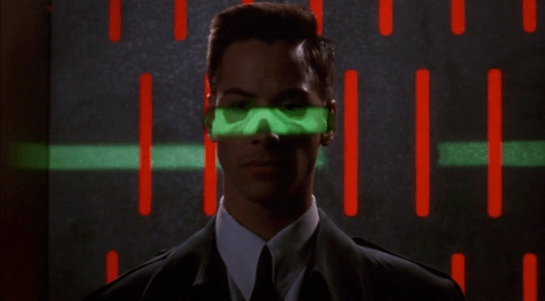
After fleeing the Yakuza in the hotel, Johnny arrives in the Free City of Newark, and has to go through immigration control. This process appears to be entirely automated, starting with an electronic passport reader.
After that there is a security scanner, which is reminiscent of HAL from the film 2001: A Space Odyssey.
The green light runs over Johnny from top to bottom.
Looking at the picture, we can see that this green light is somehow making Johnny’s skeleton visible. It would be possible, by having an X-ray imaging system running at the same time and then re-projecting the X-ray image back onto the body, but why? Since there don’t appear to be any actual human beings on duty, I can only suggest that it is meant to look intimidating and impressive to encourage obedience. In the film Johnny appears to be alone and cannot see this himself, but it would be much more common for there to be multiple passengers, so each could watch the others being scanned.
There is also a screen showing another scan, a blurry body image, and text appearing on the right side. A voice repeats the text content. For the first time we see a blue background, the most common color for futuristic film interfaces.
The scanner detects Johnny’s implant, but whatever secrecy measures are present cause the system to decide that it is a registered dyslexia aid. The popup alert below includes the registration issuer and a domain name, so perhaps this is online verification over the Internet. Presumably Johnny can see this screen himself, if he cares.
The voiceover helpfully informs Johnny that there is “synaptic seepage”, and he should seek medical attention within 24 hours. This shows quite high level decision making by the system and an offer of assistance. Johnny says “thanks” in reply, an anthropomorphic response to this seemingly intelligent machine.
However, there seems to be a more detailed explanation in smaller text on the right of the display, and this isn’t announced. It’s not clear in this scene whether Johnny can see this display or not, but even if he could it would be difficult to read. Perhaps this is a legacy system from the days when airport security had actual staff.
Next
At this point Johnny leaves the airport, riding in a taxi from the airport. It is a good time for the first review of a group of related interfaces, which will be the next series of posts.
The doctor’s office is a stark, concrete room with a single desk framed under large windows and a tall vaulted ceiling. Two chairs sit on a carpet in front of the desk for patients. A couple pieces of art and personal photos line the room, but they are overwhelmed by the industrial-ness of the rest of the space.
When the doctor enters, he carries a large folder with the patient’s health information and background on paper. He then talks with the patient directly, without help from notes or his patient’s folder.
There is no visible computer in the room.
While not a traditional interface, this office is interesting because it lacks any traditional interactive features of a futuristic doctor’s office; things like holograms, giant computer screen walls, and robots are completely absent.
It is also the patient’s interface to the medical industry and its news for her. And it can use some improvement.
Authority Figure
In this situation, the Doctor is acting as an authority figure to tell Laura what her diagnosis is and how likely she is to recover. The office is setup to put all the focus on the doctor, and his method of entry adds to the power focused on him.
Even the lack of computer indicates that the doctor is alone in the final call of what the diagnosis is. There is no intermediary between caregiver and patient.
This sets up a psychological condition where the patient is not in a position to question the doctor’s advice or diagnosis. The doctor tells the patient what they have, and the patient has to deal with it.
Medical Goals
Here, the doctor’s goal should be to help the patient through the situation and give them the best chance possible to recover. Generally, this means making sure:
The patient understands their situation
Knows what their options are
and follows through on the best plan of treatment.
From the transcript:
(In a large room, looking up through a glass ceiling. Ships are flying past overhead. Camera pans down to Laura Roslin, sitting in a chair in front of a desk. She’s looking out the window, and jumps at the sound of the door. A doctor in a white coat walks in.)
Doctor: I’m afraid the tests are positive. The mass is malignant. It’s advanced well beyond our…
(Noises drown him out [Laura no longer paying attention]—we see a ship taking off and then moving through space.)
As we are shown by Laura’s reaction to the doctor’s first words, she completely fails to understand the second two points. The doctor’s emphasis on power has scared Laura so badly that she can only focus on the fact that she has cancer. She leaves without being confident in her plan of care or her chances of survival.
That means that she is unlikely to follow through on the plan of care (which is exactly what we see later on), and she is unlikely to continue trusting that doctor (which we don’t see, only because the doctor’s office is violently removed from the planet along with pretty much everything else shortly after the visit).
Help the Patient
Research is now showing (a white-paper by Samira Pasha in 2013 (http://www.ncbi.nlm.nih.gov/pubmed/24089182) does a good job of collecting previous research and showing the importance of good design in the garden) that patients do better when surrounded by greenspace and people who are willing to talk to them in ways they can understand. Doctors who explain a patient’s options well are shown to improve the rates at which patients follow through on their treatments.
Ulfelder Healing Garden, Massachusetts General Hospital, Boston, MA. Photo by Naomi Sachs
Immediate improvements could include the following:
Add plants and trees
Take more care with the patient’s state of mind
Lower the ceiling to create more personal space
Refrain from invoking authoritarian criticism
Adding in more plants and trees to the office would have an immediate benefit for both the patient (Laura) and the doctor. Explaining the options more confidently and with a greater care towards the patient’s emotional state would give Laura a better chance to actually take the doctor’s advice. Additionally, that giant binder of Laura’s medical history is impossible for a reasonable patient to read through and understand. A basic overview and history could remind Laura of the procedures she’s been through and the encounters she’s had with various doctors. This could be followed by a summary sheet with the doctor’s recommendations and links to relevant treatment information.
Don’t Intimidate
A doctor’s job should not be to intimidate their patient with the doctor’s skill and experience. Instead, they should be focused on helping their patient through a very tough time in their life. Various tools can help both the patient and doctor in this situation. By restructuring the office to be more inviting and creating effective summaries of patient encounters, both the patient and doctor can create positive outcomes for the patient’s health.
After landing on Tau Ceti, Barbarella is captured by feral children who tie Barbarella to a set of poles and turn a set of robot dolls on her.
The dolls exhibit some crude intelligence. They walk on their own toward Barbarella. Stomoxys (or is it Glossina? It’s tough to tell with these two.) twists a knob on a control panel of four similar, unlabeled knobs, and the dolls’ piranha-toothed mouths begin to crank open and slam shut. They then attack Barbarella, clinging and biting her legs and arms.
At first the dials seem a strange choice for a killing device, but then you realize that this isn’t mean to be efficient. Rather, the choice of dials for controls fits the childrens’ awful goal. Stop dials are best for setting variables within a range of values. The dolls must have a few variables, like walking speed, biting force, and biting speed, that the horrible children will want to play with as they entertain themselves with this torture.
And of course to “improve” this interface you might want to label the dials so a new user would know what does what, but who would really want to make torture toys more usable?