Airport Security

After fleeing the Yakuza in the hotel, Johnny arrives in the Free City of Newark, and has to go through immigration control. This process appears to be entirely automated, starting with an electronic passport reader.

jm-9-customs-b

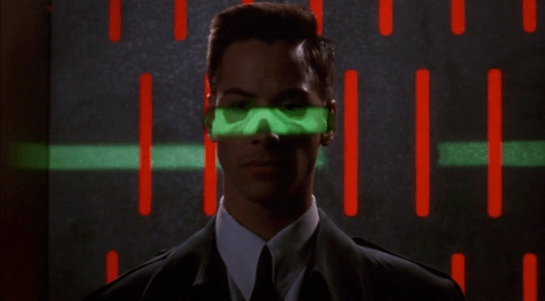
After that there is a security scanner, which is reminiscent of HAL from the film 2001: A Space Odyssey.

jm-9-customs-f

The green light runs over Johnny from top to bottom.
jm-9-customs-c

Looking at the picture, we can see that this green light is somehow making Johnny’s skeleton visible. It would be possible, by having an X-ray imaging system running at the same time and then re-projecting the X-ray image back onto the body, but why? Since there don’t appear to be any actual human beings on duty, I can only suggest that it is meant to look intimidating and impressive to encourage obedience. In the film Johnny appears to be alone and cannot see this himself, but it would be much more common for there to be multiple passengers, so each could watch the others being scanned.

There is also a screen showing another scan, a blurry body image, and text appearing on the right side. A voice repeats the text content. For the first time we see a blue background, the most common color for futuristic film interfaces.

jm-9-customs-d

The scanner detects Johnny’s implant, but whatever secrecy measures are present cause the system to decide that it is a registered dyslexia aid. The popup alert below includes the registration issuer and a domain name, so perhaps this is online verification over the Internet. Presumably Johnny can see this screen himself, if he cares.

jm-9-customs-e

The voiceover helpfully informs Johnny that there is “synaptic seepage”, and he should seek medical attention within 24 hours. This shows quite high level decision making by the system and an offer of assistance. Johnny says “thanks” in reply, an anthropomorphic response to this seemingly intelligent machine.

However, there seems to be a more detailed explanation in smaller text on the right of the display, and this isn’t announced. It’s not clear in this scene whether Johnny can see this display or not, but even if he could it would be difficult to read. Perhaps this is a legacy system from the days when airport security had actual staff.

Next

At this point Johnny leaves the airport, riding in a taxi from the airport. It is a good time for the first review of a group of related interfaces, which will be the next series of posts.

Rotwang’s Maschinenmensch (Machine-Man)

Rotwang’s Machine-Man is the most magical technology seen in the film. This is understandable since there the only common precedent available to the audience were stories of golems and imps, soulless and wicked servants out to wreck havoc at their master’s bidding. Despite this imp paradigm, many of the interfaces around the Machine-Man are worthy of note.

Rotwang reveals the Machine-Man.

When Rotwang first reveals the Machine-Man to Joh, he does so with a dramatic yank of a curtain to the side. There sits the automaton, in a throne before a catwalk. In response to the curtain’s opening, the catwalk gradually illuminates. Did the Man-Machine turn the lights on? Was it a “curtain switch?” The movie gives no clues, but the lesson is clear. Light signals power, and the Machine-Man is imbued with a lot of it.

The Machine-Woman awaits Rotwang’s instructions.

The Machine-Man as Joh meets it is entirely machine in appearance. (Beautifully designed by Walter Schulze-Mittendorff. This piece of sci-fi is so iconic and seminal that it warrants its own Wikipedia page.) At Joh’’s instruction, Rotwang gives the Machine-Man the outward likeness of Maria. How he is actually able to accomplishing this is vague, but note that as he twists up the power, more and more bars illuminate at the foot of the table. An early establishment that, as power increases, so does light.

Rotwang powers the transformation table.

This “light = power” theme is reinforced a number of times throughout this sequence.

Some machine glows as Rotwang turns it on.

With a switch the transformation begins.

Rotwang increases the power to the transformation table.

What does the tall tank, the arcing sphere, or the large wafer switch do? We don’’t know. But with the flick of a switch, something glows, and even without any sound to tell us, we know that he’’s summoning a great deal of power for what he’s about to do next.

Machine-Maria devises her saboteur’’s scheme.

Machine-Maria looks nearly identical to the real Maria. But in seeking to make the differences clear to the audience, actress Brigitte Helm needed to supply some kind of uncanny valley a century before the term was invented. Her response, which underscores the “evil twin” nature of Machine-Maria, was to adopt sharp, precise movements, an under-the-brow stare, and asymmetry. These simple cues let us know in a few seconds that she is not human and not to be trusted.

On the pyre, Machine-Maria reverts to her original form.

Machine-Maria’s death also underscores its deeply magical roots. When burning on the pillar, Machine-Maria transforms back to her original, machine-like form for little given reason other than her spell has been somehow broken.