Airport Security

After fleeing the Yakuza in the hotel, Johnny arrives in the Free City of Newark, and has to go through immigration control. This process appears to be entirely automated, starting with an electronic passport reader.

jm-9-customs-b

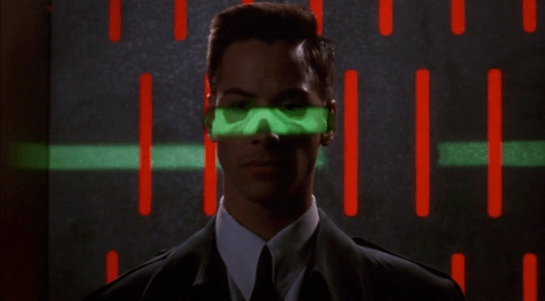
After that there is a security scanner, which is reminiscent of HAL from the film 2001: A Space Odyssey.

jm-9-customs-f

The green light runs over Johnny from top to bottom.
jm-9-customs-c

Looking at the picture, we can see that this green light is somehow making Johnny’s skeleton visible. It would be possible, by having an X-ray imaging system running at the same time and then re-projecting the X-ray image back onto the body, but why? Since there don’t appear to be any actual human beings on duty, I can only suggest that it is meant to look intimidating and impressive to encourage obedience. In the film Johnny appears to be alone and cannot see this himself, but it would be much more common for there to be multiple passengers, so each could watch the others being scanned.

There is also a screen showing another scan, a blurry body image, and text appearing on the right side. A voice repeats the text content. For the first time we see a blue background, the most common color for futuristic film interfaces.

jm-9-customs-d

The scanner detects Johnny’s implant, but whatever secrecy measures are present cause the system to decide that it is a registered dyslexia aid. The popup alert below includes the registration issuer and a domain name, so perhaps this is online verification over the Internet. Presumably Johnny can see this screen himself, if he cares.

jm-9-customs-e

The voiceover helpfully informs Johnny that there is “synaptic seepage”, and he should seek medical attention within 24 hours. This shows quite high level decision making by the system and an offer of assistance. Johnny says “thanks” in reply, an anthropomorphic response to this seemingly intelligent machine.

However, there seems to be a more detailed explanation in smaller text on the right of the display, and this isn’t announced. It’s not clear in this scene whether Johnny can see this display or not, but even if he could it would be difficult to read. Perhaps this is a legacy system from the days when airport security had actual staff.

Next

At this point Johnny leaves the airport, riding in a taxi from the airport. It is a good time for the first review of a group of related interfaces, which will be the next series of posts.

Videoconferencing

BttF_122

Marty Sr. answers a call from a shady business colleague shortly after coming home. He takes the call in the den on the large video screen there. As he approaches the screen, he sees a crop of a Renoir painting, “Dance at La Moulin de la Galette,” with a blinking legend “INCOMING CALL” along the bottom. When he answers it, the Renoir shrinks to a corner of the screen, revealing the live video feed with his correspondent. During the conversation, the Renoir disappears, and text appears near the bottom of the screen providing reminders about the speaker. This appears automatically, with no prompting from Marty Sr.

Needles, Douglas J.
Occupation: Sys Operations
Age: 47
Birthday: August 6, 1968
Address: 88 Oriole Rd, A6t
Wife: Lauren Anne
Children: Roberta, 23 Amy, 20
Food Prefence: Steak, Mex
Food Dislike: Fish, Tuna
Drinks: Scotch, Beer
Hobbies: Avid Basketball Fan
Sports: Jogging, Slamball, Tennis
Politics: None

This is an augmented reality teleconference, as mentioned in Chapter 8 of Make It So: Interaction Design Lessons from Science Fiction. See more information in that chapter. In short, it’s a particularly good example of one type of augmentation that is very useful for people having to interact with networks of people much larger than Dunbar’s number equips us for. Unfortunately, the information appears in a distracting scroll across the bottom, and is not particularly pertinent to the conversation, so could benefit from a bit of context awareness or static high-resolution display to be really useful.

When the conversation is done, the screen fades to black, and an animated AT&T logo appears as a female voice offers Thank you for using AT&T. Afterwards, another odd crop of a famous impressionist artwork appears on screen. (1887-88 Self-Portrait with Grey Felt Hatby Van Gogh, if you’re curious.) This must be a preference set by the McFlys.

During the conversation, Needles convinces Marty Sr. to front some money for a shady deal. To provide the money, he grabs his briefcase and presses one of several lit buttons on its surface. A thin reader raises from the surface on mechanized accordion arms. The slot glows white, and Marty inserts his ID card into the recess and yanks it to the right. Marty presses another button and the reader retracts.

Though pretty cool, this portable authenticator seems multimodal, the two objects are both of the same type, i.e. something he possesses, and so is only marginally more secure than unimodal systems.

BttF_131

Almost instantly, Marty is caught in the act and fired by his boss over the same video phone. To bring home the news, Fujitsu-san presses some button off screen and large letters YOU’RE FIRED appear overlaid on the screen, animating repeatedly for emphasis. Simultaneously, he sends Marty faxes, which Marty receives numerous times in the faxes in his suitcases and others which are installed all over the house, including the in the closet where Jennifer is hiding.

I’m not sure what would lead Needles or Marty(2015) to engage in something illegal that is obviously and instantly discoverable by authorities, but that is not a matter of interaction design.