Tattoo surveillance

In the prior Idiocracy post I discussed the car interface, especially in terms of how it informs the passengers what is happening when it is remotely shut down. Today let’s talk about the passive interface that shuts it down: Namely, Joe’s tattoo and the distance-scanning vending machine.

It’s been a while since that prior post, so here’s a recap of what’s happening in Idiocracy in this scene:

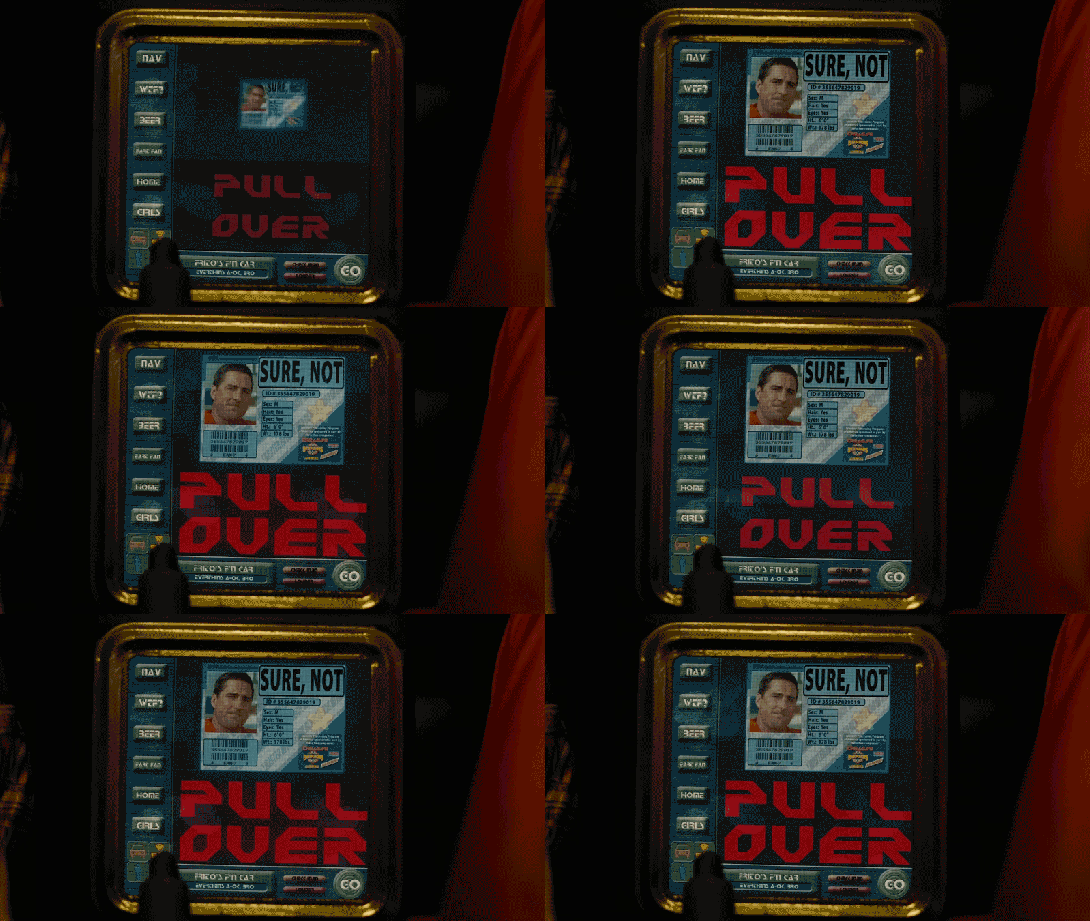
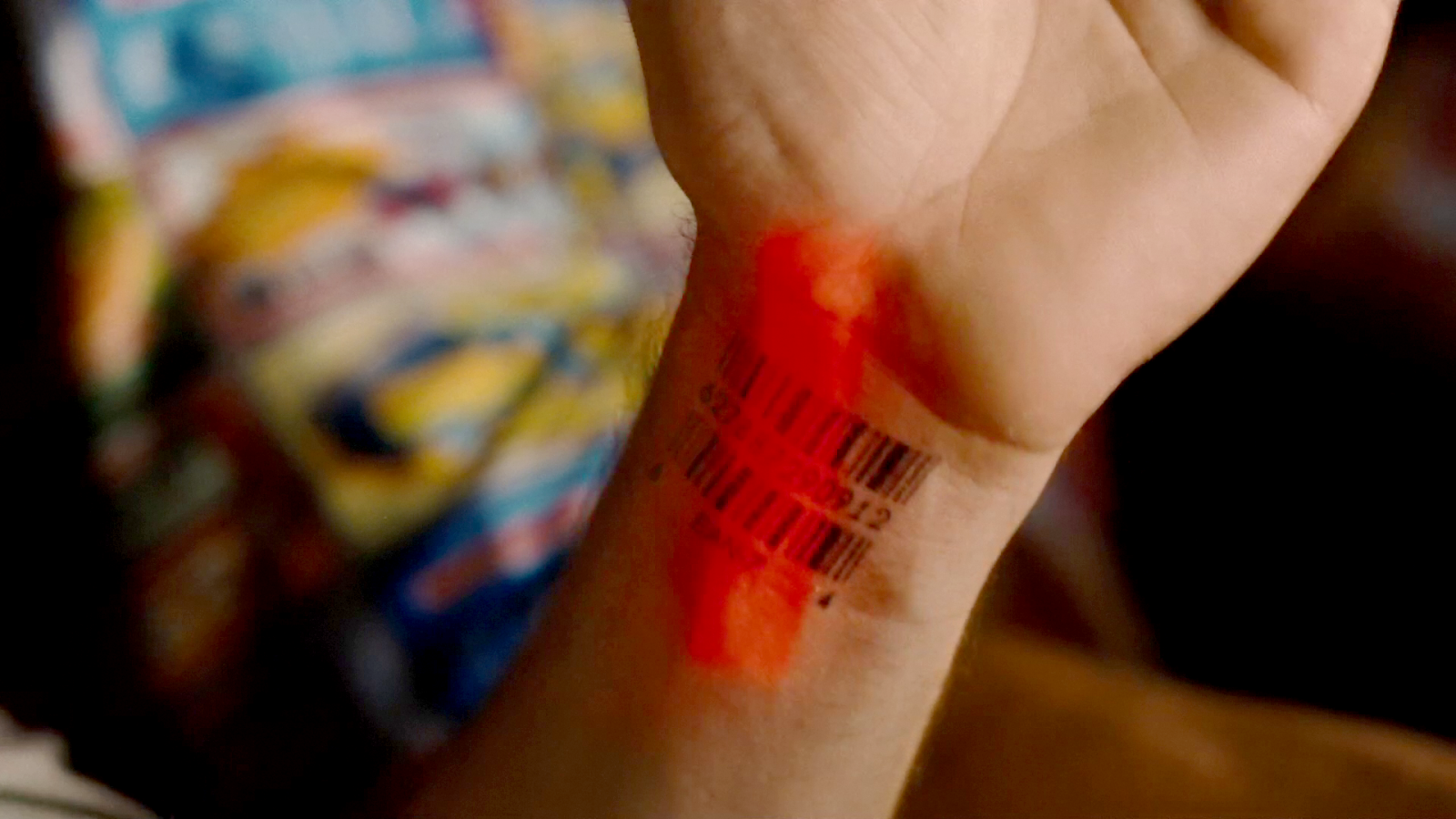
When Frito is driving Joe and Rita away from the cops, Joe happens to gesture with his hand above the car window, where a vending machine he happens to be passing spots the tattoo. Within seconds two harsh beeps sound in the car and a voice says, “You are harboring a fugitive named NOT SURE. Please, pull over and wait for the police to incarcerate your passenger.”

Frito’s car begins slowing down, and the dashboard screen shows a picture of Not Sure’s ID card and big red text zooming in a loop reading PULL OVER.

It’s a fast scene and the beat feels more like a filmmaker’s excuse to get them out of the car and on foot as they hunt for the Time Masheen. I breezed by it in an earlier post, but it bears some more investigation.
This is a class of transaction where, like taxes and advertising, the subject is an unwilling and probably uncooperative participant. But this same interface has to work for payment, in which the subject is a willing participant. Keep this in mind as we look first at the proximate problem, i.e. locating the fugitive for apprehension; and at the ultimate goal, i.e. how a culture deals with crime.

A quick caveat: While it’s fair to say I’m an expert on interaction design, I’m Just a Guy when it comes to criminology and jurisprudence. And these are ideas with some consequence. Feel free to jump in and engage in friendly debate on any of these points.

Proximate problem: Finding the fugitive

The red scan is fast, but it’s very noticable. The sudden flash of light, the red color. This could easily tip a fugitive off and cause them to redouble efforts at evasion, maybe even covering up the tattoo, making the law’s job of apprehending them that much harder. Better would be some stealthier means of detection like RFID chips. I know, that’s not as cinegenic, so the movie version would instead use image recognition, showing the point of view from the vending machine camera (machine point of view or MPOV), with some UI clues showing it identifying, zooming in to, and confirming the barcode.

Yes, that’s a shout-out.

So we can solve stealth-detection cinematically, using tropes. But anytime a designer is asked to consider a scenario, it is a good idea to see if the problem can be more effectively addressed somewhere higher up the goal chain. Is stealth-detection really better?

Goal chain

  • Why is the system locating him? To tell authorities so they can go there and apprehend him.
  • Why are they apprehending him? He has shown an inability to regulate damaging anti-social behavior (in the eyes of the law, anyway) and the offender must be incarcerated.
  • Why do we try to incarcerate criminals? To minimize potential damage to society while the offender is rehabilitated.
  • Why do we try to rehabilitate criminals? Well, in the Idiocracy, it’s an excuse for damnatio ad vehiculum, that is, violent public spectacle based on the notion that jurisprudence is about punishment-as-deterrent. (Pro-tip: That doesn’t work. Did I say that doesn’t work? Because that doesn’t work.) In a liberal democracy like ours, it’s because we understand that the mechanisms of law are imperfect and we don’t want the state to enact irreversible capital punishment when it could be wrong, and, moreover, that human lives have intrinsic value. We should try to give people who have offended a chance to demonstrate an understanding of their crime and the willingness to behave lawfully in the future. Between incarceration and rehabilitation, we seek to minimize crime.
  • Why do we try to minimize crime? (This ought to be self-evident, but juuust in case…) Humans thrive when they do not need to guard against possible attack by every other human they encounter. They can put their resources towards the pursuit of happiness rather than the defense of encroachment. Such lawful societies benefit from network effects.

The MPOV suggestion above fixes the problem at the low level of detection, but each step in the goal chain invites design at a more effective level. It’s fun to look at each of these levels and imagine an advanced-technology solution (and even find sci-fi examples of each), but for this post, let’s look at the last one, minimizing crime, in the context of the tattoo scanner.

Ultimate problem: Preventing crime

In his paper “Deterrence in the Twenty-First Century,” Daniel Nagin reviewed state of the art criminology findings and listed five things about deterrence. Number one in his list is that the chance of being caught is a vastly more effective deterrent than even draconian punishment.

Research shows clearly that the chance of being caught is a vastly more effective deterrent than even draconian punishment.

Daniel S. Nagin, 2013

How might we increase the evident chance of being caught?

  1. Fund police forces well so they are well-staffed, well-trained, and have a near-constant, positive presence in communities, and impressive capture rates. Word would get around.
  2. Nagin himself suggests concentrating police presence in criminal hotspots, ensuring that they have visible handcuffs and walkie-talkies.
  3. Another way might be media: Of making sure that potential criminals hear an overwhelming number of stories through their network of criminals being captured successfully. This could involve editorial choice, or even media manipulation, filtering to ensure that “got caught” narratives appear in feeds more than “got away with it” ones. But we’re hopefully becoming more media savvy as a result of Recent Things, and this seems more deceptive than persuasive.
  4. The other way is to increase the sense of observation. And that leads us (as so many things do) to the panopticon.

The Elaboratory*

The Panopticon is almost a trope at this point, but that’s what this scene points to. If you’re not familiar, it is an idea about the design of buildings in which “a number of persons are meant to be kept under inspection,” conceived in the late 1700s by Samuel Bentham and formalized by his brother James in letters to their father. Here is a useful illustration.

*Elaboratory was one of the alternate terms he suggested for the idea. It didn’t catch on since it didn’t have the looming all-seeing-eye ring of the other term.
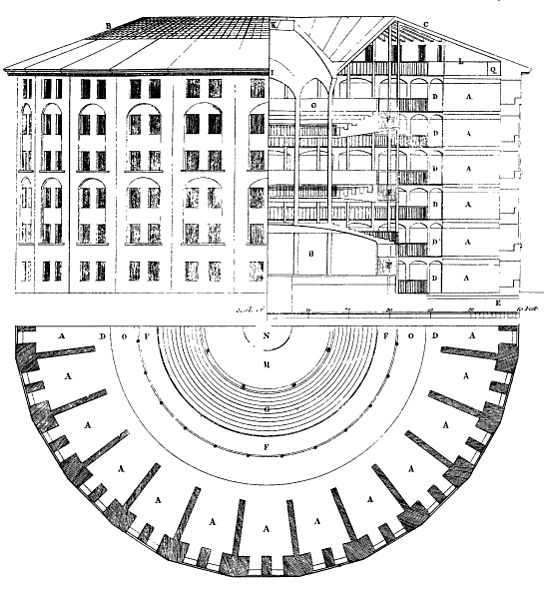
Elevation, section, and plan as drawn by Willey Reveley, 1791

The design of the panopticon is circular, with prisoners living in isolated cells along the perimeter. The interior wall of each cell is open to view so the inmate can be observed by a person in a central tower or “inspector’s lodge.” Things are structured so the inmates cannot tell whether or not they are being observed. (Bentham suggested louvers.) Over time, the idea goes, the inmate internalizes the unseen authority as a constant presence, and begins to regulate themselves, behaving as they believe the guard would have them behave. Bentham thought this was ideal from an efficacy and economic standpoint.

“Ideal perfection, if that were the object, would require that each person should actually [be under the eyes of the persons who should inspect them], during every instant of time.”

—Jeremey Bentham

It’s an idea that has certainly enjoyed currency. If you hadn’t come across the idea via Bentham, you may have come across it via Foucault in Discipline and Punish, who regarded it not as a money-saving design, but as an illustration of the effect of power. Or maybe Orwell, who did not use the term, but extended it to all of society in 1984. Or perhaps you heard it from Shoshana Zuboff, who in The Age of the Smart Machine reconceived it for information technology in a work environment.
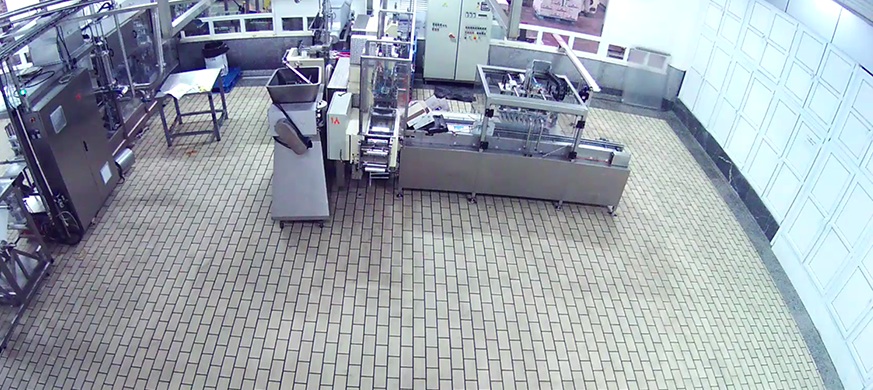
Umm…Carol? Why aren’t you at your centrifuge?

In Benjamen Walker’s podcast Theory of Everything, he dedicates an episode to the argument that as a metaphor it needs to be put away, since…

  1. It builds on one-way observation, and modern social media has us sharing information about ourselves willingly, all the time. The diagram is more dream catcher than bicycle wheel. We volunteer ourselves to the inspector, any inspector, and can become inspectors to anyone else any time. Sousveillance. Stalking.
  2. Most modern uses of the metaphor are anti-government, but surveillance capitalism is a more pernicious problem (here in the West), where advertising uses all the information it can to hijack your reward systems and schlorp money out of you.
  3. Bentham regarded it as a tool for behavior modification, but the metaphor is not used to talk about how surveillance changes us and our identities, but rather as a violation of privacy rights.

It’s a good series, check it out, and hat tip to Brother-from-a-Scottish-Mother John V Willshire for pointing me in its direction.

To Walker’s list I will add another major difference: Panopticon inmates must know they are being watched. It’s critical to the desired internalization of authority. But modern surveillance tries its best to be invisible despite the fact that it gathers an enormous amount of information. (Fortunately it often fails to be invisible, and social media channels can be used to expose the surveillance.)

Guns are bad.

But then, Idiocracy

In Idiocracy, this interface—of the tattoo and the vending machine—is what puts this squarely back in Bentham’s metaphor. The ink is in a place that will be seen very often by the owner, and a place that’s very difficult to casually hide. (I note that the overwhelming majority of Hillfinger [sic] shirts in the movie are even short-sleeved.) So it serves as that permanent—and permanently-visible—identifier. You are being watched. (Holy crap now I have yet another reason to love Person of Interest. It’s adding to our collective media impression the notion of AI surveillance. Anyway…) In this scene, it’s a clear signal that he and his co-offenders could see, which means they would tell their friends this story of how easily Joe was caught. It’s pretty cunningly designed as a conspicuous signal.

Imagine how this might work throughout that world. As people went around their business in the Idiocracy, stochastic flashes of light on their and other people’s wrists keep sending a signal that everyone is being watched. It’s crappy surveillance which we don’t like for all the reasons we don’t like it, but it illustrates why stealth-detection may not be the ideal for crime preventions and why this horrible tattoo might be the thing that a bunch of doomed eggheads might have designed for the future when all that was left was morons. Turns out at least for the Idiocracy, this is a pretty well-designed signal for deterrence, which is the ultimate goal of this interface.
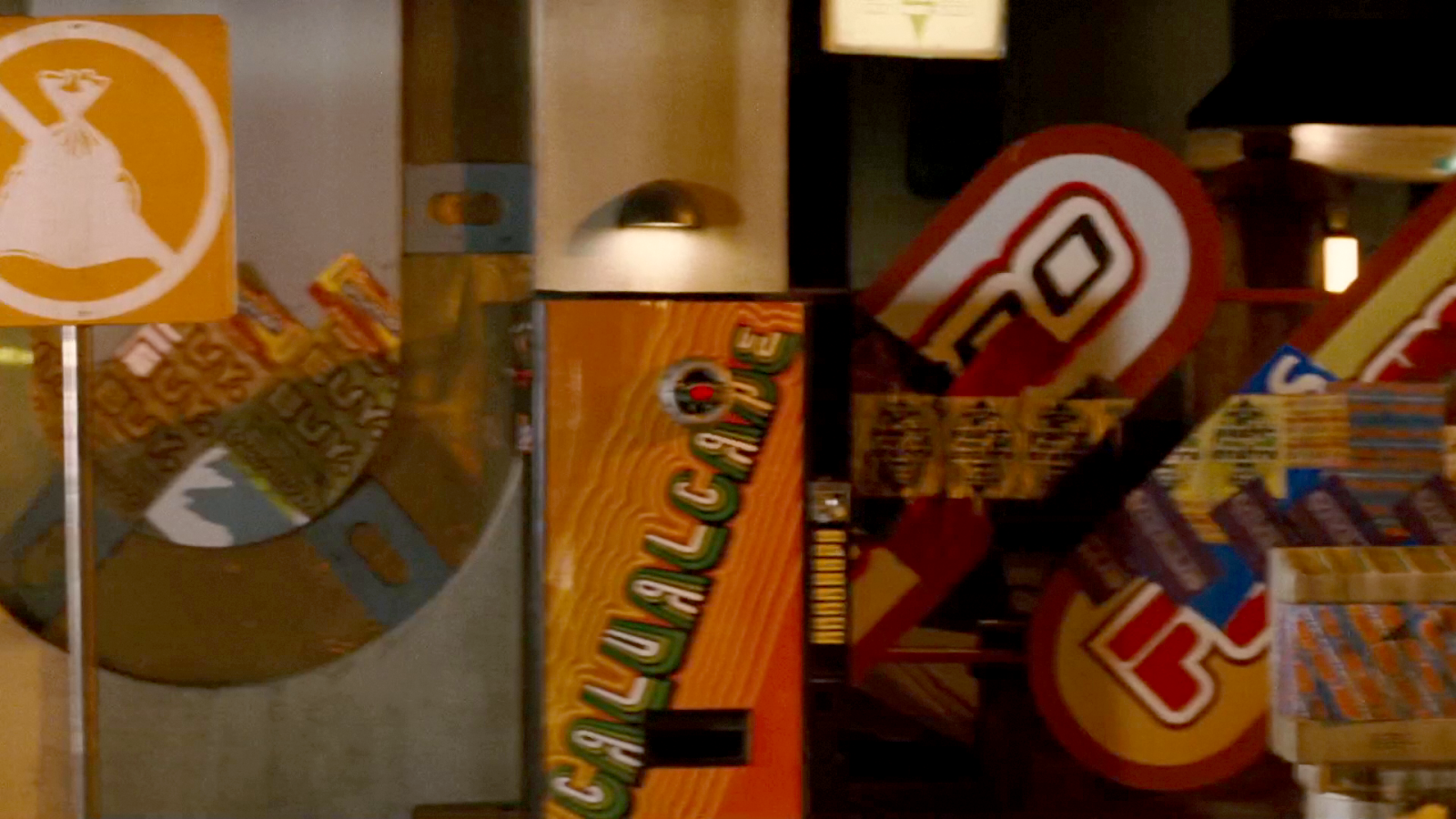
Beep.


Frito’s F’n Car interface

When Frito is driving Joe and Rita away from the cops, Joe happens to gesture with his hand above the car window, where a vending machine he happens to be passing spots the tattoo. Within seconds two harsh beeps sound in the car and a voice says, “You are harboring a fugitive named NOT SURE. Please, pull over and wait for the police to incarcerate your passenger.”

Frito’s car begins slowing down, and the dashboard screen shows a picture of Not Sure’s ID card and big red text zooming in a loop reading “PULL OVER”

IDIOCRACY-fncar

The car interface has a column of buttons down the left reading:

  • NAV
  • WTF?
  • BEER
  • FART FAN
  • HOME
  • GIRLS

At the bottom is a square of icons: car, radiation, person, and the fourth is obscured by something in the foreground. Across the bottom is Frito’s car ID “FRITO’S F’N CAR” which appears to be a label for a system status of “EVERYTHING’S A-OK, BRO”, a button labeled CHECK INGN [sic], another labeled LOUDER, and a big green circle reading GO.

idiocracy-pullover

But the car doesn’t wait for him to pull over. With some tiny beeps it slows to a stop by itself. Frito says, “It turned off my battery!” Moments after they flee the car, it is converged upon by a ring of police officers with weapons loaded (including a rocket launcher pointed backward.)

Visual Design

Praise where it’s due: Zooming is the strongest visual attention-getting signals there is (symmetrical expansion is detected on the retina within 80 milliseconds!) and while I can’t find the source from which I learned it, I recall that blinking is somewhere in the top 5. Combining these with an audio signal means it’s hard to miss this critical signal. So that’s good.

comingrightatus.png
In English: It’s comin’ right at us!

But then. Ugh. The fonts. The buttons on the chrome seem to be some free Blade Runner font knock off, the text reading “PULL OVER” is in some headachey clipped-corner freeware font that neither contrasts nor compliments the Blade Jogger font, or whatever it is. I can’t quite hold the system responsible for the font of the IPPA licence, but I just threw up a little into my Flaturin because of that rounded-top R.

bladerunner

Then there’s the bad-90s skeuomorphic, Bevel & Emboss buttons that might be defended for making the interactive parts apparent, except that this same button treatment is given to the label Frito’s F’n Car, which has no obvious reason why it would ever need to be pressed. It’s also used on the CHECK INGN and LOUDER buttons, taking their ADA-insulting contrast ratios and absolutely wrecking any readability.

I try not to second-guess designer’s intentions, but I’m pretty sure this is all deliberate. Part of the illustration of a world without much sense. Certainly no design sense.

In-Car Features

What about those features? NAV is pretty standard function, and having a HOME button is a useful shortcut. On current versions of Google Maps there’s an Explore Places Near You Function, which lists basic interests like Restaurants, Bars, and Events, and has a more menu with a big list of interests and services. It’s not a stretch to imagine that Frito has pressed GIRLS and BEER enough that it’s floated to the top nav.

explore_places_near_you

That leaves only three “novel” buttons to think about: WTF, LOUDER, and FART FAN. 

WTF?

If I have to guess, the WTF button is an all-purpose help button. Like a GM OnStar, but less well branded. Frito can press it and get connected to…well, I guess some idiot to see if they can help him with something. Not bad to have, though this probably should be higher in the visual hierarchy.

LOUDER

This bit of interface comedy is hilarious because, well, there’s no volume down affordance on the interface. Think of the “If it’s too loud, you’re too old” kind of idiocy. Of course, it could be that the media is on zero volume, and so it couldn’t be turned down any more, so the LOUDER button filled up the whole space, but…

  • The smarter convention is to leave the button in place and signal a disabled state, and
  • Given everything else about the interface, that’s giving the diegetic designer a WHOLE lot of credit. (And our real-world designer a pat on the back for subtle hilarity.)

FART FAN

This button is a little potty humor, and probably got a few snickers from anyone who caught it because amygdala, but I’m going to boldly say this is the most novel, least dumb thing about Frito’s F’n Car interface.

Heart_Jenkins_960.jpg
Pictured: A sulfuric gas nebula. Love you, NASA!

People fart. It stinks. Unless you have active charcoal filters under the fabric, you can be in for an unpleasant scramble to reclaim breathable air. The good news is that getting the airflow right to clear the car of the smell has, yes, been studied, well, if not by science, at least scientifically. The bad news is that it’s not a simple answer.

  • Your car’s built in extractor won’t be enough, so just cranking the A/C won’t cut it.
  • Rolling down windows in a moving aerodynamic car may not do the trick due to something called the boundary layer of air that “clings” to the surface of the car.
  • Rolling down windows in a less-aerodynamic car can be problematic because of the Helmholtz effect (the wub-wub-wub air pressure) and that makes this a risky tactic.
  • Opening a sunroof (if you have one) might be good, but pulls the stench up right past noses, so not ideal either.

The best strategy—according to that article and conversation amongst my less squeamish friends—is to crank the AC, then open the driver’s window a couple of inches, and then the rear passenger window half way.

But this generic strategy changes with each car, the weather (seriously, temperature matters, and you wouldn’t want to do this in heavy precipitation), and the skankness of the fart. This is all a LOT to manage when one’s eyes are meant to be on the road and you’re in an nauseated panic. Having the cabin air just refresh at the touch of one button is good for road safety.

If it’s so smart, then, why don’t we have Fart Fan panic buttons in our cars today?

I suspect car manufacturers don’t want the brand associations of having a button labeled FART FAN on their dashboards. But, IMHO, this sounds like a naming problem, not some intractable engineering problem. How about something obviously overpolite, like “Fast freshen”? I’m no longer in the travel and transportation business, but if you know someone at one of these companies, do the polite thing and share this with them.

Idiocracy-car
Another way to deal with the problem, in the meantime.

So aside from the interface considerations, there are also some strategic ones to discuss with the remote kill switch, but that deserves it’s own post, next.

Identity Processing Program of America

After his initial arrest, Joe is led by a noose stick (and a police officer speaking some devolved version of copspeak) to a machine to get an identity tattoo. Joe sits in the chair and a synthesized voice says, “Welcome to the Identity Processing Program of America. Please insert your forearm into the forearm receptacle.” Joe does as instructed and it locks his arm into place. A screen in front of him shows the legend “Identity Processing Program of America” superimposed over an USA pattern made up of company names and Carls Junior amputated star logos. Five rectangles across the top are labeled: System, Identity, Verify, Imprint, and Done.

Idiocracy_ippa02
It prompts him to “…speak your name as it appears on your current federal identity card, document number G24L8.” Joe says, “I’m not sure if—“ The machine interprets this as input and blinks the name as it says, “You have entered the name ‘Not Sure.’ Is this correct, Not Sure?”

Idiocracy_ippa05
Joe tries to correct it, saying, “No…it’s not correct.” On the word “correct” it dings and continues, “Thank you. ‘Not’ is correct.” “Not” stops blinking in the interface.

“…Is ‘Sure’ correct?” Joe has patience and tries to correct it. “No, it’s not. My name is Joe.” It blurts out some error beeps. “You’ve already confirmed your first name is Not. Please confirm your last name, ‘Sure.’”

Joe: My…My last name is not Sure.
Kiosk: Thank you, Not Sure.
Joe: No. What I mean is my name is Joe.
Kiosk: Confirmation is complete. Please wait while I tattoo your new identity on your arm.
The machine begins to shake and make noises. Joe says, “Wait a second. Can we start over? Can I cancel this?” He sees a progress bar, labeled “Tattoo In Progress…”

Idiocracy_ippa06

“Can we cancel this and just go back to the beginning? They’re gonna tat—Ow. Could I speak to your supervisor? Ow!” While he’s trying to wrench his arm free, the machine instructs him, “Please hold still for your photograph.” It flashes an unflattering picture of him and the clamp on his arm releases. He removes his arm to see the new tattoo. The screen shows him his identity card.

Idiocracy_ippa08
In exasperation from the whole ordeal he mumbles, “Oh, that’s fuckin’ great.”

This scene is played for the Vaudevillian yuks, but it does illustrate some problems with conversational design. And note that, if you’re interested in this topic, let me make an early shout out to the book Conversational Design by Erika Hall, published earlier this year.

conversational_design.jpg

Understanding intent

When it hears Joe say “I’m not sure…” it takes it as a literal answer. It does not recognize that Joe isn’t answering the question. It is one meta-level up. He has a question about the question being asked. Humans are pretty good at recognizing when another human is breaking the usual logic of adjacency pairs and not providing an answer to the question. (This was discussed in Make It So in Chapter 5, “Gestural Interfaces” in relation to Minority Report) Computers have a harder time of it. If this kiosk understood it, it would be know that he’s not answering the question, and resolve what conversational analysis calls “the expansion” before returning to the question. (Disclosure: I work there and know the guy who wrote that.)

Aside: Douglas Hofstadter in his mind-expanding book Godel, Escher, and Bach, writes about the trick question “Have you stopped beating your spouse?” for which neither “yes” nor “no” are good answers, but the only “correct” answers according to the binary frame of the question. In that text he introduces the eastern answer of “mu” (or “wu” in Chinese languages) that means roughly “the answer does not fit the question.” So it can be said that computers have a hard time understanding mu.

mu-seal.png


Designers of digital assistants have to wrangle with this, but it’s rarely a problem that the individual designer must wrestle with. Language and naming are informal, slippery notions as far as computers are concerned, so it’s understandably a hard problem. It’s entirely possible that someone has chosen “Not Sure” as a name, but it’s highly unlikely. And that’s another problem.

Understanding likelihood

Understanding intent might be a little easier if the computer could recognize that “Not” and “Sure” are unlikely values for a name. (Even in Idiocracy where names tend to be brands like Lexus, and Frito, and Biggiez. More on this later.) If it knew that, it would have a low confidence that it “heard” correctly, and shift into a repair or at least clarification mode. “‘Not’ would be very uncommon name. Let me be extra careful, here…” It could even shift into a more deliberate mode of input, like a keyboard, or asking him to spell his name out (or, you know, cancel the whole thing.)

Catching not

When the kiosk is asking for confirmation, it hears Joe say, “No it’s not correct” and registers the keyword “correct” but misses the function word “not” which completely flips the meaning.

Again, avoiding this speech-to-text error would be a developer’s task, but dealing with the back-and-forth would definitely fall to a designer. When clarifying low-confidence input, users should be able to provide discrete high-confidence feedback.

Joe could, for instance, be shown the kiosk’s (stupid) understanding of his input and—since this has a pretty permanent consequence—wait on his confirmation and providing the simple option to redo it so he can try some other tactic to getting “Joe Bauers” in there until he gets it right.
But, of course, this is Idiocracy, and Joe is stuck with it.

Idiocracy_ippa09
Sorry, Joe.

But we’re not

I mean, Republicans have done all they can to suppress votes that don’t favor them. They don’t care about Democracy or the will of the American people as they do staying in power to serve their 1% overlords. But research shows that people who have a plan to vote are more likely to actually do it, and if we all do it, we can overwhelm them with sheer numbers.
There are lots of tools to help you make a plan, but let’s send some traffic to our friends at Planned Parenthood. They’ve been under a lot of pressure during this administration. Maybe throw them a few sheckles while you’re there. Not for the election, but because you’re a good person. And vote all of them out.

20161101-GOTV-Make-Plan-Tool-BLOG.png

OmniBro

The OmniBro is the ubiquitous payment and identification system in Idiocracy. We see it four times in the movie.

Doc office

Idiocracy_omnibro02

Dr. Lexus asks Joe to pay for his visit, “…if you could just go ahead and, like, put your tattoo in that shit.” In this case, that shit is a barcode scanner mounted to the back of a desktop register. We don’t get to see it in use, because as described in the prior post, Dr. Lexus freaks out, realizing Joe is unscannable and hitting the panic button.

Prison

Idiocracy_omnibro04.png

Another time we see the OmniBro is in the prison. After talking his way past the guard, another guard at a checkout counter has him scan his new tattoo. The guard checks the screen and tells him, “Uh. Yeah, I don’t see you in here. So you’re going to have to…uh…stay in prison.” Joe says, “Could you check again, because I was definitely in prison. OK. I got sat on my face and everything. Maybe check those files back there?” The guard turns, and Joe runs. There’s admittedly a post in there about prison security and release (and America has a lot to improve, especially in its reprehensible prison-for-profit systems), but this post is about the OmniBro.

Carl’s Junior

The third time we see it is at the Carl’s Junior kiosk. (More on the whole system in the next post.) Though the customer appears to have already scanned, it is how anyone ordering food pays for it.

Idiocracy_omnibro24

What’s good?

If I had to note the positives of the OmniBro system, it is that it seems easy for even morons to explain, understand, and use. Wrists are more commonly pointed down, so it’s a little more deliberate to have to turn the wrist up to pay. So adding to its ease-of-use is some measure of biology against accidental activation.

Also it’s more sterile than money. (Yeah, money’s dirty.)

And it’s ubiquitous, so a citizen of Idiocracy doesn’t need a credit card totem to know whether or not a vendor accepts their money. There are airlines and even a restaurant that I know of in San Francisco that only accept credit cards, and it’s disgusting. (Yes, yes, I know what the Department of the Treasury says, but I think it’s gross, classist, and corporatist to require your customers first have a relationship with a credit card company before you’ll do business with them.) So I suppose that aspect encourages an easy-to-access marketplace.

So, the good: It’s usable, sterile, and ubiquitous.

What’s questionable?

Where to start? Well, certainly it’s horrible that participation in the economy requires a permanent body modification. I’m not at all religious, but I agree wholeheartedly with the admonishment against any totalitarian “mark of the beast” just to participate in culture, for all the body autonomy and social justice reasons that one should be against it. (Before anyone gets their apophenia into an uproar about biblical meanings, you can relax. Idiocracy’s tattoos are on the wrong hand.)

You might imagine that the mark signals some sort of ingroup membership, but if everyone in Idiocracy has one, there’s no real outgroup.

Still, it raises lots of questions about the choice of a tattoo:

  • Skin stretches and changes as time wears on. Tattoos get sun blurred (and the wrist gets a lot more sun exposure than other areas.) What happens to a citizen when their barcode no longer works? The tattoo machine (a post on this later) looks like it only tattoos in one place, so another visit won’t fix it, and likely would make matters worse. Is there some do-over machine?
  • What about people who don’t have a left wrist? (The machine can only work on left arms.) What about people who get the tattoo but later lose their left arm?
  • Where’s any other factor for multifactor authentication? Cash fails this as well, but if you are robbed of your cash, at least you still have an arm left to try and acquire some more.

What’s awful, though, is the fourth time we see it in the movie.

Rando vending surveillance

When fleeing the police with Freeto and Rita in Frito’s car, Joe accidentally makes the mistake of raising his tattooed wrist above the door frame, where it is scanned through the window by a vending machine he happens to be passing. The scan identifies Joe and the car he’s in, and something sends a shutdown signal to Frito’s car. (More on the car interface a later post.)

Ease-to-consume is concomitant with ease-to-surveil. Sure, the citizen doesn’t have to carry cash, do rudimentary math, or remember their bank balance, but in exchange they leave themselves open to constant tracking and identification. In the movie this just means it’s easy to find Joe. They’re comparatively dumb enough to make his escape the stuff of comedy.

But in our world, where the forces that market you away from your money are vastly more funded, equipped, and dedicated to their task than you, this tradeoff winds up putting Americans in a terrible debt load that may be *gasp* worse than Italy’s by 2023. (Sorry, dear Italian friends.) Combine this debt load with the health gamble and 40-year stagnant wages, and it seems like the tradeoff only an idiot would take. But hey, it’s easy to wave your phone for a fix at Starbucks, so what am I going on about, right?

Fight the Idiocracy

The Bloomberg article about American debt load includes this tasty paragraph, “While Trump and congressional Republicans raised alarms about the debt and deficit when Democrat Barack Obama was president, spending hasn’t abated with the GOP in control of the White House and Congress.

Where the GOP used to tout themselves as the party of fiscal conservatism, it’s now clearer than ever that they’re just hypocrite oligarchs; spending wildly, giving free tax passes to their insanely wealthy friends, hoping a hundred dollars a month is enough to convince you to look the other way, all the while planning to gut your “entitlement” programs like social security, medicare, and medicaid. It’s insanity. They have to be voted way, way out if we have any hope of saving our economic well being.

voteworms.jpg
Sold out womp womp

I wanted with this post to convince you to give out Cards Against Humanity’s Vote Worms, but they’re already sold out. So instead I’ll point you to their smart Hacks the Election campaign, which did not do as well on launch, but would definitely have more effect if it sold out. If you are in or know someone in one of the following swing districts, definitely check this out.

  1. California 25th district: Help elect Katie Hill
  2. Iowa 1st district: Help elect Abby Finkenauer
  3. Illinois 26th district: Help elect Sean Casten
  4. Illinois 14th district: Help elect Lauren Underwood
  5. Kansas 4th district: Help elect James Thompson
  6. Texas 26th district (what is it about 26th districts?): Help elect Linsey Fagan
CAH-hackselection.png

St. God’s: Unscannable Panic

During Joe’s consultation with Dr. Lexus, all the clues he has been stumbling past finally begin to sink in. When Dr. Lexus asks him to pay the bill, and—thinking Joe is mentally challenged—instructs him to put his tattoo up to the OmniBro payment system, he realizes that Joe has no barcode on his wrist.

Idiocracy_treatment01

The doctor is absolutely terrified of this. He can barely conceive it. “Why come you don’t have a tattoo?” [sic] “You’re not unscannable, are you‽…You’re unscannable!!” In a panic he reaches out to his treatment panel and smashes the lower-left hand icon, shouting, “UNSCANNABLE!!” This causes a klaxon to sound and red beacon light to blink. Joe realizes he can’t stay and flees.

The panel

Dr. Lexus has a 3×4 mini-panel similar to Biggiez’ intake interface. It gets only a blurry half a second of screen time, but through the annoying power of screengrab, I can see that they’re a subset of the graphics from the intake interface.

Lexus-panel.png
Artists’ janky interpretation

Too bad. It was an opportunity for more hilarity, perhaps something similar to Dr. Lexus’ moronic ramblings. Think buttons for Kick Ass, Sound like a Dick, and Fucked Up. (Serious props to Jason Long for pulling these lines off so hilariously.) But let’s instead talk about mashing buttons.

Avoiding accidental activation

We want to ensure that a doctor only presses this high-cost button deliberately, but it still has to be easy to press. The classic CTRL-ALT-DELETE key chord is an example of deliberateness. It was designed to be very difficult to press accidentally. A gas station shut-off emergency shut off is an example of an emergency button that is easy to find and press.

Dr. Lexus’ panic button is the opposite of this: A high-cost button that looks like and sits adjacent to all these other presumably low-cost buttons, and even sits in one of the easiest-to-hit areas, requiring some of the least precision. The risk of accidental activation seems very high. Don’t do this.

Idiocracy_treatment07

On the other hand, it’s possible that the keyboard is aware of Dr. Lexus’ emotional state, either from lots of context cues, or the strength of his mashing, or the fact that he’s touching four buttons at once.

Affective input

Smashing is its own kind of input—it’s different than the deliberate key presses of ordinary use. It means that either the user is in some intense emotional state (angry, panicked, or…a joyful toddler, maybe?) or not actually trying to provide input, just manipulating the interface (say, picking up the keyboard to move it.) These are events which designers can consider and design for. A real world example is the mobile version of Google Maps, shake it and it presumes that you are angry and asks you for feedback.

So it’s possible—if you want to give interfaces in the Idiocracy more credit than is justifiable given the idiocracy—that the panel is detecting the fast, hard, mashing of multiple keys, and registering that as a distress call. Long-time readers may recall Zorg mashing his desktop keypad in a panic as he chokes on a cherry pit in The Fifth Element. Perhaps this interface can sit alongside it as a possible opposite.

Triple your resistance to the Idiocracy (today)

Straight from DSCC: The last FEC deadline before Election Day is in just two days. That means the final decisions are being made right now about where to allocate resources for the last weeks before November’s elections.

It also means that the final ad buys of the midterm elections are being made—and we need to make sure sane candidates have the resources they need to get their message out. Enter the DSCC.

dscc_facebook_share2.png

They have a $300,000 goal, and only have until Wednesday at midnight to hit it. If you make a donation, it will be TRIPLE-MATCHED to give candidates what they need to flip the Senate and put some necessary counterbalance to the insanity coming from the executive branch.

Snitch phone

If you’re reading these chronologically, let me note here that I had to skip Bea Arthur’s marvelous turn as Ackmena, as she tends the bar and rebuffs the amorous petitions of the lovelorn, hole-in-the-head Krelman, before singing her frustrated patrons out of the bar when a curfew is announced. To find the next interface of note, we have to forward to when…

Han and Chewie arrive, only to find a Stormtrooper menacing Lumpy. Han knocks the blaster out of his hand, and when the Stormtrooper dives to retrieve it, he falls through the bannister of the tree house and to his death.

SWHS_generalalert-09.png
Why aren’t these in any way affiiiiixxxxxxeeeeeeed?

Han enters the home and wishes everyone a Happy Life Day. Then he bugs out.

SWHS_generalalert-12.png
But I still have to return for the insane closing number. Hold me.

Then Saun Dann returns to the home just before a general alert comes over the family Imperial Issue Media Console.

SWHS_generalalert-07.png

This is a General Alert. Calling Officer B4711. Officer B4711. We are unable to reach you on your comlink. Is there a problem. [sic] You are instructed to turn on your comlink immediately.

Dann tells the family he can handle it. He walks to the TV and pulls a card out of his wallet. He inserts it into the console, mashes a few buttons and turns his attention to the screen. After a moment of op-art static, General Alert person appears. He says, “We have two way communication, traitor Saun Dann. Is this a report about the missing trooper?”

Dann (like so many rebels) lies, saying the stormtrooper robbed the house and fled for the hills. GA says, “Very well, we’ll send out a search party.” Sean thanks him and the exchange is over. Sean hits a button, pulls his card out of the console, and returns it to his wallet.

Sadly I must bypass the plot questions about the body of the Stormtrooper that is still lying in the forest floor beneath them that will surely be found, or that GA will eventually not find B4711 in the forest and return demanding answers, or why everyone is acting like welp that’s fixed. For this blog is about interfaces.

Whether the card was meant as identification or payment, the interaction is pretty decent. Saun has no trouble fitting it in the slot, and apparently he has no trouble recalling the number to dial the Empire. The same guy in the message answers the call quickly. After the exchange, it’s quick to wrap up. Pull out card, and call is over. Seriously, that’s as short and simple as we could make it.

What was the card for?

If it was payment, we would expect some charges to appear during and after the fact, so let’s just presume it was an identification card for the Empire to track. Since the Empire is evil, they might hide or not provide feedback that the caller has been identified. So it’s not diegetically surprising to note that there’s none.

For all the interfaces that are utter crap in this show, this one actually passes muster. It tempts me to establish some sort of law—that the more mundane interfaces in a show will always be the more believable ones. I’ll think on that. It would need a name.

rat-prompt.png

If I was to add any improvement, it would be to not burden the citizen’s memory with remembering the general alert or how to act on it. What if you’d just caught the end of it? Rather than burdening memory, the Empire could add a crawl to the feed, that persistently repeats the call to action including contact information. Persuasively, it would be an annoyance that would cause citizens watching TV to really want B4711 to hurry up and turn his damn comlink on, or for someone to rat him out.

There are probably some fascist tactics for incentivizing either the Stormtrooper or a snitch’s compliance, but I’m not a fascist, so let’s not go there.

Instead let’s rejoice that there is but one more interface to review, and we can stop with the Star Wars Holiday Special.

Ministry of Art detector gate

ChildrenofMen-Artgate-01

Jumping back in the film a bit, we’re going to visit the Ministry of Art. When Theo goes there to visit his brother, after the car pulls to the front of the secured building, Theo steps out and walks toward a metal-detector gate.

Its quite high, about 3 meters tall. The height helps to reinforce the notion that this is a public space.

  1. This principle, that short ceilings are personal, and high ceilings are public, is I believe a well-established one in architectural design. Read the Alexandrian pattern if you’d like to read more about it.
  2. Is it a public space? It is, since it’s a Ministry. But it isn’t, since he joins his brother in what looks like a rich person’s private dining room. I was always a bit confused by what this place was meant to be. Perhaps owning to The Dark Times, Nigel has cited Minister rights and cordoned off part of the Tate Modern to live in. If anyone can explain this, please speak up.
  3. On the downside, the height makes the text more out of sight and harder to read by the people meant to be reading it.

The distance is balanced by the motion graphics of the translucent sign atop the gate. Animated red graphics point the direction of ingress, show a security stripe pattern, and provide text instructions.

Motion is a very strong attention-getting signal, and combined with the red colors, does all the attention-getting that the height risks. But even that’s not a critical issue, as there is of course a guard standing by to ensure his understanding and compliance.

ChildrenofMen-Artgate-05

Note that there is no interaction here (which is the usual filter for this blog), but since I’m publishing an interview with the designer of this and the Kubris interface soon, I thought I’d give it a quick nod.

Binoculars

BttF_023

Doc Brown uses some specialized binoculars to verify that Marty’ Jr. is at the scene according to plan. He flips them open and puts his eyes up to them. When we see his view, a reticle of green corners is placed around the closest individual in view. In the lower right hand corner are three measurements, “DISTgamma, and “XYZ.” These numbers change continuously. A small pair of graphics at the bottom illustrate whether the reticle is to left or right of center.

BttF_025

As discussed in Chapter 8 of Make It So, augmented reality systems like this can have several awarenesses, and this has some sensor display and people awareness. I’m not sure what use the sensor data is to Doc, and the people detector seems unable to track a single individual consistently.

BttF_024

So, a throwaway interface that doesn’t help much beyond looking gee-whiz(1989).

Explorer Surveillance

The Control Room of Jurassic Park has a basic video/audio feed to the Tour Explorers that a controller (or, in this case, John Hammond) can use to talk to the tour participants.  He is able to switch to different cameras using the number keys on the keyboard attached to the monitor. The cameras themselves appear to be fixed in place.

JurassicPark_FordSurveillance01

We never see the cameras themselves in the Explorers, but we do see Malcolm tap on one of the cameras during the tour while Hammond is watching it’s feed, so they are visible to the riders.

Hammond occasionally speaks through his audio link, and can hear a constant audio feed from the Explorers. He has some kind of mute button (he says a couple disparaging comments that the other characters don’t appear to hear), but the feed from the Explorers is real-time. It isn’t obvious how he switches between the different Explorers’ audio feeds, or whether he hears both Explorers simultaneously.

Deadly-stupid limitations

Each Explorer can hold a limited number of passengers, but it’s clear that Hammond wanted larger groups of people on a single tour together. Whether this was because of monetary concerns and wanting to pack more tours on the same rail, or because he didn’t want large families to be left out is less clear. Jurassic Park doesn’t have any trouble handling two Explorers.

What it does struggle with is the clear delineation between who is in Explorer 1, and who is in Explorer 2. Despite the audio and video feeds going back and forth between the Explorers and the control center, the passengers have no way to talk to someone in the other Explorers.

This leads directly to Malcolm’s injury and Gennaro’s death at the T-Rex pen.

On a good tour, these same systems would allow one Explorers to talk to the other. If someone saw a dinosaur, but the other Explorers didn’t, the first group could point it out.

Give the tour guide context

It isn’t clear either what the day-to-day job of the tour guide would be. Hammond clearly enjoys talking about his park, but the pre-recorded voice seems to be giving most of the “tour” information to the passengers.

JurassicPark_FordSurveillance02

What might be more useful is giving the tour guide access to the monitoring maps and exterior cameras so that he/she can answer questions that can’t be easily answered by pre-recorded systems: “Hey, what’s that triceratops doing to that other triceratops?”

If the tour guide sees a dinosaur that the passengers don’t, or if the dinosaur is doing something odd that the passengers are wondering about, it would be a great point for the tour guide to jump in and add more context. More exterior camera views would improve their ability to do that job.

Privacy

Theme parks are notorious for their lack of privacy. Hammond has a chance to challenge that expectation here with his focus on high-end tours. Although it doesn’t look possible now, the cameras don’t need to be on constantly, and could at least have a clear indication of when someone was watching. Maybe a ringlight around the lens?

Additionally, the Explorers could give the passengers a way to turn off the video and audio feeds. This imposes a security risk, but would give the tours a more primeval and isolated feel. It might not be as bluntly educational, but the improvement in atmosphere might make up for it.

Expectations

Overall, this system acts exactly like someone would expect a basic security and surveillance system to act.  It has basic controls, always-on CCTV, and the ability for the control room to control what’s happening. The improvements mentioned above could upgrade this system from a basic monitor into a valuable addition to the Jurassic Park experience.

The SandPhone

LogansRun037

Not everyone is comfortable giving over to the flimsy promise of Carrousel [sic]. Some citizens run, and Sandmen find and terminate these cultural heretics.

Sandmen carry a device with them that has many different uses. It goes unnamed in the movie, so let’s just call it the SandPhone. It is a thick black rectangle about 20cm at its long edge, about the size of a very large cell phone. Near the earpiece on one broad side is a small screen for displaying text and images. Below that is a white line. The lower half of this face is metallic grill that covers a microphone. On the left edge is a momentary button that allows talking. Just above this is a small red button. When not in use, the device is holstered on the sandman’s belt.

The SandPhone lets the Sandman receive information through a display that can show both image and text. The Sandman sends back information and requests by voice in a CB radio metaphor.

Notifications

The first time we see the device is when Logan and Francis are attending Carrousel. Somehow, on his belt it catches his attention. With the crowd too loud for sound, and no evidence it’s light, my bet’s on haptics. Realizing he’s got a message, he picks it up, presses the edge button and the screen displays two lines of text:

RUNNER: GREAT HALL
ENTRANCE WEST.

He then puts the device to his face as we would a cell phone and shouts, “Affirmative!” as loud as he can.

LogansRun038

Perp wayfinding

Running with the device outside the Great Hall, Logan uses the SandPhone as a detector. By holding it flat out in front of him he hears a rhythmic pulse. Turning it this way and that, he listens for the change in pitch. It rises when he is pointing towards the targeted runner.

Bio identification

LogansRun046
LogansRun050

When he and Francis have terminated the runner, he snaps the device off his belt, and pressing the edge button, he reports back to dispatch, “Runner terminated, 0.31. Ready for cleanup.” Then by placing the device near the head of the dead runner, the device displays on the screen the last photographic image of him on file. Since the face on the SandPhone screen does not match the face he sees before him, Logan lifts the device to his face and, holding the edge button, requests an identity check of dispatch. Instantly he pulls the device away from his face to show the text:

IDENT. AFFIRM
NEW YOU #483
FACE CHANGE.

LogansRun182

Send backup

Much later in the film we see Logan alert dispatch to the location of the underground hideout by reaching down to the holstered device and pressing the white line button on its face. Its screen pulses green, and his position is highlight on the runner board (see below) at dispatch. Minutes later the location is raided by Sandmen.

Analysis

The first thing to note is that this is pretty close to a modern smart phone. He receives images and text messages, can talk to dispatch, and it has a biometric capability for identifying citizens. It’s tempting to paint this as visionary, but keep in mind that the first mobile phone was demonstrated in 1973, three years earlier, so it’s likely that the film makers were riffing off of the demo technology they’d heard about or maybe even seen in person.

We evaluate an interface’s design by how well it helps its user achieves his goals. (Even if those goals are anethma. That’s how we judge an interface.) In this case, the SandPhone helps Logan get the information he needs, when he needs it, across multiple channels. It doesn’t distract him with other functions. It’s context aware and doesn’t apparently have battery issues.

There are improvements of course.

We should make sure his hands are free by making the information available as an augmented reality display instead of a handheld device. This would also give him the information privately rather than display it for anyone (notably members of the resistance) to see it. Wayfinding would be more sensible as an overlay to his vision through this device.

Some surface tweaks might also be made, such as giving him a means of text input so he wouldn’t have to shout above the roar of Carrousel. Some silent means of input would help for when he needs to provide silent input as well. First I thought optical inputs might be ideal, given the augmented reality, but we don’t want his eyes distracted like that, even for the duration of glances. Instead some other gestural input—perhaps a face twitch or subvocal input—that lets him keep the rest of his body tense and ready for action.

Citizen biometrics should be a background fact, given the penopticon of Dome City. The information would come to him when he gets his assignement. But turn those same biometrics around on Logan, and his body could request reinforcements before he even thought to do so manually. When his heart rate elevates and galvanic skin response lowers, dispatch would know something was up, and route backup immediately.

A strategic interaction designer would even ask why he has to chase runners at all, when predictive algorithms could guess which citizens were likely to run and take action to forestall their rebellion. But then we’re into Minority Report, and this needs to stay Logan’s Run.