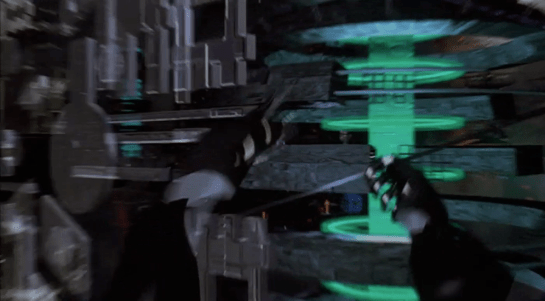
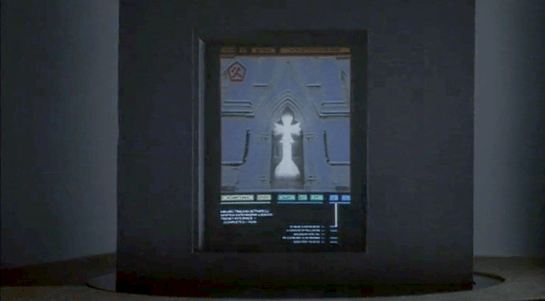
The transition from Beijing to the Newark copyshop is more involved. After he travels around a bit, he realizes he needs to be looking back in Newark. He “rewinds” using a pull gesture and sees the copyshop’s pyramid. First there is a predominantly blue window that unfolds as if it were paper.
And then the copyshop initial window expands. Like the Beijing hotel, this is a floor plan view, but unlike the hotel it stays two dimensional. It appears that cyberspace works like the current world wide web, with individual servers for each location that can choose what appearance to present to visitors.
Johnny again selects data records, but not with a voice command. The first transition is a window that not only expands but spins as it does so, and makes a strange jump at the end from the centre to the upper left.
Once again Johnny uses the two-handed expansion gesture to see the table view of the records.
Johnny searches again, but either because there are so few records or because they’re in English, he doesn’t use voice commands. Instead he just runs his fingers over the cells, which highlight as he does so. Again this would be familiar to a current day spreadsheet user.
The contents of the cell are, once more, not useful. Johnny dismisses the copyshop with a sweeping arm gesture which slides the “window” off the right of the screen.
Aside: At normal viewing speed, it looks like the window disappears and, as would be the case in a 1995 or current day desktop system, reveals the previously-displayed windows underneath. Stepping through frame by frame shows that actually it reveals an identical copy of the sliding content! Graphics programmers have always tried hard to avoid such visual glitches, but sometimes they slip into production code anyway.
Next
At this point in the plot, Johnny hasn’t found the images he so desperately needs. He thinks for a moment, and decides to contact the owner of a local bulletin board. Unknown to him, he has also been located by the Pharmakom tracker. Shinji and the Yakuza are on the way, and Shinji orders “initiate the virus.”
After selecting its location from a map, Johnny is now in front of the virtual entrance to the hotel. The virtual Beijing has a new color scheme, mostly orange with some red.
The “entrance” is another tetrahedral shape made from geometric blocks. It is actually another numeric keypad. Johnny taps the blocks to enter a sequence of numbers.
The tetrahedral keypad
Note that there can be more than one digit within a block. I mentioned earlier that it can be difficult to “press” with precision in virtual reality due to the lack of tactile feedback. Looking closely, here the fingers of Johnny’s “hands” cast a shadow on the pyramid, making depth perception easier.
Something is wrong, and Johnny receives an electric shock.
He reacts as if the shock is real, pulling his hands back and cursing.
In the 1980s and 1990s cyberpunk books such as Neuromancer and Hardwired and roleplaying games such as Cyberpunk and ShadowRun suggested that future virtual reality systems would be able to physically attack users, the dreaded “Black ICE”. While the more vigilant Internet copyright enforcers would probably be in favour, it seems unlikely that the liability lawyers at any computer manufacturer would allow a product that could electrocute users to be released, or that users would agree to put something like that on their hands. So this is most likely just Johnny expressing the same frustration as a current day video gamer who loses a life in a first person shooter.
The last necessary step before being granted access is, for some reason, to reshape the pyramid.
Here the pyramid serves as a combination lock or puzzle as well as a keypad. It’s not obvious, but Johnny does make a small 3D rotating gesture on the entire pyramid before pulling and pushing blocks around. You can also see a second layer of structure underneath the moving shapes.
Is this an effective security system? Not really. Two-factor authentication systems rely both on knowingsomething, here a numeric code, and either havingsomething, such as a specific mobile phone or token generator, or beingsomeone, with a specific fingerprint. Reshaping the blocks is just a second thing the would-be user must know, and is just as vulnerable to being guessed as the numeric code. On the other hand, it might be enough to keep out simple-minded attacks that only try the first step.
The floorplan
The “interior” of the hotel site is first displayed as a flat plan view. This builds up incrementally, a transition known among VR developers since the film Tron came out as “rezzing up”. The completed plan then rotates into a 3D structure.
We hear the voice feedback announce “General accounts selected” but don’t see how Johnny did this. A window expands out, and Johnny splits it in half to reveal some tabular data.
The fax and phone records are displayed in a simple tabular view, which would not look out of place on any 1995 or indeed current day desktop computer spreadsheet. There’s no need to use 3D graphics for such this.
There are new interface elements here, overlaying the tabular data in pink. At the top we can read SEARCH > FAX CHARGES: FOUND. And on the right is a set of inscrutable numbers with headings GRID, LEVEL, MENU, and XYZ. This could be some orientation within the data, but it doesn’t make sense. In the lower-left we see a label for elevation, with data as “coordinates in sector 4.”
Below that a 9-key arrangement with arrow shapes. Perhaps this is a navigation aid for people using conventional 2D desktop interfaces rather than full virtual reality equipment, allowing them to move around by clicking the onscreen arrows or pressing the equivalent keys. If the keys are similar to those used in computer games, the up and down arrow keys move forward or backwards and the left and right keys rotate, assuming movement is predominantly in the horizontal plane. The other keys might be for banking or vertical movement.
Johnny searches for the outgoing fax. He does not use any graphical gestures for this, instead specifying the search date and time ranges by speaking. Words and operators are more precise than graphic symbols for this kind of database query, but typing on a virtual keyboard would be more awkward than speech.
When the particular table cell is found, he uses the fingertips of both hands to expand the contents, one of the standard gestures described in the Make It So book.
Not surprisingly for a Beijing hotel, the internal records are not in English. Johnny again uses a voice command to ask for translation.
The hotel record is just the metadata, not the actual images he’s looking for, suggesting that “fax” system is fully digital and the faxes themselves are treated like modern email messages and deleted once sent. The metadata does tell Johnny that the images were faxed to a online copyshop in Newark. Since it is network connected, Johnny can jump straight to it in cyberspace.
Cyberspace is usually considered to be a 3D spatial representation of the Internet, an expansion of the successful 2D desktop metaphor. The representation of cyberspace used in books such as Neuromancer and Snow Crash, and by the film Hackers released in the same year, is an abstract cityscape where buildings represent organisations or individual computers, and this what we see in Johnny Mnemonic. How does Johnny navigate through this virtual city?
Gestures and words for flying
Once everything is connected up, Johnny starts his journey with an unfolding gesture. He then points both fingers forward. From his point of view, he is flying through cyberspace. He then holds up both hands to stop.
Both these gestures were commonly used in the prototype VR systems of 1995. They do however conflict with the more common gestures for manipulating objects in volumetric projections that are described in Make It So chapter 5. It will be interesting to see which set of gestures is eventually adopted, or whether they can co-exist.
Later we will see Johnny turn and bank by moving his hands independently.
We also see him using voice commands, saying “hold it” to stop forward motion immediately. Later we see him stretch one arm out and bring it back, apparently reversing a recent move.
In cyberpunk and related fiction users fly everywhere in cyberspace, a literal interpretation of the spatial metaphor. This is also how users in our real world MUD and MOO cyberspaces start. After a while, travelling through all the intermediate locations between your start and destination gets tedious. MUDs and MOOs allow teleporting, a direct jump to the desired location, and the cyberspace in Johnny Mnemonic has a similar capability.
Gestures for teleporting
Mid sequence, Johnny wants to jump to the Beijing hotel where the upload took place. To do this, he uses a blue geometric shape at the lower left of his view, looking like a high tech, floating tetrahedron. Johnny slowly spins this virtual object using repeated flicking gestures with his left hand, with his ring and middle fingers held together.
It looks very similar to the gesture used on a current-day smartphone to flick through a photo album or set of application icon screens. And in this case, it causes a blue globe to float into view (see below).
Johnny grabs this globe and unfolds it into a fullscreen window, using the standard Hollywood two handed “spread” gesture described in Chapter 5 of Make It So.
The final world map fills the entire screen. Johnny uses his left hand to enter a number on a HUD style overlay keypad, then taps on the map to indicate China.
I interpret this as Johnny using the hotel phone number to specify his destination. It would not be unusual for there to be multiple hotels with the same name within a city such as Beijing, but the phone number should be unique. But since Johnny is currently in North America, he must also specify the international dialing code or 2021 equivalent, which he can do just by pointing. And this is a well-designed user interface which accepts not only multimodal input, but in any order, rather than forcing the user to enter the country code first.
Keyboards and similar physical devices often don’t translate well into virtual reality, because tactile feedback is non-existent. Even touch typists need the feeling of the physical keyboard, in particular the slight concavity of the key tops and the orientation bumps on the F and J keys, to keep their fingers aligned. Here though there is just a small grid of virtual numbers which doesn’t require extended typing. Otherwise this is a good design, allowing Johnny to type a precise number and just point to a larger target.
Next
After he taps a location, the zoomrects indicate a transition into a new cyberspace, in this case, Beijing.
Note to readers: The author and editor of this series of posts would like to be Matrix-style cool, competent, stylishly-dressed world-changers with superhuman abilities. In reality we are much closer to the protagonists of Johnny Mnemonic: always frantically improvising to stay one step ahead of disaster with a mix of clunky technology. (And we don’t even have a cybernetic dolphin helping out.) So, um, yeah. This post is out of order. Sorry. Please pretend you haven’t read Cyberspace: the Hardware yet. OK. On to an analysis of the phone system.
The video phones in Johnny Mnemonic all seem easy to use and reliable, but this is generally true of all phones in film and TV, video or otherwise. The audience want to see the characters communicate, not struggle with technology – unless difficulty or failure is necessary for the plot!
Rather than look at individual devices, I think it is more interesting to consider the video phone system as a whole. In Johnny Mnemonic the user experience of the phone system is more a software service than a hardware device.
In the film, phones range in size from the giant wall-mount screens to Shinji’s tiny handheld device, and from fixed locations to moving vehicles or handheld. Any computing and display device, wired or wireless, can act as a phone. The system has followed the same evolution as the web-based applications such as Facebook and GMail we use today that are available anywhere there is a web browser. The Internet makes ubiquitous software services possible.
The alternative path, which with the benefit of hindsight we can see is what happened with our current day phones, is personal devices. Instead of expecting computing devices running software to be available everywhere, we have one hardware device with our software on it that we carry everywhere instead. (Obviously this is over-simplifying a bit: the mobile phone system does require cell towers and/or base stations!) It’s an interesting choice for designers.
The two are not necessarily mutually exclusive. Within the film we see Takahashi using a hand tracker, a specialised piece of hardware built into his desk, to control a puppet avatar, a real time photorealistic avatar. Nobody else seems to have such capability, nor does Johnny consider the possibility that the person he is talking to might not be real. This gives Takahashi an advantage over others – but only while he makes all phone calls from his desk.
Why does the phone system still exist?
Current day phones, including the few remaining public phone booths, are all dedicated devices. Even though our mobile phones have become portable computers, the phone capability is still restricted to a manufacturer-installed application. In Johnny Mnemonic the phone system is more like the Ethernet jacks in a hotel room or convention centre, allowing users to connect their own devices. Since every call appears to be digital and is recorded in cyberspace, why have a phone network with numbers instead of, say, email addresses?
While the phone system in Johnny Mnemonic is very flexible in how numbers can be dialed and what can be used as video and audio sources, we only see it used for video phone calls, nothing else. Convergence of the phone system and Internet is often predicted but hasn’t happened because the one advantage that phone networks have is low latency and guaranteed resource allocation. Current day phone calls don’t have the occasional stuttering or delays that occasionally affect Skype sessions. (Your non-Internet phone call may be cut off entirely, but it won’t slow down.) In 2021, the phone system may be entirely digital and with video added, but still carrying traffic on separate, dedicated links to ensure quality.
At the time of writing WebRTC, a collection of standards for Web Real-Time Communication including audio and video, is starting to appear in prototype form in widely available browser software. Perhaps by 2021 the future phone system of Johnny Mnemonic will seem much more realistic.
And finally we come to the often-promised cyberspace search sequence, my favourite interface in the film. It starts at 36:30 and continues, with brief interruptions to the outside world, to 41:00. I’ll admit there are good reasons not to watch the entire film, but if you are interested in interface design, this will be five minutes well spent. Included here are the relevant clips, lightly edited to focus on the user interfaces.
Johnny and Jane have broken into a neighbourhood computer shop, which in 2021 will have virtual reality gear just as today even the smallest retailer has computer mice. Johnny clears miscellaneous parts off a table and then sits down, donning a headset and datagloves.
Headset
Headsets haven’t really changed much since 1995 when this film was made. Barring some breakthrough in neural interfaces, they remain the best way to block off the real world and immerse a user into the virtual world of the computer. It’s mildly confusing to a current day audience to hear Johnny ask for “eyephones”, which in 1995 was the name of a particular VR headset rather than the popular “iPhone” of today.
Throughout this cyberspace sequence the virtual reality system Johnny uses gives vocal feedback, usually just confirming what has happened or repeating information visible in cyberspace. Johnny will also use voice commands himself. Jane seemingly can’t hear this feedback, as she has no idea what is happening other than what Johnny tells her. No earbuds or headphones are visible, but nearly all headsets then and now incorporate audio output as well as visual display so presumably sound is the function of the silver bulges at the back of the headset.
Dataglove
Datagloves are less common today. These track the position and orientation of the hands as they move, in this particular case to the bending of individual fingers. In 1995 this was done with magnetic or ultrasonic trackers on each hand and various fibre optic or potentiometer bend sensors on the finger joints, all built into a rather bulky glove. Today this can be done passively by a video camera, for example the Microsoft Kinect or Leap Motion Controller. With these technologies it’s not even necessary to paint dots on the fingers, which unlike faces have convenient gaps in between the points of interest.
Johnny mostly keeps his arms horizontal just above the table surface, but we will occasionally see him reach up. As chapter 5 of Make It So points out, trying to operate a vertical touch screen or gesture interface for any length of time is exhausting, and the same would be true if the VR system required him to frequently lift his hands and arms above the conventional keyboard height.
System status
There is also a system status display on the table.
Various indicators light up as Johnny gets ready. It would be helpful if this were mirrored to the headset, so Johnny could at least see which components are working or not without removing it.
My first impression was that the grid on the table might be some kind of optical tracking aid. Then I remembered that this is a worktable, and protective table mats with a grid pattern printed on them are sold in craft and hardware shops. Not everything in the future needs to be advanced technology.
Voice feedback
As Johnny performs his various actions in cyberspace, another synthesized voice gives him constant feedback, most often telling him which actions and objects have been selected. I suggest this is for new users, who may be confused about exactly what they can and cannot do in virtual reality. (Of course, it is also very useful for telling us the audience what is happening.) Johnny himself is not a new VR users, but since this is a system assembled straight out of the box he gets the default setting. Over time a voice constantly telling you what you’ve done probably becomes irritating, which is why earlier systems were not so chatty.
The tracker
We see a second person in cyberspace during this sequence, although only briefly. This is the Pharmakom tracker, who is trying to locate Johnny and Jane for the Yakuza.
He too wears a headset and gloves, but also has a one piece earphone and microphone. He uses this not for voice commands, but for a phone connection to Shinji, the Yakuza leader in a car.
He is standing in front of a lectern type display.
This shows a street map, with the red cross hairs presumably the location being examined. Current day VR systems often mirror what the headset is showing to a more conventional display as this is very useful in testing and debugging. Note also the rows of unmarked buttons on either side. I’ll discuss these and similar buttons below.
Having him stand is an interesting choice. The advantage of standing in VR is that it allows the participant to bend and turn more freely, using body motion as an input as well as hands and head. The disadvantages are that this is more tiring, and that with the headset blocking the real world, it’s very easy to bump into things. The first commercial VR game, “Dactyl Nightmare” by W Industries, had a waist-high padded fence around the player to stop them falling over or walking too far and breaking the cables.
Here the tracker is risking a painful bruised knee. Perhaps he is a standing desk enthusiast who believes the other health benefits make it worthwhile.
The Curious Unmarked Buttons…
A recurring hardware interface in Johnny Mnemonic is the grid of unmarked buttons. There were two in the upload hotel suite, the image grabber, and the fax machine. And here the lectern display used by the tracker has more of the same.
I can’t recall any others like this, with one exception: the Pixar animated short “Lifted”, which has a vast array of unmarked identical switches. But that was a deliberate caricature, making fun of terribly designed and confusing interfaces.
Research tells us that labelled buttons and keys are the best for learning and use, from computers and phones to their software equivalents on modern touchscreen phones. Even the buttons on consumer remote controls are marked, however cryptic the symbols may be. The only unmarked buttons in current day regular use are those used around the edges of displays for ATMs and in aircraft cockpits. Here the meaning of these “soft buttons” will be shown by the text or graphic displayed nearby.
Image by the author
But this isn’t possible for the unmarked buttons in Johnny Mnemonic, which either don’t have screens or don’t have buttons next to the screen.
…Are a platform for virtual buttons
Perhaps the buttons on the lectern are unmarked because they’re intended for use in cyberspace. If the computer system generating the virtual reality is aware of the lectern’s location in relation to the user, it could generate labels within the virtual reality that the user would perceive as exactly where the physical buttons are. The buttons would then provide actual tactile feedback for location and when pressed.
As mentioned, Johnny in the last phone conversation in the van is not talking to the person he thinks he is. The film reveals Takahashi at his desk, using his hand as if he were a sock puppeteer—but there is no puppet. His desk is emitting a grid of green light to track the movement of his hand and arm.
The Make It So chapter on gestural interfaces suggests Takahashi is using his hand to control the mouth movements of the avatar. I’d clarify this a bit. Lip synching by human animators is difficult even when not done in real time, and while it might be possible to control the upper lip with four fingers, one thumb is not enough to provide realistic motion of the lower lip.
Instead I suggest that the same computer modifying his voice is also providing the fine mouth movements, using the same camera that must be present for the video phone calls. So what are the hand motions for? They provide cues as to how fast or slow Takahashi wants his puppet to speak, further disguising his own speech patterns. And the arm position could provide different body language for the avatar as a whole, to ensure for example that the puppet avatar does not react with surprise or anger even if Takahashi himself expresses those emotions.
We saw this avatar in a phone call once before, when Johnny dialed into an internal phone number from the phone booth. But we’ve also seen the video image of Takahashi himself when he called Street Preacher. Perhaps the avatar is an option for incoming calls, just as today we can assign custom ringtones to individual callers on our mobiles. For outgoing calls, an important person such as Takahashi would be more likely to use his true face to impress the callee.
Video phones have been predicted in science fiction fiction and film for a very long time now, but have never achieved wide scale usage. Human communication is richer and more expressive when we can see each other, so why are we resistant? One reason is that in the real world we don’t have makeup artists following us around to ensure we look our best at all times. Donald Norman suggested in chapter 8 of his book Things That Make Us Smart that real time video enhancement would solve this problem, but then if we’re all going to be presenting false avatars to each other, why bother?
A Cringing Computer
After the call ends, Anna, a personality uploaded into a mainframe, appears on the screen. Takahashi is annoyed by this and makes a sweeping arm gesture to get rid of her, detected by the green light grid. The computer screen actually sinks into the desk in response.
This is discussed in chapter 10 of the book as an interface handling emotional input. I’d like to add that this is also an emotional output, the computer seeming to hide itself from an angry user. Given how often current day users express the wish to beat their computers with heavy blunt objects, perhaps that is exactly what it is doing.
Computers in film and TV often have annoying personalities, which is surprising for (presumably) commercial products. Another cringing computer, emphasised by being named “Slave”, made regular appearances in season 4 of Blake’s 7. Would users feel more comfortable if their computer systems gave the appearance of being afraid every time they had to report an error? It’s worth considering.
The characters in Johnny Mnemonic make quite a few video phone calls throughout the film, enough to be grouped in their own section on interfaces.
The first thing a modern viewer will note is that only one of the phones resembles a current day handheld mobile. This looks very strange today and it’s hard to imagine why we would ever give up our beloved iPhones and Androids. I’ll just observe that accurately predicting the future is difficult (and not really the point) and move on.
More interesting is the variety of phones used. In films from the 1950s to the 1990s, everyone uses a desk phone with a handset. (For younger readers: that is the piece you picked up and held next to your ear and mouth. There’s probably one in your parents’ house.) The only changes were the gradual replacement of rotary dials by keypads, and some cordless handsets. In 21st century films everyone uses a small sleek handheld box. But in Johnny Mnemonic every phone call uses a different interface.
New Darwin
First is the phone call Johnny makes from the New Darwin hotel.
As previously discussed, Johnny is lying in bed using a remote control to select numbers on the onscreen keypad. He is facing a large wall mounted TV/display screen, with what looks like a camera at the top. The camera is realistic but unusual: as Chapter 10 of Make It So notes, films very rarely show the cameras used in visual communication.
Taxi
The second phone call takes place in Newark, as Johnny rides in a taxi from the airport. Since this is a moving vehicle rather than a room, it shows that wireless videophones also exist. We don’t see how the call is made, just the conversation. Johnny is looking at and speaking into a small screen in front of his seat.
Quick aside: The blue lines at the bottom of the screen are a street map, with the glowing dot being the taxi. While it’s not the focus of this particular interface, it’s interesting that this map seems to be fixed with the indicator moving sideways. Aircraft and now car navigators use a moving map with the indicator moving up for forward. But this is for the passenger rather than the driver so doesn’t need to be particularly useful. And it’s blue, so must be advanced.
At the other end is Ralphie, who is using a desk screen with a keyboard.
We get to see things from Ralphie’s end. His keyboard only has ten keys in two rows of five. Ralphie touches the middle key in the bottom row to end the call.
Is this a dedicated phone rather than a computer? The only full-sized keyboards we see in Johnny Mnemonic are part of systems implied to be outdated or salvaged. Perhaps by 2021 voice recognition is good enough to handle most input. Or perhaps by 2021 status indicators have changed and once again nobody who considers themselves important would have a QWERTY keyboard on their desk, leaving others to do the more “menial” typing.
Shinji’s mobile
There is a cyberspace sequence (discussed in a separate post) during which there is a conversation between a Pharmakom tracker and Shinji, the leader of the Yakuza searching for Johnny, who is in en route by car. Shinji’s phone seems to be just like a current day mobile, if perhaps a little smaller than we’re used to.
Takahashi’s desk phone
Takahashi, head of Pharmakom in Newark, has a desktop screen too. This is a general purpose computer which at various times displays video of his daughter and a corporate database entry about Anna, the Pharmakom founder.
There is no keyboard, but later we will see that the desk surface has hand gesture tracking capability. Here the screen displays an onscreen video phone window and numeric keypad, similar to what we saw in the New Darwin sequence, but Takahashi doesn’t use that interface. Instead he just says “Get me Karl” and the phone dials the recipient automatically.
Takahashi doesn’t prefix his command with a control phrase such as“Siri” or “Computer” which would imply that the computer is always listening. For an executive with a private office this would be reasonable: who else could he be addressing? A second possibility is that the computer does voice recognition and would not respond to commands from anyone else.
Street Preacher’s Phone
As before, the recipient has chosen to show a video splash screen on connection instead of a live video feed.
“Karl” is more commonly known as Street Preacher and works within a church of sorts. We don’t know whether this is genuine religion belief on his part or a cover operation. His phone system is built into a large book, which I thought was intended to be a Bible but Chris identifies as a 16th century ecclesiastical history. There are no controls visible, but we see Karl “pick up” by opening the book so perhaps he “hangs up” by closing it again. Otherwise it could be operated purely by voice.
Public phone
Earlier in the film, Johnny picked up an “Infobahn 3000” handset with built in phone keypad.
His next phone call is from a public phone booth. On screen we see the now familiar videophone keypad. (Apparently this time in cyan, although it’s a very minor color shift.). To the right of the screen are physical buttons, some of which are labelled “start” “stop” and “pause” so perhaps duplicate the onscreen controls. Johnny begins by borrowing Jane’s phone card and swiping it through the payment slot.
The red Infobahn handset is connected to Jane’s card by a cable, although we don’t see Johnny doing this. Johnny types on the handset keypad rather than using the onscreen controls, presumably doing some hacking through the interface.
At first sight it seems unlikely that the phone system could be hacked through an EFTPOS card reader. However there is a long and unhappy history of programmers leaving backdoors and unused functionality in products, often excused with “Well, nobody else knows about it”, which are then exploited. Payment cards themselves often have embedded integrated circuits. This particular hack is not completely implausible.
When the Pharmakom splash screen appears, Johnny types again on the handset. He is manipulating the internal company phone system to gain access to a number that normally would not be available to the public.
The new number connects Johnny to a surprised corporate type who wants to know how Johnny got through.
We’ll learn later on that this gentleman is not at all who he seems to be. For now, note that Johnny talks and listens directly to the screen and speakers in the phone booth, not the handset he is holding.
Spider phone
Just before his brain is scanned by Spider, Johnny tries to make another call. This time he uses a typical 1990s computer CRT display and keyboard. He wears a conventional looking earpiece and microphone, and there is a small camera mounted on top of the display. He types the number on the keyboard and reaches a Pharmakom receptionist, but Johnny is interrupted.
Van call
The last phone call is made by Johnny to Pharmakom again. This time he is in Spider’s van, which doesn’t have a built in phone like the taxi we saw earlier. He uses the handset for audio and a small portable screen for video. There must be a wireless transmitter and receiver somewhere, but it isn’t obvious.
Johnny doesn’t realise that he is actually talking to Takahashi, the head of Pharmakom, through a puppet avatar, which I’ll talk about in the next post.
The hospital doesn’t have the equipment to decrypt and download the actual data. But Jane knows that the LoTeks can, so they drive to the ruined bridge that is the LoTek home base. As mentioned earlier under Door Bombs and Safety Catches the bridge guards nearly kill them due to a poorly designed defensive system. Once again Johnny is not impressed by the people who are supposed to help him.
When Johnny has calmed down, he is introduced to Jones, the LoTek codebreaker who decrypts corporate video broadcasts. Jones is a cyborg dolphin.
Jones has not just an implant like Johnny or an augmented nervous system like Jane, but a full neural brain interface that gives him active control. The thing behind his eye and under the cable can rotate, and he can also direct and control an external microwave radar dish. In the background there are a lot of cables and blinking lights apparently connecting Jones to the LoTek video broadcast gear.
For his part, Johnny is sitting in a chair, upper head strapped into a helmet-like brain scanner. This one is very big and clunky, perhaps because it is salvaged old technology or perhaps because this is not just a passive scanner, so needs additional elements and power to actively modify the brain.
When this starts operating, we see the same strobing white light flashes that the first scanner used.
J-Bone, the LoTek leader, uses a handheld camera to feed the first access code image into the system. This is yet another piece of talking technology, announcing that the first image has been loaded.
The captured image is processed to remove the perspective keystoning, and displayed on one of three small panels on the wall, side by side. That specialised displays are made solely for displaying three images suggests that this form of access code is a standard method of data protection in 2021. The other two panels display rolling static.
Wait…static?
Why is there static in a 2021 system for displaying computer images? It’s not just because they’re analog: old CRT computer monitors went blank if there was nothing to display. This is a missing or scrambled signal.
Since the LoTeks rely on scavenged technology, it’s quite likely that they are the last people on the planet still using coax video cables. Another possibility is that this is a deliberate imitation, as we saw earlier with the digital fax machine that made analog sounds. Computer graphics programmers are constantly wondering whether the screen is black because they didn’t draw anything, or black because they accidently drew everything in that color. The rolling static makes it clear that there is no image to display, not that the image is blank.
The first download attempt is interrupted by the Yakuza attacking the bridge. There’s some equipment damage, but by the end of the fight Johnny and company have recovered the second access code image.
Still not enough, but Johnny now attempts to “hack his own brain” which is successful (discussed below). The data is finally downloaded and the LoTeks broadcast the cure for NAS worldwide.
Tech Tease
The hacking and downloading take place in another virtual reality space, the internal representation of the implant. These sequences are action-packed and filled with eye catching visuals. If we wanted, there’s much that could be written about, from the visual representations of hacking used in film and TV to the advisability of transmitting vital scientific data through a video encoder. But we never get to see the interface!
Instead, we see Johnny just sit and do nothing other than maintain a death grip on the chair armrests and try not to grind his teeth into fragments. According to the running commentary on the hack provided by J-Bone, Johnny is performing actions in VR. It’s possible that the LoTek brain scanner is a true brain interface that gives him active control by thought alone with no sound or audio experience.
But this is evidently high grade encryption, which could only be broken by an expert hacker. Without visible controls for the brain scanner, the expert hacker would need to be using a direct brain interface. And the hacker would naturally have their own avatar. The only person present who definitely meets all these requirements is not Johnny, but Jones.
Could Jones be really doing all the work? In the original short story it was Jones, and here he’s certainly doing something in virtual reality. Johnny would make a useful distraction, and J-Bone might deliberately mislead the non-LoTek bystanders to keep Jones a secret.
Whether it’s Johnny or Jones, we only get to see what happens, not how. Rather than end on this disappointing note, I’ll now jump back to discuss the more rewarding interfaces for phone calls and cyberspace search sequence.
The second half of the film is all about retrieving the data from Johnny’s implant without the full set of access codes. Johnny needs to get the data downloaded soon or he will die from the “synaptic seepage” caused by squeezing 320G of data into a system with 160G capacity. The bad guys would prefer to remove his head and cryogenically freeze it, allowing them to take their time over retrieval.
1 of 3: Spider’s Scanners
The implant cable interface won’t allow access to the data without the codes. To bypass this protection requires three increasingly complicated brain scanners, two of them medical systems and the final a LoTek hacking device. Although the implant stores data, not human memories, all of these brain scanners work in the same way as the Non-invasive, “Reading from the brain” interfaces described in Chapter 7 of Make It So.
The first system is owned by Spider, a Newark body modification specialist. Johnny sits in a chair, with an open metal framework surrounding his head. There’s a bright strobing light, switching on and off several times a second.
Nearby a monitor shows a large rotating image of his head and skull, and three smaller images on the left labelled as Scans 1 to 3.
The largest image resembles a current-day MRI or CT display. It is being drawn on a regular flat 2D display rather than as a 3D holographic type projection, so does not qualify as a volumetric projection even though a current day computer graphics programmer might call it such. The topmost Scan 1 is the head viewed from above in the same rendering style. Scan 2 in the middle shows a bright spot around the implant, and Scan 3 shows a circuit board, presumably the implant itself. The background is is blue, which so far has been common but not as predominant as it is in other science fiction interfaces. Chris suggests this is because blue LEDs were not common in 1995, so the physical lights we see are red and green and likewise the onscreen graphics use many bright colors.
Occasionally a purple bar slides across the main image. It perhaps represents some kind of processing update, but since the image is already rotating, that seems superfluous. At one point the color of the main image changes to red, with a matching red sliding bar, but we don’t know why. All the smaller images rotate or flash regularly, with faint ticking sounds as they do.
From this system, Spider is able to tell Johnny that there is a problem with his implant and it must be painful. (Understandably, Johnny is not impressed with this less than helpful diagnosis.) Unlike either the scanner at Newark Airport or the LoTek binoculars, there are no obvious messages or indicators providing this information. But this is a specialised piece of medical technology rather than a public access system, so presumably Spider has sufficient expertise to interpret the displays without needing large popup text.
2 of 3: Hospital Scanner
Spider takes Johnny to a hospital for a more thorough scan. Here the first step is attaching a black flexible strip with various cables around his head. His implant cable is also connected.
There isn’t a clear shot of the entire system, but behind Johnny is a CRT monitor and to his left, our right, is a bank of displays that look like electronic oscilloscopes. Since embedded body electronics are common in the world of Johnny Mnemonic, that is probably exactly what they are intended to be. Spider adjusts some controls on these.
The oscilloscopes show no text, just green lines and shapes. The CRT behind Johnny is now showing the same head image that we saw at the end of the previous scan.
In front of the oscilloscopes is a PC keyboard from the 1990s. In 2021 this will look even older, but this entire hospital is portrayed as a shoestring operation relying on donations and salvage. Spider types on the keyboard, and the CRT changes to show a lot of scrolling text.
This is enough for Spider to announce that the “data” is the cure for NAS, the world wide epidemic disease that Jane is showing symptoms of. Again it’s not clear how he can determine this, as the data is still protected by the access codes. Perhaps the scrolling text is unencrypted metadata in the implant that is more easily retrieved. Given the apparent hazardous life of a mnemonic courier, it would make sense to attach the equivalent of a sticky label to the implant, briefly describing the contents and who they should be delivered to.
(This is also the point where one has to ask why this valuable data is encrypted and protected to begin with. Using a mnemonic courier for distribution makes sense, to avoid content filters on the Internet. But now the data is here in Newark, with the intended recipients, so why is it so hard to get at? The best answer I can think of is that the scientists wanted to ensure that the mnemonic courier couldn’t keep the data for themselves and sell it to the highest bidder.)
The third of the three brain interfaces warrants its own post, coming up next.
In Johnny Mnemonic we see two different types of binoculars with augmented reality overlays and other enhancements: Yakuz-oculars, and LoTek-oculars.
Yakuz-oculars
The Yakuza are the last to be seen but also the simpler of the two. They look just like a pair of current day binoculars, but this is the view when the leader surveys the LoTek bridge.
I assume that the characters here are Japanese? Anyone?
In the centre is a fixed-size green reticule. At the bottom right is what looks like the magnification factor. At the top left and bottom left are numbers, using Western digits, that change as the binoculars move. Without knowing what the labels are I can only guess that they could be azimuth and elevation angles, or distance and height to the centre of the reticule. (The latter implies some sort of rangefinder.)
So far, this is a simple uncluttered display. But why is there a brightly glowing Pharmakom logo at the top right? It blocks part of the view, and probably doesn’t help anyone trying to keep their eyes adapted for night vision.
LoTek-oculars
The LoTeks, despite their name, have more impressive binoculars. They’re first used when Johnny gets out of his airport taxi.
There’s a third tube above the optics, a rectangular inlet, and an antenna.
In these binoculars, the augmented reality overlay is much more dynamic. Instead of a fixed circle, green lines converge in a bounding box around the image of Johnny. Text slides onto the display from left to right, the last line turning yellow.
Zoomrect
The animated transition of the bounding box resembles what Classic MacOS programmers of the 1990s called “zoomrects” used for showing windows opening or closing. It’s a very effective technique to draw attention to a particular area of an image.
Animated text
Text appearing character by character is ubiquitous in film interfaces. In the 1960s and 1970s mainframe and minicomputer terminals really did display incrementally, as the characters arrived one by one over slow serial port links. On any more recent computer it actually takes extra programming to achieve this effect, as the normal display of text is so fast that we would perceive it as instantaneous. But people like to see incremental text, or have been conditioned by film to expect it, so why not?
Bioscanning
The binoculars detect Johnny’s implant. It might just be possible to detect this passively from infrared or electronic signals, but more likely the binoculars include a high resolution microwave radar as well. If there had been more than one person in view, the bounding box would indicate which one the text refers to. And note that the last line of text is a different color. What that means is unclear here, but it becomes clear (and I’ll discuss it) later.
The second time we see the LoTek binoculars is when a lookout spots Street Preacher, a very bad guy and another who wants to remove Johnny’s head. Once again the binoculars have performed more than just a visual scan.
The binocular view and overlay are being relayed to another character, the LoTek leader J-Bone who can watch on a monitor. Here the film anticipates the WiFi webcam.
The overlay text now changes.
Narrow AI?
This is interesting, because the binoculars can not only detect implants and other cyborg modifications, but are apparently able to evaluate and offer advice. It appears that the green text is used for the factual (more or less) information about what has been detected, while yellow text is uncertain or or speculative.
Does this imply a general artificial intelligence? Not necessarily. This warning could be based solely on the detected signature, in the same way that current day military passive sonars and radar warning receivers can identify threats based on identifying characteristics of a received signal. In the world of Johnny Mnemonic it would make sense to assume that anyone with full custom biomechanics is extremely dangerous. Or, since Street Preacher is a resident rather than a stranger and already feared by others, his appearance and the warning could have been entered into a LoTek facial recognition database that the binocular system uses as a reference.
These textual overlays are an excellent interface, not interfering with normal vision and providing a fast and easy-to-understand analysis. But, the user must have faith that the computer analysis is accurate. There’s no reason given as to why any of the text is displayed. If Johnny was carrying an implant in his pocket instead of his brain, would the computer know the difference?
An alternative approach would be some kind of sensor fusion or false spectrum display, with the raw infrared or radar image overlaid over the visuals and the viewer responsible for interpreting the data. The problem with such systems is that our visual system didn’t evolve to interpret such imagery, so a lot of training and practice is required to be both fast and accurate. And the overlay itself interferes with our normal visual recognition and processing. If the computer can do a better job of deciphering the meaning of non-visual data, it should do so and summarise for the human viewer.
Further advantages of this interface are that even a novice sentry will benefit from the built-in scanning and threat analysis, and the wireless transmission ensures that the information is shared rather than being limited to the person on watch.