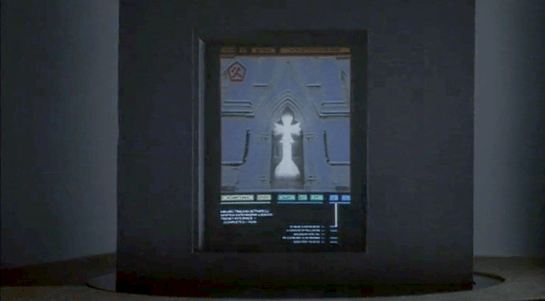
Wakandan Med Table

When Agent Ross is shot in the back during Klaue’s escape from the Busan field office, T’Challa stuffs a kimoyo bead into the wound to staunch the bleeding, but the wounds are still serious enough that the team must bring him back to Wakanda for healing. They float him to Shuri’s lab on a hover-stretcher.

Here Shuri gets to say the juicy line, “Great. Another white boy for us to fix. This is going to be fun.
Sorry about the blurry screen shot, but this is the most complete view of the bay.

The hover-stretcher gets locked into place inside a bay. The bay is a small room in the center of Shuri’s lab, open on two sides. The walls are covered in a gray pattern suggesting a honeycomb. A bas-relief volumetric projection displays some medical information about the patient like vital signs and a subtle fundus image of the optic nerve.

Shuri holds her hand flat and raises it above the patient’s chest. A volumetric display of 9 of his thoracic vertebrae rises up in response. One of the vertebrae is highlighted in a bright red. A section of the wall display displays the same information in 2D, cyan with orange highlights. That display section slides out from the wall to draw observer’s attentions. Hexagonal tiles flip behind the display for some reason, but produce no change in the display.

Shuri reaches her hands up to the volumetric vertebrae, pinches her forefingers and thumbs together, and pull them apart. In response, the space between the vertebrae expands, allowing her to see the top and bottom of the body of the vertebra.

She then turns to the wall display, and reading something there, tells the others that he’ll live. Her attention is pulled away with the arrival of Wakabe, bringing news of Killmonger. We do not see her initiate a treatment in the scene. We have to presume that she did it between cuts. (There would have to be a LOT of confidence in an AI’s ability to diagnose and determine treatment before they would let Griot do that without human input.)

We’ll look more closely at the hover-stretcher display in a moment, but for now let’s pause and talk about the displays and the interaction of this beat.

A lab is not a recovery room

This doesn’t feel like a smart environment to hold a patient. We can bypass a lot of the usual hospital concerns of sterilization (it’s a clean room) or readily-available equipment (since they are surrounded by programmable vibranium dust controlled by an AGI) or even risk of contamination (something something AI). I’m mostly thinking about the patient having an environment that promotes healing: Natural light, quiet or soothing music, plants, furnishing, and serene interiors. Having him there certainly means that Shuri’s team can keep an eye on him, and provide some noise that may act as a stimulus, but don’t they have actual hospital rooms in Wakanda? 

Why does she need to lift it?

The VP starts in his chest, but why? If it had started out as a “translucent skin” illusion, like we saw in Lost in Space (1998, see below), then that might make sense. She would want to lift it to see it in isolation from the distracting details of the body. But it doesn’t start this way, it starts embedded within him?!

The “translucent skin” display from Lost in Space (1998)

It’s a good idea to have a representation close to the referent, to make for easy comparison between them. But to start the VP within his opaque chest just doesn’t make sense.

This is probably the wrong gesture

In the gestural interfaces chapter of  Make It So, I described a pidgin that has been emerging in sci-fi which consisted of 7 “words.” The last of these is “Pinch and Spread to Scale.” Now, there is nothing sacred about this gestural language, but it has echoes in the real world as well. For one example, Google’s VR painting app Tilt Brush uses “spread to scale.” So as an increasingly common norm, it should only be violated with good reason. In Black Panther, Shuri uses spread to mean “spread these out,” even though she starts the gesture near the center of the display and pulls out at a 45° angle. This speaks much more to scaling than to spreading. It’s a mismatch and I can’t see a good reason for it. Even if it’s “what works for her,” gestural idiolects hinder communities of practice, and so should be avoided.

Better would have been pinching on one end of the spine and hooking her other index finger to spread it apart without scaling. The pinch is quite literal for “hold” and the hook quite literal for “pull.” This would let scale be scale, and “hook-pull” to mean “spread components along an axis.”

Model from https://justsketch.me/

If we were stuck with the footage of Shuri doing the scale gesture, then it would have made more sense to scale the display, and fade the white vertebrae away so she could focus on the enlarged, damaged one. She could then turn it with her hand to any arbitrary orientation to examine it.

An object highlight is insufficient

It’s quite helpful for an interface that can detect anomalies to help focus a user’s attention there. The red highlight for the damaged vertebrae certainly helps draw attention. Where’s the problem? Ah, yes. There’s the problem. But it’s more helpful for the healthcare worker to know the nature of the damage, what the diagnosis is, to monitor the performance of the related systems, and to know how the intervention is going. (I covered these in the medical interfaces chapter of Make It So, if you want to read more.) So yes, we can see which vertebra is damaged, but what is the nature of that damage? A slipped disc should look different than a bone spur, which should look different than one that’s been cracked or shattered from a bullet. The thing-red display helps for an instant read in the scene, but fails on close inspection and would be insufficient in the real world.

This is not directly relevant to the critique, but interesting that spinal VPs have been around since 1992. Star Trek: The Next Generation, “Ethics” (Season 5, Episode 16).

Put critical information near the user’s locus of attention

Why does Shuri have to turn and look at the wall display at all? Why not augment the volumetric projection with the data that she needs? You might worry that it could obscure the patient (and thereby hinder direct observations) but with an AGI running the show, it could easily position those elements to not occlude her view.

Compare this display, which puts a waveform directly adjacent to the brain VP. Firefly, “Ariel” (Episode 9, 2002).

Note that Shuri is not the only person in the room interested in knowing the state of things, so a wall display isn’t bad, but it shouldn’t be the only augmentation.

Lastly, why does she need to tell the others that Ross will live? if there was signifcant risk of his death, there should be unavoidable environmental signals. Klaxons or medical alerts. So unless we are to believe T’Challa has never encountered a single medical emergency before (even in media), this is a strange thing for her to have to say. Of course we understand she’s really telling us in the audience that we don’t need to wonder about this plot development any more, but it would be better, diegetically, if she had confirmed the time-to-heal, like, “He should be fine in a few hours.”

Alternatively, it would be hilarious turnabout if the AI Griot had simply not been “trained” on data that included white people, and “could not see him,” which is why she had to manually manage the diagnosis and intervention, but that would have massive impact on the remote piloting and other scenes, so isn’t worth it. Probably.

Thoughts toward a redesign

So, all told, this interface and interaction could be much better fit-to-purpose. Clarify the gestural language. Lose the pointless flipping hexagons. Simplify the wall display for observers to show vitals, diagnosis and intervention, as well as progress toward the goal. Augment the physician’s projection with detailed, contextual data. And though I didn’t mention it above, of course the bone isn’t the only thing damaged, so show some of the other damaged tissues, and some flowing, glowing patterns to show where healing is being done along with a predicted time-to-completion.

Stretcher display

Later, when Ross is fully healed and wakes up, we see a shot of of the med table from above. Lots of cyan and orange, and *typography shudder* stacked type. Orange outlines seem to indicate controls, tough they bear symbols rather than full labels, which we know is better for learnability and infrequent reuse. (Linguist nerds: Yes, Wakandan is alphabetic rather than logographic.)

These feel mostly like FUIgetry, with the exception of a subtle respiration monitor on Ross’ left. But it shows current state rather than tracked over time, so still isn’t as helpful as it could be.

Then when Ross lifts his head, the hexagons begin to flip over, disabling the display. What? Does this thing only work when the patient’s head is in the exact right space? What happens when they’re coughing, or convulsing? Wouldn’t a healthcare worker still be interested in the last-recorded state of things? This “instant-off” makes no sense. Better would have been just to let the displays fade to a gray to indicate that it is no longer live data, and to have delayed the fade until he’s actually sitting up.

All told, the Wakandan medical interfaces are the worst of the ones seen in the film. Lovely, and good for quick narrative hit, but bad models for real-world design, or even close inspection within the world of Wakanda.


MLK Day Matters

Each post in the Black Panther review is followed by actions that you can take to support black lives.

Today is Martin Luther King Day. Normally there would be huge gatherings and public speeches about his legacy and the current state of civil rights. But the pandemic is still raging, and with the Capitol in Washington, D.C. having seen just last week an armed insurrection by supporters of outgoing and pouty loser Donald Trump, (in case that WP article hasn’t been moved yet, here’s the post under its watered-down title) worries about additional racist terrorism and violence.

So today we celebrate virtually, by staying at home, re-experiening his speeches and letters, and listening to the words of black leaders and prominent thinkers all around us, reminding us of the arc of the moral universe, and all the work it takes to bend it toward justice.

With the Biden team taking the reins on Wednesday, and Kamala Harris as our first female Vice President of color, things are looking brighter than they have in 4 long, terrible years. But Trump would have gotten nowhere if there hadn’t been a voting block and party willing to indulge his racist fascism. There’s still much more to do to dismantle systemic racism in the country and around the world. Let’s read, reflect, and use whatever platforms and resources we are privileged to have, act.

Video Phone Calls

The characters in Johnny Mnemonic make quite a few video phone calls throughout the film, enough to be grouped in their own section on interfaces.

The first thing a modern viewer will note is that only one of the phones resembles a current day handheld mobile. This looks very strange today and it’s hard to imagine why we would ever give up our beloved iPhones and Androids. I’ll just observe that accurately predicting the future is difficult (and not really the point) and move on.

More interesting is the variety of phones used. In films from the 1950s to the 1990s, everyone uses a desk phone with a handset. (For younger readers: that is the piece you picked up and held next to your ear and mouth. There’s probably one in your parents’ house.) The only changes were the gradual replacement of rotary dials by keypads, and some cordless handsets. In 21st century films everyone uses a small sleek handheld box. But in Johnny Mnemonic every phone call uses a different interface.

New Darwin

First is the phone call Johnny makes from the New Darwin hotel.

jm-3-phone-hotel-c-adjusted

As previously discussed, Johnny is lying in bed using a remote control to select numbers on the onscreen keypad. He is facing a large wall mounted TV/display screen, with what looks like a camera at the top. The camera is realistic but unusual: as Chapter 10 of Make It So notes, films very rarely show the cameras used in visual communication.

Taxi

The second phone call takes place in Newark, as Johnny rides in a taxi from the airport. Since this is a moving vehicle rather than a room, it shows that wireless videophones also exist. We don’t see how the call is made, just the conversation. Johnny is looking at and speaking into a small screen in front of his seat.

jm-10-taxi-a-adjusted

Quick aside: The blue lines at the bottom of the screen are a street map, with the glowing dot being the taxi. While it’s not the focus of this particular interface, it’s interesting that this map seems to be fixed with the indicator moving sideways. Aircraft and now car navigators use a moving map with the indicator moving up for forward. But this is for the passenger rather than the driver so doesn’t need to be particularly useful. And it’s blue, so must be advanced.

At the other end is Ralphie, who is using a desk screen with a keyboard.

jm-10-taxi-b-adjusted

We get to see things from Ralphie’s end. His keyboard only has ten keys in two rows of five. Ralphie touches the middle key in the bottom row to end the call.

Is this a dedicated phone rather than a computer? The only full-sized keyboards we see in Johnny Mnemonic are part of systems implied to be outdated or salvaged. Perhaps by 2021 voice recognition is good enough to handle most input. Or perhaps by 2021 status indicators have changed and once again nobody who considers themselves important would have a QWERTY keyboard on their desk, leaving others to do the more “menial” typing.

Shinji’s mobile

There is a cyberspace sequence (discussed in a separate post) during which there is a conversation between a Pharmakom tracker and Shinji, the leader of the Yakuza searching for Johnny, who is in en route by car. Shinji’s phone seems to be just like a current day mobile, if perhaps a little smaller than we’re used to.

jm-12-1-car-phone

Takahashi’s desk phone

Takahashi, head of Pharmakom in Newark, has a desktop screen too. This is a general purpose computer which at various times displays video of his daughter and a corporate database entry about Anna, the Pharmakom founder.

jm-15-takahashi-a-adjusted

There is no keyboard, but later we will see that the desk surface has hand gesture tracking capability. Here the screen displays an onscreen video phone window and numeric keypad, similar to what we saw in the New Darwin sequence, but Takahashi doesn’t use that interface. Instead he just says “Get me Karl” and the phone dials the recipient automatically.

Takahashi doesn’t prefix his command with a control phrase such as“Siri” or “Computer” which would imply that the computer is always listening. For an executive with a private office this would be reasonable: who else could he be addressing? A second possibility is that the computer does voice recognition and would not respond to commands from anyone else.

Street Preacher’s Phone

As before, the recipient has chosen to show a video splash screen on connection instead of a live video feed.

jm-15-takahashi-b-adjusted

“Karl” is more commonly known as Street Preacher and works within a church of sorts. We don’t know whether this is genuine religion belief on his part or a cover operation. His phone system is built into a large book, which I thought was intended to be a Bible but Chris identifies as a 16th century ecclesiastical history. There are no controls visible, but we see Karl “pick up” by opening the book so perhaps he “hangs up” by closing it again. Otherwise it could be operated purely by voice.

jm-15-takahashi-c-adjusted

Public phone

Earlier in the film, Johnny picked up an “Infobahn 3000” handset with built in phone keypad.

jm-16-phonebooth-a

His next phone call is from a public phone booth. On screen we see the now familiar videophone keypad. (Apparently this time in cyan, although it’s a very minor color shift.). To the right of the screen are physical buttons, some of which are labelled “start” “stop” and “pause” so perhaps duplicate the onscreen controls. Johnny begins by borrowing Jane’s phone card and swiping it through the payment slot.

jm-16-phonebooth-b-adjusted

The red Infobahn handset is connected to Jane’s card by a cable, although we don’t see Johnny doing this. Johnny types on the handset keypad rather than using the onscreen controls, presumably doing some hacking through the interface.

At first sight it seems unlikely that the phone system could be hacked through an EFTPOS card reader. However there is a long and unhappy history of programmers leaving backdoors and unused functionality in products, often excused with “Well, nobody else knows about it”, which are then exploited. Payment cards themselves often have embedded integrated circuits. This particular hack is not completely implausible.

jm-16-phonebooth-c

When the Pharmakom splash screen appears, Johnny types again on the handset. He is manipulating the internal company phone system to gain access to a number that normally would not be available to the public.

jm-16-phonebooth-e-adjusted

The new number connects Johnny to a surprised corporate type who wants to know how Johnny got through.

jm-16-phonebooth-g-adjusted

We’ll learn later on that this gentleman is not at all who he seems to be. For now, note that Johnny talks and listens directly to the screen and speakers in the phone booth, not the handset he is holding.

Spider phone

Just before his brain is scanned by Spider, Johnny tries to make another call. This time he uses a typical 1990s computer CRT display and keyboard. He wears a conventional looking earpiece and microphone, and there is a small camera mounted on top of the display. He types the number on the keyboard and reaches a Pharmakom receptionist, but Johnny is interrupted.

jm-19-old-phonecall-adjusted

Van call

The last phone call is made by Johnny to Pharmakom again. This time he is in Spider’s van, which doesn’t have a built in phone like the taxi we saw earlier. He uses the handset for audio and a small portable screen for video. There must be a wireless transmitter and receiver somewhere, but it isn’t obvious.

jm-22-puppet-call-a-adjusted
jm-22-puppet-call-b-adjusted

Johnny doesn’t realise that he is actually talking to Takahashi, the head of Pharmakom, through a puppet avatar, which I’ll talk about in the next post. 

Krell technology

Morbius is the inheritor of a massive underground complex of technology once belonging to a race known as the Krell. As Morbius explains, ““In times long past, this planet was the home of a mighty and noble race of beings which called themselves the Krell….”

Morbius tours Adams and Doc through the Krell technopolis.

“Ethically as well as technologically, they were a million years ahead of humankind; for in unlocking the mysteries of nature they had conquered even their baser selves… “…seemingly on the threshold of some supreme accomplishment which was to have crowned their entire history, this all but divine race perished in a single night.

““In the centuries since that unexplained catastrophe even their cloud-piercing towers of glass and porcelain and adamantine steel have crumbled back into the soil of Altair, and nothing——absolutely nothing——remains above ground.””

Despite this advancement, unless we ascribe to the Krell some sort of extra sensory perception and control, much of the technology we see has serious design flaws.

Morbius plays half-a-million-year-old Krell music.

The first piece of technology is a Krell recorded-music player, which Morbius keeps on the desk in his study. The small cylindrical device stands upright, bulging slighty around its middle. It is made of a gray metal, with a translucent pink band just below the middle. A hollow button sits on top.

The cylinder rests in a clear plastic base, with small, identical metal slugs sitting upright in recessions evenly spaced around it. To initiate music playback, Morbius picks one of the slugs and inserts it into the hollow of the button. He then depresses the momentary button once. The pink translucent band illuminates, and music begins to flow from unseen speakers around the office.

Modern audiences have a good deal of experience with music players, and so the device raises a great many questions. How does a user know which slug relates to what music? The slugs all look the same so this seems difficult at best. How does a user eject the slug? If by upending the device, one hopes that the cylinder comes free from the base easily, or the other slugs will all fall out as well. It must have impressed audiences to see music contained in such small containers, but otherwise the device is more attractive than usable.

Morbius inputs the combination to open the door.

Many Krell doors are protected by a combination lock. The mechanism stands high enough that Morbius can easily reach out and operate it. Its large circular face has four white triangles printed on its surface at the cardinal points, and other geometric red and yellow markings around the remainder. A four-spoke handle is anchored to a swivel joint at the center of the face. To unlock the door, a user twists the handle such that one of its spokes lines up with the north point, and then angles the handle to touch the spoke to the triangle there, before returning the handle to a neutral angle and twisting to the next position in the combination. When the sequence is complete, the triangles, the tips of the spokes, and a large ring around the face all light up and blink as the two-plane aperture doors slide open.

Even Walter Pigeon has trouble making sense of this awkward device. There appear to be no snap-to affordances for the neutral angle of the handle or the cardinal orientations, leaving the user unsure if each step in the sequence has been received correctly. Additionally, if the combination consists of particular spokes at this one point, why are the spokes undifferentiated? If the combination consists of pointing to different triangles, why are there four spokes instead of one? Is familiarity with some subtle cue part of the security measures?

Morbius shares operation of the Krell encyclopedia.

All of Krell wisdom and knowledge is contained in a device that Morbius shows to Adams and Doc. It consists of an underlit scroll of material sliding beneath a rectangular hole cut in the surface of a table. To illuminate it, Morbius turns one of the two ridged green dials located to the left of the “screen” about 45 degrees clockwise. To move the scroll, Morbius turns the other green dial clockwise as well.

Why is the least frequently used dial, i.e. the power button, closer than the more frequently used button, i.e. the scroll wheel? This requires the reader to be stretched awkwardly. Why is the on-off dial free spinning? There appear to be only two states: lit and unlit. The dial should have two states as well. If the content of the pages is discretely chunked into pages, it would also argue for a click-stop rather than free-spinning dial as well, but we do not get a good look at the scroll contents. One might also question the value of a scroll as the organizing method for a vast body of information, since related bits of information may be distractingly far apart.