Video Phone Calls

The characters in Johnny Mnemonic make quite a few video phone calls throughout the film, enough to be grouped in their own section on interfaces.

The first thing a modern viewer will note is that only one of the phones resembles a current day handheld mobile. This looks very strange today and it’s hard to imagine why we would ever give up our beloved iPhones and Androids. I’ll just observe that accurately predicting the future is difficult (and not really the point) and move on.

More interesting is the variety of phones used. In films from the 1950s to the 1990s, everyone uses a desk phone with a handset. (For younger readers: that is the piece you picked up and held next to your ear and mouth. There’s probably one in your parents’ house.) The only changes were the gradual replacement of rotary dials by keypads, and some cordless handsets. In 21st century films everyone uses a small sleek handheld box. But in Johnny Mnemonic every phone call uses a different interface.

New Darwin

First is the phone call Johnny makes from the New Darwin hotel.

jm-3-phone-hotel-c-adjusted

As previously discussed, Johnny is lying in bed using a remote control to select numbers on the onscreen keypad. He is facing a large wall mounted TV/display screen, with what looks like a camera at the top. The camera is realistic but unusual: as Chapter 10 of Make It So notes, films very rarely show the cameras used in visual communication.

Taxi

The second phone call takes place in Newark, as Johnny rides in a taxi from the airport. Since this is a moving vehicle rather than a room, it shows that wireless videophones also exist. We don’t see how the call is made, just the conversation. Johnny is looking at and speaking into a small screen in front of his seat.

jm-10-taxi-a-adjusted

Quick aside: The blue lines at the bottom of the screen are a street map, with the glowing dot being the taxi. While it’s not the focus of this particular interface, it’s interesting that this map seems to be fixed with the indicator moving sideways. Aircraft and now car navigators use a moving map with the indicator moving up for forward. But this is for the passenger rather than the driver so doesn’t need to be particularly useful. And it’s blue, so must be advanced.

At the other end is Ralphie, who is using a desk screen with a keyboard.

jm-10-taxi-b-adjusted

We get to see things from Ralphie’s end. His keyboard only has ten keys in two rows of five. Ralphie touches the middle key in the bottom row to end the call.

Is this a dedicated phone rather than a computer? The only full-sized keyboards we see in Johnny Mnemonic are part of systems implied to be outdated or salvaged. Perhaps by 2021 voice recognition is good enough to handle most input. Or perhaps by 2021 status indicators have changed and once again nobody who considers themselves important would have a QWERTY keyboard on their desk, leaving others to do the more “menial” typing.

Shinji’s mobile

There is a cyberspace sequence (discussed in a separate post) during which there is a conversation between a Pharmakom tracker and Shinji, the leader of the Yakuza searching for Johnny, who is in en route by car. Shinji’s phone seems to be just like a current day mobile, if perhaps a little smaller than we’re used to.

jm-12-1-car-phone

Takahashi’s desk phone

Takahashi, head of Pharmakom in Newark, has a desktop screen too. This is a general purpose computer which at various times displays video of his daughter and a corporate database entry about Anna, the Pharmakom founder.

jm-15-takahashi-a-adjusted

There is no keyboard, but later we will see that the desk surface has hand gesture tracking capability. Here the screen displays an onscreen video phone window and numeric keypad, similar to what we saw in the New Darwin sequence, but Takahashi doesn’t use that interface. Instead he just says “Get me Karl” and the phone dials the recipient automatically.

Takahashi doesn’t prefix his command with a control phrase such as“Siri” or “Computer” which would imply that the computer is always listening. For an executive with a private office this would be reasonable: who else could he be addressing? A second possibility is that the computer does voice recognition and would not respond to commands from anyone else.

Street Preacher’s Phone

As before, the recipient has chosen to show a video splash screen on connection instead of a live video feed.
jm-15-takahashi-b-adjusted

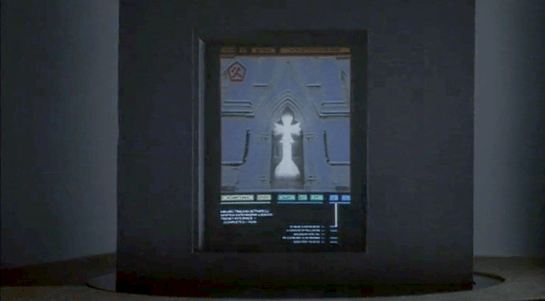
“Karl” is more commonly known as Street Preacher and works within a church of sorts. We don’t know whether this is genuine religion belief on his part or a cover operation. His phone system is built into a large book, which I thought was intended to be a Bible but Chris identifies as a 16th century ecclesiastical history. There are no controls visible, but we see Karl “pick up” by opening the book so perhaps he “hangs up” by closing it again. Otherwise it could be operated purely by voice.

jm-15-takahashi-c-adjusted

Public phone

Earlier in the film, Johnny picked up an “Infobahn 3000” handset with built in phone keypad.

jm-16-phonebooth-a

His next phone call is from a public phone booth. On screen we see the now familiar videophone keypad. (Apparently this time in cyan, although it’s a very minor color shift.). To the right of the screen are physical buttons, some of which are labelled “start” “stop” and “pause” so perhaps duplicate the onscreen controls. Johnny begins by borrowing Jane’s phone card and swiping it through the payment slot.

jm-16-phonebooth-b-adjusted

The red Infobahn handset is connected to Jane’s card by a cable, although we don’t see Johnny doing this. Johnny types on the handset keypad rather than using the onscreen controls, presumably doing some hacking through the interface.

At first sight it seems unlikely that the phone system could be hacked through an EFTPOS card reader. However there is a long and unhappy history of programmers leaving backdoors and unused functionality in products, often excused with “Well, nobody else knows about it”, which are then exploited. Payment cards themselves often have embedded integrated circuits. This particular hack is not completely implausible.

jm-16-phonebooth-c

When the Pharmakom splash screen appears, Johnny types again on the handset. He is manipulating the internal company phone system to gain access to a number that normally would not be available to the public.

jm-16-phonebooth-e-adjusted

The new number connects Johnny to a surprised corporate type who wants to know how Johnny got through.

jm-16-phonebooth-g-adjusted

We’ll learn later on that this gentleman is not at all who he seems to be. For now, note that Johnny talks and listens directly to the screen and speakers in the phone booth, not the handset he is holding.

Spider phone

Just before his brain is scanned by Spider, Johnny tries to make another call. This time he uses a typical 1990s computer CRT display and keyboard. He wears a conventional looking earpiece and microphone, and there is a small camera mounted on top of the display. He types the number on the keyboard and reaches a Pharmakom receptionist, but Johnny is interrupted.

jm-19-old-phonecall-adjusted

Van call

The last phone call is made by Johnny to Pharmakom again. This time he is in Spider’s van, which doesn’t have a built in phone like the taxi we saw earlier. He uses the handset for audio and a small portable screen for video. There must be a wireless transmitter and receiver somewhere, but it isn’t obvious.

jm-22-puppet-call-a-adjusted
jm-22-puppet-call-b-adjusted

Johnny doesn’t realise that he is actually talking to Takahashi, the head of Pharmakom, through a puppet avatar, which I’ll talk about in the next post. 

Hotel Remote

The Internet 2021 shot that begins the film ends in a hotel suite, where it wakes up lead character Johnny. This is where we see the first real interface in the film. It’s also where this discussion gets more complicated.

A note on my review strategy

As a 3D graphics enthusiast, I’d be happy just to analyze the cyberspace scenes, but when you write for Sci Fi Interfaces, there is a strict rule that every interface in a film must be subjected to inspection. And there are a lot of interfaces in Johnny Mnemonic. (Curse your exhaustive standards, Chris!)

A purely chronological approach which would spend too much time looking at trees and not enough at the forest. So I’ll be jumping back and forth a bit, starting with the gadgets and interfaces that appear only once, then moving on to the recurring elements, variations on a style or idea that are repeated during the film.

Description

The wakeup call arrives in the hotel room as a voice announcement—a sensible if obvious choice for someone who is asleep—and also as text on a wall screen, giving the date, time, and temperature. The voice is artificial sounding but pleasant rather than grating, letting you know that it’s a computer and not some hotel employee who let himself in. The wall display functions as both a passive television and an interactive computer monitor. Johnny picks up a small remote control to silence the wake up call.

jm-2-check-email-a

This remote is a small black box like most current-day equivalents, but with a glowing red light at one end. At the time of writing blue lights and indicators are popular for consumer electronics, apparently following the preference set by science fiction films and noted in Make It So. Johnny Mnemonic is an outlier in using red lights, as we’ll see more of these as the film progresses. Here the glow might be some kind of infrared or laser beam that sends a signal, or it might simply indicate the right way to orient the control in the hand for the controls to make sense.

First thing every morning: Messages

After silencing the alarm, Johnny, like so many of us today, checks his email. (In 1995 doing so before even getting out of bed might have been intended to show his detachment from humanity. Today, it seems perfectly natural!) He uses the remote to switch the display to the hotel “Message Centre”. We see his thumb move around, so the remote must have multiple buttons, but can’t tell whether this is a simple arrow keypad or something more complicated.

jm-2-check-email-b-adjusted

The message centre of the New Darwin Inn system both displays the text message visually and also speaks it aloud in the same synthesized voice that woke him up. Voiceovers are common in films so the audience doesn’t have to try to read the cinema screen, but in this case it would be genuinely useful. Guests could start doing something else without needing to pay full attention to the display.

Is it necessary for Johnny to explicitly switch to the Message Center? The system could have displayed this message automatically after the wakeup call, or shown the 2021 equivalent of his InBox.  On the other hand, this is a giant, clearly visible screen and Johnny was not alone in the suite. Johnny, and other guests, might wish to keep their communications private.

As Johnny has no messages, he uses the remote to switch the display to a TV channel.

The hotel room “phone” call

Next he uses the remote to make a phone call. He starts by using the remote to dial the number, which appears on the display. We can’t see whether he is typing numbers directly, or using arrow keys and an Enter or OK button to navigate around the onscreen keypad. It’s certainly convenient for guests to be able to make a call without getting out of bed, but a voice recognition interface might be even easier. We’ll see a phone system that accepts voice commands later on, so perhaps using the remote is just a preference.

jm-3-phone-hotel-a-adjusted

What is the strange blue window to the right of the keypad? It’s there because all phone calls in 2021 are in fact video calls. The equivalent to a busy waiting tone in this world is a video splash screen. These can be customized by the recipient, here showing the company name, Dataflow.

jm-3-phone-hotel-b-adjusted

And finally both parties can see and hear each other. Note  also the graphical reverse, stop, and play buttons at the bottom right of the keypad. These imply some sort of recording capability, but we never see them used.

jm-3-phone-hotel-c-adjusted

Next

I’ll discuss the 2021 phone system in more detail later on, so for now we just need to know that this phone call is the setup that sends Johnny to Beijing for his next, and hopefully last, job.

Itchy’s SFW Masturbation Chair

With the salacious introduction, “Itchy, I know what you’d like,” Saun Dann reveals himself as a peddler of not just booby trapped curling irons, but also softcore erotica! The Life Day gift he gives to the old Wookie is a sexy music video for his immersive media chair.

SWHS-Chair-03

The chair sits in the family living room, and has a sort of helmet fixed in place such that Itchy can sit down and rest his head within it. On the outside of the helmet are lights that continuously blink out of sync with each other and seem unrelated to the actual function of the chair. Maybe a fairy-lights power indicator?

SWHS-Chair-02

Saun first powers the device by inserting a “proton pack” into the back of the chair. This is kind of strange since none of the other devices seen in the home require batteries or charging. Are they lower power so batteries last longer? Is there an unseen electrical infrastructure but that monitors any plugged in object for illegal-device signatures? Whatever the reason, the battery pack plugs in and the chair comes to life.

When Itchy sits down, he rests his head in the helmet, and Saun puts a media cartridge into a tray sticking out of the armrest. There is a single red button on the forward edge. He then engages the cartridge by slapping it on edge so the tray slides into a recess. Then he lowers the forehead plate of the helmet over Itchy, who sits back to enjoy the show. Saun wishes him, “Happy Life Day!” and then with a nudge-nudge-wink-wink-you-know-seeeeexxxxx tone in his voice, leans in to reiterate, “And I do mean Happy Life Day!”

SWHS-Chair-09

Itchy punches the top of the armrest with his hairy finger, and the media plays, full of theremin meanderings, stage lights and spandex dancers shot through a kaleidoscope-refraction lens, and a scantily-feathered singer (IMDB tells me the character name is Mermeia Holographic Wow, played by the diva Diahann Carroll) who purrs out a full 5 minutes of mind-numbing introduction before a 4-minute musical number. You can almost hear the director saying over a soggily-chewed stogie, “Sorry, Diahann, but we don’t have a lot to work with, here, you’re really going to have to stretch this out.”

I know you’re searching for me
Searching
Searching
I am here
My voice is for you alone
I am found in your eyes only
I exist for you
I am in your mind
As you create me
Oh yes
I can feel my creation
{Giggle}
I’m getting your message
Are you getting mine?

Itchy growls and spasms in his chair enthusiastically.

Oh, oh! We are excited aren’t we?
Well just relax
Just relax
Yes

{More Itchy grunting}

Now
We can have a good time
Can’t we?

{spasming, panting}

I’ll tell you a secret
I find you adorable

Itchy loves this assertion so much that he punches a control on the armrest, and the playback jumps back to replay the line again. And again. And again. Four times in total.

(I find you adorable)
I don’t need to ask how you found me
You see, I am your fantasy
I am your experience
So experience me
I am your pleasure
So enjoy me
This is our moment together in time
That we might turn this moment an eternity

{Music mercifully begins}

SWHS-Chair-07
I’m sorry to have to remind people about this low point in your career, Diahann.

So…Exactly what is this machine?

So, if the words of the recording are to be believed, this machine automatically reads the mind (or stored preferences) of its user to create a custom, on-the-fly immersive video.

Here you should note that Itchy’s species of sexual preference is human, not Wookie, and then note with sadness that Chewie is not mixed-species. Itchy is living an unfulfilled life.

If it constructs its visions on-the-fly, then what is the cartridge for? It can’t be Itchy’s preferences. Why would Saun have them? My best guess is that the cartridge contains the template of the song, This Minute Now, and the device reads the wearer’s in-the-moment preferences to pick the avatar that sings it. That template isn’t neutral, though. It has to be a sexy template, because Saun does all the nod’s as good as a wink to a blind bat routine. Aww, yeah, sexy template for Life Day.

Knowing that this might be a privately-observed sexytime moment, I’d recommend the designers add a curtain or perhaps situate the chair inside a private chamber to make the user less exposed. Otherwise it might be awkward—for a human user at least—for other members of the family to observe him becoming visibly and audibly aroused (the panting), much less do…uh…anything about it. Of course I don’t know Wookie social rules, so this might be well within their social norms. Kinda makes you wonder about how Chewie spends his idle time on the Falcon in front of Han. “Chewie. Do you mind? Take it into your berth!”

Controls

The instant replay feature is useful to the task. And it’s quite well executed, since it’s a quick-to-press button to replay the last moment, and that moment is of unspecified length. The media must have very sophisticated and detailed markup for a “repeat that bit” to work, and it does. Of course, it also can read Itchy’s mind, so maybe it just knows to play across the most-recent high-excitement part. It’s a self-administered dopamine hit.

A better tool might monitor the user’s brainwaves for a perfect combination of tension and release to ensure a perfectly satisfying experience. No button needed. That would also alleviate the problem that the user’s hand might be otherwise engaged during the exciting part to try and target a button. The (prolly NSFW text, even if it’s WebMDsexual response cycle of humans is a known thing, so surely a Wookie’s is too. Let me disturb you by visualizing the combination of concepts so implied.

Wookie-Response-Cycle

But we also have to ask after the placement and purpose of that sole red button. Saun slapped the cartridge edge-on to lodge the tray in place. But that’s where the button is. Did the lodging activate the play, or did pressing the button?

If the cartridge, what does the button do? (Not replay, Itchy clearly presses the top of the armrest for that.) And how does it avoid accidental activation while being slapped in?

If the button, why have the tray slide in and out? To keep it private? Sorry, you lost that battle with the living room masturbatorium. To protect the media? Then why have it in the armrest where it’s sure to be subject to the bangings of Wookie demands for again!?

With the commercial release of Oculus Rift just about to ship post-CES, let’s not turn to this device for any immersive-media lessons. There is better blind-use masturbation VR in Strange Days, more dystopic ones in THX-1138 (yes, I now realize, it’s a recurring Lucas theme), more private ones in Sleeper, and less creepy things almost anywhere you turn.

Let’s just let Itchy have his personalized-avatar, happy Life Day, there, in the middle of the astroturfed family room.

SWHS-Chair-10

Stay classy, Star Wars Holiday Special.