Otto’s Manual Control

WallE-Otto02

WallE-Otto06

When it refused to give up authority, the Captain wrested control of the Axiom from the artificial intelligence autopilot, Otto. Otto’s body is the helm wheel of the ship and fights back against the Captain. Otto wants to fulfil BNL’s orders to keep the ship in space. As they fight, the Captain dislodges a cover panel for Otto’s off-switch. When the captain sees the switch, he immediately realizes that he can regain control of the ship by deactivating Otto. After fighting his way to the switch and flipping it, Otto deactivates and reverts to a manual control interface for the ship.

The panel of buttons showing Otto’s current status next to the on/off switch deactivates half its lights when the Captain switches over to manual. The dimmed icons are indicating which systems are now offline. Effortlessly, the captain then returns the ship to its proper flight path with a quick turn of the controls.

One interesting note is the similarity between Otto’s stalk control keypad, and the keypad on the Eve Pod. Both have the circular button in the middle, with blue buttons in a semi-radial pattern around it. Given the Eve Pod’s interface, this should also be a series of start-up buttons or option commands. The main difference here is that they are all lit, where the Eve Pod’s buttons were dim until hit. Since every other interface on the Axiom glows when in use, it looks like all of Otto’s commands and autopilot options are active when the Captain deactivates him.

A hint of practicality…

The panel is in a place that is accessible and would be easily located by service crew or trained operators. Given that the Axiom is a spaceship, the systems on board are probably heavily regulated and redundant. However, the panel isn’t easily visible thanks to specific decisions by BNL. This system makes sense for a company that doesn’t think people need or want to deal with this kind of thing on their own.

Once the panel is open, the operator has a clear view of which systems are on, and which are off. The major downside to this keypad (like the Eve Pod) is that the coding of the information is obscure. These cryptic buttons would only be understandable for a highly trained operator/programmer/setup technician for the system. Given the current state of the Axiom, unless the crew were to check the autopilot manual, it is likely that no one on board the ship knows what those buttons mean anymore.

WallE-Otto03

Thankfully, the most important button is in clear English. We know English is important to BNL because it is the language of the ship and the language seen being taught to the new children on board. Anyone who had an issue with the autopilot system and could locate the button, would know which button press would turn Otto off (as we then see the Captain immediately do).

Considering that Buy-N-Large’s mission is to create robots to fill humans’ every need, saving them from every tedious or unenjoyable job (garbage collecting, long-distance transportation, complex integrated systems, sports), it was both interesting and reassuring to see that there are manual over-rides on their mission-critical equipment.

…But hidden

The opposite situation could get a little tricky though. If the ship was in manual mode, with the door closed, and no qualified or trained personnel on the bridge, it would be incredibly difficult for them to figure out how to physically turn the ship back to auto-pilot. A hidden emergency control is useless in an emergency.

Hopefully, considering the heavy use of voice recognition on the ship, there is a way for the ship to recognize an emergency situation and quickly take control. We know this is possible because we see the ship completely take over and run through a Code Green procedure to analyze whether Eve had actually returned a plant from Earth. In that instance, the ship only required a short, confused grunt from the Captain to initiate a very complex procedure.

Security isn’t an issue here because we already know that the Axiom screens visitors to the bridge (the Gatekeeper). By tracking who is entering the bridge using the Axiom’s current systems, the ship would know who is and isn’t allowed to activate certain commands. The Gatekeeper would either already have this information coded in, or be able to activate it when he allowed people into the bridge.

For very critical emergencies, a system that could recognize a spoken ‘off’ command from senior staff or trained technicians on the Axiom would be ideal.

Anti-interaction as Standard Operating Procedure

WallE-Otto05

The hidden door, and the obscure hard-wired off button continue the mission of Buy-N-Large: to encourage citizens to give up control for comfort, and make it difficult to undo that decision. Seeing as how the citizens are more than happy to give up that control at first, it looks like profitable assumption for Buy-N-Large, at least in the short term. In the long term we can take comfort that the human spirit–aided by an adorable little robot–will prevail.

So for BNL’s goals, this interface is fairly well designed. But for the real world, you would want some sort of graceful degradation that would enable qualified people to easily take control in an emergency. Even the most highly trained technicians appreciate clearly labeled controls and overrides so that they can deal directly with the problem at hand rather than fighting with the interface.

The Gatekeeper

WallE-Gatekeeper04

After the security ‘bot brings Eve across the ship (with Wall-e in tow), he arrives at the gatekeeper to the bridge. The Gatekeeper has the job of entering information about ‘bots, or activating and deactivating systems (labeled with “1”s and “0”s) into a pedestal keyboard with two small manipulator arms. It’s mounted on a large, suspended shaft, and once it sees the security ‘bot and confirms his clearance, it lets the ‘bot and the pallet through by clicking another, specific button on the keyboard.

The Gatekeeper is large. Larger than most of the other robots we see on the Axiom. It’s casing is a white shell around an inner hardware. This casing looks like it’s meant to protect or shield the internal components from light impacts or basic problems like dust. From the looks of the inner housing, the Gatekeeper should be able to move its ‘head’ up and down to point its eye in different directions, but while Wall-e and the security ‘bot are in the room, we only ever see it rotating around its suspension pole and using the glowing pinpoint in its red eye to track the objects its paying attention to.

When it lets the sled through, it sees Wall-e on the back of the sled, who waves to the Gatekeeper. In response, the Gatekeeper waves back with its jointed manipulator arm. After waving, the Gatekeeper looks at its arm. It looks surprised at the arm movement, as if it hadn’t considered the ability to use those actuators before. There is a pause that gives the distinct impression that the Gatekeeper is thinking hard about this new ability, then we see it waving the arm a couple more times to itself to confirm its new abilities.

WallE-Gatekeeper01

The Gatekeeper seems to exist solely to enter information into that pedestal. From what we can see, it doesn’t move and likely (considering the rest of the ship) has been there since the Axiom’s construction. We don’t see any other actions from the pedestal keys, but considering that one of them opens a door temporarily, it’s possible that the other buttons have some other, more permanent functions like deactivating the door security completely, or allowing a non-authorized ‘bot (or even a human) into the space.

An unutilized sentience

The robot is a sentient being, with a tedious and repetitive job, who doesn’t even know he can wave his arm until Wall-e introduces the Gatekeeper to the concept. This fits with the other technology on board the Axiom, with intelligence lacking any correlation to the robot’s function. Thankfully for the robot, he (she?) doesn’t realize their lack of a larger world until that moment.

So what’s the pedestal for?

It still leaves open the question of what the pedestal controls actually do. If they’re all connected to security doors throughout the ship, then the Gatekeeper would have to be tied into the ship’s systems somehow to see who was entering or leaving each secure area.

The pedestal itself acts as a two-stage authentication system. The Gatekeeper has a powerful sentience, and must decide if the people or robots in front of it are allowed to enter the room or rooms it guards. Then, after that decision, it must make a physical action to unlock the door to enter the secure area. This implies a high level of security, which feels appropriate given that the elevator accesses the bridge of the Axiom.

Since we’ve seen the robots have different vision modes, and improvements based on their function, it’s likely that the Gatekeeper can see more into the pedestal interface than the audience can, possibly including which doors each key links to. If not, then as a computer it would have perfect recall on what each button was for. This does not afford a human presence stepping in to take control in case the Gatekeeper has issues (like the robots seen soon after this in the ‘medbay’). But, considering Buy-N-Large’s desire to leave humans out of the loop at each possible point, this seems like a reasonable design direction for the company to take if they wanted to continue that trend.

It’s possible that the pedestal was intended for a human security guard that was replaced after the first generation of spacefarers retired. Another possibility is that Buy-N-Large wanted an obvious sign of security to comfort passengers.

What’s missing?

We learn after this scene that the security ‘bot is Otto’s ‘muscle’ and affords some protection. Given that the Security ‘bot and others might be needed at random times, it feels like he would want a way to gain access to the bridge in an emergency. Something like an integrated biometric scanner on the door that could be manually activated (eye scanner, palm scanner, RFID tags, etc.), or even a physical key device on the door that only someone like the Captain or trusted security officers would be given. Though that assumes there is more than one entrance to the bridge.

This is a great showcase system for tours and commercials of an all-access luxury hotel and lifeboat. It looks impressive, and the Gatekeeper would be an effective way to make sure only people who are really supposed to get into the bridge are allowed past the barriers. But, Buy-N-Large seems to have gone too far in their quest for intelligent robots and has created something that could be easily replaced by a simpler, hard-wired security system.

WallE-Gatekeeper05

Dispatch

LOGANS_RUN_map_520

At dispatch for the central computer, Sandmen monitor a large screen that displays a wireframe plan of the city, including architectural detail and even plants, all color coded using saturated reds, greens, and blues. When a Sandman has accepted the case of a runner, he appears as a yellow dot on the screen. The runner appears as a red dot. Weapons fire can even be seen as a bright flash of blue. The red dots of terminated runners fades from view.

Using the small screens and unlabeled arrays of red and yellow lit buttons situated on an angled panel in front of them, the seated Sandman can send a call out to catch runners, listen to any spoken communications, and respond with text and images.

LogansRun094

*UXsigh* What are we going to do with this thing? With an artificial intelligence literally steps behind them, why rely on a slow bunch of humans at all for answering questions and transmitting data? It might be better to just let the Sandmen do what they’re good at, and let the AI handle what it’s good at.

But OK, if it’s really that limited of an Übercomputer and can only focus on whatever is occupying it at the moment, at least make the controls usable by people. Let’s do the hard work of reducing the total number of controls, so they can be clustered all within easy reach rather than spread out so you have to move around just to operate them all. Or use your feet or whatever. Differentiate the controls so they are easy to tell apart by sight and touch rather than this undifferentiated mess. Let’s take out a paint pen and actually label the buttons. Do…do something.

LogansRun095

This display could use some rethinking as well. It’s nice that it’s overhead, so that dispatch can be thinking about field strategy rather than ground tactics. But if that’s the case, it could use some design help and some strategic information. How about downplaying the saturation on the things that don’t matter that much, like walls and plants? Then the Sandmen can focus more on the interplay of the Runner and his assailants. Next you could augment the display with information about the runner, and perhaps a best-guess prediction of where they’re likely to run, maybe the health of individuals, or the amount of ammunitition they have.

Which makes me realize that more than anything, this screen could use the hand of a real-time strategy game user interface designer, because that’s what they’re doing. The Sandmen are playing a deadly, deadly video game right here in this room, and they’re using a crappy interface to try and win it.

Lifeclock: The central conceit

LogansRun004

The central technological conceit of the movie is the lifeclock, a rosette crystal that is implanted in each citizen’s left palm at birth. This clock changes color in stages over the course of the individual’s lifetime.

Though the information in the movie is somewhat contradictory as to the actual stages, the DVD has an easter egg that explains the stages as follows.

White white Birth to 8 years
Yellow yellow 9 to 15 years
Green green 16 to 23 years
Red red 24 years to 10 days before Lastday (30 years)
Blinking Red red_blink from 10 days before Lastday to Lastday
Black black End of Lastday (Carousel/death)

LOGANS_RUN_blinking_520

Lifeclocks derive their signal and possibly power from a local-area broadcast in the city. When Logan and Jessica leave the city their lifeclocks turn clear.

The signal of the lifeclock is so central to life that most citizens dress exclusively in colors that match their lifeclock color. Only certain professions, such as Sandmen and the New You doctor, are seen to wear clothing that lacks clear reference to a lifeclock color, even though the individuals in these professions have lifeclocks and are still subject to carousel at Lastday. We can presume, though are not shown explicitly, that certain rights and responsibilities are conferred on citizens in different stages, such as legal age of sexual consent and access to intoxicants, so the clothing acts as a social signal of status.

LogansRun018

As an interface the lifeclock is largely passive, and can be discussed for its usability in two main ways.

Color

The first is the color. Are the stages easily discernable by people? The main problem would be between the red and green stages since the forms of red-green color blindness affects around 4% of the population. To accommodate for this, reds are made more discernable with a brighter glow than the green. As a wavelength, red carries the farthest, and blinking is of course a highly visible and attention-getting signal, which makes it difficult for an individual to socially hide that his or her time for carousel has come.

LogansRun228

Black is a questionable signal since this indicates actual violation of the law but does not draw any attention to itself. Casual observation of a relaxed hand with a black lifeclock might even be mistaken for a colored lifeclock in shadow, but as the citizenry has complete faith in the system and a number of countermeasures in place to ensure that everyone either attends carousel or is terminated, perhaps this is not a concern.

But if we’re just going on human signal processing, the red should be reserved for LastWeek, and a blinking red for after LastDay. That leaves a color gap between 24 and 30. I’d make this phase blue, since it looks so clearly different from red. The new colors would be as follows.

White white Birth to 8 years
Yellow yellow 9 to 15 years
Green green 16 to 23 years
Blue blue 24 years to 10 days before Lastday (30 years)
Red red from 10 days before Lastday to Lastday
Blinking Red red_blink End of Lastday (Carousel/death)

Location on the body

The second question is the location of the lifeclock. Where should it be placed? It is a social signal, and as such needs to be visible. The parts of the body that are most often seen uncovered in the film are the hand, the neck, and the head. The neck and head are problematic since these are not visible to the citizen himself, useful for reinforcing compliance with the system. This leaves the hand.

LogansRun_placement

Given the hand, the palm seems an odd choice since in a relaxed position or when the hand is in use, the palm is often hidden from view of other people. The colored clothing seen in the film show that a citizen’s life stage is not really considered a private matter, so a location on the back of the hand would have made more sense. To keep it in view of its owner, a location on the fleshy pad between the thumb and the forefinger would have made a better, if less cinematic, choice.

Brain VP

GitS-VPbrain-04

When trying to understand the Puppet Master, Kusanagi’s team consults with their staff Cyberneticist, who displays for them in his office a volumetric projection of the cyborg’s brain. The brain floats free of any surrounding tissue, underlit in a screen-green translucent monochrome. The edge of the projection is a sphere that extends a few centimeters out from the edge of the brain. A pattern of concentric lines routinely passes along the surface of this sphere. Otherwise, the "content" of the VP, that is, the brain itself, does not appear to move or change.

The Cyberneticist explains, while the team looks at the VP, "It isn’t unlike the virtual ghost-line you get when a real ghost is dubbed off. But it shows none of the data degradation dubbing would produce. Well, until we map the barrier perimeter and dive in there, we won’t know anyting for sure."

GitS-VPbrain-01

GitS-VPbrain-02

GitS-VPbrain-03

The VP does not appear to be interactive, it’s just an output. In fact, it’s just an output of the surface features of a brain. There’s no other information called out, no measurements, or augmenting data. Just a brain. Which raises the question of what purpose does this projection serve? Narratively, of course, it tells us that the Cyberneticist is getting deep into neurobiology of the cyborg. But he doesn’t need that information. Kunasagi’s team doesn’t even need that information. Is this some sort of screen saver?

And what’s up with the little ripples? It’s possible that these little waves are more than just an artifact of the speculative technology’s refresh. Perhaps they’re helping to convey that a process is currently underway, perhaps "mapping the barrier perimeter." But if that was the case, the Cyberneticist would want to see some sense of progress against a goal. At the very least there should be some basic sense of progress: How much time is estimated before the mapping is complete, and how much time has elapsed?

Of course any trained brain specialist would gain more information from looking at the surface features of a brain than us laypersons could understand. But if he’s really using this to do such an examination, the translucency and peaked, saturated color makes that task prohibitively harder than just looking at the real thing an office away or a photograph, not to mention the routine rippling occlusion of the material being studied.

Unless there’s something I’m not seeing, this VP seems as useless as an electric paperweight.

Profiling “CAT” scan

fifthelement-122

After her escape from the nucleolab, Leeloo ends up on a thin ledge of a building, unsure where to go or what to do. As a police car hovers nearby, the officers use an onboard computer to try and match her identity against their database. One officer taps a few keys into an unseen keyboard, her photograph is taken, and the results displays in about 8 seconds. Not surprisingly, it fails to find a match, and the user is told so with an unambiguous, red “NO FILE” banner across the screen.

fifthelement-128

This interface flies by very quickly, so it’s not meant to be read screen by screen. Still, the wireframes present a clear illustration of what the system doing, and what the results are.

The system shouldn’t just provide dead ends like this, though. Any such system has to account for human faces changing over the time since the last capture: aging, plastic surgery, makeup, and disfiguring accidents, to name a few. Since Leeloo isn’t inhuman, it could provide some results of “closest matches,” perhaps with a confidence percentage alongside individual results. Even if the confidence number was very low, that output would help the officers understand it was an issue with the subject, and not an issue of an incomplete database or weak algorithm.

One subtle element is that we don’t see or hear the officer telling the system where the perp is, or pointing a camera. He doesn’t even have to identify her face. It automatically finds her in the camera few, identifies her face, and starts scanning. The sliding green lines tell the officer what it’s finding, giving him confidence in its process, and offering an opportunity to intervene if it’s getting things wrong.

Nucleolab Progress Indicator

FifthE-nucleolab-009

As the nucleolab is reconstructing Leeloo, the screen on the control panel provides update, detailing the process. For the most part this update is a wireframe version of what everyone can see with their eyes.

FifthE-nucleolab-029

FifthE-nucleolab-015

The only time it describes something we can’t see with our own eyes is when Leeloo’s skin is being “baked” by an ultraviolet light under a metal cover. Of course we know this is a narrative device to heighten the power of the big reveal, but it’s also an opportunity for the interface to actually do something useful. It has a green countdown clock, and visualizes something that’s hidden from view.

FifthE-nucleolab-020

As far as a progress indicator goes, it’s mostly useful. Mactilburgh presumably knows roughly how long things take and even the order of operations. All he needs is confirmation that his system is doing what it’s supposed to be, and the absence of an error is enough for him. The timer helps, too, since he’s like a kid waiting for an Easy Bake Oven…of science.

But Munro doesn’t know what the heck is going on. Sure he knows some of the basics of biology. There’s going to be a skeleton, some muscle, some nerves. But beyond that, he’s got a job to do, and that’s to take this thing out the minute it goes pear-shaped. So he needs to know: Is everything going OK? Should I pop the top on a tall boy of Big Red Button? It might be that the interface has some kind of Dire Warning mode for when things go off the rails, but that doesn’t help during the good times. Giving Munro some small indicator that things are going well would remove any ambiguity and set him at ease.

An argument could be made that you don’t want Munro at ease, but a false positive might kill Leeloo and risk the world. A false negative (or a late negative) just risks her escape. Which happens anyway. Fortunately for us.

FifthE-nucleolab-024

Taxi navigation

FifthE-attackdetection-001

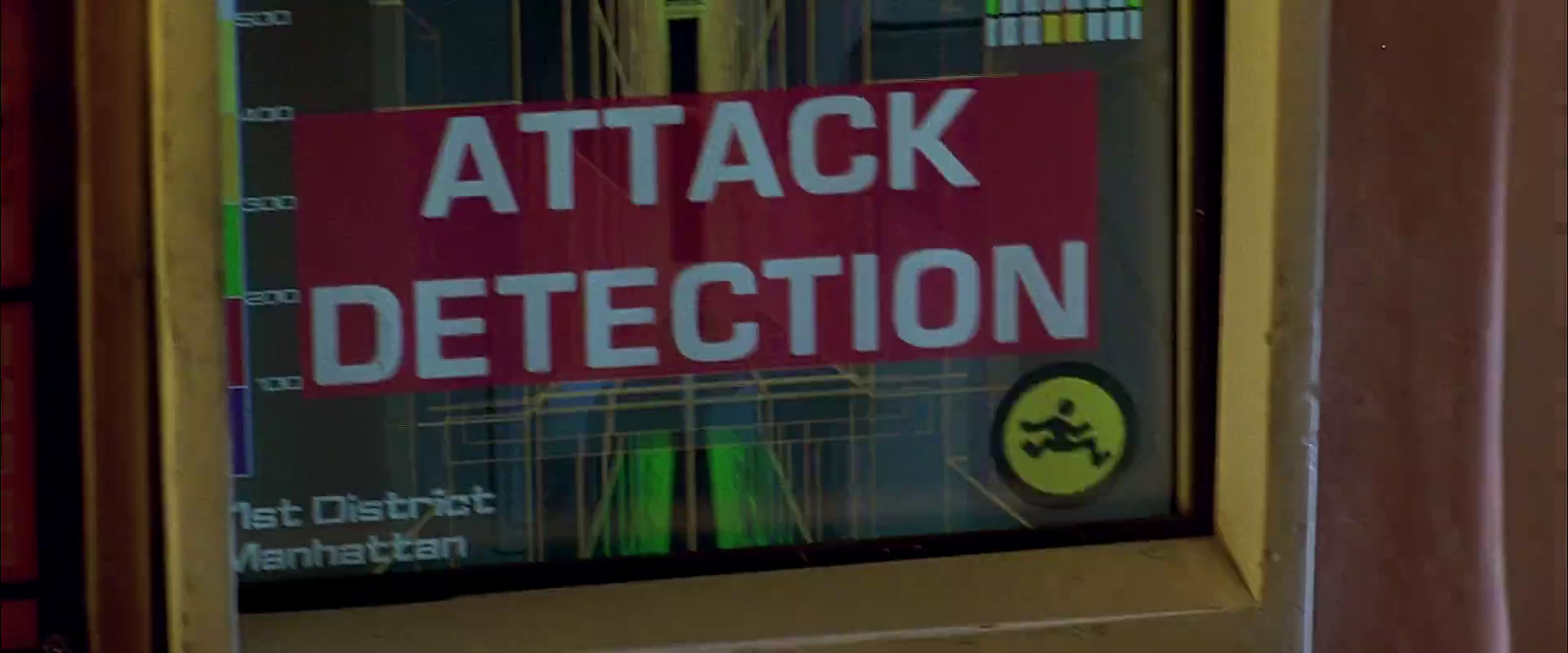
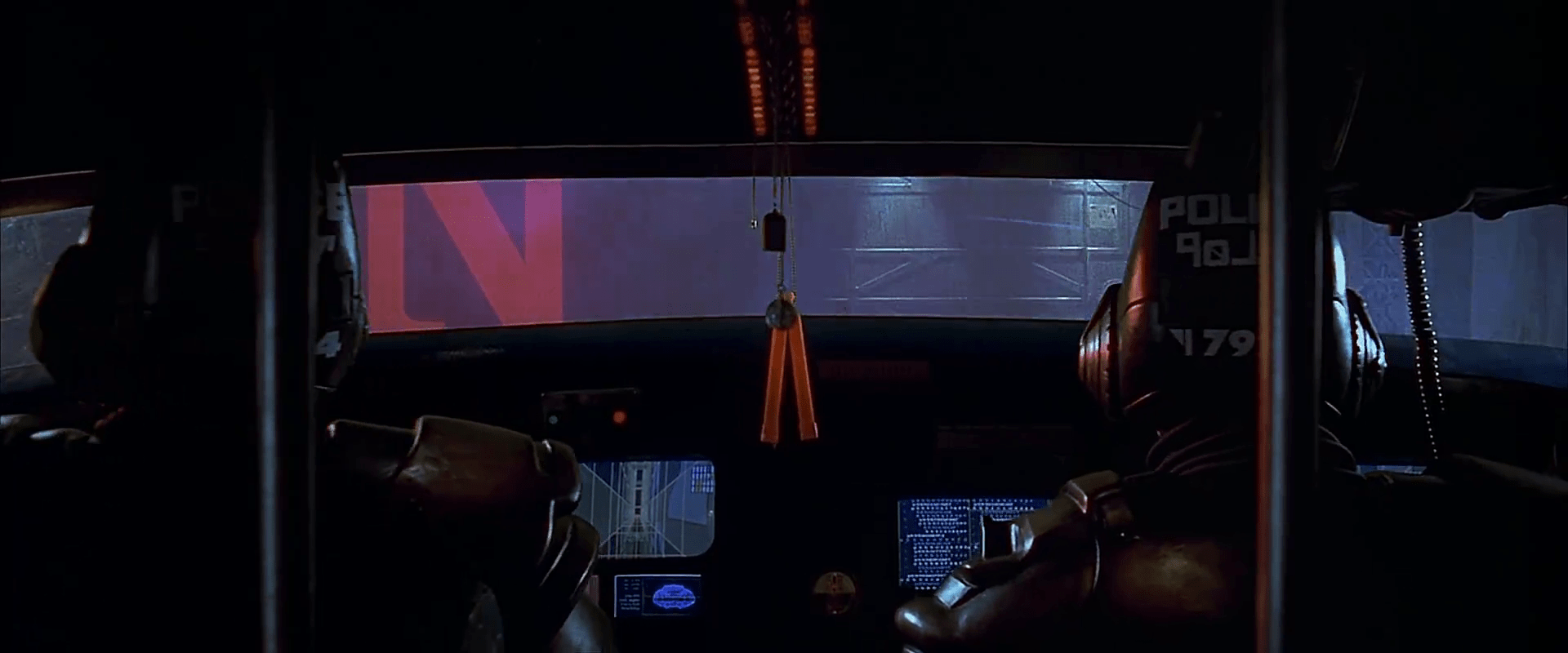
The taxi has a screen on the passenger’s side dashboard that faces the driver. This display does two things. First, it warns the driver when the taxi is about to be attacked. Secondly, it helps him navigate the complexities of New York circa 2163.

Warning system

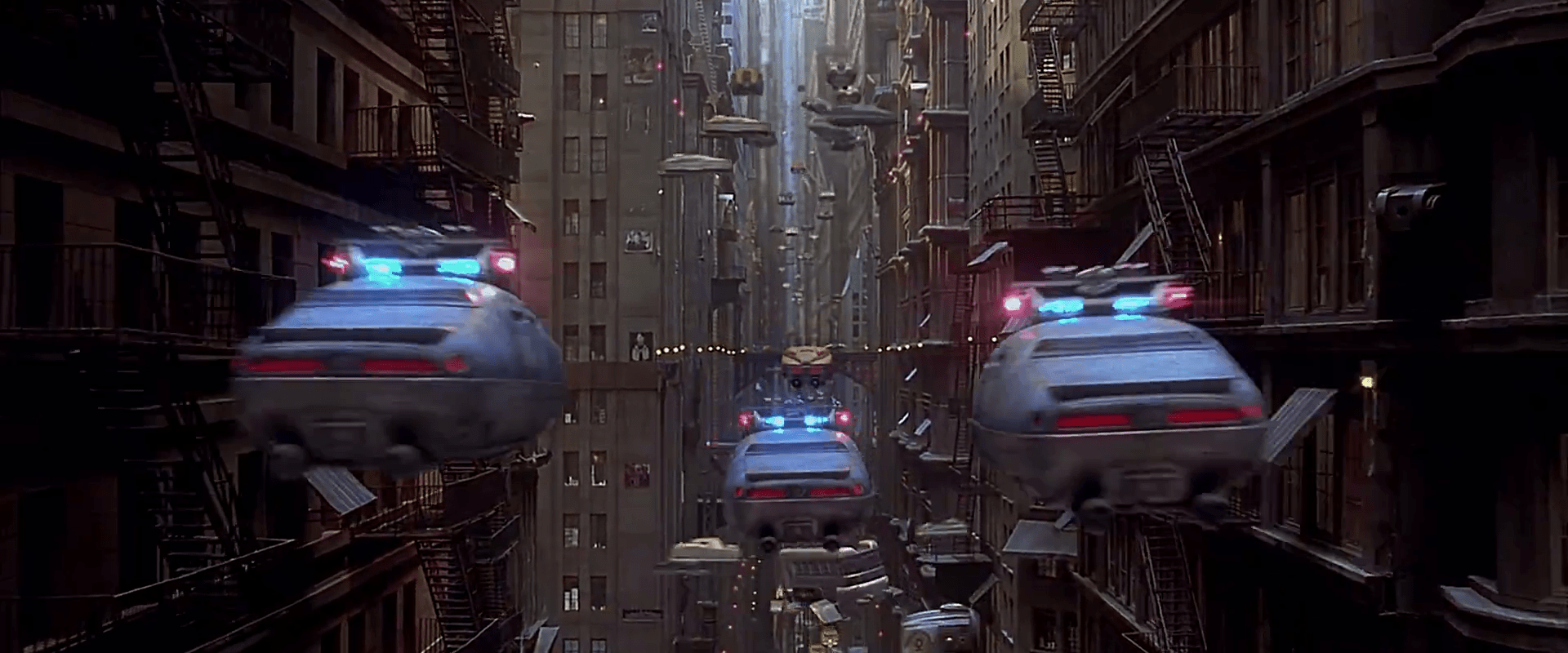
After Korben decides to help Leeloo escape the police, they send a squadron of cop cars to apprehend them. And by apprehend I mean blow to smithereens. The moment Korben’s taxi is in sights, they don’t try to detain or disable the vehicle, but to blast it to bits with bullets and more bullets. It seems this is a common enough thing to have happen that Korben’s on-board computer can detect it in advance and provide a big, flashing, noisemaking warning to this effect.

FifthE-attackdetection-008

In many cases I object to the Big Label, but not here. In fact, for such a life-threatening issue, more of the taxi’s interface should highlight the seriousness. My life’s in danger? Go full red alert, car. Change the lights to crimson. Dim non-essential things. You’ve got an “automatic” button there. Does that include evasive maneuvering? If so, make that thing opt-out rather than opt-in. Help a brother out.

Navigation aid

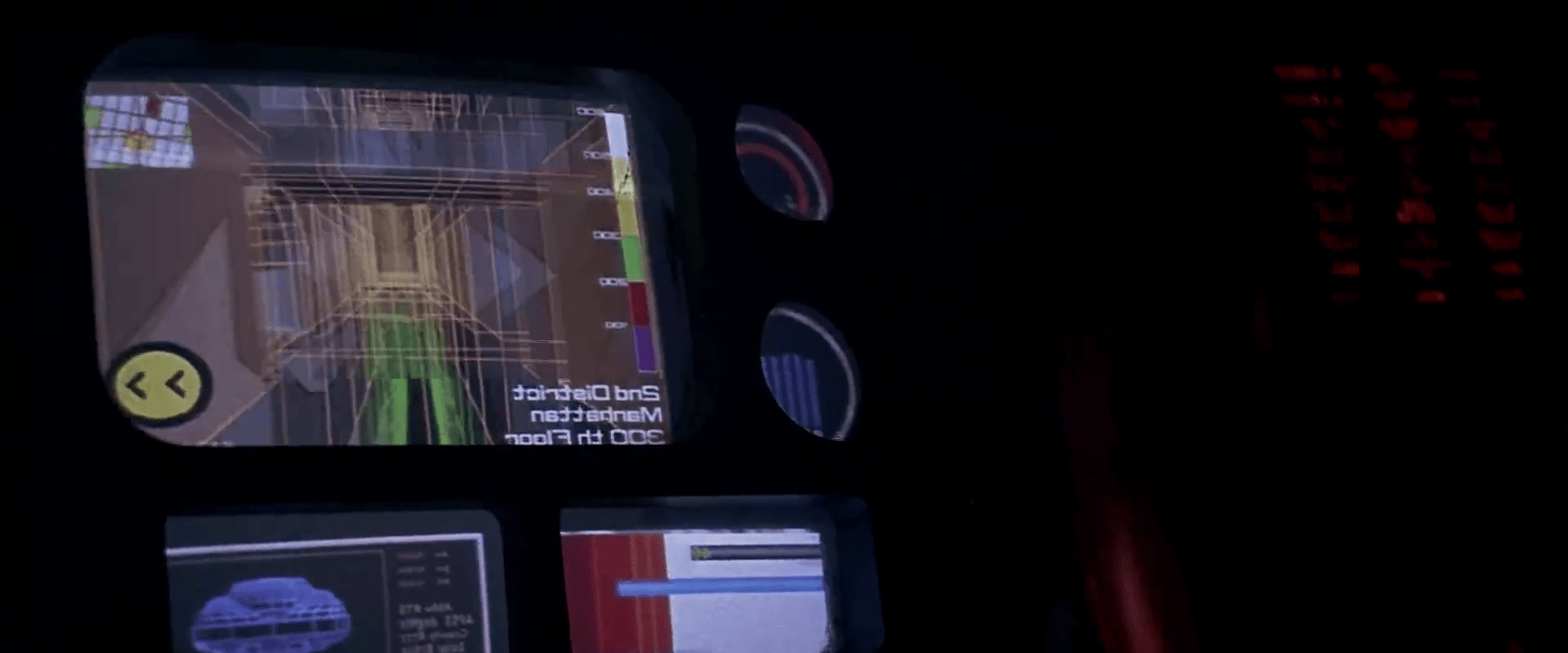
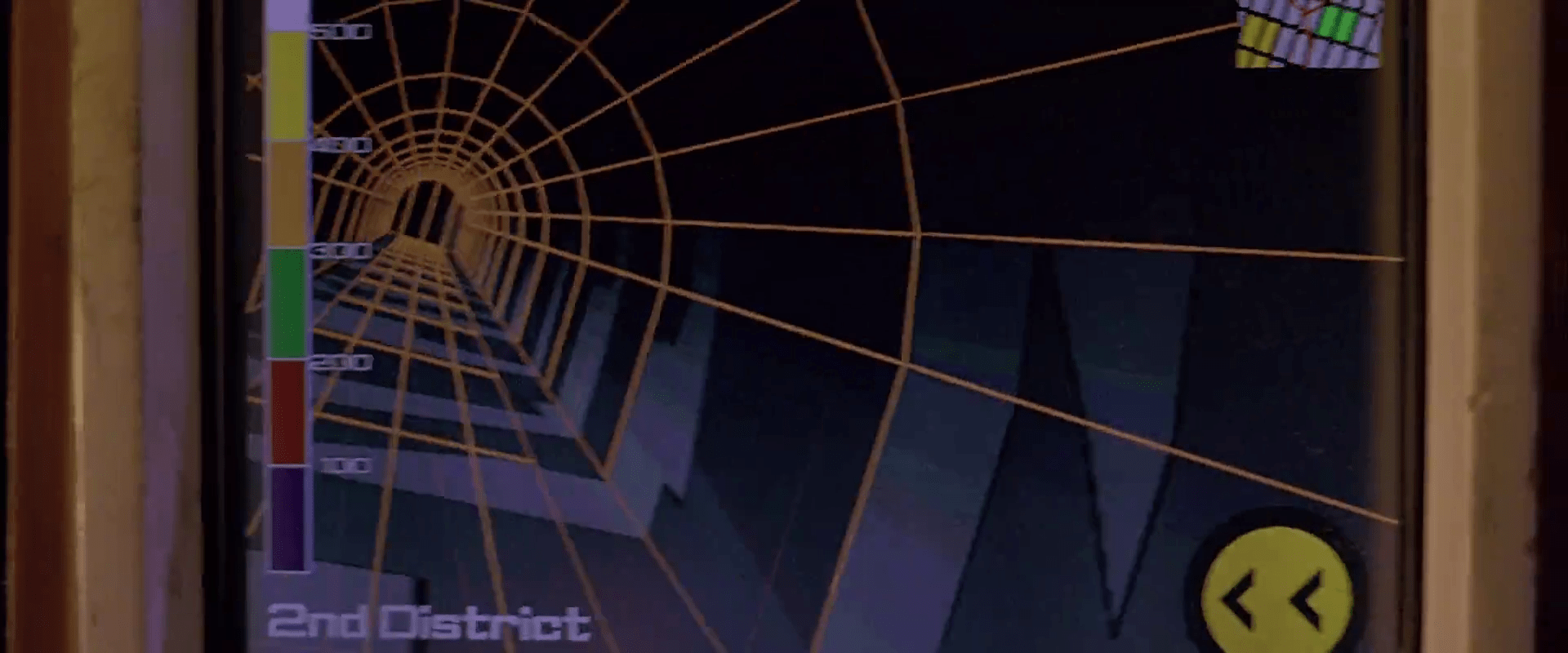
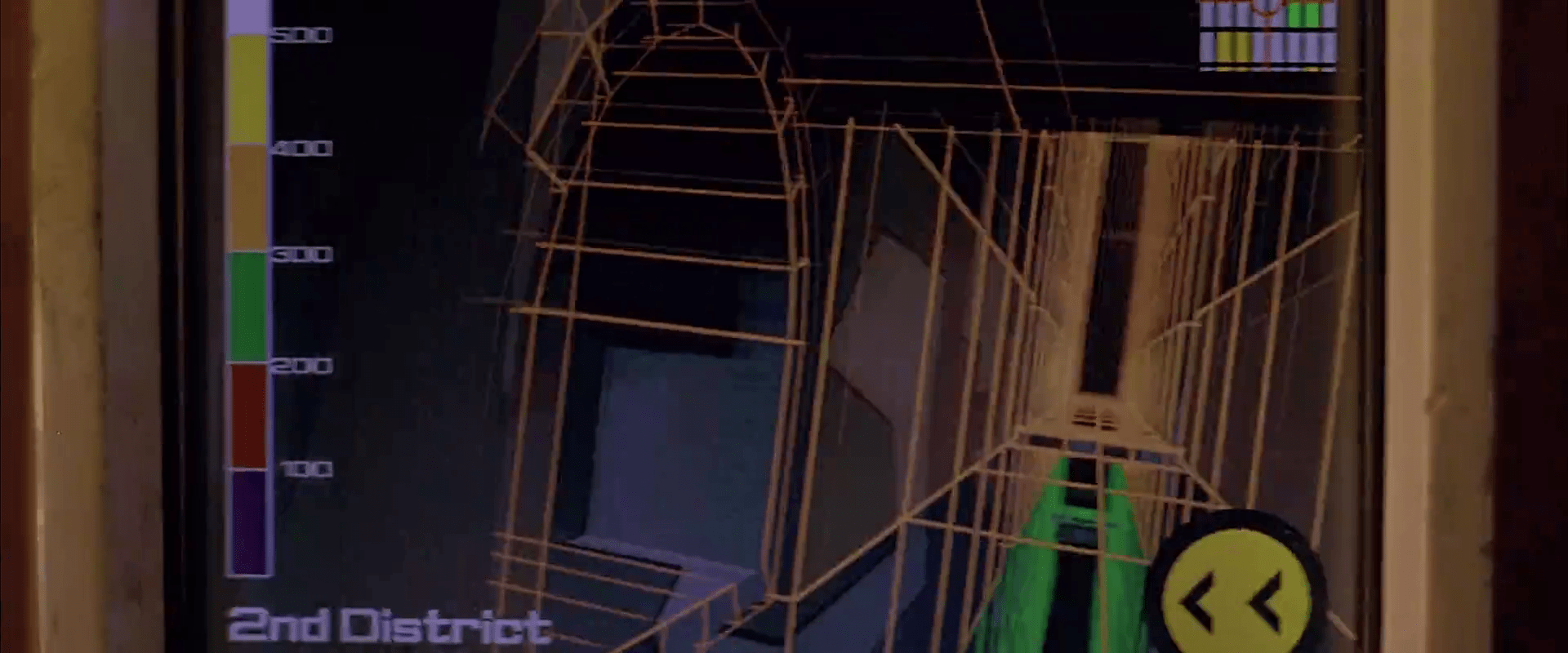
At other times during the chase scene, Korben can glance at the screen to see a wireframe of the local surroundings. This interface has a lot of problems.

1. This would work much, much more safely and efficiently for Korben if it was a heads-up display on the windshield. Let’s shrink that feedback loop. Every time a driver glances down he risks a crash and in this case, Korben risks the entire world. If HUD tech isn’t a part of the diegesis, audio cues might be some small help that don’t require him to take his eyes of the “road.”

2. How does the wireframe style help? It’s future-y of course, but it adds a lot of noise to what he’s got to process. He doesn’t need to understand tesselations of surfaces. He needs to understand the shapes and velocities of things around him so he can lose the tail.

FifthE-attackdetection-006

(Exercise for the reader: Provide a solid diegetic explanation for why this screen appeared in the film flipped horizontally.)

FifthE-attackdetection-010

3. There’s some missing information. If the onboard computer can do some real-time calculations and make a recommendation on the best next step, why not do it? We see above that the police have the same information that Korben does. So even better might be information on what the tail is likely to do so Korben can do the opposite. Or maneuvers that Korben can execute that the cop car can’t. If it’s possible to show places he should definitely not go, like dead ends or right into the path, say, of a firing squad of police cars, that would be useful to know, too.

FifthE-attackdetection-002

FifthE-attackdetection-004

4. What are those icons in the lower right meant to do? They’re not suggestions as they appear after Korben performs his maneuvers, and sometimes appear along with warnings instead of maneuvers.

Even if they are suggestions, what are they directions to? His original destination? He didn’t have one. Some new destination? When did he provide it? Simple, goal-aware directions to safety? Whatever the information, these icons add a lot cognitive weight and visual work. Surely there’s some more direct way to provide cues, like being superimposed on the 3D so he can see the information rather than read and interpret it.

If they’re something else other than suggestions, they’re just noise. In a pursuit scenario, you’d want to strip that stuff out of the interface.

FifthE-attackdetection-003

5. What is that color gradient on the left meant to tell him? All the walls in this corridor are 350…what? The screen shot above hints that it represents simple height from the ground, but the 2D map has these colors as well, and height cues wouldn’t make sense there. If it is height, this information might help Korben quickly build a 3D mental map of the information he’s seeing. But using arbitrary colors forces him to remember what each color means. Better would be to use something with a natural order to it like the visible spectrum or black-body spectrum. Or, since people already have lots of experience with monocular distance cues and lighting from above, maybe a simple rendering as if the shapes were sunlit would be fastest to process. Taking advantage of any of these perceptual faculties would let him build a 3D model quickly so he can focus on what he’s going to do with the information.

Side note: Density might actually make a great deal more sense to the readout, knowing that Korben has a penchant for ramming his taxi through things. If this was the information being conveyed, varying degrees of transparency might have served him better to know what he can smash through safely, and even what to expect on the other side.

6. Having the 2D map helps a bit to understand the current level of the city from a top-down view. Having it be small in the upper right is a sound placement, since that’s a less-important subset of the information he really needs. It has some color coding but as mentioned above it doesn’t seem to relate to what’s colored in the 3D portion, which could make for an interpretation disaster. In any case, Korben shouldn’t have to read this information in the tiny map. It’s a mode, a distraction. While he’s navigating the alleys and tunnels of the city, he’s thinking in a kind of 3D node-graph. Respect that kind of thinking with a HUD that puts information on the “edges” of the graph, i.e., the holes in the surfaces around him that he’s looking at. That’s his locus of attention. That’s where he’s thinking. Augment that.

So, you know…bad

Fortunately, given that the interface has so many problems, Korben only really glances at this once during the chase, and that’s at the warning sound. But if the younger Korben was meant to use this at all, there’s a lot of work to make this useful rather than dangerous.

Resistance Chutes

Barbarella-079

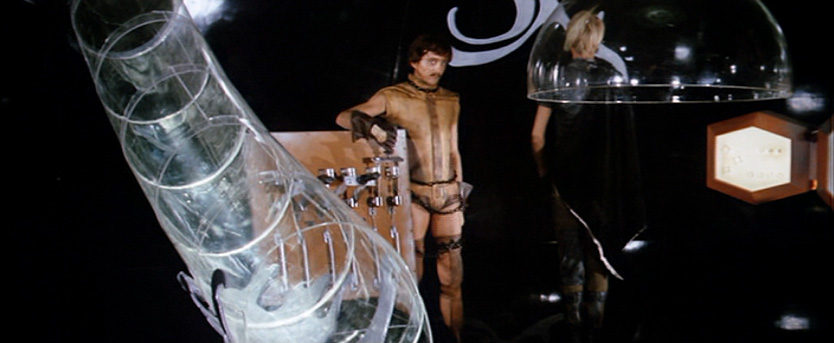
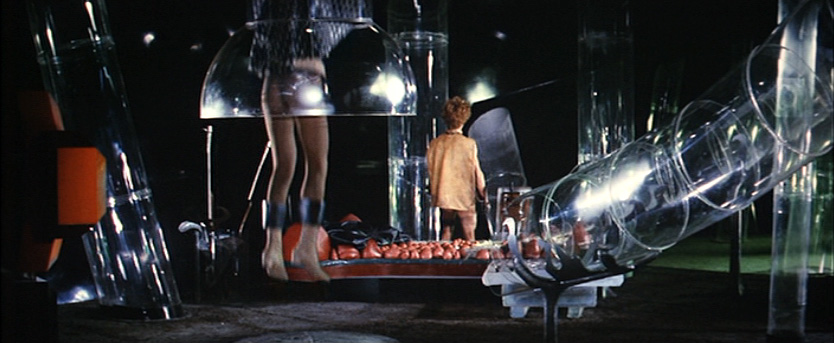
In order to conduct its subversions, the Resistance has a set of secret pneumatic chutes throughout SoGo. To monitor them, they have a map of the city with the chutes drawn as lines and places within the city illuminated with small lights.

The purpose of the lights is a bit vague, since just before Barbarella leaves Resistance Headquarters, Dildano glances at the map to see a red dot flashing at the very top. Gesturing at the light he remarks, “The time is right. The Queen is in her Chamber of Dreams.” But we know from the end of the film that the Queen’s Dream Chamber is on the lowest level of the city, close to Mathmos. (It would seem the Resistance has some severe information gathering issues.) So is each location able to change color to represent prominent individuals? What if two prominent people are in the same place? How does Dildano indicate which prominent person he wishes to track? We never see these controls, and per the axiom of providing inputs near outputs, we would want them to be somewhere around here.

We do get to see one interface in action, though. The chutes themselves are controlled by a set of rather rickety knife switches with large handles. A Resistance member throws one of the switches to initiate suction in a particular tube. (Fans of Futurama should note some similarities to the public transportation system in New New York.)

Barbarella-081

One the switch is thrown, a traveler extends his or her arms upwards, and then the tube handles the rest. The exits is ungraceful, tumbling travelers onto the floor in conspicuous places somewhere in SoGo.

Barbarella-096