Rhod’s rod

TheFifthElement-Rhod-011

One of the most delightfully flamboyant characters in sci-fi is the radio star in The Fifth Element, Ruby Rhod. He wears a headpiece to hear his producers as well as to record his own voice. But to capture the voices of others, he has a technological staff that he carries.

Function

The handle of the device has a microphone built into it. Because of the length of the staff, his reach to potential interviewees is extended. The literal in-your-face nature of the microphone matches Ruby’s in-your-face show.

TheFifthElement-Rhod-004

To let interviewees know when they’re being recorded, a red light in the handle illuminates. This also lets others nearby know that the interviewee is “on air” and not to interrupt.

Ruby also has a single switch on the handle. It’s a small silver toggle. It’s likely that he can set this switch to function as he likes. The one time we see it in action, he has set it to play back an “audio cut,” (the sound clips morning radio talk show hosts insert into their programs) in this case an intimate recording of the Princess of Kodar Japhet. He flips the toggle to play the cut, and flips it back when it’s done.

Here, a different input would have worked better. The toggle switch is too easy to bump and kind of ruins the design of the handle. Better would be a billet button. This sort of momentary button sits flush with a bezel, which prevents accidental activation from, say, a finger laying across it, or resting the button against a flat surface. If Ruby wants the recorded sound to play out completely, and the button press only starts or stops the playback, it would be good to know the state of the playback, and using a billet button with a LED ring would be best.

We also know that Ruby is a performer. He would be happier if he had more than a play button, but a way to express himself. His hand is already in a grip to hold the staff, so the control should fit that—If you could outfit the billet button with directional pressure sensitivity, he could assign each direction to a control. So, for instance, while he was pressing the button, the audio would play, and the harder he pressed up, the volume for each echo would increase. Or pressing down could lower the sample in tone, etc. This would allow him to not just play the audio cut, but perform it.

Fashion

To work as a device that the character would want to carry, it has to match his sense of style. I mean this first in a general sense, and the device does that, with its handle of ornately carved silver. Ruby’s necklaces, bracelets, and rings are all silver, and they work together. The staff also works in his hand like a drum major’s baton, augmenting his larger-than-life presence with an attention-commanding object.

It has to fit his daily fashion as well, and the staff does that, too. The shaft can change appearance. I don’t know if it’s an e-ink-type surface, replaceable staves, or fabric sleeves that change out, but when Ruby’s in leopard print, the staff is in leopard print, too. When Ruby’s decked out in rose-adorned tuxedo black, the staff matches.

TheFifthElement-Rhod-002

TheFifthElement-Rhod-006

Though this is more a portable than a wearable technology, the fact that it can change to match the personal style of the wearer makes it not only functional, but since it fits his persona, desirable as well.

Four a day

An electronic quit smoking device displaying refill options, a countdown timer, and various indicators.

After Korben’s alarm clock starts the music and lights the lights, it also drops his daily allotment of cigarettes into place inside vertical glass tubes in a small dispensary mounted on the wall. Each tube has a purple number printed across the top, reinforcing the limit. A robotic voice tells reminds him to only have “four. a. day.”

fifthelement-4aday

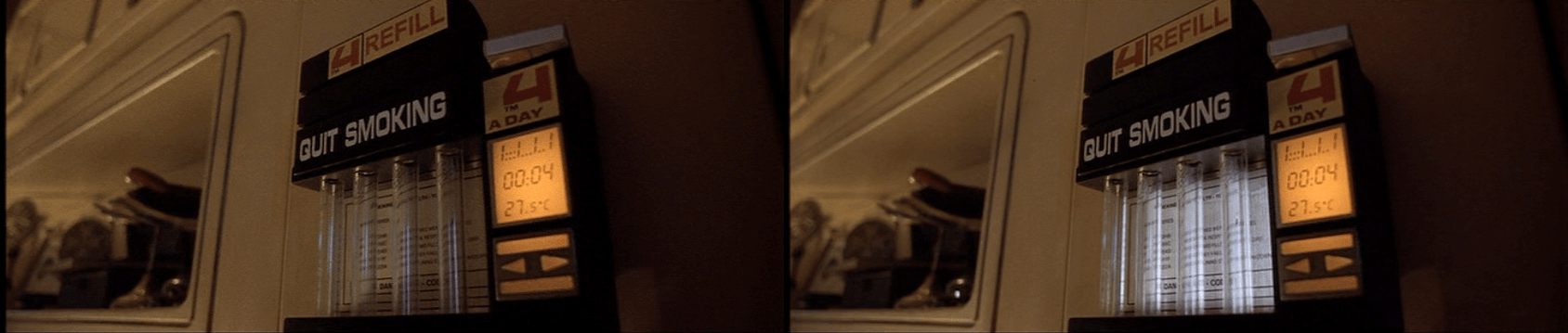
The dispensary is loaded with warnings to get him to quit. Across the top we read 4™ REFILLS. Just below that is a white imperative, QUIT SMOKING. To the right another legend reinforces the principles spoken aloud, 4™ A DAY. A legend across the bottom, written in glittery red capitals reminds him that, TO QUIT IS MY GOAL. Behind the glass tubes is something like a Surgeon General’s warning about the dangers of smoking.

On the right is a small LCD panel with a mysterious readout at the top of 1:::1…1..1, a counter in the middle reading 00:04 (it looks like just after midnight in military time, but we know from his alarm clock it’s just after 02:00), and a temperature readout that confirms the temperature that the clock displays, 27.5° C. Below this panel is a small set of four buttons: two horizontal ones that sandwich two triangular ones pointing in opposite directions. Korben presses the lowest button to pick up the first cigarette, and the #1 cylinder of glass slides up. A smaller “vase” of glass holds the cigarette upright for Korben to grab.

A shirtless man talking on a phone while pointing at a control panel on the wall.

The LCD panel

The top readout is a mystery, and the middle might be a counter of number of cigarettes remaining for the day or in the refill, but why it’s in 24-hour notation is another mystery. The temperature doesn’t make much sense here. Better might be the variable information that the addicted smoker really wants: How soon until I can get my next fix. A clock showing that time would be useful, and give the smoker something to fixate on instead of the cravings. A countdown clock might be information that the smoker wants, but it would focus his attention on the device rather than on his willpower.

To quit is my goal

Really, it’s beyond the scope of this blog post to try and state the authoritative psychology of quitting smoking, but it does seem like this device accomplishes one common strategy well, which is reminding smokers of their goal. There it is, in glittery red, in a first-person voice.

But it doesn’t do everything well. Another strategy to quit is for smokers to have reminders of the negative consequences of continuing to smoke, and the device only kind of does this with the warning label. The fact that it’s behind the glass tubes is nice since to get at the cigarettes the smoker wants, he is faced with that text. But, it’s only text, and easy to simply not read. The fact that the cylindrical glass distorts the text makes willful ignoring even easier, since it hinders readability. Better would be a visceral, instantly-recognizable image, like Australia mandated on their cigarette packaging in 2011. The disturbing nature of these images would be enhanced by the cylinder’s distortions.

Cigarette warning packaging highlighting the effects of smoking, including blindness, mouth and throat cancer, and the dangers of secondhand smoke to children.

On the other hand, one strategy is to eliminate the triggers that remind a smoker about cigarettes, and this dispensary does exactly the opposite. By being prominently displayed on the wall, being associated with waking up, and having the word “smoking” appear in high-contrast capital letters at eye level, it pretty much acts as a trigger to remind Korben about smoking. Better might be a hideaway dispensary, similar to his bed, refrigerator, or shower in the apartment, which hide themselves away when not in use.

Surgeon General’s Warning

The other problem is habituation. After repeated exposure to this device on a daily basis, Korben will begin to disregard the signal. A more persuasive system would change, such that the consequences and goals are kept fresh on Korben’s mind. To make sure it hits home at the right time, I would get rid of the extraneous buttons and have one “time-release” button, that requires him to press and hold it for a few seconds to get at the cigarette. During this enforced moment of boredom, the device can flash a new message and dissuasive image, giving Korben a moment to consider this and whether he really wants to keep pressing the button for his cigarette. The LCD panel would need to display these instructions first, and then switch to showing the time at which the next cigarette will be available.

A device displaying the message 'SMOKING CAUSES BLINDNESS' with a digital screen indicating daily goals beside a series of tubes visible in the front.

Good morning, Korben

5E-alarm_notext

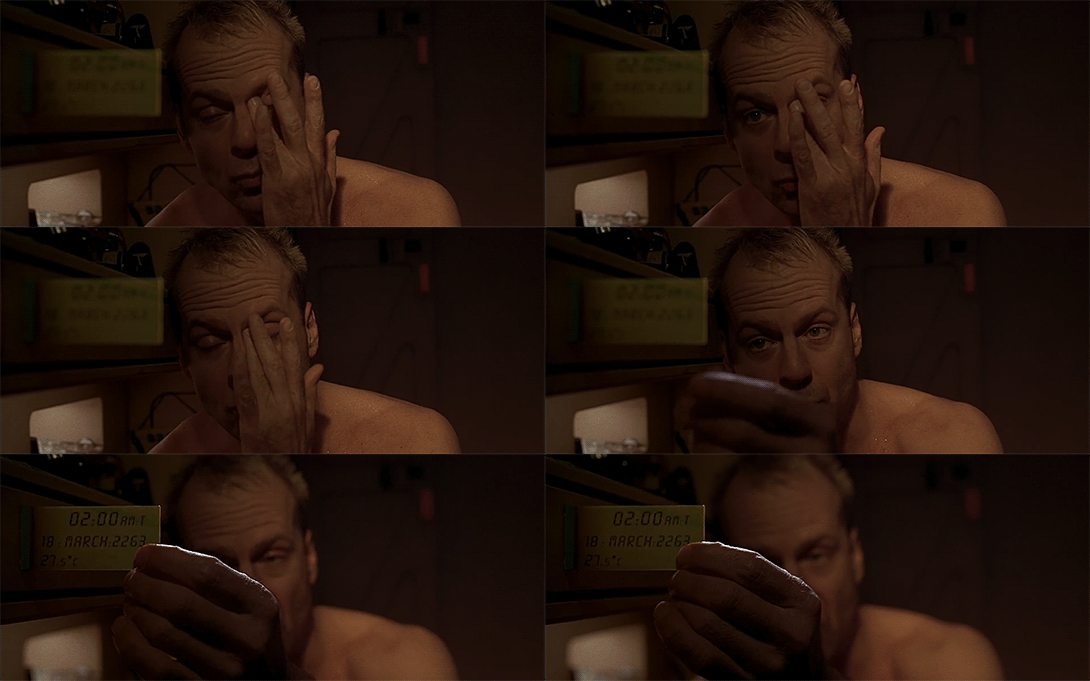
Korben’s alarm clock is a transparent liquid-crystal display that juts out from a panel at the foot of his bed. When it goes off, it emits a high-pitched repetitive whine. To silence it, Korben must sit up and pinch it between his fingers.

There’’s some subtle, wicked effeciveness to that deactivation. Like a regular alarm clock, the tactic is to emit some annoying sound that persists until the sleeper can rouse themselves enough to turn off the alarm. The usual problem with this tactic is that the sleeper is stupefied in his half-awakeness. If he can sleepily stop the alarm and just go back to sleep, he’ll do it. This clock dissuades sleepy flailing with its sharp-ish corners. After just a few times trying to do that and failing, the scratches on his hand will teach him. Even if the motion is memorized, the sleeper has to wake enough to target it properly and execute the simple but precise input.

The display itself shows the time in astronomical format, i.e. “02:00”, the date (Director Luc Besson‘s birthday), “18 MAR 2263″, and a temperature, 27.5° C.” Since this is quite warm, I presume this is the temperature outside.

fifthelement-fish

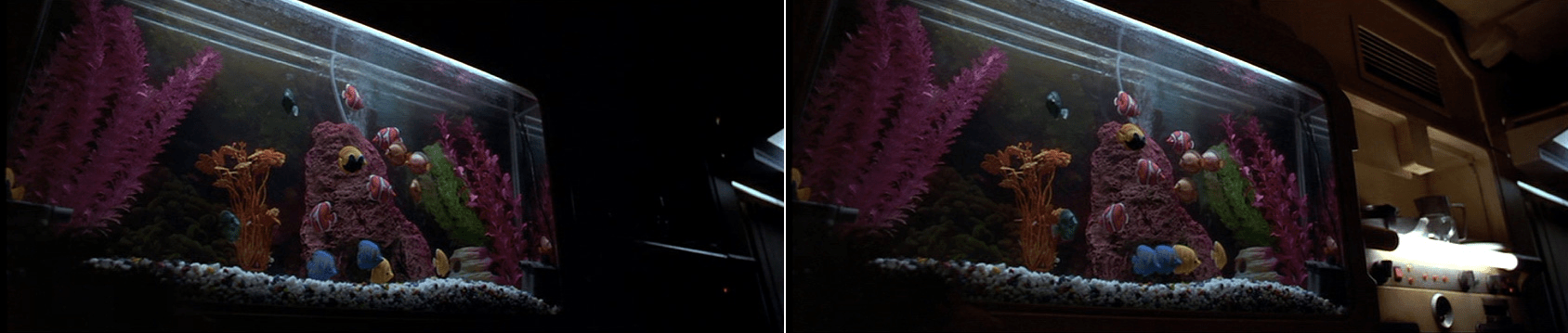
Once Korben cancels the alarm, his apartment comes to life. Heavy-beat music begins to play and lights automatically illuminate near the fake-fish tank above the stove and in his cigarette dispenser.

fifthelement-cigs

All these signals combine to make it difficult for sleepy Korben to stay in bed past when awake Korben knows he should be up and moving.

Headsets

FifthE-UFT005

On duty military personnel—on the ship and attending the President—all wear headsets. For personnel talking to others on the bridge, this appears to be a passive mechanism with no controls, perhaps for having an audio record of conversations or ensuring that everyone on the bridge can hear one another perfectly at all times.

FifthE-UFT009

Personnel communicating with people both on the ship’s bridge and the president have a more interesting headset.

Signaling dual-presence

The headsets have antennas rising from the right ear, and each is tipped with a small glowing red light. This provides a technological signal that the device is powered, but also a social signal that the wearer may be engaged in remote conversations. Voice technologies that are too small and don’t provide the signal risk the speaker seeming crazy. Unfortunately this signal as it’s designed is only visible from certain directions. A few extra centimeters of height would help this be more visible. Additionally, if the light could have a state to indicate when the wearer is listening to audio input that others can’t hear, it would provide a person in the same room a cue to wait a moment before getting his attention.

FifthE-UFT016

Secondary conversants

Each headset has a default open connection, which is always on, sending and receiving to one particular conversant. In this way General Staedert can just keep talking and listening to the President. Secondary parties are available by means of light gray buttons on the earpieces. We see General Munro lift his hand and press (one/both of?) these buttons while learning about the growth rate of the evil planet.

FifthE-UFT011

The strategy of having one default and a few secondary conversants within easy access makes a great deal of sense. Quick question and answer transactions can occur across a broad network of experts this way and get information to a core set of decision makers.

The design tactic of having buttons to access them is OK, but perhaps not optimal. Having to press the buttons means the communicator ends up mashing his ear. The easiest to “press” wouldn’t be a button at all but a proximity switch, that simply detects the placement of the hand. This has some particular affordance challenges, but we can presume military personnel are well trained and expert users.

Dianthus calling

Barbarella-022

Alphy’’s first action in the film is to announce a call from Dianthus, President of Earth and Rotating Premier of the Sun System. During Alphy’’s announcement, a free-standing mock-classical sculpture of a woman shifts to enlarge the crescent frame she holds above her shoulder. This becomes the organically-shaped view screen for the videophone conference between Barbarella and the President.

Barbarella-017

When it is fully extended, the frame fills with the video feed from Dianthus. No camera mechanism is seen. The gaze matching (see Chapter 4, Volumetric Projection) is handled somewhat mysteriously. For an early part of the conversation Dianthus is looking directly at her breasts rather than her eyes. Barbarella was steeped in the sexual freedom utopia tropes of its day, but this actually seems to be an error in presentation, since neither acknowledges it. Also Dianthus appears at several distances and heights during the course of the fall, sometimes sitting and sometimes standing. He must have had a cameraman. This isn’t inconceivable for a President of Earth, but not yet scalable for mass market use.

Barbarella-Dianthus-gaze

When during the call Barbarella gets upset at the possibility of “archaic insecurity,” she crosses to the far side of the statue. This reveals that the display surface is two-dimensional, and displays perfectly from both sides. During her movement, Dianthus follows her and turns around to talk with her from the other side of the statue. We do see at the beginning of the conversation that his camera moves, so he has some kind of different setup than hers. This raises some curious questions about what Dianthus is seeing from his side of the exchange, but alas, we are never shown, so it is an exercise left for the designer/fan.

As with the Purple Drank, controls are never seen for this communication. Alphy handles absolutely everything.

The Shagpile Cockpit

Barbarella-029

Barbarella’‘s rocket ship has a single main room, which is covered wall-to-wall with shagpile carpet. The visual panel of her voice-interface computer, called Alphy, is built into the wall near the back. On the right side of Alphy sits the video phone statue. To the left a a large reproduction of Seurat’’s A Sunday Afternoon on the Island of La Grande Jatte masks a door to exit the ship.

Barbarella-015

A recessed, circular seating space near the front acts as the cockpit. From this position Barbarella can see through a large angled viewport. One nice aspect of the design of the cockpit is that when things are going poorly for the rocket ship, and Barbarella is being buffeted about, the pile keeps the damage to a minimum and, the recessed cockpit is likely to “catch” her and hold her there, in a place where she can try and remedy the situation. (This is exactly what happens when they encounter “magnetic disturbances” on their approach to Tau Ceti.)

Barbarella-038
Magnetic Disturbances

The control panel for the ship is a wide band of roughly 60 unlabeled black, white, and gray keys, curving around the pilot like amphitheater seating. The keys themselves are random lengths, stacking in some places two and three to a column. Barbarella presses these keys when she must manually pilot the ship, at one point pressing a particular one several times in quick succession. That action suggests not controls for building up commands like a computer keyboard, but rather direct-effect controls, like an automobile dashboard, where each key has a different, direct effect.

Barbarella-039

This keyboard panel lacks any clues as to the functions of the keys for first-time users, but the high-contrast and cluster patterns make it easy for expert users like Barbarella (being as she is a 5-star double-rated Astro-Navigatrix) to visually locate a particular key amongst them. But there’s a lot that could be improved. First and most obvious is that the extents of the keyboard are quite spread out from her immediate reach. Bringing them within easy reach would mean less physical work. We also know that like an automotive dashboard, unless these keys are all controlling things with direct, obvious consequences, some status indicators in the periphery of her vision would be damned handy. And even with the unique key configuration, Barbarella would have an even easier time of it with physically differentiated controls, ideally with carefully designed affordances.

The other features of the cockpit, including a concave panel in the wall to her left with large, round, colored lights, and a set of large, reflective black domes on the right hand side of the cockpit, are not seen in use.

Audio Syringe

Prometheus-247

David uses this device when Shaw begins to double over from the pain of the alien growing in her womb. It is a palm-sized cylinder with a large needle sticking out one end and a yellow button on the other. To administer it, he jams it into her shoulder, depressing the yellow button with his thumb, and holds it there until the spraying sound coming from it ceases.

Prometheus-246

This is not a hypospray (as described in Chapter 12, Medicine, of the book), which would not have a needle, so where is the sound coming from? It might be an audio augmentation to let the administrator know. This would be a reasonable sound, as it gives sense of pressure releasing. But there should be some clear signal—like a soft double-beep—when the doseage is complete, less it be removed too soon for misinterpreting the audio signal.

VP language instructor

During David’s two year journey, part of his time is spent “deconstructing dozens of ancient languages to their roots.” We see one scene illustrating a pronunciation part of this study early in the film. As he’s eating, he sees a volumetric display of a cuboid appear high in the air opposite his seat at the table. The cuboid is filled with a cyan glow in which a “talking head” instructor takes up most of the space. In the left is a column of five still images of other artificial intelligent instructors. Each image has two vertical sliders on the left, but the meaning of these sliders is not made clear. In the upper right is an obscure diagram that looks a little like a constellation with some inscrutable text below it.

On the right side of the cuboid projection, we see some other information in a pinks, blues, and cyans. This information appears to be text, bar charts, and line graphs. This information is not immediately usable to the learner, so perhaps it is material about the entire course, for when the lessons are paused: Notes about the progress towards a learning goal, advice for further study, or next steps. Presuming this is a general-purpose interface rather than a custom one made just for David, this information could be the student’s progress notes for an attending human instructor.

We enter the scene with the AI saying, “…Whilst this manner of articulation is attested in Indo-European descendants as a purely paralinguistic form, it is phonemic in the ancestral form dating back five millennia or more. Now let’s attempt Schleicher’s Fable. Repeat after me.”

In the lower part of the image is a waveform of the current phrase being studied. In the lower right is the written text of the phrase being studied, in what looks like a simplified phoenetic alphabet. As the instructor speaks this fable, each word is hilighted in the written form. When he is done, he prompts David to repeat it.

akʷunsəz dadkta,
hwælna nahast
təm ghεrmha
vagam ugεntha,

After David repeats it, the AI instructor smiles, nods, and looks pleased. He praises David’s pronunciation as “Perfect.”

This call and response seems par for modern methods of language learning software, even down to “listening” and providing feedback. Learning and studying a language is ultimately far more complicated than this, but it would be difficult to show much more of it in such a short scene. The main novelty that this interface brings to the notion of language acquisition seems to be the volumetric display and the hint of real-time progress notes.

Military communication

All telecommunications in the film are based on either a public address or a two-way radio metaphor.

Commander Adams addresses the crew.

To address the crew from inside the ship, Commander Adams grabs the microphone from its holder on the wall. Its long handle makes it easy to grab. By speaking into the lit, transparent circle mounted to one end, his voice is automatically broadcast across the ship.

Commander Adams lets Chief Quinn know he’s in command of the ship.

Quinn listens for incoming signals.

The two-way radio on his belt is routed through the communications officer back at the ship. To use it, he unclips the small cylindrical microphone from its clip, flips a small switch at the base of the box, and pulls the microphone on its tether close to his mouth to speak. When the device is active, a small array of lights on the box illuminates.

Confirming their safety by camera, Chief Quinn gets an eyeful of Alta.

The microphone also has a video camera within it. When Chief Quinn asks Commander Adams to “activate the viewer,” he does so by turning the device such that its small end faces outwards, at which time it acts as a camera, sending a video signal back to the ship, to be viewed on the “view plate.”

The Viewplate is used frequently to see outside the ship.

Altair IV looms within view.

The Viewplate is a large video screen with rounded edges that is mounted to a wall off the bridge. To the left of it three analog gauges are arranged in a column, above two lights and a stack of sliders. These are not used during the film.

Commander Adams engages the Viewplate to look for Altair IV.

The Viewplate is controlled by a wall mounted panel with a very curious placement. When Commander Adams rushes to adjust it, he steps to the panel and adjusts a few horizontal sliders, while craning around a cowling station to see if his tweaks are having the desired effect. When he’’s fairly sure it’’s correct, he has to step away from the panel to get a better view and make sure. There is no excuse for this poor placement.