The Excessive Machine

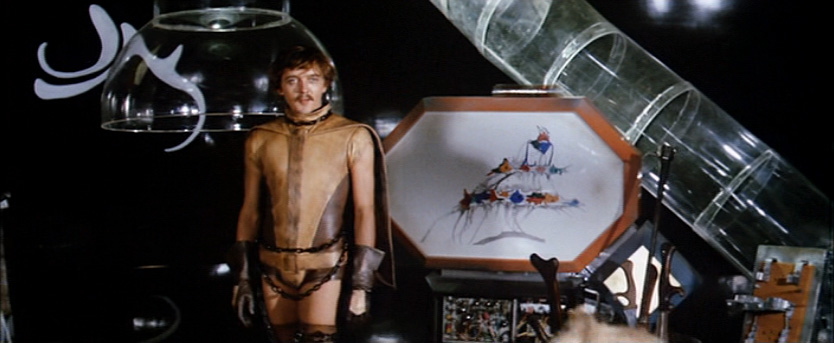
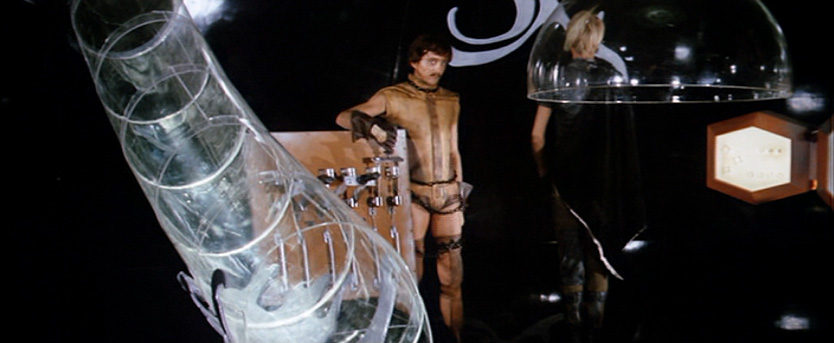
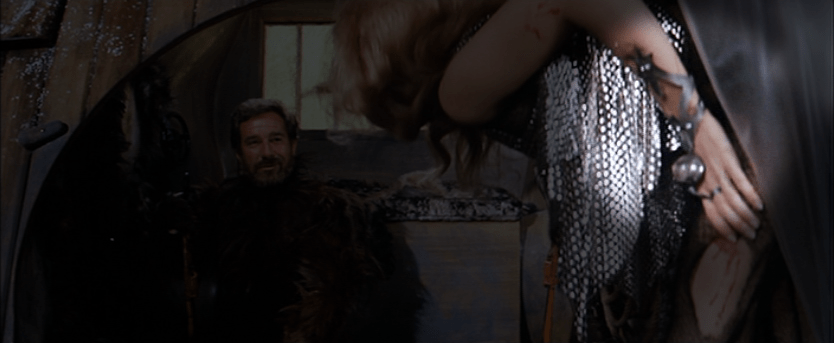
When Durand-Durand captures Barbarella, he places her in a device which he calls the “Excessive Machine. She sits in a reclining seat, covered up to the shoulders by the device. Her head rests on an elaborate red leather headboard. Durand-Durand stands at a keyboard, built into the “footboard” of the machine, facing her.

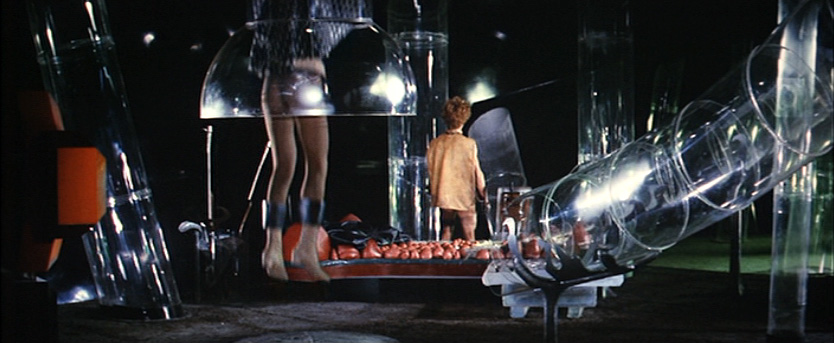
The keyboard resembles that of an organ, but with transparent vertical keys beneath which a few colored light pulse. Long silver tubes stretch from the sides of the device to the ceiling. Touching the keys (they do not appear to depress) produces the sound of a full orchestra and causes motorized strips of metal to undulate in a sine wave above the victim.

When Durand-Durand reads the strange sheet music and begins to play “Sonata for Executioner and Various Young Women,” the machine (via means hidden from view) removes Barbarella’s clothing piece by piece, ejecting them through a tube in the side of the machine near the floor. Then in an exchange Durand-Durand reveals its purpose…

  • Barbarella
  • It’s sort of nice, isn’t it?
  • Durand-Durand
  • Yes. It is nice. In the beginning. Wait until the tune changes. It may change your tune as well.
  • Barbarella
  • Goodness, what do you mean?
  • Durand-Durand
  • When we reach the crescendo, you will die of pleasure. Your end will be swift, but sweet, very sweet.

As Durand-Durand intensifies his playing, Barbarella writhes in agony/ecstasy. But despite his most furious playing, he does not kill Barbarella. Instead his machine fails dramatically, spewing fire and smoke out of the sides as its many tubes burn away. Barbarella is too much woman for the likes of his technology.

I’m going to disregard this as a device for torture and murder, since I wouldn’t want to improve such a thing, and that whole premise is kind of silly anyway. Instead I’ll regard it as a BDSM sexual device, in which Durand-Durand is a dominant, seeking to push the limits of an (informed, consensual) submissive using this machine. It’s possible that part of the scene is demonstration of prowess on a standardized, difficult-to-use instrument. If so, then a critique wouldn’t matter. But if not…Since the keys don’t move, the only variables he’s controlling are touch duration and vertical placement of his fingers. (The horizontal position on each key seems really unlikely.) I’d want to provide the player some haptic feedback to detect and correct slipping finger placement, letting him or her maintain attention on the sub who is, after all, the point.

Resistance Chutes

Barbarella-079

In order to conduct its subversions, the Resistance has a set of secret pneumatic chutes throughout SoGo. To monitor them, they have a map of the city with the chutes drawn as lines and places within the city illuminated with small lights.

The purpose of the lights is a bit vague, since just before Barbarella leaves Resistance Headquarters, Dildano glances at the map to see a red dot flashing at the very top. Gesturing at the light he remarks, “The time is right. The Queen is in her Chamber of Dreams.” But we know from the end of the film that the Queen’s Dream Chamber is on the lowest level of the city, close to Mathmos. (It would seem the Resistance has some severe information gathering issues.) So is each location able to change color to represent prominent individuals? What if two prominent people are in the same place? How does Dildano indicate which prominent person he wishes to track? We never see these controls, and per the axiom of providing inputs near outputs, we would want them to be somewhere around here.

We do get to see one interface in action, though. The chutes themselves are controlled by a set of rather rickety knife switches with large handles. A Resistance member throws one of the switches to initiate suction in a particular tube. (Fans of Futurama should note some similarities to the public transportation system in New New York.)

Barbarella-081

One the switch is thrown, a traveler extends his or her arms upwards, and then the tube handles the rest. The exits is ungraceful, tumbling travelers onto the floor in conspicuous places somewhere in SoGo.

Barbarella-096

Barbarella’s energy box

Barbarella-037

In addition to the portable brainwave detector, Dianthus also provides Barbarella with a number of weapons from the Museum of Conflict for her mission. All of these weapons are powered by a single energy box.

We only see it in use after she fires a single shot from the smallest of the weapons. She tries a second shot, but when it doesn’’t work, she glances at a device on the cuff of her boot. The device is designed in a taijitu, a yin-yang set of lights: one red, one white. They are blinking in an alternating pattern, and after viewing it she tells Pygar, ““My energy box is completely dead.””

Energy-Box

Though having a visual signal is quite useful to understand the state of an invisible resource like power, the signal would be much more useful if it showed the amount of energy remaining, and gave warnings before the power was completely out. Failing all that, it would be more useful if she just put the device on the glove of her shooting hand so it was in her field of view at all times.

And though Barbarella’s culture doesn’t understand war, even a peaceful person can quickly come to realize the risk in making your available resources—like power for your weapons—wholly visible to your enemies.

Portable brainwave detector

Barbarella-032

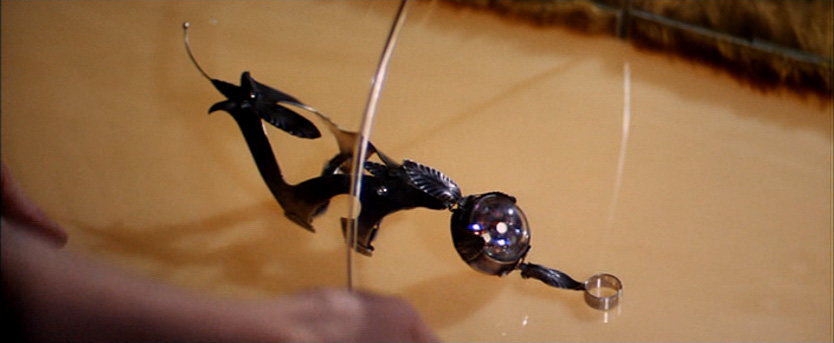
Through the atom transmitter Dianthus bestows several gifts on Barbarella to help her with her mission. The first of these is the “portable brainwave detector…to test for Durand-Durand’s presence.” To operate it, Barbarella must press “a contact,” (Dianthus is offscreen when he indicates the contact, but later we see her operating the leaf-like button near the wrist) and if Durand-Durand is around, the ball of lights will glow and an alarm will sound.

vlcsnap-00002

The device is wearable, wrapping around Barbarella’s forearm, and held in place by a ring. This aspect of the design is good, since it means the device is ever-present for operation, and the design of it makes it lovely enough to be overlooked as a fashion accessory. In fact many characters see her wearing it and make no mention.

PBD_worn

Manual activation is less than ideal, though, since this might tip off the suspect. This is especially true with the blinking, glowing ball of light and audio feedback. And, in fact, this is what happens later in the film when Durand-Durand trips over the device. The blinking light and audio catch his attention, betray the device for what it is, and blow Barbarella’’s cover in the process.

Portable Brainwave Device

The best feedback would be invisible, like a haptic vibration through the cuff to her skin. Ideally, the device would be constantly on, to detect the subject passively, the moment he came into range. But presuming battery life is the issue, the activation cue should be something much more subtle, like Barbarella’s touching the back of the ring with the thumb of the same hand. Such a gesture would match the existing design of the object, be discreet to an observer, and yet still discrete enough to prevent accidental activation.

Atom transmitter

Barbarella-024

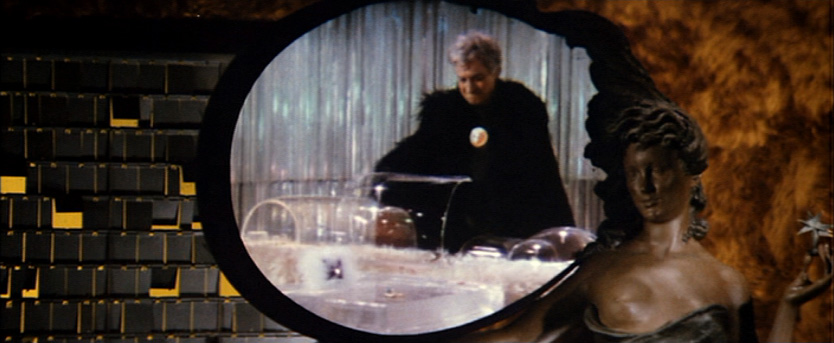
To equip Barbarella for her perilous task, Dianthus sends her things using the atom transmitter. The device looks like a glowing table with a plastic dome sealing the top. One section of the dome is hinged on one side so it can be lifted and set back into place. The sender places the item to send on the surface and lowers the lid. The table glows brightly and the object disappears.

A “boing” noise repeats while the item is in transit. The person receiving enters a shared three digit number into her machine. (Dianthus has her set her “personal atom transmitter to 0-3-5.”) The receiving table begins to glow brightly. The transmitted item appears, the “boing” noise stops, and the table dims.

In this way Dianthus equips Barbarella with weapons and a means to identify Durand-Durand.

Let’s bypass the whole question of whether teleportation is possible. The key information a sender must provide is which matter is to be sent and when to send it. People are generally pretty good at simple physics, so using a physical space with a tangible interface to provide both sets of information is going to be pretty usable. This is also at a very comfortable height for placing and viewing objects.

The device, in turn, needs to communicate when it is in progress and when it is done. If Make It So has taught us nothing else, it’s that technology glows, so using light to communicate this state also makes quite a bit of sense. Using a transparent material lets the user see the progress and visually confirm that yep, it’s been sent.

The receiver needs to know when something is being sent to her and the ability to retrieve it. Having those things be similar to the sender’s device makes it easy to learn, once, and to infer use from watching the sender.

There are all sorts of exception case questions that would need to be answered for a complete design of such a system, but for the basic interaction of atom transferrance, this is a pretty awesome design.

Barbarella-037

Gravity controls

Barbarella-002

In what may be the only mid-title interface use seen in sci-fi to date, after Barbarella completely strip-teases her space suit off, she restores artificial gravity to her space rocket. To do this, she floats to a panel and depresses one of a set of four transparent, underlit buttons. The row of buttons dim as she depresses one of them, and she drops to the fur-lined floor.

This moment quickly sets the tone for the design of the film, which is more whimsy than utility.

Wouldn’t push buttons be easy to accidentally bump while floating around in zero-g?

Why are they a hard material shaped kind of like bullets? Wouldn’t a softer material and gentler shape reduce the risk of injury?

Why are there four buttons? Are there four levels of artificial gravity that she can induce? Wouldn’t that work better as a dial? Or four different speeds of transitioning gravity? Shouldn’t the controls look a bit different to indicate their different functions?

Why does the gravity shift so suddenly? That could prove dangerous if she was precariously positioned in the air, especially with the bullet shapes protruding from the floor. Best would be a more gradual transition from zero- to one-g.

In zero-g, pushing the button would simultaneously push her away from the wall, increasing the height of her fall. Shouldn’t she have a handle to grip and keep herself anchored?

Then again, why does she need a physical control at all? Once she has her helmet off, why not just speak to Alphy (the conversational computer that we’ll meet in a later post) and have him turn it on slowly?

Barbarella-007

Despite these questions, there are three things I really like about the design of this control.

  1. The floor is covered in fake fur, which cushions her fall a bit. Hopefully there is padding beneath the fur lining as well, though this is less necessary if the transition is made more gradual.
  2. The control is placed on the floor, which means—since she has to be near it to activate it—her fall is minimized. Of course this raises questions about accidental deactivation later by a foot or a sexy space pillow fight, but let’s presume that’s a different control entirely for safety reasons. Then a design improvement might be to have the buttons recess into the floor after activation.
  3. The buttons are dim when the gravity is turned on. Ordinarily buttons should be illuminated when a system is on, but humans are best adapted to working with gravity, so the on switch should draw attention.

Alien Astrometrics

Prometheus-222

When David is exploring the ancient alien navigation interfaces, he surveys a panel, and presses three buttons whose bulbous tops have the appearance of soft-boiled eggs. As he presses them in order, electronic clucks echo in in the cavern. After a beat, one of the eggs flickers, and glows from an internal light. He presses this one, and a seat glides out for a user to sit in. He does so, and a glowing pollen volumetric projection of several aliens appears. The one before David takes a seat in the chair, which repositions itself in the semicircular indentation of the large circular table.

Prometheus-204

The material selection of the egg buttons could not be a better example of affordance. The part that’s meant to be touched looks soft and pliable, smooth and cool to the touch. The part that’s not meant to be touched looks rough, like immovable stone. At a glance, it’s clear what is interactive and what isn’t. Among the egg buttons there are some variations in orientation, size, and even surface texture. It is the bumpy-surfaced one that draws David’s attention to touch first that ultimately activates the seat.

The VP alien picks up and blows a few notes on a simple flute, which brings that seat’s interface fully to life. The eggs glow green and emit green glowing plasma arcs between certain of them. David is able to place his hand in the path of one of the arcs and change its shape as the plasma steers around him, but it does not appear to affect the display. The arcs themselves appear to be a status display, but not a control.

After the alien manipulates these controls for a bit, a massive, cyan volumetric projection appears and fills the chamber. It depicts a fluid node network mapped to the outside of a sphere. Other node network clouds appear floating everywhere in the room along with objects that look like old Bohr models of atoms, but with galaxies at their center. Within the sphere three-dimensional astronomical charts appear. Additionally huge rings appear and surround the main sphere, rotating slowly. After a few inputs from the VP alien at the interface, the whole display reconfigures, putting one of the small orbiting Bohr models at the center, illuminating emerald green lines that point to it and a faint sphere of emerald green lines that surround it. The total effect of this display is beautiful and spectacular, even for David, who is an unfeeling replicant cyborg.

Prometheus-226

At the center of the display, David observes that the green-highlighted sphere is the planet Earth. He reaches out towards it, and it falls to his hand. When it is within reach, he plucks it from its orbit, at which point the green highlights disappear with an electronic glitch sound. He marvels at it for a bit, turning it in his hands, looking at Africa. Then after he opens his hands, the VP Earth gently returns to its rightful position in the display, where it is once again highlighted with emerald, volumetric graphics.

Prometheus-229

Finally, in a blinding flash, the display suddenly quits, leaving David back in the darkness of the abandoned room, with the exception of the small Earth display, which is floating over a small pyramid-shaped protrusion before flickering away.

After the Earth fades, david notices the stasis chambers around the outside of the room. He realizes that what he has just seen (and interacted with) is a memory from one of the aliens still present.

Prometheus-238

Prometheus-239

Hilarious and insightful Youtube poster CinemaSins asks in the video “Everything Wrong with Prometheus in 4 minutes or Less,” “How the f*ck is he holding the memory of a hologram?” Fair question, but not unanswerable. The critique only stands if you presume that the display must be passive and must play uninterrupted like a television show or movie. But it certainly doesn’t have to be that way.

Imagine if this is less like a YouTube video, and more like a playback through a game engine like a holodeck StarCraft. Of course it’s entirely possible to pause the action in the middle of playback and investigate parts of the display, before pressing play again and letting it resume its course. But that playback is a live system. It would be possible to run it afresh from the paused point with changed parameters as well. This sort of interrupt-and-play model would be a fantastic learning tool for sensemaking of 4D information. Want to pause playback of the signing of the Magna Carta and pick up the document to read it? That’s a “learning moment” and one that a system should take advantage of. I’d be surprised if—once such a display were possible—it wouldn’t be the norm.

Starmetheus

The only thing I see that’s missing in the scene is a clear signal about the different state of the playback:

  1. As it happened
  2. Paused for investigation
  3. Playing with new parameters (if it was actually available)

David moves from 1 to 2, but the only change of state is the appearance and disappearance of the green highlight VP graphics around the Earth. This is a signal that could easily be missed, and wasn’t present at the start of the display. Better would be some global change, like a global shift in color to indicate the different state. A separate signal might compare As it Happened with the results of Playing with new parameters, but that’s a speculative requirement of a speculative technology. Best to put it down for now and return to what this interface is: One of the most rich, lovely, and promising examples of sensemaking interactions seen on screen. (See what I did there?)

For more about how VP might be more than a passive playback, see the lesson in Chapter 4 of Make It So, page 84, VP Systems Should Interpret, Not Just Report.

Touch Walls

Prometheus-134

When exploring the complex, David espies a few cuneiform-like characters high up on a stone wall. He is able to climb a ladder, decipher the language quickly, ascertain that it is an interface rather than an inscription, and figure out how to surreptitiously operate it. To do so, he puts his finger at the top of one of the grooves and drags downward. The groove illuminates briefly in response, and then fades. He does this to another groove, then presses a dot, and presses another dot not near the first one at all. Finally he presses a horizontal triangle firmly, which after a beat plays a 1:1 scale glowing-pollen volumetric projection.

The material and feedback of this interaction are lovely. The grooves provide a nice, tactile, physical affordance for the gesture. A groove is for dragging. A dot or a shape is for pressing. But I cannot imagine what kind of affordances are available to this language such that David can suss out the order of operation on two undifferentiated grooves. Of course presuming that the meaning of the dot and triangle are somehow self-evident to speakers of Architect, David has a 50% chance of getting the order of the grooves right. So we might be able to cut this scene some slack.

Prometheus-139

But a few scenes later, this is stretched beyond credulity. When David encounters a similarly high-up interface, he is able to ascertain on sight that chording—pressing two controls at once—is possible and necessary for operation. For this interface, he presses and drags 14 different chords flawlessly to open the ancient alien door. This is a much longer sequence involving an interaction that has no affordance.

Prometheus-149

Looking at the design of the command, an evaluation depends if it’s just a command or a password. If it’s just a control that means “open the door,” why would it take 14 characters’ worth of a command? Is there that much that this door can do? Otherwise a simple press-to-open seems like a more usable design.

If it’s a door security system then the 14 part input is a security password. This would be the more likely interpretation since the chamber beyond contains the deadly, deadly xenomorph liquid. With this in mind it’s a good design to have a 14-part password that includes a required interaction with no affordance. I’m no statistician, but I think the likelihood of guessing the correct password to be 14 factorial, or around 87,178,291,200 to 1. I have no idea what the odds are for guessing the correct operation of an interaction with zero affordance. We’d have to show some aliens MS-DOS to get some hard numbers, but that seems pretty damned secure. Unfortunately, it also stretches the believability of the scene way past the breaking point, to presume that David can just observe the alien login screen and guess the giant password.

Alien head stem line

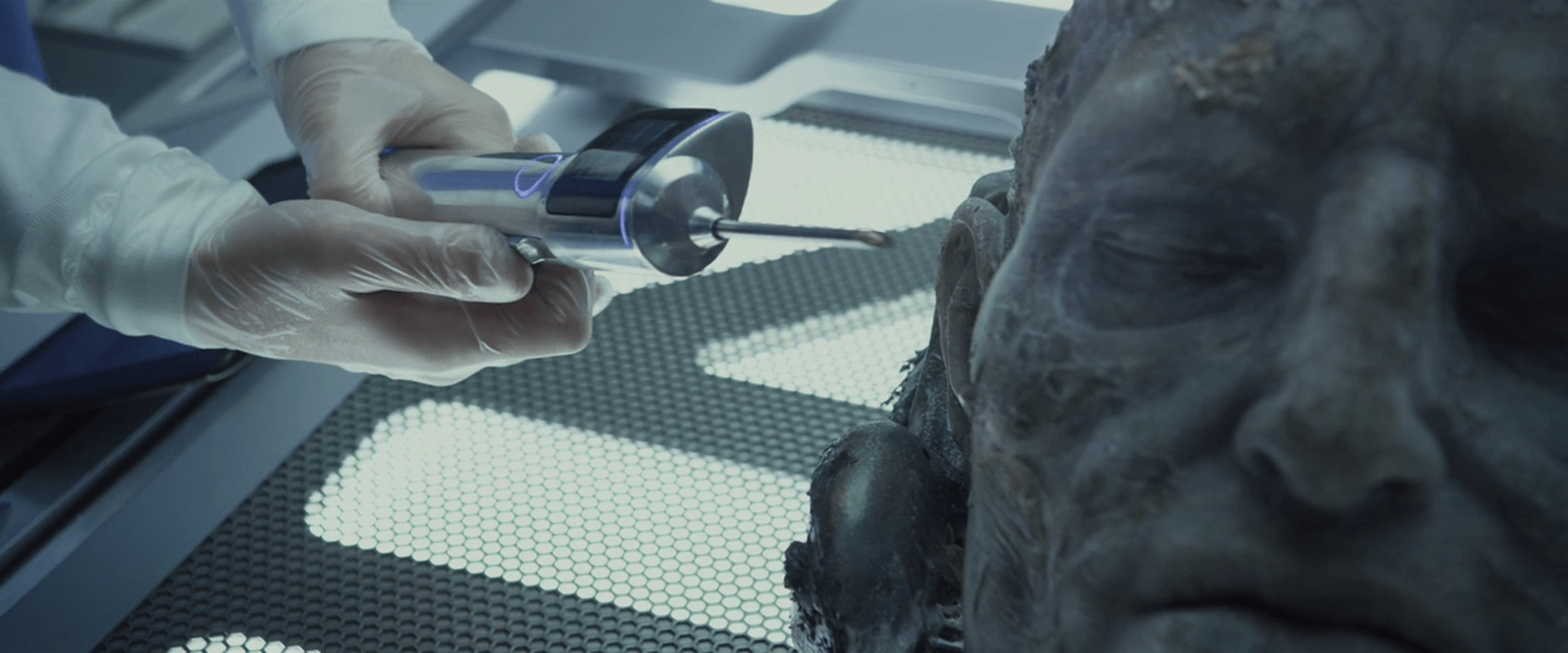
Using a tool that looks suspiciously identical to the Injection Carbon Reader, the stem line provides electrical current to nerve endings. It is inserted directly into the alien head and then controlled wirelessly via unseen controls on a nearby touch-sensitive slate pad.

Prometheus-168

The output on the stem line device animates with changes, but it seems the numbers appear near the middle and then slide to fixed positions on the top and bottom. If the point of the display was output, and it is meant to be seen from a distance, wouldn’t a simpler large-number display make more sense? If motion is meant to convey the meaning, like a digital gauge on a multimeter, then the text should be fixed on the graduated background and slide with it.

stemline

By stimulating the locus coeruleus of the alien, the Prometheus scientists seek to “trick it into thinking it’s still alive,” even though they have not confirmed the physiology of this 2000 year old alien specimen, or even that (in a quick Googling, the author learned that) this is the panic area of the nervous system. Were the results really that surprising?

Floating-pixel displays

In other posts we compared the human and alien VPs of Prometheus. They were visually distinct from each other, with the alien “glowing pollen” displays being unique to this movie.

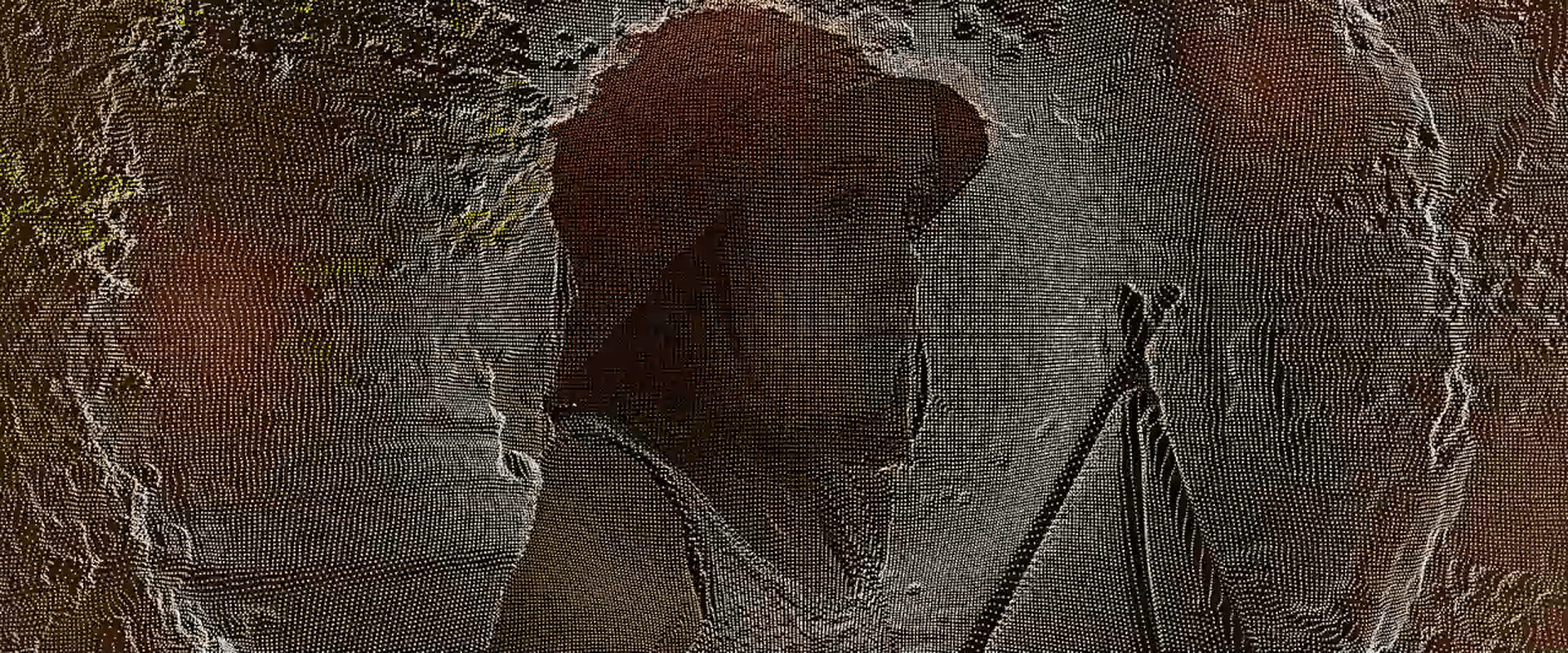
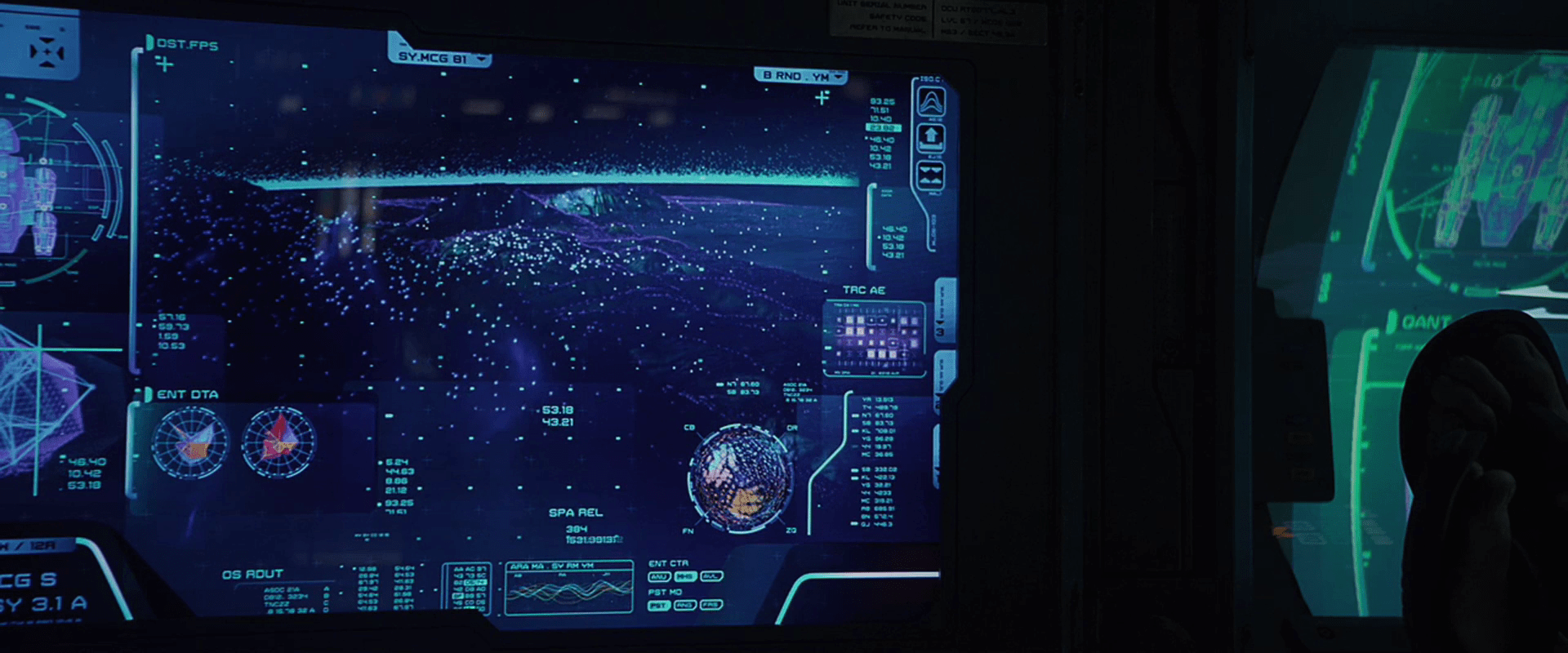
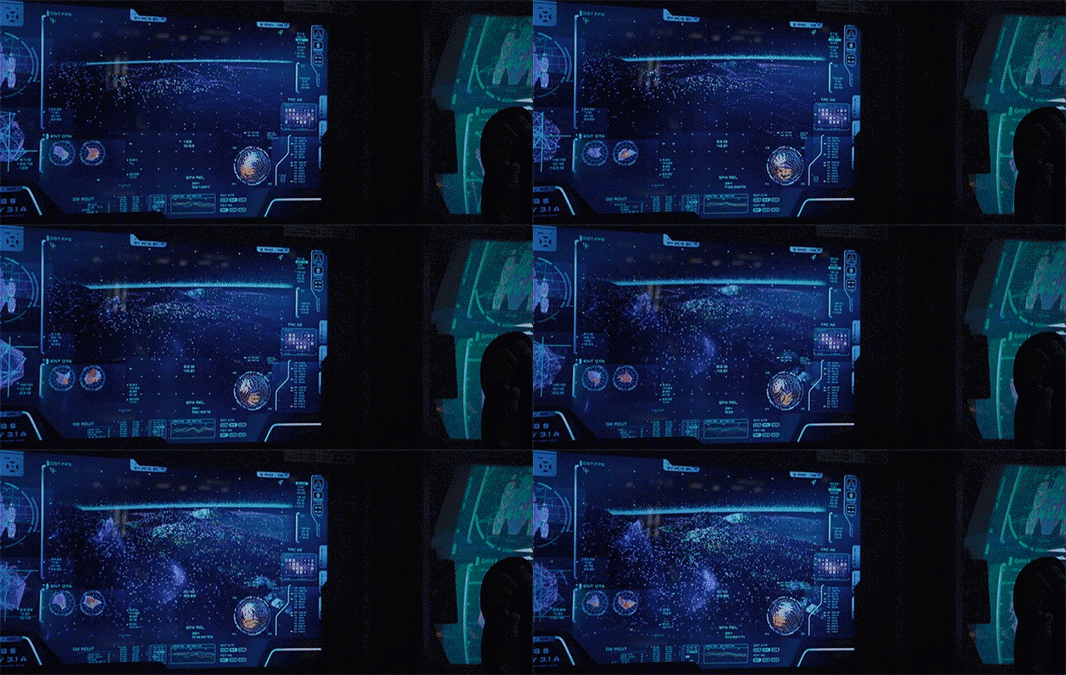
There is a style of human display in Prometheus that looks similar to the pollen. Since the users of these displays don’t perceive these points in 3D, it’s more precise to call it a floating-pixel style. These floating-pixel displays appear in three places.

  • David’s Neurovisor for peering into the dreams of the hypersleeping Shaw. (Note this may be 3D for him.)
  • The landing-sequence topography displays
  • The science lab scanner, used on the alien head
Prometheus-007
Prometheus-096
Prometheus-165

There is no diegetic reason offered in the movie for the appearance of an alien 3D display technology in human 2D systems. When I started to try and explain it, it quickly drifted away from interaction design and into fan theory, so I have left it as an exercise for the reader. But there remains a question about the utility of this style.

Poor cues for understanding 3D

Floating, glowing points are certainly novel to our survey as a way to describe 3D shapes for users. And in the case of the alien pollen, it makes some sense. Seeing these in the world, our binocular vision would help us understand the relationships of each point as well as the gestalt, like walking around a Christmas tree at night.

But in 2D, simple points are not ideal for understanding 3D surfaces. Especially when the pixels are all the same apparent size. We normally use the small bits of scale to help us understand an object’s relative distance from us. Though the shape can be kind-of inferred through motion, it still creates a great deal of visual noise. It also hurts when the points are too far apart. It doesn’t give us a gestalt sense of surface.

I couldn’t find any scientific studies of the readability of this style, this is my personal take on it. But we also can look to the real world, namely to the history of maps, where cartographers have wrestled with similar problems to show topography. Centuries of their trial-and-error have resulted in four primary techniques for describing 3D shapes on a 2D surface: hachures, contour lines, hypsometric tints, and shaded relief.

(images from http://www.siskiyous.edu/shasta/map/map/)

These styles utilize lines, shades, and colors to describe topography, and notably not points. Even modern 3D modeling software uses tessellated wireframes instead of floating points as a lightweight rendering technique. To my knowledge, only geographic information systems display anything similar, and that’s only when the user wants to see actual data points.

These anecdotal bits of evidence combine with my observations of these interfaces in Prometheus to convince me that while it’s stylistically unique (and therefore useful to the filmmakers), it’s seriously suboptimal for real-world adoption.