Sleep regulator

TheFifthElement-redmike-003

To make your flight as short as possible, our flight attendants are switching on the sleep regulator, which will regulate your sleeping during the flight.

First, props to screenwriters Luc Besson & Robert Mark Kamen for absolutely nailing annoying airline doublespeak. “Regulate your sleeping” means “knock you unconscious,” and even when Korben raises a finger to interject, the flight attendant ignores him and presses a button to begin “regulating his sleep.”

Given that ignoring passenger interruptions is standard operating procedure, it’s a nice design feature that the berths are horizontal and less than a meter tall. Even if a passenger was somehow all the way at the top of the berth, the fall to the cushy flooring would likely do them no harm.

TheFifthElement-sleepregulator-003

The panel has four rounded rectangles: One for each person who might be in the berth? On approach, an amber, underlit toggle button is already on. She presses an adjacent toggle button, which glows yellow, and Korben passes out immediately. Three pairs of steady lights illuminate on the right side of the panel, one pair yellow, the other two red, but it is not clear what these indicate.

On arrival to the planet Fhloston Paradise, the attendants press the yeloow buttons and the passengers awake immediately.

Analysis

Let me be blunt. The panel is a pretty crap interface, with no labeling to indicate what the buttons mean and no security to prevent mischievous passengers from messing with other passengers. (Imagine the poor kid trapped inside and subject to the button flicking of a sibling.) There’s no clear medical monitoring on the outside, which you’d think would be vital with any interface that affects biology like this. Even if a centralized station had the monitoring details elsewhere on the ship, anyone passing by should get some indication of what’s happening.

Admittedly, this is an interface with complex attention-getting needs. The attendants need to know that the regulator is working, and that bears a light. But the attendants also need to know when something is medically trending poorly or just plain failing, and that also bears a light. It would be important to clearly distinguish these signals, since confusing one for the other could be deadly.

Better would have been a well labeled system-is-operating signal facing the attendant when she is standing at the panel, and another well-labeled, blinking, loud, system-needs-attention signal that can be seen down either end of the hallway. Let us pray that they never, ever remake this film, but if there’s a directors cut, this interface could use a makeover.

Red mics

TheFifthElement-redmike-001

We saw in an earlier post how the military uses communication headsets with red LEDs in the tips of the antennas that provide a social signal about the attention of its wearer. On board the spaceship to Fhloston Paradise, the same technique is used to signal functioning microphones.

TheFifthElement-redmike-002

TheFifthElement-redmike-003

The simple status signal of glowing signals to the speaker that the device is on and that their voice is being broadcast, listened to, or might be overheard.

These are two binary states: microphone recording/not, light on/off. and the relationship could be swapped such that the light illuminates when the device is not recording. But since the consequences for accidentally broadcasting the wrong thing are dire, it makes sense to associate the attention-getting signal with the costly state that requires attention and care.

The red appears elsewhere as a signal for microphone or antenna, even when it’s not glowing. We see it on Korben’s wireless phone at home, Zorg’s assistant’s headset, on Korben’s room phone aboard the Fhloston Paradise, on the handheld mic aboard Zorg’s ship, and on the President’s wireless phone. We can presume it’s a signal common pattern across all the commucication technology of this world. The commonality helps signal to anyone familiar with it the purpose of an otherwise unmarked and miniaturized component.

Rhod’s rod

TheFifthElement-Rhod-011

One of the most delightfully flamboyant characters in sci-fi is the radio star in The Fifth Element, Ruby Rhod. He wears a headpiece to hear his producers as well as to record his own voice. But to capture the voices of others, he has a technological staff that he carries.

Function

The handle of the device has a microphone built into it. Because of the length of the staff, his reach to potential interviewees is extended. The literal in-your-face nature of the microphone matches Ruby’s in-your-face show.

TheFifthElement-Rhod-004

To let interviewees know when they’re being recorded, a red light in the handle illuminates. This also lets others nearby know that the interviewee is “on air” and not to interrupt.

Ruby also has a single switch on the handle. It’s a small silver toggle. It’s likely that he can set this switch to function as he likes. The one time we see it in action, he has set it to play back an “audio cut,” (the sound clips morning radio talk show hosts insert into their programs) in this case an intimate recording of the Princess of Kodar Japhet. He flips the toggle to play the cut, and flips it back when it’s done.

Here, a different input would have worked better. The toggle switch is too easy to bump and kind of ruins the design of the handle. Better would be a billet button. This sort of momentary button sits flush with a bezel, which prevents accidental activation from, say, a finger laying across it, or resting the button against a flat surface. If Ruby wants the recorded sound to play out completely, and the button press only starts or stops the playback, it would be good to know the state of the playback, and using a billet button with a LED ring would be best.

We also know that Ruby is a performer. He would be happier if he had more than a play button, but a way to express himself. His hand is already in a grip to hold the staff, so the control should fit that—If you could outfit the billet button with directional pressure sensitivity, he could assign each direction to a control. So, for instance, while he was pressing the button, the audio would play, and the harder he pressed up, the volume for each echo would increase. Or pressing down could lower the sample in tone, etc. This would allow him to not just play the audio cut, but perform it.

Fashion

To work as a device that the character would want to carry, it has to match his sense of style. I mean this first in a general sense, and the device does that, with its handle of ornately carved silver. Ruby’s necklaces, bracelets, and rings are all silver, and they work together. The staff also works in his hand like a drum major’s baton, augmenting his larger-than-life presence with an attention-commanding object.

It has to fit his daily fashion as well, and the staff does that, too. The shaft can change appearance. I don’t know if it’s an e-ink-type surface, replaceable staves, or fabric sleeves that change out, but when Ruby’s in leopard print, the staff is in leopard print, too. When Ruby’s decked out in rose-adorned tuxedo black, the staff matches.

TheFifthElement-Rhod-002

TheFifthElement-Rhod-006

Though this is more a portable than a wearable technology, the fact that it can change to match the personal style of the wearer makes it not only functional, but since it fits his persona, desirable as well.

Fuel cell

fifthelement-233

Just before the spaceship takes off for Fhloston Paradise, the audience gets to see the manual interface that the airport employees use to refuel the ship. On the tarmac beneath the spaceship, the ground crewman plugs in a portable control box to the underside of the plane, and presses a button to open a hatch in the ground, from which a new, glowing green radioactive fuel cell emerges.

One of the crewmen grabs it by its circular handles at the end, removes it from the hatch, and sets it on the ground.

He then uses the plugged-in control box to open a compartment on the underside of the spaceship, from which one of the ground crew removes the spent fuel cell by hand, and inserts it into the still-open hatch.

Finally they pick up the full fuel cell and insert it into the compartment on the plane.

fifthelement-237

This scene is there to set up how Cornelius stows away on the craft, but also serves as a cinematic pun when it crosscuts to a scene inside the ship (but which must be seen rather than read to appreciate.) For such a “throwaway” technology, it’s handled really well.

  • The ground affords natural shielding from any collection of radioactive fuel cells.
  • Being circular, the cells and the handles to manipulate the cells are orientation-less.
  • There are familiar black-and-yellow-stripe warnings on the walls of the hatch and the revealed sides of the spaceship compartment. These warnings are only visible when it’s relevant.
  • The radioactivity trefoil symbol has the same colors and appears on the fuel cell, the hatch, and the compartment.
  • Having a portable and wired control box means that it’s not readily available for any passing hackers.
  • The transparent container lets the material act as an additional warning to observers: There is danger here.
  • The transparent container lets the fuel itself tell the ground crew which cell is spent and which one is full.

All told, short of making it automated, this is how it should work.

fifthelement-238

Police light

TheFifthElement-police-003

This post (the first in what is going to amount to The Fifth Element Police Week. What is this, sweeps?) is going to veer to the edge of interaction design, getting into the Venn overlap of industrial design and wearable tech.

The police seen throughout New York each wear uniforms that feature a large, circular, glowing light over the right side of their chest.

There are only two things to say that’s positive about this police light. One: Yes, it looks cool. Two: It certainly gives narby citizens a clear, attention-getting signal that something is up. This might be OK for community relations officers, who are only ever interfacing with the public. But when it comes to dealing with actual criminals, it’s a terrible idea.

TheFifthElement-police-002

It’s a terrible idea because of its placement

Imagine this scene from the chief’s perspective. When he addresses Leeloo down the pipe as she’s standing on the ledge of the building, he is in an isosceles stance, with his shoulders perpendicular to the target and his weapon held in front of his heart. This common stance would place the weapon directly in the glow of the circle. This means that his forearms and weapon will have the brightest illumination in his field of vision and be distracting. This might be manageable by coating his uniform and the back of the weapon with a super black coating to absorb much of this light. But, depending on the distance of the target, it is also likely to place the perp in shadow, making them harder to see and harder to hit.

Looking at the officer on the right, we see he is taking a different stance. He is “bladed” to the target, closer to a Weaver stance, with his body turned a bit sideways. This stance turns the light to the adjacent wall, which minimizes the backscatter and perp-shadow effects, but also aims the light toward his fellow officer, possibly distracting him or her. That’s a pretty crappy design. But wait, it gets worse.

TheFifthElement-police-036

It’s a terrible idea because it’s a giant, glowing target

What’s worse is to imagine the scene from the perspective of the perp, say, the Mondosahwans in the airport. They want to specifically shoot the police in the crowd and all they have to do is shoot towards the glowing discs. That’s right, the police in 2263 are actually wearing attention-drawing targets. Admittedly, if you are going to get shot in the line of duty, you’d rather draw fire away from the head to a place with a solid slab of bone and lots of body armor. But why draw their fire in the first place?

As we saw in another post, Zorg believes in the fallacy/parable of the broken window, and so favors a bit of destruction that encourages market activity. We also know from the film that he has a lot of control over the NYPD. It might be that he’s deliberately sabotaging the police through this design to encourage the sale of more body armor and weapons, but are we to believe that the cops themselves are willing to go along with this? C’mon. They’re smarter than this.

Improve it with a little bit of smarts

Outfit the light with a little agentive smarts, and most of these problems could be fixed. The light could simply dim when it’s counterproductive to have it illuminated. Proximity sensors can sense when the officer’s arm is in the way. Context aware sensors can sense when it might blind another officer. It would take a lot of smarts to know when the officer is being targeted by a weapon, but certainly simple audio sensors should shut it off in the sound of gunfire.

NucleoLab Display

FifthE-nucleolab-002

The scientist Mactilburgh reconstructs Leeloo from a bit of her remains in his “nucleolab.” We see a few interfaces here.

FifthE-nucleolab-003

We never see Mactilburgh interact with the controls on this display: Potentiometers, dials with circular LED readout rings, glowing toggle buttons, and unlit buttons labeled “OFF” and “ESC.” There’s not much to grasp onto for analysis. These are just “sciencey” set of physical controls. The display is a bit of similar scienciness, meant to vaguely convey that Leeloo is a higher-order being, but beyond that, incomprehensible. Interestingly, the Mondoshawan DNA shows not just a more detailed graphic, but adds color to convey an additional level of complexity.

FifthE-nucleolab-004

An odd bit: In the lower right hand corner of the screen you can see the words “FAMILIAL HYPERCHOL TEROLEMIA.” Looking up this term reveals the genetic condition Familial Hypercholesterolemia. It’s only missing the “ES.” What’s this label doing here? This could be the area on the DNA chain where the markers appear for this predisposition to high cholesterol, but wouldn’t you expect that to take up 5000 times less room on a DNA strand of a perfect being, not the same percentage? Also it kind of takes the winds out of the sails of Mactilburgh’s breathless claim that she’s perfect. Anyway it’s a warning lesson for sci-fi interface designers: Watch where you pull your sciencey words from. If it’s a real thing, ask whether the meaning runs counter to your purposes or not.

The daffy bastard

FifthE-taxilicense-001

When Korben gets in his taxi and sits down, it recognizes this and in a female version of the hazy synthesized voice heard in the 4 a day cigarette dispenser, prompts him to “Please enter your license.” Korben fits his license into a small horizontal slot mounted in the ceiling of the cab, just above the driver’s seat near the windshield. He slams it in. It verifies that he’s authorized and starts the cab, including lighting the taxi light up top. It tells him, “Welcome on board, Mr. Dallas. Fuel level 10.”

Korben steers with an X-shaped control yoke. We never see his feet, so don’t know if he has any foot pedals. He has a throttle that maps like a boat throttle: push forward to increase thrust.

In the central dashboard he has an underlit panel of toggle buttons. Each button has a single function, which is printed on its surface.

Main controls: Docking lock, Automatic, Emergency power, Power. Light controls: Auxiliary lights, Parking lights, Smog lights, Main lights. Alerts: Power level low, Power failure, Light failure, Environment warning

FifthE-taxilicense-007

Two small panels to his left provide him a similar array of “comfort controls”, “taxi controls”, and “main panel one.” A more free-form keyboard sits beneath a vertical grayscale monitor, crammed full of unreadable text and, occasionally, annoyingly, blinking.

FifthE-taxilicense-006

The buttons across these panels are completely labeled, lit for easy reading in the dim cabin light, clustered in meaningful groups, and nicely positioned so that Korben can utilize his spatial memory to map the functions. But they are also labeled in all capital letters and aren’t much differentiated beyond that, which might require Korben to take his eyes off the road to target a particular one, which could increase the odds of an accident. Better inputs using physical controls would have more physical differentiation so he could find them with just one hand, labeling that was easier to read at a glance, and the most common controls right on the yoke near his fingers.

In the scene, Korben reaches to the center panel and presses “power.” The voice confirms that he’s using “Propulsion 2-X-4,” (whatever that means.) Then Korben presses “Docking lock,” which releases the mechanical hold on the taxi.

The voice reminds him sternly that he has five points left on his license, and as the garage door opens, to “Have a nice day.” Lights on either side of the garage door shine green, signaling to him that the skyway is clear. But on pulling out, they turn red just as a car passes and Korben has to slam on the brakes.

Of course the humor comes from how these interfaces aren’t entirely helpful, and the green lights shouldn’t tell him the same information he can see with his own eyes. It should be doing a bit of calculation to signal if it’s clear for the next several seconds so he can safely pull out. But of course doing that right would ruin the joke. Maybe we’re meant to understand that Korben just can’t afford any but the crappiest versions of technology.

FifthE-taxilicense-013

Later, when Leeloo does her daring cliff dive from the side of a building and crashes through the roof of his cab, Korben struggles to maintain control of it and get the hell out of the way of oncoming traffic. During the chaos, the computerized voice tells him, “You’ve just had an accident.” Korben sardonically shouts, “Yes! I know I just had an accident, you daffy bastard.” It continues adding unhelpfully, “You have one point left on your license.” Of course the fun is how annoying the taxi is, but let’s just be explicit: the cab should wait until it senses that Korben has regained control before burdening his attention with this information, and possibly making it worse.

FifthE-taxilicense-019

When Korben risks it all to help Leeloo, the speaker cover near where his license is lodged glows bright red as it says, “One point has been removed from your license…” Korben, furious and with zero points left on his license and nothing to lose, rips the device off his ceiling to shut the daffy bastard up.

FifthE-taxilicense-020

Headsets

FifthE-UFT005

On duty military personnel—on the ship and attending the President—all wear headsets. For personnel talking to others on the bridge, this appears to be a passive mechanism with no controls, perhaps for having an audio record of conversations or ensuring that everyone on the bridge can hear one another perfectly at all times.

FifthE-UFT009

Personnel communicating with people both on the ship’s bridge and the president have a more interesting headset.

Signaling dual-presence

The headsets have antennas rising from the right ear, and each is tipped with a small glowing red light. This provides a technological signal that the device is powered, but also a social signal that the wearer may be engaged in remote conversations. Voice technologies that are too small and don’t provide the signal risk the speaker seeming crazy. Unfortunately this signal as it’s designed is only visible from certain directions. A few extra centimeters of height would help this be more visible. Additionally, if the light could have a state to indicate when the wearer is listening to audio input that others can’t hear, it would provide a person in the same room a cue to wait a moment before getting his attention.

FifthE-UFT016

Secondary conversants

Each headset has a default open connection, which is always on, sending and receiving to one particular conversant. In this way General Staedert can just keep talking and listening to the President. Secondary parties are available by means of light gray buttons on the earpieces. We see General Munro lift his hand and press (one/both of?) these buttons while learning about the growth rate of the evil planet.

FifthE-UFT011

The strategy of having one default and a few secondary conversants within easy access makes a great deal of sense. Quick question and answer transactions can occur across a broad network of experts this way and get information to a core set of decision makers.

The design tactic of having buttons to access them is OK, but perhaps not optimal. Having to press the buttons means the communicator ends up mashing his ear. The easiest to “press” wouldn’t be a button at all but a proximity switch, that simply detects the placement of the hand. This has some particular affordance challenges, but we can presume military personnel are well trained and expert users.

Gravity (?) Scan

FifthE-UFT001

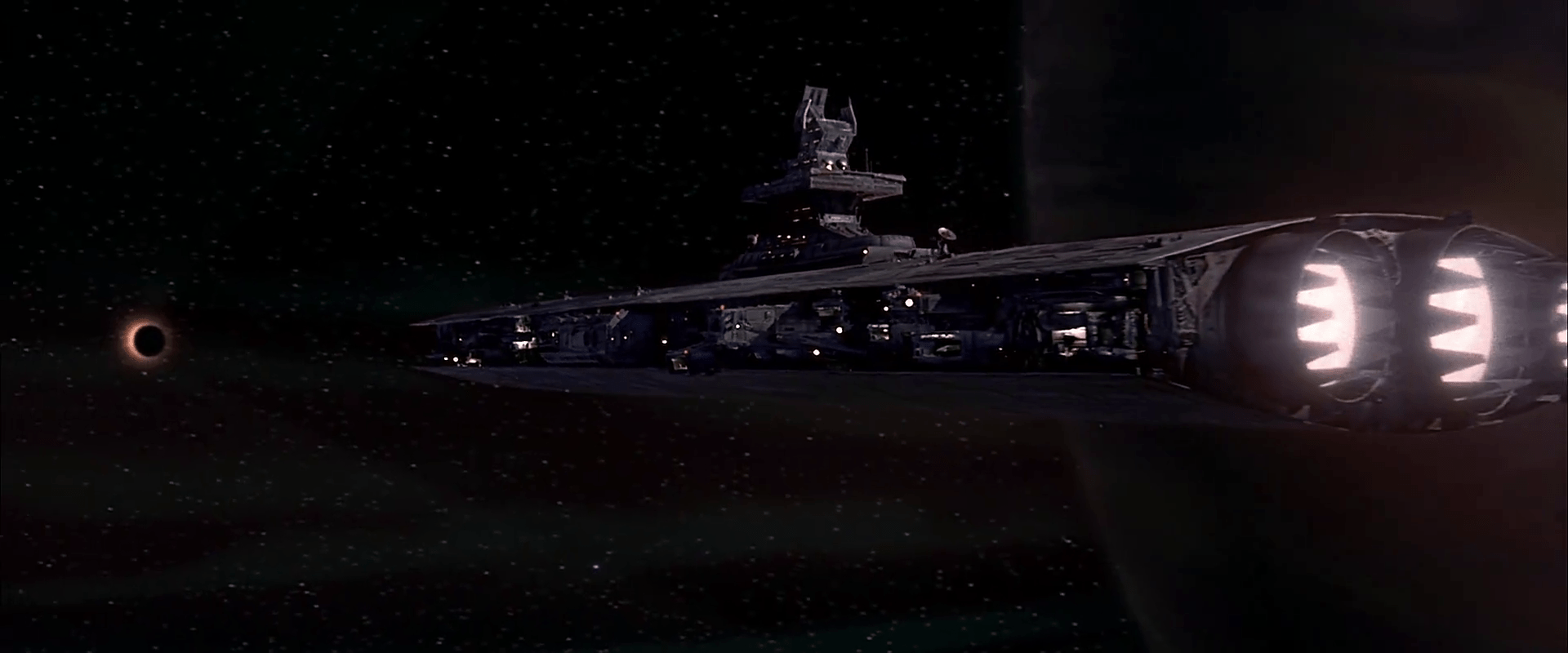
The first bit of human technology we see belongs to the Federation of Territories, as a spaceship engages the planet-sized object that is the Ultimate Evil. The interfaces are the screen-based systems that bridge crew use to scan the object and report back to General Staedert so he can make tactical decisions.

FifthE-UFT006

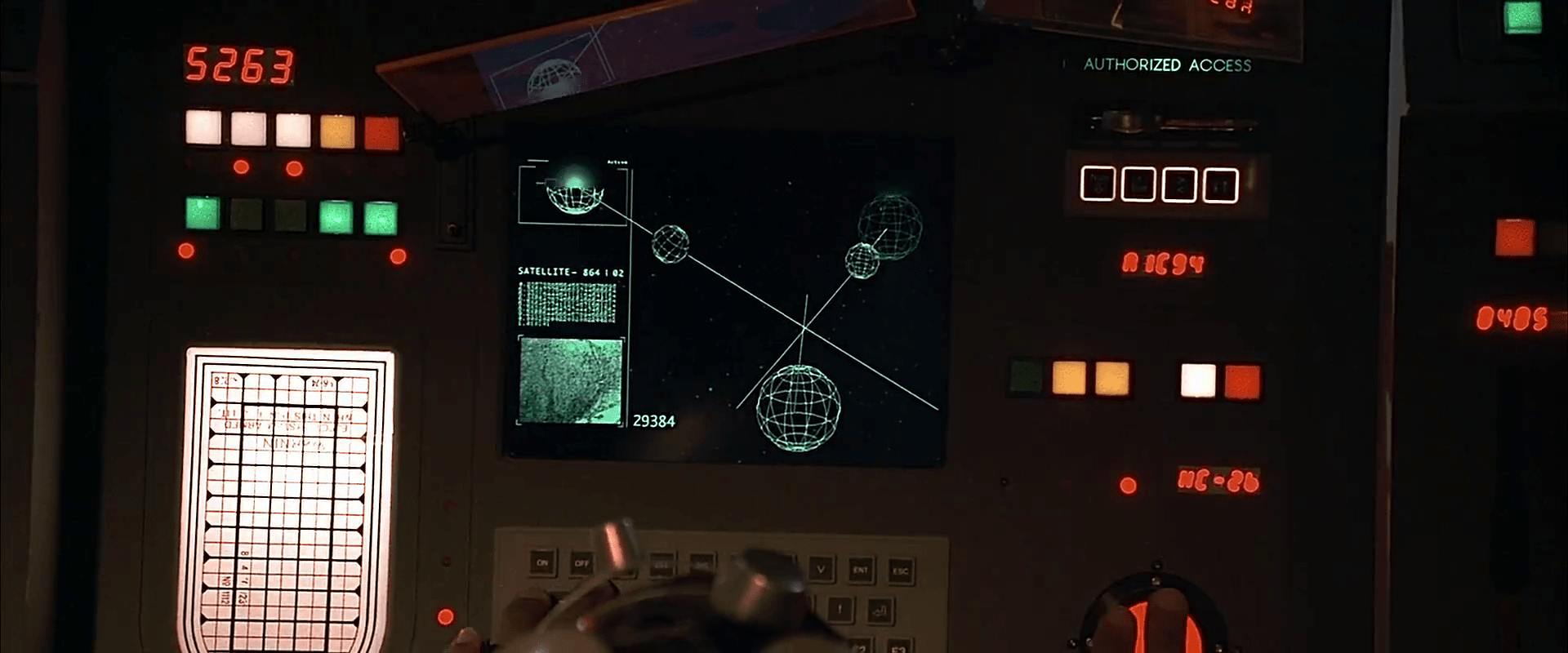
We see very few input mechanisms and very little interaction with the system. The screen includes a large image on the right hand side of the display and smaller detailed bits of information on the left. Inputs include

  • Rows of backlit modal pushbuttons adjacent to red LEDs
  • A few red 7-segment displays
  • An underlit trackball
  • A keyboard
  • An analog, underlit, grease-pencil plotting board.
    (Nine Inch Nails fans may be pleased to find that initialism written near the top.)

The operator of the first of these screens touches one of the pushbuttons to no results. He then scrolls the trackball downward, which scrolls the green text in the middle-left part of the screen as the graphics in the main section resolve from wireframes to photographic renderings of three stars, three planets, and the evil planet in the foreground, in blue.

FifthE-UFT008 FifthE-UFT014 FifthE-UFT010

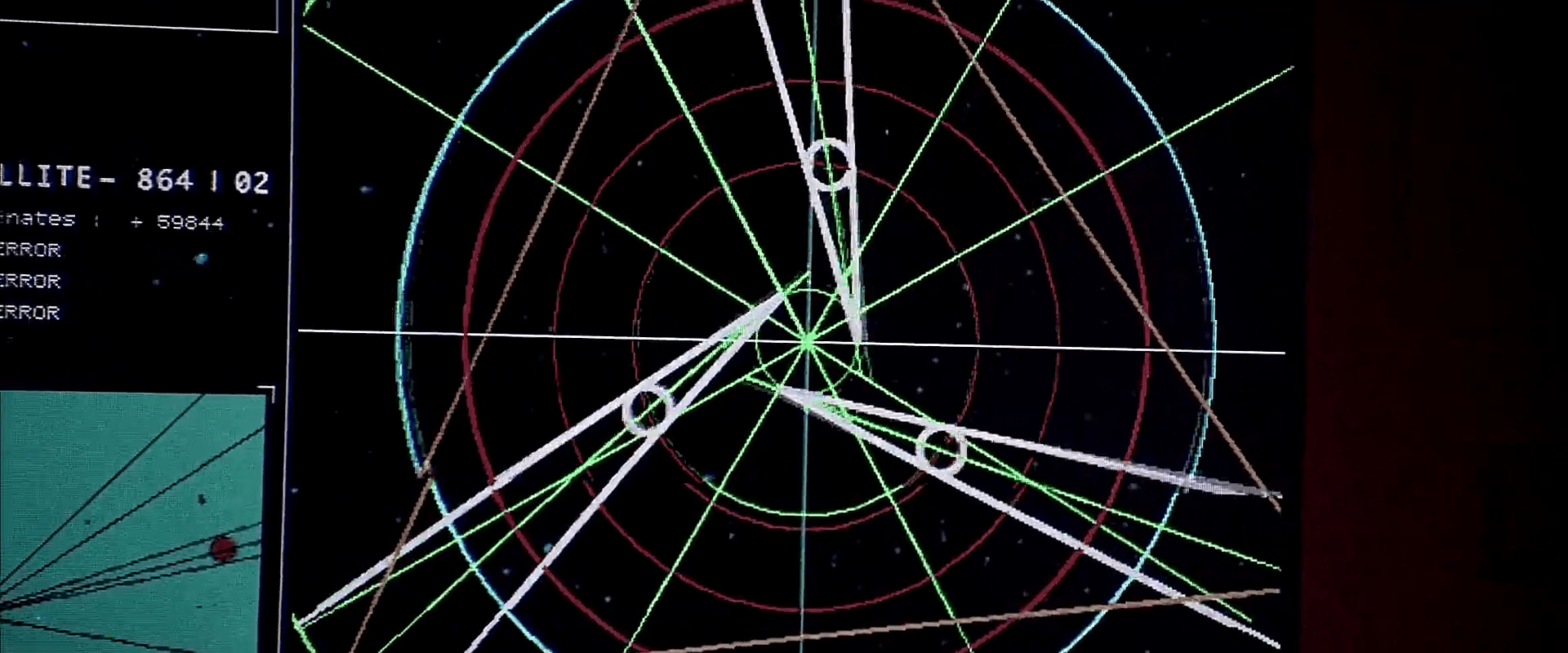
The main challenge with the system is what the heck is being visualized? Professor Pacoli says in the beginning of the film that, “When the three planets are in eclipse, the black hole, like a door, is open.” This must refer to an unusual, trinary star system. But if that’s the case, the perspective is all wrong on screen.

Plus, the main sphere in the foreground is the evil planet, but it is resolved to a blue-tinted circle before the evil planet actually appears. So is it a measure of gravity and event horizons of the “black hole?” Then why are the others photo-real?

Where is the big red gas giant planet that the ship is currently orbiting? And where is the ship? As we know from racing game interfaces and first-person shooters, having an avatar representation of yourself is useful for orientation, and that’s missing.

And finally, why does the operator need to memorize what “Code 487” is? That places a burden on his memory that would be better used for other, more human-value things. This is something of a throw-away interface, meant only to show the high-tech nature of the Federated Territories and for an alternate view for the movie’s editor to show, but even still it presents a lot of problems.

Self-Destruct

Barbarella-140

Furious at Durand-Durand’’s betrayal, the Black Queen walks to a set of five shoulder-height levers, each baroquely shaped, transparent, and hinged to a base on the floor. She pulls the middle one, and a bright white light below the base begins to glow. She then pulls the first lever. She glances at the fourth, but then changes her mind and pulls the fifth one, explaining that she is unleashing the Mathmos to devour the city. The Queen’’s brief hesitation implies that this isn’’t just an interface, but a self-destruct mechanism that must be activated in some particular, secret order to take effect. Upon completion of the sequence the city begins to fall into the liquid creature, Mathmos, that lives beneath the city.

Barbarella-144