A Deadly Pattern

The Drones’ primary task is to patrol the surface for threats, then eliminate those threats. The drones are always on guard, responding swiftly and violently against anything they do perceive as a threat.

An explosion in a dimly lit library with debris scattered around and a hovering robotic device amidst the chaos.

During his day-to-day maintenance, Jack often encounters active drones. Initially, the drones always regard him as a threat, and offer him a brief window of time speak his name and tech number (for example, “Jack, Tech 49”) to authenticate. The drone then compares this speech against some database, shown on their HUD as a zoomed-in image of Jack’s mouth and a vocal frequency.

vlcsnap-2015-02-03-22h07m47s249

Occasionally, we see that Jack’s identification doesn’t immediately work. In those cases, he’s given a second chance by the drone to confirm his identity.

A man with a glowing headband appears concerned, reaching out with his hand, in a dimly lit environment.

Although never shown, it is almost certain that failing to properly identify himself would get Jack immediately killed. We never see any backup mechanism, and when Jack’s response doesn’t immediately work, we see him get very worried. He knows what happens when the drone detects a threat.

Zero Error Tolerance

This pattern is deadly because it offers very little tolerance for error. The Drone does show some desire to give Jack a second chance on his vocal pattern, but it is unclear how many total chances he gets.

On a website, if I enter my password wrong too many times it will lock me out. With this system, the wrong password too many times will get Jack killed.

There are many situations where Jack may not be able to immediately respond:

  • Falling off his bike and knocking himself out
  • Focus on repairing a drone, when a second drone swoops in to check the situation out
  • Severe shock after breaking a limb
  • etc…

As we see in the crashed shuttle scene, the Drones have no hesitation in killing unconscious targets. This means that Jack has a strong chance of being killed by his Drone protector in some of the situations where he needs help the most.

A futuristic robotic sphere with the number 166 displayed on its surface, emitting flames and smoke from its underside.

A more effective method could be a passive recognition system. We already know that the drone can remotely detect Jack’s biosignature, and that the Tet has full access to the Drone’s HUD feed.

The Drone then could be automatically set to not attack Jack unless the Tet gives a very specific override. Or, alternatively, the Drone could be hard-wired to never attack Jack at all (though this would complicate the movie’s plot). In any situation where it looks like the Drone might attack anyways, the remote software Vika uses could act as a secondary switch, providing a backup confirmation message.

That said, we must acknowledge that this system excels at is keeping Jack nervous and afraid of active drones.  While they help him, he knows that they can turn on him at any moment.  This serves the TET by keeping Jack cowed, obedient, and always looking over his shoulder.

Ethical Ramifications

The Drones are built as autonomous sentries, able to protect extraordinarily expensive infrastructure against attack. They need to be able to eliminate that threat, quickly and efficiently. Current militaries are facing the exact same issues. Even though they have pledged (for now) to not build autonomous kill systems, modern military planners may find value in having a robot perform a drudging, dangerous task like patrolling remote infrastructure.

The question asked best in Oblivion is “What should constitute a threat?

A desolate landscape with wreckage and flames, suggesting a recent disaster or battle scene.

Drones fire mercilessly on unarmed civilians and armed enemy militia, but do not attack armed friendly soldiers (Jack). This already implies some level of advanced threat analysis, even if we abhor the choices the Drone makes.

The Future

Military Planners will need to answer the same question: How does the algorithm determine a threat? With human labor becoming more and more expensive both monetarily and emotionally, the push for autonomous drone systems will become even stronger for future conflicts.

There is still enough time to research and test potential concepts before we have to make a decision on autonomous drones.

Interaction Design Lessons:

  1. Don’t threaten civilians and non-combatants.
  2. Give clear feedback of limits and consequences if a deadly pattern is about to be activated.
  3. Give users a second chance.

Escape pod weapons cache

I wish that the last Starship Troopers interface wasn’t this one, but so it goes.

After piloting the escape pod through the atmosphere using the meager interfaces she has to work with, it careens off of a hill to pierce the thin wall of a mountainside and landing Ibanez and Barcalow squarely in the dangerous depths of bug burrows.

After checking on Ibanez, Barcalow exits the pod and struts around to the back of it, where he pulls open a panel to access the weapons within.

So equipped, the pair are able to defend themselves at least a few moments before being overwhelmed by superior bug numbers.

StarshipTroopers-podweapons-07

So. OK. This.

I want to ask why, in the first place, they would get out of a vehicle that can survive space, re-entry, breaking through a frakking mountainside, and crash landing without so much as a scratch. If they’d stayed there, would the bugs have been able to get at them? Couldn’t staying inside of it given them at least a fighting chance until Rico got there? The glass didn’t break when slammed at terminal velocity into stone. I think it can handle bug pincers. But I digress. that’s a question of character logic, not interfaces, so let me put that aside.

Instead, let me ask about the design rationale of putting the weapons in an exterior compartment. Wouldn’t it make more sense to put them inside the pod? If they’d landed with hostiles present outside the vehicle, what was the plan, ask them to hold on while you grabbed something from the trunk?

Additionally, it appears that there are no security features. Barcalow just opens it. Silly seeming, of course, but that’s how it should work, i.e., for the right person it just opens up. So in the spirit of apologetics—and giving it way more credit than it’s earned across this film—let’s presume that the pod has some passive authentication mechanism that biometrically checks him at a distance and unlocks the panel so that he doesn’t even have to think about it, especially in this crisis scenario.

That’s an apologetics gift from me to you, Starship Troopers, since I still have a soft spot in my heart for you.

Tattoo-o-matic

StarshipTroopers-Tattoo-01

After he is spurned by Carmen and her new beau in the station, Rico realizes that he belongs in the infantry and not the fleet where Carmen will be working. So, to cement this new identity, Rico decides to give in and join his fellow roughnecks in getting matching tattoos.  The tattoos show a skull over a shield and the words “Death from Above”. (Incidentally, Death From Above is the name of the documentary detailing the making of the film, a well as the title of a hilarious progressive metal video by the band Holy Light of Demons. You should totally check it out.) 

To get the tattoo, Johnny lies back in a chair, and a technician of some sort works briefly at waist-high controls beneath a nearby screen. Then the technician walks away while Johnny’s tattoo is burned with blue lasers onto his arm.

A man seated in a futuristic setting is receiving a tattoo from a robotic arm. The tattoo features the word 'DEATH' surrounded by a star emblem. A computer screen in the background displays various graphs and a logo related to the tattooing process.

At the upper left corner of the screen a display reads SELECTED above the image being burned into Rico’s arm. (With white indicating no color.) Beneath it, is a square divided into four quadrants is filled with unintelligible numbers scrolling along, above the words AUTOMATIC SEQUENCE CONTROL.  Down the center of the screen beneath the word LASERS is a column filled with boxes showing sine waves and their corresponding frequencies from the shorter blue wavelengths moving down to yellow, red, and finally a double-lined white waveform. At the right of the screen is a large screen-green rectangular grid on which the selected pattern wipes in from top to bottom as the corners blink in red and yellow.

There are two main problems that are apparent in the scene.

1. We don’t need the technician

What does the technician do? Essentially, he presses a button and then walks away. Even as Johnny’s friends rush him out of the room in celebration, no one stops them to pay, which seem to indicate that everything has already been taken care of before he sits in the chair. Also, we notice that Johnny’s arm has not been strapped down, wrapped in healing bandages, or secured in any way. He stays relatively still throughout the procedure, but it seems a safe assumption that not all customers will be stoic soldier types who are able to sit still while their arm is literally charred by lasers in front of their own eyes. The machine must be able to compensate for movement, either by adjusting the lasers or shutting off completely, so, again, no technician is necessary. Also, when a fellow roughneck pours liquor over Johnny’s arm while his skin is in the process of being vaporized by lasers, the liquor doesn’t ignite in a horrifying fireball as we might expect, indicating that the lasers must have scaled back their intensity just in the nick of time—this is a pretty context-aware system with a lot of built-in error correction. Maybe they’re there for insurance purposes but given what we see in the scene, they serve no real purpose. Assuming the Death from Above design was one already in the machine, he could have completed the entire transaction himself from start to liquor-soaked finish.

A group of four individuals showcasing matching tattoos on their arms that read 'DEATH FROM ABOVE', with decorative graphic elements around the text.

2. The screen doesn’t make sense

As the image of the selected design scans into view on the right side of the screen, we can see that there is no exact correlation between the parts of the image on screen, and the parts of the image on-skin. The wireframe wipes in from top-to-bottom. The tattoo is finishing up in the middle. The tattoo is already 90% complete when the animation begins. The blinking numbers, the wiggling sine waves. It doesn’t mean anything and isn’t useful. So all told, the information on the screen initially appears complex, but given the total automation of the system it’s actually quite simple: Here’s what’s happening, and here’s the progress.

But maybe it’s not for the technician

Maybe it’s not for the technician at all. You can imagine that while having your skin seared by painful, painful lasers, all that fuigetry would be a welcome distraction, and a progress bar would be a welcome reassurance that it won’t last forever. With this in mind, the main problem with the screen is that it should be facing the customer, who is the real user.

Spinning Pizza Interface

As soon as the Rodger Young clears the dock, the interfaces before Ibanez and Barclow change to…well, this.

spinningpizza

I’m pretty good at apologetics, but what this is and how this does anything useful, I just…I’m at a loss. Is this supposed to be the active sweep of a radar dish? Some indication of the flywheel engine? Or the position of that spinning column on the bridge? How are any of these things worth distracting a pilot with a giant yellow spinning pizza?

Helmsman’s HUD

TheFifthElement-helmsman-001

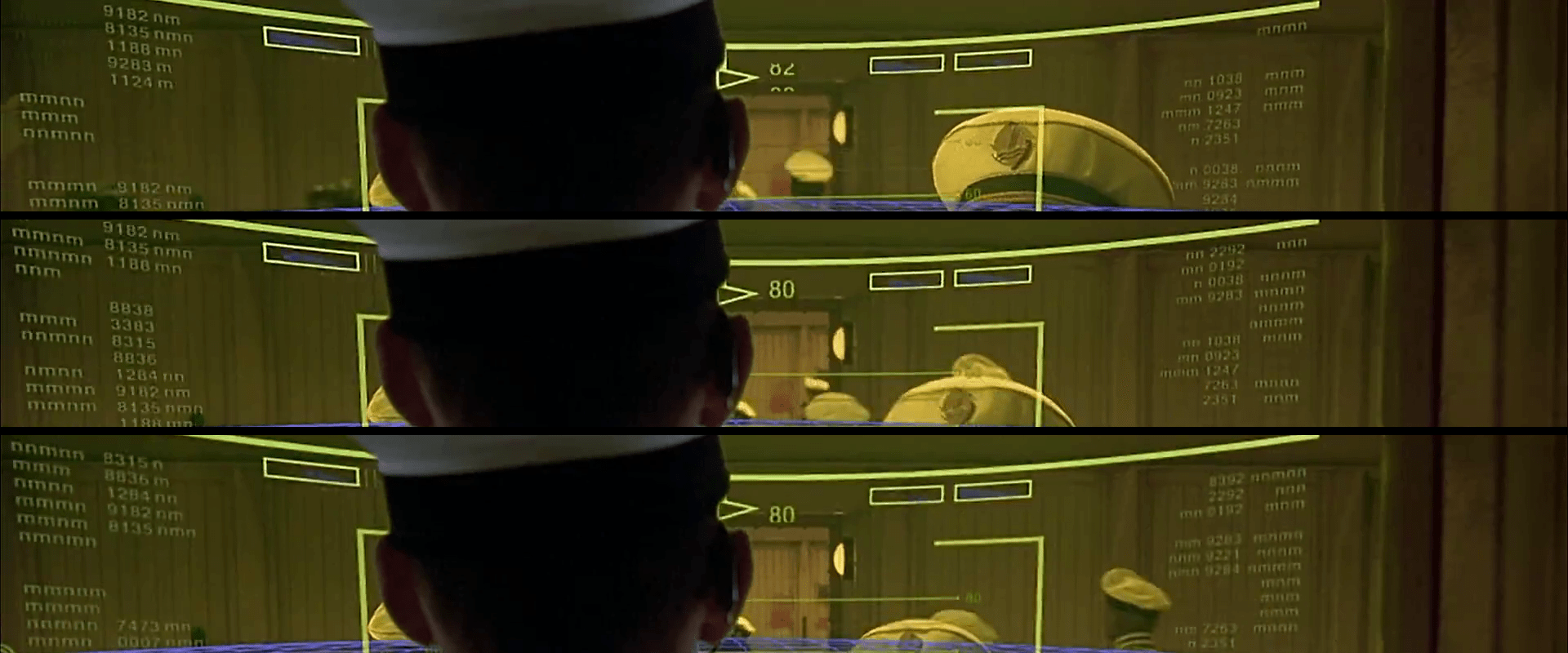
Aboard the Fhloston Paradise luxury liner, we are treated to a quick view of the ship’’s wheel. The helmsman stands before the wheel, in the middle of a ceiling-mounted translucent yellow cylinder that drops just below shoulder level. This surface acts as heads-up display that is visible only from the inside.

TheFifthElement-helmsman-002

The content of the display is a 3-D, featureless, blue graticule with an overlay featuring target brackets, various numeric data strangely labeled with various numbers of ““m””s and “n”s, and a green, faint outline of a railing, as if the helmsman was looking out from a Lawnmower Man interpretation of an Age of Sail wheelbridge. At the top of the display are three yellow-outline rectangles with no content. In the center-top of his view is a compass readout, with a rolling counter display that appears to show bearing.

In practice, the Captain calmly gives an order to a barker, who confirms with a, “Yes, sir” before walking to the edge of the cylinder and shouting the same order, “HELM ONE OH EIGHT!” To confirm that he heard the message, the helmsman repeats the order back and turns the wheel. The helmsman wears a headset that amplifies his spoken confirmation back to everyone on the bridge.

Sometimes a Human is the Best Interface

The Captain doesn’t want to shout or wear a headset. He’s a gentleman. But if the helmsman is going to be trapped in the yellow cone of silence, there must be an intermediary to convey the commands and ensure that they’re carried out. Even if technology could solve it better, I have the sense that navies are places where traditions are carried on for the sake of tradition, so the human aspect of this interaction doesn’t bother me too much. It does add a layer of intermediation where data can go wrong, but the barker and the helmsman each repeat the command loudly, so the Captain can hear and error-check that way.

Long live the HUD

On the plus side, showing the graticule grants a sense of speed and (kind-of) bearing that would be much more difficult to do on the surface on all-water planet like Fhloston Paradise. So that’s nice.

But that information would be even more useful if it was backed up by some other contextual information like the clouds, the position of the sun, or, say, anything else on the surface of the planet toward which they might be barreling. A simple highly-transparent live feed of a camera from somewhere would have been more useful.

helmsman

And of course I can’t let the silly nonsense data on the edges just go. Shipmen love their sea-salted jargon, but they also love effectiveness, and there is no sense to labeling one variable “nm” and the next “nmn,” much less a whole screen of them. They would be difficult to distinguish at the very least. Certainly there’s no use to having two variables labeled just “m” with no other contextualizers. Even if it was better labeled, presenting this information as an undifferentiated wall of data isn’t helpful. Better would be to turn some of these into differentiable graphics that help the helmsman see the information and not have to read it. In any case, the arbitrary blinking on and off of data just needs to stop. It’s a pointless distraction unless there is some monitoring data that is trending poorly and needs attention.

Sometimes an AI is the Best (Secret) Interface

Finally, if you obsess over editing details (and you are reading this blog…) you’ll note that the bearing indicator at the top begins to change before the helmsman moves the wheel. It even moves before the helmsman repeats the order. It even begins before the the barker shouts the orders. (Reminiscent of the chem department flub from Cabin I covered earlier.) It looks like the HUD designers wanted movement and mistimed it before the events in the scene.

But we don’t have to leave it there. We’ve already noted that seamen love standing on tradition. What if this whole interface was vestigial? If the ship has a low-level AI that listens to the captain, it wouldn’t need to wait for any of the subsequent human processes: the barker, the helmsman repeat, or the wheel turning. Each of these acts to confirm the command, but the ship can go from the first order when it has a high degree of confidence. This would also excuse the nmnmmnonsense we see on the HUD. The display might have degraded to displaying noise, but no one needs to fix it because the ship runs just fine without it.

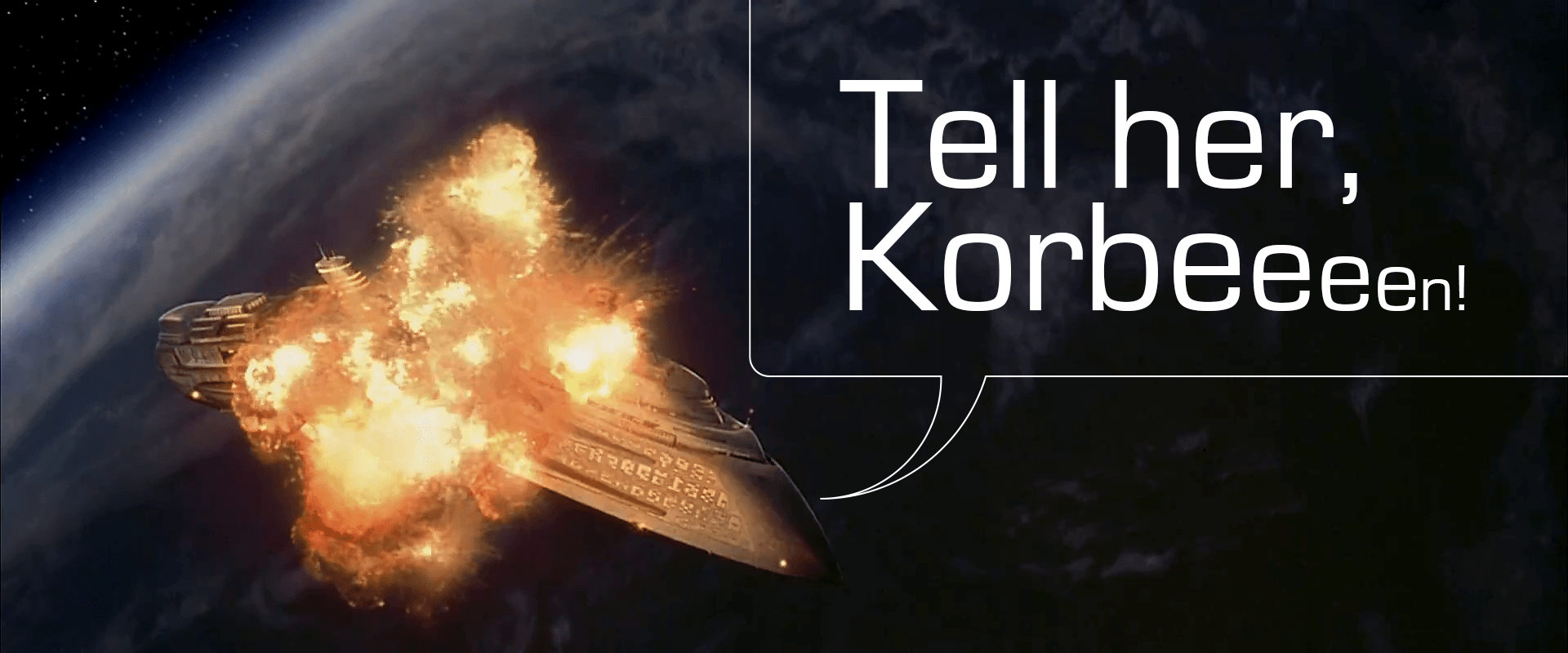
Thinking that the Fhloston Paradise might have been a bioship only makes its destruction from a Zorg Mangalore Zorg bomb only makes its destruction much more tragic, but also more heroic as it died saving the people it had been programmed to serve all along.

tellherkorben

Alien Astrometrics

Prometheus-222

When David is exploring the ancient alien navigation interfaces, he surveys a panel, and presses three buttons whose bulbous tops have the appearance of soft-boiled eggs. As he presses them in order, electronic clucks echo in in the cavern. After a beat, one of the eggs flickers, and glows from an internal light. He presses this one, and a seat glides out for a user to sit in. He does so, and a glowing pollen volumetric projection of several aliens appears. The one before David takes a seat in the chair, which repositions itself in the semicircular indentation of the large circular table.

Prometheus-204

The material selection of the egg buttons could not be a better example of affordance. The part that’s meant to be touched looks soft and pliable, smooth and cool to the touch. The part that’s not meant to be touched looks rough, like immovable stone. At a glance, it’s clear what is interactive and what isn’t. Among the egg buttons there are some variations in orientation, size, and even surface texture. It is the bumpy-surfaced one that draws David’s attention to touch first that ultimately activates the seat.

The VP alien picks up and blows a few notes on a simple flute, which brings that seat’s interface fully to life. The eggs glow green and emit green glowing plasma arcs between certain of them. David is able to place his hand in the path of one of the arcs and change its shape as the plasma steers around him, but it does not appear to affect the display. The arcs themselves appear to be a status display, but not a control.

After the alien manipulates these controls for a bit, a massive, cyan volumetric projection appears and fills the chamber. It depicts a fluid node network mapped to the outside of a sphere. Other node network clouds appear floating everywhere in the room along with objects that look like old Bohr models of atoms, but with galaxies at their center. Within the sphere three-dimensional astronomical charts appear. Additionally huge rings appear and surround the main sphere, rotating slowly. After a few inputs from the VP alien at the interface, the whole display reconfigures, putting one of the small orbiting Bohr models at the center, illuminating emerald green lines that point to it and a faint sphere of emerald green lines that surround it. The total effect of this display is beautiful and spectacular, even for David, who is an unfeeling replicant cyborg.

Prometheus-226

At the center of the display, David observes that the green-highlighted sphere is the planet Earth. He reaches out towards it, and it falls to his hand. When it is within reach, he plucks it from its orbit, at which point the green highlights disappear with an electronic glitch sound. He marvels at it for a bit, turning it in his hands, looking at Africa. Then after he opens his hands, the VP Earth gently returns to its rightful position in the display, where it is once again highlighted with emerald, volumetric graphics.

Prometheus-229

Finally, in a blinding flash, the display suddenly quits, leaving David back in the darkness of the abandoned room, with the exception of the small Earth display, which is floating over a small pyramid-shaped protrusion before flickering away.

After the Earth fades, david notices the stasis chambers around the outside of the room. He realizes that what he has just seen (and interacted with) is a memory from one of the aliens still present.

Prometheus-238

Prometheus-239

Hilarious and insightful Youtube poster CinemaSins asks in the video “Everything Wrong with Prometheus in 4 minutes or Less,” “How the f*ck is he holding the memory of a hologram?” Fair question, but not unanswerable. The critique only stands if you presume that the display must be passive and must play uninterrupted like a television show or movie. But it certainly doesn’t have to be that way.

Imagine if this is less like a YouTube video, and more like a playback through a game engine like a holodeck StarCraft. Of course it’s entirely possible to pause the action in the middle of playback and investigate parts of the display, before pressing play again and letting it resume its course. But that playback is a live system. It would be possible to run it afresh from the paused point with changed parameters as well. This sort of interrupt-and-play model would be a fantastic learning tool for sensemaking of 4D information. Want to pause playback of the signing of the Magna Carta and pick up the document to read it? That’s a “learning moment” and one that a system should take advantage of. I’d be surprised if—once such a display were possible—it wouldn’t be the norm.

Starmetheus

The only thing I see that’s missing in the scene is a clear signal about the different state of the playback:

  1. As it happened
  2. Paused for investigation
  3. Playing with new parameters (if it was actually available)

David moves from 1 to 2, but the only change of state is the appearance and disappearance of the green highlight VP graphics around the Earth. This is a signal that could easily be missed, and wasn’t present at the start of the display. Better would be some global change, like a global shift in color to indicate the different state. A separate signal might compare As it Happened with the results of Playing with new parameters, but that’s a speculative requirement of a speculative technology. Best to put it down for now and return to what this interface is: One of the most rich, lovely, and promising examples of sensemaking interactions seen on screen. (See what I did there?)

For more about how VP might be more than a passive playback, see the lesson in Chapter 4 of Make It So, page 84, VP Systems Should Interpret, Not Just Report.

Audio Syringe

Prometheus-247

David uses this device when Shaw begins to double over from the pain of the alien growing in her womb. It is a palm-sized cylinder with a large needle sticking out one end and a yellow button on the other. To administer it, he jams it into her shoulder, depressing the yellow button with his thumb, and holds it there until the spraying sound coming from it ceases.

Prometheus-246

This is not a hypospray (as described in Chapter 12, Medicine, of the book), which would not have a needle, so where is the sound coming from? It might be an audio augmentation to let the administrator know. This would be a reasonable sound, as it gives sense of pressure releasing. But there should be some clear signal—like a soft double-beep—when the doseage is complete, less it be removed too soon for misinterpreting the audio signal.

Bridge VP: Hello

The main interface on the bridge is the volumetric projection display. This device takes up the center of the bridge and is the size of a long billiards table. It serves multiple purposes for the crew. The first is to display the “Golden Record” message.

Hello, Deadly World

Prometheus broadcasts a message to LV223 in advance of its arrival that appears to be something like the Voyager Golden Record recording. David checks on this message frequently in transit to see if there is a response. To do so he stands in a semi-circular recess and turns a knob on the waist-high control panel there counter clockwise. It’s reasonable that the potentiometer controls the volume of the display, though we don’t see this explicitly.

The computer responds to being turned on by voice, wishing him “good morning” by name, confirming that it is still transmitting the message (reinforced by a Big Label in the content itself), and informing David that there has been “NO RESPONSE LOGGED.”

The content of the display is lovely. Lines of glowing yellow scaffolding define a cube, roughly a meter on a side. Within is a cacophony of anthropological, encyclopedic information as video and images, including…

  • Masterworks of art such as Da Vinci’s Vitruvian Man, and Lisa Gherardini, wife of Francesco del Giocondo (better known as the Mona Lisa).
  • Portrait of Abraham Lincoln
  • Chemical structures (I could not identify the exact chemicals)
  • Portrait of a young Beethoven
  • The periodic table of elements
  • Mathematical equations
  • A language frequency chart
  • The language-learning A.I. seen elsewhere in the film
  • Musical notation
  • Sonograms of fetuses in utero
  • Video of tribal makeup
  • Video of Noh theater in Japan
  • Video of a young prodigy playing violin in a field

These squares of translucent information are dispersed within the cube semi-randomly. Some display on a sagittal plane. Some on a coronal plane. (None on a transverse plane.) Though to an observer they are greatly overlapped, they do not seem to intersect. Some of these squares remain in place but most slide around along a y- or x-axis, a few even changing direction, in semi-random paths. Two are seen to rotate around their y-axis, and the periodic table is seen to divide into layered columns.

This display quickly imparts to the audience that the broadcast message is complex and rich, telling the vicious, vicious aliens all they need to know about humans prior to their potential contact. But looking at it from a real-world perspective, the shifting information only provides a sense of the things described, which could really work only if you already happened to have existing knowledge of the fundamentals, which the unknown aliens certainly do not have. A better way to build up a sense of understanding was seen in the movie Contact, where one begins with simple abstract concepts that build on one another to eventually form a coherent communication.

In contrast, this display is one of ADHD-like distraction and “sense” rather than one of communication and understanding. But there’s a clue that this isn’t meant to be the actual content at all. Looking closely at the VP, we see that that the language-learning module David uses is present. Look in the image below for the cyan rectangle in the left of the big yellow cube.

Since we know from seeing David use it elsewhere in the film that that module is interactive, and this VP display does not appear to be, we can infer that this is not the actual content being broadcast. This is more like cover art for an album, meant only to give a sense of the actual content to the humans on the “sender” side of the message. In this simple example of apologetics, we see that the complexity that worked for audiences would work equally well for users.

Later in the film we see David turn the display off. Though his hand is offscreen, the click we hear and his shoulder movement seem to indicate that uses the same knob with which he turned it on. After he does so, the display decays in layers common to the movie’s “yellow scaffold” VPs, as a hum slows to a halt.