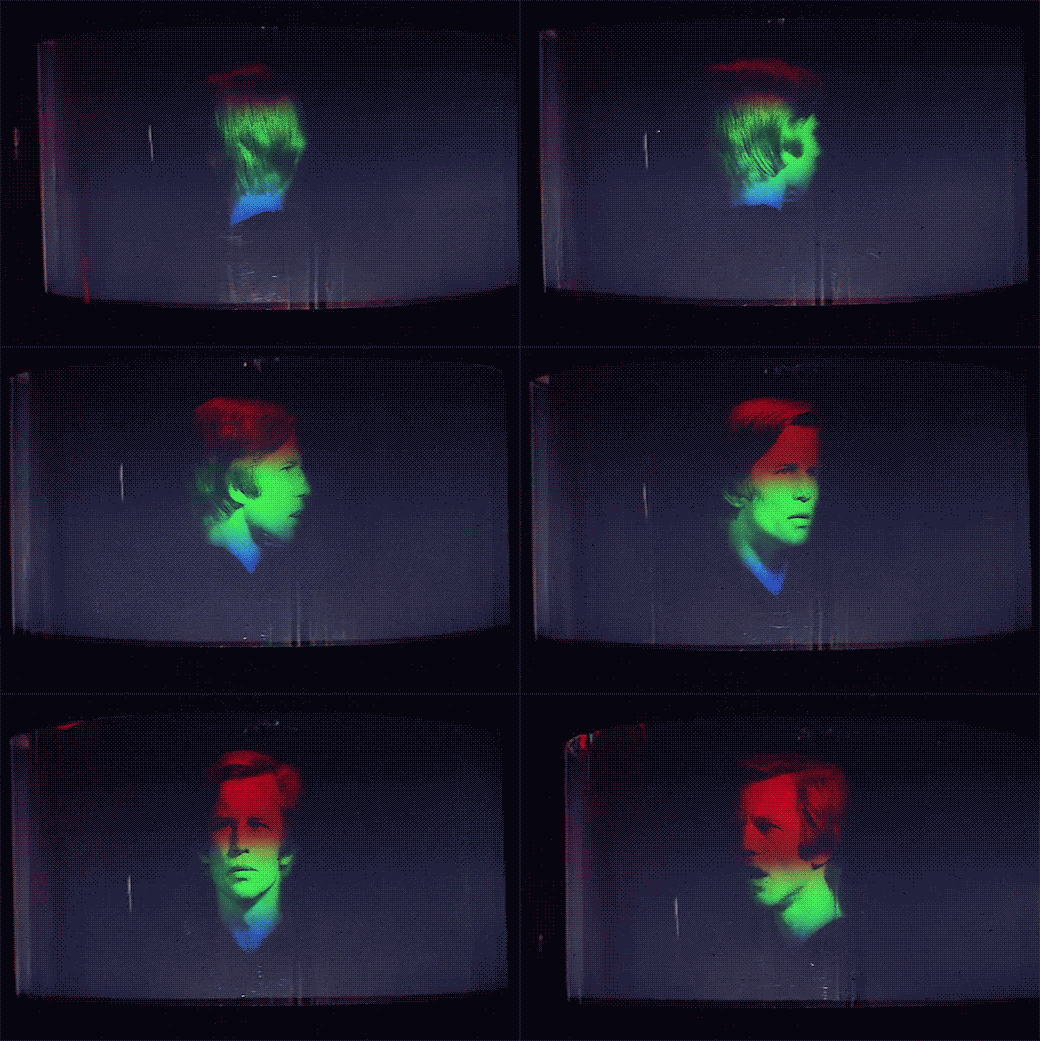
The Evidence Tray (ordinary use)

LogansRun082

Sandmen surrender any physical objects recovered from the bodies of runners to the Übercomputer for evaluation via a strange device I’m calling The Evidence Tray.

LogansRun083

As a Sandman enters the large interrogation chamber, a transparent cylinder lowers from the ceiling. At the top of this cylinder an arm continuously rotates bearing four pin lights. A chrome cone sits in the center of the base. The Sandman can access the interior of the cylinder through a large oblong opening in the side the top of which is just taller than Sandmen (who seem to be a near-uniform height).

The Sandman puts any evidence he has found into the bottom of this cylinder. (What if the evidence was too large to fit? What if the critical evidence is not physical, or ephemeral? But I digress.) In response to his placing the objects, lights on the rotating arm illuminate, scanning them. The voice of the Übercomputer prompts the Sandman to “identify,” a request that is repeated on a large screen mounted on the wall in view through the transparent backing of the Evidence Tray.

LogansRun090

The Sandman identifies himself by placing his palm on a cone in the cylinder’s center, positioning his lifeclock in the small indention in its tip. The base section of the cylinder illuminates, and after a pause, the voice and screen confirm that his identity has been “affirmed.” Logan removes his hand, and in a flash of blue light the objects in the tray disappear. The film gives no clue as to whether the objects are teleported somewhere or disintegrated into thin air.

LogansRun-vaporizer04

Objections

There are of course the usual objections to the authentication. The lifeclock check is really a biometric check, something that Logan “is” (since he can’t remove the lifeclock) and—per the principles of multifactor authentication—should need to provide an additional factor, such as something he has (like a key) and something he knows (like a password).

There’s another objection there to the fact that the authentication requires that his hand be put into a teleport/distingration chamber. Perhaps narratively this shows the audence the insane levels of trust citizens have in their Nanny Program, but for the real world let’s just say it’s best that you don’t require police to submit to a Flash Gordon Wood Beast just to hand over exhibit A.

There’s a nice touch to the transparent walls allowing him to see the computer screen through it, to get the visual confirmation of what he’s hearing. But I suspect the curved surface also adds a bit of distortion to his view that doesn’t help readability. So the industrial design aspects of the interface sort of even out. Unless I’m missing something. Any industrial designers want to weigh in?

A final objection is the unnecessarily vast architecture that is part of the workflow. Why this giant room with a thin cylinder in the middle of it? Sure there are narrative reasons for it (welcome to this digital heart of darkness) but it seems like something that Sandmen would be doing routinely, and this giant ritual just makes a creepy, big deal about it.

Better

Better might be a wide, waist-high cubby off to the side of their offices, whatever those are, with a wide tray and computer screen. Sandmen could drop the evidence into the tray and place their hands into an authenticator outside the tray, initiating the scan. This would save them the awkward time of waiting for the computer to order them to authenticate, and tightly couple the objects with their identity. The improved semiotics say, “I, Logan, found these and am surrendering them to you.” Then if the computer needed to speak more about it, it could summon them to an interlocution room, or something with a similarly awkward 70s name.

Dispatch

LOGANS_RUN_map_520

At dispatch for the central computer, Sandmen monitor a large screen that displays a wireframe plan of the city, including architectural detail and even plants, all color coded using saturated reds, greens, and blues. When a Sandman has accepted the case of a runner, he appears as a yellow dot on the screen. The runner appears as a red dot. Weapons fire can even be seen as a bright flash of blue. The red dots of terminated runners fades from view.

Using the small screens and unlabeled arrays of red and yellow lit buttons situated on an angled panel in front of them, the seated Sandman can send a call out to catch runners, listen to any spoken communications, and respond with text and images.

LogansRun094

*UXsigh* What are we going to do with this thing? With an artificial intelligence literally steps behind them, why rely on a slow bunch of humans at all for answering questions and transmitting data? It might be better to just let the Sandmen do what they’re good at, and let the AI handle what it’s good at.

But OK, if it’s really that limited of an Übercomputer and can only focus on whatever is occupying it at the moment, at least make the controls usable by people. Let’s do the hard work of reducing the total number of controls, so they can be clustered all within easy reach rather than spread out so you have to move around just to operate them all. Or use your feet or whatever. Differentiate the controls so they are easy to tell apart by sight and touch rather than this undifferentiated mess. Let’s take out a paint pen and actually label the buttons. Do…do something.

LogansRun095

This display could use some rethinking as well. It’s nice that it’s overhead, so that dispatch can be thinking about field strategy rather than ground tactics. But if that’s the case, it could use some design help and some strategic information. How about downplaying the saturation on the things that don’t matter that much, like walls and plants? Then the Sandmen can focus more on the interplay of the Runner and his assailants. Next you could augment the display with information about the runner, and perhaps a best-guess prediction of where they’re likely to run, maybe the health of individuals, or the amount of ammunitition they have.

Which makes me realize that more than anything, this screen could use the hand of a real-time strategy game user interface designer, because that’s what they’re doing. The Sandmen are playing a deadly, deadly video game right here in this room, and they’re using a crappy interface to try and win it.

Cleanup

LogansRun052

Sandmen have a clean-up crew to quickly rid the city’s floors of the unsightly corpses they create when they terminate runners. Logan summons one through the CB function of his SandPhone, telling dispatch, “Runner terminated, 0.31, ready for cleanup.”

LogansRun053

Minutes later, Cleanup arrives. This crew floats around the city in a slow-moving hover platforms, that look a little like a vertical knee raise machine with anti-gravity pads and a faulty muffler. The controls aren’t apparent, but the operator maneuvers the platform over the cadaver to spray it with a fast-acting solvent that emits out the base.

This is the surface question of the Cleanup platform interface. If the operators don’t move, how are they controlling the platform? Of course it could be a brain interface, but that’s an easy answer. There are at least three alternative types of input that could explain what we see on screen.

  1. Force-sensing resistors or strain gauge that read the amount of force being applied to a stationary surface and act accordingly. The grips could be outfitted with force strips for each finger giving a high degree of complex input.
  2. Gaze interactions, where eye tracking equipment registers glances, blinks, pupil dilation, and eyelid spread over time as controls.
  3. Subvocal recognition allow a user to move their throat and mouth as if they were speaking, and even without actually producing any sound, register it as speech input.

Each of these technologies permit input via movements that are difficult to detect through observation, but facilitate rich enough input to pilot a personal vehicle through 3D space. Sadly, this level of sensory sophistication is not in evidence anywhere else in the film, so we’ll just have to chalk it up to a nifty tech for our real world toolboxes.

And though these technologies are cool, they don’t answer any of the experience or service design questions from the perspective of the Übercomputer. Why it is good for the operator to appear perfectly still in the first place? Is there some reason why they need to be dehumanized or robotic? It can’t be that they’re doing something horrible. Sandmen do the actual killing (and as we see do it gleefully, cruelly) and are highly visible, clearly human participants in the system?

The SandPhone

LogansRun037

Not everyone is comfortable giving over to the flimsy promise of Carrousel [sic]. Some citizens run, and Sandmen find and terminate these cultural heretics.

Sandmen carry a device with them that has many different uses. It goes unnamed in the movie, so let’s just call it the SandPhone. It is a thick black rectangle about 20cm at its long edge, about the size of a very large cell phone. Near the earpiece on one broad side is a small screen for displaying text and images. Below that is a white line. The lower half of this face is metallic grill that covers a microphone. On the left edge is a momentary button that allows talking. Just above this is a small red button. When not in use, the device is holstered on the sandman’s belt.

The SandPhone lets the Sandman receive information through a display that can show both image and text. The Sandman sends back information and requests by voice in a CB radio metaphor.

Notifications

The first time we see the device is when Logan and Francis are attending Carrousel. Somehow, on his belt it catches his attention. With the crowd too loud for sound, and no evidence it’s light, my bet’s on haptics. Realizing he’s got a message, he picks it up, presses the edge button and the screen displays two lines of text:

RUNNER: GREAT HALL
ENTRANCE WEST.

He then puts the device to his face as we would a cell phone and shouts, “Affirmative!” as loud as he can.

LogansRun038

Perp wayfinding

Running with the device outside the Great Hall, Logan uses the SandPhone as a detector. By holding it flat out in front of him he hears a rhythmic pulse. Turning it this way and that, he listens for the change in pitch. It rises when he is pointing towards the targeted runner.

Bio identification

LogansRun046
LogansRun050

When he and Francis have terminated the runner, he snaps the device off his belt, and pressing the edge button, he reports back to dispatch, “Runner terminated, 0.31. Ready for cleanup.” Then by placing the device near the head of the dead runner, the device displays on the screen the last photographic image of him on file. Since the face on the SandPhone screen does not match the face he sees before him, Logan lifts the device to his face and, holding the edge button, requests an identity check of dispatch. Instantly he pulls the device away from his face to show the text:

IDENT. AFFIRM
NEW YOU #483
FACE CHANGE.

LogansRun182

Send backup

Much later in the film we see Logan alert dispatch to the location of the underground hideout by reaching down to the holstered device and pressing the white line button on its face. Its screen pulses green, and his position is highlight on the runner board (see below) at dispatch. Minutes later the location is raided by Sandmen.

Analysis

The first thing to note is that this is pretty close to a modern smart phone. He receives images and text messages, can talk to dispatch, and it has a biometric capability for identifying citizens. It’s tempting to paint this as visionary, but keep in mind that the first mobile phone was demonstrated in 1973, three years earlier, so it’s likely that the film makers were riffing off of the demo technology they’d heard about or maybe even seen in person.

We evaluate an interface’s design by how well it helps its user achieves his goals. (Even if those goals are anethma. That’s how we judge an interface.) In this case, the SandPhone helps Logan get the information he needs, when he needs it, across multiple channels. It doesn’t distract him with other functions. It’s context aware and doesn’t apparently have battery issues.

There are improvements of course.

We should make sure his hands are free by making the information available as an augmented reality display instead of a handheld device. This would also give him the information privately rather than display it for anyone (notably members of the resistance) to see it. Wayfinding would be more sensible as an overlay to his vision through this device.

Some surface tweaks might also be made, such as giving him a means of text input so he wouldn’t have to shout above the roar of Carrousel. Some silent means of input would help for when he needs to provide silent input as well. First I thought optical inputs might be ideal, given the augmented reality, but we don’t want his eyes distracted like that, even for the duration of glances. Instead some other gestural input—perhaps a face twitch or subvocal input—that lets him keep the rest of his body tense and ready for action.

Citizen biometrics should be a background fact, given the penopticon of Dome City. The information would come to him when he gets his assignement. But turn those same biometrics around on Logan, and his body could request reinforcements before he even thought to do so manually. When his heart rate elevates and galvanic skin response lowers, dispatch would know something was up, and route backup immediately.

A strategic interaction designer would even ask why he has to chase runners at all, when predictive algorithms could guess which citizens were likely to run and take action to forestall their rebellion. But then we’re into Minority Report, and this needs to stay Logan’s Run.

Boycott Ender’s Game

Today Ender’s Game hits cinemas in the United States, and there’s controversy around it. A number of folks have asked if I would be seeing it and/or reviewing it for scifiinterfaces.com, in light of the boycott against it.

In case you didn’t know, the author of the original work is a far-right-wing extremist who amongst other things, has used his notoriety to spread lies about and fight against gay rights, as well as being a vitriolic board member of the hate-group-with-a-baked-cookie-name National Organization for Marriage. (arensb on Epsilon Clue has a well-sourced article that traces many other examples, should you want to check on details.)

Is it possible to separate an author from his or her work?

Can you enjoy the Ring Cycle or The Love Song of J. Alfred Prufrock as a Jewish person? Can a misogynist enjoy The Avengers? Should you see Minority Report if you believe depression is, well, real? Can you watch Rosemary’s Baby if you’re firmly against statutory rape? I’m being oblique with the references, but each is a genuinely tricky question. There are lots of angles to fret over. Is the author still alive? Was the distasteful part a privately held opinion or public efforts? Is the content of their work distasteful, or just their real-world actions? In the case of Ender’s Game, should you “punish” the cast and crew who worked on the film but are outspoken in their support of gay rights and condemnation of Card? There’s even some evidence that Card won’t be getting any money from the film at all, but is profiting from the increased book sales that the movie has engendered. So what then? What good does the boycott do? It’s a rich topic, and worth discussing with friends and family at the next lull in conversation.

Ultimately I’ve decided not to see the film in cinemas. One’s efforts of avoidance should correspond to the toxin in question, and Card has proven himself to be deeply toxic. Plus I don’t want to encourage a sequel or franchise, where he might make money or his books sell more as a result.

I may watch it on a plane, or borrow it from a local library once it’s there. I want the movie industry to know that it needs to think about the people with whom it does business, either as an author or a producer, and money is the thing that will get their attention. Even though there are plenty of talented people who worked on the film, I just can’t stand the idea of putting money into Orson’s filthy wallet, directly through salary/residuals, or indirectly through book sales, that he’s going to use against me, my family, and my friends.

I’m still making my mind up about whether to review the interfaces and interaction design. It’s something that I can uniquely offer to the cast and crew for their efforts. But I’ve got months before the movie is released to DVD & Blu-Ray to decide that.

Every thoughtful sci-fi fan should wrestle with this question. Some people I greatly respect have looked at the same questions and come to the opposite conclusion. They will see the film. If you’ve decided you are going to go, please consider buying a “hater offset” (my term: it’s like carbon offsets, but you know, for Card) and make a donation for the cost of your ticket to a pro-queer charity, like SkipEndersGame or EqualityInitiative. If they strike it big as a result of the “buyer boycott,” it will send an equally big message to the film makers.

And as an added bonus, I’ve included trailers for other films you might want to see around now.

Carrousel [sic]

LogansRun019

The hedonistic and carefree lifestyle in Dome City comes with a price. When a citizen’s lifeclock begins to blink, it means he or she is now too old, and due to attend a public ritual called Carrousel and die in a public spectacle. As this is a major event in the lives of citizens, most of the public attends these events.

Description

Lastdays are outfitted in special clothes and masks. After filing wearing these costumes and encircling a huge lifeclock, lastdays expose their palms to show the blinking lifeclock to confirm their status.

LogansRun024

Then they look up to a crystal at the ceiling that begins to spin. The lastdays become weightless, and they struggle to reach the top, for the opportunity to reach renewal.

When they fail—and they always fail—they explode in a fiery shower of sparks. The audience greets each explosion with a roar of excitement and applause.

Analaysis

A public ritual is at the edge of the definition of interface that I provided in Make It So:

All parts of a thing that enable its use.

But in this case, the culture of Dome City pays for its lavish lifestyle admidst fixed resources with these public executions, and something must turn what by rights should be met with horror and revulsion into something palatable, even enjoyable. It is in this sense that citizens use Carrousel.

Nearly everything we see in the ritual helps to hide its raw, morbid truth. The false promise of renewal hides the finality of the act. The masks won by participants hide the individual identity from the audience, easing the sense of personal loss. The identical costumes dehumanize participants, underscoring their role in the culture. The ritual actions give participants something to do during a time that is psychologically stressful. The public-ness of it reinforces its cultural importance and imprints onto the audience that one day, they do will participate.

LogansRun033

Dome City Rail

LogansRunCar-08

Citizens move between the distant parts of the city by means of a free, public transportation system. It is an ultra-light rail, featuring cars for two passengers, that move between long translucent tubes that connect the domes of the city. When one car stops at a station, its door slides open to allow exit and entry. We never see a car waiting behind another. Once seated, riders press a red button on a panel between the two seats (just visible in the screen capture below), and the car seals shut and takes off to the next station.

LogansRunCar-04
LogansRun144

A small panel inside the car alerts passengers to the name of the next stop as well as any additional information that is of use. When Logan and Jessica head to Cathedral Station, the panel blinks a red light to draw their attention. (The paired green light is never seen illuminated. What’s it there for?) A female voice says “Entering a reservation for violent delinquents. Authorized persons only.” The screen before them reads, “personal risk area.” (For those wondering why it stops there at all, anyone can get out of their car here, but Logan has to use his personal communication device with Control to have the gate to Cathedral opened.

The panel and voice output are useful to alert riders whose attention has drifted. Text could be put in the environment of course, since this information rarely changes, but it’s a bit harder to read when it’s moving and isn’t as likely to gain a distracted rider’s attention.

The last bit of interface is the LED displays on the walls of fancier stops like Arcade (the dome with the shopping mall and Caroussel.) We never see this sign change, but it makes sense that while riders are at the station, it displays the stop as a reinforcing bit of information, and can display alternate messages for citizens waiting on a car otherwise.

LogansRunCar-03

The interface is incredibly simple because the system is so constrained. You have to hop on at a station, and like an airport tram or a shabbat elevator, the car runs along a fixed loop. You hop out when you’re there. The main negative issues I see are selecting a stop and perhaps safety.

Selecting a stop

It’s a waste of time and energy to have cars stopping and starting at unwanted stations. It can also be distracting to have the car tell you about all the intermediate stops when you’re not interested in them.

To solve this problem, the track system should be built with track bypasses so we have to worry less about track congestion at stops. Then riders could either ride the “local” from stop to stop, or optionally have some way to indicate their desired stop, bypassing the ones in between. What’s this indication look like? In the panopticon of Dome City, the Übercomputer can just listen to your conversations wherever you’re having them, and when you get to a car default to the stop expressed in conversation. Logan and Jessica had just spoken about Cathedral Station, so when they stepped in, it could have just asked them to confirm. If the selection was wrong, or no stop had been mentioned recently, riders should be able to speak their destination or the event to which they’re headed. As a last fallback, a screen displaying discrete options could allow them to select a destination by touch or gesture.

LogansRunCar-07

Rider safety

The safety issue is subtle, but if riders have no control over the cars, why are the seats facing forward? It’s much safer in a head-on collision to be seated “backward,” like an infant’s car seat. Psychologically, people are most comfortable sitting forward to see in the direction of potential collisions, but if you lived in an UberNanny State like Dome City, the system would just force people to sit in the safest way.

It’s going to be more complicated than this

Getting public transportation experience design right is tough enough. But it’s going to get more complicated. Here at the dawn of computer-driven cars and computer-requested and computer-wayfinding “routeless” busses, the challenges will be manifold. How do you signal a stop? How does it gracefully degrade? How do you pay? How do you get to a just-in-time defined stop? How do you indicate your destination(s), willingness to share the ride, and urgency? How do you not disenfranchise people just because they have no cell phone? Dome City is small and constrained enough to ignore such problems, like a light rail in a small, wealthy, downtown core, making it almost too simple to be instructive.

LogansRunCar-06

The Aesculaptor Mark III

LogansRun177

The device with which the cosmetic surgery is conducted is delightfully called the Aesculaptor Mark III. Doc brags that it is “the latest. It’s completely self-contained.

In it, the patient lies flat in a recess on a rounded table, the tilt and orientation of which is computer controlled. Above the table is a metallic sphere with six spidery articulated arms. Some of these house laser scalpels and some of these house healing sprays. The whole mechanism is contained in a cylinder of glass.

To control the system, Doc has a panel made up of unlabeled buttons and dials, a single blue monitor, and another panel displaying a random five-digit number and two levers. One is labeled “ANODYNE” and the other is labeled “KINESIS.”

LogansRun167

When Doc receives a mysterious call (on what may be the earliest wireless telephone in mainstream science fiction,) he receives instructions to murder Logan. To do so he turns off the healing by moving the ANODYNE lever into the lower position.

LogansRun172

So. Yeah. Also just terrible. I mean there’s the plot question. I ordinarily don’t drop into questions of plot, but come on. If Doc wanted to eliminate Logan, wouldn’t he increase the anodyne, so Logan wouldn’t know he was being killed until it was too late? If you wanted to torture him, wouldn’t you put him under a paralytic first, and only then turn off the anodyne? Turning on the KINESIS (moving lasers?) and turning off the anodyne just seem counter to his actual goals. Unless you want to fantheory this so that Doc’s instruction was “make him escape.”

But yes, back to the interface. There’s almost nowhere to start. Undifferentiated controls? Unlabeled controls? No visual hierarchy? Only the device itself and an oscilloscope to monitor the system and the patient’s trending state? Un-safeguarded knife switches for the primary controls? And note that the fail state is in the direction of gravity. If that knife switch gets loose, oops, you’re screwed.

Image of the Therac-25 from http://fauxdurbeyfield.wordpress.com/2011/11/03/therac-25-because-there-isnt-enough-radiation-in-this-world/
Image from http://fauxdurbeyfield.wordpress.com/2011/11/03/therac-25-because-there-isnt-enough-radiation-in-this-world/

Logan’s Run took place long before the lessons of the Therac-25, with its tragic interface and programming problems that resulted in the deaths of several cancer patients, but even audiences in 1976 would not believe that any medical device would have such an easy means of disabling the only aspect of it that keeps it from becoming an abattoir.

New You Selector

LogansRun154

In addition to easy sex and drugs, citizens of Dome City who are either unhappy or even just bored with the way they look can stop by one of the New You salons for a fast, easy cosmetic alternation.

LogansRun157
NewYou2rs

At the salon we get a glimpse of an interface a woman is using to select new facial features. She sits glancing down at a small screen on which she sees an image of her own face. A row of five unlabeled, gray buttons are mounted on the lower bevel of the screen. A black circle to the right of the screen seems to be a camera. She hears a soft male voice advising, “I recommend a more detailed study of our projections. There are new suggestions for your consideration.

She presses the fourth button, and the strip of image that includes her chin slides to the right, replaced with another strip of image with the chin changed. Immediately afterwards, the middle strip of the image slides left, replaced with different cheekbones.

In another scene, she considers a different shape of cheekbones by pressing the second button.

So. Yeah. Terrible.

  • The first is poor mapping of buttons to the areas of the face. It would make much more sense, if the design was constrained to such buttons, to place them vertically along the side of the screen such that each button was near to the facial feature it will change.
  • Labels would help as well, so she wouldn’t have to try buttons out to know what they do (though mapping would help that.)
  • Another problem is mapping of controls to functions. In one scene, one button press changes two options. Why aren’t these individual controls?
  • Additionally, if the patron is comparing options, having the serial presentation places a burden on her short term memory. Did she like the apple cheeks or the modest ones better? If she is making her decision based on her current face, it would be better to compare the options in questions side-by-side.
  • A frontal view isn’t the only way her new face would be seen. Why does she have to infer the 3D shape of the new face from the front view? She should be able to turn it to any arbitrary angle, or major viewing angles at once, or watch videos of her moving through life in shifting light and angle conditions, all with her new face on.
  • How many options for each component are there? A quick internet search showed, for noses, types show anything between 6 and 70. It’s not clear, and this might change how she makes her decision. If it’s 70, wouldn’t some subcategories or a wizard help her narrow down options?
  • Recovery. If she accidentally presses the wrong button, how does she go back? With no labeling and an odd number of buttons to consider, it’s unclear in the best case and she’s forced to cycle through them all in the worst.
  • The reason for the transition is unclear. Why not a jump cut? (Other than making sure the audience notices it.) Or a fade? Or some other transition.
  • Why isn’t it more goal-focused? What is her goal in changing her face? Like, can she elect to look more like a perticular person? Or what she thinks her current object of affection will like? (Psychologically quite dystopian.) Or have her face follow current face fashion trends? Or point out the parts of herself that she doesn’t like? Or randomize it, and just “try something new?”

OK I guess for both showing how easy cosmetic surgery is in the future, and how surface Dome City’s residents’ concepts of beauty are, this is OK. But for actual usability, a useless mess.