IQ Testing

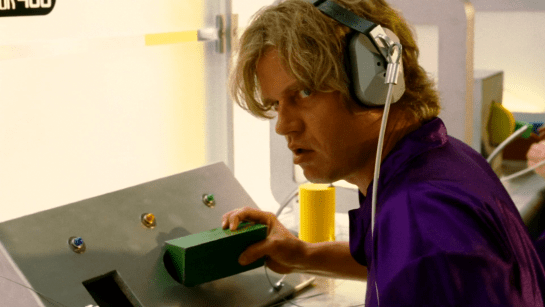
When Joe is processed after his arrest, he is taken to a general IQ testing facility. He sits in a chair wearing headphones. A recorded voice asks, “If you have one bucket that holds two gallons, and another bucket that holds five gallons, how many buckets do you have?” Into a microphone he says, incredulous that this is a question, “Two?” The recorded voice says, “Thank you!”

IDIOCRACY-IQ11

Joe looks to his left to see another subject is trying to put a square blue peg into the middle round hole of a panel and of course failing. Joe looks to his right, to see another subject with a triangular green peg in hand that he’s trying to put into the round middle hole in his interface. Small colored bulbs above each hole are unlit, but they match the colors of the matching blocks, so let’s presume they illuminate when the correct peg is inserted. When you look closely, it’s also apparent that the blocks are tethered to the panel so they’re not lost, and each peg is tethered directly below its matching hole. So there are lots and lots of cues that would let a subject figure it out. And yet, they are not. The subject to Joe’s right even eyes Joe suspiciously and turns his body to cover his test so Joe won’t try and crib…uh…“answers.”
Idiocracy_iq03

Comedy

The comedy in the scene comes from how rudimentary these challenges are. Most toddlers could complete the shape test. Even if you couldn’t figure out the shapes, you could match the colors, i.e. the blue object goes in the hole under the blue bulb. Most preschoolers could answer the spoken challenge. It underscores the stupidity of this world that generalized IQ tests for adults test below grade school levels.

IQ Testing

Since Binet invented the first one in 1904, IQ testing has a long, and problematic past (racism and using it to justify eugenic arguments, just for instance) but it can have a rational goal: How do we measure the intelligence of a set of people (students in a classroom, or applicants to intelligence jobs) for strategic decisions about aptitude, assistance, and improvement? But intelligence is a very slippery concept, and complicated to study much less test. The good news in this case is that the citizens of Idiocracy don’t have very sophisticated intellects, so very basic tests of intelligence should suffice.

Some nice things

So, that said, the shape test has some nice aspects. The panel is angled so the holes are visible and targetable, without being so vertical it’s easy to drop the pegs while manipulating them. The panel is plenty thick for durability and cleaning. The speech-to-text tech seems to work perfectly, unlike the errors and bad design that riddle most technologies in Idiocracy.

Idiocracy_iq02

A garden path match

There’s an interesting question of affordances in the device. You can see in the image above that the yellow round block fits just fine in the square hole. Ordinarily, a designer would want to prevent errors like this by, say, increasing the diameter of the round peg (and its hole) so that it couldn’t be inserted into the square hole. That version of the test would just test the time it took by even trial-and-error to match pegs to their matching holes, then you could rank subjects by time-to-completion. But by allowing the round peg to fit in the square hole, you complicate the test with a “garden path” branch where some subjects can get lost in what he thinks is a successful subtask. This makes it harder to compare subjects fairly, because another subject might not have wandered down this path and paid an unfair price in their time-to-complete.

Another complication is that this test has so many different clues. Do they notice the tethers? Do subjects notice the colored bulbs? (What about color blind subjects?) Having it test cognitive skills as well as fine-motor manipulation skills as well as perception skills seems quite complicated and less likely to enable fair comparisons. 

We must always scrutinize IQ tests because people put so much stock in them and it can be very much to an individual’s detriment. Designers of these tests ought to instrument them carefully for passive and active feedback about when the test itself is proving to be problematic.

Challenging the “superintelligent?”

A larger failing of the test is that it doesn’t challenge Joe at all. All his results would tell him is that he’s much much more intelligent than these tests are built for. Fair enough, there’s nothing in the world of Idiocracy which would indicate a need to test for superintelligence among the population, but this test had to be built by someone(s), generations ago. Could they not even have the test work on someone as smart as themselves? That’s all it would need to test Joe. But we live in a world that should be quite cautious about the emergence of a superintelligence. It would be comforting to imagine that we could test for that. Maybe we should include the Millennium Problems at the end of every test. Just in case.

GOPad.png

Another Idiot Test

As “luck” would have it, Trump tweeted an IQ test just this morning. (I don’t want to link to it to directly add any fuel to his fire, but you can Google it easily.) It’s an outrageous political video ad. As you watch it:

  • Do you believe that a single anecdote about a troubled, psychotic individual is generalizable to everyone with brown skin? Or even to everyone with brown skin who is not American and seeking legal asylum in the U.S.?
  • Do you ignore the evidence of the past decades (and the last week) that show it’s conservative white males who are much more of a problem? (Noting that vox is a liberal-leaning publication, but look at the article’s citations.)
  • Can you tell that the war drums under the ad are there only to make you feel scared, appealing to your emotions with cinematic tricks?
  • Do you uncritically fall for implicature and the slippery slope fallacy?

If the answers to all these are yes, well, sorry. You’ve failed an IQ test put to you by one of the most blatantly racist political ads since WIllie Horton. (Not many ads warrant a deathbed statement of regret, but that one did.) Maybe it’s best you take the rest of the week off treating yourself. Leave town. Take a road trip somewhere. Eat some ice cream.

For the rest of you, congratulations on passing the test. We have 5 days until the election. Kick the racist bastards and the bastards enabling the racist bastards out.

OmniBro

The OmniBro is the ubiquitous payment and identification system in Idiocracy. We see it four times in the movie.

Doc office

Idiocracy_omnibro02

Dr. Lexus asks Joe to pay for his visit, “…if you could just go ahead and, like, put your tattoo in that shit.” In this case, that shit is a barcode scanner mounted to the back of a desktop register. We don’t get to see it in use, because as described in the prior post, Dr. Lexus freaks out, realizing Joe is unscannable and hitting the panic button.

Prison

Idiocracy_omnibro04.png

Another time we see the OmniBro is in the prison. After talking his way past the guard, another guard at a checkout counter has him scan his new tattoo. The guard checks the screen and tells him, “Uh. Yeah, I don’t see you in here. So you’re going to have to…uh…stay in prison.” Joe says, “Could you check again, because I was definitely in prison. OK. I got sat on my face and everything. Maybe check those files back there?” The guard turns, and Joe runs. There’s admittedly a post in there about prison security and release (and America has a lot to improve, especially in its reprehensible prison-for-profit systems), but this post is about the OmniBro.

Carl’s Junior

The third time we see it is at the Carl’s Junior kiosk. (More on the whole system in the next post.) Though the customer appears to have already scanned, it is how anyone ordering food pays for it.

Idiocracy_omnibro24

What’s good?

If I had to note the positives of the OmniBro system, it is that it seems easy for even morons to explain, understand, and use. Wrists are more commonly pointed down, so it’s a little more deliberate to have to turn the wrist up to pay. So adding to its ease-of-use is some measure of biology against accidental activation.

Also it’s more sterile than money. (Yeah, money’s dirty.)

And it’s ubiquitous, so a citizen of Idiocracy doesn’t need a credit card totem to know whether or not a vendor accepts their money. There are airlines and even a restaurant that I know of in San Francisco that only accept credit cards, and it’s disgusting. (Yes, yes, I know what the Department of the Treasury says, but I think it’s gross, classist, and corporatist to require your customers first have a relationship with a credit card company before you’ll do business with them.) So I suppose that aspect encourages an easy-to-access marketplace.

So, the good: It’s usable, sterile, and ubiquitous.

What’s questionable?

Where to start? Well, certainly it’s horrible that participation in the economy requires a permanent body modification. I’m not at all religious, but I agree wholeheartedly with the admonishment against any totalitarian “mark of the beast” just to participate in culture, for all the body autonomy and social justice reasons that one should be against it. (Before anyone gets their apophenia into an uproar about biblical meanings, you can relax. Idiocracy’s tattoos are on the wrong hand.)

You might imagine that the mark signals some sort of ingroup membership, but if everyone in Idiocracy has one, there’s no real outgroup.

Still, it raises lots of questions about the choice of a tattoo:

  • Skin stretches and changes as time wears on. Tattoos get sun blurred (and the wrist gets a lot more sun exposure than other areas.) What happens to a citizen when their barcode no longer works? The tattoo machine (a post on this later) looks like it only tattoos in one place, so another visit won’t fix it, and likely would make matters worse. Is there some do-over machine?
  • What about people who don’t have a left wrist? (The machine can only work on left arms.) What about people who get the tattoo but later lose their left arm?
  • Where’s any other factor for multifactor authentication? Cash fails this as well, but if you are robbed of your cash, at least you still have an arm left to try and acquire some more.

What’s awful, though, is the fourth time we see it in the movie.

Rando vending surveillance

When fleeing the police with Freeto and Rita in Frito’s car, Joe accidentally makes the mistake of raising his tattooed wrist above the door frame, where it is scanned through the window by a vending machine he happens to be passing. The scan identifies Joe and the car he’s in, and something sends a shutdown signal to Frito’s car. (More on the car interface a later post.)

Ease-to-consume is concomitant with ease-to-surveil. Sure, the citizen doesn’t have to carry cash, do rudimentary math, or remember their bank balance, but in exchange they leave themselves open to constant tracking and identification. In the movie this just means it’s easy to find Joe. They’re comparatively dumb enough to make his escape the stuff of comedy.

But in our world, where the forces that market you away from your money are vastly more funded, equipped, and dedicated to their task than you, this tradeoff winds up putting Americans in a terrible debt load that may be *gasp* worse than Italy’s by 2023. (Sorry, dear Italian friends.) Combine this debt load with the health gamble and 40-year stagnant wages, and it seems like the tradeoff only an idiot would take. But hey, it’s easy to wave your phone for a fix at Starbucks, so what am I going on about, right?

Fight the Idiocracy

The Bloomberg article about American debt load includes this tasty paragraph, “While Trump and congressional Republicans raised alarms about the debt and deficit when Democrat Barack Obama was president, spending hasn’t abated with the GOP in control of the White House and Congress.

Where the GOP used to tout themselves as the party of fiscal conservatism, it’s now clearer than ever that they’re just hypocrite oligarchs; spending wildly, giving free tax passes to their insanely wealthy friends, hoping a hundred dollars a month is enough to convince you to look the other way, all the while planning to gut your “entitlement” programs like social security, medicare, and medicaid. It’s insanity. They have to be voted way, way out if we have any hope of saving our economic well being.

voteworms.jpg
Sold out womp womp

I wanted with this post to convince you to give out Cards Against Humanity’s Vote Worms, but they’re already sold out. So instead I’ll point you to their smart Hacks the Election campaign, which did not do as well on launch, but would definitely have more effect if it sold out. If you are in or know someone in one of the following swing districts, definitely check this out.

  1. California 25th district: Help elect Katie Hill
  2. Iowa 1st district: Help elect Abby Finkenauer
  3. Illinois 26th district: Help elect Sean Casten
  4. Illinois 14th district: Help elect Lauren Underwood
  5. Kansas 4th district: Help elect James Thompson
  6. Texas 26th district (what is it about 26th districts?): Help elect Linsey Fagan
CAH-hackselection.png

Snitch phone

If you’re reading these chronologically, let me note here that I had to skip Bea Arthur’s marvelous turn as Ackmena, as she tends the bar and rebuffs the amorous petitions of the lovelorn, hole-in-the-head Krelman, before singing her frustrated patrons out of the bar when a curfew is announced. To find the next interface of note, we have to forward to when…

Han and Chewie arrive, only to find a Stormtrooper menacing Lumpy. Han knocks the blaster out of his hand, and when the Stormtrooper dives to retrieve it, he falls through the bannister of the tree house and to his death.

SWHS_generalalert-09.png
Why aren’t these in any way affiiiiixxxxxxeeeeeeed?

Han enters the home and wishes everyone a Happy Life Day. Then he bugs out.
SWHS_generalalert-12.png
But I still have to return for the insane closing number. Hold me.

Then Saun Dann returns to the home just before a general alert comes over the family Imperial Issue Media Console.

SWHS_generalalert-07.png

This is a General Alert. Calling Officer B4711. Officer B4711. We are unable to reach you on your comlink. Is there a problem. [sic] You are instructed to turn on your comlink immediately.

Dann tells the family he can handle it. He walks to the TV and pulls a card out of his wallet. He inserts it into the console, mashes a few buttons and turns his attention to the screen. After a moment of op-art static, General Alert person appears. He says, “We have two way communication, traitor Saun Dann. Is this a report about the missing trooper?”

Dann (like so many rebels) lies, saying the stormtrooper robbed the house and fled for the hills. GA says, “Very well, we’ll send out a search party.” Sean thanks him and the exchange is over. Sean hits a button, pulls his card out of the console, and returns it to his wallet.

Sadly I must bypass the plot questions about the body of the Stormtrooper that is still lying in the forest floor beneath them that will surely be found, or that GA will eventually not find B4711 in the forest and return demanding answers, or why everyone is acting like welp that’s fixed. For this blog is about interfaces.

Whether the card was meant as identification or payment, the interaction is pretty decent. Saun has no trouble fitting it in the slot, and apparently he has no trouble recalling the number to dial the Empire. The same guy in the message answers the call quickly. After the exchange, it’s quick to wrap up. Pull out card, and call is over. Seriously, that’s as short and simple as we could make it.

What was the card for?

If it was payment, we would expect some charges to appear during and after the fact, so let’s just presume it was an identification card for the Empire to track. Since the Empire is evil, they might hide or not provide feedback that the caller has been identified. So it’s not diegetically surprising to note that there’s none.

For all the interfaces that are utter crap in this show, this one actually passes muster. It tempts me to establish some sort of law—that the more mundane interfaces in a show will always be the more believable ones. I’ll think on that. It would need a name.

rat-prompt.png

If I was to add any improvement, it would be to not burden the citizen’s memory with remembering the general alert or how to act on it. What if you’d just caught the end of it? Rather than burdening memory, the Empire could add a crawl to the feed, that persistently repeats the call to action including contact information. Persuasively, it would be an annoyance that would cause citizens watching TV to really want B4711 to hurry up and turn his damn comlink on, or for someone to rat him out.

There are probably some fascist tactics for incentivizing either the Stormtrooper or a snitch’s compliance, but I’m not a fascist, so let’s not go there.

Instead let’s rejoice that there is but one more interface to review, and we can stop with the Star Wars Holiday Special.

Ministry of Art detector gate

ChildrenofMen-Artgate-01

Jumping back in the film a bit, we’re going to visit the Ministry of Art. When Theo goes there to visit his brother, after the car pulls to the front of the secured building, Theo steps out and walks toward a metal-detector gate.

Its quite high, about 3 meters tall. The height helps to reinforce the notion that this is a public space.

  1. This principle, that short ceilings are personal, and high ceilings are public, is I believe a well-established one in architectural design. Read the Alexandrian pattern if you’d like to read more about it.
  2. Is it a public space? It is, since it’s a Ministry. But it isn’t, since he joins his brother in what looks like a rich person’s private dining room. I was always a bit confused by what this place was meant to be. Perhaps owning to The Dark Times, Nigel has cited Minister rights and cordoned off part of the Tate Modern to live in. If anyone can explain this, please speak up.
  3. On the downside, the height makes the text more out of sight and harder to read by the people meant to be reading it.

The distance is balanced by the motion graphics of the translucent sign atop the gate. Animated red graphics point the direction of ingress, show a security stripe pattern, and provide text instructions.

Motion is a very strong attention-getting signal, and combined with the red colors, does all the attention-getting that the height risks. But even that’s not a critical issue, as there is of course a guard standing by to ensure his understanding and compliance.

ChildrenofMen-Artgate-05

Note that there is no interaction here (which is the usual filter for this blog), but since I’m publishing an interview with the designer of this and the Kubris interface soon, I thought I’d give it a quick nod.

Green Laser Scan

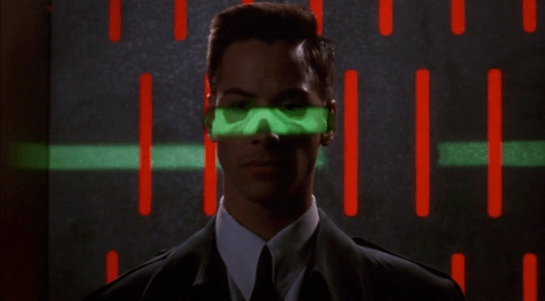
In a very brief scene, Theo walks through a security arch on his way into the Ministry of Energy. After waiting in queue, he walks towards a rectangular archway. At his approach, two horizontal green laser lines scan him from head to toe. Theo passes through the arch with no trouble.

childrenofmen-002

Though the archway is quite similar to metal detection technology used in airports today, the addition of the lasers hints at additional data being gathered, such as surface mapping for a face-matching algorithm.

We know that security mostly cares about what’s hidden under clothes or within bodies and bags, rather than confirming the surface that security guards can see, so it’s not likely to be an actual technological requirement of the scan. Rather it is a visual reminder to participants and onlookers that the scan is in progress, and moreover that this the Ministry is a secured space.

Though we could argue that the signal could be made more visible, laser light is very eye catching and human eyes are most sensitive at 555nm, and this bright green is the closest to the 808 diode laser at 532nm. So for being an economic, but eye catching signal, this green laser is a perfect choice.

Airport Security

After fleeing the Yakuza in the hotel, Johnny arrives in the Free City of Newark, and has to go through immigration control. This process appears to be entirely automated, starting with an electronic passport reader.

jm-9-customs-b

After that there is a security scanner, which is reminiscent of HAL from the film 2001: A Space Odyssey.

jm-9-customs-f

The green light runs over Johnny from top to bottom.

jm-9-customs-c

Looking at the picture, we can see that this green light is somehow making Johnny’s skeleton visible. It would be possible, by having an X-ray imaging system running at the same time and then re-projecting the X-ray image back onto the body, but why? Since there don’t appear to be any actual human beings on duty, I can only suggest that it is meant to look intimidating and impressive to encourage obedience. In the film Johnny appears to be alone and cannot see this himself, but it would be much more common for there to be multiple passengers, so each could watch the others being scanned.

There is also a screen showing another scan, a blurry body image, and text appearing on the right side. A voice repeats the text content. For the first time we see a blue background, the most common color for futuristic film interfaces.

jm-9-customs-d

The scanner detects Johnny’s implant, but whatever secrecy measures are present cause the system to decide that it is a registered dyslexia aid. The popup alert below includes the registration issuer and a domain name, so perhaps this is online verification over the Internet. Presumably Johnny can see this screen himself, if he cares.

jm-9-customs-e

The voiceover helpfully informs Johnny that there is “synaptic seepage”, and he should seek medical attention within 24 hours. This shows quite high level decision making by the system and an offer of assistance. Johnny says “thanks” in reply, an anthropomorphic response to this seemingly intelligent machine.

However, there seems to be a more detailed explanation in smaller text on the right of the display, and this isn’t announced. It’s not clear in this scene whether Johnny can see this display or not, but even if he could it would be difficult to read. Perhaps this is a legacy system from the days when airport security had actual staff.

Next

At this point Johnny leaves the airport, riding in a taxi from the airport. It is a good time for the first review of a group of related interfaces, which will be the next series of posts.

Brain Upload

Once Johnny has installed his motion detector on the door, the brain upload can begin.

3. Building it

Johnny starts by opening his briefcase and removing various components, which he connects together into the complete upload system. Some of the parts are disguised, and the whole sequence is similar to an assassin in a thriller film assembling a gun out of harmless looking pieces.

jm-6-uploader-kit-a

It looks strange today to see a computer system with so many external devices connected by cables. We’ve become accustomed to one piece computing devices with integrated functionality, and keyboards, mice, cameras, printers, and headphones that connect wirelessly.

Cables and other connections are not always considered as interfaces, but “all parts of a thing which enable its use” is the definition according to Chris. In the early to mid 1990s most computer user were well aware of the potential for confusion and frustration in such interfaces. A personal computer could have connections to monitor, keyboard, mouse, modem, CD drive, and joystick – and every single device would use a different type of cable. USB, while not perfect, is one of the greatest ever improvements in user interfaces.

Why not go wireless? Wireless devices remove the need for a physical connection, but this means that anyone, not just you, could potentially connect. So instead of worrying about whether we have the right kind of cable, we now worry about the right kind of Bluetooth pairing and WiFi encryption password scheme. Mobile wireless devices also need their own batteries, which have to be charged. So wireless may seem visually cleaner, but comes with its own set of problems.

As of early 2016 we have two new standards, Lightning and USB-C, that are orientation-independent (only fifty years after audio cables), high bandwidth, and able to transmit power to peripherals as well. Perhaps by 2021 cables will have made a comeback as the usual way to connect devices.

2. Explaining it

Johnny explains the process to the scientists. He needs them to begin the upload by pushing a button, helpfully labelled “start”, on the gadget that resembles an optical disk drive. There’s a big red button as well, which is not explained but would make an excellent “cancel” button.

jm-6-uploader-kit-b

It would be simpler if Johnny just did this himself. But we will shortly discover that the upload process is apparently very painful. If Johnny had his hands near the system, he might involuntarily push another button or disturb a cable. So for them, having a single, easily differentiated button to press minimizes their chance of messing it up.

1. Making codes

He also sticks a small black disk on the hotel room’s silver remote control. The small disk is evidently is a wireless controller or camera of some kind. The scientists must watch the upload progress counter, and as it approaches the end, use this modified remote to grab three frames from the TV display, which will become the “access code” for the data. (More on this below.)

jm-6-uploader-kit-x

None of the buttons on this remote have markings or labels, but neither Johnny nor the scientist who will be using it are bothered. Perhaps this hotel chain tries to please every possible guest by not favouring any particular language? But even in that case, I’d expect there to be some kind of symbols on the buttons and a multilingual manual to explain the meaning of each. Maybe Johnny spends so much time in hotel suites that he has memorised the button layout?

Short of a mind reading remote that can translate any button press into “what the user intended”, I have to admit this is a terrible interface.

(There is a label on the black disk, but I have no idea what it means or even which script that is. Anyone?)

0. Go go go

Johnny plugs in his implant, puts on a headset with more cables, and bites down on a mouthguard. He’s ready.

jm-6-uploader-kit-d

The scientist pushes the start button and the upload begins. Johnny sees the data stream in his headset as a flood of graphics and text.

jm-7-uploading-a

Why does he need the headset when there is a direct cable connection to the implant? The movie doesn’t make it explicit. It could be related to the images used as the access code. (More on this below.) Perhaps the images need to be processed by the recipient’s own optic nerve system for more reliable storage?

Still, in the spirit of apologetics we should try to find a better explanation than “an opportunity for 1995 cutting edge computer generated graphics.” Perhaps it is a very flashy progress indicator? Older computer systems had blinking lights on disk drives to indicate activity, copied on some of today’s USB sticks. Current-day file upload or download GUIs have progress bars. As processing and graphics capabilities increase, it will be possible for software to display thumbnails or previews of the actual data being transferred without slowing down.

Unfortunately there is an argument against this, which is that the obvious upload progress indicator is a numeric display counting gigabytes down to zero, and it makes a fast chirping sound as a sonic indicator as well. The counter shows the data flowing at gigabytes per second, the entire upload lasting about a minute. There’s also the problem that it’s not Johnny who is interested in knowing whether the upload is scientific data rather than, say, a video collection; but the scientists, and they can’t see it.

jm-7-uploading-b

As the counter drops below one hundred, the scientist points the remote with black disk at the TV display, currently showing a cartoon, and presses the middle button. The image from the TV appears overlaid on the data stream to Johnny. This is a little odd, because Johnny assured the scientists that he wouldn’t know what the access codes were himself. Maybe these brief flashes are not enough time for him to remember these particular images among the gigabytes of visual content. But the way they’re shown to us, I’ll bet you can remember them when they come up again later in the plot.

jm-7-uploading-d

Two more images are grabbed before the counter stops. When the upload finishes, the three images are printed out. (In the original film this is shown upside down, so I have rotated the image.)

jm-7-uploading-f-rotated

Tagged

So what are the images for? The script isn’t clear. I suggest that the images are being used as the equivalents of very large random numbers for whatever cryptography scheme protects the data against unauthorised access. Some current day systems use the timing of key presses and mouse movements as a source of randomness because humans simply can’t move their fingers with microsecond precision. Here, the human element makes it impossible to predict exactly which frame is chosen.

Humans also find images much easier to recognise than hundred digit numbers. Anyone who has seen the printout will be able to say whether a particular image is part of the access code or not with a high degree of confidence. In computer systems today, Secure Shell, or ssh, is a widely used encrypted terminal program for secure access to servers. Recent versions of ssh have a ‘randomart’ capability which shows a small ASCII icon generated from the current cryptographic key to everyone who logs on. If this ASCII icon appears different, this alerts everyone that the server key has been changed.

There’s one potential usability problem with the whole “pick three random images” mechanism. The last frame was grabbed when the counter was very close to zero. What would have happened if he had been too slow and missed altogether? Wouldn’t it be more reliable to have the upload system automatically grab the images rather than rely on a human? Chris suggests that maybe it secretly did grab three images that could have used without human input, but privileged the human input since it was more reliably random.

Quick aside: You may be asking, if images would be so wonderful, why aren’t we using them in this way already? It’s because our current security systems need not just very large random numbers, but very large random numbers with particular mathematical properties such as being prime. But let’s cut Johnny Mnemonic some slack,  saying that by 2021 we may have new algorithms.

OK, back to the plot.

-1. Sharing the codes

The access codes are to be faxed from Beijing to Newark, although this gets interrupted by the Yakuza intruders. This is yet another device with unmarked buttons.

jm-7-uploading-g

This device makes the same beeps and screeches as a 1990s analog fax machine. Since we’ll later learn that all the fax messages and phone calls are stored digitally in cyberspace, this must be a skeuomorphism, the old familiar audio tones now serving just as progress indicators.

As with other audio output, the tones allow the user to know that the transmission is proceeding and when it ends without having to pay full attention to the device. On the other hand, there is potential for confusion here as the digital upload is (presumably) much faster. Most current day computer systems could upload three photos, even in high resolution, well before the sequence of tones would complete. Users would most likely wait longer than actually necessary before moving on to their next task.

-2. Washing up

During the upload Johnny clenches his fists and bites his mouthguard. When the upload finishes, he retreats to the bathroom in considerable pain. At one point blood flows from his nose, and he swipes his hand over the tap to wash it down the drain. The bathroom announces that the water temperature is 17 degrees. We’ll come back to this later.

jm-8-bathroom-tap

As Make It So emphasises in the chapter on brain interfaces, there is nothing in our current knowledge to suggest that writing or reading memories to or from a human brain would be painful. On the other hand, we know that information in the brain isthe shape of the neurons in the brain. Who knows what side effects will happen as those neurons are disconnected and reconnected as they need to be? We don’t know, so can’t really say whether it would hurt or not.

-3. Escaping the Yakuza

As mentioned in a prior post, while he is in the bathroom, the motion detector Johnny installed on the hotel door isn’t very effective and the Yakuza break in, kill everyone else, and acquire the second of the three access code images. Johnny escapes with the first image and flies to Newark, North America. 

Dradis Console

image09

Dradis is the primary system that the Galactica uses to detect friendly and enemy units beyond visual range.  The console appears to have a range of at least one light second (less than the distance from Earth to the Moon), but less than one light minute (one/eighth the distance from Earth to the Sun).

How can we tell?  We know that it’s less than one light minute because Galactica is shown orbiting a habitable planet around a sun-like star.  Given our own solar system, we would have at least some indication of ships on the Dradis at that range and the combat happening there (which we hear over the radios).  We don’t see those on the Dradis.

We know that it’s at least one light second because Galactica jumps into orbit (possibly geosynchronous) above a planet and is able to ‘clear’ the local space of that planet’s orbit with the Dradis

image03

The sensor readings are automatically interpreted into Friendly contacts, Enemy contacts, and missiles, then displayed on a 2d screen emulating a hemisphere. A second version of the display shows a flat 2d view of the same information.


Friendly contacts are displayed in green, while enemy units (Cylons) are displayed in red.  The color of the surrounding interface changes from orange to red when the Galactica moves to Alert Stations.

image06

The Dradis is displayed on four identical displays above the Command Table, and is viewable from any point in the CIC.  ‘Viewable’ here does not mean ‘readable’.  The small size, type, and icons shown on the screen are barely large enough to be read by senior crew at the main table, let alone officers in the second or third tier of seating (the perspective of which we see here).

It is possible that these are simply overview screens to support more specific screens at individual officer stations, but we never see any evidence of this.

Whatever the situation, the Dradis needs to be larger in order to be readable throughout the CIC and have more specific screens at officer stations focused on interpreting the Dradis.

As soon as a contact appears on the Dradis screen, someone (who appears to be the Intelligence Officer) in the CIC calls out the contact to reiterate the information and alert the rest of the CIC to the new contact.  Vipers and Raptors are seen using a similar but less powerful version of the Galactica’s sensor suite and display.  Civilian ships like Colonial One have an even less powerful or distinct radar system.


2d display of 3d information

The largest failing of the Dradis system is in its representation of the hemisphere.  We never appear to see the other half of the sphere. Missing half the data is pretty serious. Theoretically, the Galactica would be at the center of a bubble of information, instead of picking an arbitrary ‘ground plane’ and showing everything in a half-sphere above that (cutting out a large amount of available information).

The Dradis also suffers from a lack of context: contacts are displayed in 3 dimensions inside the view, but only have 2 dimensions of reference on the flat screen in the CIC.  For a reference on an effective 3d display on a 2d screen, see Homeworld’s (PC Game, THQ and Relic) Sensor Manager:

image04

In addition to rotation of the Sensor Manager (allowing different angles of view depending on the user’s wishes), the Sensor Manager can display reference lines down to a ‘reference plane’ to show height above, and distance from, a known point.  In Homeworld, this reference point is often the center of the selected group of units, but on the Dradis it would make sense for this reference point to be the Galactica herself.

image07

Dradis Contact

Overall, the crew of the Galactica never seems to be inhibited by this limitation.  The main reasons they could be able to work around this limitation include:

  • Extensive training
  • Effective communication between crew members
  • Experience operating with limited information.  

This relies heavily on the crew operating at peak efficiency during an entire combat encounter.  That is a lot to ask from anyone.  It would be better to improve the interface and lift the burden off of a possibly sleep deprived crewmember.

The Dradis itself displays information effectively about the individual contacts it sees.  This isn’t visible at the distances involved in most CIC activities, but would be visible on personal screens easily.  Additionally, the entire CIC doesn’t need to know every piece of information about each contact.

In any of those three cases, crew efficiency would be improved (and misunderstandings would be limited) by improving how the Dradis displayed its contacts on its screen.

Rebel videoscope

Talking to Luke

Hidden behind a bookshelf console is the family’s other comm device. When they first use it in the show, Malla and Itchy have a quick discussion and approach the console and slide two panels aside.

SWHS-rebelcomms-02

The device is small and rectangular, like an oscilloscope, sitting on a shelf about eye level. It has a small, palm sized color cathode ray tube on the left. On the right is an LED display strip and an array of red buttons over an array of yellow buttons. Along the bottom are two dials.

SWHS-rebelcomms-03

Without any other interaction, the screen goes from static to a direct connection to a hangar where Luke Skywalker is working with R2-D2 to repair some mechanical part. He simply looks up to the camera, sees Malla and Itchy, and starts talking. He does nothing to accept the call or end it. Neither do they.

We also see the conversation from Luke’s perspective as well. It’s even more oscillioscopey, with lots of dials, switches, and sliders to either side.

SWHS-rebelcomms-06

So this all might be intriguing (and right in line with agentive design) but before we start to investigate, we need to look at another instance of its use. Just like the Imperial-issie Media Console, this functions differently later in the same show.

Talking to Leia

SWHS-rebelcomms-08

After Itchy’s SFW living room masturbation chair sequence, the camera cuts to Leia and C-3PO in an unspecified office somewhere. The droid works at a console for a moment and finally turns a dial. In the Wookie household, a loud dee-DEEP dee-DEEP sounds until Malla rushes to the console, and slides the panels aside. C-3PO sees Malla’s face, and turns to Leia saying, “Ah. I have made the connection. You may speak now if you wish.

SWHS-rebelcomms-10

They do, and when the conversation is over, the feed just shuts off, with neither party doing anything to make it happen.

So. Yeaaaaah.

Activation

How is it turned on? One possibility is an architectural switch activated by sliding the panels. It would be a good design decision, as it is an action that needs to be undertaken anyway to use it. But that doesn’t explain Luke’s use.

Connection

How does Malla’s device know to call Luke once it’s on? It could be that it’s a fixed connection, like an intercom, that only calls that one other device. But it’s a Rebel garage. That doesn’t make sense. Why would Malla need to only call there? And of course they receive a call from Leia, who isn’t in that same garage, so it’s not exactly fixed.

Security

The device contains incriminating evidence, i.e. the direct connection to the Rebel base, and so it needs some sort of security. Why is that not in evidence?

Secret agent?

One technological concept that would answer a lot of these questions is that of agentive technology, i.e. artificial narrow intelligence that does things on behalf of its users.

It could explain how the device turns on and (some of) the security: the camera has hairy face recognition and persistently watches for authorized users, turning on when it sees one of them. Conceptually that would be far beyond common sci-fi tropes of the time, but in keeping with the New Criticism stance of the blog, should be considered.

It could explain how it knew to call Luke: It understands Shyriiwook and listened to the conversation that Itchy and Malla had before they opened the panel, knew they wanted to call Luke, and found him in the garage.

It could explain how it turns off: It’s smart enough to understand the linguistic, social, and physical cues that the conversation has ended.

The world of Star Wars even has this technology in evidence. The droids all exhibit artificial general intelligence, and it is only a failure of imagination that this intelligence should not be incorporated into important devices, or spaceships, or architecture.

This would also explain why c-3PO is managing the interface on his end but nobody else has to bother: An AI does not need another AI, just an API.

It would even explain why the damned thing rings. Take a moment to appreciate that. This is an illegal device on the Empire-controlled Kazook. We know this because it’s deliberately hidden, and our protagonists really work to avoid the Empire’s finding it. Yet when an unexpected call comes in, it shrilly announces the fact of itself to everyone within screeching range. The only way this is not the most moronic feature possible of an illegal object is if it can scan the surroundings and verify that it’s OK to ring. Because otherwise, it would be the most stupid feature of a stupidly stupid technology made in haste for a stupid show slopped together in haste and without any respect for a logical or consistent diegesis.

Whew.

Thank The Maker for apologetics.

Thumbpay

Biff(2015) pays for his taxi ride to the McFly household with his thumbprint. When the ride ends, a synthesized voice gives the price “one-seven-four-point-five-zero.” The taxi driver presents him with a book-sized device with the price at the top on a red 7-segment LED display. Biff presses his thumb on a reader at the bottom that glows white as it scans. When the payment is verified, the thumbprint reader and the price go dark as a sound plays like a register.

BttF_105

For due diligence, let me restate: multimodal biometric or multifactor authentication is more secure.