Mission slot

To provide the Victim Cards to the Robot Asesino, Orlak inserts it into an open slot in the robot’s chest, which then illuminates, confirming that the instructions have been received.
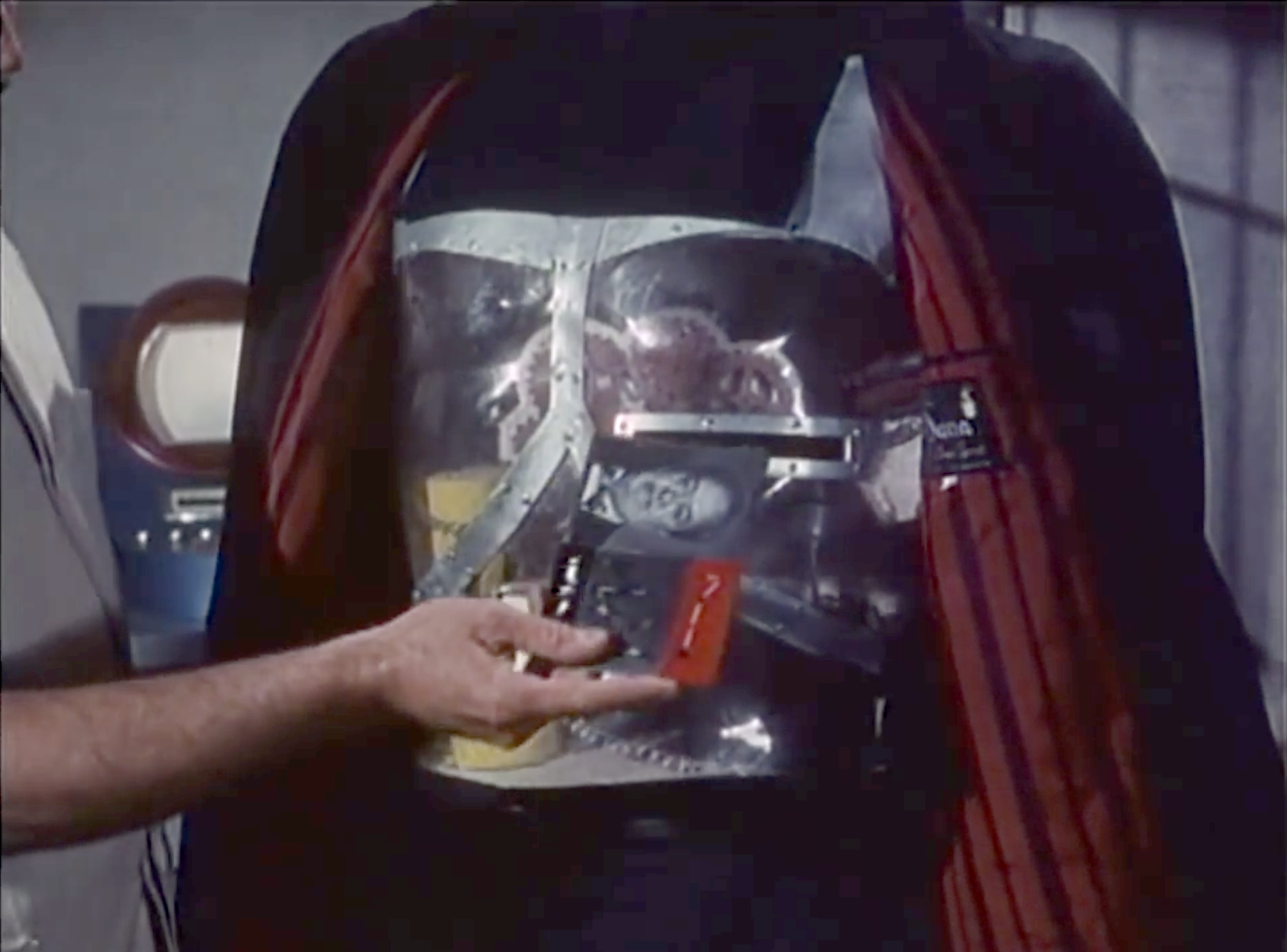
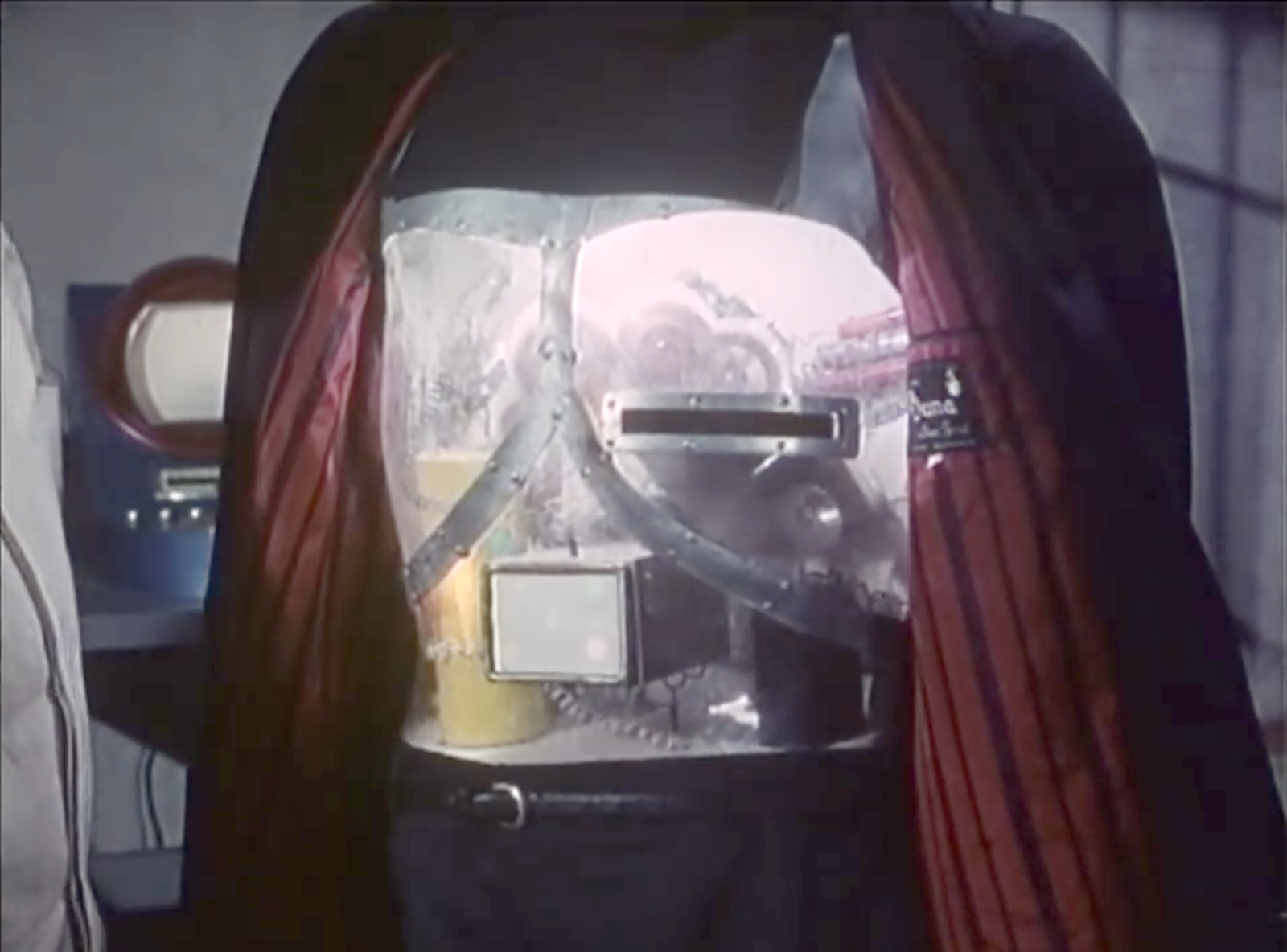
There is, I must admit, a sort of lovely, morbid poetry to a cardiogram being inserted into a slot where the robot heart would be to give the robot instructions to end the beating of the human heart described in the cardiogram. And we don’t see a lot of poetry in sci-fi interface designs. So, props for that.

The illumination is a nice bit of feedback, but I think it could convey the information in more useful and cinegenic ways.

In this new scenario…

  • Orlak has the robot pull back its coat
  • The chamfered slot is illuminated, signaling “card goes here.”
  • As Orlak inserts the target card, the slot light dims as the chest-cavity light brightens, signaling “I have the card.”
  • After a moment, the chest-cavity light turns blood red, signaling confirmation of the victim and the new dastardly mission.

When the robot returns to Orlak after completing a mission, the red light would dim as the slot light illuminates again, signaling that it is ready for its next mission.

These changes improve the interface by first drawing the user’s locus of attention exactly where it needs to go, and then distinguishing the internal system states as they happen. It would also work for the audience, who understands by association that red means danger.

The shape of the slot is pretty good for its base usability. It has clear affordances with its placement, orientation, and metallic lining. There’s plenty of room to insert the target card. It might benefit from a fillet or chamfer for the slot, to help avoid accidentally crumpling the paper cards when they are aimed poorly.
In addition to the tactical questions of illumination and shape of the slot, I have a few strategic questions.

  • There is no authorization in evidence. Can just anyone specify a target? Why doesn’t Gaby use her luchadora powers to Spin-A-Roonie a target card with Orlak’s face on it and let the robot save the day? Maybe the robot has a whitelist of heartbeats, and would fight to resist anyone else, but that’s just me making stuff up.
  • Also I’m not sure why the card stays in the robot. That leaves a discoverable paper trail of its crimes, perfect for a Scooby to hand over to the federales. Maybe the robot has some incinerator or shredder inside? If not, it would be better from Orlak’s perspective to design it as an insert-and-hold slot, which would in turn require a redesign of the card to have some obvious spot to hold it, and a bump-in on the slot to make way for fingers. Then he could remove the incriminating evidence and destroy it himself and not worry whether the robot’s paper shredder was working or not.
  • Another problem is that, since the robot doesn’t talk, it would be difficult to find out who its current target is at any given time. Since anyone can supply a target, Orlak can’t just rely on his memory to be certain. If the card was going to stay inside, it would be better to have it displayed so it’s easy to check.
  • How would Orlak cancel a target?
  • It is unclear how Orlak specifies whether the target is to be kidnapped or killed even though some are kidnapped and some are killed.
  • It’s also unclear about how Orlak might rescind or change an order once given.
  • It is also unclear how the assassin finds its target. Does it have internal maps with addresses? Or does it have unbelievably good hearing that can listen to every sound nearby, isolate the particular heartbeat in question, and just head in that direction, destroying any walls it encounters? Or can it reasonably navigate human cities and interiors to maintain its disguise? Because that would be some amazing technology for 1969. This last is admittedly not an interface question, but a backworlding question for believability.

So there’s a lot missing from the interface.

It’s the robot assassin designer’s job to not just tick a box to tell themselves that they have provided feedback, but to push through the scenarios of use to understand in detail how to convey to the evil scientist what’s happening with his murderous intent.

Who did it better? Victim card edition.

Let’s cut to the chase. Las Luchadoras is a wholesale rip-off of Cybernauts, from the 1961–1969 British TV series The Avengers, specifically the episode “Return of the Cybernauts” from 1967. Thanks to readers Xavier Mouton-Dubosc @dascritch and Roger Long @evil_potato for drawing my attention to the complete ripoffery.

Dust off your stereoscopes for this one.

Compare freely…

  • Bad robot is silver-faced, wears a black trench coat, does not speak, wears black sunglasses, and a black hat.
  • Bad robot is given instructions via a graphically-designed card inserted into a machine slot.
  • Bad robot smashes through walls to gain access to victims who stand there in horror rather than, say, running from the slow-walking golem.
  • When bad robot kills, it does so with karate chops.
  • Bad human captures scientists and forces them to provide engineering specs to fulfill his evil ambitions.
  • Bad human forces scientists to build a wrist-wearable mind-control device, for use on Team Good. (One’s a bracelet. The other is a watch.) The main target for mind-control is a woman.
  • Bad human has plans to use the mind-controlled person to fight the rest of Team Good.
  • The day is saved (spoiler? I guess?) by pulling the mind-control device from the victim and putting it on the robot, which instead of granting the bad human more control of the robot, causes it to go berserk.

It’s like René Cardona saw “Return of the Cybernauts” on TV, loved it, and thought there is only one thing that could make this better: Lady. Wrestlers. So he added luchadoras and hoped BBC Four wouldn’t notice. He just wanted to make the world better, y’all.

If you think I’m exaggerating, here are a few side by side shots.

I guess we can give credit to Cardona’s selection of a Bolero hat instead of that tired Fedora thing? SciFiFashionChoices.com
A split image featuring two scenes: on the left, characters from 'The Avengers' (1967) in a futuristic setting, with a woman in a red outfit and a man in a suit; on the right, characters from 'Luchadoras...' (1969) dressed in silver and white, in a laboratory environment.
I like the implication in Luchadoras that audiences wouldn’t trust that these men were engineers unless they were in medical scrubs. (?) Way to trust your audience, Cardona.

The main differences from the technology point of view is that in “The Cybernauts” (the first episode from The Avengers to feature the robots, when the series was still shot in black and white), the robots didn’t track their victims by heartbeat. The robots followed a radio signal emitted from a pen that was gifted to the victim. In “The Return of the Cybernauts,” they’d gotten an upgrade, and did their tracking via sensors that were all on board.

A man in a black coat and hat sits in a chair, wearing sunglasses and gloves, against a plain background.
10 FOLLOW PEN / 20 GOTO 10

Additionally, in The Avengers, the victim card is inserted into an angled control panel attached to a wall-sized computer. In Luchadoras, the card is inserted into a slot built into the Robot Asesino. (The next post.) Otherwise, the steps of interaction are the same.

A display card showing a black and white photo of a man in a suit, with identifying information and a graphical representation of data, including a heartbeat line and braille.

Which brings us to the Victim Cards

Behold them, side-by-side.

A split image featuring a portrait of a man from 'The Avengers' (1967) on the left and a man holding a photo from 'Luchadoras...' (1969) on the right, both accompanied by abstract graphics and data.

It’s easier to tally the differences than the similarities, because they are quite alike.

  • Avengers’ cards are affixed to transparent plastic. Luchadoras’ cards are a thick paper.
  • Avengers’ has its elements separated by light blue rule lines. Luchadoras’ has no borders.
  • Avengers’ has a numeric unique identifier in the lower left.
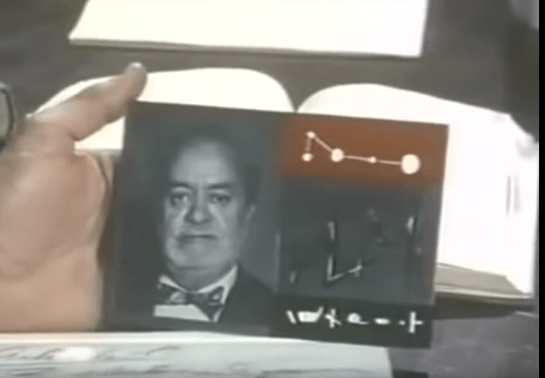
  • Avengers’ top graphic looks like black computer-readable shapes on a white background. (Though it was almost certainly graphic tape.) Luchadoras’ looks like a white star chart on a red background.
  • Avengers’ middle graphic is clearly a cardiogram (even if cardiograms are continuous not plotted points). Luchadoras’ is hard to read because of the crappy transfer, but nothing like a cardiogram.
  • Avengers’ lower graphic looks something like white braille pips on a red background. Luchadoras’ is weird white glyphs on a black background.

So…Who did it better?

Let’s not use the low resolution of this transfer against Luchadores. And we won’t use the lack of trippy face-stabilizing algorithms in the transfer of The Avengers against it.

Production

The bits on The Avengers’ card are clearly pasted there. The corners are curling up! But the plastic card feels solid and monumental. Luchadoras’ card seems like it was printed the way we see it! Using a color printer today, this would be a no big deal. But back in 1969 this was quite an achievement. Luchadoras wins.

A profile image of a man in a bow tie displayed alongside a graph and numerical data, suggesting a medical or identification context.

Graphics

Avengers top graphic is perfect. Like an early version of OCR. It’s very convincingly an instruction for a computer: precise and high contrast. Sadly the cardiogram is a little off, since even if it was plotted points, those points would be evenly spaced, and having the irregular plots on graph paper only highlights the unevenness. The braille-like bits at the bottom are, again, very convincingly an instruction for a 1960s computer to easily read.

Luchadores’ is just…nonsensical. A star chart? Hieroglyphs? “Cardiogram” lines that go backwards and cross back over themselves?

Avengers wins, leaving us with a need for a tie-breaker.

Diegetic usability

This is the main measure, and I’m just being coy for leaving it to the last. The purpose of the card is for henchmen and bad guys to provide programs for a robot assassin.Luchadoras’ space-filling layout and production quality make it look more in-line with modern design sensibilities on the surface, the actual content of those graphics are just 4th-wall-destroyingly awful.

Plus, since, the Avengers’ has the unique ID that makes it easy to for the humans to talk about with each other,…

“Get me the Peel card!”
“Uh, which is that?”
“The only person presenting as a woman?”
“Wut?”
“1252.”
“Oh, Hahaha. Got it.

A close-up of a card featuring a black and white photo of a woman with long hair, alongside various graphs and printed patterns.

…it wins.

If you’re going to copy, Luchadoras, seek to deeply understand the thing you’re copying first.


For more Who Did it Better, see the tag. Right now there’s only the fingernail-o-matics from The Fifth Element and Total Recall, but I’ll tag future things with that same tag.

Playing the Victim Card

To specify a target for assassination or kidnapping, Orlak (or a henchman) inserts a specially designed card into a slot built into the robot’s chest, right at its heart. One of those cards is below.

The layout of the card puts the victim’s picture on the left; a node-graph diagram that looks like a constellation diagram, and some inscrutable symbols on the right. The characters discuss that this card contains a cardiogram of the victim, but it’s unclear which part of the card has this information, because they usually look something like this:

1896 Copyrighted work available under Creative Commons Attribution
only license CC BY 4.0 http://creativecommons.org/licenses/by/4.0/

Oh, it’s probably worth mentioning that one of the movie’s givens is that a cardiogram can uniquely identify a person, like a thumbprint (which isn’t as provably unique as popular culture would have us believe). But to use a cardiogram to locate a person without a ubiquitous sensing network (unthinkable in 1969) would require a very high resolution cardiogram, a wall-piercing sensors, and some shockingly advanced pattern matching on the part of the robot, and I’m not sure I’m willing to give this film that much credit.

Presuming that there are lots of technical reasons for the stuff on the right, and the robot needs the profile for visual recognition, I imagine the only thing missing is a human-readable name so these are easy for the henchmen and scientists to discuss amongst themselves. I mean, they might happen to know every single scientist in town by sight, but having the name would avoid possible misidentifications. The design of artifacts have to take into account all common scenarios of use, including production, maintenance, and storage.

Speaking of which, it’s unclear how these cards are produced. They seem like they take a lot of expert effort to produce and fabricate. Let’s give the film credit to say that this is a deliberate attempt by the enslaved scientists to…

  • Make something as irrevocable as a death sentence very difficult to order.
  • Ensure an order to the murderous robot takes time, and thereby give time to let passions subside and orders to be rescinded.
  • Serve as a bailiwick of sorts, being too difficult for a layperson to do, and thereby difficult to turn on its masters.
  • Secure their jobs.

LATE BREAKING UPDATE: Turns out these cards are a copy of cards from The Avengers (1961–1969). Check out the comparison.

Overview: Las Luchadoras vs el Robot Asesino

This week marks the otherwise unsung 50th anniversary of the absolutely terrible film Las luchadoras vs el robot asesino, or Wrestling Women versus the Robot Assassin. I know I have to finish Idiocracy, but I wanted to pause to share this with you here on its anniversary. It’s a Mexican B-movie from 1969, it has an AI of sorts, and it is brain-explodingly bad with a handful of simple, evil interfaces to review.

Release Date: 9 January 1969 (USA)

Overview

The mad scientist Dr. Orlak has created a robot assassin, which he programs to punch through cheaply constructed set walls and capture scientists to enact his nefarious world domination plan.

massive-spoilers_sign_color
Continue reading

Boosting underrepresented voices

I’ve had this going for a few days via Twitter and Facebook, but a friend pointed out that since most of my readers subscribe, I need a blog post!

donage_now

Scifiinterfaces is working on a project about gender representation in sci-fi, specifically around gendered AI in screen sci-fi. I am soliciting guest authors for the posts, and I think it is especially important to hear from underrepresented voices. I’m conscious of how much work those folks are already doing uncompensated, so I want to make a special point of arranging compensation in this case.  Please help support these authors doing important work!

correlations_pages

A teaser graphic from the study tempts you. You want to help this thing come to life. </hypnotist voice>

All donations are shared equally among guest authors. None will be kept by myself.

INCENTIVE #1: One anonymous donor has let me know they will be matching the first $150 of donations. An easy way to double your money!

INCENTIVE #2: As of yesterday, 04 DEC 2018, I upped the ante a little bit. I’m committing that the biggest bid by the time we meet the $600 goal will get a physical copy of the book. Used, these start at $55 on amazon, so it’s nothing to sneeze at. If your bid is over $55, I’ll sign it for you, per your request.

donage_now

Frito’s F’n Car interface

When Frito is driving Joe and Rita away from the cops, Joe happens to gesture with his hand above the car window, where a vending machine he happens to be passing spots the tattoo. Within seconds two harsh beeps sound in the car and a voice says, “You are harboring a fugitive named NOT SURE. Please, pull over and wait for the police to incarcerate your passenger.”

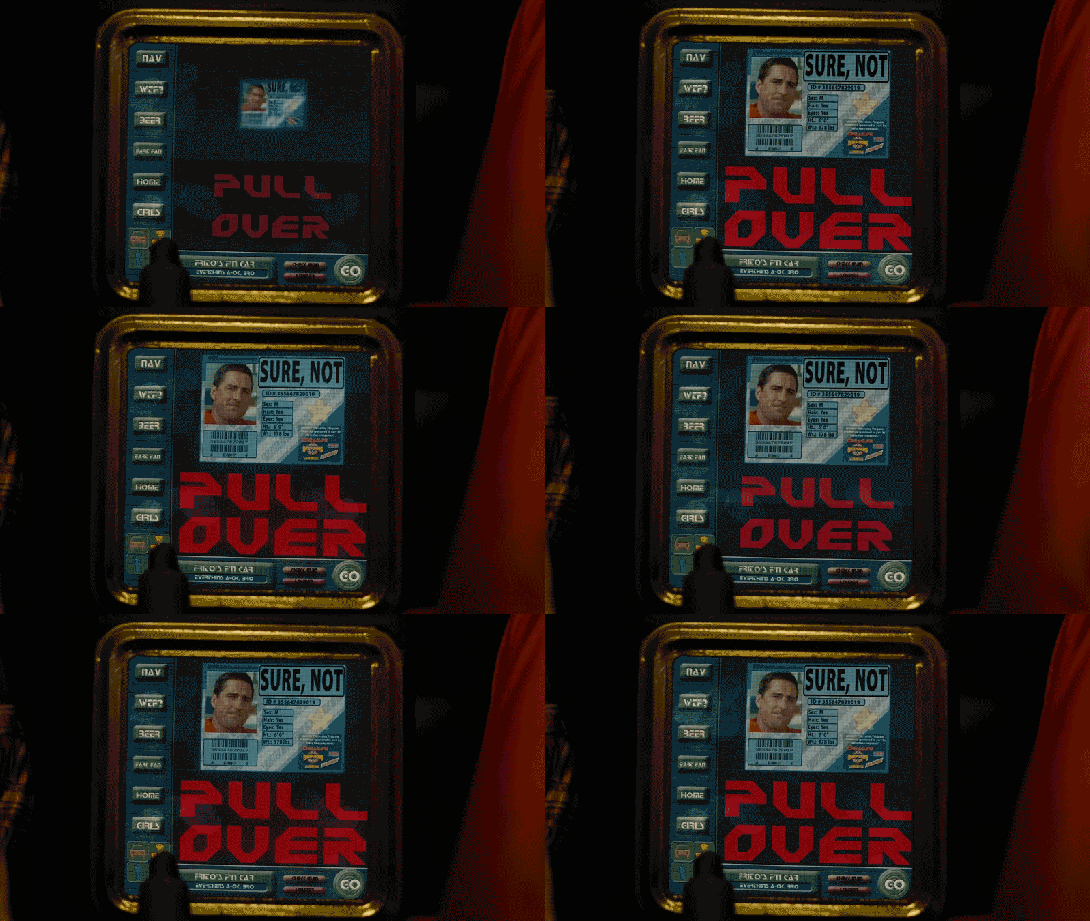
Frito’s car begins slowing down, and the dashboard screen shows a picture of Not Sure’s ID card and big red text zooming in a loop reading “PULL OVER”

IDIOCRACY-fncar

The car interface has a column of buttons down the left reading:

  • NAV
  • WTF?
  • BEER
  • FART FAN
  • HOME
  • GIRLS

At the bottom is a square of icons: car, radiation, person, and the fourth is obscured by something in the foreground. Across the bottom is Frito’s car ID “FRITO’S F’N CAR” which appears to be a label for a system status of “EVERYTHING’S A-OK, BRO”, a button labeled CHECK INGN [sic], another labeled LOUDER, and a big green circle reading GO.

idiocracy-pullover

But the car doesn’t wait for him to pull over. With some tiny beeps it slows to a stop by itself. Frito says, “It turned off my battery!” Moments after they flee the car, it is converged upon by a ring of police officers with weapons loaded (including a rocket launcher pointed backward.)

Visual Design

Praise where it’s due: Zooming is the strongest visual attention-getting signals there is (symmetrical expansion is detected on the retina within 80 milliseconds!) and while I can’t find the source from which I learned it, I recall that blinking is somewhere in the top 5. Combining these with an audio signal means it’s hard to miss this critical signal. So that’s good.

comingrightatus.png
In English: It’s comin’ right at us!

But then. Ugh. The fonts. The buttons on the chrome seem to be some free Blade Runner font knock off, the text reading “PULL OVER” is in some headachey clipped-corner freeware font that neither contrasts nor compliments the Blade Jogger font, or whatever it is. I can’t quite hold the system responsible for the font of the IPPA licence, but I just threw up a little into my Flaturin because of that rounded-top R.

bladerunner

Then there’s the bad-90s skeuomorphic, Bevel & Emboss buttons that might be defended for making the interactive parts apparent, except that this same button treatment is given to the label Frito’s F’n Car, which has no obvious reason why it would ever need to be pressed. It’s also used on the CHECK INGN and LOUDER buttons, taking their ADA-insulting contrast ratios and absolutely wrecking any readability.

I try not to second-guess designer’s intentions, but I’m pretty sure this is all deliberate. Part of the illustration of a world without much sense. Certainly no design sense.

In-Car Features

What about those features? NAV is pretty standard function, and having a HOME button is a useful shortcut. On current versions of Google Maps there’s an Explore Places Near You Function, which lists basic interests like Restaurants, Bars, and Events, and has a more menu with a big list of interests and services. It’s not a stretch to imagine that Frito has pressed GIRLS and BEER enough that it’s floated to the top nav.

explore_places_near_you

That leaves only three “novel” buttons to think about: WTF, LOUDER, and FART FAN. 

WTF?

If I have to guess, the WTF button is an all-purpose help button. Like a GM OnStar, but less well branded. Frito can press it and get connected to…well, I guess some idiot to see if they can help him with something. Not bad to have, though this probably should be higher in the visual hierarchy.

LOUDER

This bit of interface comedy is hilarious because, well, there’s no volume down affordance on the interface. Think of the “If it’s too loud, you’re too old” kind of idiocy. Of course, it could be that the media is on zero volume, and so it couldn’t be turned down any more, so the LOUDER button filled up the whole space, but…

  • The smarter convention is to leave the button in place and signal a disabled state, and
  • Given everything else about the interface, that’s giving the diegetic designer a WHOLE lot of credit. (And our real-world designer a pat on the back for subtle hilarity.)

FART FAN

This button is a little potty humor, and probably got a few snickers from anyone who caught it because amygdala, but I’m going to boldly say this is the most novel, least dumb thing about Frito’s F’n Car interface.

Heart_Jenkins_960.jpg
Pictured: A sulfuric gas nebula. Love you, NASA!

People fart. It stinks. Unless you have active charcoal filters under the fabric, you can be in for an unpleasant scramble to reclaim breathable air. The good news is that getting the airflow right to clear the car of the smell has, yes, been studied, well, if not by science, at least scientifically. The bad news is that it’s not a simple answer.

  • Your car’s built in extractor won’t be enough, so just cranking the A/C won’t cut it.
  • Rolling down windows in a moving aerodynamic car may not do the trick due to something called the boundary layer of air that “clings” to the surface of the car.
  • Rolling down windows in a less-aerodynamic car can be problematic because of the Helmholtz effect (the wub-wub-wub air pressure) and that makes this a risky tactic.
  • Opening a sunroof (if you have one) might be good, but pulls the stench up right past noses, so not ideal either.

The best strategy—according to that article and conversation amongst my less squeamish friends—is to crank the AC, then open the driver’s window a couple of inches, and then the rear passenger window half way.

But this generic strategy changes with each car, the weather (seriously, temperature matters, and you wouldn’t want to do this in heavy precipitation), and the skankness of the fart. This is all a LOT to manage when one’s eyes are meant to be on the road and you’re in an nauseated panic. Having the cabin air just refresh at the touch of one button is good for road safety.

If it’s so smart, then, why don’t we have Fart Fan panic buttons in our cars today?

I suspect car manufacturers don’t want the brand associations of having a button labeled FART FAN on their dashboards. But, IMHO, this sounds like a naming problem, not some intractable engineering problem. How about something obviously overpolite, like “Fast freshen”? I’m no longer in the travel and transportation business, but if you know someone at one of these companies, do the polite thing and share this with them.

Idiocracy-car
Another way to deal with the problem, in the meantime.

So aside from the interface considerations, there are also some strategic ones to discuss with the remote kill switch, but that deserves it’s own post, next.

Fox News

“He tried taking water from toilets, but it’s Secretary Not Sure who finds himself in the toilet now. And as history pulls down its pants and prepares to lower its ass on Not Sure’s head it will be Daddy Justice who will be crapping on him this time.”

Idiocracy_fox-news03

Today is election day. If you’re American, you’re voting, of course. (or, you know, GTFO.)

Because of voter suppression efforts by the GOP, many who are voting will be facing long lines. Help encourage these Americans, slogging as they are through the GOP swamp just for their right to vote, to stay the course by buying them some pizza. And if it’s you, know that you can report your long line to the same place and have some ‘za sent your way.

pizzatothepolls.png

https://polls.pizza/

Godspeed, America.

Idiocracy_fox-news05

I’ll get back to wrapping up Idiocracy later.

House of Representin’

The U.S. House of Representin’ in Idiocracy is a madhouse. When Joe is sworn in as the Secretary of the Interior, he takes his seat in the balcony with the other Cabinet members. He looks down into the gallery. It is dimly lit. When Joe is sworn in as the Secretary of the Interior, he enters the chamber and sits in the balcony with the rest of the Cabinet. He looks down into the gallery. It is dimly lit. There are spotlights roving across the Representatives, who don’t sit at desks but stand in a mosh pit. There is even a center-hung video display like you’d see at an indoor sports area. Six giant LED screens. Ring displays showing weird ASCII characters.

Idiocracy_house-of-representin03
Sadly, we do not get to The Sennit for a comparison.

Someone plays an entrance theme consisting mostly of a cowbell and grunts. Strobe lights flash. An announcer says, like he was announcing a World Wrestling Entertainment performer, “Ladies and gentlemen…the President of America!” Camacho comes out of a side door screaming. He’s dressed in lots of red and white stripes with a cape made of the union blue. (n.b. The federal code forbids the wearing the flag as apparel.) He does some made-up karate poses. There are logos on the rostrum and currency sheets for wallpaper. He stands at the lectern and begins his address to the Representatives by saying, “Shut up.”

money-wallpaper.jpg

There’s a kind of ritual to his entrance, but the proceedings are all chaos. I think if you mentioned the Jefferson’s Manual you’d be accused of talking like a fag. (Jefferson’s Manual was penned by Thomas Jefferson in 1801 and still stands as a guideline for how the House and to a lesser extent the Senate runs its…but there I go talking faggy again.) When the delegation from South Carolina start talking smack, he grabs a semi-automatic and shoots it into the ceiling to get everyone’s attention again.

IDIOCRACY-governance.png
He tells it like it is.

Ordinarily I might try and critique this as some abstract interface for the task of vetting a Cabinet member or legislating, since it is meant to be that, but Idiocracy is just too far gone. Plus, tomorrow is the midterm elections, and it’s more instructive to talk about its tone.

What makes this scene so marvelous is how un-governmental it all is. It’s macho posing and buzz words. Insults and tribalism. It’s a circus (without, in this case, the bread). Empty promises and showmanship.

Come with me now to walk far, far back from it all, to try to get it all into view and really think hard about the scope of the institution we call government. We grant this thing the highest authority that we possibly can. It has power over our life and death, war and money, our children and our environment—and it is only right that this trust be met by the occupants of that government with gravity, some serious consideration for the power with which they have been entrusted. It is grotesque for it to become a show. When people think corporations and government should be best buds, and the highest offices of the land become a shill for product. When the participants conceive it as a high-school parking lot gang fight where scoring insults against the other team counts as some beer-swilling victory while, you know, actual human suffering and violent death occurs as collateral damage. When they justify horrible things by saying, “You had your turn.” When demagogues keep you stupidly, stupidly distracted.

Idiocracy_house-of-representin02
Yet here we are.

If this is government, we shout at the screen, those morons in the electorate should replace it with something better.

Replace it with something better

We’re not done with reviews of Idiocracy, but tomorrow is the 2018 midterm election in the USA.

If you’ve stayed with me this far it means you’re probably not a supporter of The Tire Fire in Chief, since, as fascists, they tend to be fanatical and abhor dissent, and would have left the blog long ago. (They will not be missed.) So you’re probably not one of them.

If you’re a progressive or even a moderate, you’ve been as shocked as I have over the past two years, and you realize how much of a disaster this administration has been. Your mind has hopefully already been made up. In early voting or by mail you may have even already voted. Rock on.
Some of my readers may have genuine hardships that prevent them from voting, even in early voting states or by mail. Please do everything you can. Remember Uber and Lyft are offering free and discounted trips to polls (there are even carpool sites), and in most states your employer is required by law to give you paid time off to vote. (Check here.) Some voters will be victims of suppression efforts and holy shit I’m sorry about that.
But let’s presume that there are yet a few undecideds, or who are choosing not to vote out of some sense of hopelessness or protest. Maybe you have some Russian troll farm meme in your head that is preventing you from voting. Not voting may feel like resistance, but it’s actually surrender. With all the voter suppression underway, you’re letting the oppressors win. With all the wrong in the world, you would be complicit. So get over yourself. Stop the decline into Idiocracy. Our choices aren’t perfect. They never are. They never will be. But even if this choice is not perfect, it is clear. The GOP is wrecking democracy, ruining the environment, and making people suffer for the benefit of the ultra-wealthy and their old, white cronies. Broadcast Democrats may not be the answers we need in the long run, but they are the only thing that can stop this Idiocracy, right here, right now.

Vote.

Let me close with a great screed by Lori Gallagher Witt about why she is a liberal. You are a sci-fi fan. You’re used to entertaining the notion of alternate realities. Imagine a world where the following becomes true.

  1. “I’ve always been a liberal, but that doesn’t mean what a lot of you apparently think it does. Let’s break it down, shall we? Because quite frankly, I’m getting a little tired of being told what I believe and what I stand for. Spoiler alert: Not every liberal is the same, though the majority of liberals I know think along roughly these same lines:
  2. I believe a country should take care of its weakest members. A country cannot call itself civilized when its children, disabled, sick, and elderly are neglected. Period.
  3. I believe healthcare is a right, not a privilege. Somehow that’s interpreted as “I believe Obamacare is the end-all, be-all.” This is not the case. I’m fully aware that the ACA has problems, that a national healthcare system would require everyone to chip in, and that it’s impossible to create one that is devoid of flaws, but I have yet to hear an argument against it that makes “let people die because they can’t afford healthcare” a better alternative. I believe healthcare should be far cheaper than it is, and that everyone should have access to it. And no, I’m not opposed to paying higher taxes in the name of making that happen.
  4. I believe education should be affordable and accessible to everyone. It doesn’t necessarily have to be free (though it works in other countries so I’m mystified as to why it can’t work in the US), but at the end of the day, there is no excuse for students graduating college saddled with five- or six-figure debt.
  5. I don’t believe your money should be taken from you and given to people who don’t want to work. I have literally never encountered anyone who believes this. Ever. I just have a massive moral problem with a society where a handful of people can possess the majority of the wealth while there are people literally starving to death, freezing to death, or dying because they can’t afford to go to the doctor. Fair wages, lower housing costs, universal healthcare, affordable education, and the wealthy actually paying their share would go a long way toward alleviating this. Somehow believing that makes me a communist.
  6. I don’t throw around “I’m willing to pay higher taxes” lightly. If I’m suggesting something that involves paying more, well, it’s because I’m fine with paying my share as long as it’s actually going to something besides lining corporate pockets or bombing other countries while Americans die without healthcare.
  7. I believe companies should be required to pay their employees a decent, livable wage. Somehow this is always interpreted as me wanting burger flippers to be able to afford a penthouse apartment and a Mercedes. What it actually means is that no one should have to work three full-time jobs just to keep their head above water. Restaurant servers should not have to rely on tips, multibillion-dollar companies should not have employees on food stamps, workers shouldn’t have to work themselves into the ground just to barely make ends meet, and minimum wage should be enough for someone to work 40 hours and live.
  8. I am not anti-Christian. I have no desire to stop Christians from being Christians, to close churches, to ban the Bible, to forbid prayer in school, etc. (BTW, prayer in school is NOT illegal; compulsory prayer in school is—and should be—illegal). All I ask is that Christians recognize my right to live according to my beliefs. When I get pissed off that a politician is trying to legislate Scripture into law, I’m not “offended by Christianity”—I’m offended that you’re trying to force me to live by your religion’s rules. You know how you get really upset at the thought of Muslims imposing Sharia law on you? That’s how I feel about Christians trying to impose biblical law on me. Be a Christian. Do your thing. Just don’t force it on me or mine.
  9. I don’t believe LGBT people should have more rights than you. I just believe they should have the same rights as you.
  10. I don’t believe illegal immigrants should come to America and have the world at their feet, especially since THIS ISN’T WHAT THEY DO (spoiler: undocumented immigrants are ineligible for all those programs they’re supposed to be abusing, and if they’re “stealing” your job it’s because your employer is hiring illegally). I’m not opposed to deporting people who are here illegally, but I believe there are far more humane ways to handle undocumented immigration than our current practices (i.e., detaining children, splitting up families, ending DACA, etc).
  11. I don’t believe the government should regulate everything, but since greed is such a driving force in our country, we NEED regulations to prevent cut corners, environmental destruction, tainted food/water, unsafe materials in consumable goods or medical equipment, etc. It’s not that I want the government’s hands in everything—I just don’t trust people trying to make money to ensure that their products/practices/etc. are actually SAFE. Is the government devoid of shadiness? Of course not. But with those regulations in place, consumers have recourse if they’re harmed and companies are liable for medical bills, environmental cleanup, etc. Just kind of seems like common sense when the alternative to government regulation is letting companies bring their bottom line into the equation.
  12. I believe our current administration is fascist. Not because I dislike them or because I can’t get over an election, but because I’ve spent too many years reading and learning about the Third Reich to miss the similarities. Not because any administration I dislike must be Nazis, but because things are actually mirroring authoritarian and fascist regimes of the past.
  13. I believe the systemic racism and misogyny in our society is much worse than many people think, and desperately needs to be addressed. Which means those with privilege—white, straight, male, economic, etc.—need to start listening, even if you don’t like what you’re hearing, so we can start dismantling everything that’s causing people to be marginalized.
  14. I am not interested in coming after your blessed guns, nor is anyone serving in government. What I am interested in is sensible policies, including background checks, that just MIGHT save one person’s, perhaps a toddler’s, life by the hand of someone who should not have a gun. (Got another opinion? Put it on your page, not mine).
  15. I believe in so-called political correctness. I prefer to think it’s social politeness. If I call you Chuck and you say you prefer to be called Charles I’ll call you Charles. It’s the polite thing to do. Not because everyone is a delicate snowflake, but because as Maya Angelou put it, when we know better, we do better. When someone tells you that a term or phrase is more accurate/less hurtful than the one you’re using, you now know better. So why not do better? How does it hurt you to NOT hurt another person?
  16. I believe in funding sustainable energy, including offering education to people currently working in coal or oil so they can change jobs. There are too many sustainable options available for us to continue with coal and oil. Sorry, billionaires. Maybe try investing in something else.
  17. I believe that women should not be treated as a separate class of human. They should be paid the same as men who do the same work, should have the same rights as men and should be free from abuse. Why on earth shouldn’t they be?

I think that about covers it. Bottom line is that I’m a liberal because I think we should take care of each other. That doesn’t mean you should work 80 hours a week so your lazy neighbor can get all your money. It just means I don’t believe there is any scenario in which preventable suffering is an acceptable outcome as long as money is saved.”

Identity Processing Program of America

After his initial arrest, Joe is led by a noose stick (and a police officer speaking some devolved version of copspeak) to a machine to get an identity tattoo. Joe sits in the chair and a synthesized voice says, “Welcome to the Identity Processing Program of America. Please insert your forearm into the forearm receptacle.” Joe does as instructed and it locks his arm into place. A screen in front of him shows the legend “Identity Processing Program of America” superimposed over an USA pattern made up of company names and Carls Junior amputated star logos. Five rectangles across the top are labeled: System, Identity, Verify, Imprint, and Done.

Idiocracy_ippa02
It prompts him to “…speak your name as it appears on your current federal identity card, document number G24L8.” Joe says, “I’m not sure if—“ The machine interprets this as input and blinks the name as it says, “You have entered the name ‘Not Sure.’ Is this correct, Not Sure?”

Idiocracy_ippa05
Joe tries to correct it, saying, “No…it’s not correct.” On the word “correct” it dings and continues, “Thank you. ‘Not’ is correct.” “Not” stops blinking in the interface.

“…Is ‘Sure’ correct?” Joe has patience and tries to correct it. “No, it’s not. My name is Joe.” It blurts out some error beeps. “You’ve already confirmed your first name is Not. Please confirm your last name, ‘Sure.’”

Joe: My…My last name is not Sure.
Kiosk: Thank you, Not Sure.
Joe: No. What I mean is my name is Joe.
Kiosk: Confirmation is complete. Please wait while I tattoo your new identity on your arm.
The machine begins to shake and make noises. Joe says, “Wait a second. Can we start over? Can I cancel this?” He sees a progress bar, labeled “Tattoo In Progress…”

Idiocracy_ippa06

“Can we cancel this and just go back to the beginning? They’re gonna tat—Ow. Could I speak to your supervisor? Ow!” While he’s trying to wrench his arm free, the machine instructs him, “Please hold still for your photograph.” It flashes an unflattering picture of him and the clamp on his arm releases. He removes his arm to see the new tattoo. The screen shows him his identity card.

Idiocracy_ippa08
In exasperation from the whole ordeal he mumbles, “Oh, that’s fuckin’ great.”

This scene is played for the Vaudevillian yuks, but it does illustrate some problems with conversational design. And note that, if you’re interested in this topic, let me make an early shout out to the book Conversational Design by Erika Hall, published earlier this year.

conversational_design.jpg

Understanding intent

When it hears Joe say “I’m not sure…” it takes it as a literal answer. It does not recognize that Joe isn’t answering the question. It is one meta-level up. He has a question about the question being asked. Humans are pretty good at recognizing when another human is breaking the usual logic of adjacency pairs and not providing an answer to the question. (This was discussed in Make It So in Chapter 5, “Gestural Interfaces” in relation to Minority Report) Computers have a harder time of it. If this kiosk understood it, it would be know that he’s not answering the question, and resolve what conversational analysis calls “the expansion” before returning to the question. (Disclosure: I work there and know the guy who wrote that.)

Aside: Douglas Hofstadter in his mind-expanding book Godel, Escher, and Bach, writes about the trick question “Have you stopped beating your spouse?” for which neither “yes” nor “no” are good answers, but the only “correct” answers according to the binary frame of the question. In that text he introduces the eastern answer of “mu” (or “wu” in Chinese languages) that means roughly “the answer does not fit the question.” So it can be said that computers have a hard time understanding mu.

mu-seal.png


Designers of digital assistants have to wrangle with this, but it’s rarely a problem that the individual designer must wrestle with. Language and naming are informal, slippery notions as far as computers are concerned, so it’s understandably a hard problem. It’s entirely possible that someone has chosen “Not Sure” as a name, but it’s highly unlikely. And that’s another problem.

Understanding likelihood

Understanding intent might be a little easier if the computer could recognize that “Not” and “Sure” are unlikely values for a name. (Even in Idiocracy where names tend to be brands like Lexus, and Frito, and Biggiez. More on this later.) If it knew that, it would have a low confidence that it “heard” correctly, and shift into a repair or at least clarification mode. “‘Not’ would be very uncommon name. Let me be extra careful, here…” It could even shift into a more deliberate mode of input, like a keyboard, or asking him to spell his name out (or, you know, cancel the whole thing.)

Catching not

When the kiosk is asking for confirmation, it hears Joe say, “No it’s not correct” and registers the keyword “correct” but misses the function word “not” which completely flips the meaning.

Again, avoiding this speech-to-text error would be a developer’s task, but dealing with the back-and-forth would definitely fall to a designer. When clarifying low-confidence input, users should be able to provide discrete high-confidence feedback.

Joe could, for instance, be shown the kiosk’s (stupid) understanding of his input and—since this has a pretty permanent consequence—wait on his confirmation and providing the simple option to redo it so he can try some other tactic to getting “Joe Bauers” in there until he gets it right.
But, of course, this is Idiocracy, and Joe is stuck with it.

Idiocracy_ippa09
Sorry, Joe.

But we’re not

I mean, Republicans have done all they can to suppress votes that don’t favor them. They don’t care about Democracy or the will of the American people as they do staying in power to serve their 1% overlords. But research shows that people who have a plan to vote are more likely to actually do it, and if we all do it, we can overwhelm them with sheer numbers.
There are lots of tools to help you make a plan, but let’s send some traffic to our friends at Planned Parenthood. They’ve been under a lot of pressure during this administration. Maybe throw them a few sheckles while you’re there. Not for the election, but because you’re a good person. And vote all of them out.

20161101-GOTV-Make-Plan-Tool-BLOG.png

IQ Testing

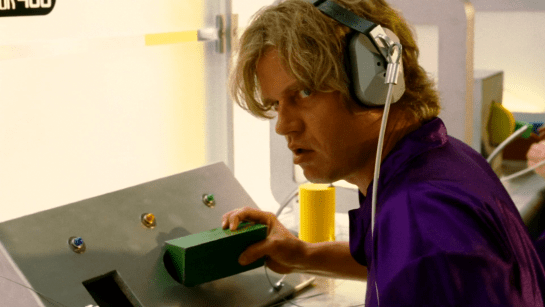
When Joe is processed after his arrest, he is taken to a general IQ testing facility. He sits in a chair wearing headphones. A recorded voice asks, “If you have one bucket that holds two gallons, and another bucket that holds five gallons, how many buckets do you have?” Into a microphone he says, incredulous that this is a question, “Two?” The recorded voice says, “Thank you!”

IDIOCRACY-IQ11

Joe looks to his left to see another subject is trying to put a square blue peg into the middle round hole of a panel and of course failing. Joe looks to his right, to see another subject with a triangular green peg in hand that he’s trying to put into the round middle hole in his interface. Small colored bulbs above each hole are unlit, but they match the colors of the matching blocks, so let’s presume they illuminate when the correct peg is inserted. When you look closely, it’s also apparent that the blocks are tethered to the panel so they’re not lost, and each peg is tethered directly below its matching hole. So there are lots and lots of cues that would let a subject figure it out. And yet, they are not. The subject to Joe’s right even eyes Joe suspiciously and turns his body to cover his test so Joe won’t try and crib…uh…“answers.”

Idiocracy_iq03

Comedy

The comedy in the scene comes from how rudimentary these challenges are. Most toddlers could complete the shape test. Even if you couldn’t figure out the shapes, you could match the colors, i.e. the blue object goes in the hole under the blue bulb. Most preschoolers could answer the spoken challenge. It underscores the stupidity of this world that generalized IQ tests for adults test below grade school levels.

IQ Testing

Since Binet invented the first one in 1904, IQ testing has a long, and problematic past (racism and using it to justify eugenic arguments, just for instance) but it can have a rational goal: How do we measure the intelligence of a set of people (students in a classroom, or applicants to intelligence jobs) for strategic decisions about aptitude, assistance, and improvement? But intelligence is a very slippery concept, and complicated to study much less test. The good news in this case is that the citizens of Idiocracy don’t have very sophisticated intellects, so very basic tests of intelligence should suffice.

Some nice things

So, that said, the shape test has some nice aspects. The panel is angled so the holes are visible and targetable, without being so vertical it’s easy to drop the pegs while manipulating them. The panel is plenty thick for durability and cleaning. The speech-to-text tech seems to work perfectly, unlike the errors and bad design that riddle most technologies in Idiocracy.

Idiocracy_iq02

A garden path match

There’s an interesting question of affordances in the device. You can see in the image above that the yellow round block fits just fine in the square hole. Ordinarily, a designer would want to prevent errors like this by, say, increasing the diameter of the round peg (and its hole) so that it couldn’t be inserted into the square hole. That version of the test would just test the time it took by even trial-and-error to match pegs to their matching holes, then you could rank subjects by time-to-completion. But by allowing the round peg to fit in the square hole, you complicate the test with a “garden path” branch where some subjects can get lost in what he thinks is a successful subtask. This makes it harder to compare subjects fairly, because another subject might not have wandered down this path and paid an unfair price in their time-to-complete.

Another complication is that this test has so many different clues. Do they notice the tethers? Do subjects notice the colored bulbs? (What about color blind subjects?) Having it test cognitive skills as well as fine-motor manipulation skills as well as perception skills seems quite complicated and less likely to enable fair comparisons. 

We must always scrutinize IQ tests because people put so much stock in them and it can be very much to an individual’s detriment. Designers of these tests ought to instrument them carefully for passive and active feedback about when the test itself is proving to be problematic.

Challenging the “superintelligent?”

A larger failing of the test is that it doesn’t challenge Joe at all. All his results would tell him is that he’s much much more intelligent than these tests are built for. Fair enough, there’s nothing in the world of Idiocracy which would indicate a need to test for superintelligence among the population, but this test had to be built by someone(s), generations ago. Could they not even have the test work on someone as smart as themselves? That’s all it would need to test Joe. But we live in a world that should be quite cautious about the emergence of a superintelligence. It would be comforting to imagine that we could test for that. Maybe we should include the Millennium Problems at the end of every test. Just in case.

GOPad.png

Another Idiot Test

As “luck” would have it, Trump tweeted an IQ test just this morning. (I don’t want to link to it to directly add any fuel to his fire, but you can Google it easily.) It’s an outrageous political video ad. As you watch it:

  • Do you believe that a single anecdote about a troubled, psychotic individual is generalizable to everyone with brown skin? Or even to everyone with brown skin who is not American and seeking legal asylum in the U.S.?
  • Do you ignore the evidence of the past decades (and the last week) that show it’s conservative white males who are much more of a problem? (Noting that vox is a liberal-leaning publication, but look at the article’s citations.)
  • Can you tell that the war drums under the ad are there only to make you feel scared, appealing to your emotions with cinematic tricks?
  • Do you uncritically fall for implicature and the slippery slope fallacy?

If the answers to all these are yes, well, sorry. You’ve failed an IQ test put to you by one of the most blatantly racist political ads since WIllie Horton. (Not many ads warrant a deathbed statement of regret, but that one did.) Maybe it’s best you take the rest of the week off treating yourself. Leave town. Take a road trip somewhere. Eat some ice cream.

For the rest of you, congratulations on passing the test. We have 5 days until the election. Kick the racist bastards and the bastards enabling the racist bastards out.