Taxi shield

FifthE-taxishield-004

The taxi panel has one weak moment. When Korben has the taxi in hiding from the police, he wants to lower the taxi shield to check on Leeloo. To lower the shield, he presses on the “DOCKING LOCK” button on the panel, which doesn’t quite make sense. We saw this button used earlier to actually do what it says. Why does its function change now?

FifthE-taxishield-001

FifthE-taxishield-002

FifthE-taxishield-003

It might be that the button has two modes, i.e. in a garage it anchors the vehicle and elsewhere it lowers the shield. Modal buttons aren’t great. What if Korben is in the garage and needs to lower the shield? Just say no to modal buttons. If the functions can be operated independently, they should have separate buttons.

Additionally, if it’s going to have to be modal and have a secondary function, it should be labeled as such. Even if the shield was aftermarket, the installing mechanic could have taken a sharpie to the button to note which of the dozens of buttons on the dashboard is the one that activates it. Mechanics, you now have no excuse.

Of course leaving behind my New Criticism stance on authorial intent, it’s entirely possible that Willis just pressed the wrong button, or that the prop he was faced with on set didn’t have a button that worked, and he just picked one at hand. But I like Willis, and I like not having to second guess film makers, so I’m going to cut him some slack for this detail that most probably, nobody but me ever noticed. Until, you know, now.

The daffy bastard

FifthE-taxilicense-001

When Korben gets in his taxi and sits down, it recognizes this and in a female version of the hazy synthesized voice heard in the 4 a day cigarette dispenser, prompts him to “Please enter your license.” Korben fits his license into a small horizontal slot mounted in the ceiling of the cab, just above the driver’s seat near the windshield. He slams it in. It verifies that he’s authorized and starts the cab, including lighting the taxi light up top. It tells him, “Welcome on board, Mr. Dallas. Fuel level 10.”

Korben steers with an X-shaped control yoke. We never see his feet, so don’t know if he has any foot pedals. He has a throttle that maps like a boat throttle: push forward to increase thrust.

In the central dashboard he has an underlit panel of toggle buttons. Each button has a single function, which is printed on its surface.

Main controls: Docking lock, Automatic, Emergency power, Power. Light controls: Auxiliary lights, Parking lights, Smog lights, Main lights. Alerts: Power level low, Power failure, Light failure, Environment warning

FifthE-taxilicense-007

Two small panels to his left provide him a similar array of “comfort controls”, “taxi controls”, and “main panel one.” A more free-form keyboard sits beneath a vertical grayscale monitor, crammed full of unreadable text and, occasionally, annoyingly, blinking.

FifthE-taxilicense-006

The buttons across these panels are completely labeled, lit for easy reading in the dim cabin light, clustered in meaningful groups, and nicely positioned so that Korben can utilize his spatial memory to map the functions. But they are also labeled in all capital letters and aren’t much differentiated beyond that, which might require Korben to take his eyes off the road to target a particular one, which could increase the odds of an accident. Better inputs using physical controls would have more physical differentiation so he could find them with just one hand, labeling that was easier to read at a glance, and the most common controls right on the yoke near his fingers.

In the scene, Korben reaches to the center panel and presses “power.” The voice confirms that he’s using “Propulsion 2-X-4,” (whatever that means.) Then Korben presses “Docking lock,” which releases the mechanical hold on the taxi.

The voice reminds him sternly that he has five points left on his license, and as the garage door opens, to “Have a nice day.” Lights on either side of the garage door shine green, signaling to him that the skyway is clear. But on pulling out, they turn red just as a car passes and Korben has to slam on the brakes.

Of course the humor comes from how these interfaces aren’t entirely helpful, and the green lights shouldn’t tell him the same information he can see with his own eyes. It should be doing a bit of calculation to signal if it’s clear for the next several seconds so he can safely pull out. But of course doing that right would ruin the joke. Maybe we’re meant to understand that Korben just can’t afford any but the crappiest versions of technology.

FifthE-taxilicense-013

Later, when Leeloo does her daring cliff dive from the side of a building and crashes through the roof of his cab, Korben struggles to maintain control of it and get the hell out of the way of oncoming traffic. During the chaos, the computerized voice tells him, “You’ve just had an accident.” Korben sardonically shouts, “Yes! I know I just had an accident, you daffy bastard.” It continues adding unhelpfully, “You have one point left on your license.” Of course the fun is how annoying the taxi is, but let’s just be explicit: the cab should wait until it senses that Korben has regained control before burdening his attention with this information, and possibly making it worse.

FifthE-taxilicense-019

When Korben risks it all to help Leeloo, the speaker cover near where his license is lodged glows bright red as it says, “One point has been removed from your license…” Korben, furious and with zero points left on his license and nothing to lose, rips the device off his ceiling to shut the daffy bastard up.

FifthE-taxilicense-020

Pneumatic Mail

fifthelement-194

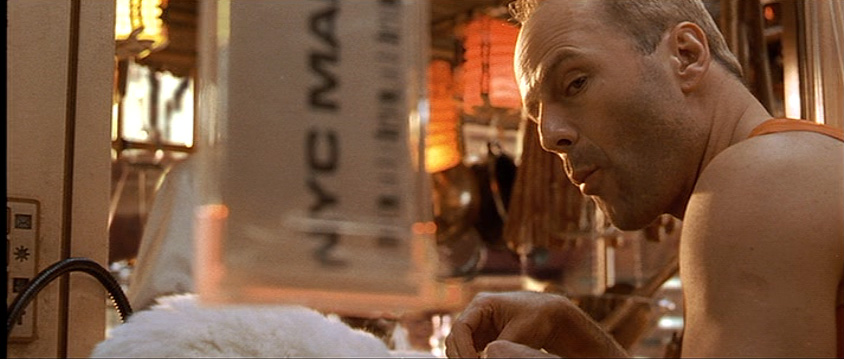
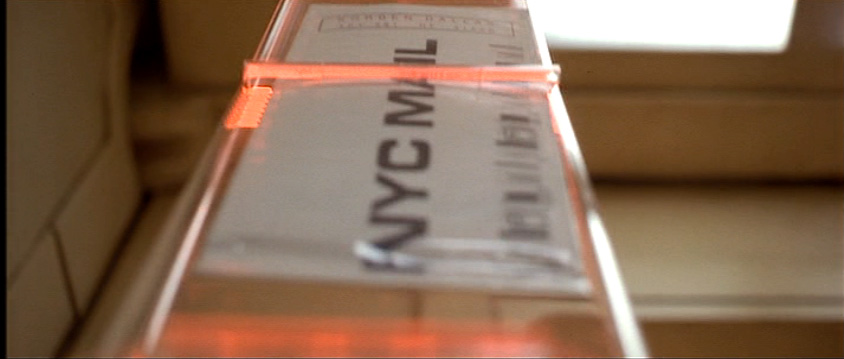
Korben receives physical mail to a transparent, flat pneumatic tube in his apartment. When new mail arrives, he hears a whoosh, the envelope drops into place, and the plastic material that the tube is made of becomes edge-lit with the film’s signature orange color.

fifthelement-193

To retrieve the letter, Korben lifts a hinged side and slides the letter out. The tube hangs at from the ceiling about waist high, to the left of his window desk on the far side of his apartment from the door.

fifthelement-195

The positioning of the tube is nice as the desk is one place he’s likely to put information received there to use: reading and storing if necessary. Another location might have been near the door, to catch his attention in a physical location that he frequents. But infrequent use is not too much of a problem since the edge lighting should catch his attention.

His attention could be drawn more aggressively to the tube by having the light blink a few times at the arrival of new mail, or when he enters the apartment. Presuming the system knows the importance of a given letters—such as when he is fired from Zorg industries—it could offer an additional audio cue, such as a simple statement of "urgent" using the same voice that announces his allotment of cigarettes in the morning.

Another tiny improvement might be to remove the flap entirely, but adding a grip gap at the edge, on the apartment-facing side of the tube. Presuming this wouldn’t mess with the pneumatic or stability of the letter in place, it would save Korben from having to target and raise the flap. Grabbing mail would just be easier.

Oddly, the edge lighting does not disappear when Korben retrieves letters, which is odd given the slight context-awareness that the rest of the apartment displays. The light should turn off or fade once the letter is removed.

The Door

fifthelement-doorpanel

The door to unit 281-53 has security and control features that make it Not Like Our Doors.

Sweetie’s Door

Korben’s white cat is named Sweetie. After a long night of carousing the 5000 block, she wants to be let back in, so she meows at the door as soon as she hears Korben’s alarm go off. He presses the lowest on the 5-button panel and a little cat-sized door opens up to let her in. After she passes through, it immediately closes behind her.

The kitty door could be improved by lessening the work it requires of Korben to zero, by automatically opening and closing for Sweetie. Even if Korben wanted her outside for certain hours of the night, we’ve seen that the apartment knows about schedules, so could accomodate another few bytes of scheduling information. To provide automatic access, though, would require some kind of identification. Low-level tokens like an RFID on her collar could work (such systems are sold today) but Korben lives in a crime-ridden area and any criminal could swipe the collar and use it to open the kitty door to “case the joint” or use some trickery to open the big door. An implanted RFID chip would be worse since it would put Sweetie’s life at risk as a “key.” More passive systems like kitty-biometrics would be much more expensive, and all the other evidence in the film tells us that this is not a wealthy man’s apartment. Ultimately, though there are other solutions for the problem, none fit the circumstances as well.

fifthelement-052

Four out of five of the panel’s icons are clearer than those seen on the apartment’s other panels.

  • A moon (the mysterious one. Night mode?)
  • A high star (for shining a light from above the door, downward?)
  • An ajar door, for opening or closing it
  • A low star (for shining a light below on Sweetie
  • A a cat face (and cat butt?) for opening Sweetie’s door

In addition to being readable, they’re also well-mapped. The button for the human is in the middle. The cat door is lower on the panel. Let’s presume the lights are similarly well mapped.

The only difficulty this system might have is accidental activation of the wrong thing since the buttons are so similar and close together. It might not be so bad to accidentally turn on a light when you meant to open the door, but if you’d intended to turn on the light to check who’s outside and then accidentally opened the door, it could mean a home invasion. This is a Fitts’ Law problem for a doorknob. Better would be for the “knob” to be a hand’s width distant from any of the other buttons. This would also save him from having to look to target it precisely to do something as common as shutting the door.

Video peephole

Unlike adorable kittens, humans on the other side of the door may pose a threat. Korben can see who has come calling via a video monitor, located above the panel. The feed is always on. The video camera sits above the lintel and aims straight down, so Korben can see all the way to where Sweetie would be. Three buttons below the monitor are not seen in use. For most cases, the monitor would work well. Korben can glance at it from anywhere in the room and have a good idea who is there. And, since it’s a one-way system, he has time to get quick things done before answering without seeming too rude.

FifthE-doormonitor001

That said, the camera is not foolproof. Early in the film Korben checks it and though it looks as if the hallway was empty, upon opening it finds a would-be robber who has donned a “hat” with a picture of the empty hallway from the perspective of the camera. Though he’s ultimately unsuccessful in robbing Korben his ruse to appear invisible to the door monitor worked perfectly. Multiple cameras might make it harder for this trick to be effective, but some other sensors, like a weight sensor under the floor outside or heat sensor would be harder to fool.

fifthelement-061

As if that weren’t bad enough, the fact that the camera has a very limited field of view allows anyone to hide just off to the side. Cornelius uses this tactic when he uses Leeloo as a sort of video bait to get him to open the door.

FifthE-doormonitor002

FifthE-doormonitor005

This latter problem could be solved with a fisheye lens on the camera (y’know, like real peepholes), which would show him more of the hallway and reduce the places where an assailant could easily hide.

Slideaway bed

slideaway

When Korben stands up, his bed recognizes the change. In response it pulls the messy bed and linens away, where they will be “autowashed,” i.e. automatically sanitized, remade, and sealed in plastic (for bedbug protection?) A fresh bed rises up to replace the messy one as the bedframe slides into the wall.

This automated response might be frustrating if it presumed too much. Say, if Korben got up in the night to use the restroom and came back to find his bed missing, so you’d want it to be as context-aware as possible. And there’s evidence that it’s not too smart a system. Later in the film Cornelius hides in the bed and is nearly suffocated as it tries to autowash the bed with him in it, and wraps him in plastic. I get the comedy in the scene, but really, if it had the sensors to know when Korben was laying down in it, it should have a safety that prevents that very thing when a person is there.

fifthelement-autowash

Korben does have manual controls. There are two panels of pushbuttons at waist height, about a meter apart on a sliver of wall above the bed recess. We don’t get great views of these panels, but we do see Korben using one of the buttons to hide General Munro and his cronies in the hideaway refrigerator. In the glimpses we get we can see that there are six buttons on each panel, each button labeled with a high-contrast icon. The leftmost button on each controls the bed. Pressing it when it’s hidden opens it. Pressing it when it’s open closes it and, as we saw before, starts the murderous autowash.

fifthelement-aptcontrols

All told it’s a pretty awesome system. The agentive part of getting up is handled seamlessly. The alarm has gone off, Korben’s up, and having the bed disappear saves space in the room and removes the temptation of Korben’s slinking back to bed and making himself late for work. And to summon the bed or hide it manually at some unusual time, Korben has understandable, accessible controls. The main down side is the lack of a safety or panic button, and the comparatively minor annoyance that Korben has to tear that plastic off every night even if he just wanted to pass out after a long day of saving the world.

Four a day

An electronic quit smoking device displaying refill options, a countdown timer, and various indicators.

After Korben’s alarm clock starts the music and lights the lights, it also drops his daily allotment of cigarettes into place inside vertical glass tubes in a small dispensary mounted on the wall. Each tube has a purple number printed across the top, reinforcing the limit. A robotic voice tells reminds him to only have “four. a. day.”

fifthelement-4aday

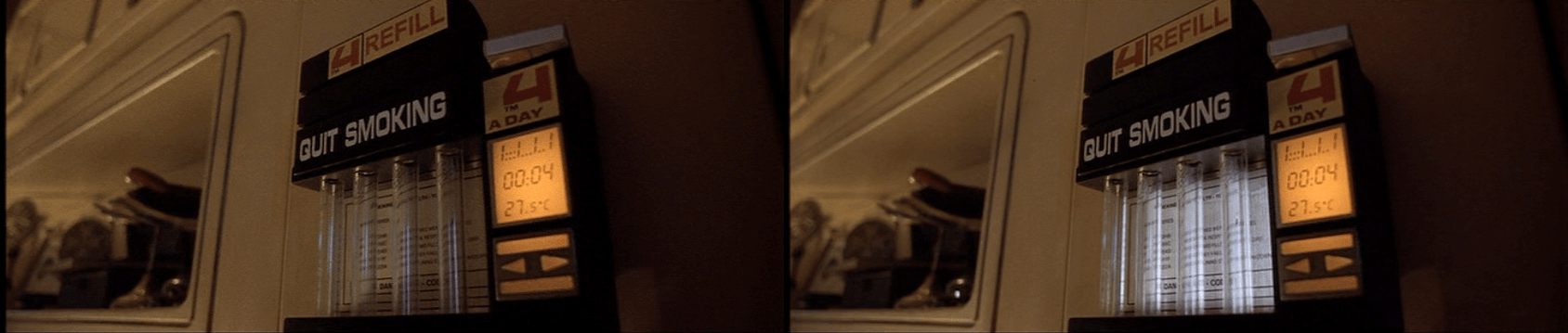
The dispensary is loaded with warnings to get him to quit. Across the top we read 4™ REFILLS. Just below that is a white imperative, QUIT SMOKING. To the right another legend reinforces the principles spoken aloud, 4™ A DAY. A legend across the bottom, written in glittery red capitals reminds him that, TO QUIT IS MY GOAL. Behind the glass tubes is something like a Surgeon General’s warning about the dangers of smoking.

On the right is a small LCD panel with a mysterious readout at the top of 1:::1…1..1, a counter in the middle reading 00:04 (it looks like just after midnight in military time, but we know from his alarm clock it’s just after 02:00), and a temperature readout that confirms the temperature that the clock displays, 27.5° C. Below this panel is a small set of four buttons: two horizontal ones that sandwich two triangular ones pointing in opposite directions. Korben presses the lowest button to pick up the first cigarette, and the #1 cylinder of glass slides up. A smaller “vase” of glass holds the cigarette upright for Korben to grab.

A shirtless man talking on a phone while pointing at a control panel on the wall.

The LCD panel

The top readout is a mystery, and the middle might be a counter of number of cigarettes remaining for the day or in the refill, but why it’s in 24-hour notation is another mystery. The temperature doesn’t make much sense here. Better might be the variable information that the addicted smoker really wants: How soon until I can get my next fix. A clock showing that time would be useful, and give the smoker something to fixate on instead of the cravings. A countdown clock might be information that the smoker wants, but it would focus his attention on the device rather than on his willpower.

To quit is my goal

Really, it’s beyond the scope of this blog post to try and state the authoritative psychology of quitting smoking, but it does seem like this device accomplishes one common strategy well, which is reminding smokers of their goal. There it is, in glittery red, in a first-person voice.

But it doesn’t do everything well. Another strategy to quit is for smokers to have reminders of the negative consequences of continuing to smoke, and the device only kind of does this with the warning label. The fact that it’s behind the glass tubes is nice since to get at the cigarettes the smoker wants, he is faced with that text. But, it’s only text, and easy to simply not read. The fact that the cylindrical glass distorts the text makes willful ignoring even easier, since it hinders readability. Better would be a visceral, instantly-recognizable image, like Australia mandated on their cigarette packaging in 2011. The disturbing nature of these images would be enhanced by the cylinder’s distortions.

Cigarette warning packaging highlighting the effects of smoking, including blindness, mouth and throat cancer, and the dangers of secondhand smoke to children.

On the other hand, one strategy is to eliminate the triggers that remind a smoker about cigarettes, and this dispensary does exactly the opposite. By being prominently displayed on the wall, being associated with waking up, and having the word “smoking” appear in high-contrast capital letters at eye level, it pretty much acts as a trigger to remind Korben about smoking. Better might be a hideaway dispensary, similar to his bed, refrigerator, or shower in the apartment, which hide themselves away when not in use.

Surgeon General’s Warning

The other problem is habituation. After repeated exposure to this device on a daily basis, Korben will begin to disregard the signal. A more persuasive system would change, such that the consequences and goals are kept fresh on Korben’s mind. To make sure it hits home at the right time, I would get rid of the extraneous buttons and have one “time-release” button, that requires him to press and hold it for a few seconds to get at the cigarette. During this enforced moment of boredom, the device can flash a new message and dissuasive image, giving Korben a moment to consider this and whether he really wants to keep pressing the button for his cigarette. The LCD panel would need to display these instructions first, and then switch to showing the time at which the next cigarette will be available.

A device displaying the message 'SMOKING CAUSES BLINDNESS' with a digital screen indicating daily goals beside a series of tubes visible in the front.

Good morning, Korben

5E-alarm_notext

Korben’s alarm clock is a transparent liquid-crystal display that juts out from a panel at the foot of his bed. When it goes off, it emits a high-pitched repetitive whine. To silence it, Korben must sit up and pinch it between his fingers.

There’’s some subtle, wicked effeciveness to that deactivation. Like a regular alarm clock, the tactic is to emit some annoying sound that persists until the sleeper can rouse themselves enough to turn off the alarm. The usual problem with this tactic is that the sleeper is stupefied in his half-awakeness. If he can sleepily stop the alarm and just go back to sleep, he’ll do it. This clock dissuades sleepy flailing with its sharp-ish corners. After just a few times trying to do that and failing, the scratches on his hand will teach him. Even if the motion is memorized, the sleeper has to wake enough to target it properly and execute the simple but precise input.

The display itself shows the time in astronomical format, i.e. “02:00”, the date (Director Luc Besson‘s birthday), “18 MAR 2263″, and a temperature, 27.5° C.” Since this is quite warm, I presume this is the temperature outside.

fifthelement-fish

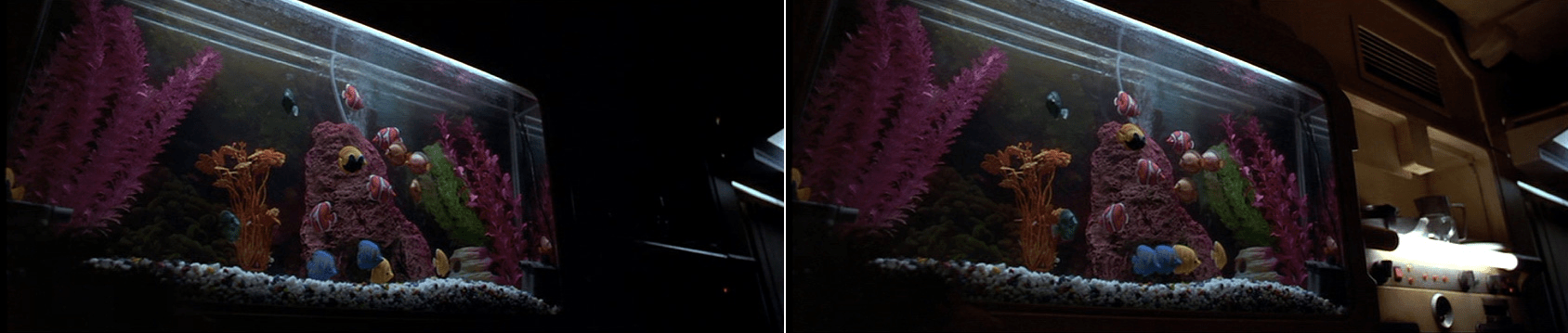
Once Korben cancels the alarm, his apartment comes to life. Heavy-beat music begins to play and lights automatically illuminate near the fake-fish tank above the stove and in his cigarette dispenser.

fifthelement-cigs

All these signals combine to make it difficult for sleepy Korben to stay in bed past when awake Korben knows he should be up and moving.

Headsets

FifthE-UFT005

On duty military personnel—on the ship and attending the President—all wear headsets. For personnel talking to others on the bridge, this appears to be a passive mechanism with no controls, perhaps for having an audio record of conversations or ensuring that everyone on the bridge can hear one another perfectly at all times.

FifthE-UFT009

Personnel communicating with people both on the ship’s bridge and the president have a more interesting headset.

Signaling dual-presence

The headsets have antennas rising from the right ear, and each is tipped with a small glowing red light. This provides a technological signal that the device is powered, but also a social signal that the wearer may be engaged in remote conversations. Voice technologies that are too small and don’t provide the signal risk the speaker seeming crazy. Unfortunately this signal as it’s designed is only visible from certain directions. A few extra centimeters of height would help this be more visible. Additionally, if the light could have a state to indicate when the wearer is listening to audio input that others can’t hear, it would provide a person in the same room a cue to wait a moment before getting his attention.

FifthE-UFT016

Secondary conversants

Each headset has a default open connection, which is always on, sending and receiving to one particular conversant. In this way General Staedert can just keep talking and listening to the President. Secondary parties are available by means of light gray buttons on the earpieces. We see General Munro lift his hand and press (one/both of?) these buttons while learning about the growth rate of the evil planet.

FifthE-UFT011

The strategy of having one default and a few secondary conversants within easy access makes a great deal of sense. Quick question and answer transactions can occur across a broad network of experts this way and get information to a core set of decision makers.

The design tactic of having buttons to access them is OK, but perhaps not optimal. Having to press the buttons means the communicator ends up mashing his ear. The easiest to “press” wouldn’t be a button at all but a proximity switch, that simply detects the placement of the hand. This has some particular affordance challenges, but we can presume military personnel are well trained and expert users.

Missile Scan

Despite its defenses, Staedert continues with the attack against the evil planet, and several screens help the crew monitor the attack with the “120” missiles.

fifthelement-030

First there is an overhead view of the space between the ship and the planet. The ship is represented as a red dot, the planet as a red wireframe, and the path of the missiles magnified as a large white wireframe column. A small legend in the upper right reads “CODIFY” with some confirmation text. Some large text confirms the missiles are “ACTIVE” and an inscrutable “W 6654” appears in the lower right.

As the missiles launch, their location is tracked along the axis of the column as three white dots. The small paragraph of text in the upper right hand scrolls quickly, displaying tracking information about them. A number in the upper left confirms the number of missiles. A number below tracks some important pair of numeric variables. In the lower right, the label has changed to “SY 6654.” A red vertical line tracks with the missiles across the display, and draws the operator’s attention to another small pair of numeric variables that also follow along.

These missiles have no effect, so he sends a larger group of 9 “240” missiles. Operators watch its impact through the same display.

fifthelement-035

fifthelement-036

fifthelement-037

These screens are quite literal in the information they provide, i.e. physical objects in space, but abstract it in a way that helps a tactician keep track of and think about the important parts without the distraction of surface appearance, or, say, first-person perspective. Of all the scanner screens, these function the best, even if General Staedert’s tactics were ultimately futile.

FifthE-UFT015

Surface Scan

fifthelement-025

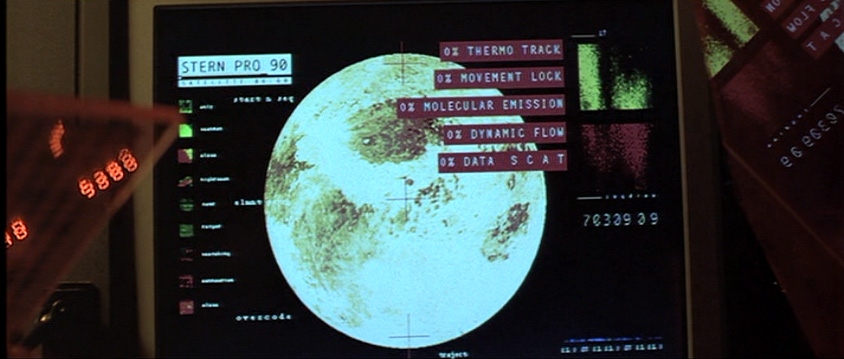
Later in the scene General Staedert orders a “thermonucleatic imaging.” The planet swallows it up. Then Staedert orders an “upfront loading of a 120-ZR missile” and in response to the order, the planet takes a preparatory defensive stance, armoring up like a pillbug. The scanner screens reflect this with a monitoring display.

fifthelement-026

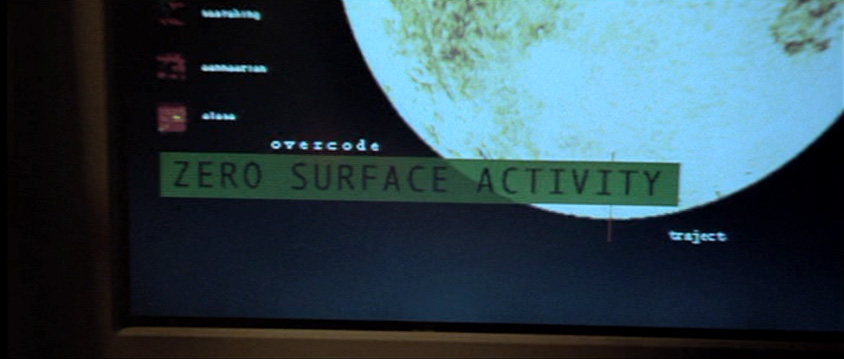
In contrast to the prior screen for the Gravity (?) Scan, these screens make some sense. They show:

  • A moving pattern on the surface of a sphere slowing down
  • clear Big Label indications when those variables hit an important threshold, which is in this case 0
  • A summary assessment, “ZERO SURFACE ACTIVITY”
  • A key on the left identifying what the colors and patterns mean
  • Some sciency scatter plots on the right

The majority of these would directly help someone monitoring the planet for its key variables.

fifthelement-027

Though these are useful, it would be even more useful if the system would help track these variables not just when they hit a threshold, but how they are trending. Waveforms like the type used in medical monitoring of the “MOVEMENT LOCK,” “DYNAMIC FLOW,” and “DATA S C A T” might help the operator see a bit into the future rather than respond after the fact.