The HoverChair Social Network

WallE-SocialNetwork03

The other major benefit to the users of the chair (besides the ease of travel and lifestyle) is the total integration of the occupant’s virtual social life, personal life, fashion (or lack-thereof), and basic needs in one device. Passengers are seen talking with friends remotely, not-so-remotely, playing games, getting updated on news, and receiving basic status updates. The device also serves as a source of advertising (try blue! it’s the new red!).

A slight digression: What are the ads there for? Considering that the Axiom appears to be an all-inclusive permanent resort model, the ads could be an attempt to steer passengers to using resources that the ship knows it has a lot of. This would allow a reprieve for heavily used activities/supplies to be replenished for the next wave of guests, instead of an upsell maneuver to draw more money from them. We see no evidence of exchange of money or other economic activity while on-board the Axiom

OK, back to the social network.

Security?

It isn’t obvious what the form of authentication is for the chairs. We know that the chairs have information about who the passenger prefers to talk to, what they like to eat, where they like to be aboard the ship, and what their hobbies are. With that much information, if there was no constant authentication, an unscrupulous passenger could easily hop in another person’s chair, “impersonate” them on their social network, and play havoc with their network. That’s not right.

It’s possible that the chair only works for the person using it, or only accesses the current passenger’s information from a central computer in the Axiom, but it’s never shown. What we do know is that the chair activates when a person is sitting on it and paying attention to the display, and that it deactivates as soon as that display is cut or the passenger leaves the chair.

We aren’t shown what happens when the passenger’s attention is drawn away from the screen, since they are constantly focused on it while the chair is functioning properly.

If it doesn’t already exist, the hologram should have an easy to push button or gesture that can dismiss the picture. This would allow the passenger to quickly interact with the environment when needed, then switch back to the social network afterwards.

And, for added security in case it doesn’t already exist, biometrics would be easy for the Axiom. Tracking the chair user’s voice, near-field chip, fingerprint on the control arm, or retina scan would provide strong security for what is a very personal activity and device. This system should also have strong protection on the back end to prevent personal information from getting out through the Axiom itself.

Social networks hold a lot of very personal information, and the network should have protections against the wrong person manipulating that data. Strong authentication can prevent both identity theft and social humiliation.

Taking the occupant’s complete attention

While the total immersion of social network and advertising seems dystopian to us (and that’s without mentioning the creepy way the chair removes a passenger’s need for most physical activity), the chair looks genuinely pleasing to its users.

They enjoy it.

But like a drug, their enjoyment comes at the detriment of almost everything else in their lives. There seem to be plenty of outlets on the ship for active people to participate in their favorite activities: Tennis courts, golf tees, pools, and large expanses for running or biking are available but unused by the passengers of the Axiom.

Work with the human need

In an ideal world a citizen is happy, has a mixture of leisure activities, and produces something of benefit to the civilization. In the case of this social network, the design has ignored every aspect of a person’s life except moment-to-moment happiness.

This has parallels in goal driven design, where distinct goals (BNL wants to keep people occupied on the ship, keep them focused on the network, and collect as much information as possible about what everyone is doing) direct the design of an interface. When goal-driven means data driven, then the data being collected instantly becomes the determining factor of whether a design will succeed or fail. The right data goals means the right design. Wrong data goals mean the wrong design.

Instead of just occupying a person’s attention, this interface could have instead been used to draw people out and introduce them to new activities at intervals driven by user testing and data. The Axiom has the information and power, perhaps even the responsibility, to direct people to activities that they might find interesting. Even though the person wouldn’t be looking at the screen constantly, it would still be a continuous element of their day. The social network could have been their assistant instead of their jailer.

One of the characters even exclaims that she “didn’t even know they had a pool!”. Indicating that she would have loved to try it, but the closed nature of the chair’s social network kept her from learning about it and enjoying it. By directing people to ‘test’ new experiences aboard the Axiom and releasing them from its grip occasionally, the social network could have acted as an assistant instead of an attention sink.

WallE-SocialNetwork05

Moment-to-moment happiness might have declined, but overall happiness would have gone way up.

The best way for designers to affect the outcome of these situations is to help shape the business goals and metrics of a project. In a situation like this, after the project had launched a designer could step in and point out those moments were a passenger was pleasantly surprised, or clearly in need of something to do, and help build a business case around serving those needs.

The obvious moments of happiness (that this system solves for so well) could then be augmented by serendipitous moments of pleasure and reward-driven workouts.

We must build products for more than just fleeting pleasure

WallE-SocialNetwork09

As soon as the Axiom lands back on Earth, the entire passenger complement leaves the ship (and the social network) behind.

It was such a superficial pleasure that people abandoned it without hesitation when they realized that there was something more rewarding to do. That’s a parallel that we can draw to many current products. The product can keep attention for now, but something better will come along and then their users will abandon them.

WallE-SocialNetwork07

A company can produce a product or piece of software that fills a quick need and initially looks successful. But, that success falls apart as soon as people realize that they have larger and tougher problems that need solving.

Ideally, a team of designers at BNL would have watched after the initial launch and continued improving the social network. By helping people continue to grow and learn new skills, the social network could have kept the people aboard the Axiom it top condition both mentally and physically. By the time Wall-E came around, and life finally began to return to Earth, the passengers would have been ready to return and rebuild civilization on their own.

To the designers of a real Axiom Social Network: You have the chance to build a tool that can save the world.

We know you like blue! Now it looks great in Red!

The Hover Chair

Three animated characters lounging in futuristic chairs, enjoying drinks, set in a vibrant, high-tech environment.

The Hover Chair is a ubiquitous, utilitarian, all-purpose assisting device. Each passenger aboard the Axiom has one. It is a mix of a beach-side deck chair, fashion accessory, and central connective device for the passenger’s social life. It hovers about knee height above the deck, providing a low surface to climb into, and a stable platform for travel, which the chair does a lot of.

A Universal Wheelchair

We see that these chairs are used by everyone by the time that Wall-E arrives on the Axiom. From BNL’s advertising though, this does not appear to be the original. One of the billboards on Earth advertising the Axiom-class ships shows an elderly family member using the chair, allowing them to interact with the rest of the family on the ship without issue. In other scenes, the chairs are used by a small number of people relaxing around other more active passengers.

At some point between the initial advertising campaign and the current day, use went from the elderly and physically challenged, to a device used 24/7 by all humans on-board the Axiom. This extends all the way down to the youngest children seen in the nursery, though they are given modified versions to more suited to their age and disposition. BNL shows here that their technology is excellent at providing comfort as an easy choice, but that it is extremely difficult to undo that choice and regain personal control.

But not a perfect interaction

We see failure from the passengers’ total reliance on the chairs when one of them (John) falls out of his chair trying to hand an empty drink cup to Wall-E. The chair shuts down, and John loses his entire connection to the ship. Because of his reliance on the chair, he’s not even able to pull himself back up and desperately reaches for the kiosk-bots for assistance.

A child's hand reaching out towards a colorful ice cream vendor cart surrounded by bright advertising posters.

This reveals the main flaw of the chair: Buy-N-Large’s model of distinct and complete specialization in robot roles has left the chair unable to help its passenger after the passenger leaves the chair’s seat. The first responders—the kiosk bots—can’t assist either (though this is due to programming, not capability…we see them use stasis/tractor beams in another part of the ship). Who or what robot the kiosk-bots are waiting for is never revealed, but we assume that there is some kind of specialized medical assistance robot specifically designed to help passengers who have fallen out of their chairs.

If these chairs were initially designed for infirm passengers, this would make sense; but the unintended conscription of the chair technology by the rest of the passengers was unforeseen by its original designers. Since BNL focused on specialization and fixed purpose, the ship was unable to change its programming to assist the less disabled members of the population without invoking the rest of the chair’s emergency workflow.

John reaching for help from the Kiosk-bots makes it appear that he either has seen the kiosk-bot use its beams before (so he knows it has the capability to help, if not the desire), or he pays so little attention to the technology that he assumes that any piece of the ship should be able to assist with anything he needs.

Whether he’s tech literate or tech insensitive and just wants things to work like magic as they do on the rest of the ship. The system is failing him and his mental model of the Axiom.

Make it ergonomic in every situation

Scene from animated movie featuring a small robot named Wall-E interacting with a large human character in a futuristic environment filled with entertainment screens.

Considering that the chairs already hover, and we know Buy-N-Large can integrate active tractor beams in robot design, it would have been better to have a chair variant that allowed the passenger to be in a standing position inside the chair while it moved throughout the ship. It would then look like a chariot or a full-body exo-skeleton.

This would allow people who may not be able to stand (either due to disability or medical condition) to still participate in active sports like tennis or holo-golf. It would also allow more maneuverability in the chair, allowing it to easily rotate to pick up a fallen passenger and reposition them in a more comfortable spot, even if they needed medical attention.

This would allow immobilization in the case of a serious accident, giving the medical-bot more time to arrive and preventing the passenger from injuring themselves attempting to rescue themselves.

The chair has been designed to be as appealing to a low-activity user as possible. But when technology exists, and is shown to be relatively ubiquitous across different robot types, it should be integrated at the front line where people will need it. Waiting for a medical bot when the situation doesn’t demand a medical response is overly tedious and painful for the user. By using technology already seen in wide use, the chair could be improved to assist people in living an active lifestyle even in the face of physical disabilities.

The SandPhone

LogansRun037

Not everyone is comfortable giving over to the flimsy promise of Carrousel [sic]. Some citizens run, and Sandmen find and terminate these cultural heretics.

Sandmen carry a device with them that has many different uses. It goes unnamed in the movie, so let’s just call it the SandPhone. It is a thick black rectangle about 20cm at its long edge, about the size of a very large cell phone. Near the earpiece on one broad side is a small screen for displaying text and images. Below that is a white line. The lower half of this face is metallic grill that covers a microphone. On the left edge is a momentary button that allows talking. Just above this is a small red button. When not in use, the device is holstered on the sandman’s belt.

The SandPhone lets the Sandman receive information through a display that can show both image and text. The Sandman sends back information and requests by voice in a CB radio metaphor.

Notifications

The first time we see the device is when Logan and Francis are attending Carrousel. Somehow, on his belt it catches his attention. With the crowd too loud for sound, and no evidence it’s light, my bet’s on haptics. Realizing he’s got a message, he picks it up, presses the edge button and the screen displays two lines of text:

RUNNER: GREAT HALL
ENTRANCE WEST.

He then puts the device to his face as we would a cell phone and shouts, “Affirmative!” as loud as he can.

LogansRun038

Perp wayfinding

Running with the device outside the Great Hall, Logan uses the SandPhone as a detector. By holding it flat out in front of him he hears a rhythmic pulse. Turning it this way and that, he listens for the change in pitch. It rises when he is pointing towards the targeted runner.

Bio identification

LogansRun046
LogansRun050

When he and Francis have terminated the runner, he snaps the device off his belt, and pressing the edge button, he reports back to dispatch, “Runner terminated, 0.31. Ready for cleanup.” Then by placing the device near the head of the dead runner, the device displays on the screen the last photographic image of him on file. Since the face on the SandPhone screen does not match the face he sees before him, Logan lifts the device to his face and, holding the edge button, requests an identity check of dispatch. Instantly he pulls the device away from his face to show the text:

IDENT. AFFIRM
NEW YOU #483
FACE CHANGE.

LogansRun182

Send backup

Much later in the film we see Logan alert dispatch to the location of the underground hideout by reaching down to the holstered device and pressing the white line button on its face. Its screen pulses green, and his position is highlight on the runner board (see below) at dispatch. Minutes later the location is raided by Sandmen.

Analysis

The first thing to note is that this is pretty close to a modern smart phone. He receives images and text messages, can talk to dispatch, and it has a biometric capability for identifying citizens. It’s tempting to paint this as visionary, but keep in mind that the first mobile phone was demonstrated in 1973, three years earlier, so it’s likely that the film makers were riffing off of the demo technology they’d heard about or maybe even seen in person.

We evaluate an interface’s design by how well it helps its user achieves his goals. (Even if those goals are anethma. That’s how we judge an interface.) In this case, the SandPhone helps Logan get the information he needs, when he needs it, across multiple channels. It doesn’t distract him with other functions. It’s context aware and doesn’t apparently have battery issues.

There are improvements of course.

We should make sure his hands are free by making the information available as an augmented reality display instead of a handheld device. This would also give him the information privately rather than display it for anyone (notably members of the resistance) to see it. Wayfinding would be more sensible as an overlay to his vision through this device.

Some surface tweaks might also be made, such as giving him a means of text input so he wouldn’t have to shout above the roar of Carrousel. Some silent means of input would help for when he needs to provide silent input as well. First I thought optical inputs might be ideal, given the augmented reality, but we don’t want his eyes distracted like that, even for the duration of glances. Instead some other gestural input—perhaps a face twitch or subvocal input—that lets him keep the rest of his body tense and ready for action.

Citizen biometrics should be a background fact, given the penopticon of Dome City. The information would come to him when he gets his assignement. But turn those same biometrics around on Logan, and his body could request reinforcements before he even thought to do so manually. When his heart rate elevates and galvanic skin response lowers, dispatch would know something was up, and route backup immediately.

A strategic interaction designer would even ask why he has to chase runners at all, when predictive algorithms could guess which citizens were likely to run and take action to forestall their rebellion. But then we’re into Minority Report, and this needs to stay Logan’s Run.

Dome City Rail

LogansRunCar-08

Citizens move between the distant parts of the city by means of a free, public transportation system. It is an ultra-light rail, featuring cars for two passengers, that move between long translucent tubes that connect the domes of the city. When one car stops at a station, its door slides open to allow exit and entry. We never see a car waiting behind another. Once seated, riders press a red button on a panel between the two seats (just visible in the screen capture below), and the car seals shut and takes off to the next station.

LogansRunCar-04
LogansRun144

A small panel inside the car alerts passengers to the name of the next stop as well as any additional information that is of use. When Logan and Jessica head to Cathedral Station, the panel blinks a red light to draw their attention. (The paired green light is never seen illuminated. What’s it there for?) A female voice says “Entering a reservation for violent delinquents. Authorized persons only.” The screen before them reads, “personal risk area.” (For those wondering why it stops there at all, anyone can get out of their car here, but Logan has to use his personal communication device with Control to have the gate to Cathedral opened.

The panel and voice output are useful to alert riders whose attention has drifted. Text could be put in the environment of course, since this information rarely changes, but it’s a bit harder to read when it’s moving and isn’t as likely to gain a distracted rider’s attention.

The last bit of interface is the LED displays on the walls of fancier stops like Arcade (the dome with the shopping mall and Caroussel.) We never see this sign change, but it makes sense that while riders are at the station, it displays the stop as a reinforcing bit of information, and can display alternate messages for citizens waiting on a car otherwise.

LogansRunCar-03

The interface is incredibly simple because the system is so constrained. You have to hop on at a station, and like an airport tram or a shabbat elevator, the car runs along a fixed loop. You hop out when you’re there. The main negative issues I see are selecting a stop and perhaps safety.

Selecting a stop

It’s a waste of time and energy to have cars stopping and starting at unwanted stations. It can also be distracting to have the car tell you about all the intermediate stops when you’re not interested in them.

To solve this problem, the track system should be built with track bypasses so we have to worry less about track congestion at stops. Then riders could either ride the “local” from stop to stop, or optionally have some way to indicate their desired stop, bypassing the ones in between. What’s this indication look like? In the panopticon of Dome City, the Übercomputer can just listen to your conversations wherever you’re having them, and when you get to a car default to the stop expressed in conversation. Logan and Jessica had just spoken about Cathedral Station, so when they stepped in, it could have just asked them to confirm. If the selection was wrong, or no stop had been mentioned recently, riders should be able to speak their destination or the event to which they’re headed. As a last fallback, a screen displaying discrete options could allow them to select a destination by touch or gesture.

LogansRunCar-07

Rider safety

The safety issue is subtle, but if riders have no control over the cars, why are the seats facing forward? It’s much safer in a head-on collision to be seated “backward,” like an infant’s car seat. Psychologically, people are most comfortable sitting forward to see in the direction of potential collisions, but if you lived in an UberNanny State like Dome City, the system would just force people to sit in the safest way.

It’s going to be more complicated than this

Getting public transportation experience design right is tough enough. But it’s going to get more complicated. Here at the dawn of computer-driven cars and computer-requested and computer-wayfinding “routeless” busses, the challenges will be manifold. How do you signal a stop? How does it gracefully degrade? How do you pay? How do you get to a just-in-time defined stop? How do you indicate your destination(s), willingness to share the ride, and urgency? How do you not disenfranchise people just because they have no cell phone? Dome City is small and constrained enough to ignore such problems, like a light rail in a small, wealthy, downtown core, making it almost too simple to be instructive.

LogansRunCar-06

Retrogram

LogansRun127

The lifeclock is alterable, as we see when the Übercomputer sets Logan’’s lifeclock to blinking red years before he is actually due to Carousel. This procedure must be beyond the capabilities of the populace since it could be used to blackmail citizens, or, if reversible, to allow them to delay carousel.

Procedure

Why this procedure was designed in a way to cause stress and discomfort on the part of the subject is unclear. Since the computer is counting on Logan and needs his cooperation, it should have taken the exact opposite approach. Even if the discomfort is a necessary part of the retrogram, the computer should have handled it like a friendly nurse, explaining that there will be some unavoidable pain, and given Logan some tools to manage it like a number to count to. And c’mon, it should skip the ominous red light.

Industrial design

The other design consideration is the placement of the divot in which Logan must place his lifeclock for retrogramming. All told, it’s pretty good. It’s a natural placement, almost difficult for Logan to avoid putting his hand in the right spot. Even if the Übercomputer is going to just “sneak up” on Logan and retrogram him without warning, it’s the right spot given that the Übercomputer seems to have no complex actuators.

LogansRun-pip

There’s an interesting issue about the divot that depends on the level of pain that Logan is feeling. If it’s too great, Logan might jerk his hand away and ruin the retrogram. In that case, the arm of the chair should hold Logan’s hand in place, like one of those automated blood pressure cuffs. But the pain we see on Logan’s face in the scene doesn’t look that great. It looks like just enough to force him to concentrate to keep it there, to do his duty and comply. In this case even if the pain isn’t a necessary part of the operation, the Übercomputer might want to add that pain in, just as a test of his continued compliance.

Roach Cam

TheFifthElement-roachcam004

To learn the plans of the President, Zorg’s flunky named Right Arm infiltrates the briefing room via a remote-controlled cockroach. This adorable insect has a small parabolic receiver antenna on its back. Right Arm can watch what it sees with its eyes and listen to what it can hear through its… cerci?

TheFifthElement-roachcam001

The screen he uses is mostly full of the roachcam video. But it is unfortunately surrounded by some screen-green sciencey nonsense. A row across the top is headed “001” with rectangles labeled “MOVE”, “METHOD”, “CHECK”, and “SYSTEM.” A row just below is headed “A-B” with rectangles labeled “SPEED”, “TIMER”, “EXIT”, and “FILTERS.” A column of screen-green nonsense shapes fills the left side. A small butterfly-shaped graph at the bottom-left is labeled “CHECK.” A small box labeled “CALCULATING” is in the lower middle, which occasionally fills with scrolling nonsense. The right side of the screen is full of a circular graph showing a seizure-inducing flashing pair of green concentric circles. A green 8×8 grid on the right stays empty the whole time, though it is arguably the most likely useful thing, i.e. an overhead view of threats, say, like presidents brandishing cockroach-smashing shoes. Below the unused grid is a diagram of the roach itself, probably useful for understanding the health of the vehicle. Below that is a bit of unintelligible text reversed out of a gray background. When the roach nears the President, a bit of green nonsense text appears overlaid on the video feed, though it never changes.

I think this screen would have been less distracting and more helpful for Right Arm if you stripped away all the gunk at the top, the nonsensical overlay, trashed the column of hastily-drawn icons, saved him the constant distraction of the seizure circle by removing it, and leaving him with the two things that would actually be useful: the map (populated of course with some useful information), and the roach health diagram. Even though this screen is seen only for a few seconds at most, it reads as if it was hastily put together, unlike most other things seen in the film.

TheFifthElement-roachcam005

TheFifthElement-roachcam003

He is able to control the roach’s movement by means of a joystick with a rotating head. In contrast to the screen, this provides exactly what Right Arm needs to control the roach, and no more. He can move it forward and back by pushing the joystick forward and back. He can have it strafe right or left by moving the joystick appropriately. And when he wants to have it turn right or left, he can twist the joystick head in that direction. Pushing or twisting farther results in more motion. All told, a perfect input control for the task at hand. At least until you ask the roach.

TheFifthElement-roachcam002

Gravity (?) Scan

FifthE-UFT001

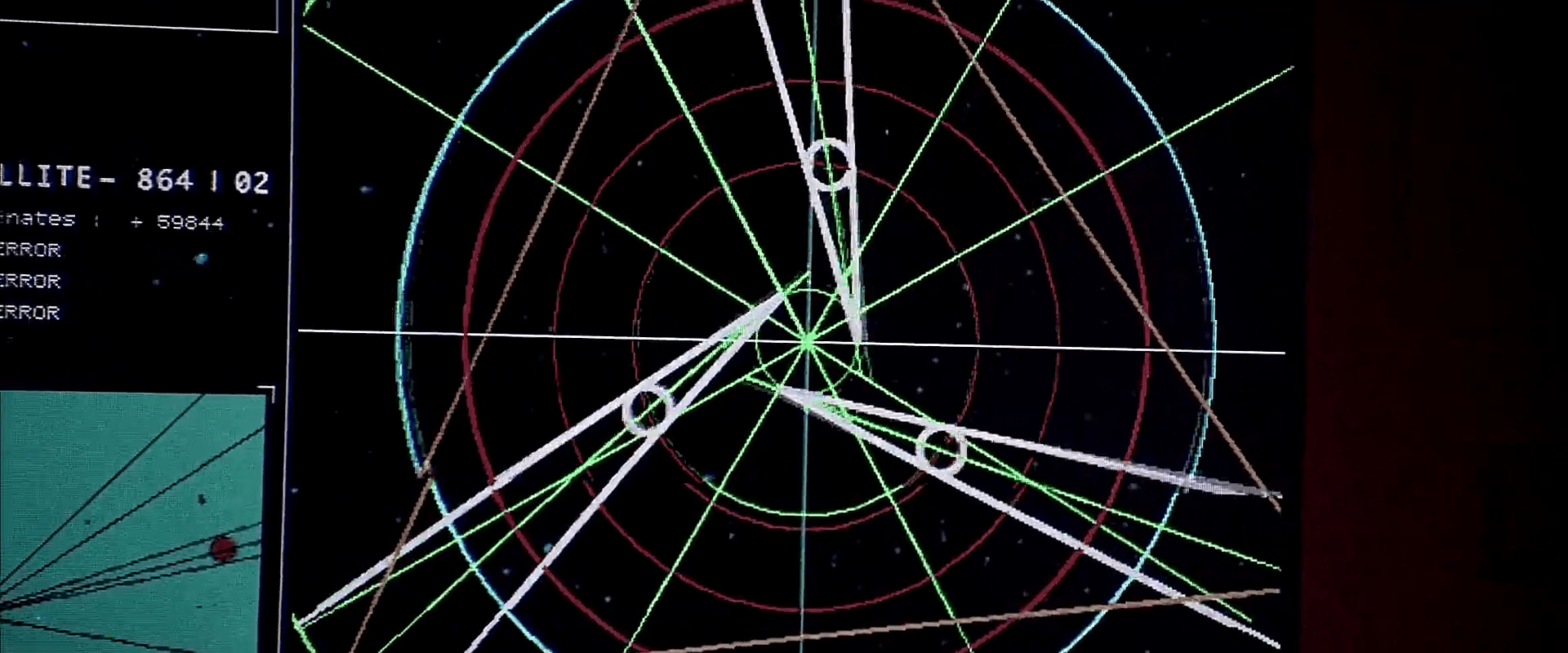
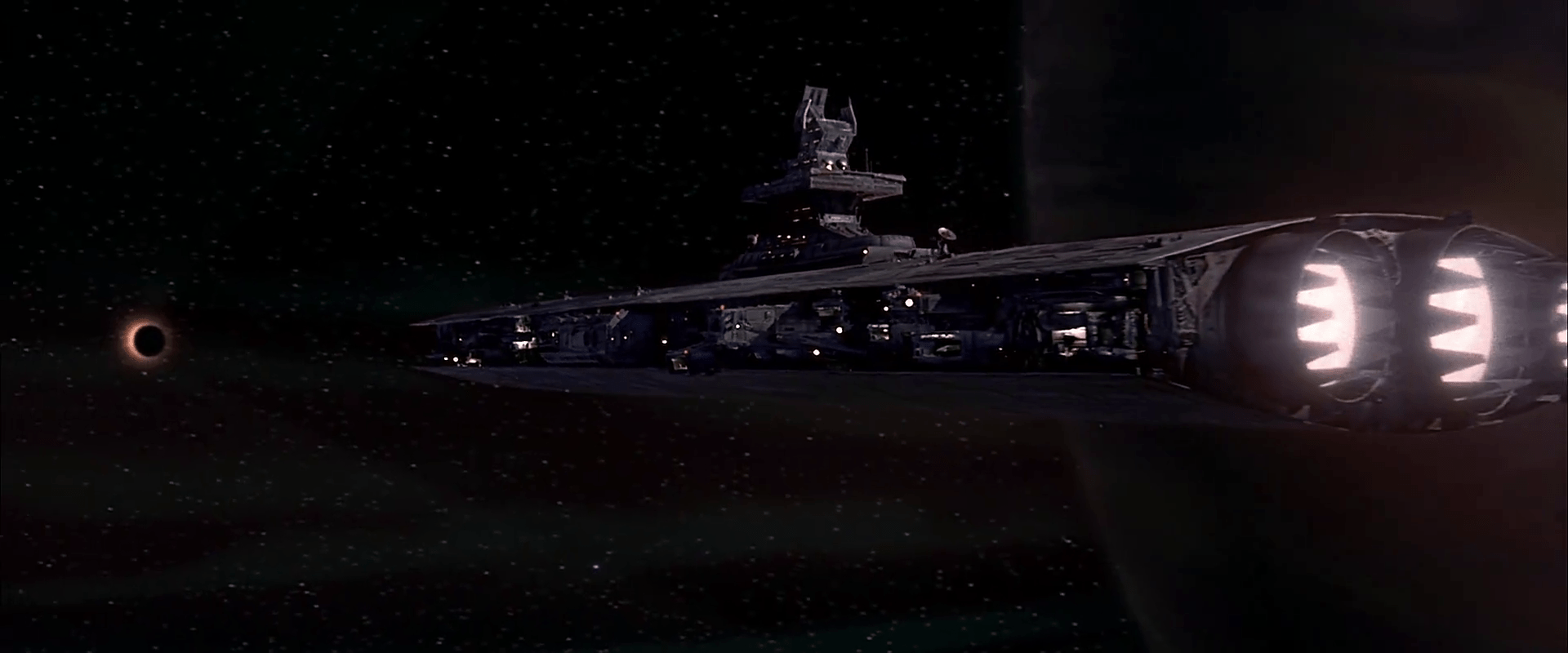
The first bit of human technology we see belongs to the Federation of Territories, as a spaceship engages the planet-sized object that is the Ultimate Evil. The interfaces are the screen-based systems that bridge crew use to scan the object and report back to General Staedert so he can make tactical decisions.

FifthE-UFT006

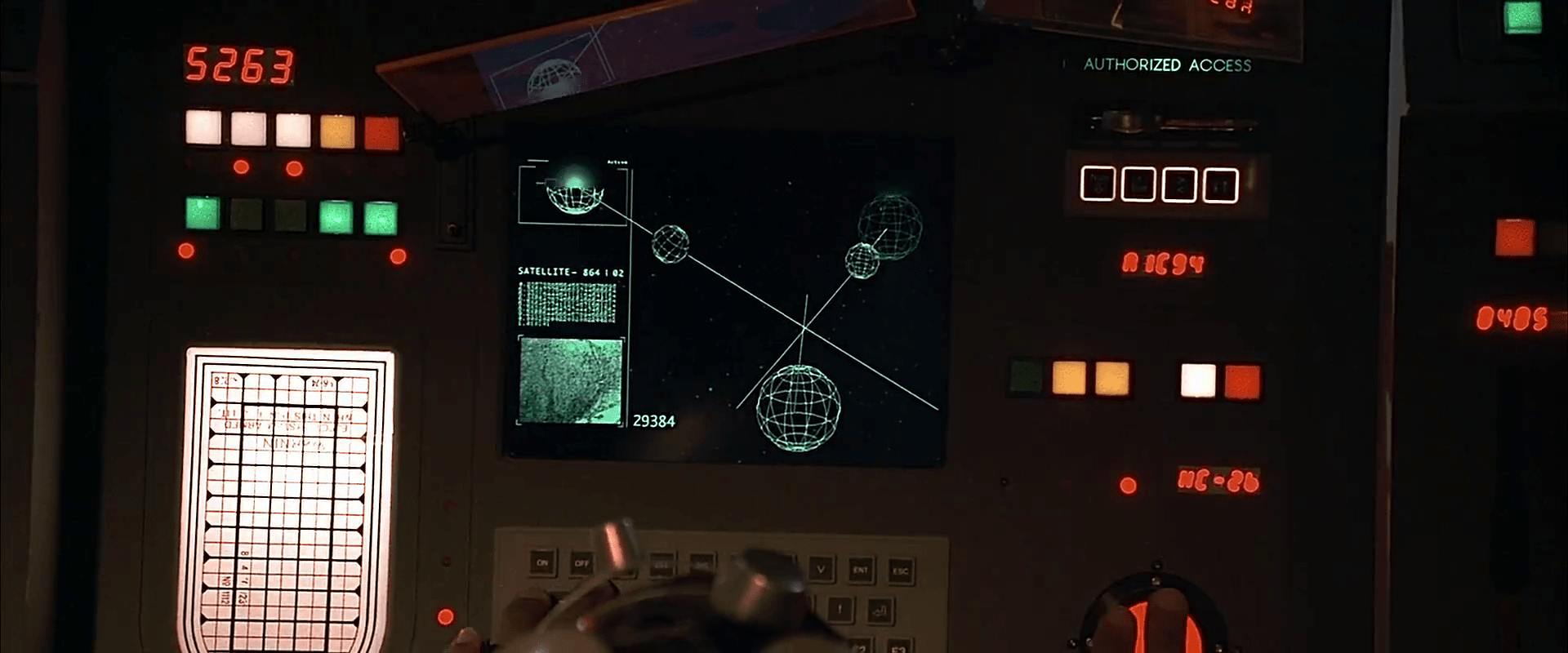
We see very few input mechanisms and very little interaction with the system. The screen includes a large image on the right hand side of the display and smaller detailed bits of information on the left. Inputs include

  • Rows of backlit modal pushbuttons adjacent to red LEDs
  • A few red 7-segment displays
  • An underlit trackball
  • A keyboard
  • An analog, underlit, grease-pencil plotting board.
    (Nine Inch Nails fans may be pleased to find that initialism written near the top.)

The operator of the first of these screens touches one of the pushbuttons to no results. He then scrolls the trackball downward, which scrolls the green text in the middle-left part of the screen as the graphics in the main section resolve from wireframes to photographic renderings of three stars, three planets, and the evil planet in the foreground, in blue.

FifthE-UFT008 FifthE-UFT014 FifthE-UFT010

The main challenge with the system is what the heck is being visualized? Professor Pacoli says in the beginning of the film that, “When the three planets are in eclipse, the black hole, like a door, is open.” This must refer to an unusual, trinary star system. But if that’s the case, the perspective is all wrong on screen.

Plus, the main sphere in the foreground is the evil planet, but it is resolved to a blue-tinted circle before the evil planet actually appears. So is it a measure of gravity and event horizons of the “black hole?” Then why are the others photo-real?

Where is the big red gas giant planet that the ship is currently orbiting? And where is the ship? As we know from racing game interfaces and first-person shooters, having an avatar representation of yourself is useful for orientation, and that’s missing.

And finally, why does the operator need to memorize what “Code 487” is? That places a burden on his memory that would be better used for other, more human-value things. This is something of a throw-away interface, meant only to show the high-tech nature of the Federated Territories and for an alternate view for the movie’s editor to show, but even still it presents a lot of problems.

Table Scanner

Prometheus-161

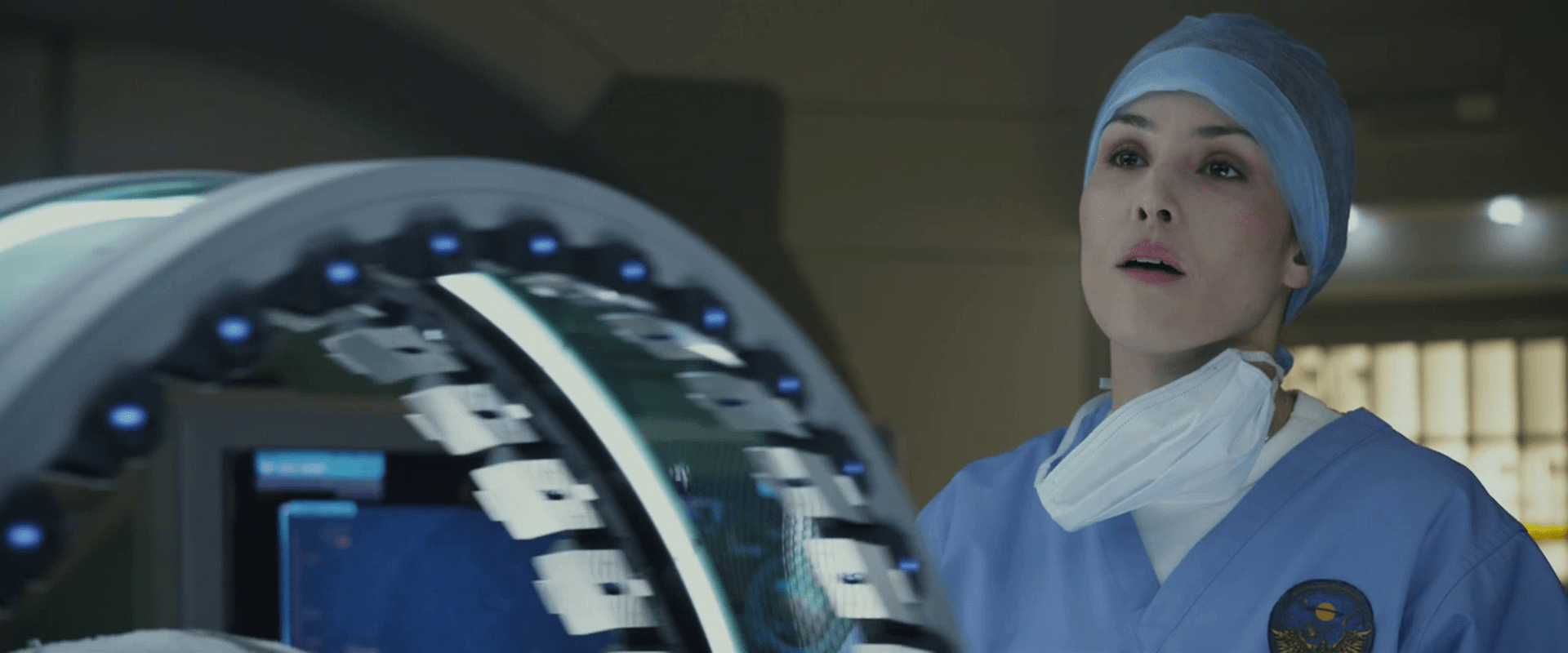
After sterilizing the alien head, it is slid out to a table scanner big enough for a crew member to lie upon. Ford brushes the head with some powered material, and says, “Scan.” In response, David presses a button on a nearby illuminated keypad before him, and an arch with sensors slides back and forth over the table on which the head rests. Ford looks at the scan on screen and says, “Dr. Shaw, look at this.”

Prometheus-162

Prometheus-164

The readout screen has a 3D floating pixel display like in the navigation and Neuro-Visor. In this case the scan reveals that the exterior of the object is not an exoskeleton but a suit. On the right side of the screen is a set of curiously organic graphic interface elements seen only on the sterilizer and otherwise unlike anything else in the film.

Prometheus-165

There isn’t a clear reason for this change in visual style, but it stands out, so bears a bit of notice. From a readout of 92% “EF-09/8 CONV.” there are lines that flow, like plant leaves, to other labels reading “PROCESSING DATA” and “SCAN HEADS STABLE.” The organic lines drop from the top of the screen to a circular element. These lines look like delicate filaments, and even overlap one another, before connecting to the circle. To the right of this circle more filaments drift from an arc to the upper third of a pie chart. And to the left of the large circle, more filaments run in organic arcs to a smaller circle reading “RKJ-RSSN RATIO”, with a bar chart augmented with numerical data, before drifting out to another circle reading 8.7, and finally arcing off to the lower right hand side of the screen. Comparing this interconnected set of GUI elements to anything else in the movie is a stark contrast. Other interfaces have horizontal and vertical lines, connected with regular filleted corners. The swoopy shapes are lovely, though a minor criticism might be that it feels a bit decorative for a scientific application.

The main criticism for this display is not its GUI but its placement. It requires the scientist to crane her neck to see the results, turning her field of vision far away from the object she’s examining. If there were sudden changes in its appearance, she’d likely miss them. Better would be to have the screen above the table or attached to its edge so a shift from object to scan can happen with a quick glance, and that would let the object remain in her peripheral vision so she would be more likely to notice any change.

Later this same scanning table is used on Dr. Shaw. No attempt is made to fit her into the de-sterilizer, though the point of the quarantine is to determine possible contagion. After a scan, he sees a VP readout that confirms she is pregnant with Halloway’s posthumous, alien baby.

Alien / Blade Runner crossover

I’m interrupting my review of the Prometheus interfaces for a post to share this piece of movie trivia. A few months ago, a number of blogs were all giddy with excitement by the release of the Prometheus Blu-Ray, because it gave a little hint that the Alien world and the Blade Runner world were one and the same. Hey internets, if you’d paid attention to the interfaces, you’d realize that this was already well established by 1982, or 30 years before.

A bit of interface evidence that Alien and Blade Runner happen in the same universe.