The Groomer

The groomer is a device for sale at the Wookie Planet Trading Post C by local proprietor Saun Dann. (It was named long before the evil pederast sense came to common use.) It looks like a dust brush with an OXO designed, black, easy-grip handle, with a handful of small silver pushbuttons on one side (maybe…three?), and a handful of black buttons on the other (again, maybe three). It’s kind of hard to call it exactly, since this is lower-res than a recompressed I Can Haz Cheezburger jpg.

SWHS-groomer-02

Let’s hear Saun describe it to the vaguely menacing Imperial shopper in his store.

Besides shaving and hair trimming, it’s guaranteed to lift stains off clothing, faces, and hands. Cleans teeth, fingers and toenails, washes eyes, pierces ears, calculates, modulates, syncopates life rhythms, and can repeat the Imperial Penal Code—all 17 volumes— in half the time of the old XP-21. Just the thing to keep you squeaky clean.

There are so many, many problems with this thing. On every level it’s wretched.

There are lots of product definition problems, of course, (e.g. worse feature bloat than iTunes) but these are issues for scifiproductdesign.com.

And there’s way too much ambiguity in the description, too. For instance, does it (calculate like a calculator), (modulate like a scientific calculator) and (syncopate life rhythms like a metronome)? Or does it (calculate life rhythms) and (modulate life rhythms) and (syncopate life rhythms)? What would any of that mean? Filed for scifiproductmanuals.com.

And is the Imperial Code thing supposed to be a joke? At first you think it’s a dig at this cog of the executive branch for some oppressive legislation enacted by the fascist political regime that gave him his license to menace, haha classic Saun Dann, but then he follows it with an actual performance metric comparison to a prior product version, which is named by model number. So it’s meant to be real? Scificomedywriting.com is still up for grabs, variety show writers from the 70s.

But for the interface questions…where to begin? How do the paucity of controls map to functions? Why are they undifferentiated? Where are the shaving bits? Why are the push controls covering the grip handle?

Which takes us to the darkest aspect of the product: as a single throwaway mention, hidden amongst distraction text, Saun says that it can pierce. Note that with the very poorly placed controls, there are no easy gaurds against accidental activation. It’s almost like it was meant to be a terribly designed, dangerous thing, as liable to leave a gaping hole in your tongue as prepare you for a visit to a dentist.

Because of its terrible industrial design, pointless features, and lawsuit-ready interface, I posit that this object is not something Saun has out to sell to beloved Wookie regulars. It’s something like a Chinese Finger Trap. Cruel shoes. A violent-joke product, only to be brought out when Imperial shoppers patronize the store, in the hopes that they would waste their time on pseudoscience, be forced to confront their own bureaucracy, and ultimately, accidentally pierce themselves in unspeakable places.

Way to subvert, shopkeep.

SWHS-groomer-01

Thumbpay

Biff(2015) pays for his taxi ride to the McFly household with his thumbprint. When the ride ends, a synthesized voice gives the price “one-seven-four-point-five-zero.” The taxi driver presents him with a book-sized device with the price at the top on a red 7-segment LED display. Biff presses his thumb on a reader at the bottom that glows white as it scans. When the payment is verified, the thumbprint reader and the price go dark as a sound plays like a register.

BttF_105

For due diligence, let me restate: multimodal biometric or multifactor authentication is more secure.

Thumbdentity

When officers Foley and Reese find the sleeping Jennifer, they thumbprint her on a wireless handheld device, and Officer Foley looks up the young girl’s information. Looking at the screen she retrieves Jennifer’(2015)’s address and age.

BttF_086

Thumbprint is a fine unimodal authenticator, but much better is multimodal biometric or multifactor authenticator to be certain of identity.

Binoculars

BttF_023

Doc Brown uses some specialized binoculars to verify that Marty’ Jr. is at the scene according to plan. He flips them open and puts his eyes up to them. When we see his view, a reticle of green corners is placed around the closest individual in view. In the lower right hand corner are three measurements, “DISTgamma, and “XYZ.” These numbers change continuously. A small pair of graphics at the bottom illustrate whether the reticle is to left or right of center.

BttF_025

As discussed in Chapter 8 of Make It So, augmented reality systems like this can have several awarenesses, and this has some sensor display and people awareness. I’m not sure what use the sensor data is to Doc, and the people detector seems unable to track a single individual consistently.

BttF_024

So, a throwaway interface that doesn’t help much beyond looking gee-whiz(1989).

Loki’s glaive: Enthrallment

Several times throughout the movie, Loki uses places the point of the glaive on a victim’s chest near their heart, and a blue fog passes from the stone to infect them: an electric blackness creeps upward along their skin from their chest until it reaches their eyes, which turn fully black for a moment before becoming the same ice blue of the glaive’s stone, and we see that the victim is now enthralled into Loki’s servitude.

Enthralling_Hawkeye
You have heart.

The glaive is very, very terribly designed for this purpose.

It freaks the victim out (or should, anyway)

Look at that damned thing. It looks like an elven shiv. A can opener for human flesh. When a victim sees it coming, he will reasonably presume it’s going to split them like a fresh-caught fish, and do whatever he or she can to flail away from it. See how Loki has to grab Hawkeye by the wrist? That’s because short of some sort of hypnosis, Hawkeye would not just stand there like that with Orcrist slicing towards his sternum. We have to backworld some sort of pre-enthrallment mind effect to explain why he’s not jerking in the other direction. As all great propaganda and persuasion masters know, you can’t approach as a threat, or the victim’s fight-or-flight might kick in and slam that window shut for winning their hearts and minds.

It might, in fact, slice the target open

Even if there’s some mystical roofie thing going on to calm the victim, if Loki had too much force behind his approach, or someone bumped either of them, the glaive could go into the victim, causing a shock of pain that might wake them up before the enthrallment could take place. Or worse, it could actually damage the heart and kill the victim, which is counter to Loki’s goal.

It requires precision, control, and time

To avoid the disheartening of an intended victim, then, Loki has to grab them, momentarily hypnotize them into calmness, and carefully ease the thing up to the target, and hold it and them in place for a few. Imagine a button on a keyboard that had to be touched with feather pressure, or it would brick the machine. This would not be a great keyboard. All these are expensive dependencies, and the time it takes is time for onlookers to intervene (or to somehow incapacitate the victim to save them.)

It tips its hand

Avengers-Glaive-14

OK, fine, the glowing-blue eyes might be an unavoidable side effect of the “tech”—and yes, I understand it’s very valuable narrative purpose to signal enthrallment—but if you were designing an enthrallment tech, you’d want to avoid such an obvious “tell,” especially right there in the main location people target when looking at other people.

A redesign

So there are a lot of ways this is less than ideal. Fortunately we don’t have to call iGlaive and tell them to shutter operations. I think we can fix this in one of a few ways.

Soften the industrial design? No.

The glaive needs to stay looking evil, and being sharp and pointy helps with that.

1. Have the glaive pull them in

A cinematic hack might be to visually imply that the glaive helps with these problems. Imagine Loki approaching Hawkeye with the glaive outstretched, and the blue fog appears and pulls Hawkeye towards its point. The point of contact can glow slightly, implying some protection, and the crystal can glow to do its enthralling. Now it’s a feature, not a bug.

2. Go broadside

If for some plot or cinematic reason that wouldn’t work, you could have Loki use the broad side of the glaive against the chest of the person. Slapping it like an oar onto someone would be a fast gesture that wouldn’t need a lot of precision to get the crystal near the heart. It could even enable sneakier attacks from the side. It might prove cinematically problematic when enthralling a female character, but since that doesn’t happen on screen in The Avengers, it’s moot.

3. A new gesture

If Loki isn’t the broadside sort, you could keep the staff the same and redesign the gesture. The mind is the thing enthralled, so it’s tempting to have it located on a forehead or neck, but we can’t have Loki gesturing to the victim’s head, because then we lose the awesome moment near the climax when Loki tries and fails to enthrall Stark on his chest reactor. So let’s keep it cardiac. Maybe we can change the relationship of the glaive to the victim.

Imagine if he lays the glaive across his left forearm, (or better: cuts into his own skin, which would explain why he just doesn’t keep enthralling everyone in sight) which begins to glow with the blue fog, and he uses a pointing index finger to tap the victim’s heart. A finger-to-sternum interaction would telegraph a lot less danger, risk fewer victims’ lives, and enable speed with less apparent precision required. As above, it might be problematic to enthrall a woman without the audience going OMG BOOBS, but again, we’re saved from that problem by the script.

In many ways this is my favorite of the redesigns. It’s a Natural User Interface. With blue fog.

Avengers-Glaive-15

Any of those tweaks might help us believe in the interaction and useful for us to keep in mind: requiring great precision of our users only slows them down and keeps them focused on the interface rather than their goals.

Scav dual-monoculars

As Jack searches early in the film for Drone 172, he parks his bike next to a sinkhole in the desert and cautiously peers into it. As he does so, he is being observed from afar by a sinister looking Scav through a set of asymmetrical…well, it’s not exactly right to call them binoculars.

scav_oculars_04

They look kind of binocular, but that term technically refers to a machine that displays two slighty-offset images shown independently to each eye such that the user perceives stereopsis, or a single field in 3D. But a quick shot from the Scav’s perspective shows that this is not what is shown at all.

scavnolculars

This device’s two lenses take in different spectrums of light and displays them side by side, with a little (albeit inscrutable) augmentation at the periphery. The larger display on the left appears to be visible light and the smaller on the right appears—based on the strong highlight around the bike’s engine and Jack’s body—to be infrared, or heat.

At this point in the story, the audience is meant to believe that the scavs are still the evil alien race, and this interface helps to convey that. It seems foreign, mysterious. All of its typographic elements (letters, numbers, symbols) are squeezed into little more than 4×4 grids of pixels, so we’re not even sure if this is a human language. So, fine, this interface serves its narrative purpose here. “Oh my,” we must think, “…he is being watched. But by what? And why?”

But after we find out [again, spoilers] that the scavs are the Terran survivors after the Tet attack, we can look at this again to understand that this interface is for humans, and with that in mind it does not fare well.

Yes, the periphery is augmented, so that’s good, but the information is unusably small, and forces the user to glance back and forth between the two images to put the disparate information together.

Two views reduce the amount of information

It almost goes without saying, but let’s say it—by dividing the available display into two halves, the amount of visual information provided to the Scav is roughly a quarter of what it would be with a single view. And since the purpose of the device is to magnify, this is a significant loss.

Two views add work

In this scene, which is quite barren, it’s very easy to tell that the objects that are warm in the right are the only two objects on the left, but if you imagine looking at a cityscape, where the bomb (hot) looks very much like every other thing around it, you can see where piecing those two disparate views together in your head can become problematic.

This is made worse when the views aren’t even positionally synchronized. In the gif below you’ll see that when you superimpose them, they drift away from each other, making the comparison between the two even more difficult. There are diegetic reasons why this might have happened, but rather than reverse engineering why, let’s just leave it that it makes using it more difficult.

scavnolculars_overlaid

The blur and low-contrast don’t help

Note that the thermal view is blurrier and lower-contrast. That might be an artifact of the diegetic tech, but it would confound quick mapping in a complex image. Even if it’s just a lower-res image, at least the device should perform some auto-leveling and sharpening functions on the live image to help make it easy to use.

Having one scaled makes it worse

The scaling makes the mapping of items from one screen to the other more difficult. Again, in the Oblivion example, there are two objects on the left and two objects on the right, and the “horizons” on which they walk are roughly aligned, so it’s trivial to track one to the other. But if the image is highly repetitive—say for example, a building—the scaling would make it difficult to map the useful point-of-interest on the right to the best-resolution image on the left. Quick…in which window is the sniper?

scav_oculars_buildings

A more direct solution

Better would be a live augmentation of a single, visual-light image. The visual light is the best anchor to the real world, with augmentation helping to convey specialness to the objects in the scene. In the comp below, you’ll see a single image where the “hot spots” have been augmented with a soft red and some trend lines in white. That red color is not arbitrary, by the way. It builds on the human experience with black body radiation associations of red == hot. This saves the (quite human) user both the physical work of glancing back and forth and the extra cognitive processing to recall that green/yellow == heat.

scav_oculars_comp

Drone Programmer

A close-up of a hand wearing a glove holding a futuristic device with a screen displaying a holographic globe and various data interfaces.

One notable hybrid interface device, with both physical and digital aspects, is the Drone Programmer. It is used to encode key tasks or functions into the drone. Note that it is seen only briefly—so we’re going off very little information. It facilitates a crucial low-level reprogramming of Drone 172.

This device is a handheld item, grasped on the left, approximately 3 times as wide as it is tall. Several physical buttons are present, but are unused in the film: aside from grasping, all interaction is done through use of a small touchscreen with enough sensitivity to capture fingertip taps on very small elements.

Jack uses the Programmer while the drone is disabled. When he pulls the cord out of the drone, the drone restarts and immediately begins to try and move/understand its surroundings.

A person stands facing a large, futuristic robotic head with multiple cameras and sensors, while two armed figures are positioned nearby in a dimly lit environment.
When Drone 172 is released from the Programmer cable, it is in a docile and inert state…
A person standing in front of a large, futuristic robotic machine with glowing lights and mechanical arms, set in a dimly lit environment.
…but it quickly becomes aware, its failsafes shut down and its onboard programming taking over.

From this we understand that drones are controlled via internal software; this is the only time we see them programmed or their behavior otherwise influenced by a human. This reprogramming requires an external device wired into the drone in direct physical proximity, which suggests an otherwise high level of autonomy for each drone.

(Narrative implications) Following Orders

The Drone Programmer, and the way it interacts with Drone 172, suggests useful information about the Drones’ default states—namely, that their default state is autonomous, aggressive, and proactive, depending upon their orders and programming.

Drone 172 does not attack at this stage, and we have seen through Jack’s eyes on the screen that this is due to an overriding primary objective, implanted directly into the Drone’s firmware / low level programming: Rendezvous with the Tet.

Low Level Controller: Handle With Care

A gloved hand holding a futuristic device with a digital screen displaying various readings and graphs.

Its suggestion of a provisional or failsafe role is reinforced by warning text above the display, (legible at high resolution,) reflective of its power: “Electric Hazard Do Not Touch Terminals on Both Lines at Same Time: Lead Ends May Be Energized…

Between this and the sparks ignited when the cable is detached from the Drone, one gets the sense of a device somewhere between a terminal and a jumper cable. Potent, hazardous, direct.

A close-up image of a hand holding a wire while interacting with the interior of a mechanical object.
A close-up of a male astronaut in a futuristic suit, focused on a mechanical device above him, set in a dimly lit environment with sparks and steam.

Jack is clearly at ease with the Programmer and its usage from repair sessions at home and in the field. This ease suggests either that his training (or memory replacement) is thorough, or that such low level work is needed frequently enough to be quite familiar.

The latter explanation, along with the Programmer’s nature as a physical device requiring direct proximity, would reinforce the interpretation that Tet places a remarkable amount of trust in instances of the human Maintenance team, and that the equipment in question is nearly symbiotic with the Team(s) in its need for frequent recovery.

Thus through this one seemingly incidental device, and its low level role in the chain of command, we can deduce that the combination of Drones and Team(s) is much more effective than either could be individually. Jack was reprogrammed by his time spent in curious wandering, crossed with the opportunity presented by the book quotation mentioned as a trigger. In the case of Jack, the book and its couplet is the low-level reprogramming device, shocking in its directness.

Dialogue within the film reinforces the analogy directly: We learn during this sequence that the first invasion phase entailed many instances of a short-lived (non-learning) Jack as soldier. We also learn that phase two is this symbiotic maintenance arrangement between human and machine. When it is suggested that Drone 172 is the weapon, Jack corrects that it is he himself—its user and maintainer—who is the weapon. Without his role as user and maintainer, the machine would ultimately be a neutralized mechanical husk.

Lessons:

  1. Low level interfaces suggest fundamental programming and activity.
    (NOTE: Compare to interfaces such as the Nostromo Self Destruct pulls in Alien, etc.)
  2. Use of low level interfaces suggests familiarity and/or “grace under pressure”, as well as systemic trust in the user.
  3. Low level interfaces suggest a deep symbiosis between the user and the machine, to the point of interdependence.
    (NOTE: Compare to failsafe systems and manual overrides in aeronautics and (a few realistic moments in) space films such as Sunshine. In an alternate universe, I have the time to cover/analyse Sunshine to uncover this very dynamic…)
  4. Bonus Lesson (Oblivion-centric): By analogy, in highly technological or post-apocalyptic settings, books are, for humans, a low level interface, forcing the user to slow down and absorb sometimes startling, unexpected, or course-changing information.

The SandPhone

LogansRun037

Not everyone is comfortable giving over to the flimsy promise of Carrousel [sic]. Some citizens run, and Sandmen find and terminate these cultural heretics.

Sandmen carry a device with them that has many different uses. It goes unnamed in the movie, so let’s just call it the SandPhone. It is a thick black rectangle about 20cm at its long edge, about the size of a very large cell phone. Near the earpiece on one broad side is a small screen for displaying text and images. Below that is a white line. The lower half of this face is metallic grill that covers a microphone. On the left edge is a momentary button that allows talking. Just above this is a small red button. When not in use, the device is holstered on the sandman’s belt.

The SandPhone lets the Sandman receive information through a display that can show both image and text. The Sandman sends back information and requests by voice in a CB radio metaphor.

Notifications

The first time we see the device is when Logan and Francis are attending Carrousel. Somehow, on his belt it catches his attention. With the crowd too loud for sound, and no evidence it’s light, my bet’s on haptics. Realizing he’s got a message, he picks it up, presses the edge button and the screen displays two lines of text:

RUNNER: GREAT HALL
ENTRANCE WEST.

He then puts the device to his face as we would a cell phone and shouts, “Affirmative!” as loud as he can.

LogansRun038

Perp wayfinding

Running with the device outside the Great Hall, Logan uses the SandPhone as a detector. By holding it flat out in front of him he hears a rhythmic pulse. Turning it this way and that, he listens for the change in pitch. It rises when he is pointing towards the targeted runner.

Bio identification

LogansRun046
LogansRun050

When he and Francis have terminated the runner, he snaps the device off his belt, and pressing the edge button, he reports back to dispatch, “Runner terminated, 0.31. Ready for cleanup.” Then by placing the device near the head of the dead runner, the device displays on the screen the last photographic image of him on file. Since the face on the SandPhone screen does not match the face he sees before him, Logan lifts the device to his face and, holding the edge button, requests an identity check of dispatch. Instantly he pulls the device away from his face to show the text:

IDENT. AFFIRM
NEW YOU #483
FACE CHANGE.

LogansRun182

Send backup

Much later in the film we see Logan alert dispatch to the location of the underground hideout by reaching down to the holstered device and pressing the white line button on its face. Its screen pulses green, and his position is highlight on the runner board (see below) at dispatch. Minutes later the location is raided by Sandmen.

Analysis

The first thing to note is that this is pretty close to a modern smart phone. He receives images and text messages, can talk to dispatch, and it has a biometric capability for identifying citizens. It’s tempting to paint this as visionary, but keep in mind that the first mobile phone was demonstrated in 1973, three years earlier, so it’s likely that the film makers were riffing off of the demo technology they’d heard about or maybe even seen in person.

We evaluate an interface’s design by how well it helps its user achieves his goals. (Even if those goals are anethma. That’s how we judge an interface.) In this case, the SandPhone helps Logan get the information he needs, when he needs it, across multiple channels. It doesn’t distract him with other functions. It’s context aware and doesn’t apparently have battery issues.

There are improvements of course.

We should make sure his hands are free by making the information available as an augmented reality display instead of a handheld device. This would also give him the information privately rather than display it for anyone (notably members of the resistance) to see it. Wayfinding would be more sensible as an overlay to his vision through this device.

Some surface tweaks might also be made, such as giving him a means of text input so he wouldn’t have to shout above the roar of Carrousel. Some silent means of input would help for when he needs to provide silent input as well. First I thought optical inputs might be ideal, given the augmented reality, but we don’t want his eyes distracted like that, even for the duration of glances. Instead some other gestural input—perhaps a face twitch or subvocal input—that lets him keep the rest of his body tense and ready for action.

Citizen biometrics should be a background fact, given the penopticon of Dome City. The information would come to him when he gets his assignement. But turn those same biometrics around on Logan, and his body could request reinforcements before he even thought to do so manually. When his heart rate elevates and galvanic skin response lowers, dispatch would know something was up, and route backup immediately.

A strategic interaction designer would even ask why he has to chase runners at all, when predictive algorithms could guess which citizens were likely to run and take action to forestall their rebellion. But then we’re into Minority Report, and this needs to stay Logan’s Run.

Multipass

TheFifthElement-multipass

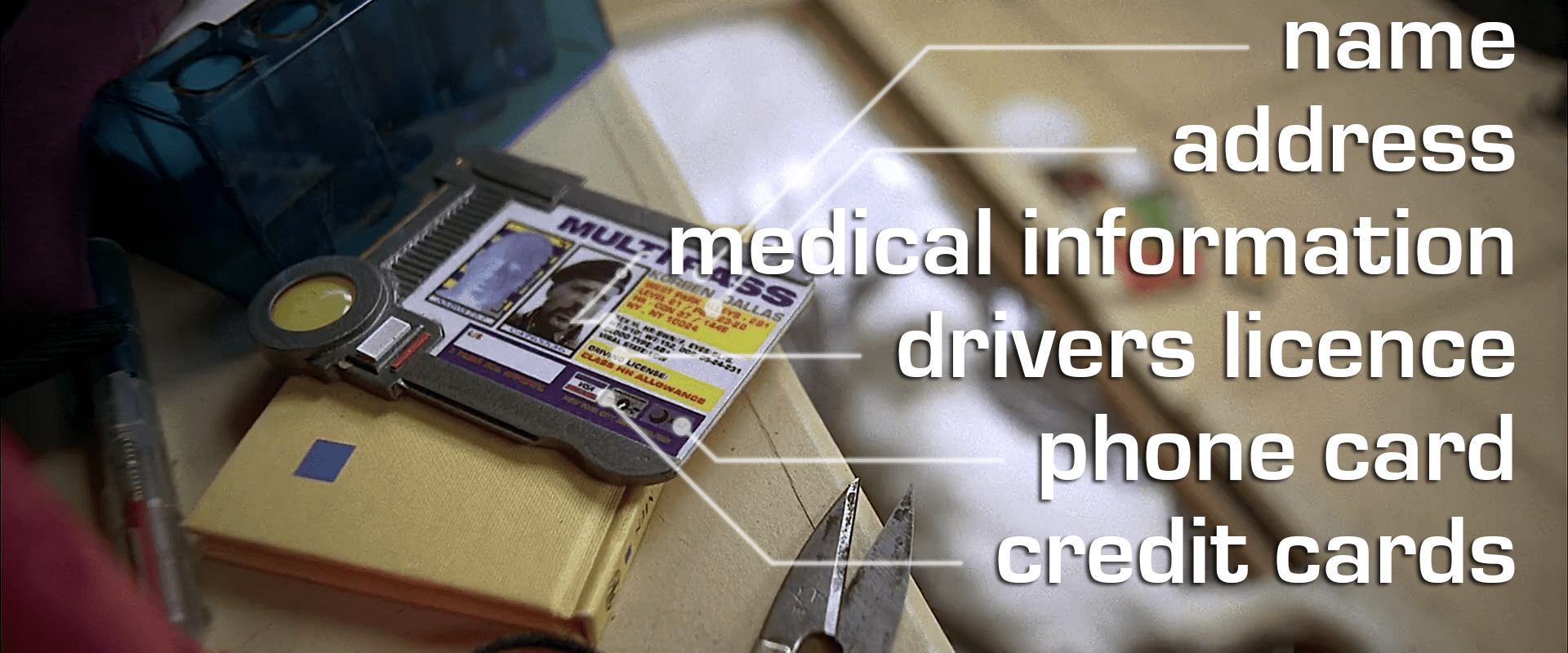
The multipass is the all-purpose card of 2263. It’s a driver’s license, work authorization record, proof of identity, emergency medical information, phone card, plus all your credit cards in one. There is a white rectangle and yellowish, rounded-bevel shape on the lower left, each of which may be a button, but that we don’t see in use.

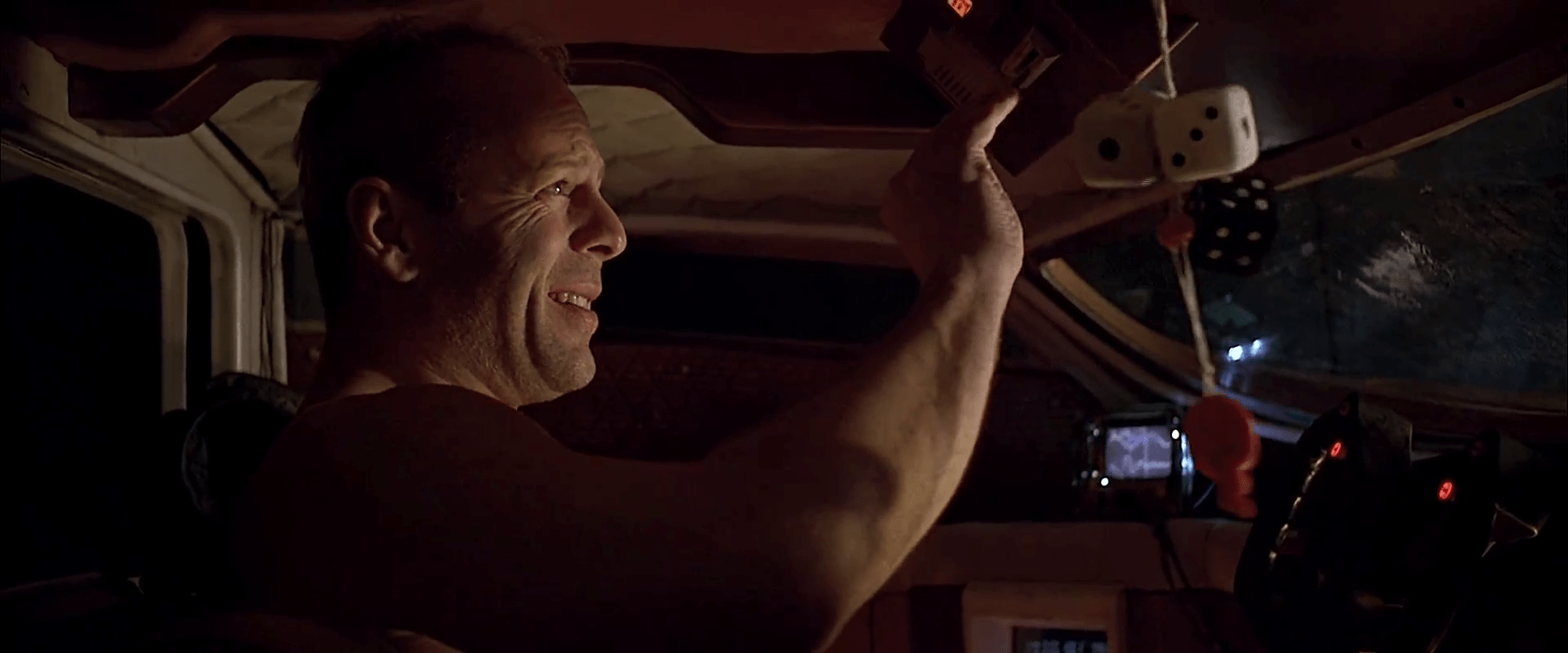
Often just showing it is enough for a human’s satisfaction, but sometimes it must be read by a machine. To do this, the holder inserts it into a slot, where the machine verifies its authenticity and registers the user locally. In Korben’s taxi, he has to leave it in as he operates the vehicle. At the Fhloston Paradise check-in booth, travelers dip it in and out of the reader.

TheFifthElement-multipass-014TheFifthElement-multipass-008

TheFifthElement-multipass-009

The act of inserting the card to authenticate may seem a bit old-fashioned in the days of RFID and read-at-a-distance technology, but it’s also nice to see that whatever agency was able to get the various corporations and government agencies to cooperate has also got privacy in mind. If it needs to be dipped to be read, maybe it can’t be read at a distance. That means the holder has more control over when and how it’s accessed.

As far as convenience, hot damn. It’s practically a wallet in and of itself. But there are security concerns to having all of this in one place. There are many cards that work like this in the world. Bus passes, skeeball tickets, gift cards. They’re generally low-cost. If you steal or forge Korben Dallas’ multipass, though, do you suddenly have his charge accounts, his taxi, and his phone card all at once? Seems high-cost, especially since the one forgery we see in the movie actually works.

This returns us, as so many things do, to multifactor authentication. This security philosophy requires that the user presents three factors: something they have, something they are, and something they know. The multipass covers only the first two.

  • The multipass itself is the thing they have.
  • The picture is something they are, i.e., what they look like.
  • It could be improved by requiring something they know, like a PIN or a password.

We don’t know what kind of power Cornelius’ order wielded in the world, but since it wasn’t enough to sway the president or purchase tickets to Paradise, let’s presume it wouldn’t have been enough to uncover Korben’s password, and in that case, the PIN would have foiled the attempted forgery.

TheFifthElement-multipass-002