Brain VP

GitS-VPbrain-04

When trying to understand the Puppet Master, Kusanagi’s team consults with their staff Cyberneticist, who displays for them in his office a volumetric projection of the cyborg’s brain. The brain floats free of any surrounding tissue, underlit in a screen-green translucent monochrome. The edge of the projection is a sphere that extends a few centimeters out from the edge of the brain. A pattern of concentric lines routinely passes along the surface of this sphere. Otherwise, the "content" of the VP, that is, the brain itself, does not appear to move or change.

The Cyberneticist explains, while the team looks at the VP, "It isn’t unlike the virtual ghost-line you get when a real ghost is dubbed off. But it shows none of the data degradation dubbing would produce. Well, until we map the barrier perimeter and dive in there, we won’t know anyting for sure."

GitS-VPbrain-01

GitS-VPbrain-02

GitS-VPbrain-03

The VP does not appear to be interactive, it’s just an output. In fact, it’s just an output of the surface features of a brain. There’s no other information called out, no measurements, or augmenting data. Just a brain. Which raises the question of what purpose does this projection serve? Narratively, of course, it tells us that the Cyberneticist is getting deep into neurobiology of the cyborg. But he doesn’t need that information. Kunasagi’s team doesn’t even need that information. Is this some sort of screen saver?

And what’s up with the little ripples? It’s possible that these little waves are more than just an artifact of the speculative technology’s refresh. Perhaps they’re helping to convey that a process is currently underway, perhaps "mapping the barrier perimeter." But if that was the case, the Cyberneticist would want to see some sense of progress against a goal. At the very least there should be some basic sense of progress: How much time is estimated before the mapping is complete, and how much time has elapsed?

Of course any trained brain specialist would gain more information from looking at the surface features of a brain than us laypersons could understand. But if he’s really using this to do such an examination, the translucency and peaked, saturated color makes that task prohibitively harder than just looking at the real thing an office away or a photograph, not to mention the routine rippling occlusion of the material being studied.

Unless there’s something I’m not seeing, this VP seems as useless as an electric paperweight.

REAL TIME FULL SCAN HACKING

GitS-cybrain-06

When Section 9 monitors a cyborg’s brain for real-time evidence of hacking, we see a monitoring scan. It shows a screen-green wireframe brain floating at an oblique angle in a black space. A 2D rectangle repeatedly builds it with a “wipe” from front to back, which leaves a dim 3D trail in its passing that describes the brain shape. Fans of the National Library of Medicine’s The Visible Human Project may see similarities, though the project’s visualizations would not be available until a year after the film’s release.

In the upper left is a legend reading, “REAL TIME FULL SCAN HACKING” with some numbers, with another unintelligible legend in the lower right. The values in the upper left never change, and the values in the lower legend change too rapidly to read them. After a beat, a text overlay appears on the right hand side of the screen with vaguely-medical terms listed in all capital letters, flying by too quickly to read*. There is an additional device seen in the corner of the frame, with progress-bar-like displays with thick green lines that wobble left and right. Two waveforms hang above this, their labels off screen. Yellow “fireworks” appear near the “temples” of the brain, indicating the parts under attack.

A question of usefulness

If data doesn’t change or changes too fast to read, it is worth asking if the data should be shown at all. If it’s moving too fast, other representations might work better, like a progress bar, a map, or sparkline. Of course, we know that many programmers may use this kind of output during the run of a program so that if the program stops, the last few activities may be immediately known, so this may be more code than interface.

*Vaguely-medical terms

If you’re the sort of nerd who obsesses over details, following is the text that flashes on the right hand side of the display. There’s nothing in it that is really helpful or informative to a review. It’s mostly internal organs or parts of the brain augmented with “CHECKS” and “CONNECTS”. There’s one exception, about halfway through the 5-second sequence, where it reads “M.YGODDESS CHECK.” Diegetically, it could be a programmers slang for a body part. More likely it’s a reference to Oh! My Goddess!, a manga by Kosuke Fujishima that’s been in print since 1988.

GitS-cybrain-07

ACCESS
CHECK CONNECT
MOTOR FIBERS CHECK
CONNECT POINT NCL
NCL. AMBIGUOUS
SEARCH AN ARTFICIAL B
NCL. AMBIGUOUS CHECK
AN ARTIFICIAL BODY’S PO
GANGLION SUPERIUS CHECK
NO REJECTION
FORAMEN JUGULARE PAG
GANGLION INFERIUS
GANGLION INFERIUS
PROPER VOLTAGE
RAMIPHARMNGEI CAL.L.D
N. LARYNGEUS SUPERIOR
RAMIPHARYNGI CHECK
PLEXUS PHARYNGEUS CHECK
NEXT
M.LEVATOR VELI PALAT
MM.CONSTRICTORES PHA
CALLING…
M.LEVATOR VELI PALAT
MM.CONSTRICTORES PHA
CONNECT
N.LARYNGEUS SUPERIOR
N.LARYNGEUS RECURRE
RAMUS EXTERNUS CHECK
NEXT
M.CIRCOTHYROIDEUS
RAMIESOPHAGEI CALLIN
N.LARYNGEUS RECURRED
NO REJECTION
CHECK FEEDBACK TO
NCL. AMBIGUUS
RAMITRACHEALES CHEC
FEEDBACK TO NCL. AMBI
RAMIESOPHAGEI CHECK
NEXT
N.LARYNGEUS INFERIOR
CONNECT N.VAGUS MOTOR
CHECK OVER
EXTEROCEPTIVE SENSOR
CHECK STRAT
CONNECT POINT NCL
NCL. SPINALIS N TRIG
SEARCH AN ARTIFICAL B
NCL.SPINALIS N.TRIGG
CHECK
AN ARTIFICIAL BODY’S PO
TR.SPINALIS N. TIGGER
NO REJECTION
TR.SPINALIS N.TRIGE
CANALICULUS MASTOID
VISCEROMOTOR FIBERS
CANALICULUS MASTOIDS
CONNECT POINT NCL
NCL. DORSALIS N. VAGI
RAMUS AURICULARIS CH
CHECK FEEDBACK TO
NCL. SPINALIS N. TRIGEG
SEARCH AN ARTIFICIAL B
N. VAGUS ENERROCEPTIN
FEEDBACK TO
NCL. SPINALIS TRIGER
CHECK OVER
ANARTIFICAL BODY’S PO
NCL.DORSAL IS N. VAGI
GANGLION SUPERIUS
NO REJECTION
GANGLION SUPERIUS CH
FORAMEN JUGULARE PAS
GANGLION INFERIUS CHE
SAFETY CONNECT PROGR
RAMICORDIACICERVICA
CALLING…
RAMICORDIACICERVICA
NO REJECTION
NEXT
RAMICORDIACICERVICA
CALLING…
PLESUS CARDIACUS CAL
RAMICORDIACICERVICA
PLESUS CARDIACUS CHE
M. ATSUMO TOKAORU CHE
ATOMIC DISPOSITION C
M.YGODDESS CHECK
CHECK OVER
GUSTATORY FIBERS
CHECK STRAT
CONNECT POINT NCL.
NCL. SOLITARIUS
SEARCH AN ARTIFICAIAL B
NCL. SOLITARIUS CHECK
AN ARTIFICIAL BODY’S PO
GANGLION SUPERIUS
NO NOIZE
NEXT
GANGLION SUPERIUS CH
FORAMEN JUGULARE PRE
GANGLION INFERIUS CHE
RAMIPHARYNGEI CALLING
RAMIPHARYNGEI CHECK
PLEXUS PHARYNGEUS CA
NO REJECTION
PLEXUS PHARYNGEUS CH
TASTE BUDS CALLING
CHECK FEEDBACK TO
NCL. SOLITARIUS
TASTE BUDS CONNECT
FEEDBACK NCL. SOLITAR
CHECK OVER
VISCEPOSENSORY FIBER
CHECK STRAT
CONNECT POINT NCL
NCL SOLITARIUS
SEACH AN ARTIFICIAL B
NCL. SOLITARIUS CHECK
AN ARTIFICIAL BODY’S PO
TRACTUS SOLITARIUS C
NO NOIZE
TRACTUS SOLITARIUS C
GANGLION SUPERIUS CA
NO REJECTION
GANGLION SUPERIUS CH
FORAMEN JUGULARE PAS
GANGLION INFERIUS CA
N.LARYNGEUS SUPERIOR
N.LARYNGEUS RECURRED
PLEXUS PULMONAL IS CA
N. LARYNGEUS RECURRED
RAMIESOPHAGUI CALLI
N. LARYNGEYS INFERIOR
RAMITRACHEALES SUPERIOR
RAMUS INTERNUS CALLI
PLEXUS INTERNUS CALLI
PLEXUS PULMONALIS CH
PLEXUS ESOPHAGEUS CA
RAMIESOPHAGEI CHECK
N.LARYNGEUS INFERIOR
PLEXUS EXOPHAGEUS CH
TRUNCUS VAGALIS POST
RAMITRACHEALES CHEC
TRUNCUS VAGALIS ANTE
RAMUS INTERNUS CHECK
VOCAL CORO CALLING
TRUNCUS VAGALIS POST
RAMICOEL CALLING
RAMIRENALES CALLING
TRUNCUS VAGALIS ANTE
RAMIHEPATICI CHECK
PLEXUS HAPATICUS CAL
RAMIGASTRICIPOSTER
RAMIRENALES CHECK
PLEXUS RENALIS CALLI
RAMICOELIACI CHECK
PLEXUS COELICUS CALL
RAMIHEPATICI CHECK
PLEXUSHEPATICUS CALL
RAMIGASTRICI ANTERIO
PLEXUS COELICUS CHEC
RAMI GASTRICIPOSTER
PLEXUS RENALIS CHECK
RAMIGASTRICI ANTERIO
CHECK FEEDBACK TO
BCL. SOLITARUS
PLEXUS HEPATICUS CHE
FEEDBACK TO NCL. SOLIT
VOCAL CORD CHECK
CHECK OVER
CHECK CONNECT
MOTOR FIBERS CHECK
CONNECT POINT NCL
NCL. AMBIGUUS
SEARCH AN ARTIFICAL B
NCL.AMBIGUOUS CHECK
AN ARTIFICAL BODY’S
GANGLION SUPERIUS CA
GANGLION SUPERIUS CH
NO REJECTION
FORAMEN JUGULARE PAS
GANGLION INFERIUS CAL
GANGLION INFERIUS CHE
PROPER VOLTAGE

Nucleolab Progress Indicator

FifthE-nucleolab-009

As the nucleolab is reconstructing Leeloo, the screen on the control panel provides update, detailing the process. For the most part this update is a wireframe version of what everyone can see with their eyes.

FifthE-nucleolab-029

FifthE-nucleolab-015

The only time it describes something we can’t see with our own eyes is when Leeloo’s skin is being “baked” by an ultraviolet light under a metal cover. Of course we know this is a narrative device to heighten the power of the big reveal, but it’s also an opportunity for the interface to actually do something useful. It has a green countdown clock, and visualizes something that’s hidden from view.

FifthE-nucleolab-020

As far as a progress indicator goes, it’s mostly useful. Mactilburgh presumably knows roughly how long things take and even the order of operations. All he needs is confirmation that his system is doing what it’s supposed to be, and the absence of an error is enough for him. The timer helps, too, since he’s like a kid waiting for an Easy Bake Oven…of science.

But Munro doesn’t know what the heck is going on. Sure he knows some of the basics of biology. There’s going to be a skeleton, some muscle, some nerves. But beyond that, he’s got a job to do, and that’s to take this thing out the minute it goes pear-shaped. So he needs to know: Is everything going OK? Should I pop the top on a tall boy of Big Red Button? It might be that the interface has some kind of Dire Warning mode for when things go off the rails, but that doesn’t help during the good times. Giving Munro some small indicator that things are going well would remove any ambiguity and set him at ease.

An argument could be made that you don’t want Munro at ease, but a false positive might kill Leeloo and risk the world. A false negative (or a late negative) just risks her escape. Which happens anyway. Fortunately for us.

FifthE-nucleolab-024

NucleoLab Display

FifthE-nucleolab-002

The scientist Mactilburgh reconstructs Leeloo from a bit of her remains in his “nucleolab.” We see a few interfaces here.

FifthE-nucleolab-003

We never see Mactilburgh interact with the controls on this display: Potentiometers, dials with circular LED readout rings, glowing toggle buttons, and unlit buttons labeled “OFF” and “ESC.” There’s not much to grasp onto for analysis. These are just “sciencey” set of physical controls. The display is a bit of similar scienciness, meant to vaguely convey that Leeloo is a higher-order being, but beyond that, incomprehensible. Interestingly, the Mondoshawan DNA shows not just a more detailed graphic, but adds color to convey an additional level of complexity.

FifthE-nucleolab-004

An odd bit: In the lower right hand corner of the screen you can see the words “FAMILIAL HYPERCHOL TEROLEMIA.” Looking up this term reveals the genetic condition Familial Hypercholesterolemia. It’s only missing the “ES.” What’s this label doing here? This could be the area on the DNA chain where the markers appear for this predisposition to high cholesterol, but wouldn’t you expect that to take up 5000 times less room on a DNA strand of a perfect being, not the same percentage? Also it kind of takes the winds out of the sails of Mactilburgh’s breathless claim that she’s perfect. Anyway it’s a warning lesson for sci-fi interface designers: Watch where you pull your sciencey words from. If it’s a real thing, ask whether the meaning runs counter to your purposes or not.

Alien head sterilizer

Prometheus-158

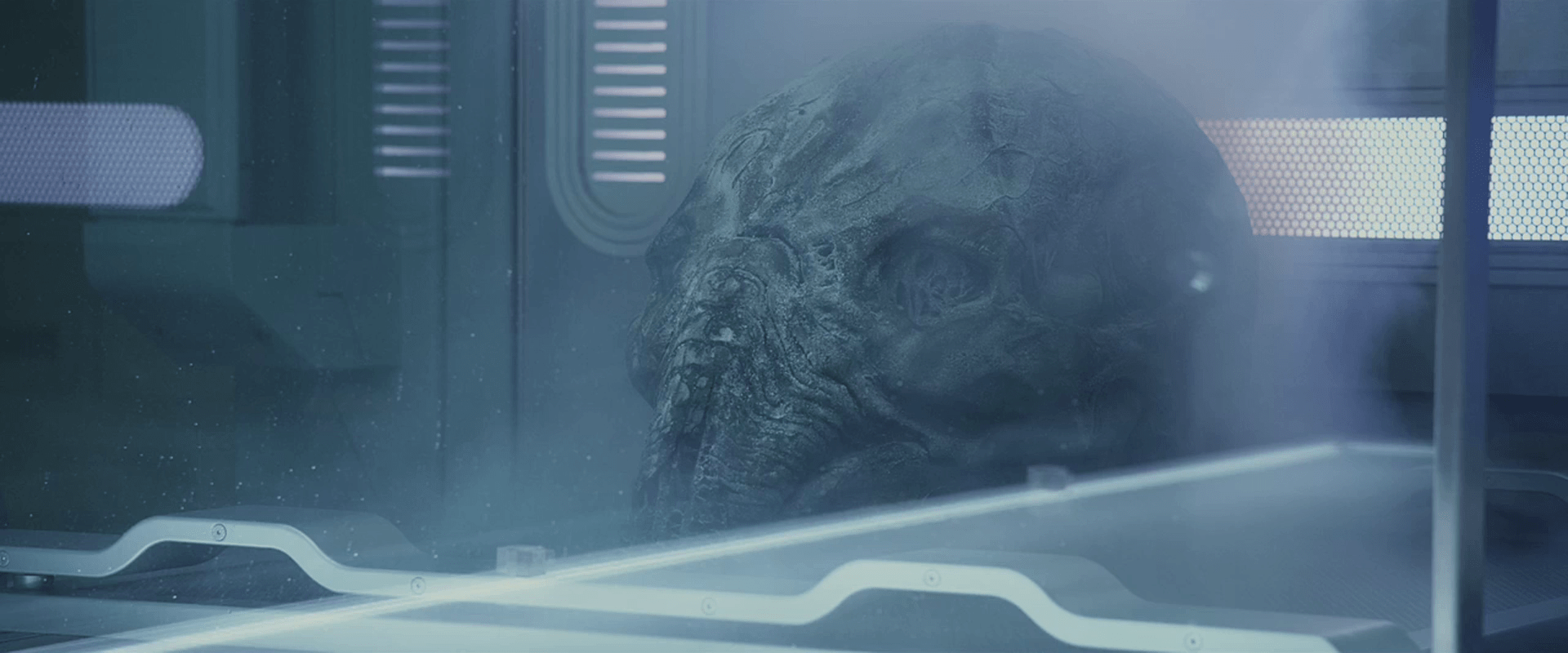
In the lab, Shaw and Ford investigate the alien head from the complex. They first seek to sterilize it. Though we don’t see how the process is initiated, after it is, a “dumb waiter” raises the head from some storage space to a glass-walled chamber where it is sprayed with some white mist. A screen displays an animation of waves passing along the surface of the head.

When the mist clears, a screen reads “SAMPLE STERILE. NO CONTAGION PRESENT,” which Ford dutifully repeats even though Shaw has a screen that says the exact same thing. Obscure metrics and graphs fill the edges of the screen.

Prometheus-156

It might have been tempting for the designers to simply supply the analysis, i.e., “no contagion,” but by providing the data from which the analysis derives, the scientists can check and verify the data for themselves, so the combination is well considered.

There are several problems with this sterilization system.

The text of the analysis reads well and unambiguously, but the graphics would be more informative if they indicated their values within clear ranges. As they are, they push the burden of understanding the context of the values onto the scientists’ memories. If this was a very commonplace activity, this might not be much of an issue.

More importantly are the problems with the industrial design. First, this device seems surprisingly head-sized. Wouldn’t a crewmember be the most likely thing they’d have to sterilize? Shouldn’t it be bigger? But moreover, this device is in the wrong place on the ship. If it was infected with an alien pathogen, sterilizing it here is already too late. The pathogen has already spread everywhere between the airlock, the storage space, and on the hands of whoever had to move it between. It would be better if possibly unsterile material could be loaded into a decontamination system outside the ship, and then only once sterilized then pass through to the interior.

Neuro-Visor

The second interface David has to monitor those in hypersleep is the Neuro-Visor, a helmet that lets him perceive their dreams. The helmet is round, solid, and white. The visor itself is yellow and back-lit. The yellow is the same greenish-yellow underneath the hypersleep beds and clearly establishes the connection between the devices to a new user. When we see David’s view from inside the visor, it is a cinematic, fully-immersive 3D projection of events in her dreams, that is presented in the “spot elevations” style that is predominant throughout the film (more on this display technique later).

Later in the movie we see David using this same helmet to communicate with Weyland who is in a hypersleep chamber, but Weyland is somehow conscious enough to have a back-and-forth dialogue with David. We don’t see either David’s for Weyland’s perspective in the scene.

David communicated with Weyland.

As an interface, the helmet seems straightforward. He has one Neuro-Visor for all the hypersleep chambers, and to pair the device to a particular one, he simply touches the surface of the chamber near the hyper sleeper’s head. Cyan interface elements on that translucent interface confirm the touch and presumably allow some degree of control of the visuals. To turn the Neuro-Visor off, he simply removes it from his head. These are simple and intuitive gestures that makes the Neuro-Visor one of the best and most elegantly designed interfaces in the movie.

HYP.SL

The android David tends to the ship and the hypersleping crew during the two-year journey.

The first part of the interface for checking in on the crew is a cyan-blue touch screen labeled “HYP.SL” in the upper left hand corner. The bulk of this screen is taken up with three bands of waveforms. A “pulse” of magnification flows across the moving waveforms from left to right every second or so, but its meaning is unclear. Each waveform appears to show a great deal of data, being two dozen or so similar waveforms overlaid onto a single graph. (Careful observers will note that these bear a striking resemblance to the green plasma-arc alien interface seen later in the film, and so their appearance may have been driven stylistically.)

HYP.SL

To the right of each waveform is a medium-sized number (in Eurostile) indicating the current state of the index. They are color-coded for easy differentiation. In contrast, the lines making up the waveform are undifferentiated, so it’s hard to tell if the graph shows multiple data points plotted to a single graph, or a single datapoint across multiple times. Whatever the case, the more complex graph would make identifying a recent trend more complicated. If it’s useful to summarize the information with a single number on the right, it would be good to show what’s happening to that single number across the length of the graph. Otherwise, you’re pushing that trendspotting off to the user’s short term memory and risking missing opportunities for preventative measures.

Another, small diagram in the lower left is a force-directed, circular edge bundling diagram, but as this and the other controls on the screen are inscrutable, we cannot evaluate their usefulness in context.

After observing the screen for a few seconds, David touches the middle of the screen, a wave of distortion spreads from his finger for a half a second, and we hear a “fuzz” sound. The purpose of the touch is unclear. Since it makes no discernable change in the interface, it could be what I’ve called one free interaction, but this seems unlikely since such cinematic attention was given to it. My only other guess is to register David’s presence there like a guard tour patrol system or watchclock that ensures he’s doing his rounds.