Odyssey Communications

A close-up of a control panel displaying a video feed of a woman speaking, with NASA logos visible in the background.

The TET is far enough away from Earth that the crew goes into suspended animation for the initial travel to it. This initial travel is either automated or controlled from Earth. After waking up, the crew speak conversationally with their mission controller Sally.

This conversation between Jack, Vika, and [actual human] Sally happens over a small 2d video communication system. The panel in the middle of the Odyssey’s control panel shows Sally and a small section of Mission Control, presumably back on Earth. Sally confirms with Jack that the readings Earth is getting from the Odyssey remotely are what is actually happening on site.

Interior view of a futuristic spaceship cockpit, featuring numerous control panels, screens, and empty pilot seats.

Soon after, mission control is able to respond immediately to Jack’s initial OMS burn and let him know that he is over-stressing the ship trying to escape the TET. Jack is then able to make adjustments (cut thrust) before the stress damages the Odyssey.

FTL Communication

Communication between Odyssey and the Earth happens in real-time. When you look at the science of it all, this is more than a little surprising.

Vika tells Sally that the Odyssey was traveling for at least 39 days in suspended animation. We see in the same scene that the Odyssey’s engines are thrusting that whole time. Even the low thrust of an ion engine would send the Odyssey a long way out into the Solar System in 39 days.

Current communication technology in space relies on radio communication for voice and video. NASA is testing out laser-based signaling, which would provide higher bandwidth but doesn’t travel faster than the speed of light. Time lag is a constant in both technologies.

In space, real-time communication and measurable distance do not go together at all. There should be a lag, especially at the distances implied by the story.

A woman with closed eyes lying inside a pod, with a control panel displaying data in the background. The pod has a NASA logo and a Russian flag emblem.

How Far?

The engines on the Odyssey look a lot like NASA’s prototype ion engines. This would fit nicely with the compact nuclear reactor on board, which would be the perfect size for generating living power and engine power for low-thrust ion engines.

Ion engines don’t have the same thrust capacity as our current rockets, but have the advantage of constant thrust over long distances that chemical rockets can’t match. NASA’s Dawn probe has an acceleration of about 0.22m/s/s (very, very rough math). A quick run through a calculator at (http://www.cthreepo.com/lab/math1/) says that over 39 days (Odyssey’s travel time), they would go about 8 astronomical units (AUs). That is 8x the distance from the Earth to the Sun just with Dawn’s level of thrust. That is a low end calculation, and doesn’t factor in any thrust from a more traditional rocket on the Earth end, or any slingshot maneuvers to add speed.

8 AUs would be more than an hour of light speed lag. That means that the Odyssey should take almost two hours to complete a single back-and-forth of a conversation.
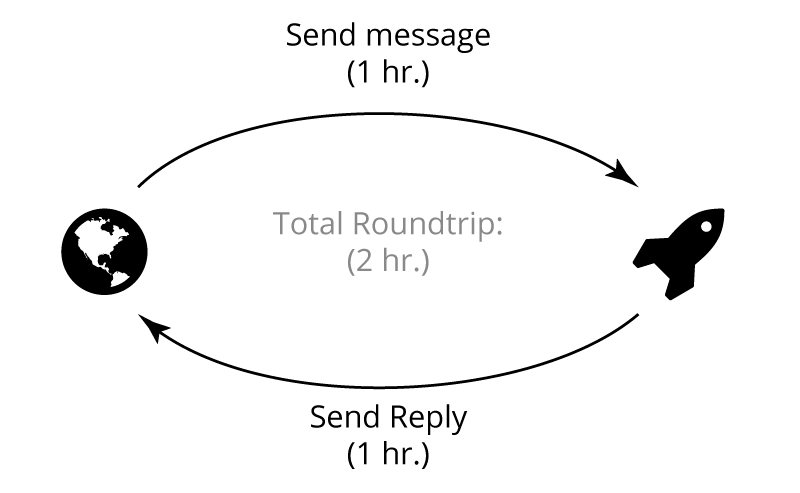
Communication-Time

If the compact nuclear reactor was actually able to produce thrust (unlikely, but possible), then in 39 days the Odyssey could have traveled even further.

At any distance beyond the Moon’s orbit, light-speed communication would become increasingly delayed. If the TET was even in a Mars orbit, it could take between 4 and 24 minutes for radio and video signals to go back and forth between Earth and the Odyssey. Further distances increase the lag time significantly.

This means that Humanity has…gasp…developed Faster-than-Light communications technologies by the time Oblivion occurs (and, yes, even before the TET could have provided the advanced alien tech to make it happen).

Close-up of a control panel displaying a distorted screen with horizontal lines and static.

Despite this FTL comm system, as the Odyssey approaches, the TET is able to disrupt the comm signal and cut off Earth from Odyssey. Jack looks concerned by this (as well as Sally’s order to cut his thrust), and stops trying to fight being drawn into the TET.

An unanswerable question here is: what kind of technology from the TET would be able to disrupt an FTL signal? Wouldn’t that require them to be time travelers? Wouldn’t this be a different movie, then?

Don’t Trust New Technology

Neither Jack nor Vika interact with the communication system during the flight that we see besides talking to it. When the signal cuts out, neither of them rushes to check settings or flip switches to try and get the signal back. Instead, they go to a backup plan and focus on what they are able to do without help from Earth. The screen that held Sally’s image cuts over to a secondary information display as soon as it detects that the signal is gone.

Close-up of a digital display panel showing numerical data, indicators, and system information related to a launch control interface.

This implies two things:

  1. The crew were trained to not rely on the communication system
  2. The communications system is a ‘black box’ to Jack and Vika: it either works or it doesn’t.

Given the previous realization that the comm system is built around an FTL link, both of these make sense. It is unlikely that a single person (or even two people) would be able to understand the equipment behind a new FTL system well enough to maintain it or fix it in an emergency. Similarly, the early Astronauts of NASA weren’t expected to maintain the advanced computers (for the time) on their ships.

If the FTL system was recently invented, and rushed through testing for this mission, it also makes sense that Jack and Vika don’t rely on it. NASA now is very careful about testing equipment to make sure that they will always work, or at least work well enough that they can be constantly relied on. (see the Kepler mission http://en.wikipedia.org/wiki/Kepler_(spacecraft) for what happens when a well-tested and critical component fails).

Jack and Vika reveal their training during the emergency situation: They have no time to think, so they fall back on memorized actions. The lack of interaction with the communications system implies that there was no training around trying to make it work.

Have a Backup Plan

Designers planning to introduce new and advanced technology into important situations should always be sure they have a backup plan for when that advanced technology fails. Likewise, if a highly efficient workflow has advanced technology introduced to improve that efficiency, make sure that failures in the new technology won’t make the workflow slower than before.

Technology should assist and improve, never impede users. And if it’s valuable enough to warrant the risk, give users a backup plan.
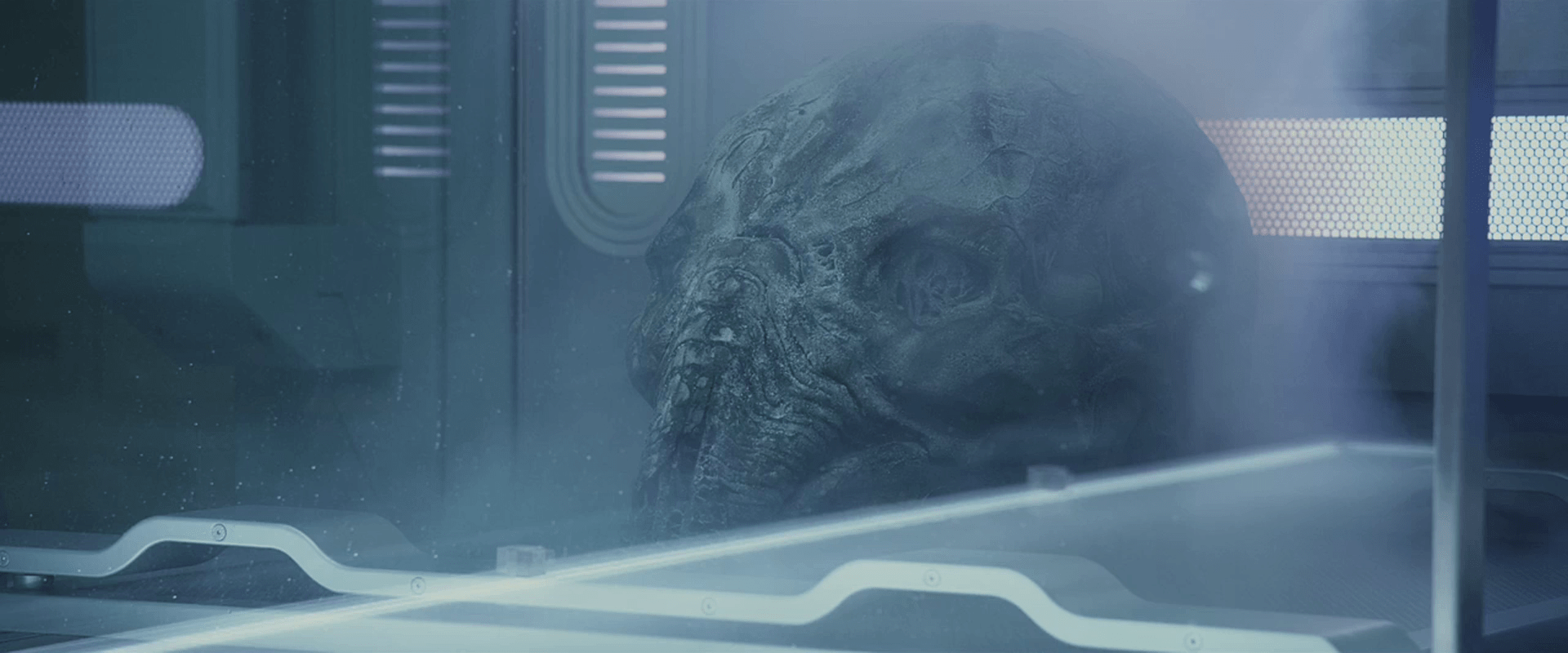
Alien head sterilizer

Prometheus-158

In the lab, Shaw and Ford investigate the alien head from the complex. They first seek to sterilize it. Though we don’t see how the process is initiated, after it is, a “dumb waiter” raises the head from some storage space to a glass-walled chamber where it is sprayed with some white mist. A screen displays an animation of waves passing along the surface of the head.

When the mist clears, a screen reads “SAMPLE STERILE. NO CONTAGION PRESENT,” which Ford dutifully repeats even though Shaw has a screen that says the exact same thing. Obscure metrics and graphs fill the edges of the screen.

Prometheus-156

It might have been tempting for the designers to simply supply the analysis, i.e., “no contagion,” but by providing the data from which the analysis derives, the scientists can check and verify the data for themselves, so the combination is well considered.

There are several problems with this sterilization system.

The text of the analysis reads well and unambiguously, but the graphics would be more informative if they indicated their values within clear ranges. As they are, they push the burden of understanding the context of the values onto the scientists’ memories. If this was a very commonplace activity, this might not be much of an issue.

More importantly are the problems with the industrial design. First, this device seems surprisingly head-sized. Wouldn’t a crewmember be the most likely thing they’d have to sterilize? Shouldn’t it be bigger? But moreover, this device is in the wrong place on the ship. If it was infected with an alien pathogen, sterilizing it here is already too late. The pathogen has already spread everywhere between the airlock, the storage space, and on the hands of whoever had to move it between. It would be better if possibly unsterile material could be loaded into a decontamination system outside the ship, and then only once sterilized then pass through to the interior.

Course-correction

The stage managers’ main raison d’être is to course-correct if and when victims begin to deviate from the path required of the ritual.

This begins with the Prep team, long before the victims enter the stage. For example, Jules’ hair dye and Marty’s laced pot. These corrections become more necessary and intense once the victims go on stage.

Making sure there are sexy times

The ritual requires that a sexy young couple have sexy times on stage before they suffer and die. “The mood” can be ruined by many things, but control has mechanisms to cope with most of them. We see three in the movie.

Temperature

The temperature can’t be too hot or too cold, but this isn’t something that can be set and forgot. What counts as the right temperature is a subjective call for the people involved and their circumstances, such as being drunk, or amount and type of clothes worn. Fortunately, the video-audio panopticon lets the stage managers know when a victim speaks about this directly, and do something about it. The moment Jules complains, for instance, Sitterson is able to reach over to a touch-screen display and tap the temperature a few degrees warmer.

Sitterson heats things up.

The gauge is an interesting study. It implies a range possible between 48 and 92 degrees Fahrenheit, each of which is uncomfortable enough to encourage different behaviors in the victims, without the temperature itself being life-threatening.

Moreover, we see that it’s a “blind” control. Before Sitterson taps it, he is only shown the current temperature as a blue rectangle that fills up four bars and that it is exactly 64 degrees. But if he knew he wanted it to be 76 degrees, what, other than experience or training, tells him where he should touch to get to that desired new temperature? Though the gauge provides immediate feedback, it still places a burden on his long-term memory. And for novice users, such unlabeled controls require a trial-and-error method that isn’t ideal. Even the slim area of white coloring at the top, which helpfully indicates temperatures warmer than cooler, appears too late to be useful.

Better would be to have the color alongside or under the gauge with smaller numbers indicated along its length such that Sitterson could identify and target the right temperature on the first try.

Libido

The next thing that can risk the mood is a lack of a victim’s amorous feelings. Should someone not be “feeling it,” Control can pipe sex pheromones to areas on stage. We see Hadley doing this by operating a throttle lever on the electronic-era control panel. After Hadley raises this lever, we see small plumes of mist erupt from the mossy forest floor that Jules and Curt are walking across.

Hadley introduces pheromones to the forest air.

This control, too, is questionable. Let’s first presume it’s not a direct control, like a light switch, but more of a set-point control, like a thermostat. Similar to the temperature gauge above, this control misses some vital information for Hadley to know where to set the lever to have the desired amount of pheromone in the air, like a parts-per-million labeling along the side. Perhaps this readout occurs on a 7-segment readout nearby or a digital reading on some other screen, but we don’t see it.

There is also no indication about how Hadley has specified the location for the pheromone release. It’s unlikely that he’s releasing this everywhere on stage, lest this become a different sort of ritual altogether. There must be some way for him to indicate where, but we don’t see it in use. Perhaps it is one of the lit square buttons to his right.

An interesting question is why the temperature gauge and pheromone controls, which are similar set-point systems, use not just different mechanisms, but mechanisms from different eras. Certainly such differentiation would help the stage managers’ avoid mistaking one for the other, and inadvertently turn a cold room into an orgy, so perhaps it is a deliberate attempt to avoid this kind of mistake.

Lights

The final variable that stands in the way of Jules’ receptiveness (the authors here must acknowledge their own discomfort in having to write about this mechanistic rape in our standard detached and observational tone) is the level of light. After she complains that it is too dark, Hadley turns a simple potentiometer and the “moonlight” on a soft bed of moss behind them grows brighter.

Control responds to Jules’ objection to the darkness.

This, too, is a different control than the others; though it controls what is essentially a floating-point variable. But since it is more of a direct control than the other two, its design as a hard-stop dial makes sense, and keeps it nicely differentiated from the others.

Marty’s Subliminal Messages

Over the course of the movie, several times we hear subliminal messages spoken to directly control Marty. We never see the inputs used by Control, but they do, at least on one occasion, actually influence him, and is one of the ways the victims are nudged into place.

Marty breaks the fourth wall

In addition to Dana & Curt’s almost not getting it on, another control-room panic moment comes when Marty accidentally breaks a lamp and finds one of the tiny spy cameras embedded throughout the cabin. Knowing that this level of awareness or suspicion could seriously jeopardize the scenario, Hadley bolts to a microphone where he says, “Chem department, I need 500 ccs of Thorazine pumped into room 3!”

Marty finds a spy camera

Hadley speaks a command to the Chem department

Careful observers will note while watching the scene that a menu appears on a screen behind him as he’s stating this. The menu lists the following four drugs.

  • Cortisol (a stress hormone)
  • Pheromones (a category of hormonal social signals, most likely sex pheromones)
  • Thorazine (interestingly, an antipsychotic known to cause drowsiness and agitation)
  • Rhohyptase (aka Rhohypnol, the date rape drug)

Given that content, the timing of the menu is curious. It appears, overlaid on the victim monitoring screen, the moment that Hadley says “500.” (Before he can even specify “Thorazine.”) How does it appear so quickly? Either there’s a team in the Chem department also monitoring the scene, and who had already been building a best-guess menu for what Hadley might want in the situation and they just happened to push it to Hadley’s screen at that moment; Or there’s an algorithmic voice- and goal-awareness system that can respond quickly to the phrase “500 ccs” and provide the top four most likely options. That last one is unlikely, since…

  • We don’t see evidence of it anywhere else in the movie
  • Hadley addresses the Chem department explicitly
  • We’d expect him to have his eyes on the display, ready to make a selection on its touch surface, if this was something that happened routinely

But, if we were designing the system today with integrated voice recognition capabilities, it’s what we’d do.

Curt suggests they stick together

After the attack begins on the cabin itself, Curt wisely tells the others, “Look, we’ve got to lock this place down…We’ll go room by room, barricade every window and every door. We’ve got to play it safe. No matter what happens, we have to stay together.” Turns out this is a little too wise for Hadley’s tastes. Sitterson presses two yellow, back-lit buttons on his control panel to open vents in the hallway, that emit a mist. As Curt passes by the vents and inhales, he pauses, turns to the others and says, “This isn’t right…This isn’t right, we should split up. We can cover more ground that way.”

Sitterson knocks some sense out of Curt.

This two-button control seems to indicate drug (single dose) and location, which is sensible. But if you are asking users to select from different variables, it’s a better idea to differentiate them by clustering and color, to avoid mistakes and enable faster targeting.

Locking the doors

Once the victims are in their rooms, Hadley acknowledges it’s time to, “Lock ‘em in.” Sitterson flips a safety cover and presses a back-lit rocker switch, which emits a short beep and bolts the doors to all the victims’ rooms at the same time.

Sitterson bolts the victims’ doors.

Marty in particular notices the loud “clunk” as the bolts slide into place. He tests the door and is confounded when he finds it is, in fact, locked tight. Control’s earlier concern about tipping their hand seems to matter less and less, since this is a pretty obvious manipulation.

The edge of the world

Bolted doors pale in comparison to the moment when Curt, Dana, and Holden violently encounter the limits of the stage. After the demolition team seals the tunnel to prevent escape that way, Curt tries to jump the ravine to the other side so he can fetch help. Unfortunately for him, the ravine is actually an electrified display screen, showing a trompe-l’œil illusion of the far side. By trying to jump the ravine, Curt unwittingly commits suicide by slamming into it.

Curt slams into the edges of the “world” of the cabin.

The effect of the screen is spectacular, full of arcs zipping along hexagonal lines and sparks flying everywhere. Dana and Holden rush to the edge of the cliff to watch him tumble down its vast, concave surface. It seems that if you’ve come this far, Control isn’t as concerned about tipping its hand as it is finishing the job.