The Positronic Ray

Barbarella-136

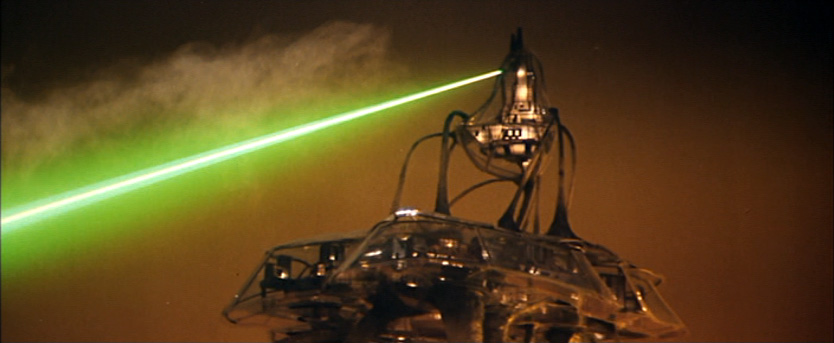
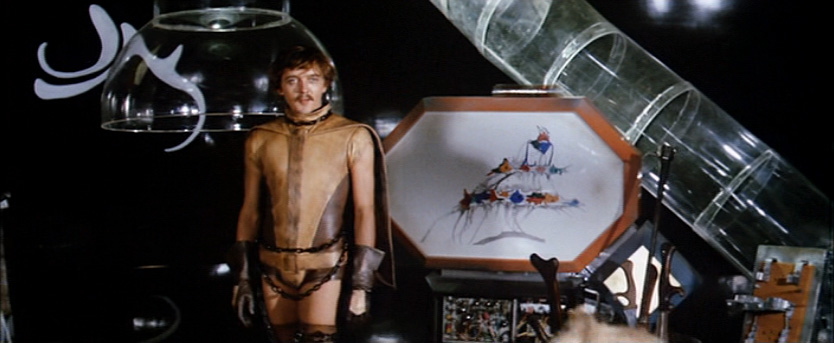
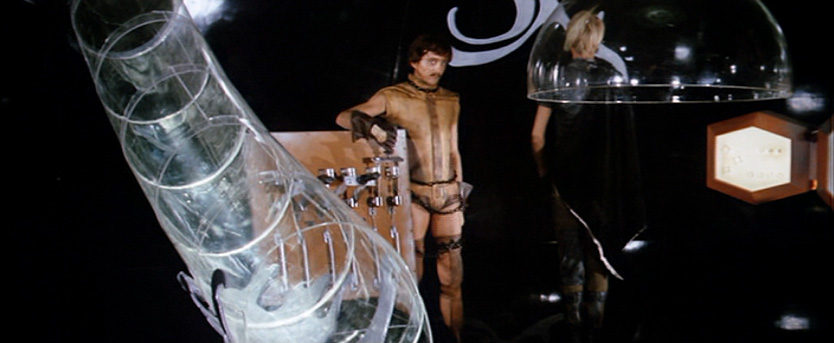
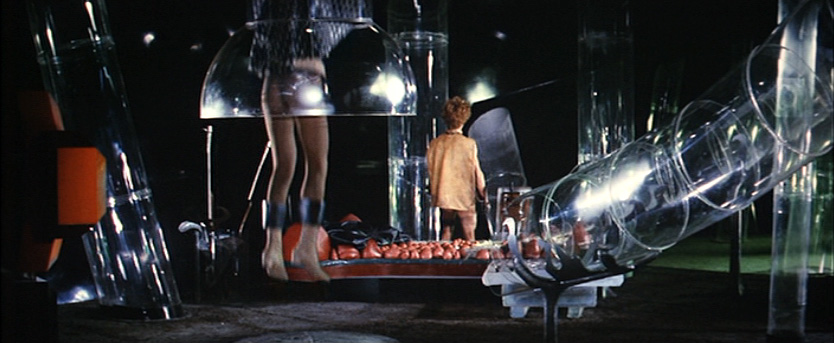
To combat the Resistance uprising, Durand-Durand unleashes his dread Positronic Ray. To control it, he approaches a high backed chair and touches a spot on the back. The curved tip of the chair extends upwards a bit allowing him to sit down. As soon as he sits, the tip retracts to rest just above his head and the video panel slides close to him. The ray itself is mounted on a two-axis swivel just behind him, with the barrel pointing out of a horizontal window.

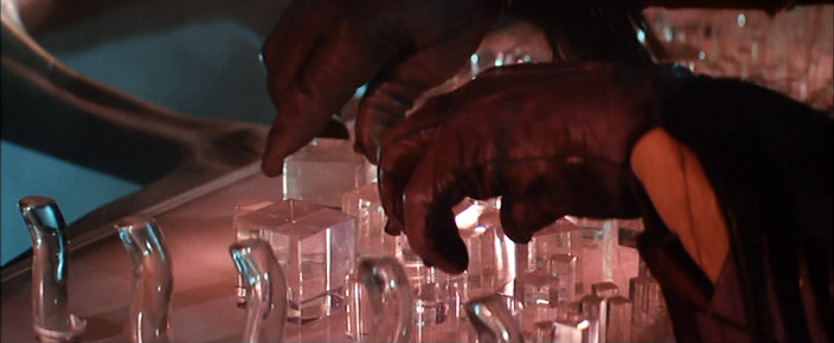
The interface consists of a complex array of transparent knobs mounted on a glowing flat panel, set beneath a large rectangular video screen. While he is using the weapon, we see his hands twiddling some of the shapes clockwise and counterclockwise.

Barbarella-139

The chair interface seems fine, if technically unnecessary, giving the gunner a small ritual feeling of power. The weapons interface, on the other hand, is a disaster. It has around 50 visible controls, none labeled for what they control or their extents, none have the slightest ergonomic consideration, and few are differentiated from the others in shape or placement. Also they’re all transparent, so add a lot of visual noise to the difficultly of use.

From his video screen we can tell that there are only a number of things to control: target (coupled to the camera), beam size (coupled to the camera zoom), and a trigger. Control for these simple variables could be accomplished with a joystick for targeting, a thumb button for triggering, and a slider at his left hand for zoom/beam size. Three controls which Durand-Durand could really think of as two.

Additionally, the screen only shows him what he’s currently focused on, failing to grant any of the field awareness that he’d need to keep the enemy at bay. Ultimately it’s a weapons interface that only a pacifist could love. Admittedly, he’s a mad engineer, and not a mad interaction designer, so maybe it’s just his insanity that explains this fiddly spread of extraneous controls with poor mapping and myopic feedback.

I’d love to credit this bad interface with saving the people of the city of SoGo, but unfortunately if its destruction hadn’t come from the Positronic Ray, it would have come from being swallowed by the Mathmos. Ultimately, they were doomed.

SoGo, destroyed

Resistance Chutes

Barbarella-079

In order to conduct its subversions, the Resistance has a set of secret pneumatic chutes throughout SoGo. To monitor them, they have a map of the city with the chutes drawn as lines and places within the city illuminated with small lights.

The purpose of the lights is a bit vague, since just before Barbarella leaves Resistance Headquarters, Dildano glances at the map to see a red dot flashing at the very top. Gesturing at the light he remarks, “The time is right. The Queen is in her Chamber of Dreams.” But we know from the end of the film that the Queen’s Dream Chamber is on the lowest level of the city, close to Mathmos. (It would seem the Resistance has some severe information gathering issues.) So is each location able to change color to represent prominent individuals? What if two prominent people are in the same place? How does Dildano indicate which prominent person he wishes to track? We never see these controls, and per the axiom of providing inputs near outputs, we would want them to be somewhere around here.

We do get to see one interface in action, though. The chutes themselves are controlled by a set of rather rickety knife switches with large handles. A Resistance member throws one of the switches to initiate suction in a particular tube. (Fans of Futurama should note some similarities to the public transportation system in New New York.)

Barbarella-081

One the switch is thrown, a traveler extends his or her arms upwards, and then the tube handles the rest. The exits is ungraceful, tumbling travelers onto the floor in conspicuous places somewhere in SoGo.

Barbarella-096

Helmet transition

Barbarella-008

The spherical helmet that Barbarella wears with her environmental suit can change from completely reflective to completely translucent. To do so she reaches with both hands and touches controls (never shown) on the back of the helmet to activate the transition. Over 40 seconds the reflectivity withdraws into the base of the helmet, revealing Barbarella’’s face through the glass.

Direct exposure to most of the electromagnetic spectrum is dangerous. To avoid Barbarella’s accidentally frying her own head in space, the suit must be designed against accidental activation. The strategy shown is called two-hand trip, which requires two hands to touch different controls at the same time to start the process. This is most often used in machines where you want hands out of the way of processes that could pinch or cut, but that aren’t dangerous after the process begins. In this case it’s less about mechanical danger than the risks with exposure.

Another strategy would be to use two-hand control, which would require constant contact during the transition. But since this transition is so slow (and presuming there is some undo mechanism that we never see) having this “two-hand trip” is not disastrous. If something or someone accidentally tripped it, she has more than enough time to recover.

On the other hand, 40 seconds is a long time for anyone to wait for things in the days of switchable glass. If your Barbarella was less dreamy-eyed & patient than this one, you might have to make a different tradeoff.

Barbarella-012

Escape Pod

Prometheus-313

When Vickers realizes Janek is really mutinying and going to ram the alien ship with the Prometheus, she has only 40 seconds to flee to an escape pod. She races to the escape room and slams her hand on a waist-high box mounted on the wall next to one of the pods. The clear, protective door over the pod lifts. She hurriedly dons her environment suit and throws herself into one of the coffin-shaped alcoves. She reaches to her right and on a pad we can’t see, she presses five buttons in sequence, shouting, “Come on!” The pod is sealed and shot away from the ship to land on the planet below.

Prometheus_EscapePod-0003

The transparent cover gives a clear view into the pod. That’s great, since if there were multiple people trying to escape, it would be easier to target an empty one. The the shape inside is unmistakeable. That’s great because at a glance even an untrained passenger could figure out what this is. The bright orange stripes are appropriately intense and attention-getting as well.

Viewers might have questions about the placement of the back-lit button panels inside the pod, seeing as how they’re in a very awkward place for Vickers to see and operate. I presume she has some other interface facing her, and the panels we see in the scene are for operating when the pod is resting on the planet’s surface and its lid opened. From that position, these buttons make more sense.

I think that’s where the greatness ends. The main consideration for an escape pod is that it is used in dire emergencies. Fractions of a second might mean the difference between safety and disintegration, and so though the cinematic tension in the scene is built up by these designed-in delays, an ideal system shouldn’t work the same way. How could it be improved? There are three delays, and each of them could be improved or removed.

Delay 1: Opening a pod

Why should she have to open the pod with a button or handprint reader or whatever that thing is? The pods should be open at all times.

Prometheus_EscapePod-0004

If pods had to be sealed for some biological or mechanical reason, then a pod should open up for her immediately when she enters the room. Simple motion detectors are all that is needed.

If she has to authorize for some dystopian, only-certain-people-can-be-saved corporate reason, then a voice print could work, allowing her to shout in the hallway as she runs for the pod.

Prometheus_EscapePod-0002

Some passive recognition would be even better since it wouldn’t cost her even the time of shouting: Face-recognition or fast retinal scan through cameras mounted in the room or the pod. Run a quick laser line across her face and she’s authorized.

Delay 2: Suiting Up

Can she put on the environment suit in the pod? Yes, the pod is cramped, but that’s the biggest delay she experiences. Increase the size of the pod slightly to allow for that kind of maneuvering, and then she can just grab the suit as she’s running by and put it on in the pod’s relative safety.

Prometheus_EscapePod-0001

Even cooler would be if the pod was the environment suit: All she would have to do is throw herself in the pod, activate it, and the minute she landed on LV223, the capsule transformed, Autobot-style, into an exosuit, giving her more protection and more enhancement for survival on an alien planet. Plus, you can imagine the awesomeness of letting Vickers fight the zombified Weyland Ripley-style.

Delay 3: Activation

This is one delay that I’m pretty sure can’t be either automatic or passive. The cost of making a mistake is too dire. Accidentally pressed a button? Sorry, you’re now being shot away from the mother ship faster than it can travel. Still, why does she have to hit a series of buttons here? Is it a (shudder) password, as a corporate cost-control measure? Yes, that spells dystopia, but it should be faster and more intuitive, and we’ve already authorized her, above.

Fortunately this doesn’t need much rethinking. Since we’ve already seen a great interaction used for an emergency procedure, i.e. the 5-finger touch-twist used for emergency decontamination on the MedPod, I’d suggest using that. Crew would only have to be trained once.

Prometheus-270

The total interaction, then, should be that Vickers:

  1. Runs to the escape room
  2. Is identified passively (and notified of it by voice)
  3. Grabs a suit (this is optional if you go with the awesome exosuit idea)
  4. Throws herself into an open pod
  5. Performs a simple gesture on a touch pad
  6. Is shot away from the soon-to-explode ship

Bam! You have saved massive amounts of time, a crewmember removed from the immediate danger, and you have the setup for an awesome ending where Vickers in her exosuit can just punch the falling alien spaceship out of the the way rather than running from it like a moron.

Audio Syringe

Prometheus-247

David uses this device when Shaw begins to double over from the pain of the alien growing in her womb. It is a palm-sized cylinder with a large needle sticking out one end and a yellow button on the other. To administer it, he jams it into her shoulder, depressing the yellow button with his thumb, and holds it there until the spraying sound coming from it ceases.

Prometheus-246

This is not a hypospray (as described in Chapter 12, Medicine, of the book), which would not have a needle, so where is the sound coming from? It might be an audio augmentation to let the administrator know. This would be a reasonable sound, as it gives sense of pressure releasing. But there should be some clear signal—like a soft double-beep—when the doseage is complete, less it be removed too soon for misinterpreting the audio signal.

Topography “Pups”

The “pups,” as low-grade sociopath and geologist Fifield calls them, are a set of spheres that float around and spatially map the surface contours of a given space in real-time.

Prometheus-202

To activate them, Fifield twists their hemispheres 90 degrees along their equator, and they begin to glow red along two red rings.

When held up for a few seconds, they rise to the vertical center of the space they are in, and begin to fly in different directions, shining laser in a coronal ring as they go.

Prometheus-118

In this way they scan the space and report what they detect of the internal topography back to the ship, where it is reconstructed in 3D in real time. The resulting volumetric map features not just the topography, but icons (yellow rotating diamonds with last initials above them) to represent the locations of individual scientists and of course the pups themselves.

Prometheus-188

The pups continue forward along the axis of a space until they find a door, at which they will wait until they are let inside. How they recognize doors in alien architecture is a mystery. But they must, or the first simple dead-end or burrow would render it inert.

The pups are simple, and for that they’re pretty cool. Activation by twist-and-lift is easy through the constraints of the environment suits, easy to remember, and quick to execute, but deliberate enough not to be performed accidentally. Unfortunately we never see how they are retreived, but it raises some interesting interaction design challenges.