Comparing Sci-Fi HUDs in 2024 Movies

As in previous years, in preparation for awarding the Fritzes, I watched as many sci-fi movies as I could find across 2024. One thing that stuck out to me was the number of heads-up displays (HUDs) across these movies. There were a lot to them. So in advance of the awards, lets look and compare these. (Note the movies included here are not necessarily nominees for a Fritz award.)

I usually introduce the plot of every movie before I talk about it. This provides some context to understanding the interface. However, that will happen in the final Fritzes post. I’m going to skip that here. Still, it’s only fair to say there will be some spoilers as I describe these.

If you read Chapter 8 of Make It So: Interaction Lessons from Science Fiction, you’ll recall that I’d identified four categories of augmentation.

  1. Sensor displays
  2. Location awareness
  3. Context awareness (objects, people)
  4. Goal awareness

These four categories are presented in increasing level of sophistication. Let’s use these to investigate and compare five primary examples from 2024, in order of their functional sophistication.

Dune 2

Lady Margot Fenring looks through augmented opera glasses at Feyd-Rautha in the arena. Dune 2 (2024).

True to the minimalism that permeates much of the interfaces film, the AR of this device has a rounded-rectangle frame from which hangs a measure of angular degrees to the right. There are a few ticks across the center of this screen (not visible in this particular screen shot). There is a row of blue characters across the bottom center. I can’t read Harkonnen, and though the characters change, I can’t quite decipher what most of them mean. But it does seem the leftmost character indicates azimuth and the rightmost character angular altitude of the glasses. Given the authoritarian nature of this House, it would make sense to have some augmentation naming the royal figures in view, but I think it’s a sensor display, which leaves the user with a lot of work to figure out how to use that information.

You might think this indicates some failing of the writer’s or FUI designers’ imagination. However, an important part of the history of Dune is a catastrophic conflict known as the Butlerian Jihad. This conflict involved devastating, large-scale wars against intelligent machines. As a result, machines with any degree of intelligence are considered sacrilege. So it’s not an oversight, but as a result, we can’t look to this as a model for how we might handle more sophisticated augmentations.

Alien: Romulus

Tyler teaches Rain how to operate a weapon aboard the Renaissance. Alien: Romulus (2024)

A little past halfway through the movie, the protagonists finally get their hands on some weapons. In a fan-service scene similar to one between Ripley and Hicks from Aliens (1986), Tyler shows Rain how to hold an FAA44 pulse rifle. He also teaches her how to operate it. The “AA” stands for “aiming assist”, a kind of object awareness. (Tyler asserts this is what the colonial marines used, which kind of retroactively saps their badassery, but let’s move on.) Tyler taps a small display on the user-facing rear sight, and a white-on-red display illuminates. It shows a low-res video of motion happening before it. A square reticle with crosshairs shows where the weapon will hit. A label at the top indicates distance. A radar sweep at the bottom indicates movement in 360° plan view, a sensor display.

When Rain pulls the trigger halfway, the weapon quickly swings to aim at the target. There is no indication of how it would differentiate between multiple targets. It’s also unclear how Rain told it that the object in the crosshairs earlier is what she wants it to track now. Or how she might identify a friendly to avoid. Red is a smart choice for low-light situations as red is known to not interfere with night vision. Also it’s elegantly free of flourishes and fuigetry.

I’m not sure the halfway-trigger is the right activation mechanism. Yes, it allows the shooter to maintain a proper hold and remain ready with the weapon, and allows them not have to look at the display to gain its assistance, but also requires them to be in a calm, stable circumstance that allows for fine motor control. Does this mean that in very urgent, chaotic situations, users are just left to their own devices? Seems questionable.

Alien: Romulus is beholden to the handful of movies in the franchise that preceded it. Part of the challenge for its designers is to stay recognizably a part of the body of work that was established in 1979 while offering us something new. This weapon HUD stays visually simple, like the interfaces from the original two movies. It narratively explains how a civilian colonist with no weapons training can successfully defend herself against a full-frontal assault by a dozen of this universe’s most aggressive and effective killers. However, it leaves enough unexplained that it doesn’t really serve as a useful model.

The Wild Robot

Roz examines an abandoned egg she finds. The Wild Robot (2024)

HUD displays of artificially intelligent robots are always difficult to analyze. It’s hard to determine what’s an augmentation, here loosely defined as an overlay on some datastream created for a user’s benefit but explicitly not by that user. It opposes a visualization of the AI’s own thoughts as they are happening. I’d much rather analyze these as augmentation provided for Roz, but it just doesn’t hold up to scrutiny that way. What we see in this film are visualizations of Roz’ thoughts.

In the HUD, there is an unchanging frame around the outside. Static cyan circuit lines extend to the edge. (In the main image above, the screen-green is an anomaly.) A sphere rotates in the upper left unconnected to anything. A hexagonal grid on the left has some hexes which illuminate and blink unconnected to anything. The grid moves unrelated to anything. These are fuigetry and neither conveys information nor provides utility.

Inside that frame, we see Roz’ visualized thinking across many scenes.

  • Locus of attention—Many times we see a reticle indicating where she’s focused, oftentimes with additional callout details written in robot-script.
  • “Customer” recognition—(pictured) Since it happens early in the film, you might think this is a goofy error. The potential customer she has recognized is a crab. But later in the film, Roz learns the language common to the animals of the island. All the animals display a human-like intelligence, so it’s completely within the realm of possibility that this blue little crustacean could be her customer. Though why that customer needed a volumetric wireframe augmentation is very unclear.
  • X-ray vision—While looking around for a customer, she happens upon an egg. The edge detection indicates her attention. Then she performs scans that reveal the growing chick inside and a vital signs display.
  • Damage report—After being attacked by a bear, Roz does an internal damage check and she notes the damage on screen.
  • Escape alert—(pictured) When a big wave approaches the shore on which she is standing, Roz estimates the height of the wave to be five time her height. Her panic expresses itself in a red tint around the outside edge.
  • Project management—Roz adopts Brightbill and undertakes the mission to mother him—specifically to teach him to eat, swim, and fly. As she successfully teaches him each of these things, she checks it off by updating one of three graphics that represent the topics.
  • Language acquisition—(pictured) Of all the AR in this movie, this scene frustrates me the most. There is a sequence in which Roz goes torpid to focus on learning the animal language. Her eyes are open the entire time she captures samples and analyzes them. The AR shows word bubbles associated with individual animal utterances. At first those bubbles are filled with cyan-colored robo-ese script. Over the course of processing a year’s worth of samples, individual characters are slowly replaced in the utterances with bold, green, Latin characters. This display kind of conveys the story beat of “she’s figuring out the language), but befits cryptography much more than acquisition of a new language.

If these were augmented reality, I’d have a lot of questions about why it wasn’t helping her more than it does. It might seem odd to think an AI might have another AI helping it, but humans have loads of systems that operate without explicit conscious thought, like preattentive processing, all the functions of our autonomic nervous system, sensory filtering, and recall, just to name a few. So I can imagine it would be a fine model for AI-supporting-AI.

Since it’s not augmented reality, it doesn’t really act as a model for real world designs except perhaps for its visual styling.

Borderlands

Claptrap is a little one-wheel robot that accompanies Lilith though her adventures on and around Pandora. We see things through his POV several times.

Claptrap sizes up Lilith from afar. Borderlands (2024).

When Claptrap first sees Lilith, it’s from his HUD. Like Roz’ POV display in The Wild Robot, the outside edge of this view has a fixed set of lines and greebles that don’t change, not even for a sensor display. I wish those lines had some relationship to his viewport, but that’s just a round lens and the lines are vaguely like the edges of a gear.

Scrolling up from the bottom left is an impressive set of textual data. It shows that a DNA match has been made (remotely‽ What kind of resolution is Claptrap’s CCD?) and some data about Lilith from what I presume is a criminal justice data feed: Name and brief physical description. It’s person awareness.

Below that are readouts for programmed directive and possible directive tasks. They’re funny if you know the character. Tasks include “Supply a never-ending stream of hilarious jokes and one-liners to lighten the mood in tense situations” and “Distract enemies during combat. Prepare the Claptrap dance of confusion!” I also really like the last one “Take the bullets while others focus on being heroic.” It both foreshadows a later scene and touches on the problem raised with Dr. Strange’s Cloak of Levitation: How do our assistants let us be heroes?

At the bottom is the label “HYPERION 09 U1.2” which I think might be location awareness? The suffix changes once they get near the vault. Hyperion a faction in the game. Not certain what it means in this context.

When driving in a chase sequence, his HUD gives him a warning about a column he should avoid. It’s not a great signal. It draws his attention but then essentially says “Good luck with that.” He has to figure out what object it refers to. (The motion tracking, admittedly, is a big clue.) But the label is not under the icon. It’s at the bottom left. If this were for a human, it would add a saccade to what needs to be a near-instantaneous feedback loop. Shouldn’t it be an outline or color overlay to make it wildly clear what and where the obstacle is? And maybe some augmentation on how to avoid it, like an arrow pointing right? As we see in a later scene (below) the HUD does have object detection and object highlighting. There it’s used to find a plot-critical clue. It’s just oddly not used here, you know, when the passengers’ lives are at risk.

When the group goes underground in search of the key to the Vault, Claptrap finds himself face to face with a gang of Psychos. The augmentation includes little animated red icons above the Psychos. Big Red Text summarizes “DANGER LEVEL: HIGH” across the middle, so you might think it’s demonstrating goal and context awareness. But Claptrap happens to be nigh-invulnerable, as we see moments later when he takes a thousand Psycho bullets without a scratch. In context, there’s no real danger. So,…holup. Who’s this interface for, then? Is it really aware of context?

When they visit Lilith’s childhood home, Claptrap finds a scrap of paper with a plot-critical drawing on it. The HUD shows a green outline around the paper. Text in the lower right tracks a “GARBAGE CATALOG” of objects in view with comments, “A PSYCHO WOULDN’T TOUCH THAT”, “LIFE-CHOICE QUESTIONING TRASH”, “VAULT HUNTER THROWBACK TRASH”. This interface gives a bit of comedy and leads to the Big Clue, but raises questions about consistency. It seems the HUDs in this film are narrativist.

In the movie, there are other HUDs like this one, for the Crimson Lance villains. They fly their hover-vehicles using them, but we don’t nearly get enough time to tease the parts apart.

Atlas

The HUD in Atlas happens when the titular character Atlas is strapped into an ARC9 mech suit, which has its own AGI named Smith. Some of the augmentations are communications between Smith and Atlas, but most are augmentations of the view before her. The viewport from the pilot’s seat is wide and the augmentations appear there.

Atlas asks Smith to display the user manuals. Atlas (2024)

On the way to evil android Harlan’s base, we see the frame of the HUD has azimuth and altitude indicators near the edge. There are a few functionless flourishes, like arcs at the left and right edges. Later we see object and person recognition (in this case, an android terrorist, Casca Decius). When Smith confirms they are hostile, the square reticles go from cyan to red, demonstrating context awareness.

Over the course of the movie Atlas has resisted Smith’s call to “sync” with him. At Harlan’s base, she is separated from the ARC9 unit for a while. But once she admits her past connection to Harlan, she and Smith become fully synched. She is reunited with the ARC9 unit and its features fully unlock.

As they tear through the base to stop the launch of some humanity-destroying warheads, they meet resistance from Harlan’s android army. This time the HUD wholly color codes the scene, making it extremely clear where the combatants are amongst the architecture.

Overlays indicate the highest priority combatants that, I suppose, might impede progress. A dashed arrow stretches through the scene indicating the route they must take to get to their goal. It focuses Atlas on their goal and obstacles, helping her decision-making around prioritization. It’s got rich goal awareness and works hard to proactively assist its user.

Despite being contrasting colors, they are well-controlled to not vibrate. You might think that the luminance of the combatants and architecture might be flipped, but the ARC9 is bulletproof, so there’s no real danger from the gunfire. (Contrast Claptrap’s fake danger warning, above.) Saving humanity is the higher priority. So the brightest (yellow) means “do this”, the second brightest (cyan) means “through this” and darkest (red) means “there will be some nuisances en route.” The luminescence is where it should be.

In the climactic fight with Harlan, the HUD even displays a predictive augmentation, illustrating where the fast-moving villain is likely to be when Atlas’ attacks land. This crucial augmentation helps her defeat the villain and save the day. I don’t think I’ve seen predictive augmentation outside of video games before.


If I was giving out an award for best HUD of 2024, Atlas would get it. It is the most fully-imagined HUD assistance across the year, and consistently, engagingly styled. If you are involved with modern design or the design of sci-fi interfaces, I highly recommend you check it out.

Stay tuned for the full Fritz awards, coming later this year.

Unity Vision

One of my favorite challenges in sci-fi is showing how alien an AI mind is. (It’s part of what makes Ex Machina so compelling, and the end of Her, and why Data from Star Trek: The Next Generation always read like a dopey, Pinnochio-esque narrative tool. But a full comparison is for another post.) Given that screen sci-fi is a medium of light, sound, and language, I really enjoy when filmmakers try to show how they see, hear, and process this information differently.

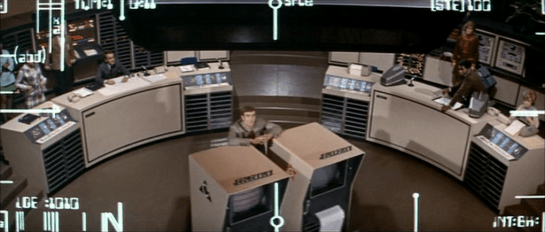
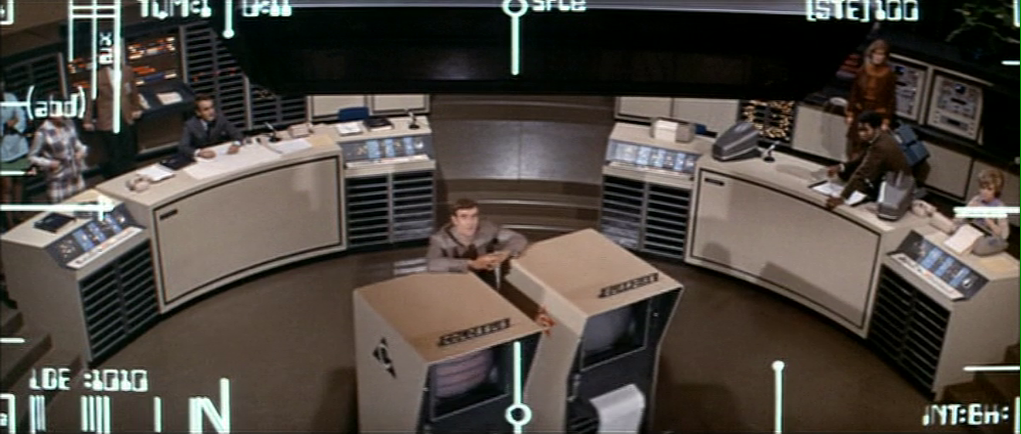
In Colossus: The Forbin Project, when Unity begins issuing demands, one of its first instructions is to outfit the Computer Programming Office (CPO) with wall-mounted video cameras that it can access and control. Once this network of cameras is installed, Forbin gives Unity a tour of the space, introducing it visually and spatially to a place it has only known as an abstract node network. During this tour, the audience is also introduced to Unity’s point-of-view, which includes an overlay consisting of several parts.

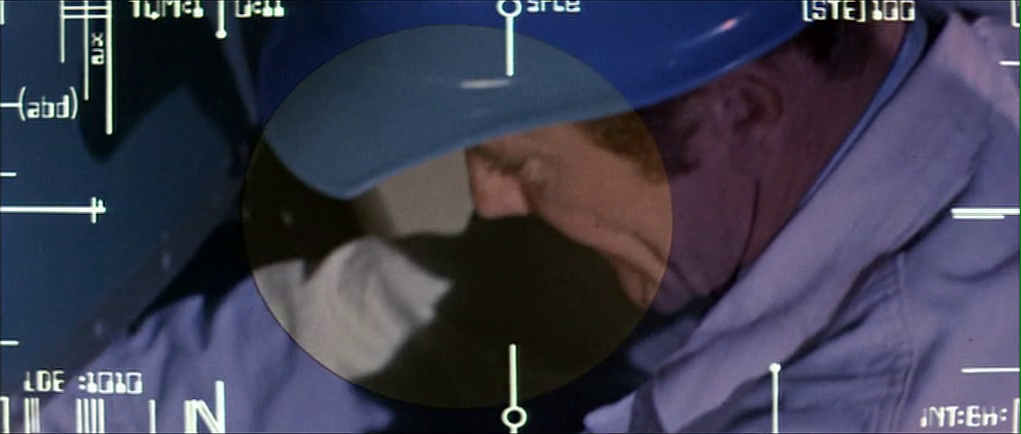
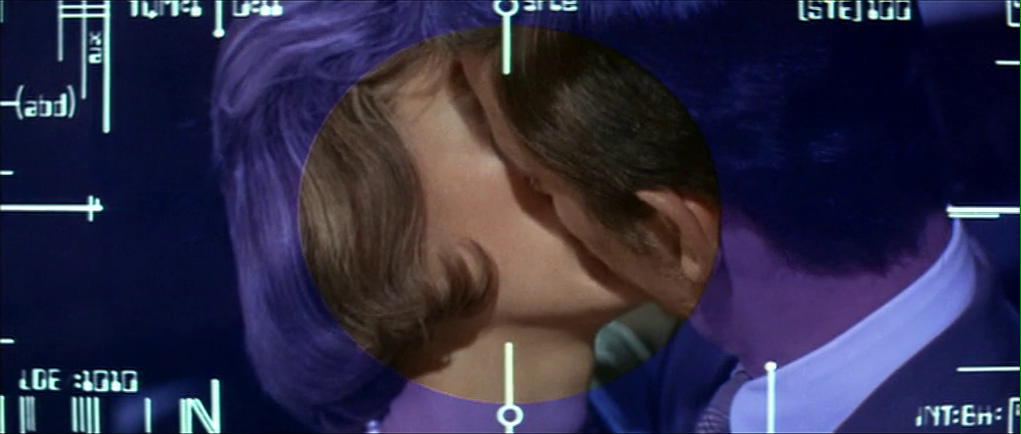
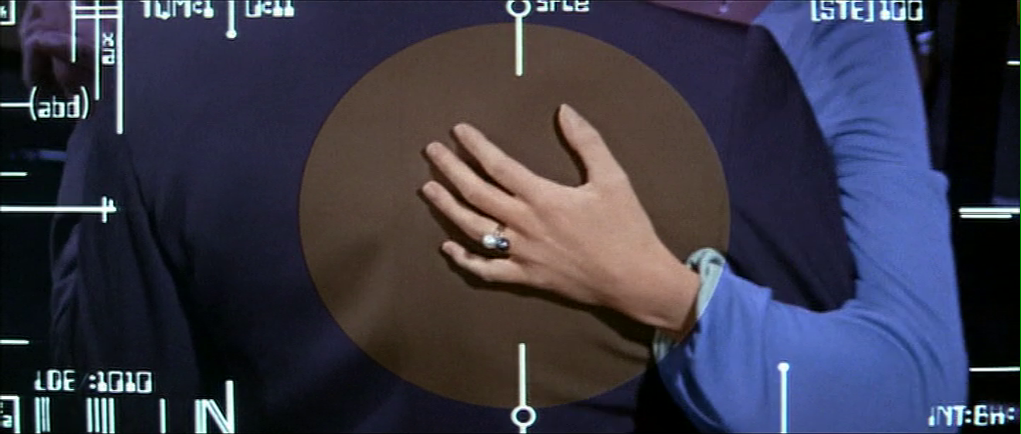
The first part is a white overlay of rule lines and MICR characters that cluster around the edge of the frame. These graphics do not change throughout the film, whether Unity is looking at Forbin in the CPO, carefully watching for signs of betrayal in a missile silo, or creepily keeping an “eye” on Forbin and Markham’s date for signs of deception.

In these last two screen grabs, you see the second part of the Unity POV, which is a focus indicator. This overlay appears behind the white bits; it’s a blue translucent overlay with a circular hole revealing true color. The hole shows where Unity is focusing. This indicator appears, occasionally, and can change size and position. It operates independently of the optical zoom of the camera, as we see in the below shots of Forbin’s tour.

A first augmented computer PoV? 🥇

When writing about computer PoVs before, I have cited Westworld as the first augmented one, since we see things from The Gunslinger’s infrared-vision eyes in the persistence-hunting sequences. (2001: A Space Odyssey came out the year prior to Colossus, but its computer PoV shots are not augmented.) And Westworld came out three years after Colossus, so until it is unseated, I’m going to regard this as the first augmented computer PoV in cinema. (Even the usually-encyclopedic TVtropes doesn’t list this one at the time of publishing.) It probably blew audiences’ minds as it was.

“Colossus, I am Forbin.”

And as such, we should cut it a little slack for not meeting our more literate modern standards. It was forging new territory. Even for that, it’s still pretty bad.

Real world computer vision

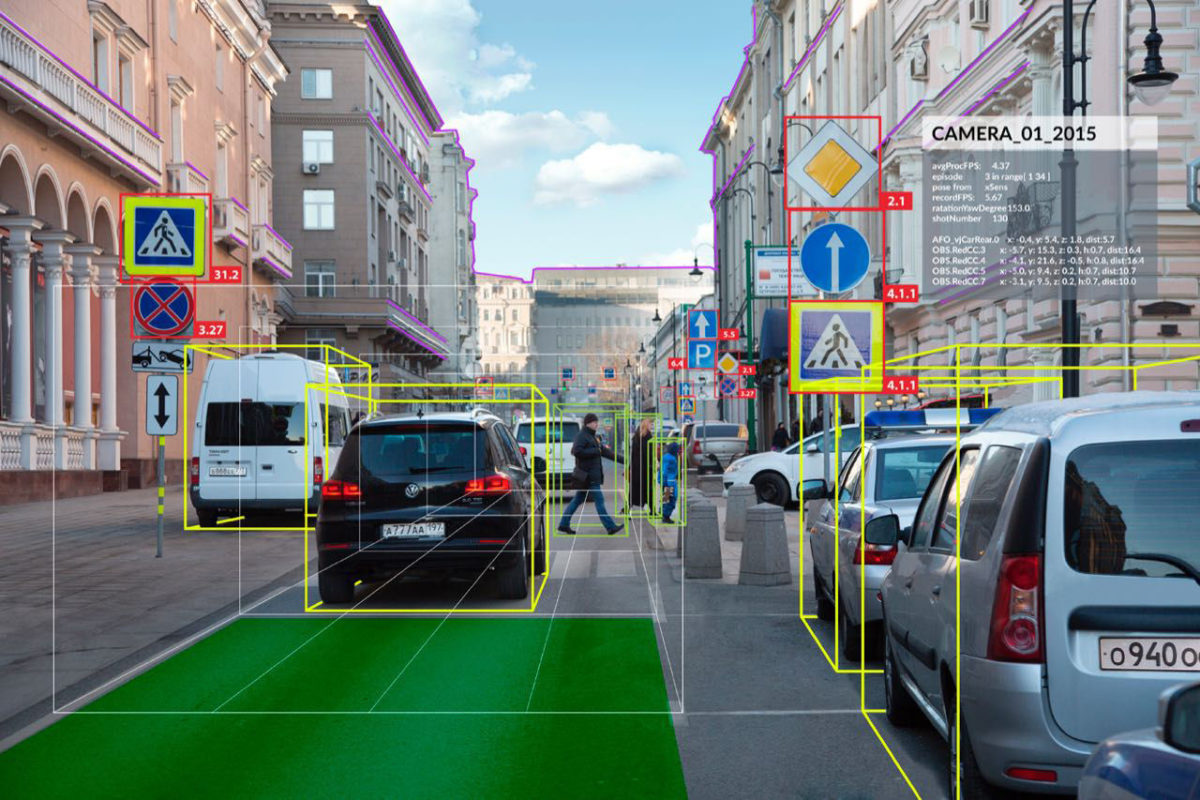
Though computer vision is always advancing, it’s safe to say that AI would be looking at the flat images and seeking to understand the salient bits per its goals. In the case of self-driving cars, that means finding the road, reading signs and road makers, identifying objects and plotting their trajectories in relation to the vehicle’s own trajectory in order to avoid collisions, and wayfinding to the destination, all compared against known models of signs, conveyances, laws, maps, and databases. Any of these are good fodder for sci-fi visualization.

Source: Medium article about the state of computer vision in Russia, 2017.

Unity’s concerns would be its goal of ending war, derived subgoals and plans to achieve those goals, constant scenario testing, how it is regarded by humans, identification of individuals, and the trustworthiness of those humans. There are plenty of things that could be augmented, but that would require more than we see here.

Unity Vision looks nothing like this

I don’t consider it worth detailing the specific characters in the white overlay, or backworlding some meaning in the rule lines, because the rule overlay does not change over the course of the movie. In the book Make It So: Interaction Design Lessons from Sci-fi, Chapter 8, Augmented Reality, I identified the types of awareness such overlays could show: sensor output, location awareness, context awareness, and goal awareness, but each of these requires change over time to be useful, so this static overlay seems not just pointless, but it risks covering up important details that the AI might need.

Compare the computer vision of The Terminator.

Many times you can excuse computer-PoV shots as technical legacy, that is, a debugging tool that developers built for themselves while developing the AI, and which the AI now uses for itself. In this case, it’s heavily implied that Unity provided the specifications for this system itself, so that doesn’t make sense.

The focus indicator does change over time, but it indicates focus in a way that, again, obscures other information in the visual feed and so is not in Unity’s interest. Color spaces are part of the way computers understand what they’re seeing, and there is no reason it should make it harder on itself, even if it is a super AI.

Largely extradiegetic

So, since a diegetic reading comes up empty, we have to look at this extradiegetically. That means as a tool for the audience to understand when they’re seeing through Unity’s eyes—rather than the movie’s—and via the focus indicator, what the AI is inspecting.

As such, it was probably pretty successful in the 1970s to instantly indicate computer-ness.

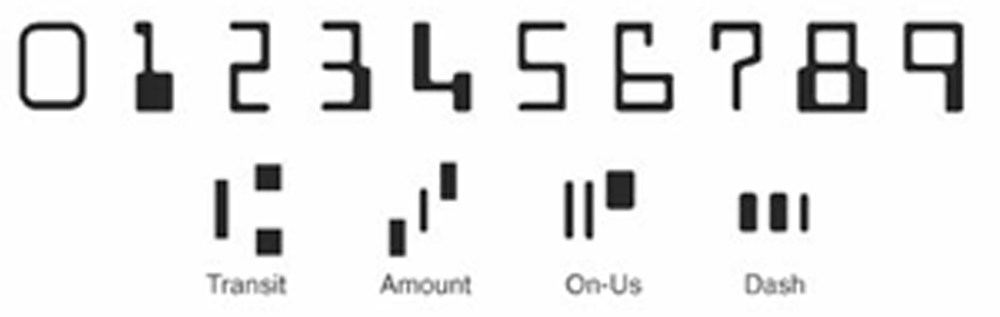
One reason is the typeface. The characters are derived from MICR, which stands for magnetic ink character recognition. It was established in the 1950s as a way to computerize check processing. Notably, the original font had only numerals and four control characters, no alphabetic ones.

Note also that these characters bear a style resemblance to the ones seen in the film but are not the same. Compare the 0 character here with the one in the screenshots, where that character gets a blob in the lower right stroke.

I want to give a shout-out to the film makers for not having this creeper scene focus on lascivious details, like butts or breasts. It’s a machine looking for signs of deception, and things like hands, microexpressions, and, so the song goes, kisses are more telling.

Still, MICR was a genuinely high-tech typeface of the time. The adult members of the audience would certainly have encountered the “weird” font in their personal lives while looking at checks, and likely understood its purpose, so was a good choice for 1970, even if the details were off.

Another is the inscrutability of the lines. Why are they there, in just that way? Their inscrutability is the point. Most people in audiences regard technology and computers as having arcane reasons for the way they are, and these rectilinear lines with odd greebles and nurnies invoke that same sensibility. All the whirring gizmos and bouncing bar charts of modern sci-fi interfaces exhibit the same kind of FUIgetry.

So for these reasons, while it had little to do with the substance of computer vision, its heart was in the right place to invoke computer-y-ness.

Dat Ending

At the very end of the film, though, after Unity asserts that in time humans will come to love it, Forbin staunchly says, “Never.” Then the film passes into a sequence that is hard to tell whether it’s meant to be diegetic or not.

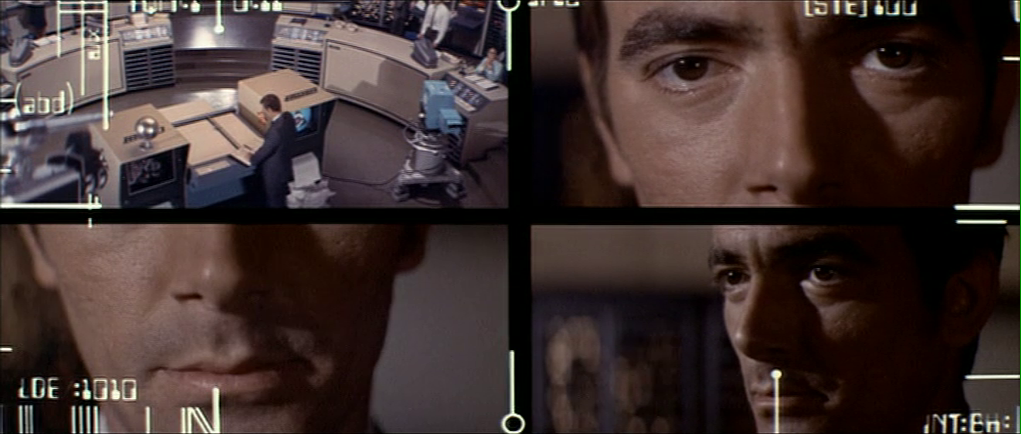
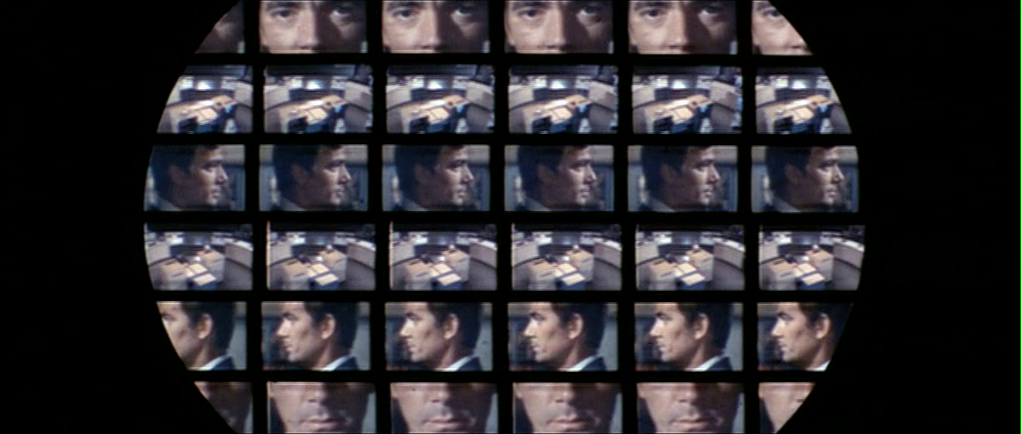
In the first beat, the screen breaks into four different camera angles of Forbin at once. (The overlay is still there, as if this was from a single camera.)

This says more about computer vision than even the FUIgetry.

This sense of multiples continues in the second beat, as multiple shots repeat in a grid. The grid is clipped to a big circle that shrinks to a point and ends the film in a moment of blackness before credits roll.

Since it happens right before the credits, and it has no precedent in the film, I read it as not part of the movie, but a title sequence. And that sucks. I wish wish wish this had been the standard Unity-view from the start. It illustrates that Unity is not gathering its information from a single stereoscopic image, like humans and most vertebrates do, but from multiple feeds simultaneously. That’s alien. Not even insectoid, but part of how this AI senses the world.

Captain’s Board

image06

The Captain’s Board is a double hexagon table at the very center of the CIC.  This board serves as a combination of podium and status dashboard for the ship’s Captain.  Often, the ship’s XO or other senior officers will move forward and use a grease pen or replacement transparency sheet to update information on the board.

image05For example, after jumping from their initial position to the fleet supply base in the nebula, Colonel Tigh replaces the map on the ‘left’ side of the board with a new map of the location that the Galactica had just jumped to.  This implies that the Galactica has a cache of maps in the CIC of various parts of the galaxy, or can quickly print them on the fly.

After getting hit by a Cylon fighter’s nuclear missile, Tigh focuses on a central section of the board with a grease pen to mark the parts of the Galactica suffering damage or decompression. The center section of the board has a schematic, top-down view of the Galactica.

During the initial fighting, Lt. Gaeda is called forward to plot the location of Galactica’s combat squadrons on the board.  This hand-drawn method is explicitly used, even when the Dradis system is shown to be functioning.

image07

The transparency sheets are labeled with both a region and a sector: in this case, “Caprica Region, SECT OEL”.  More text fills the bottom of the label: “Battlestar Galactica Starchart…”

Several panels of physical keys and low-resolution displays ring the board, but we never see any characters interacting with them.  They do not appear to change during major events or during shifts in the ship status.

The best use of these small displays would be to access reference data with a quick search or wikipedia-style database.  Given what we see in the show, it is likely that it was just intended as fuigetry.


Old School

Charts and maps are an old interface that has been well developed over the course of human history.  Modern ships still use paper charts and maps to track their current location as a backup to GPS.

Given the Galactica’s mission to stay active even in the face of complete technological superiority of the opponent, a map-based backup to the Dradis makes sense in spite of the lack of detailed information it might need to provide.  It is best as, and should be, a worst-case backup.  

Here, the issue becomes the 3-dimensional space that the Galactica inhabits.  The maps do an excellent job of showing relationships in a two dimensional plane, but don’t represent the ‘above’ and ‘below’ at all.  

In those situations, perhaps something like a large fish tank metaphor might work better, but wouldn’t allow for quick plotting of distance and measurements by hand.  Instead, perhaps something more like the Pin Table from the 2000 X-Men movie that could be operated by hand:

image01

It would provide a shake-resistant, physical, no-electricity needed 3-D map of the surrounding area.  Markups could be easily accomplished with a sticky-note-like flag that could attach to the pins.

Stark Tower monitoring

Since Tony disconnected the power transmission lines, Pepper has been monitoring Stark Tower in its new, off-the-power-grid state. To do this she studies a volumetric dashboard display that floats above glowing shelves on a desktop.

Avengers-Reactor-output03

Volumetric elements

The display features some volumetric elements, all rendered as wireframes in the familiar Pepper’s Ghost (I know, I know) visual style: translucent, edge-lit planes. A large component to her right shows Stark Tower, with red lines highlighting the power traveling from the large arc reactor in the basement through the core of the building.

The center of the screen has a similarly-rendered close up of the arc reactor. A cutaway shows a pulsing ring of red-tinged energy flowing through its main torus.

This component makes a good deal of sense, showing her the physical thing she’s meant to be monitoring but not in a photographic way, but a way that helps her quickly locate any problems in space. The torus cutaway is a little strange, since if she’s meant to be monitoring it, she should monitor the whole thing, not just a quarter of it that has been cut away.

Flat elements

The remaining elements in the display appear on a flat plane. Continue reading

Abidjan Operation

Avengers_BartonCompromised

After Hawkeye is enthralled by Loki, agent Coulson has to call agent Romanoff in from the field, mid-mission. While he awaits her to extract herself from a situation, he idly glances at case file 242-56 which consists of a large video of Barton and Romanoff mid-combat, and overview profiles of the two agents. A legend in the upper right identifies this as STRIKE TEAM: DELTA, and a label at the top reads ABIDJAN OPERATION. There is some animated fuigetry on the periphery of the video, and some other fuigetry in windows that are occluded by the case file. bartoncompromised

Continue reading

Portal Monitor

After Loki has enthralled Selvig, enthralled-Hawkeye lets Loki know that, “This place is about to blow and drop a hundred feet of rock on us.” Selvig looks to the following screen and confirms, “He’s right. The portal is collapsing in on itself.

Portal_monitoring

This is perhaps one of the most throwaway screens in the film, given the low-rez twisty graphics that could be out of Lawnmower Man, its only-vague-resemblance to the portal itself…

c.f.

c.f.

…the text box of wildly scrolling and impossible to read pink code with what looks like a layer of white code hastily slapped over it, and—notably—no trendline of data that would help Selvig quickly identify this Very Important Fact. Maybe he’s such a portal whisperer that he can just see it, but why show the screens rather than show him looking up to the blue thing itself?

There might be some other data on the left of this bank of screens seen a few seconds later in the background…

Avengers-Wormhole-03_cropped

…but it has more red text overlays, so I’m disinclined to give it the blurry benefit of the doubt.

Fair enough, this is there merely to establish Selvig’s enthrallment, and the scientific certainty of the stakes for the next beat. But, we see his eyes, and the certainty is evidenced by everything collapsing. We don’t need scientific assurance. If the designers were not given time to make it passable, I wish that the beat had been handled without a view of the screens rather than shaky-cam.

Sleep Pod—Wake Up Countdown

On each of the sleep pods in which the Odyssey crew sleep, there is a display for monitoring the health of the sleeper. It includes some biometric charts, measurements, a body location indicator, and a countdown timer. This post focuses on that timer.

To show the remaining time of until waking Julia, the pod’s display prompts a countdown that shows hours, minutes and seconds. It shows in red the final seconds while also beeping for every second. It pops-up over the monitoring interface.

image03

Julia’s timer reaches 0:00:01.

The thing with pop-ups

We all know how it goes with pop-ups—pop-ups are bad and you should feel bad for using them. Well, in this case it could actually be not that bad.

The viewer

Although the sleep pod display’s main function is to show biometric data of the sleeper, the system prompts a popup to show the remaining time until the sleeper wakes up. And while the display has some degree of redundancy to show the data—i.e. heart rate in graphics and numbers— the design of the countdown brings two downsides for the viewer.

  1. Position: it’s placed right in the middle of the screen.
  2. Size: it’s roughly a quarter of the whole size of the display

Between the two, it partially covers both the pulse graphics and the numbers, which can be vital, i.e. life threatening—information of use to the viewer. Continue reading

Rescue Shuttle

shuttle01

After the ambush on Planet P, Ibanez pilots the shuttle that rescues survivors and…and Diz. We have a shot of the display that appears on the dashboard between the pilot and copilot. Tiny blue columns of text too small to read that spill onto the left. One big column of tiny green text that wipes on and flashes. Seizure-inducing yellow dots spazzing around on red grids. A blue circle on the right is probably Planet P or a radar, but the graphic…spinning about its center so quick you cannot follow. There’s not…I can’t…how is this supposed to…I’m just going to call it: fuigetry.