Santa Tech: Rise of the Guardians (2012)

We interrupt the 3D file browsing series for this Santa-holiday one-off post. If you’re trapped somewhere needing design-and-Santa-related distraction, here’s a bunch of words, images, and links for you.

Longtime readers may recall the Who Did it Better? Santa Claus edition from 2020, in which I took a look at speculative interfaces that help Santa Claus do his Saintly Nick business. (If not, check it out at the link above, especially if you need a refresher on the core myth.) Earlier this year a dear friend mentioned Rise the Guardians as an additional candidate. So I watched it, and hereby add it as an addendum to that study. I might make it a habit to do every year, because they aren’t going to stop making Santa movies anytime soon.

Spoiler alert: There aren’t many interfaces, and they don’t fare well, but the joy is in the analysis, so let’s dive in.

Quick plot recap

Children around the world are protected by a group called the Guardians:

  • North (Santa)
  • Tooth (the Tooth Fairy)
  • (the Easter) Bunnymund
  • Sandman

…all appointed by the mysterious Man in the Moon. Who is just the moon, communicating via moonbeams.

Pictured: A plot-critical character peering in through the shutter like some kind of celestial stalker.

One day, an ancient foe named Pitch Black returns, who plots to get all the children to stop believing in the guardians, thereby robbing them of their power and clearing the way for his fear-mongering world domination. In response, the Man in the Moon names a new Guardian to help defeat him: Jack Frost. Jack initially resists, but over the course of the film and the help of one special child, Jack comes around, learns to care, and helps defeat Pitch. Children around the world believe in him, and he formally joins the ranks of the Guardians.

Our heroes face off against Pitch. Sandman is Disney-dead at this point in the story, and so not pictured.

n.b. Santa’s are only a subset of the film’s devices

The abilities of the Guardians are a blend of innate magic and magic items, fueled with *vaguely gestures at childhood belief* and not a lot of observable cause-and-effect interfaces. For instance, when Pitch breaks Jack’s magic crook, Jack just holds the pieces and wills it back whole with glowy sparkliness and grunting psychic effort despite never having done anything like this before. No interfaces there. Magic things don’t really befit the usual sort of analysis done on this blog. But North does have three interfaces to do his gift-giving duties that bear the cold light of examination, you heartless, Vulcan bastards. (Yaaay! My people!)

  1. Snow globes
  2. Sleigh dashboard
  3. The Belief Globe

(Tooth and her hummingbird-like Baby Teeth helpers have some proper interfaces as well, but are kind of creepy and this post is about Santa tech. Maybe I’ll do teeth tech interfaces later. Maybe March 6.)

Snow globes

These handheld spheres look like the popular winter decorations, but with no base by which they can rest on a surface. Instead they are kept loose in the user’s pocket until they are needed. By shaking it and speaking a destination, a preview of the destination appears on the inside, surrounded by swirls of “snow.” Then by pitching it like a baseball, the globe disappears in a puff, replaced with a circular portal to that destination. Move or toss something through, and the portal closes behind.

If this interface seems well-designed, that’s because the examples in the movie are damned convenient. Each time we see a snow globe used in the movie…

  • …the destination has a globally-unique name
  • …the destination has a unique and easily identifiable landmark to display in the globe
  • …the appearance of the destination is already known to the user, so the visual helps confirm the selection

But change any one of these, and it starts to fail. Consider if North, in the course of doing his Santa-ly duties, had to jump to a “San José.” There are at least 334 San Josés around the world. Very few of which have identifiable landmarks. How does North know the one that’s being visualized is the right one? He might have eidetic memory because of Рождество Христово magic or something, but these tools are used by the yetis, too, and I doubt they have that same gift.

How would it help them disambiguate? If the displayed destination is not the right one, how does the user provide more specificity to get to the right one? What if they only know the name? How does the snow globe help them narrow things down from 334 to 1? Since the globe disappears on use, and pockets have a limited capacity, the cost for getting it wrong can be quite high. The yetis might very well have to walk back to the North Pole should they run out.

Maybe, maybe, there are only a limited number of destinations possible, but then you’d expect some reference on the globe itself to help a user know that.

Pictured in the globe: a San José from Google Earth, and I’ll send a free PDF copy of the book to the first person who names which San José correctly, because I’m fairly confident it’s nigh-impossible.

It’s also worth noting that there’s no indication how the portals know when it’s OK to close, rather than say, chopping the traveler in half or leaving them stranded. Is it time-based? Where’s the countdown? Is it dependent on a code word or thought? How does the user know whether the code word has been received or rejected? Does the portal close as soon as a single, “whole object” passes through? Theseus would like a word. There’s no interface in evidence, so it must be “smart,” but as we know, “smart” is not always smart, and design is critical for making users more confident and avoiding costly errors. There are far too many unanswered questions to give this any stamp of approval.

Sleigh dashboard

North has a sleigh of course. It has a dashboard with some controls. One of these controls we see in use is a lever, whose purpose is a mystery. It can’t be a booster, since the motile force here is rangiferine, not mechanical. The control is shaped like an engine control lever on a boat or a thrust control on an airplane. After the switch is thrown, the camera cuts to a very blurry shot of the sleigh’s undercarriage where, if something happens, I can’t discern what is it. Maybe the runners go from flat to vertical, for a more ice-skating-like experience? Exacerbating our lack of information, the control is unlabeled, so it’s hard for a new user to know what it does, or what state it’s in, or what the options are. It has no safety mechanism, so depending on the force required, might be easily accidentally activated. Cannot recommend this, either.

The major element in the dashboard is a large globe inset in its center. It’s roughly shoulder-width in diameter. We never see it in use, but it bears great resemblance to the Belief Globe (see below). I want to believe it’s a you-are-here navigation device that automatically orients to match the position and bearing of the sleigh, because that might be useful. And it would be an awesome opportunity for a super-charming brass location indicator, mounted to a quarter-meridian arm. But I suspect this device is actually meant to be a miniaturized copy of the Belief Globe, which would not be useful for reasons you’ll read in the next section.

North and Jack chuckle at Bunnymund’s terror of flying. Fear is so funny.

The Belief Globe

This display is not explicitly named over the course of the movie, but I have to call it something. It is a huge globe that mechanically rotates in the center of North’s arctic fortress. It is covered with beautiful, arcane symbols and Cyrillic writing (North is Russian—this movie was from the halcyon days between the end of the Cold War and its horrific current genocidal landgrab attempts against Ukraine), and displays tiny points of light all over it.

Tooth, explaining the globe to Jack, says, “Each of those lights is a child.” North explains further, “A child who believes.” But some of the dots are bigger and others brighter. It’s unclear what information those variables are meant to convey. Older kids? Degree of belief? Relative niceness? We don’t see anyone looking into individual dots, which, if that’s not possible, really means that this device, diegetically, just shows where the Guardians might want to focus their activities, conspicuously, to bolster Belief in that geographical area.

And belief seems to be at critical levels. I asked chatGPT to count the dots in the second image in the gallery above. It estimated 39,674 dots and that that pictured chunk of South America to be about 12% of the world’s total landmass, excluding Antarctica. South America has around 5% of the world’s total population, which extrapolates out to a total 725,280 dots we would expect to see across the world. According to populationpyramid.com, global population in 2012—the time this film was released—was 7.2 billion, with 1.91 billion being 14 years old or younger (a generous age for childlike belief, since the average age of losing faith in a “real” Santa tends to be around 10 years old in the USA, but let’s run with it.)

I am delighted that this happens to look like a morbid, morbid Christmas tree.

That means that in the world of the Guardians, only 4 out of 100 children believe in any of them to begin with, even before Pitch comes a-calling. This would have been so easy to fix in the script. Have Tooth say, “These lights represent children who believe.” The plural would have left it ambiguous.

But I’ve digressed.

North has a viewing deck which seems custom-built for observing the globe, and which gives us an important perspective for analysis.

This over-the-yeti-shoulder shot helps point out a major failing of this display: visibility of the information.

With the globe anchored in place at the poles and the observation deck so low, this makes the dots in the southern hemisphere much more prominent in the viewers’ sight, introducing an availability bias. It looks like anything above 50N latitude is just…out of sight, and that includes significant populations in Europe as well as North’s own fortress. (We’ll see in the Control Panel that there’s a miniature globe mounted there that provides a view of the Northern Hemisphere, but we don’t see lights on it, and it would be a bad idea to split the information across two sources of differing scales, anyway. So let’s hope that’s not its intended purpose.)

There is an easy fix for the orientation problem, and it of course comes from the world of globe-making. By attaching the poles of the globe to a full meridian that encircles the globe, and then attaching the full meridian to a half meridian at the equator, you create a gimbal that allows the globe to rotate to any orientation.

Like this. Example from UltimateGlobes.com

This is called a full-swing mount, and it would allow arbitrary inspection of any point on the globe. It would be lovely to see writ large and mechanical in the film.

This display also privileges land in a possibly-misleading way, in the same way that election maps can. Let’s all recall that land doesn’t vote, but this kind of implies otherwise.

Same image as above, repeated for easy reference.

For example, on the Belief Globe, it looks like Australian kids are way behind in Belief metrics than New Zealand kids, but Australia has a density of 3.4 inhabitants per square kilometer compared to New Zealand’s 19.1, and this map doesn’t make that easy to understand. Proportion of per capita belief would be a better metric for delivering actionable Santa insight.

Like this, but inverse. From Colin Mathers on Medium.

Even better would be to show change in belief over time (“боже мой!” North might shout, “Bunny! Get to Czech Republic, немедленно!”), though information over time is notoriously difficult to do on a geographical map.

But even if we solve the orientation and representation problems, putting the information on a globe means at least half of it is out of sight at any given time. In the yeticam view above, what’s going on in Bermuda? You don’t know! It does revolve slowly, but by my own rough estimation at the speed we see in this scene, it would take around 6 minutes for this globe to make a complete, sidereal rotation, which is way, way beyond the vigilance threshold limit required to put that picture together holistically in your mind. If the whole picture is important (and I’m asserting that it is), the information display should be a map rather than a globe.

Eh…it’s a crappy Midjourney comp, but you get the gist.

You don’t want to lose the charming magical-Soviet machine feeling of it, but with a world map, maybe you have some mechanics that physically simulate the day/night cycle? And since the Man in the Moon is so important to this story, maybe the lunar cycle as well? Or you could make some mechanical interactive fisheye focus effect, which would be even more spectacular. (Please, somebody, do this.)

I also have to note that having Belief hold such a prominent place in this command and control room seems really self-serving. That much real estate is dedicated to telling you how much gas you have in the tank? There are plenty of additional things that a Santa and his team would want to keep track of that would be of as much importance: Days until Christmas, location of kids at risk of losing belief, percentage of toys complete, bowl-full-of-jelly BMI score, naughty/nice balance in the world, current value of elf pension fund, just to name a few. These could be split-flap displays for nostalgia and lovely clacking audio opportunities.

Globe Control Panel

On the observation deck, North has a control panel of sorts. There are two parts whose functions we can infer, a trackball and a Bat-Guardian-Signal, but most of it—like the levers and joysticks with lit toggle buttons—we cannot. Let’s look at the two whose purpose we can infer.

The trackball

The trackball is a miniature Belief Globe, inset on the right hand of the control panel. It is quite similar to the trackballs we see in Arthur Christmas (2011, the year before) and The Christmas Chronicles (2018, six years later). If it controls the orientation of the Belief Globe, and its movement is constrained similarly to how the globe is, a user hoping to focus on Mauritius would have to memorize that it is due south of Oman, and do the same for the entirety of the southern hemisphere.

I hope you‘ve memorized your world geography, mate.

It should also be constrained to left-right movement like the thing being controlled, as if on a hidden inclination mount. But this looks like a free-spin trackball, so could use a knob in the pole and maybe a meridian arm to help signal its constraint. It should also be well-mapped to the globe as the observer sees it. It is not. Compare the orientation of the Globe to the trackball in the screen shot. They do not match.

All told, a pretty underthought component.

Bat-Guardian-Signal

Early in the film, when North realizes Pitch is back, he grabs the control in the far lower-right-hand corner. He twists it 90 degrees counterclockwise and pushes down. The ice-like octagonal button below begins to glow brightly.

This sets the Belief Globe to glowing with aurora lights, that extend out across the globe and alert the Guardians, signaling them to report to Commissioner Gordon North’s compound at once. Mentioned here only out of a sense of completeness, this control is germane to North’s being leader of a team rather than any of his Santa duties. It’s unlabeled, it can’t possibly have the global reach that it needs, and I’m not sure why the Globe was selected to be the source of the aurora, but meh, it’s just not that important in this context.

Final score: Lump of Coal

We have to keep in mind this is a movie for kids, and kids won’t be put off by any of these interface failings. But for our overthinking design-nerd purposes in reviewing the Santa tech, these just don’t hold up. Because of this, Rise of the Guardian’s Santa tech poses zero threat to dethroning The Santa Chronicle’s lovely Santa interfaces. But good to remind ourselves of the principles to which we should be paying attention.

Enjoy the movie for the fun voice acting, the awesome character design, the gorgeous Sandman visuals, and any nearby kids’ sense of wonder, but don’t worry about the interfaces as anything to admire or mimic in the real world.

Happy holidays, however you celebrate, to most everyone except you, asshole elf.

Who did it better? Santa Claus edition

I presume my readership are adults. I honestly cannot imagine this site has much to offer the 3-to-8-year-old. That said, if you are less than 8.8 years old, be aware that reading this will land you FIRMLY on the naughty list. Leave before it’s too late. Oooh, look! Here’s something interesting for you.


For those who celebrate Yule (and the very hybridized version of the holiday that I’ll call Santa-Christmas to distinguish it from Jesus-Christmas or Horus-Christmas), it’s that one time of year where we watch holiday movies. Santa features in no small number of them, working against the odds to save Christmas and Christmas spirit from something that threatens it. Santa accomplishes all that he does by dint of holiday magic, but increasingly, he has magic-powered technology to help him. These technologies are different for each movie in which they appear, with different sci-fi interfaces, which raises the question: Who did it better?

Unraveling this stands to be even more complicated than usual sci-fi fare.

  • These shows are largely aimed at young children, who haven’t developed the critical thinking skills to doubt the core premise, so the makers don’t have much pressure to present wholly-believable worlds. The makers also enjoy putting in some jokes for adults that are non-diegetic and confound analysis.
  • Despite the fact that these magical technologies are speculative just as in sci-fi, makers cannot presume that their audience are sci-fi fans who are familiar with those tropes. And things can’t seem too technical.
  • The sci in this fi is magical, which allows makers to do all-sorts of hand-wavey things about how it’s doing what it’s doing.
  • Many of the choices are whimsical and serve to reinforce core tenets of the Santa Claus mythos rather than any particular story or worldbuilding purpose.

But complicated-ness has rarely cowed this blog’s investigations before, why let a little thing like holiday magic do it now?

Ho-Ho-hubris!

A Primer on Santa

I have readers from all over the world. If you’re from a place that does not celebrate the Jolly Old Elf, a primer should help. And if you’re from a non-USA country, your Saint Nick mythos will be similar but not the same one that these movies are based on, so a clarification should help. To that end, here’s what I would consider the core of it.

Santa Claus is a magical, jolly, heavyset old man with white hair, mustache, and beard who lives at the North Pole with his wife Ms. Claus. The two are almost always caucasian. He can alternately be called Kris Kringle, Saint Nick, Father Christmas, or Klaus. The Clark Moore poem calls him a “jolly old elf.” He is aware of the behavior of children, and tallies their good and bad behavior over the year, ultimately landing them on the “naughty” or “nice” list. Santa brings the nice ones presents. (The naughty ones are canonically supposed to get coal in their stockings though in all my years I have never heard of any kids actually getting coal in lieu of presents.) Children also hang special stockings, often on a mantle, to be filled with treats or smaller presents. Adults encourage children to be good in the fall to ensure they get presents. As December approaches, Children write letters to Santa telling him what presents they hope for. Santa and his elves read the letters and make all the requested toys by hand in a workshop. Then the evening of 24 DEC, he puts all the toys in a large sack, and loads it into a sleigh led by 8 flying reindeer. Most of the time there is a ninth reindeer up front with a glowing red nose named Rudolph. He dresses in a warm red suit fringed with white fur, big black boots, thick black belt, and a stocking hat with a furry ball at the end. Over the evening, as children sleep, he delivers the presents to their homes, where he places them beneath the Christmas tree for them to discover in the morning. Families often leave out cookies and milk for Santa to snack on, and sometimes carrots for the reindeer. Santa often tries to avoid detection for reasons that are diegetically vague.

There is no single source of truth for this mythos, though the current core text might be the 1823 C.E. poem, “A Visit from St. Nicholas” by Clement Clarke Moore. Visually, Santa’s modern look is often traced back to the depictions by Civil War cartoonist Thomas Nast, which the Coca-Cola Corporation built upon for their holiday advertisements in 1931.

Both these illustrations are by Nast.

There are all sorts of cultural conversations to have about the normalizing a magical panopticon, what effect hiding the actual supply chain has, and asking for what does perpetuating this myth train children; but for now let’s stick to evaluating the interfaces in terms of Santa’s goals.

Santa’s goals

Given all of the above, we can say that the following are Santa’s goals.

  • Sort kids by behavior as naughty or nice
    • Many tellings have him observing actions directly
    • Manage the lists of names, usually on separate lists
  • Manage letters
    • Reading letters
    • Sending toy requests to the workshop
    • Storing letters
  • Make presents
  • Travel to kids’ homes
    • Find the most-efficient way there
    • Control the reindeer
    • Maintain air safety
      • Avoid air obstacles
    • Find a way inside and to the tree
    • Enjoy the cookies / milk
  • Deliver all presents before sunrise
  • For each child:
    • Know whether they are naughty or nice
    • If nice, match the right toy to the child
    • Stage presents beneath the tree
  • Avoid being seen

We’ll use these goals to contextualize the Santa interfaces against.

This is the Worst Santa, but the image is illustrative of the weather challenges.

Typical Challenges

Nearly every story tells of Santa working with other characters to save Christmas. (The metaphor that we have to work together to make Christmas happen is appreciated.) The challenges in the stories can be almost anything, but often include…

  • Inclement weather (usually winter, but Santa is a global phenomenon)
  • Air safety
    • Air obstacles (Planes, helicopters, skyscrapers)
  • Ingress/egress into homes
  • Home security systems / guard dogs

The Contenders

Imdb.com lists 847 films tagged with the keyword “santa claus,” which is far too much to review. So I looked through “best of” lists (two are linked below) and watched those films for interfaces. There weren’t many. I even had to blend CGI and live action shows, which I’m normally hesitant to do. As always, if you know of any additional shows that should be considered, please mention it in the comments.

https://editorial.rottentomatoes.com/guide/best-christmas-movies/https://screenrant.com/best-santa-claus-holiday-movies-ranked/

After reviewing these films, the ones with Santa interfaces came down to four, presented below in chronological order.

The Santa Clause (1994)

This movie deals with the lead character, Scott Calvin, inadvertently taking on the “job” of Santa Clause. (If you’ve read Anthony’s Incarnations of Immortality series, this plot will feel quite familiar.)

The sleigh he inherits has a number of displays that are largely unexplained, but little Charlie figures out that the center console includes a hot chocolate and cookie dispenser. There is also a radar, and far away from it, push buttons for fog, planes, rain, and lightning. There are several controls with Christmas bell icons associated with them, but the meaning of these are unclear.

Santa’s hat in this story has headphones and the ball has a microphone for communicating with elves back in the workshop.

This is the oldest of the candidates. Its interfaces are quite sterile and “tacked on” compared to the others, but was novel for its time.

The Santa Clause on imdb.com

Fred Claus (2007)

This movie tells the story of Santa’s n’er do well brother Fred, who has to work in the workshop for one season to work off bail money. While there he winds up helping forestall foreclosure from an underhanded supernatural efficiency expert, and un-estranging himself from his family. A really nice bit in this critically-panned film is that Fred helps Santa understand that there are no bad kids, just kids in bad circumstances.

Fred is taken to the North Pole in a sled with switches that are very reminiscent of the ones in The Santa Clause. A funny touch is the “fasten your seatbelt” sign like you might see in a commercial airliner. The use of Lombardic Capitals font is a very nice touch given that much of modern Western Santa Claus myth (and really, many of our traditions) come from Germany.

The workshop has an extensive pneumatic tube system for getting letters to the right craftself.

This chamber is where Santa is able to keep an eye on children. (Seriously panopticony. They have no idea they’re being surveilled.) Merely by reading the name and address of a child a volumetric display appears within the giant snowglobe. The naughtiest children’s names are displayed on a digital split-flap display, including their greatest offenses. (The nicest are as well, but we don’t get a close up of it.)

The final tally is put into a large book that one of the elves manages from the sleigh while Santa does the actual gift-distribution. The text in the book looks like it was printed from a computer.

Fred Clause on imdb.com

Arthur Christmas (2011)

In this telling, the Santa job is passed down patrilineally. The oldest Santa, GrandSanta, is retired. The dad, Malcolm, is the current-acting Santa one, and he has two sons. One is Steve, a by-the-numbers type into military efficiency and modern technology. The other son, Arthur, is an awkward fellow who has a semi-disposable job responding to letters. Malcolm currently pilots a massive mile-wide spaceship from which ninja elves do the gift distribution. They have a lot of tech to help them do their job. The plot involves Arthur working with Grandsanta using his old Sleigh to get a last forgotten gift to a young girl before the sun rises.

To help manage loud pets in the home who might wake up sleeping people, this gun has a dial for common pets that delivers a treat to distract them.

Elves have face scanners which determine each kids’ naughty/nice percentage. The elf then enters this into a stocking-filling gun, which affects the contents in some unseen way. A sweet touch is when one elf scans a kid who is read as quite naughty, the elf scans his own face to get a nice reading instead.

The S-1 is the name of the spaceship sleigh at the beginning (at the end it is renamed after Grandsanta’s sleigh). Its bridge is loaded with controls, volumetric displays, and even a Little Tree air freshener. It has a cloaking display on its underside which is strikingly similar to the MCU S.H.I.E.L.D. helicarrier cloaking. (And this came out the year before The Avengers, I’m just sayin’.)

The north pole houses the command-and-control center, which Steve manages. Thousands of elves manage workstations here, and there is a huge shared display for focusing and informing the team at once when necessary. Smaller displays help elf teams manage certain geographies. Its interfaces fall to comedy and trope, mostly, but are germane to the story beats

One of the crisis scenarios that this system helps manage is for a “waker,” a child who has awoken and is at risk of spying Santa.

Grandsanta’s outmoded sleigh is named Eve. Its technology is much more from the early 20th century, with switches and dials, buttons and levers. It’s a bit janky and overly complex, but gets the job done.

One notable control on S-1 is this trackball with dark representations of the continents. It appears to be a destination selector, but we do not see it in use. It is remarkable because it is very similar to one of the main interface components in the next candidate movie, The Christmas Chronicles.

Arthur Christmas on imdb.com

The Christmas Chronicles (2018)

The Christmas Chronicles follows two kids who stowaway on Santa’s sleigh on Christmas Eve. His surprise when they reveal themselves causes him to lose his magical hat and wreck his sleigh. They help him recover the items, finish his deliveries, and (well, of course) save Christmas just in time.

Santa’s sleight enables him to teleport to any place on earth. The main control is a trackball location selector. Once he spins it and confirms that the city readout looks correct, he can press the “GO” button for a portal to open in the air just ahead of the sleigh. After traveling in a aurora borealis realm filled with famous landmarks for a bit, another portal appears. They pass through this and appear at the selected location. A small magnifying glass above the selection point helps with precision.

Santa wears a watch that measures not time, but Christmas spirit, which ranges from 0 to 100. In the bottom half, chapter rings and a magnifying window seem designed to show the date, with 12 and 31 sequential numbers, respectively. It’s not clear why it shows mid May. A hemisphere in the middle of the face looks like it’s almost a globe, which might be a nice way to display and change time zone, but that may be wishful thinking on my part.

Santa also has a tracking device for finding his sack of toys. (Apparently this has happened enough time to warrant such a thing.) It is an intricate filligree over a cool green and blue glass. A light within blinks faster the closer the sphere is to the sack.

Since he must finish delivering toys before Christmas morning, the dashboard has a countdown clock with Nixie tube numbers showing hours, minutes, and milliseconds. They ordinary glow a cyan, but when time runs out, they turn red and blink.

This Santa also manages his list in a large book with lovely handwritten calligraphy. The kids whose gifts remain undelivered glow golden to draw his attention.

The Christmas Chronicles on imdb.com

So…who did it better?

The hard problem here is that there is a lot of apples-to-oranges comparisons to do. Even though the mythos seems pretty locked down, each movie takes liberties with one or two aspects. As a result not all these Santas are created equally. Calvin’s elves know he is completely new to his job and will need support. Christmas Chronicles Santa has perfect memory, magical abilities, and handles nearly all the delivery duties himself, unless he’s enacting a clever scheme to impart Christmas wisdom. Arthur Christmas has intergenerational technology and Santas who may not be magic at all, but fully know their duty from their youths but rely on a huge army of shock troop elves to make things happen. So it’s hard to name just one. But absent a point-by-point detailed analysis, there are two that really stand out to me.

The weathered surface of this camouflage button is delightful (Arthur Christmas).

Coverage of goals

Arthur Christmas movie has, by far, the most interfaces of any of the candidates, and more coverage of the Santa-family’s goals. Managing noisy pets? Check? Dealing with wakers? Check. Navigating the globe? Check. As far as thinking through speculative technology that assists its Santa, this film has the most.

Keeping the holiday spirit

I’ll confess, though, that extradiegetically, one of the purposes of annual holidays is to mark the passage of time. By trying to adhere to traditions as much as we can, time and our memory is marked by those things that we cannot control (like, say, a pandemic keeping everyone at home and hanging with friends and family virtually). So for my money, the thoroughly modern interfaces that flood Arthur Christmas don’t work that well. They’re so modern they’re not…Christmassy. Grandsanta’s sleigh Eve points to an older tradition, but it’s also clearly framed as outdated in the context of the story.

Gorgeous steampunkish binocular HUD from The Christmas Chronicles 2, which was not otherwise included in this post.

Compare this to The Christmas Chronicles, with its gorgeous steampunk-y interfaces that combine a sense of magic and mechanics. These are things that a centuries-old Santa would have built and use. They feel rooted in tradition while still helping Santa accomplish as many of his goals as he needs (in the context of his Christmas adventure for the stowaway kids). These interfaces evoke a sense of wonder, add significantly to the worldbuilding, and which I’d rather have as a model for magical interfaces in the real world.

Of course it’s a personal call, given the differences, but The Christmas Chronicles wins in my book.

Ho, Ho, HEH.

For those that celebrate Santa-Christmas, I hope it’s a happy one, given the strange, strange state of the world. May you be on the nice list.


For more Who Did it Better, see the tag.

Gravity (?) Scan

FifthE-UFT001

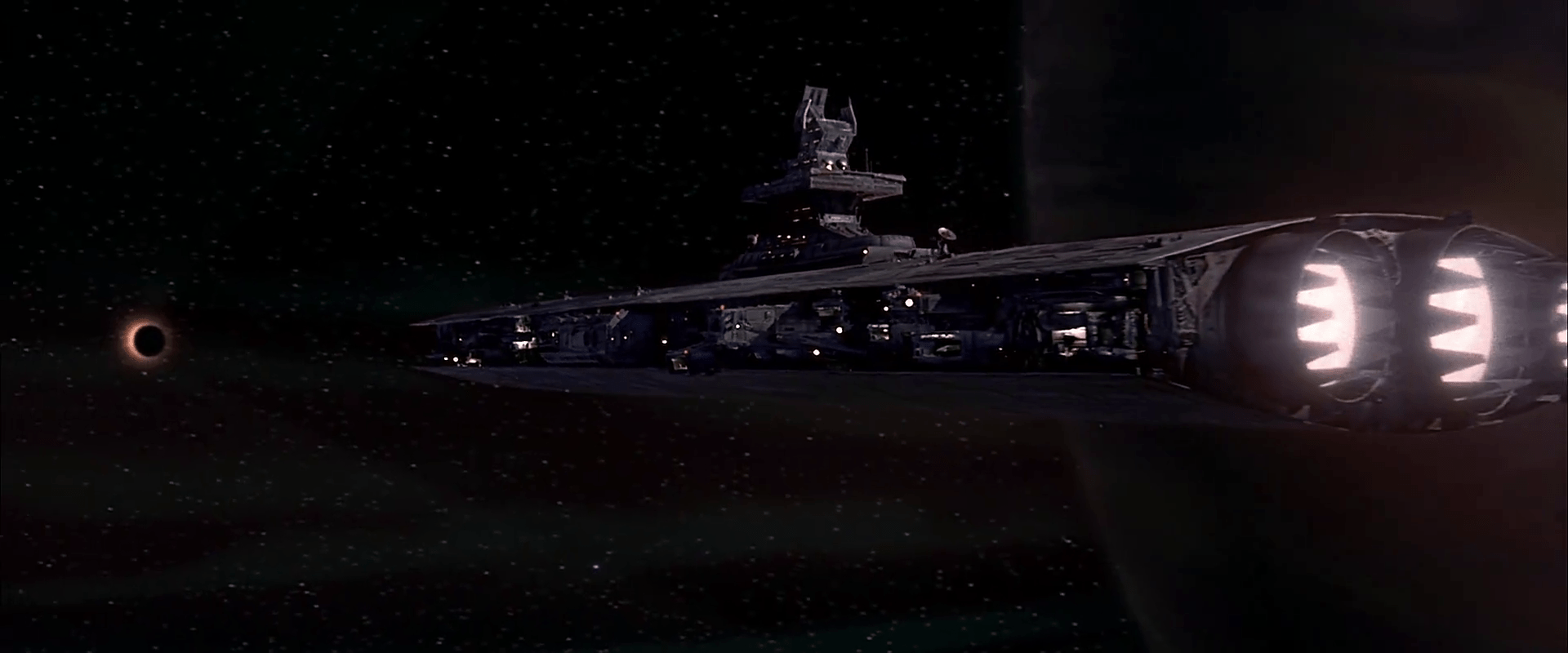
The first bit of human technology we see belongs to the Federation of Territories, as a spaceship engages the planet-sized object that is the Ultimate Evil. The interfaces are the screen-based systems that bridge crew use to scan the object and report back to General Staedert so he can make tactical decisions.

FifthE-UFT006

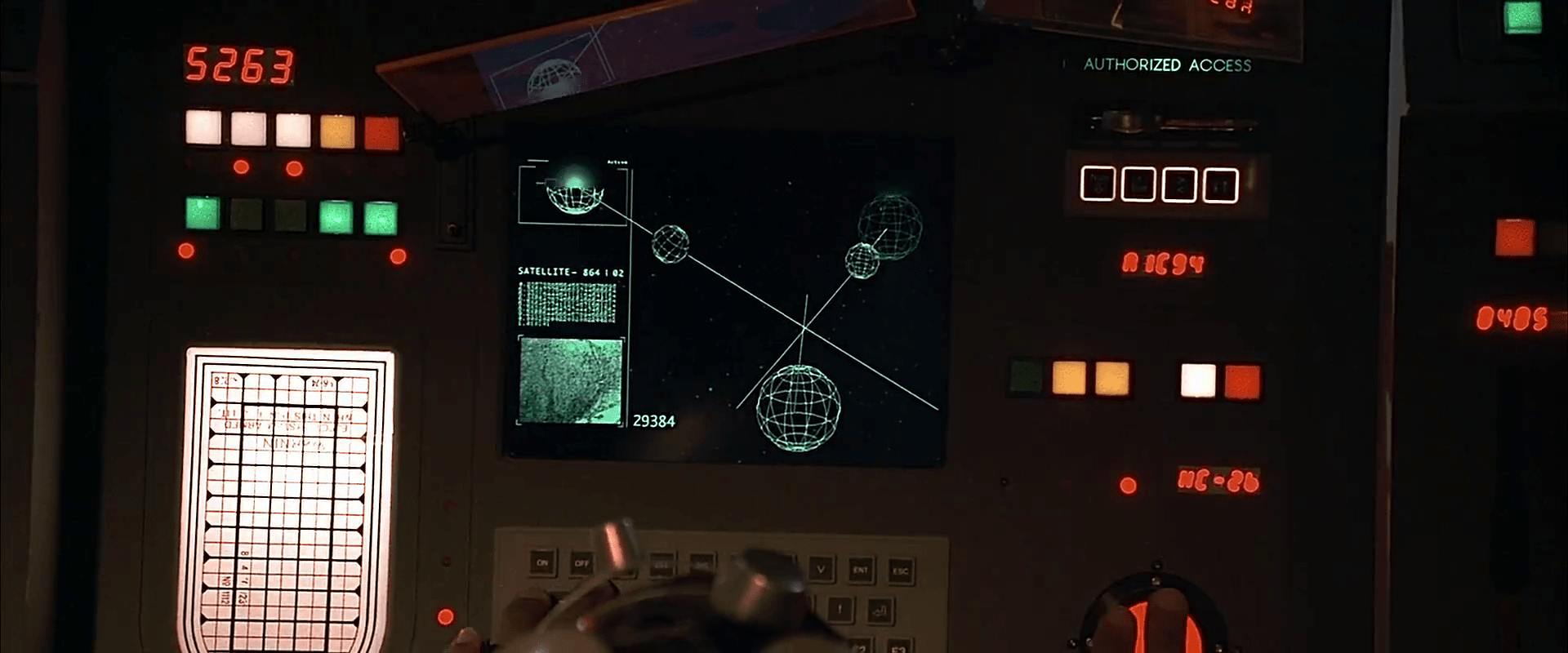
We see very few input mechanisms and very little interaction with the system. The screen includes a large image on the right hand side of the display and smaller detailed bits of information on the left. Inputs include

  • Rows of backlit modal pushbuttons adjacent to red LEDs
  • A few red 7-segment displays
  • An underlit trackball
  • A keyboard
  • An analog, underlit, grease-pencil plotting board.
    (Nine Inch Nails fans may be pleased to find that initialism written near the top.)

The operator of the first of these screens touches one of the pushbuttons to no results. He then scrolls the trackball downward, which scrolls the green text in the middle-left part of the screen as the graphics in the main section resolve from wireframes to photographic renderings of three stars, three planets, and the evil planet in the foreground, in blue.

FifthE-UFT008 FifthE-UFT014 FifthE-UFT010

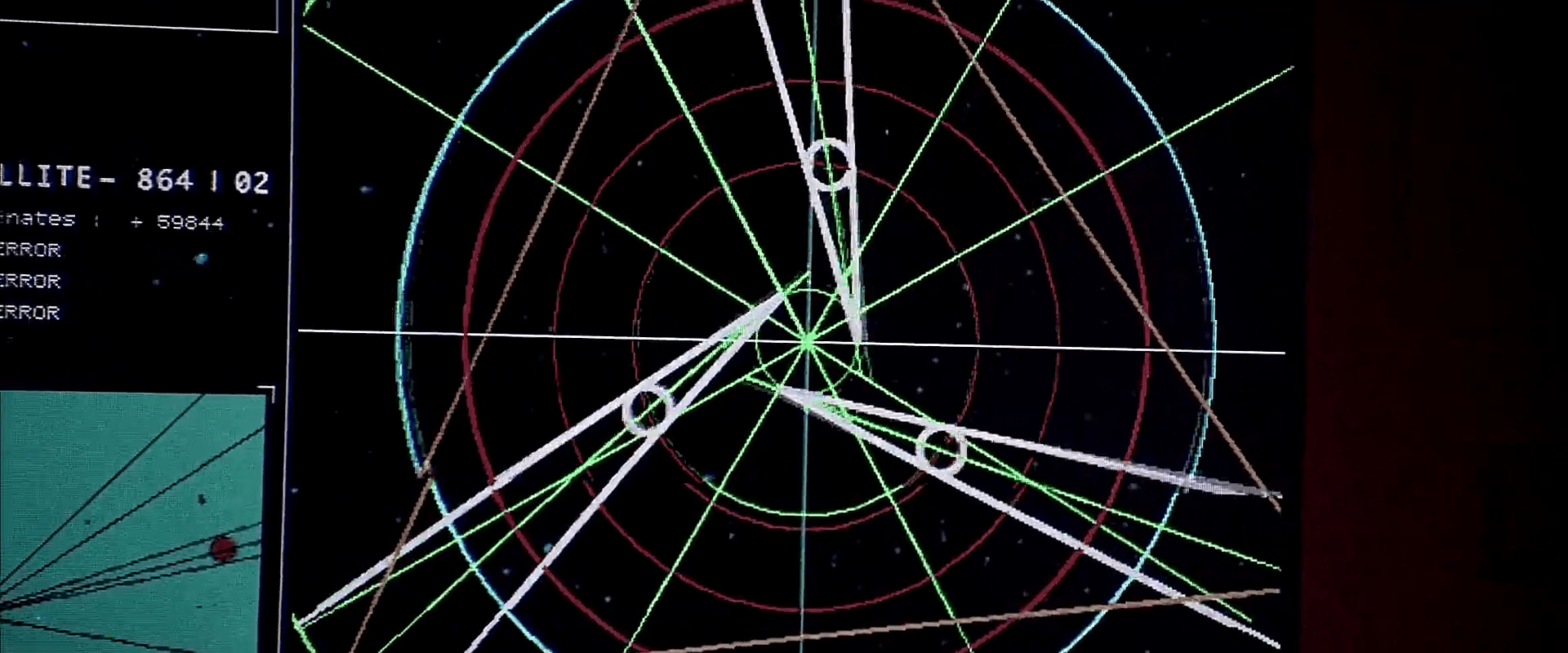
The main challenge with the system is what the heck is being visualized? Professor Pacoli says in the beginning of the film that, “When the three planets are in eclipse, the black hole, like a door, is open.” This must refer to an unusual, trinary star system. But if that’s the case, the perspective is all wrong on screen.

Plus, the main sphere in the foreground is the evil planet, but it is resolved to a blue-tinted circle before the evil planet actually appears. So is it a measure of gravity and event horizons of the “black hole?” Then why are the others photo-real?

Where is the big red gas giant planet that the ship is currently orbiting? And where is the ship? As we know from racing game interfaces and first-person shooters, having an avatar representation of yourself is useful for orientation, and that’s missing.

And finally, why does the operator need to memorize what “Code 487” is? That places a burden on his memory that would be better used for other, more human-value things. This is something of a throw-away interface, meant only to show the high-tech nature of the Federated Territories and for an alternate view for the movie’s editor to show, but even still it presents a lot of problems.