Barbarella’s energy box

Barbarella-037

In addition to the portable brainwave detector, Dianthus also provides Barbarella with a number of weapons from the Museum of Conflict for her mission. All of these weapons are powered by a single energy box.

We only see it in use after she fires a single shot from the smallest of the weapons. She tries a second shot, but when it doesn’’t work, she glances at a device on the cuff of her boot. The device is designed in a taijitu, a yin-yang set of lights: one red, one white. They are blinking in an alternating pattern, and after viewing it she tells Pygar, ““My energy box is completely dead.””

Energy-Box

Though having a visual signal is quite useful to understand the state of an invisible resource like power, the signal would be much more useful if it showed the amount of energy remaining, and gave warnings before the power was completely out. Failing all that, it would be more useful if she just put the device on the glove of her shooting hand so it was in her field of view at all times.

And though Barbarella’s culture doesn’t understand war, even a peaceful person can quickly come to realize the risk in making your available resources—like power for your weapons—wholly visible to your enemies.

Interior Doors

Certain doors within Prometheus require the user open them by providing input to a glowing keypad on the door. Reviewing these door panels in detail shows a great deal of variation in their design and interaction.

Descriptions

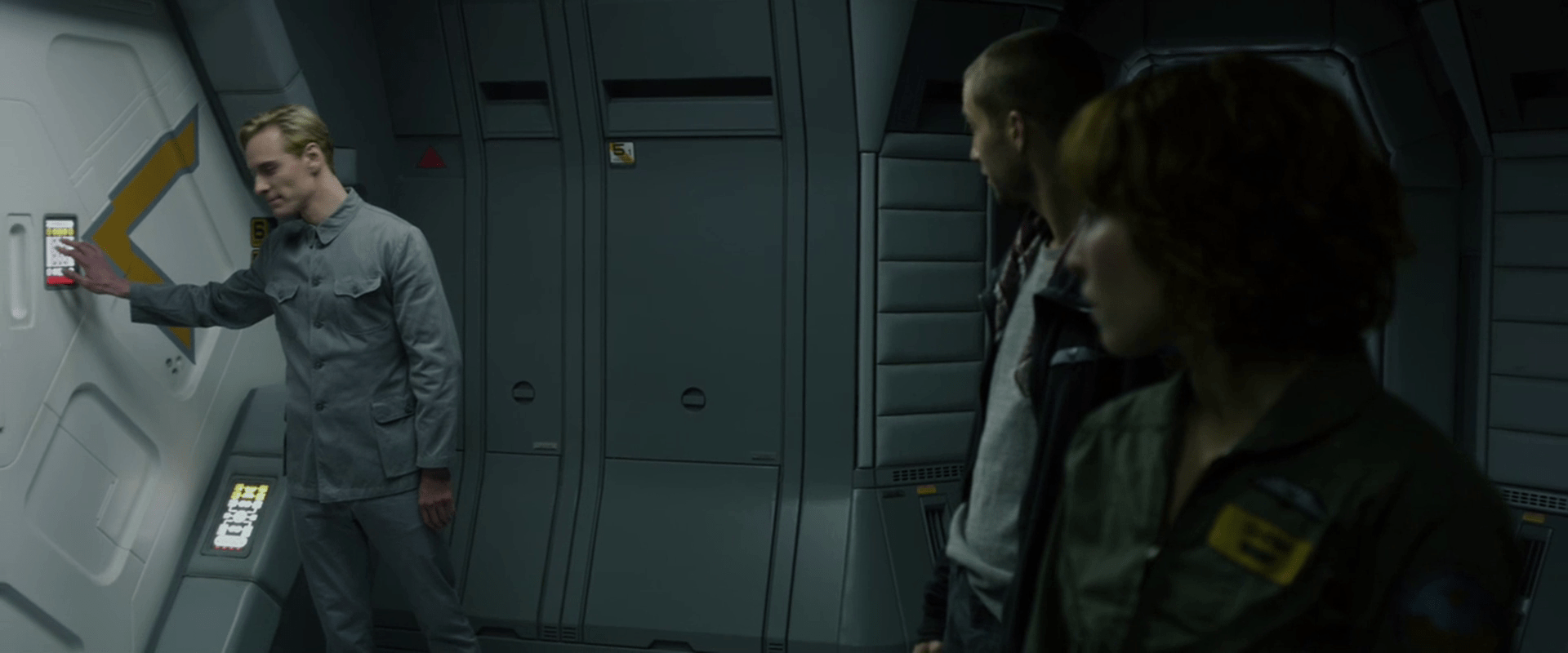
The first one we see has the panel to the left within arm’s reach of the door’s central seam. To open this door, David touches a black square on the interface, though its details are difficult to see. We do hear a beeping to confirm the touch before the door whooshes open.

Prometheus-008

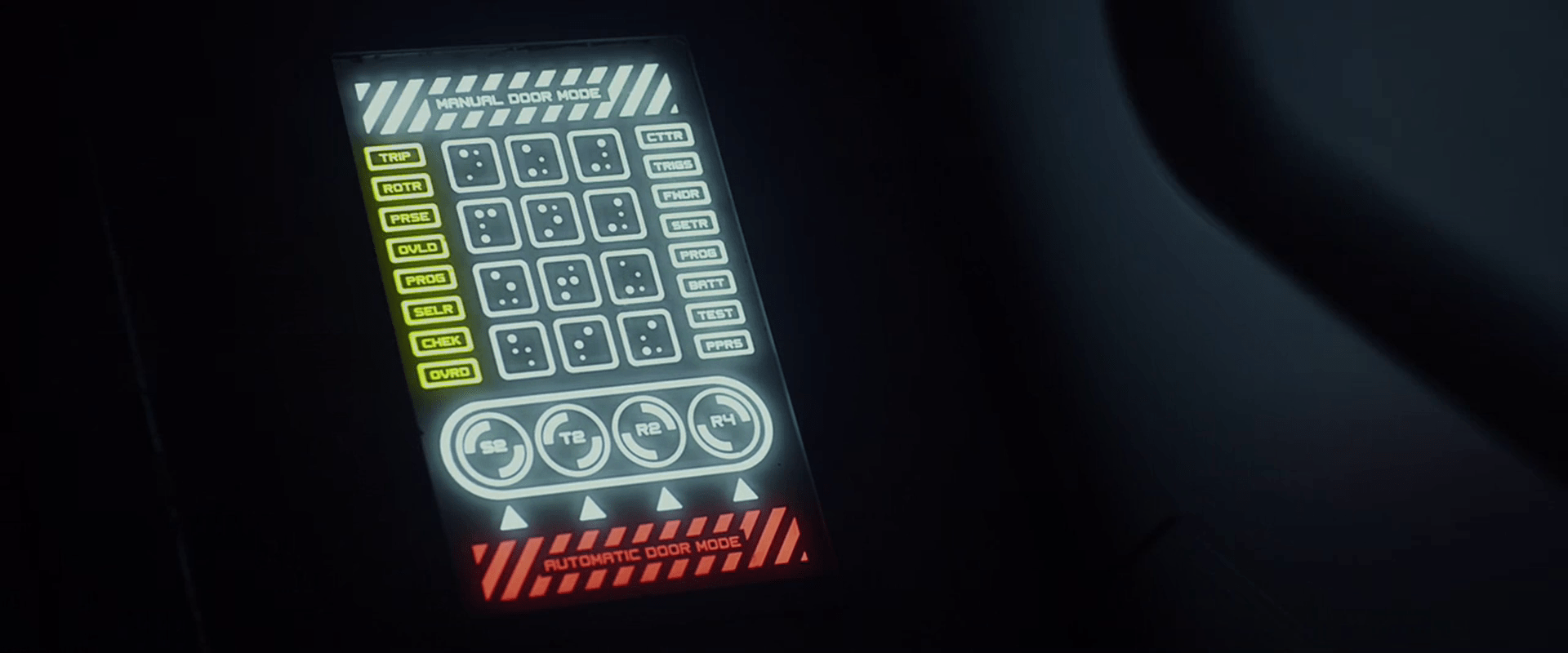
We get a clearer view of the panel that lets him into a hallway. This door is just around a meter wide, and the panel is on the left near the frame at chest level. This vertical panel has white safety stripes at the top, with a yellow row of buttons below that. The middle of the panel has two columns on the left and right edges stacked with buttons, and a 4×3 grid of buttons, labeled with characters that look something like Braille, but that don’t translate readily from English Braille, and with some of the dots in the cells larger or brighter than others. Below that grid of buttons is a white duplication of the yellow buttons above. At the bottom is a red duplication of the safety stripes button at the top.

To gain access to the hallway (where the destination threshold event occurs), David presses two keys at once—what would be the 2 and 4 keys on a telephone keypad—and the door slides open.

Later he touches the same chord of keys to open a door for Shaw and Holloway.

Prometheus-084

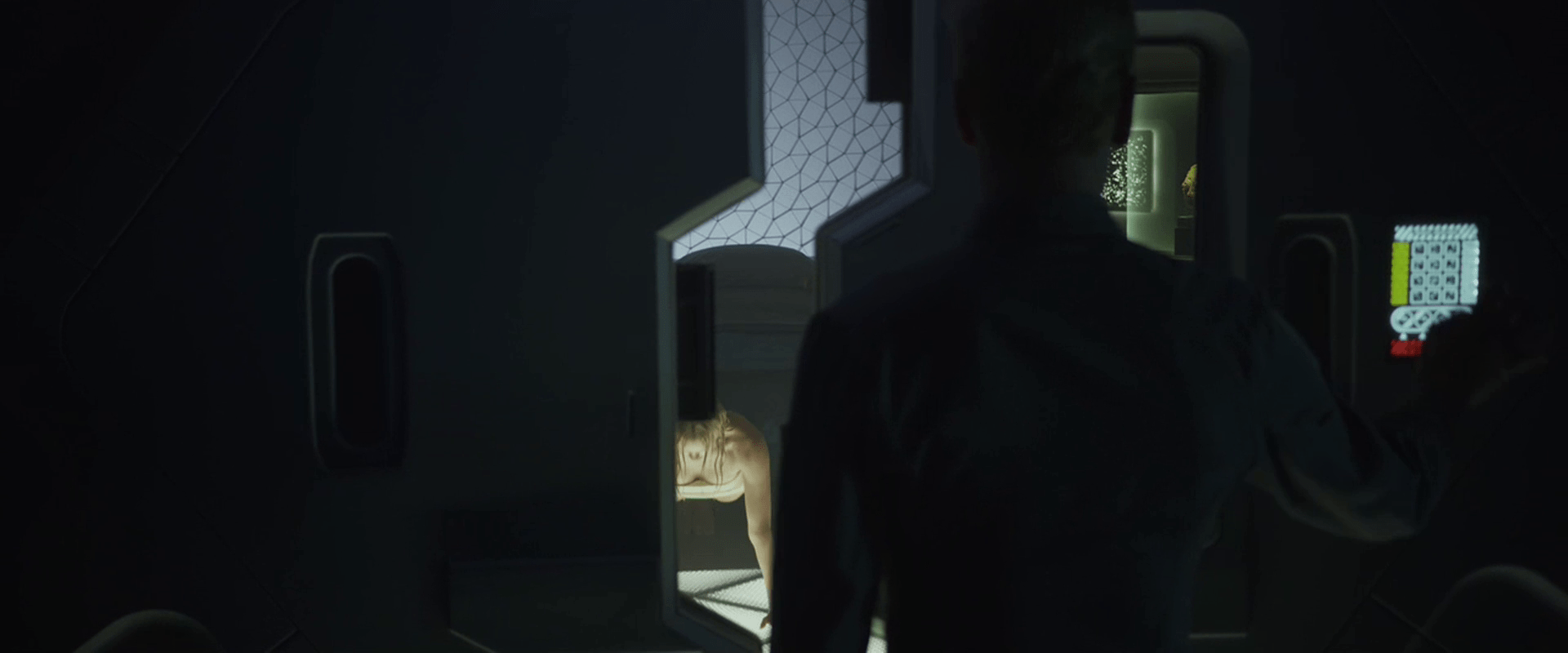
There is another design for the door panel outside of Meredith’s room. This panel has the white safety stripe button, the Braille-ish panel (but with the left column colored yellow), a new yellow panel of triangles, and the red safety stripe button at the bottom.

The door is slightly open when he approaches it, but unpassable. After Meredith commands, “Robe!” he presses the “5” key on the panel and the door opens fully. This panel is on the right side of the door.

Prometheus-036

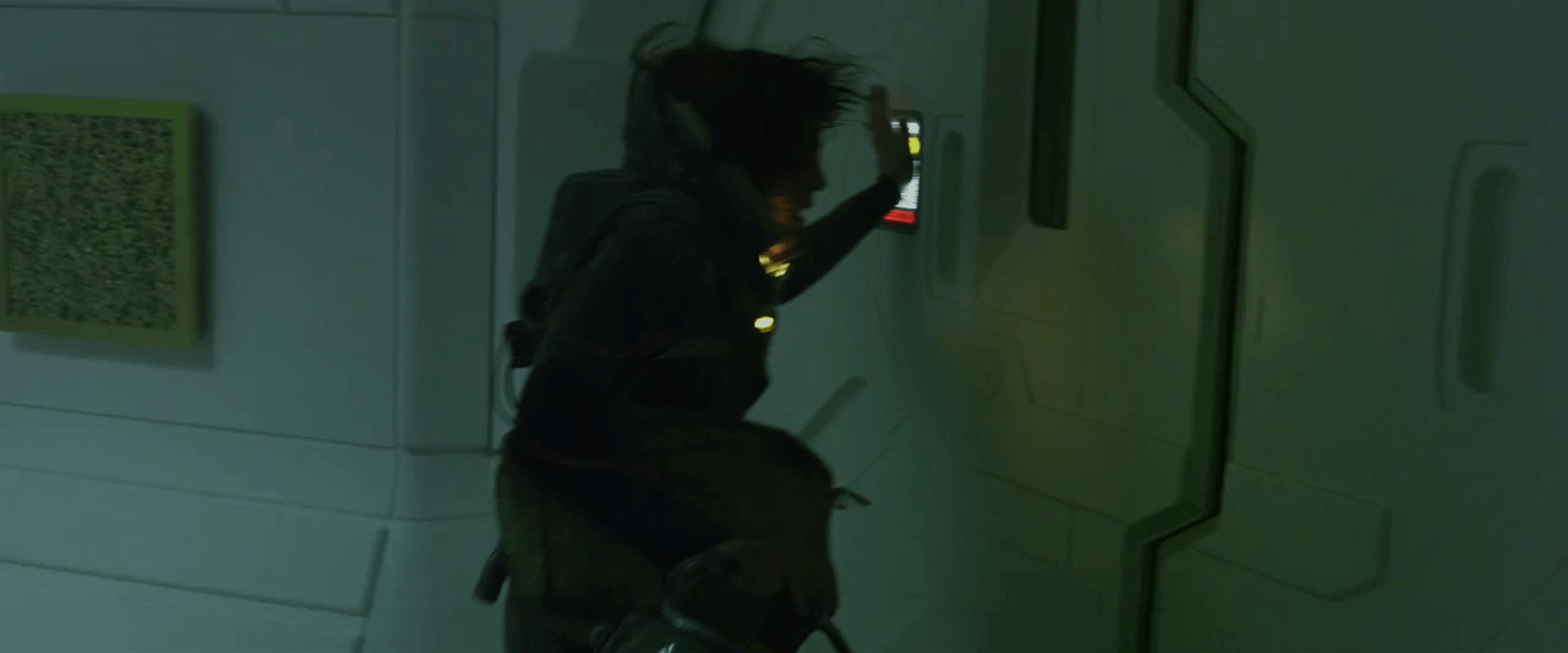
The panel to exit Weyland’s sickbay is on the door just to the left. When Shaw wants to leave the room after her traumatizing alien-abortion, she slams both hands against the panels, sliding her fingers along it and pressing what sounds like five separate buttons.

Prometheus-271

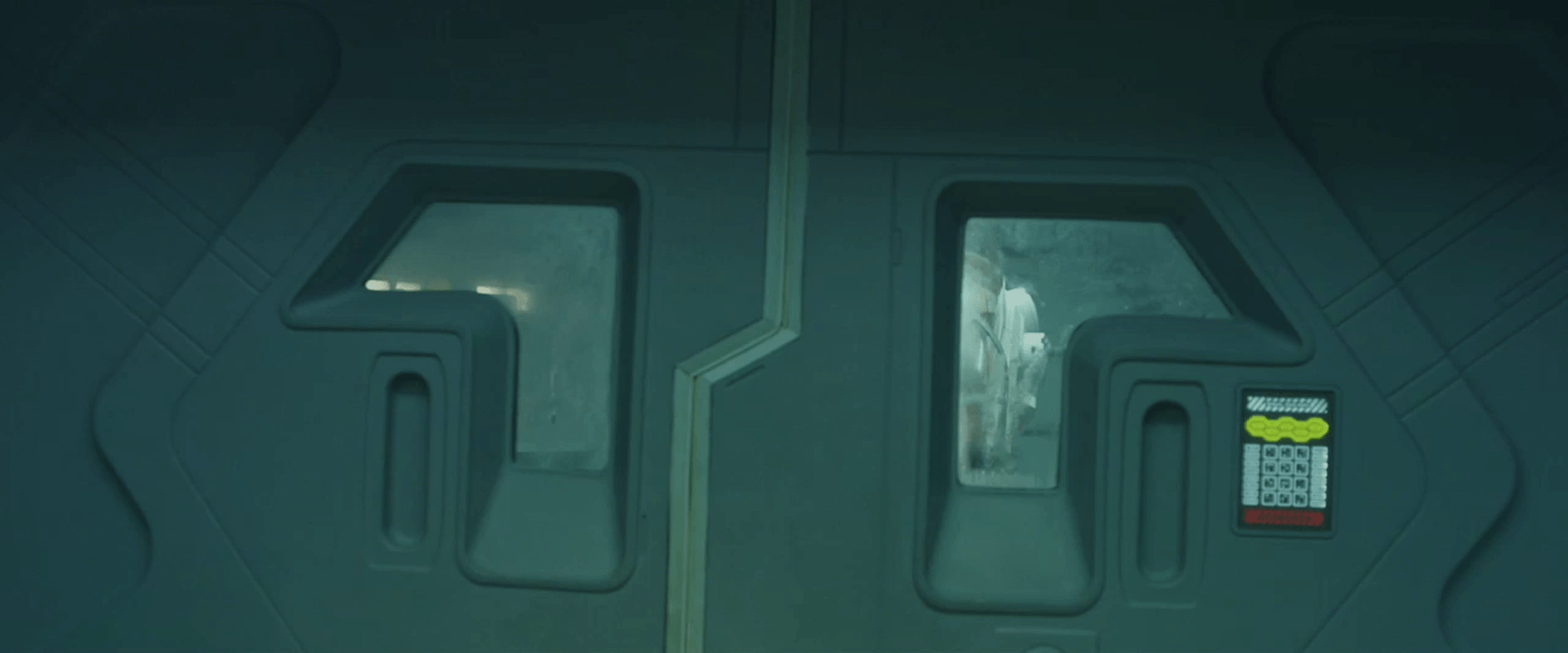
The panel that gives Shaw access back into the escape pod’s sickbay is again different, with many of the same elements from other panels, but a row of five yellow ovals outlined below the safety stripes button at the top.

Prometheus-323b

This is the only time we also see the panel on the far side of the same door. We only see a corner of it, but it does not have ovals on the other side, and some circular elements below the Braille panel. It is probably the same design as on Meredith’s door.

Prometheus-323c

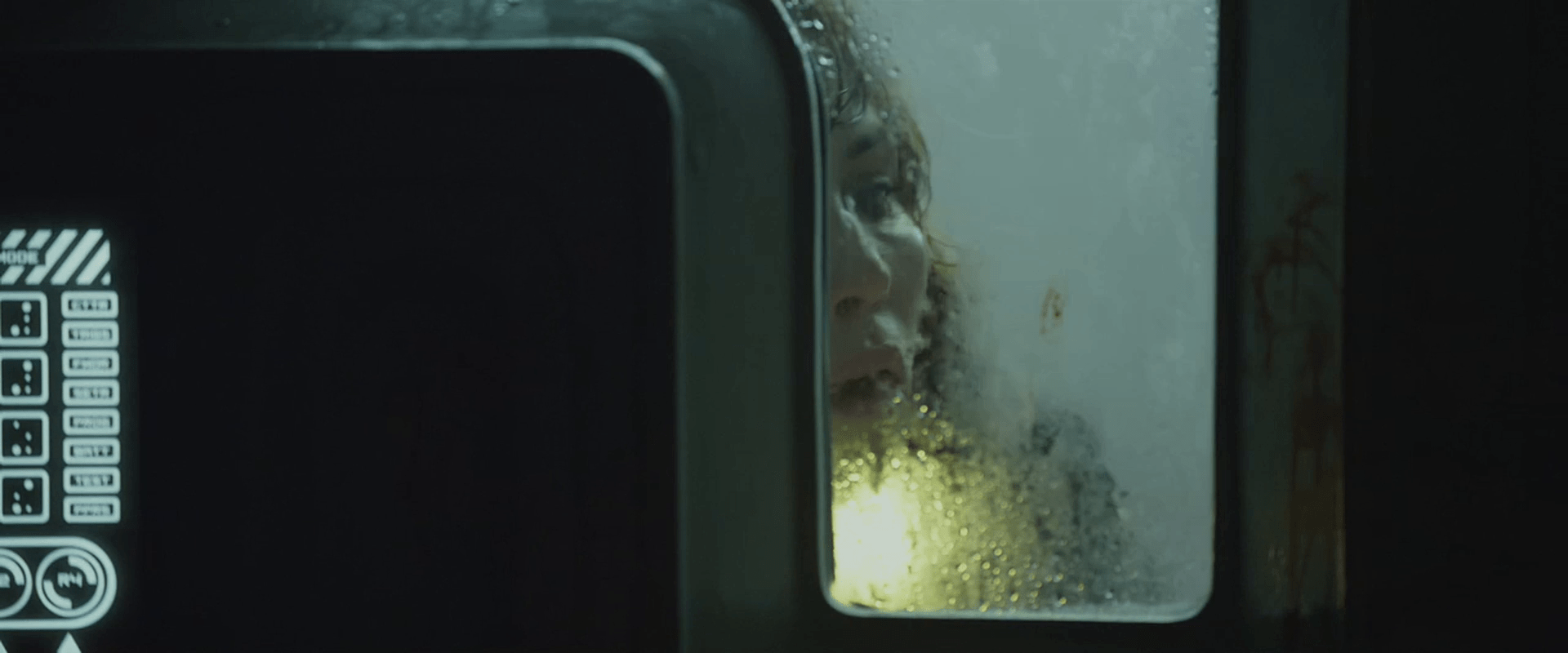
Then when the alien breaks into the escape pod and pins her against this door, we see a close up of a panel, but this one appears identical to the one on the inside of the door, rather than the yellow-oval one we saw moments before. It also appears to be identical to the one on the inside of the door (and outside Meredith’s quarters.) A confusing detail in this panel is that while similar “Braille” cells are differentiated in other panels by a variation in the dots, in this one the the “3” and “6” keys seem to be the exact same character, highlights and all. Since we don’t know the meanings of this character, it could be a “shift” or modifier key which bears repeating, we don’t know. To activate this panel, she slams her left hand downward onto it. This opens the door, freeing the massive xenomorph alien within to grapple the architect alien.

Prometheus-326

And finally, when we see her escaping the hallway where the aliens are locked in combat, she approaches a door with an oval interface, which she opens by slamming the heel of her palm against it with a grunt.

Prometheus-327

Analysis

Passing through doorways is probably one of the most common non-work activities that a crew member can do onboard a spaceship. To have crewmember key in a password every time seems like a pointless waste of everyone’s time. There are so many passive ways to check identity to authorize access that it seems silly to even bother to list them. Why not use any of these alternate technologies?

Add to that that each door panel seems to have a different one of half-dozen different designs, placed randomly on the left or right side of the door, and at least in the escape pod, multiple designs per door at several different heights. What value can there be to this chaos? It would be grossly error prone and frustrating. This level of randomness to the interface even defies the notion of it being a watchclock.

Since David and Shaw each had multiple, different-length passwords for different doors, it might seem that it’s a security measure. But when it can be opened with a punch or a hand bump, is it really security? Giving this aspect of the design the benefit of the doubt, perhaps it has some contextual awareness of Shaw’s heightened stress levels, and responds to the affective command where it might not in normal circumstances. This affective computing apology would be the way you wanted doors to work, but the film gives no evidence that this is what is at play.

Given the apparent randomness of the other panel interfaces, even apology ultimately fails us in making sense of these confusing interfaces.

Security and Control’s control

The mission is world-critical, so like a cockpit, the two who are ultimately in control are kept secure. The control room is accessible (to mere humans, anyway) only through a vault door with an armed guard. Hadley and Sitterson must present IDs to the guard before he grants them access.

Sitterson and Hadley pass security.

Truman, the guard, takes and swipes their cards through a groove in a hand-held device. We are not shown what is on the tiny screen, but we do hear the device’s quick chirps to confirm the positive identity. That sound means that Truman’s eyes aren’t tied to the screen. He can listen for confirmation and monitor the people in front of him for any sign of nervousness or subterfuge.

Hadley boots up the control room screens.

The room itself tells a rich story through its interfaces alone. The wooden panels at the back access Bronze Age technology with its wooden-handled gears, glass bowls, and mechanical devices that smash vials of blood. The massive panel at which they sit is full of Space Age pushbuttons, rheostats, and levers. On the walls behind them are banks of CRT screens. These are augmented with Digital Age, massive, flat panel displays and touch panel screens within easy reach on the console. This is a system that has grown and evolved for eons, with layers of technology that add up to a tangled but functional means of surveillance and control.

The interfaces hint at the great age of the operation.

Utter surveillance

In order for Control to do their job, they have to keep tabs on the victims at all times, even long before the event: Are the sacrifices conforming to archetype? Do they have a reason to head to the cabin?

The nest empties.

To these ends, there are field agents in the world reporting back by earpiece, and everything about the cabin is wired for video and audio: The rooms, the surrounding woods, even the nearby lake.

Once the ritual sacrifice begins, they have to keep an even tighter surveillance: Are they behaving according to trope? Do they realize the dark truth? Is the Virgin suffering but safe? A lot of the technology seen in the control room is dedicated to this core function of monitoring.

The stage managers monitor the victims.

There are huge screens at the front of the room. There are manual controls for these screens on the big panel. There is an array of CRTs on the far right.

The small digital screens can display anything, but a mode we often see is a split in quarters, showing four cameras in the area of the stage. For example, all the cameras fixed on the rooms are on one screen. This provides a very useful peripheral signal in Sitterson and Hadley’s visual field. As they monitor the scenario, motion will catch their eyes. If that motion is not on a monitor they expect it to be, they can check what’s happening quickly by turning their head and fixating. This helps keep them tightly attuned to what’s happening in the different areas on “stage.”

For internal security, the entire complex is also wired for video, including the holding cages for the nightmare monsters.

Sitterson looks for the escapees amongst the cubes.

The control room watches the bloody chaos spread.

One screen that kind of confuses us appears to be biometrics of the victims. Are the victims implanted with devices for measuring such things, or are sophisticated non-invasive environmental sensors involved? Regardless of the mechanisms, if Control has access to vital signs, how are they mistaken about Marty’s death? We only get a short glance at the screen, so maybe it’s not vital signs, but simple, static biometrics like height, and weight, even though the radiograph diagram suggests more.

Sitterson tries to avoid talking to Mordecai.

Communications

Sitterson and Hadley are managing a huge production. It involves departments as broad ranging as chemistry, maintenance, and demolitions. To coordinate and troubleshoot during the ritual, two other communications options are available beyond the monitors; land phone lines and direct-connection, push-to-talk microphones.

Hadley receives some bad news.