Headrest jack

GitS-3Dscanner-010

The jack mechanism in the intercept van is worth noting for its industrial design. Kusanagi has four jacks on the back of her neck in a square pattern. Four plugs sit on the headrest of her seat. To jack in, she simply leans back, and they seat perfectly. She leans forward, and the cables extend from the seat. Given the simple back and forward motion, it takes all of a second. Seems simple enough. But I’ve committed a blog post to it, so of course you can guess it’s not really that simple. I can see two issues with this interface.

How do the jacks and plugs meet so perfectly?

Of course, she’s a super cyborg, so we can presume she can be quite precise in her movements. But does she have eyes/cameras on the back of her head, or precision kinesthetics and a perfect body memory for position? Even if she does, it would be better would be to accommodate some margin of error to account for bumpy roads or action-packed driving maneuvers.

How to do this? One way would be a countersink so that a sloppy approach is corrected by shape. The popular (and difficult-to-source) keyhole for drunk people uses this same principle. Unfortunately, in the case of this headrest jack, the base object is Kusanagi’s neck, which is functionally a cylinder. The cones on the back of her neck would have to be unsightly large or a miss would splay the plugs and force her to retry. Fortunately, the second issue leads us to another solution.

keyhole

How does she genuinely rest against the seat when she doesn’t want to jack in?

Is that even an option here? How does she simply lean back for a road trip nap without being blasted awake by a neon green 3D Google Map?

If it was a magnetic connection, like Apple’s MagSafe power connectors, the jacks and plugs could be designed such that magnetic forces pull them together. But unlike MagSafe, these jacks could be electromagnets controlled by Kusanagi. This would not only ensure intended connections, but also help deal with the precision issues raised above. The electromagnets would snap the plugs into place even if they were misaligned.

MagSafe

An electromagnetic interface would also answer the question of how this works for taller or shorter cyborgs hoping to use the same headrest jack.

An automated solution

This solution does require complex mechanics in the body of the rider. That’s no problem for the Ghost in the Shell diegesis, but if we were facing a challenge like this in the real world, implanting users with tech isn’t a viable solution. Instead, we could push the technology back on the van by letting it do the aiming. In the half a second she leans back, the van itself can look through a camera in the headrest to gauge the fit, and position the plugs correctly with, say, linear actuators. This solution lets human users stay human, but would ensure a precision fit where it was needed.

Police light

TheFifthElement-police-003

This post (the first in what is going to amount to The Fifth Element Police Week. What is this, sweeps?) is going to veer to the edge of interaction design, getting into the Venn overlap of industrial design and wearable tech.

The police seen throughout New York each wear uniforms that feature a large, circular, glowing light over the right side of their chest.

There are only two things to say that’s positive about this police light. One: Yes, it looks cool. Two: It certainly gives narby citizens a clear, attention-getting signal that something is up. This might be OK for community relations officers, who are only ever interfacing with the public. But when it comes to dealing with actual criminals, it’s a terrible idea.

TheFifthElement-police-002

It’s a terrible idea because of its placement

Imagine this scene from the chief’s perspective. When he addresses Leeloo down the pipe as she’s standing on the ledge of the building, he is in an isosceles stance, with his shoulders perpendicular to the target and his weapon held in front of his heart. This common stance would place the weapon directly in the glow of the circle. This means that his forearms and weapon will have the brightest illumination in his field of vision and be distracting. This might be manageable by coating his uniform and the back of the weapon with a super black coating to absorb much of this light. But, depending on the distance of the target, it is also likely to place the perp in shadow, making them harder to see and harder to hit.

Looking at the officer on the right, we see he is taking a different stance. He is “bladed” to the target, closer to a Weaver stance, with his body turned a bit sideways. This stance turns the light to the adjacent wall, which minimizes the backscatter and perp-shadow effects, but also aims the light toward his fellow officer, possibly distracting him or her. That’s a pretty crappy design. But wait, it gets worse.

TheFifthElement-police-036

It’s a terrible idea because it’s a giant, glowing target

What’s worse is to imagine the scene from the perspective of the perp, say, the Mondosahwans in the airport. They want to specifically shoot the police in the crowd and all they have to do is shoot towards the glowing discs. That’s right, the police in 2263 are actually wearing attention-drawing targets. Admittedly, if you are going to get shot in the line of duty, you’d rather draw fire away from the head to a place with a solid slab of bone and lots of body armor. But why draw their fire in the first place?

As we saw in another post, Zorg believes in the fallacy/parable of the broken window, and so favors a bit of destruction that encourages market activity. We also know from the film that he has a lot of control over the NYPD. It might be that he’s deliberately sabotaging the police through this design to encourage the sale of more body armor and weapons, but are we to believe that the cops themselves are willing to go along with this? C’mon. They’re smarter than this.

Improve it with a little bit of smarts

Outfit the light with a little agentive smarts, and most of these problems could be fixed. The light could simply dim when it’s counterproductive to have it illuminated. Proximity sensors can sense when the officer’s arm is in the way. Context aware sensors can sense when it might blind another officer. It would take a lot of smarts to know when the officer is being targeted by a weapon, but certainly simple audio sensors should shut it off in the sound of gunfire.

Barbarella’s energy box

Barbarella-037

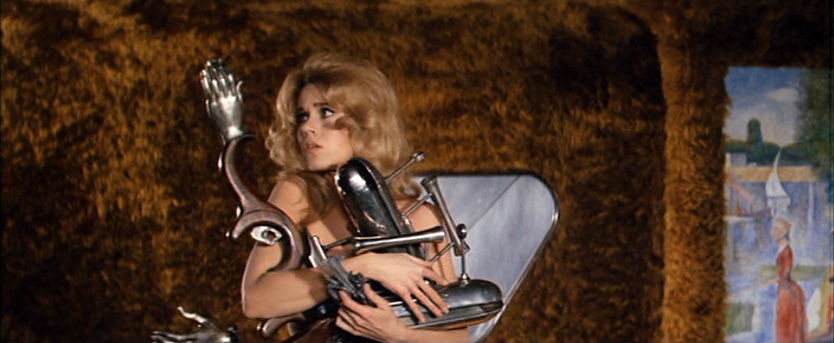
In addition to the portable brainwave detector, Dianthus also provides Barbarella with a number of weapons from the Museum of Conflict for her mission. All of these weapons are powered by a single energy box.

We only see it in use after she fires a single shot from the smallest of the weapons. She tries a second shot, but when it doesn’’t work, she glances at a device on the cuff of her boot. The device is designed in a taijitu, a yin-yang set of lights: one red, one white. They are blinking in an alternating pattern, and after viewing it she tells Pygar, ““My energy box is completely dead.””

Energy-Box

Though having a visual signal is quite useful to understand the state of an invisible resource like power, the signal would be much more useful if it showed the amount of energy remaining, and gave warnings before the power was completely out. Failing all that, it would be more useful if she just put the device on the glove of her shooting hand so it was in her field of view at all times.

And though Barbarella’s culture doesn’t understand war, even a peaceful person can quickly come to realize the risk in making your available resources—like power for your weapons—wholly visible to your enemies.

Portable brainwave detector

Barbarella-032

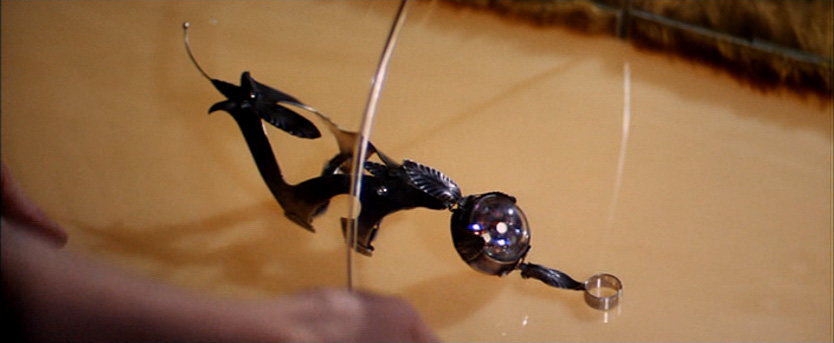
Through the atom transmitter Dianthus bestows several gifts on Barbarella to help her with her mission. The first of these is the “portable brainwave detector…to test for Durand-Durand’s presence.” To operate it, Barbarella must press “a contact,” (Dianthus is offscreen when he indicates the contact, but later we see her operating the leaf-like button near the wrist) and if Durand-Durand is around, the ball of lights will glow and an alarm will sound.

vlcsnap-00002

The device is wearable, wrapping around Barbarella’s forearm, and held in place by a ring. This aspect of the design is good, since it means the device is ever-present for operation, and the design of it makes it lovely enough to be overlooked as a fashion accessory. In fact many characters see her wearing it and make no mention.

PBD_worn

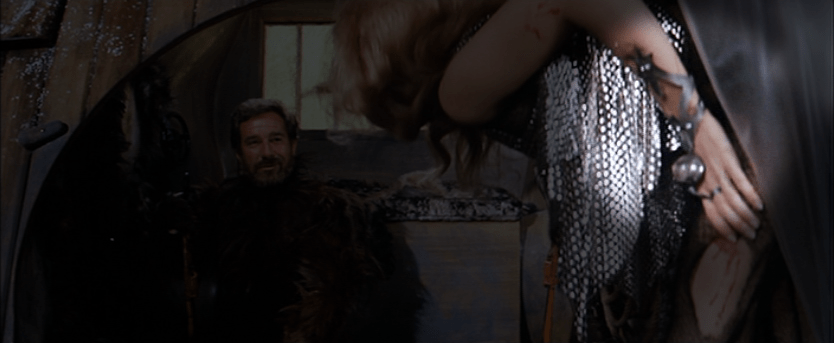
Manual activation is less than ideal, though, since this might tip off the suspect. This is especially true with the blinking, glowing ball of light and audio feedback. And, in fact, this is what happens later in the film when Durand-Durand trips over the device. The blinking light and audio catch his attention, betray the device for what it is, and blow Barbarella’’s cover in the process.

Portable Brainwave Device

The best feedback would be invisible, like a haptic vibration through the cuff to her skin. Ideally, the device would be constantly on, to detect the subject passively, the moment he came into range. But presuming battery life is the issue, the activation cue should be something much more subtle, like Barbarella’s touching the back of the ring with the thumb of the same hand. Such a gesture would match the existing design of the object, be discreet to an observer, and yet still discrete enough to prevent accidental activation.

Neuro-Visor

The second interface David has to monitor those in hypersleep is the Neuro-Visor, a helmet that lets him perceive their dreams. The helmet is round, solid, and white. The visor itself is yellow and back-lit. The yellow is the same greenish-yellow underneath the hypersleep beds and clearly establishes the connection between the devices to a new user. When we see David’s view from inside the visor, it is a cinematic, fully-immersive 3D projection of events in her dreams, that is presented in the “spot elevations” style that is predominant throughout the film (more on this display technique later).

Later in the movie we see David using this same helmet to communicate with Weyland who is in a hypersleep chamber, but Weyland is somehow conscious enough to have a back-and-forth dialogue with David. We don’t see either David’s for Weyland’s perspective in the scene.

David communicated with Weyland.

As an interface, the helmet seems straightforward. He has one Neuro-Visor for all the hypersleep chambers, and to pair the device to a particular one, he simply touches the surface of the chamber near the hyper sleeper’s head. Cyan interface elements on that translucent interface confirm the touch and presumably allow some degree of control of the visuals. To turn the Neuro-Visor off, he simply removes it from his head. These are simple and intuitive gestures that makes the Neuro-Visor one of the best and most elegantly designed interfaces in the movie.