The Cloak of Levitation, Part 2: Could it ever work?

How could this work as technology instead of magic?

In the prior post I looked at the Cloak as a bit of wearable technology. Today let’s ask ourselves how possible this is in the real world.

The abilities of the Cloak listed in the first post imply a great deal of functionality: Situational awareness, lightning fast thinking, precision actuators throughout its fabric, gravity controls for itself and its wearer, goal awareness, knowledge of the world. Some of these aren’t going to happen, but some are conceivable over time.

Cloak-of-Levitation-vitrine.gif

Parts of it are conceivable over time

Some of those abilities make sense with what we know of the arc of technology.

Actuators

Technology keeps shrinking, so a fabric made of strong actuators might be conceivable. I’m not sure muscle wire will ever be this strong, but let’s presume generative design can discover a way to use its relatively weak strength for greater-than-human feats of strength, and that wires can be coordinated when woven into a fabric.

Sensors

The Cloak has complete situational awareness, but where are its sensors? It demonstrates field awareness. We don’t see sensors, but it has to be building this awareness from something. One possibility is that if it was able to connect to sensors around it, much like The Machine and Samaritan Super AIs from Person of Interest or Batman’s cellular panopticon. Alternately, the cape could be dotted with sensors that detect in the x-ray or infrared spectrums, so they can be hidden under the fabric. Let’s say this is pretty futuristic, but possible.

The Cloak’s AI

Yes we have crazy fast processors that seem to keep getting faster, so perhaps the processors could become embeddable in the cloth or perhaps the fibulae. And the amount of cloth in the Cloak is much more than most wearables, so sure, let’s say the computational power can be made this small and sartorial.

Cloak-of-Levitation-fibulae.png
Writing this blog takes my vocabulary to some obscure places.

There is the problem of the AI. Some of the Cloak’s abilities imply general, rather than narrow, artificial intelligence. It has complete situation awareness, a clear theory of mind, and seems to learn. We’re not at general AI yet and at least according to Nick Bostrom’s poll, computer scientists are estimating it will be about another decade until we get there, if we can get there at all. Opinions are split as to whether it’s possible, but let’s go optimistic with this one and put it in the conceivable category, with the caveat that it may be wishful thinking.

But some parts break the laws of physics

But then there are a few things that just break the laws of physics, the first of which is flying.

There’s no evidence from other things in the scenes that it is employing a propellant of some kind to do this lifting. It just moves where it wants to. Cloak don’t give a shit. Add the fact that it can hang in place (see the vitrine gif, above) as if it can just ignore the Earth’s gravity, and we’ve got something that earns the Isaac Newton seal of WTF.

It also seems able to pull in any arbitrary direction in space with a great deal of force, as it does when it drags around one of the beefier zealots in a defend-the-master move that would make a Molossus war dog lower its head in respect. Flatworms are the closest thing to a muscled bit of fabric that evolution has come up with, and I don’t think physics would allow it to do this kind of maneuver, either. 

Cloak-of-Levitation-wrap.gif

Then, when Strange flies wearing it, it doesn’t seem to use its powers to carry him. That would look more like a hammock, or a flying carpet. Instead it somehow grants the power of arbitrary space positioning to him, and then it just gets to relax and ride along and concentrate on looking majestic.

So it can pull in any direction with no anchor, propellant, or regard for gravity; and grant this ability to someone on contact. Sorry, but I think we have to admit that these aspects of the Cloak are just wish fulfillment.

Cloak-of-Levitation-24

Even if flight could be overlooked, then there comes the question of where’s the power coming from? I don’t see much battery technology trending towards infinite especially when it has to be small enough to be wearable.


So while an engaging vision, we have to be quite careful about drawing design lessons from the Cloak. Enabling technology would be far in the future. And even though personal flight technology (of sorts) exists, but we should take in mind their designs have to deal with the very real issues of thrust and power.

That’s enough for today. In the next post we’ll look at the intelligence and agency evident in the Cloak.

The Cloak of Levitation, Part 1: An overview

When Dr. Strange visits the New York Sanctum for the first time, he passes by a vitrine in which a lush red cape hovers in midair. It’s the Cloak of Levitation, and in this moment it chooses Strange. We see many of its functions throughout the movie.

Functions

  • When the glass of the vitrine is broken and Kaecilius stabs at Strange with a Soul Sword, the Cloak reaches out with a corner and stays Kaecilius’ hand to save Strange.
  • When Kaecilius knocks Strange down a stairwell, the Cloak chases him, catches him, and floats him back up to the fight. (See above.)
  • Attached by two fibulae to his surcoat, it can pull him, physically, and does so several times for different reasons:
    • to get him out of the first fight with Kaecilius
    • to help him dodge the soul sword
    • to keep him from grabbing ineffective weapons, pointing him instead to the more effective Crimson Bands of Cyttorak
  • Unbidden, the Cloak wraps itself around the head of one of Kaecilius’ zealots, drags him around, and slams his head into the walls and floor until the zealot is dead. (Even though, for the entire end of the fight, Strange is across town getting medical attention.) After the combat, the Cloak hovers next to the dead zealot, perhaps keeping watch.
  • After Strange tells Christine goodbye in the surgical prep room, the Cloak gently floats itself into place and uses the corner of its popped collar to remove blood from Strange’s face, to his annoyance. He tells it to, “Stop!” and it relaxes.
  • It pulls him out of the path of some flying debris while time is reversed before the Hong Kong Sanctum, and defends him from a punch later in the same sequence.
  • He uses it to fly through the portal into the Dark Dimension to face Dormammu.
  • It dons itself in the Kamar-Taj, brusquely enough to cause Strange to catch his balance.

The Cloak is like a guardian angel. Or maybe a super-familiar, in the wizard sense. It keeps an eye out for Strange. It is able to predict, protect, crudely inform, and, not least, fly. It acts as both an assistant and an agent. (More on this later)

Wearable Analysis

Let’s first look at it as a wearable. Turns out it fares well according to the wearable principles I laid out in the The Combadge & ideal Wearables post. Those principles are discussed individually below.

Sartorial? Yes.

The Cloak is literally a piece of clothing and quite inline with fashion trends of the sorcerous and superhero worlds. A dash of panache for the workday and a night flying above the town. I’m saying it looks quite in place for being a piece of tech.

Social? Yes, kind of.

The cape does not signal its cape-abilities (how many terrible puns will I allow myself, here? Time will tell…) and so might score low on its social aspect. But it is a unique mystical item. Those in the know, know. Its reputation conveys its abilities. To those who don’t know, its cape-ness grants an initial element of surprise, as we saw when it blocked Kaecilius’ stab the first and second time. The villain was as surprised as we. The Cloak is cloaked, but this is a feature.

Tough to accidentally activate? Yes.

To fly to the Dark Dimension, he places his hands in a “Devil sign,” with 1st and 4th fingers extended and the others bent down to the thumb. He points his hands towards his feet, and flies off in the opposite direction. This isn’t him casting a spell. It’s him telling the Cloak what he wants it to do. That’s hard to do by accident.

Apposite I/O? Yes.

For the most part, the Cloak acts of its own accord. Looking at the list above, the only times it acts under instruction is when Strange tells it to stop wiping his cheek and when he uses it to fly to the Dark Dimension. He uses speech for the former and finger-tutting for the latter.

The rest of its functionality (that is, most of it) is it acting on its own, which doesn’t befit an i/o mapping evaluation.

Easy to access and use? Yes, exceptionally.

Being a key part of Strange’s uniform, and able to both get out of the way and onto shoulders when it needs to, the Cloak is not just easy to use, but it makes itself easy to access and use, so it scores high here.

In total, a very usable and useful wearable tech. Next let’s look at how we might get to a Cloak-like object using real world technology.

Kubris

Perhaps the most unusual interface in the film is a game seen when Theo visits his cousin Nigel for a meal and to ask for a favor. Nigel’’s son Alex sits at the table silent and distant, his attention on a strange game that it’s designer, Mark Coleran, tells me is called “Kubris,” a 3D hybrid of Tetris and Rubik’s Cube.

ChildrenofMen-018.jpg

Alex operates the game by twitching and sliding his fingers in the air. With each twitch a small twang is heard. He suspends his hand a bit above the table to have room. His finger movements are tracked by thin black wires that extend from small plastic discs at his fingertips back to a device worn on his wrist. This device looks like a streamlined digital watch, but where the face of a clock would be are a set of multicolored LEDs arranged in rows.  These LEDs flicker on and off in inscrutable patterns, but clearly showing some state of the game. There is an inset LED block that also displays an increasing score.

The game also features a small, transparent, flat screen that rests on the table in front of him. It displays a computer-generated cube, similar to a 5×5 Rubik’s Cube, made up of smaller transparent cubes that share colors with the LEDs on his wrist. As Alex plays, he changes the orientation of the cube, and positions smaller cubes along the surface of the larger.

ChildrenofMen-022.jpg

Alex plays this game continually during the course of the scene. He is so engrossed in it that when Nigel asks him twice to take his pills, he doesn’t even register the instruction. Nigel must yell at him to get Alex to comply.

Though the exact workings of the game are a mystery, it serves to illustrate in a technological way how some of the younger people in 2027 disengage from the horror of the world through games that have been designed for addiction and obsession.

VR Goggles

BttF_118

At the dinner table, both Marty Jr. and Marlene have VR goggles. Marty wears his continuously, but Marlene is more polite and rests hers around her neck when with the family. When she receives a call, red LEDs flash the word “PHONE” on the outside of the goggles as they ring. This would be a useful signal if the volume were turned down or the volume was baffled by ambient sounds.

BttF_120

Marty Jr’’s goggles are on, and he announces to Marty Sr. that the phone is for him and that it’s Needles.

This implies a complete wireless caller ID system (which had only just been released to market in the United States the year before the movie was released) and a single number for the household that is distributed amongst multiple communications devices simultaneously, which was not available at the time (or hey, even now), so it’s quite forward looking. Additionally, it lets the whole social circle help manage communication requests, even if it sacrifices a bit of privacy.

Wearable soundboard

One of Griff Tannan’’s gang, named Data, wears a sound board on his vest. When Tannan gets a rise out of Marty by asking if he’’s “chicken,” the gang member underscores the accusation by removing a protective plate over some buttons on his vest and holds one down to play a looping sound clip of a clucking chicken.

BttF_062

That’s pretty awesome, actually. Having all the sounds available at the touch of a button adds a layer of remix culture expressiveness with maximum speed. No modes, no menus, just remembering which sound goes with which button, and his spatial memory is perfect for that. If the buttons were labeled with the sound, or shaped informatively, it might reduce the burden on memory.

BttF_066

You might also reduce the time it takes to respond by removing the protective plate, but Griff is enough of a loose cannon that he might go violent if an accidental sound effect insulted him. So that extra step is probably the safest.

But if we were to really make this it’s most awesome, you’d make it agentive, such that the plate constantly listened to the conversation for keywords or keyphrases and responded with appropriate snarky sound effects. (Smartphone startup founded around this idea in 3…2…1…)

The Jacket

BttF_030

Dr. Brown gives Marty some 21st century clothes in order to blend in. The first is the pair of Nike MAGs. The other item of clothing Marty must don is a jacket. It has two functions. When Marty first tries it on, the sleeves are nearly twice as long as they ought to be. After complaining that it doesn’t fit, Dr. Brown reaches and pinches a blinking and beeping red LED at the base of the jacket’’s zipper. In response, the sleeves retract to a proper length, the pocket flaps shrink, and the epaulettes flatten out as a synthesized voice states, “Adjusting fit.”

BttF-Griff-gang

You might wonder why, if the jacket is designed to be properly fitted, the sleeves start at a length” that would not fit any human. My answer is fashion. Later, when we see Marty Jr. in the 80s shop, one sleeve is left super long. It could be that his is busted or just that he’s disheveled, but youth fashion has often adopted Handicap Principle as markers of status and aloofness. c.f. hip hop baggy pants. No one else shows this same thing, but fashion seems very individualized in 2015 (1985).

Later after Marty gets soaked in the town square reflecting pool, the red LED on the zipper begins beeping and blinking again. Marty reaches down and pinches it, and a voice announces, “Drying clothes: on,” as hidden air dryers puff the jacket around him drying his hair and the jacket. When it’’s done it emits a slim beep it announces happily, “Your jacket is now dry!

BttF_083

Sure, that’s pretty cool, and obviously played for the How-Wacky-Is-This joke. But the one-button interface speaks to a great deal of context awareness and capabilities for a wearable.

Nike MAGs

BttF_026Dr. Brown gives Marty some 21st century clothes in order to blend in. The first of these items are shoes. Marty is surprised to see no laces. To activate them, he pushes his foot into the shoe. When his heel makes contact, the main strap constricts to hold his heel in place. Then the laces constrict to hold the ball of the heel down. Finally, the tongue of the shoe and the “Nike” logo glow.

Yep. Perfect. The activation is natural to the act of putting on the device. The glow acts as a status indicator and symbol. No wonder everyone wanted them.

Night Vision Goggles

Genarro: “Are they heavy?”
Excited Kid: “Yeah!”
Genarro: “Then they’re expensive, put them back”
Excited Kid: [nope]

Screenshot-(248)

The Night Vision Goggles are large binoculars that are sized to fit on an adult head.  They are stored in a padded case in the Tour Jeep’s trunk.  When activated, a single red light illuminated in the “forehead” of the device, and four green lights appear on the rim of each lens. The green lights rotate around the lens as the user zooms the binoculars in and out. On a styling point, the goggles are painted in a very traditional and very adorable green and yellow striped dinosaur pattern.

Tim holds the goggles up as he plays with them, and it looks like they are too large for his head (although we don’t see him adjust the head support at all, so he might not have known they were adjustable).  He adjusts the zoom using two hidden controls—one on each side.  It isn’t obvious how these work. It could be that…

  • There are no controls, and it automatically focuses on the thing in the center of the view or on the thing moving.
  • One side zooms in, and the other zooms out.
  • Both controls have a zoom in/zoom out ability.
  • Each side control powers its own lens.
  • Admittedly, the last option is the least likely.

Unfortunately the movie just doesn’t give us enough information, leaving it as an exercise for us to consider.

Screenshot (241)

Dr. Grant, Timmy is hogging the tech

Note that there aren’t enough goggles in the Jeep for everyone.  During a tour this might set up a competition for the goggles.  Considering how much a ticket to the island is implied to cost, the passengers in the Jeep would likely be unhappy at this constraint.

Better here would be some kind of HUD for the entire Jeep, with a thermal overlay or night-vision projection of what’s around the Jeep.

Alternatively, if cost is indeed an issue to Hammond, the TV screen could be used to show camera feeds of the pen and dinosaurs inside.

Hopefully A Prototype

The lights on the front show what’s happening internally, and give feedback that the goggles are doing something to people watching.  As we learn soon after this scene, dinosaurs are also very sensitive to light and motion.  Especially the T-Rex.

These night vision goggles would work best in darkness, where it would add to the tour to see a dinosaur behaving (relatively) naturally.  If the dinosaurs on the tour are very sensitive to light, then the motion on the front of the goggles would actually be counter to the goals person using the goggles.

So let’s presume these were a prototype, and why they were in the trunk and not mentioned by Hammond at the start of the tour.

Overall

The goggles look easy to use, but appear to need refinement from field experience.  A key point will be how the passengers react to having enough of them, and whether they serve the tourists in experiencing the park as intended.

Jack’s Bike

image03

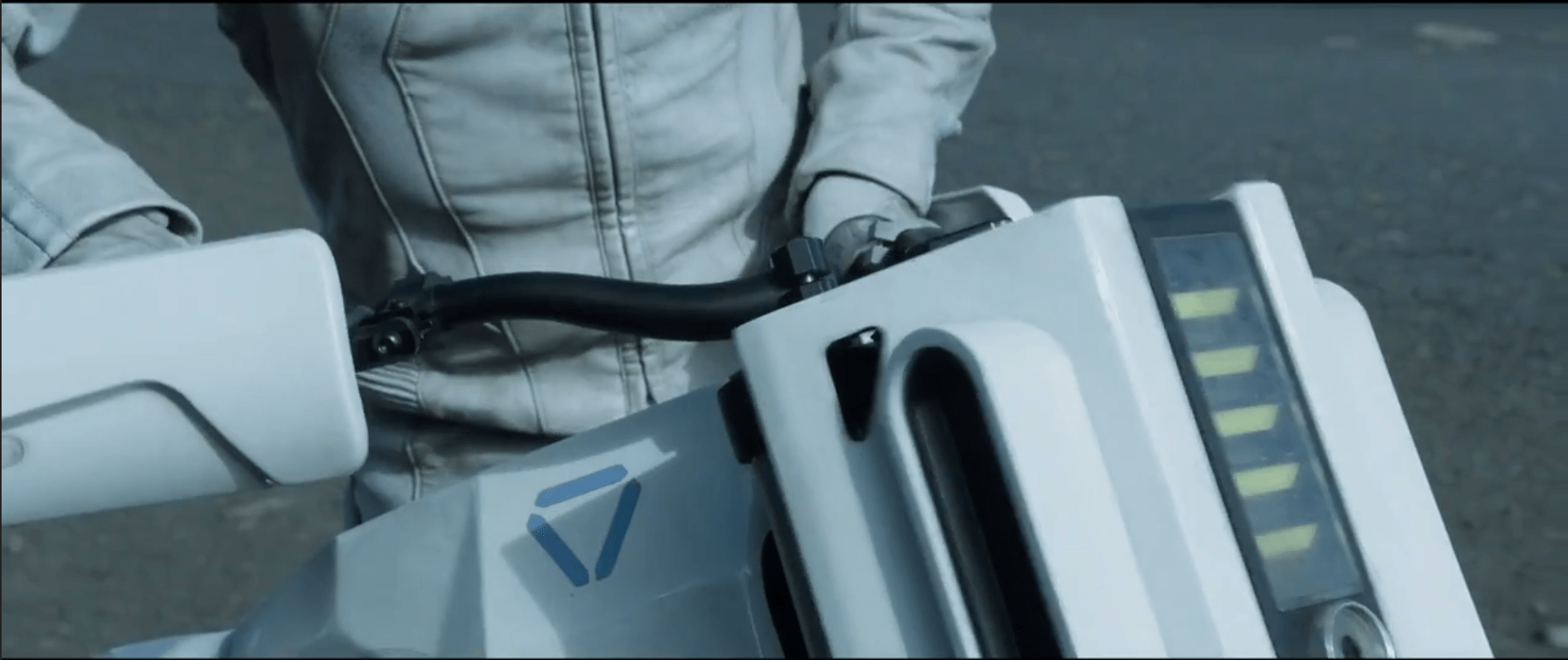
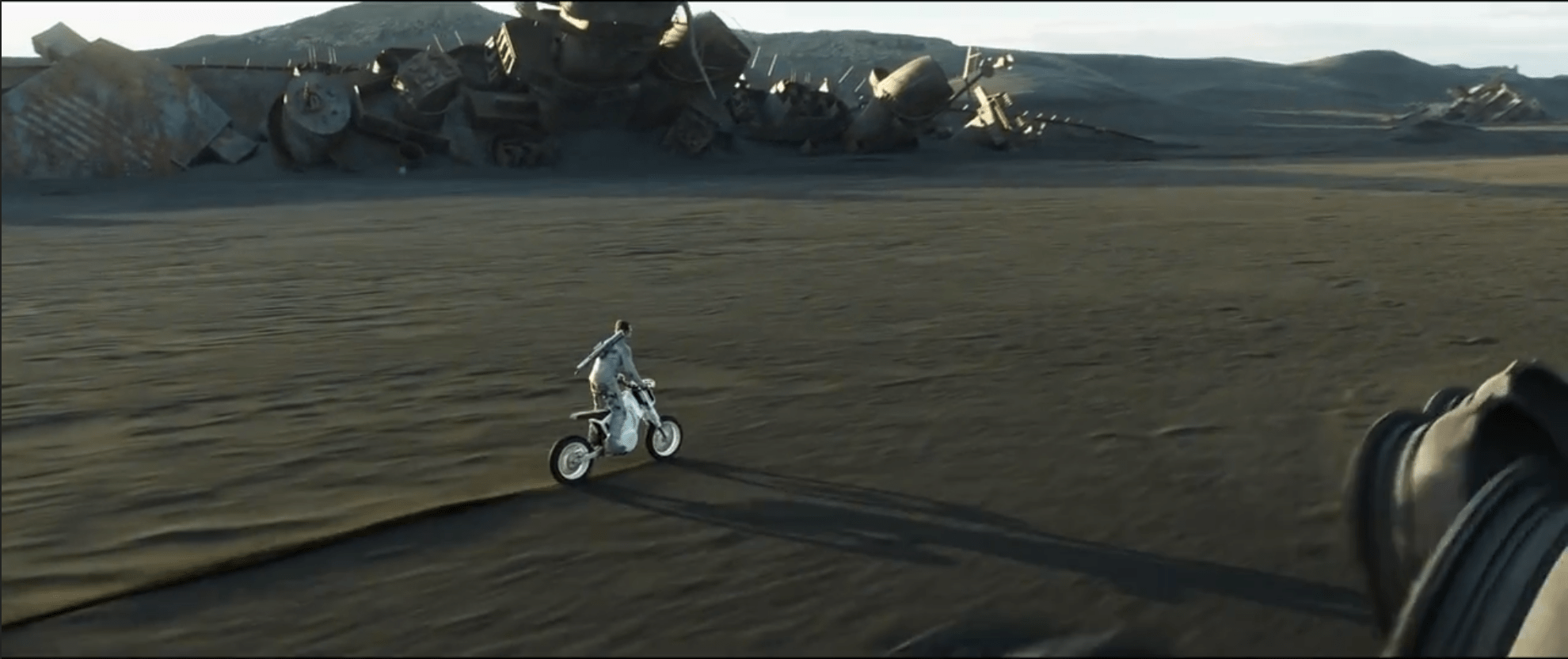
Jack’s Bike is a compact, moto-cross-like motorcycle. It’s stored folded up in a rear cargo area of the Bubbleship when not in use. To get it ready to ride Jack:

  1. Unlocks the cargo pod from a button on his wrist
  2. Pulls it out of the Bubbleship
  3. Unfolds its components (which lock automatically into place)
  4. Rides off.

When Jack mounts the bike it automatically powers on and is ready to ride.

image01

The bike is heavy, as shown by Jack’s straining to lift it out as well as the heavy sound it makes when he drops it on the ground. It is very solid, and no parts shift even when dropped from lifting height.

Purpose?

image02

There is no obvious reason for Jack to use a bike instead of the Bubbleship. The bike does contain a small radar system, but such functionality could be easily integrated into the Bubbleship. Otherwise the Bubbleship is faster, more comfortable, has longer range, ignores the problems presented by difficult terrain, and has a better connection to the rest of Jack’s support network. So there’s no obvious functional advantage.

It makes more sense that this bike is a release for Jack’s exploratory personality. We see several times that Jack goes and does something brash or dangerous, simply to do something different and make his day more interesting. It’s part of who he is and how he engages with the world.

If so, then Jack simply likes taking the bike out for a ride. He is happy when he takes it out of the Bubbleship, and he does several unnecessary jumps on the bike just for fun. Even though the Bubbleship could have found the signal quicker and easier than the Bike, the bike was a more entertaining way to spend the day. We also see that, when things get serious, Jack quickly calls for Drone backup and is happy to see the Bubbleship waiting for him at the surface.

Let’s presume the TET saw these behaviors (or lost several early Jacks to boredom when this option wasn’t available), and created the bike to make him more happy and effective.

Delight Your Users

image00

So here’s an interesting lesson: The most efficient tool for the job might not always be the most effective. A user’s experiential needs are just as important as their need to get the job done, and considering those needs may lead to a design that is satisfyingly fun.

That can be hard for designers who are focused on improving efficiency, and can be even more difficult for product teams. But if you can figure it out, it’s worth it.

After all, you don’t want to have to keep replacing your Jacks.

Bubbleship Comms

image01

Jack communicates with Vika via the HUD in the Bubbleship, and a small earbud that provides two-way audio.

He talks normally to Vika, who responds in kind. There is no visible confirmation of his connection to Vika, and no obvious way for him to send information back other than the sound of his voice.

As shown during the lightning strike sequence, Jack’s earbud is connected directly to the Bubbleship. All of his audio and telemetry requires the Bubbleship to connect with Vika’s control tower. When the Bubbleship’s power goes out, Jack’s communication is cut too.

Eye in the Sky

Vika has complete control over the communications in the Bubbleship. She is able to see Jack’s video, hear his audio, and send him mission updates whenever she so chooses. Jack only has control over his connection to Vika by going places where the direct comms can’t reach.

Given the post apocalyptic wasteland they inhabit and the strength of other systems Jack uses, Jack should always have a communication link back to Vika. Current infrastructure, like the Drones or the TET when it is overhead, should act as a repeater system for Jack’s earbud.

A handful of orbiting drones and a satellite radio phone attached to Jack’s belt could easily provide near 100% uptime in communications and give a backup to systems like the Bubbleship. Judging by Jack’s reaction during the lightning strike, power failures in the Bubbleship happen often enough for him to have a routine for them.

Jack should also have an easy way to pause or mute communications. When he is in a stressful situation, he may not want the distraction of audio. The audio might also leak from the earphone in quiet places, leaving him vulnerable to Scav ambush.

Any two-way communication system should have equal control for equal parties.

Electronic Shielding

Ideally, comm failures should never happen in the first place. Modern aircraft are well shielded against lightning strikes, and do not fall from the sky (a Guardian post indicates that each commercial aircraft is hit, on average, once per year). The Bubbleship should be at least as well shielded as a modern commercial aircraft, and be able to maintain contact with its control tower during routine thunderstorms.

image00

Advances in technology should not forget basic safety techniques from the generation of technology it is replacing.