Fritzes 2026: Best Narrative

The Fritzes award honors the best interfaces in a full-length motion picture in the past year. Interfaces play a special role in our movie-going experience, and are a craft all their own that does not otherwise receive focused recognition.

Today we’ll be covering Best Narrative. These movies’ interfaces blow us away with evocative visuals and the richness of their future vision. They engross us in the story world by being spectacular.

The 2026 Award goes to: Elio

Pixar consistently puts great thought into their animated interfaces, and Elio is no different. The little wearable personal devices that help the different intergalactic species all share a space are so simple, and provide both a bit of worldbuilding as well as moments of comedy. The incomprehensibility of the alien spaceship controls are a plot-critical, candy-colored glowing hoot (and reminiscent of another Pixar short, Lifted.) I loved the lemniscate-shaped AI encyclopedia that Elio consults when preparing for his negotiations. We should be able to talk to Wikipedia and not just its articles. (Though I wish the entries were more than just text and an image.) Also this film has the only example I’ve seen where one character acts as an environmental suit for another character (not pictured, but you know the scene).

Also check out: Mickey 17

It’s a dark world where the hoarding class has made the working class so desperate that some people have to agree to be cloned for critical tasks that are likely death sentences. The interfaces in Mickey 17 help sell that very world, and even the ways that some folks use that same tech to eke out a little naughty joy amongst the drudgery. (With echoes of a similarly flirty interface from Starship Troopers.)

Also check out: Fantastic Four: First Steps

Marvel was once a main-stay for interfaces to study, but they’ve pointed their camera increasingly away from interfaces of late. So I was delighted to see Fantastic Four: First Steps bring to life interfaces from Jack Kirby’s Silver Age Fantastic Four. I don’t know if it was CGI, but I swear the giant, spherical quadrilateral screens are actual giant CRTs right down to the blurriness and chromatic aberration. If that’s CGI, it’s great attention to the detail from the reference material. All the spherical displays!

The “big” award in the Fritzes is Best Interface, but to amp up the anticipation, let’s look at some of the idiosyncratic awards from 2025 first.

Next up: The best comedy-horror interface

Destination threshold

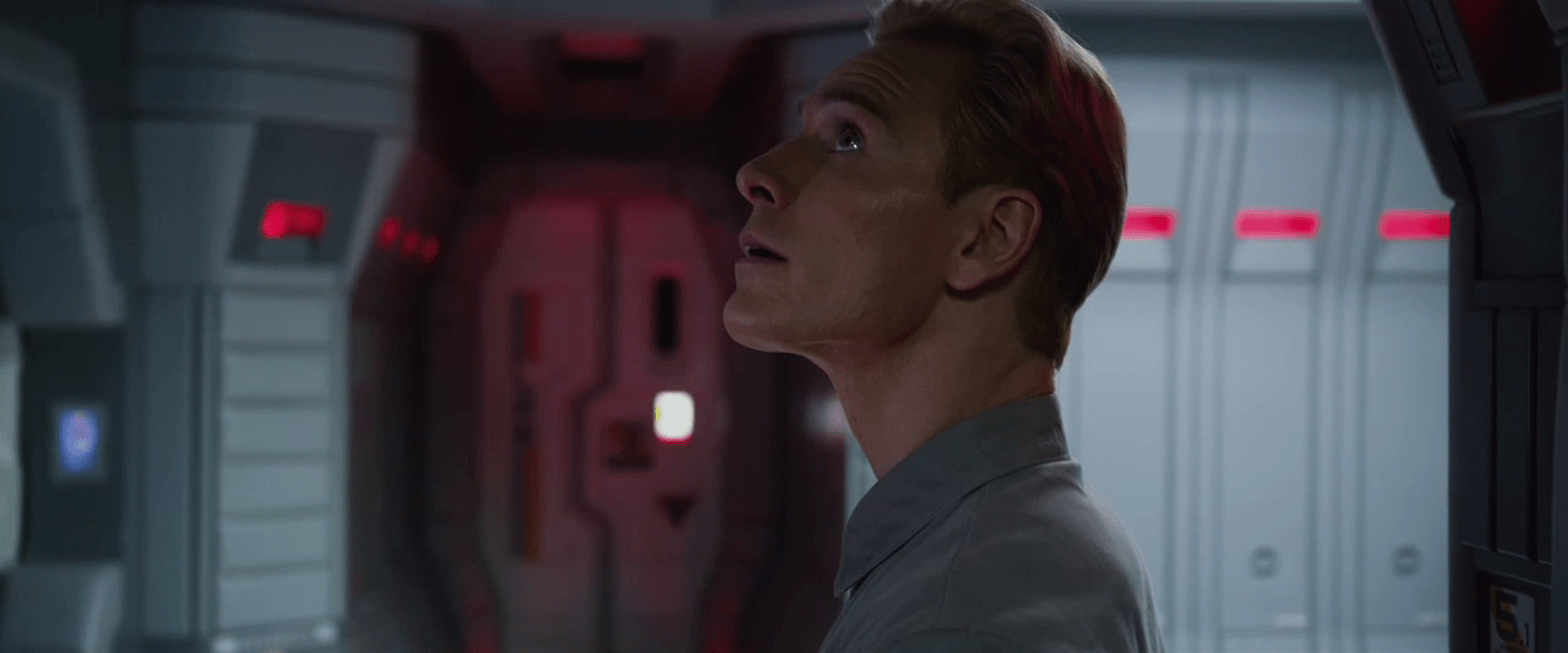
As David is walking through a ship’s hallway, a great clanging sounds from deep in the ship, as the colored lights high in the walls change suddenly from a purple to a flashing red, and a slight but urgent beeping begins. He glances at a billiards table in an adjacent room, sees the balls and cue sliding, and understands that it wasn’t just him: gravity has definitely changed.

Prometheus-020

There are questions about what’s going on with the ship that the gravity changed so fast, but our interest must be in the interfaces.

Why did David not expect this? If they’re heading to a planet and the route is known, David should know well in advance. The ship should have told him, especially if the event is going to be one that could potentially topple him. Presuming the ship has sensors to monitor all of this, it should not have come as a surprise.

The warning itself seems mostly well designed, using multiple modes of signal and clear warning signs:

  • Change in color from a soft to intense color (They even look like eyes squinting and concentrating in the thumbnails.)
  • A shift to red, commonly used for warning or crisis
  • Blinking red is a hugely attention-getting visual signal
  • Beeping is a auditory signal that is also a common warning signal, and hard to ignore

After David sees these signals, he walks to wall panel and presses a few offscreen buttons which beep back at him and silence the beeping, replacing it with overhead pulses of light that race up and down the hallway. Over the sound system a male voice announces “Attention. Destination threshold.”

Prometheus-Destination_Threshold

Why should David have to go find out what the crisis is at the wall interface? If he had been unable to get to the wall interface, how would he know what happened? Or if it required split-second action, why require of him to waste his time getting there and pressing buttons? In a crisis, the system should let you know what the crisis is quickly and intrusively if it’s a dire crisis in need of remedy. The audio announcement should have happened automatically.

Racinglights

The overhead lights are almost a nice replacement for beeping. It still says, “alert” without the grating annoyance that audio can sometimes be. (There’s still a soft “click” with each shifting light, just not as bad.) But if he’s able to silence the audio at this wall panel, why wasn’t he able to silence the race lights as well? And why do they “race” up and down the hallway rather than just blink? The racing provides an inappropriate sense of motion. Given that this signal is for when the crew is in an unusual and potentially dangerous situation, it would be better to avoid the unhelpful motion cue by simply blinking, or to use the sense of direction they provide to signal to David where he ought to be. A simple option would be to have the hallway lights race continuously in the direction of the bridge, leading the crew to where they would be most effective. Even better is if the ship has locational awareness of individual crew members, then you can cut all overhead illumination by 20% and pulse a light a few feet away in the desired direction between 80 and 100 percent, while darkening the hallway in the opposite direction. Then, as David walks towards the blinking light, the ship can lead him, even around corners, to get him where he needs to be. In a real crisis, this would be an easy and intuitive way to lead people where they’re need to be. It would of course need simple overrides in case the crew knew something about the situation that the ship did not.

After walking through the racing-light hallways, he turns just past the door and into the bridge, where we can see the legend “DESTINATION THRESHOLD” across the pilots HUD. He turns on a light, licks a finger, and presses another button to activate all of the interfaces on the bridge. He walks to the pilot’s panel, presses a button to open the forward viewscreen, observing LV223 with wide-eyed wonder.

This entire sequence seems strange from an interface perspective. We’re going to presume that licking his fingers was just a character tic and not required by the system. But in addition to the fact, raised above, that David seems somewhat surprised by it all, that he should have to open doors and manually turn on lights and interfaces during a crisis seems pointless. It’s either not a crisis and these signals should diminish, or it is a crisis and more of this technology should be automated.