
Category Archives: ~ scifianimatedgifs
Slow Police

Wrapping up our week of The Fifth Element police interfaces…
When the police chase Korben into the permanent fog bank at street level of the city, the exciting car chase must stop. They must slow down and undergo a careful search. The front of the car has an LED scrolling sign between its beacon lights that cuts back and forth between displaying “SLOW” and “POLICE.”


From a citizen standpoint, having such text can certainly make the police’s circumstances and desires quite clear. Then again, language can be quite ambiguous. What would you do if you saw a police car that read, “CELLAR DOOR” as it passed? How are you meant to comply?
Though we never actually see the sign change to display any other text, the fact that it’s LED implies that it can and does. Sure, I get the movie’s joke of the police calling themselves “slow,” but there are lots of interaction questions left unanswered. Can the officers in the car change the sign? If so, how? Does the passenger have a keyboard? Or is it voice command? If there’s a control available to the driver, how is it made safe, and not as deadly as a driver trying to compose a text message today? And to what degree can the message be changed? Can they create anything, or do they select from a commissioner-approved menu of options? Or can they not control it at all—is the sign completely controlled from dispatch, or from some context-aware algorithm?
The film gives no clues, so it’s left as an exercise for the design viewer. Which, sometimes, is just the way I like it.

Eepholes

Please forgive the title. It’s a portmanteau of “e” and “peepholes” that was too goofy to resist and not part of the official Fifth Element canon.
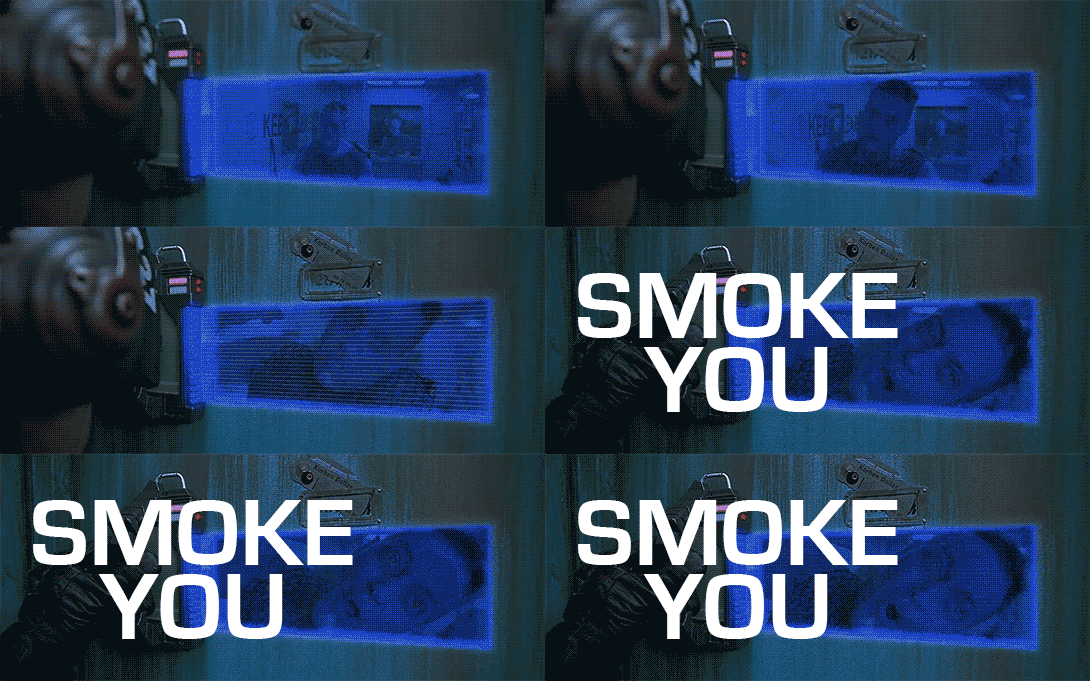
When the police have an apartment in lockdown, they have a special tool to evaluate individual citizens in their apartments. It’s an electronic peephole that allows them to see and communicate with the citizen inside their apartment. To use it, a police officer places a handheld device shaped something like an iron up to the door near eye height. Pressing a button at the thumb switches a status light from green to red and opens an electronic “hole” in the door, through which the officer can see, but out of which the citizen cannot.

While the eephole is activated, the intercom between the yellow circles in which the citizen has placed his or her hands glows orange, letting them know that the call is active. Then the officer can freely interrogate the citizen.
Officer: Sir, are you classified as human?
Korben: Negative. I am a meat popsicle.
Analysis
How the device works is something of a mystery, but we have to take its results at face value. We’re concerned about the interaction, and that works OK. The device has a single handle and flat plate that fits against the door readily. The thumb button is placed so it’s easy to activate while holding it up with one hand. The fact that it’s portable rather than embedded in the door means that it can be taken away by the police after their business is done, rather than leaving it there to be hacked.
If I had to make any improvements, I would hope to make the device stick to the door so the officer could have both hands ready for his weapon should he need it, or feel more free to dodge out of the way. I would also omit any of the many glowing lights that appear extraneous, at least to what we see in this scene. I might also provide some output to the officer that the interaction is under warrant, or maybe even that it’s being being recorded, to remind them not to abuse this breach of privacy. Clearly it causes stress among the citizens subject to it.
5E-opedia: In-depth topic

Leeloo learns about the facts of the human race which she is destined to save through an online encyclopedia available to her in many places: in Cornelius’ home, the spaceship to Fhloston Paradise, and aboard Zorg’s ship. Three modes are seen for it. Today we discuss the second mode, which is to select an in-depth topic.
In-Depth Topic
Leeloo can understand each item in the topic lists as they fly past. If she sees a topic that interests her in particular, she can press a button to find out more about that topic in more detail. (We don’t see the button, we just hear it.) Given that she’s looking at a screen of at most 66 and at least 4 options, and we don’t see a selection indicator, it’s anyone’s guess as to how she does this. Later we’ll see that she has a QWERTY keyboard to search for a particular word, and we don’t see that same search interface here, so it’s something other than that.
Once she indicates that she’s interested in martial arts, the entry fills the screen. The screen is a mix of a paragraph of text, images zooming around, and subtopics writ in large red majuscule letters scrolling past: KRAV CONTACT, SUMO, WRESTLING, SAVATE, KUNG FU, JU JITSU, NINJITSU, WRANG DO, FULL CONTACT… A still image of Bruce Lee from Enter the Dragon appears. This style of still-image and animated-text continues to play in a watch-and-learn way until it’s done, and then returns to the topic list.

Here, as before, I am examining things unmeant for examination. Still, I have a job to do. In the diegesis of the film, the text flies by too quick for anyone but a perfect Mondoshawan to read. But here in the real world, I hit pause. There I learned that the paragraph of text in the background has nothing to do with martial arts. We only see snippets, but they read as follows. (Please post your short sci-fi stories that can make sense of these lines in exactly this same order.)
: a hindu thus
talks to hi[s] troops about taking
d takes on a persona of its own.
monster, if it wants to live, have
loved. We then get a news flash
cult (think Waco siege coverage)
This little bit of text reads much more like a script than an encyclopedia entry. Like it was a bit of text just lying around on someone’s computer. In any case it would not help Leeloo learn Jeet Kun Do in the slightest.
On the right side of the screen (see above) we also see a vertical green rectangle. At the top is the number 5, bookended with arrows. Below that is a graph, a set of thumbnail images (whose captions are too small to read) are linked by right-angle connecting lines, like what you might see in a tech-tree for a real-time strategy video game.

When the display shifts to showing the subtopics, this green area changes. The 5 changes to a dot, and a grid of circular icons appears, each with a green rectangle to its right. The left column of icons is hard to decipher, but the right column of icons looks like control buttons one might expect: More detail, next in sequence, prior in sequence, zoom out, zoom all the way out, fast forward. Missing are common controls for video such as pause and play. A the bottom is a button labeled “EDIT”. This control panel is not seen in use.
It’s still about the learning, stupid
That stuff on the left is pointless. Of course that bit from a script is goofy. The animated stuff might be interesting for getting someone kind of excited about the topic, or maybe to remember how awesome martial arts (that they already knew about) are, but for learning any of it from a computer screen, she would have been better off spending time on youtube. Even the subtopics make no sense. Sure, they’re all martial arts, but what’s the order? Not alphabetical. Not age. Savate (18th century) is between wrestling and Sumo, both far more ancient. It’s not even a list of the same scope of thing. Aren’t Krav and Full Contact different translations for the same thing? Anyway, learning the vocabulary of a domain is only a rudimentary first step to actually learning it, much less performing it. Good thing she’s “perfect.”
The first green area on the right does actually seem useful for learning. It’s an abstract representation of how some things fit together. There’s a relationship implied between parts. It may also provide a map to a bigger picture in which this particular topic fits. That’s actually pretty useful and even Wikipedia adopts it for entries that fit into larger domains of knowledge. So, OK, we’ll cut it some slack there.
The second green area, even though I’m doing a lot of inference there from icons, also seems like it might be pretty useful. It’s too bad we don’t get to see it in action.
Better for Leeloo’s purposes of learning a topic—even if you did it blazingly fast—would be to provide her a definition, a bit about the history, and then some blazingly fast how-tos of modern practice augmented with the principles at work in each of the examples.
5E-opedia: Watch and learn

Leeloo learns about the facts of the human race which she is destined to save through an online encyclopedia available to her in many places: in Cornelius’ home, the spaceship to Fhloston Paradise, and aboard Zorg’s ship. Three modes are seen for it. Today we discuss the first mode, which is just play-and-watch.
Watch-and-learn
When we first see her using the (unnamed) encyclopedia, she is simply watching four columns of words quickly scroll by. The words are arranged alphabetically, top-to-bottom before continuing to the next column. There is a large, blinking, lower-case letter reversed out of a white square in the lower left. Near the middle of the screen, a thick bracket emphasizes four of the words from the screen and red lines connects each of the words to a large image on the right side of the screen. The words and pictures fly by at a rate that’s impossible for us mere humans to follow, but Cornelius assures David that she”s ‘learning our history…the last 5,000 years she’s missed. She’s been asleep for quite a while, you know.”

This mode is all passive. When in the scene Leeloo goes to grab a turkey from the kitchen to bring back and eat, the screen is still moving with no one in front of it. We see a menu of capital letters, and a selection moving from “A” to “M”, by itself.
The Tyranny of Pause
Here I’m going to have to break the usual stance with which I review interfaces. That is, I usually treat each interface as if it was perfectly as it should be in the world of the movie or TV show, trying to willfully ignore its speculative nature. (That’s how we can make it relevant to our real world work.) But here, there’s just too much that’s broken in the content to make any sense. You only notice it when you slow the movie down to read and examine the screens, so this is totally unfair. But then again, the DVD format had been in the world for two years by the time The Fifth Element came out, so there’s not a great excuse for playback technology. They could presume it would eventually be paused.
First off, the words in the lists are repeated. The first column is identical to the third. The second is identical to the fourth. I can’t imagine a good reason why this would help a reader. I was hoping maybe there was some autostereogram thing going on, but no. It just adds noise.
Secondly, the vast majority of images have little to do with the words to which they’re connected. “Me” points to a halved cantaloupe filled with blackberries. (See the image above.) “Maunder” points to an image of a woman’s softly parted, lipsticked lips. What on earth is Leeloo meant to learn from that? (Also I think it’s high time we bring back maunder into common usage.)

Worse, the images repeat. So the same picture of a chimpanzee connects to both “meadow” and “matriarch.” The same picture of a nose (flipped horizontally once) connects to “nav(vv?)y,” “nefarious,” and “negate.”


Also the same word may appear multiple times, connected to different pictures. “Maw” points once to a mouth, which is sensible, but once to a full-body portrait of a model in a little black dress. I’m all for polysemy and homonymy, but this just makes no sense.


Only once does the connection make absolute sense, as “Napoleon” points to François Gérard’s 1804 portrait of “Napoleon Bonaparte, Emperor of France, at Malmaison.”

Now I understand the tough challenge the interface designers faced: They probably had zero time, the damned thing had to look…well…encyclopedic, it had to make Leeloo look like a learning machine, no one had the budget or time to create new media for all these entries. Plus Larry Lessig wouldn’t found the Creative Commons organization for four years later. But…still.
Sometimes the words are arbitrarily cut off, as in “mayonnais” and “masturbat.” (Both the prurient-minded and those prone to conspiracies about subliminal influence may note that the word “masturbat~” appears three times, twice as a full word, and once cut off in this way.)


So, in short, unless she’s studying the Dada Encyclopedia, this display just makes no sense.
Um…learning?
Even if the images didn’t repeat, the words didn’t repeat, the images made sense for the words, and words appeared fully spelled out, it’s a ridiculous display for what Leeloo is trying to do. At best, this might be able to teach her the written words for some concrete things. But even this is doubtful. How does she know that “Napoleon” as a word means a particular individual rather than the word for a painted portrait, or the name of the uniform being depicted? Without going too far into history or learning theory, we can say that Leeloo would need exposure to some propositional language to understand history as interrelated events occurring across time, and an alphabetical list of words and pictures just isn’t enough.
ZF-1

Amongst its many holdings (including taxi cab companies) Zorg industries manufactures weapons, including their flagship weapon, the ZF-1. It has a great many features. It stores as a sealed pod, and can be activated by a remote control. With a press of a button, shielding retracts and parts extend so it can be handled like a traditional small arms weapon.


Zorg makes a pitch to the Mangalores for the ZF-1, so we’ll just let his own words sell it.
It’s light. The handle is adjustable for easy carrying. Good for righties and lefties. Breaks down into four parts. Undetectable by x-ray. Ideal for quick, discreet interventions. A word on firepower: Titanium recharger. 3,000 round clip with liquid bursts of 3-to-300.”
Next he pitches something quite unique to the weapon.
“With the Replay™ button—another Zorg invention—it’s even easier. One shot…and Replay™ sends every following shot to the same location…”


As he turns and points the weapons at the Mangalores, the ammunition arcs around to home in on the first shot.


But wait, don’t answer. The ZF-1 has other features as well.
…And to finish the job, all the Zorg oldies but goldies: Rocket launcher, arrow launcher with explosive, poisonous gas heads (very practical), our famous net launcher, the always-efficient flamethrower (my favorite), and for the grand finale, the all-new Ice Cube™ System.
After the Magalores fail to uphold their end of the bargain, Zorg leaves them to play with the weapons. As they do, one discovers that the glowing red button on the side is actually an explosive self-destruct.


Analysis
I know Mangaglores are not meant to be shining examples of intellect, but if I was considering a purchase, I would yes, compliment the incredibly nifty technology of Replay, but follow it up with four more important questions about the design of the thing.
First, Mr. Zorg, what good is the remote control? Doesn’t this make the weapon hackable remotely? Isn’t that device easy to misplace? What on-weapon means do we have to unlock it?
Second, how are you selecting from among the six different types of ammunition?

On the exterior, we only see that red button. There might be some other subtle switches somewhere on the exterior, but you had to support the weight of the device with your left hand, so it’s fairly immobilized and I didn’t see you moving it. Unless it can only fire in exactly the order we saw, there’s got to be some other control. With your right hand hidden up inside the weapon, there must be other activation switches there. What switches are tucked up in there that are easy to differentiate by touch and easy to activate with your palm remaining against the grip?
Third, there’s that red button. Sure, who wouldn’t want to carry around a device that could erupt as an all-consuming fireball, but I notice that it doesn’t have a safety cover on it, gives no pause or warning during which the command can be retracted, and draws attention to itself by its glow. Isn’t that going to be increadibly easy to, you know, accidentally kill all my troops?
Fourth, during the demonstration we got a good glimpse at the front of the weapon. It’s got animated, blinking red LEDs whose pattern merges together to form a bright red diamond shape near the top of the weapon before looping over again.

I’m not a militarily-minded person, but isn’t it counter to a soldier’s goals to have anything blinking, glowing, or pinpointing the soldier’s exact midline to enemies, much less something that does all three at once, and in red, the color that travels the farthest in atmosphere?
What was that about “discreet” interventions?
Mondoshawan Thrusters

If you haven’t been following it, there’s been some great discussion in the comments about my critique of the Mondoshawan flight interface. Clayton and Phil raised some great points and the discussion necessitates understanding the apparent capabilities of the actuators, i.e. thrusters. So here are some images for reference.

The capabilities may be fairly limited. The only evidence we have that the thrusters move at all are from early in the film. When the ship has to fight the gravity of a planet, they splay out like the ribs of an umbrella. Otherwise, in space we never see them move.
-

- Mangalores attack.
-

- Ship continues in a straight line.
-

- Ship crash lands on a planet.
What’s worse is that the actual maneuverability of the ship seems minimal. When the ship is attacked by Mangalores, it doesn’t even turn to try and evade.
Most of the time interaction designers don’t have the opportunity to redesign actuators, only controls and displays. If we presume that the Mondoshawan thrusters can only splay from the ship’s axis, how would this change the fit of the controls?
Mondoshawan piloting

The Mondoshawan pilot grasps two handles. Each handle moves in a transverse plane (parallel to the floor), being attached to a base by two flat hinges. We only see this interface for a few seconds, but it seems very poorly mapped.
Here on Earth, a pilot primarily needs to specify pitch, roll, and thrust. She supplies this input through a control yoke and a throttle. Each action is clearly differentiated. Pitch is specified by pushing or pulling the yoke. Roll is specified by rolling the yoke like a steering wheel. Thrust is specified by pushing or pulling the throttle. It’s really rare that a pilot wanting to lift the plane will accidentally turn the yoke to the right.
But look at the Mondoshawan inputs. They can specify four basic variables, i.e., an X and a Z for each hand. Try as I might, I can’t elegantly make that fit the act of flying well. (Pipe up if I’m not seeing something obvious.) Even if roll, pitch, and thrust was each assigned to an axis arbitrarily, the pilot would end up having to use the same motion on different hands for different variables, and there would be one “extra” axis. Of course there are two other Mondoshawans visible in the ship, and perhaps between them they’re managing that third axis of control somehow. With training and their “200,000 DNA memo groups,” the Mondoshawans could probably manage it, but it would spell trouble for us poor humans with our measly 40 and need for more direct mapping and control differentiation.

Infomercial cop


(inspired by http://mashable.com/2013/03/24/infomercial-gif/)
Good morning, Korben

Korben’s alarm clock is a transparent liquid-crystal display that juts out from a panel at the foot of his bed. When it goes off, it emits a high-pitched repetitive whine. To silence it, Korben must sit up and pinch it between his fingers.
There’s some subtle, wicked effeciveness to that deactivation. Like a regular alarm clock, the tactic is to emit some annoying sound that persists until the sleeper can rouse themselves enough to turn off the alarm. The usual problem with this tactic is that the sleeper is stupefied in his half-awakeness. If he can sleepily stop the alarm and just go back to sleep, he’ll do it. This clock dissuades sleepy flailing with its sharp-ish corners. After just a few times trying to do that and failing, the scratches on his hand will teach him. Even if the motion is memorized, the sleeper has to wake enough to target it properly and execute the simple but precise input.
The display itself shows the time in astronomical format, i.e. “02:00”, the date (Director Luc Besson‘s birthday), “18 MAR 2263″, and a temperature, 27.5° C.” Since this is quite warm, I presume this is the temperature outside.
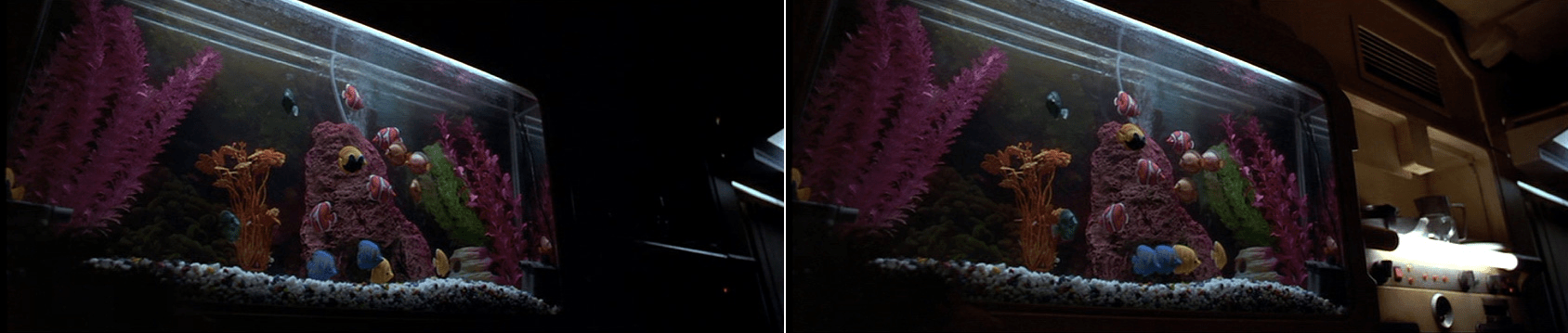
Once Korben cancels the alarm, his apartment comes to life. Heavy-beat music begins to play and lights automatically illuminate near the fake-fish tank above the stove and in his cigarette dispenser.
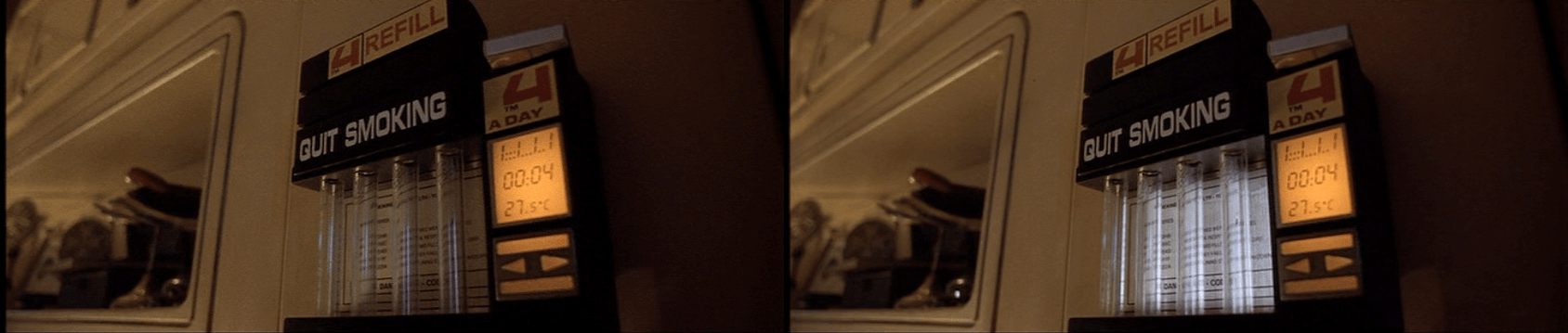
All these signals combine to make it difficult for sleepy Korben to stay in bed past when awake Korben knows he should be up and moving.