The Fifth Element: Overview

Release Date: 7 May 1997, France

Title card for 'The Fifth Element' with a cosmic background featuring stars and space.

In 1914 an alien race called the Mondoshawan visit a pyramid in Egypt to retrieve and secure four sacred stones, which are part of a weapon to defeat Ultimate Evil. Jump forward to the year 2263, when the Ultimate Evil has formed again and comes to threaten the Earth, partly through coercion of an evil corporatist named Zorg, who is ordered to capture the stones and thereby disable the weapon. A Mondoshawan spaceship coming to help Earth crashes, killing all aboard. Federation scientists use some of the remains to reconstruct one of the aliens, to discover that it is a strikingly powerful and beautiful woman named Leeloo. She escapes the facility to crash into the taxi of Korben Dallas. At her request, he takes her to a priest named Cornelius who belongs to a sect that serves the Mondoshawans. Cornelius recognizes that she is a prophesized “promised one.” Leeloo tells the priest the whereabouts of the four stones.

Dallas accepts an undercover job from the Federation and flies with Leeloo to a vacation spaceship liner called Fhloston Paradise. There he defeats an uprising of Mangalore aliens and unlocks a mystery to find the four sacred stones in the abdomen of the Diva Plavalaguna. Zorg arrives to lay a bomb, attempt to destroy Leeloo, and steal the stones, but fails at all three, dying instead from a Mangalore bomb. Dallas and Leeloo escape back to Earth, where they discover how to use the stones and activate the Ultimate Weapon that destroys Ultimate Evil in the nick of time.

A glowing portal with vibrant colors emitting light, showing a figure appearing to be suspended or emerging from the center.

IMDB: https://www.imdb.com/title/tt0119116/Currently streaming on:

The Door to the Chamber of Dreams

Barbarella-112

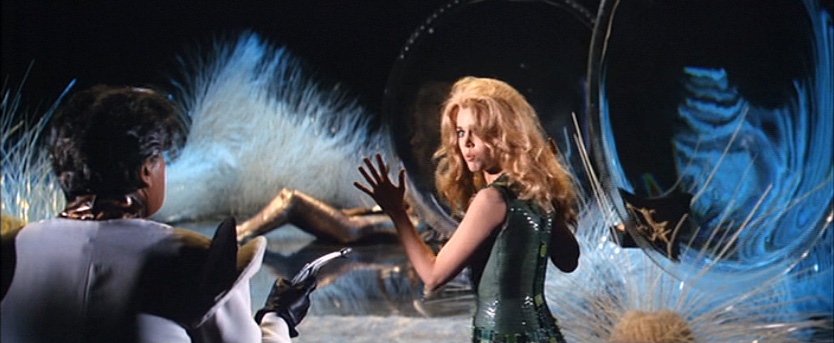
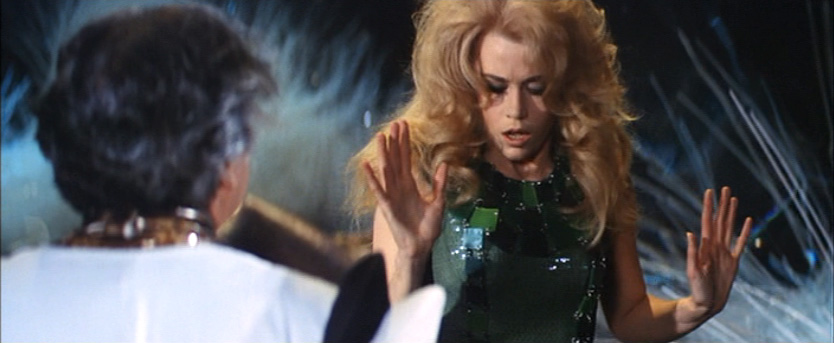
Durand-Durand forces Barbarella at gunpoint to take the invisible key she wears in a chain around her neck to the bedchamber of the Black Queen, also known as the Chamber of Dreams. There they encounter an invisible wall and have a difficult time trying to discern the location of the keyhole. Luckily, in a struggle she drops the key, and it falls through the transparent floor which ripples like water under their feet. This unlocks the invisible door and allows them both to pass into the Chamber of Dreams.

keyhole

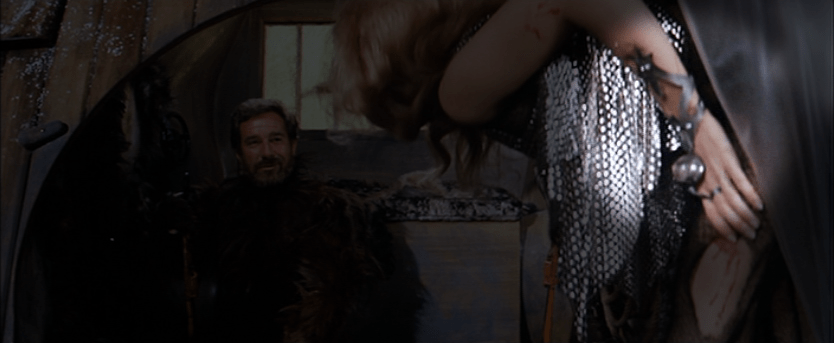
Just within the chamber atop a pedestal sits a second invisible key that can reclose the invisible door. To imprison Barbarella and the Queen within, he rushes in, grabs the key, and throws it down to the floor before Barbarella can react.

Though of course this sequence of events is in place simply to show that Durand-Durand has imprisoned Barbarella and the Black Queen, as a system it raises many questions.

Barbarella-121

An invisible key certainly means that it can be hidden in plain sight and so has some extra security from that perspective. But its being invisible means that recovering it when lost is problematic at best. Plus, unless it is kept somewhere on the body, the invisibility places a burden on the memory of the keeper as to where it is. (You can’t leave a physical reminder of where it is or you lose the benefit of its being invisible.) Are these costs to memory worth the mildly increased security?

Also, as we see, any spot on the floor is an acceptable target for dropping a key. At first this might seem like hyper-usability, since it’s nearly impossible to miss the keyhole, but it also means it’s hard to recover from a mistake. No, wait. It’s impossible to recover from a mistake. That is, if you fumble and accidentally drop a key, the door will activate. We don’t see a key-return mechanism, so this mistake is deeply unrecoverable. Even if that key-return mechanism is somewhere else in the palace, that’s a disaster for usability.

That might be bad enough, but when you realize that this is a royal chamber, it seems an impossible oversight, as if it were custom designed just to imprison people. The Queen seems genuinely distressed when she realizes Durand-Durand has stolen her key, insisting that they “are doomed. Dooooomed!’ but I’m pretty sure anyone who had given it just a moment’s thought before would have realized that this was the inevitable result of this ridiculous design. Maybe the true power of the Mathmos is to keep the queen perpetually blind to stupid interaction design.

The Black Queen Dreams

Barbarella’s energy box

Barbarella-037

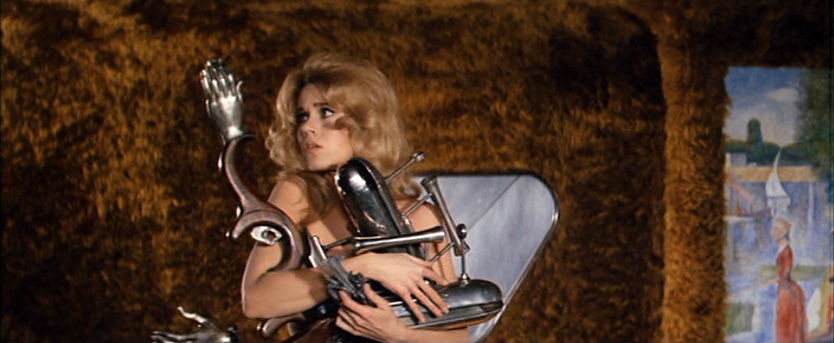
In addition to the portable brainwave detector, Dianthus also provides Barbarella with a number of weapons from the Museum of Conflict for her mission. All of these weapons are powered by a single energy box.

We only see it in use after she fires a single shot from the smallest of the weapons. She tries a second shot, but when it doesn’’t work, she glances at a device on the cuff of her boot. The device is designed in a taijitu, a yin-yang set of lights: one red, one white. They are blinking in an alternating pattern, and after viewing it she tells Pygar, ““My energy box is completely dead.””

Energy-Box

Though having a visual signal is quite useful to understand the state of an invisible resource like power, the signal would be much more useful if it showed the amount of energy remaining, and gave warnings before the power was completely out. Failing all that, it would be more useful if she just put the device on the glove of her shooting hand so it was in her field of view at all times.

And though Barbarella’s culture doesn’t understand war, even a peaceful person can quickly come to realize the risk in making your available resources—like power for your weapons—wholly visible to your enemies.

Portable brainwave detector

Barbarella-032

Through the atom transmitter Dianthus bestows several gifts on Barbarella to help her with her mission. The first of these is the “portable brainwave detector…to test for Durand-Durand’s presence.” To operate it, Barbarella must press “a contact,” (Dianthus is offscreen when he indicates the contact, but later we see her operating the leaf-like button near the wrist) and if Durand-Durand is around, the ball of lights will glow and an alarm will sound.

vlcsnap-00002

The device is wearable, wrapping around Barbarella’s forearm, and held in place by a ring. This aspect of the design is good, since it means the device is ever-present for operation, and the design of it makes it lovely enough to be overlooked as a fashion accessory. In fact many characters see her wearing it and make no mention.

PBD_worn

Manual activation is less than ideal, though, since this might tip off the suspect. This is especially true with the blinking, glowing ball of light and audio feedback. And, in fact, this is what happens later in the film when Durand-Durand trips over the device. The blinking light and audio catch his attention, betray the device for what it is, and blow Barbarella’’s cover in the process.

Portable Brainwave Device

The best feedback would be invisible, like a haptic vibration through the cuff to her skin. Ideally, the device would be constantly on, to detect the subject passively, the moment he came into range. But presuming battery life is the issue, the activation cue should be something much more subtle, like Barbarella’s touching the back of the ring with the thumb of the same hand. Such a gesture would match the existing design of the object, be discreet to an observer, and yet still discrete enough to prevent accidental activation.

Alphy

Barbarella-014

Barbarella’’s onboard conversational computer is named Alphy. He speaks with a polite male voice with a British accent and a slight lisp. The voice seems to be omnidirectional, but confined to the cockpit of the space rocket.

Goals

Alphy’’s primary duties are threefold. First, to obey Barbarella’’s commands, such as waking her up before their approach to Tau Ceti. Second, autopilot navigation. Third, to report statuses, such as describing the chances of safe landing or the atmospheric analysis that assures Barbarella she will be able to breathe.

Display

Alphy

Whenever Alphy is speaking, a display panel at the back of the cockpit moves. The panel stretches from the floor to the ceiling and is about a meter wide. The front of the panel consists of a large array of small rectangular sheets of metal, each of which is attached on one side to one of the horizontal bars that stretch across the panel. As Alphy talks, individual rectangles lift and fall in a stochastic pattern, adding a small metallic clacking to the voice output. A flat yellow light fills the space behind the panel, and the randomly rising and falling rectangles reveal it in mesmerizing patterns.

The light behind Alphy’’s panel can change. As Barbarella is voicing her grave concerns to Dianthus, Alphy turns red. He also flashes red and green during the magnetic disturbances that crash her ship on Tau Ceti. We also see him turn a number of colors after the crash on Tau Ceti, indicating the damage that has been done to him.

In the case of the conversation with Dianthus, there is no real alert state to speak of, so it is conceivable that these colors act something like a mood ring, reflecting Barbarella’’s affective state.

Language

Like many language-capable sci-fi computer systems of the era, Alphy speaks in a stilted fashion. He is given to “computery” turns of phrases, brusque imperatives, and odd, unsocialized responses. For example, when Barbarella wishes Alphy a good night before she goes to sleep, he replies, “Confirmed.”

Barbarella even speaks this way when addressing Alphy sometimes, such as when they risk crashing into Tau Ceti and she must activate the terrascrew and travel underground. As she is piloting manually, she says things like, “Full operational power on all subterranean systems,” “45 degree ascent,” and “Quarter to half for surfacing.”

Barbarella-Alphy-color-04

Nonetheless, Alphy understands Barbarella completely whenever she speaks to him, so the stilted language seems very much like a convention than a limitation.

Anthropomorphism

Despite his lack of linguistic sophistication, he shows a surprising bit of audio anthropomorphism. When suffering through the magnetic disturbances, his voice gets distressed. Alphy’’s tone also gets audibly stressed when he reveals that the Catchman has performed repairs “in reverse,” in each case underscoring the seriousness of the situation. When the space rocket crashes on Tau Ceti, Alphy asks groggily, ““Where are we?” We know this is only affectation because within a few seconds, he is back up to full functioning, reporting happily that they have landed, ““Planet 16 in the system Tau Ceti. Air density oh-point-oh-51. Cool weather with the possibility of stormy precipitations.”” Alphy does not otherwise exhibit emotion. He doesn’t speak of his emotions or use emotional language. This convention, too, is to match Barbarella’s mood and make make her more comfortable.

Agency

Alphy’s sensors seem to be for time, communication technology, self-diagnostics, and for analyzing the immediate environment around the ship. He has actuators to speak, change his display, supply nutrition to Barbarella, and focus power to different systems around the ship, including the emergency systems. He can detect problems, such as the “magnetic disturbance”, and can respond, but has no authority to initiate action. He can only obey Barbarella, as we hear in the following exchange.

Barbarella: What’s happening?
Alphy: Magnetic disturbances.
Barbarella: Magnetic disturbances?…Emergency systems!
Alphy: All emergency systems will now operate.

His real function?

All told, Alphy is very limited in what he can do. His primary functions are reading aloud data that could be dials on a dashboard and flipping switches so Barbarella won’t have to take her hands off of…well, switches…in emergency situations. The bits of anthropomorphic cues he provides to her through the display and language confirm that his primary goal is social, to make Barbarella’s adventurous trips through space not feel so lonely.

Alien head stem line

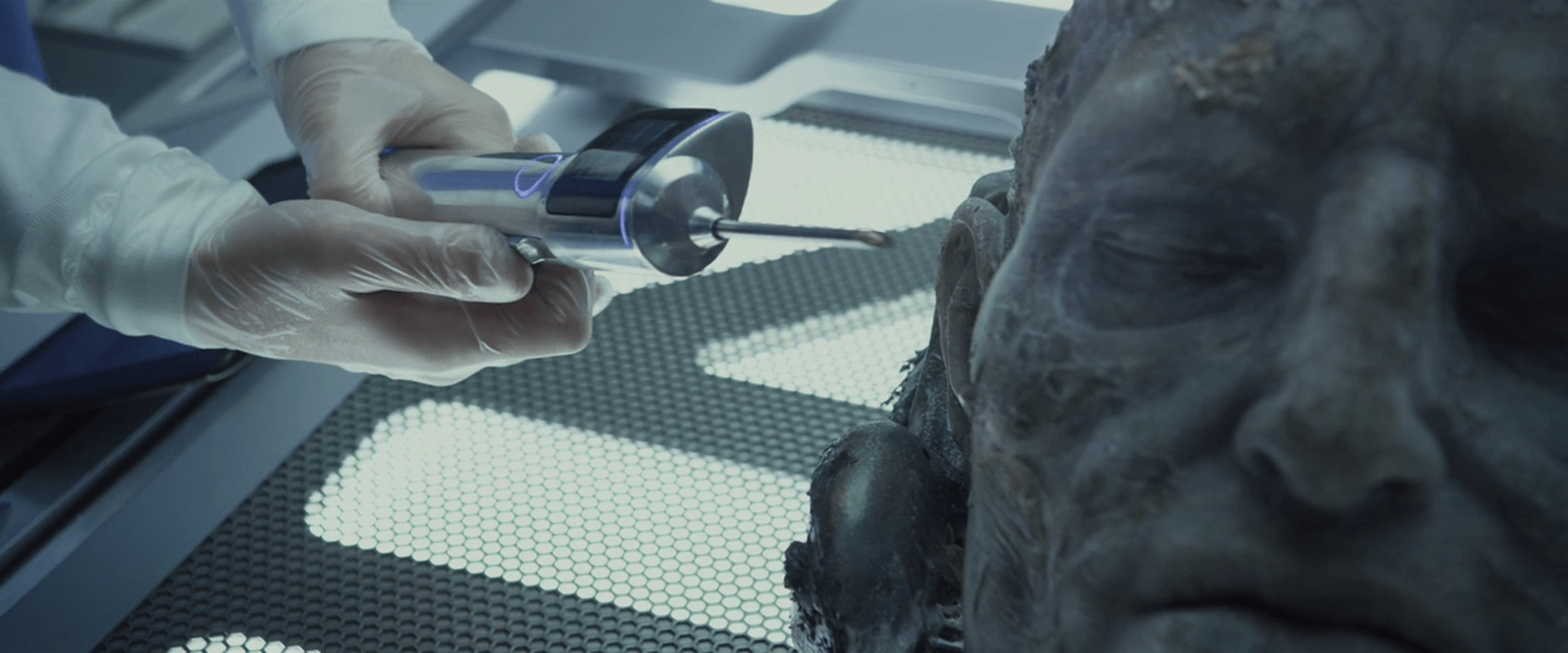
Using a tool that looks suspiciously identical to the Injection Carbon Reader, the stem line provides electrical current to nerve endings. It is inserted directly into the alien head and then controlled wirelessly via unseen controls on a nearby touch-sensitive slate pad.

Prometheus-168

The output on the stem line device animates with changes, but it seems the numbers appear near the middle and then slide to fixed positions on the top and bottom. If the point of the display was output, and it is meant to be seen from a distance, wouldn’t a simpler large-number display make more sense? If motion is meant to convey the meaning, like a digital gauge on a multimeter, then the text should be fixed on the graduated background and slide with it.

stemline

By stimulating the locus coeruleus of the alien, the Prometheus scientists seek to “trick it into thinking it’s still alive,” even though they have not confirmed the physiology of this 2000 year old alien specimen, or even that (in a quick Googling, the author learned that) this is the panic area of the nervous system. Were the results really that surprising?

Destination threshold

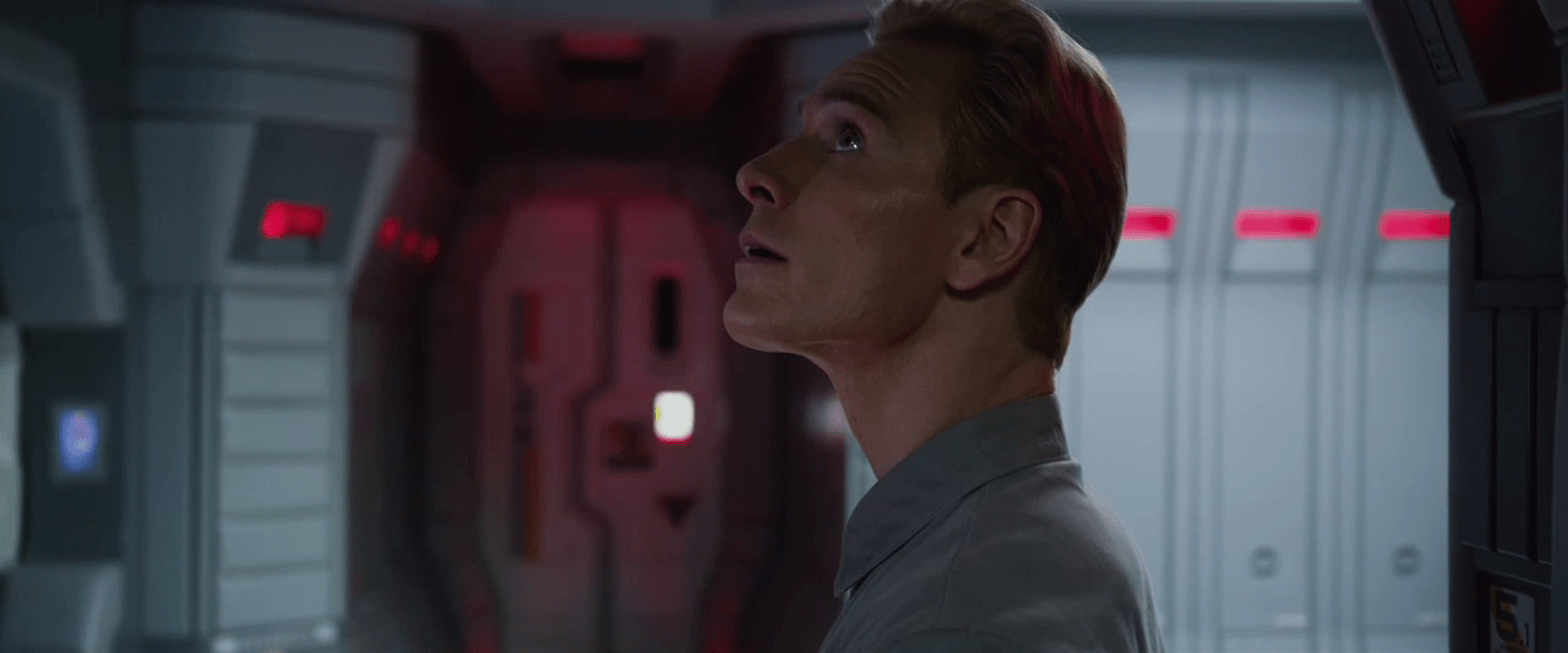
As David is walking through a ship’s hallway, a great clanging sounds from deep in the ship, as the colored lights high in the walls change suddenly from a purple to a flashing red, and a slight but urgent beeping begins. He glances at a billiards table in an adjacent room, sees the balls and cue sliding, and understands that it wasn’t just him: gravity has definitely changed.

Prometheus-020

There are questions about what’s going on with the ship that the gravity changed so fast, but our interest must be in the interfaces.

Why did David not expect this? If they’re heading to a planet and the route is known, David should know well in advance. The ship should have told him, especially if the event is going to be one that could potentially topple him. Presuming the ship has sensors to monitor all of this, it should not have come as a surprise.

The warning itself seems mostly well designed, using multiple modes of signal and clear warning signs:

  • Change in color from a soft to intense color (They even look like eyes squinting and concentrating in the thumbnails.)
  • A shift to red, commonly used for warning or crisis
  • Blinking red is a hugely attention-getting visual signal
  • Beeping is a auditory signal that is also a common warning signal, and hard to ignore

After David sees these signals, he walks to wall panel and presses a few offscreen buttons which beep back at him and silence the beeping, replacing it with overhead pulses of light that race up and down the hallway. Over the sound system a male voice announces “Attention. Destination threshold.”

Prometheus-Destination_Threshold

Why should David have to go find out what the crisis is at the wall interface? If he had been unable to get to the wall interface, how would he know what happened? Or if it required split-second action, why require of him to waste his time getting there and pressing buttons? In a crisis, the system should let you know what the crisis is quickly and intrusively if it’s a dire crisis in need of remedy. The audio announcement should have happened automatically.

Racinglights

The overhead lights are almost a nice replacement for beeping. It still says, “alert” without the grating annoyance that audio can sometimes be. (There’s still a soft “click” with each shifting light, just not as bad.) But if he’s able to silence the audio at this wall panel, why wasn’t he able to silence the race lights as well? And why do they “race” up and down the hallway rather than just blink? The racing provides an inappropriate sense of motion. Given that this signal is for when the crew is in an unusual and potentially dangerous situation, it would be better to avoid the unhelpful motion cue by simply blinking, or to use the sense of direction they provide to signal to David where he ought to be. A simple option would be to have the hallway lights race continuously in the direction of the bridge, leading the crew to where they would be most effective. Even better is if the ship has locational awareness of individual crew members, then you can cut all overhead illumination by 20% and pulse a light a few feet away in the desired direction between 80 and 100 percent, while darkening the hallway in the opposite direction. Then, as David walks towards the blinking light, the ship can lead him, even around corners, to get him where he needs to be. In a real crisis, this would be an easy and intuitive way to lead people where they’re need to be. It would of course need simple overrides in case the crew knew something about the situation that the ship did not.

After walking through the racing-light hallways, he turns just past the door and into the bridge, where we can see the legend “DESTINATION THRESHOLD” across the pilots HUD. He turns on a light, licks a finger, and presses another button to activate all of the interfaces on the bridge. He walks to the pilot’s panel, presses a button to open the forward viewscreen, observing LV223 with wide-eyed wonder.

This entire sequence seems strange from an interface perspective. We’re going to presume that licking his fingers was just a character tic and not required by the system. But in addition to the fact, raised above, that David seems somewhat surprised by it all, that he should have to open doors and manually turn on lights and interfaces during a crisis seems pointless. It’s either not a crisis and these signals should diminish, or it is a crisis and more of this technology should be automated.