The Door to the Chamber of Dreams

Barbarella-112

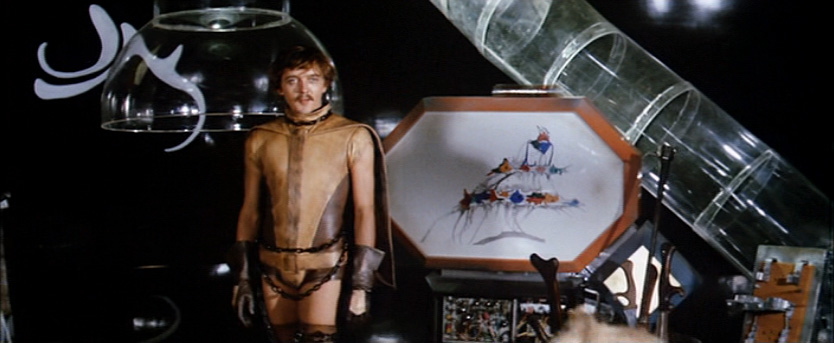
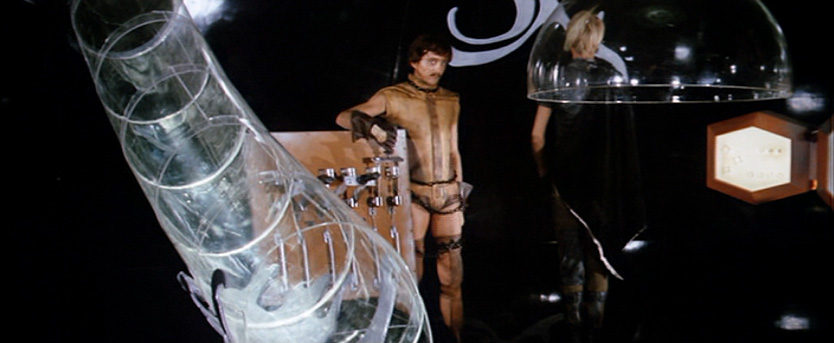
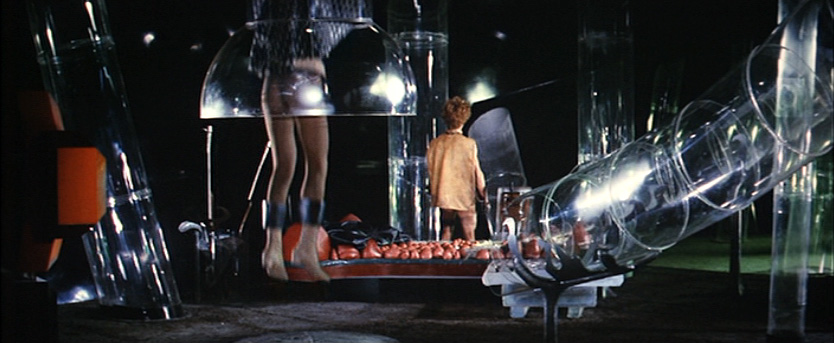
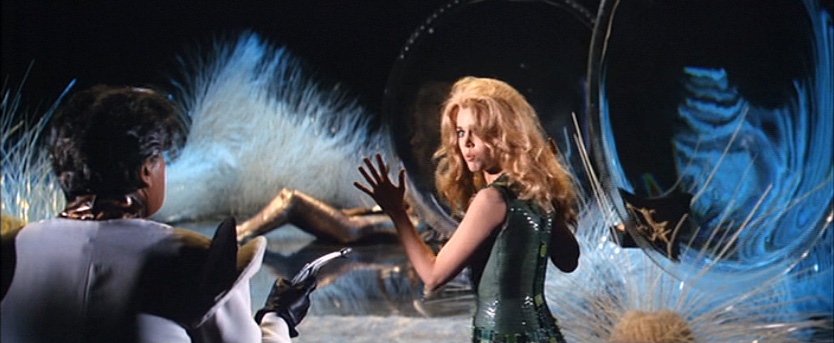
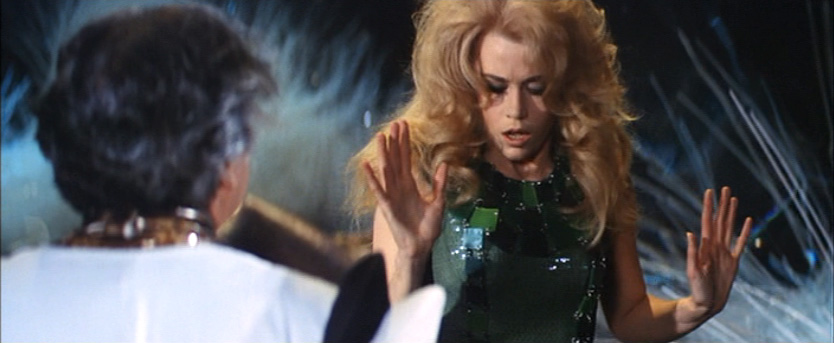
Durand-Durand forces Barbarella at gunpoint to take the invisible key she wears in a chain around her neck to the bedchamber of the Black Queen, also known as the Chamber of Dreams. There they encounter an invisible wall and have a difficult time trying to discern the location of the keyhole. Luckily, in a struggle she drops the key, and it falls through the transparent floor which ripples like water under their feet. This unlocks the invisible door and allows them both to pass into the Chamber of Dreams.

keyhole

Just within the chamber atop a pedestal sits a second invisible key that can reclose the invisible door. To imprison Barbarella and the Queen within, he rushes in, grabs the key, and throws it down to the floor before Barbarella can react.

Though of course this sequence of events is in place simply to show that Durand-Durand has imprisoned Barbarella and the Black Queen, as a system it raises many questions.
Barbarella-121

An invisible key certainly means that it can be hidden in plain sight and so has some extra security from that perspective. But its being invisible means that recovering it when lost is problematic at best. Plus, unless it is kept somewhere on the body, the invisibility places a burden on the memory of the keeper as to where it is. (You can’t leave a physical reminder of where it is or you lose the benefit of its being invisible.) Are these costs to memory worth the mildly increased security?

Also, as we see, any spot on the floor is an acceptable target for dropping a key. At first this might seem like hyper-usability, since it’s nearly impossible to miss the keyhole, but it also means it’s hard to recover from a mistake. No, wait. It’s impossible to recover from a mistake. That is, if you fumble and accidentally drop a key, the door will activate. We don’t see a key-return mechanism, so this mistake is deeply unrecoverable. Even if that key-return mechanism is somewhere else in the palace, that’s a disaster for usability.

That might be bad enough, but when you realize that this is a royal chamber, it seems an impossible oversight, as if it were custom designed just to imprison people. The Queen seems genuinely distressed when she realizes Durand-Durand has stolen her key, insisting that they “are doomed. Dooooomed!’ but I’m pretty sure anyone who had given it just a moment’s thought before would have realized that this was the inevitable result of this ridiculous design. Maybe the true power of the Mathmos is to keep the queen perpetually blind to stupid interaction design.

The Black Queen Dreams

The Excessive Machine

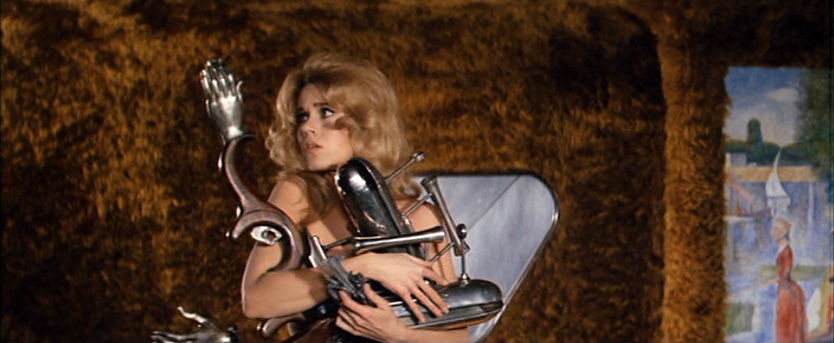
When Durand-Durand captures Barbarella, he places her in a device which he calls the “Excessive Machine. She sits in a reclining seat, covered up to the shoulders by the device. Her head rests on an elaborate red leather headboard. Durand-Durand stands at a keyboard, built into the “footboard” of the machine, facing her.

The keyboard resembles that of an organ, but with transparent vertical keys beneath which a few colored light pulse. Long silver tubes stretch from the sides of the device to the ceiling. Touching the keys (they do not appear to depress) produces the sound of a full orchestra and causes motorized strips of metal to undulate in a sine wave above the victim.

When Durand-Durand reads the strange sheet music and begins to play “Sonata for Executioner and Various Young Women,” the machine (via means hidden from view) removes Barbarella’s clothing piece by piece, ejecting them through a tube in the side of the machine near the floor. Then in an exchange Durand-Durand reveals its purpose…

  • Barbarella
  • It’s sort of nice, isn’t it?
  • Durand-Durand
  • Yes. It is nice. In the beginning. Wait until the tune changes. It may change your tune as well.
  • Barbarella
  • Goodness, what do you mean?
  • Durand-Durand
  • When we reach the crescendo, you will die of pleasure. Your end will be swift, but sweet, very sweet.

As Durand-Durand intensifies his playing, Barbarella writhes in agony/ecstasy. But despite his most furious playing, he does not kill Barbarella. Instead his machine fails dramatically, spewing fire and smoke out of the sides as its many tubes burn away. Barbarella is too much woman for the likes of his technology.

I’m going to disregard this as a device for torture and murder, since I wouldn’t want to improve such a thing, and that whole premise is kind of silly anyway. Instead I’ll regard it as a BDSM sexual device, in which Durand-Durand is a dominant, seeking to push the limits of an (informed, consensual) submissive using this machine. It’s possible that part of the scene is demonstration of prowess on a standardized, difficult-to-use instrument. If so, then a critique wouldn’t matter. But if not…Since the keys don’t move, the only variables he’s controlling are touch duration and vertical placement of his fingers. (The horizontal position on each key seems really unlikely.) I’d want to provide the player some haptic feedback to detect and correct slipping finger placement, letting him or her maintain attention on the sub who is, after all, the point.

Resistance Chutes

Barbarella-079

In order to conduct its subversions, the Resistance has a set of secret pneumatic chutes throughout SoGo. To monitor them, they have a map of the city with the chutes drawn as lines and places within the city illuminated with small lights.

The purpose of the lights is a bit vague, since just before Barbarella leaves Resistance Headquarters, Dildano glances at the map to see a red dot flashing at the very top. Gesturing at the light he remarks, “The time is right. The Queen is in her Chamber of Dreams.” But we know from the end of the film that the Queen’s Dream Chamber is on the lowest level of the city, close to Mathmos. (It would seem the Resistance has some severe information gathering issues.) So is each location able to change color to represent prominent individuals? What if two prominent people are in the same place? How does Dildano indicate which prominent person he wishes to track? We never see these controls, and per the axiom of providing inputs near outputs, we would want them to be somewhere around here.

We do get to see one interface in action, though. The chutes themselves are controlled by a set of rather rickety knife switches with large handles. A Resistance member throws one of the switches to initiate suction in a particular tube. (Fans of Futurama should note some similarities to the public transportation system in New New York.)

Barbarella-081

One the switch is thrown, a traveler extends his or her arms upwards, and then the tube handles the rest. The exits is ungraceful, tumbling travelers onto the floor in conspicuous places somewhere in SoGo.

Barbarella-096

Piranha dolls

Barbarella-061

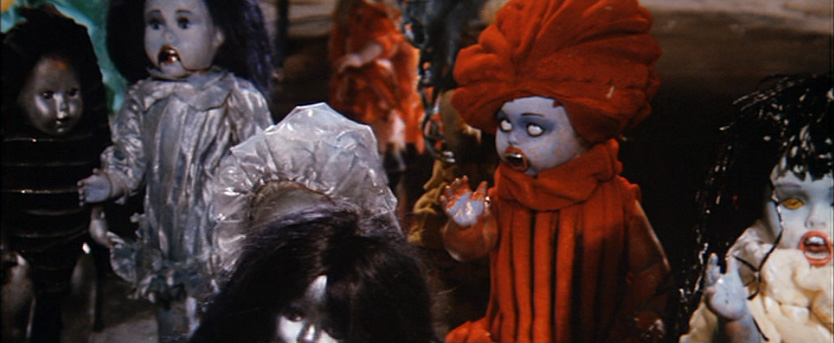
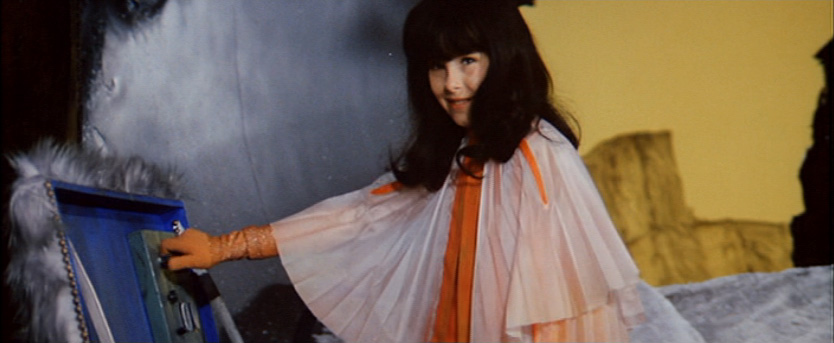
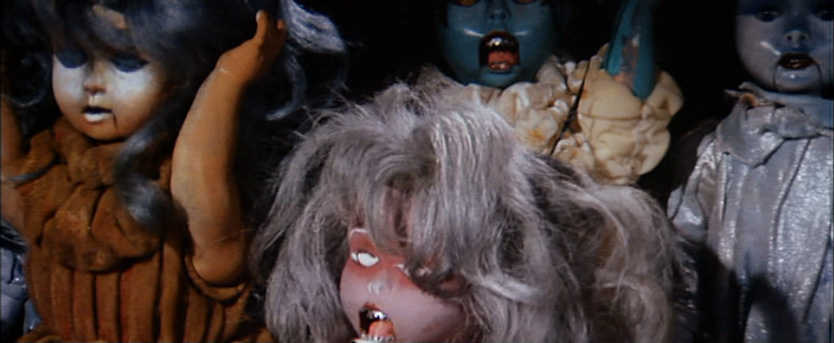
After landing on Tau Ceti, Barbarella is captured by feral children who tie Barbarella to a set of poles and turn a set of robot dolls on her.

The dolls exhibit some crude intelligence. They walk on their own toward Barbarella. Stomoxys (or is it Glossina? It’s tough to tell with these two.) twists a knob on a control panel of four similar, unlabeled knobs, and the dolls’ piranha-toothed mouths begin to crank open and slam shut. They then attack Barbarella, clinging and biting her legs and arms.

Barbarella-062 Barbarella-063

At first the dials seem a strange choice for a killing device, but then you realize that this isn’t mean to be efficient. Rather, the choice of dials for controls fits the childrens’ awful goal. Stop dials are best for setting variables within a range of values. The dolls must have a few variables, like walking speed, biting force, and biting speed, that the horrible children will want to play with as they entertain themselves with this torture.

And of course to “improve” this interface you might want to label the dials so a new user would know what does what, but who would really want to make torture toys more usable?

Barbarella-064

Barbarella’s energy box

Barbarella-037

In addition to the portable brainwave detector, Dianthus also provides Barbarella with a number of weapons from the Museum of Conflict for her mission. All of these weapons are powered by a single energy box.

We only see it in use after she fires a single shot from the smallest of the weapons. She tries a second shot, but when it doesn’’t work, she glances at a device on the cuff of her boot. The device is designed in a taijitu, a yin-yang set of lights: one red, one white. They are blinking in an alternating pattern, and after viewing it she tells Pygar, ““My energy box is completely dead.””

Energy-Box

Though having a visual signal is quite useful to understand the state of an invisible resource like power, the signal would be much more useful if it showed the amount of energy remaining, and gave warnings before the power was completely out. Failing all that, it would be more useful if she just put the device on the glove of her shooting hand so it was in her field of view at all times.

And though Barbarella’s culture doesn’t understand war, even a peaceful person can quickly come to realize the risk in making your available resources—like power for your weapons—wholly visible to your enemies.