Multipass

TheFifthElement-multipass

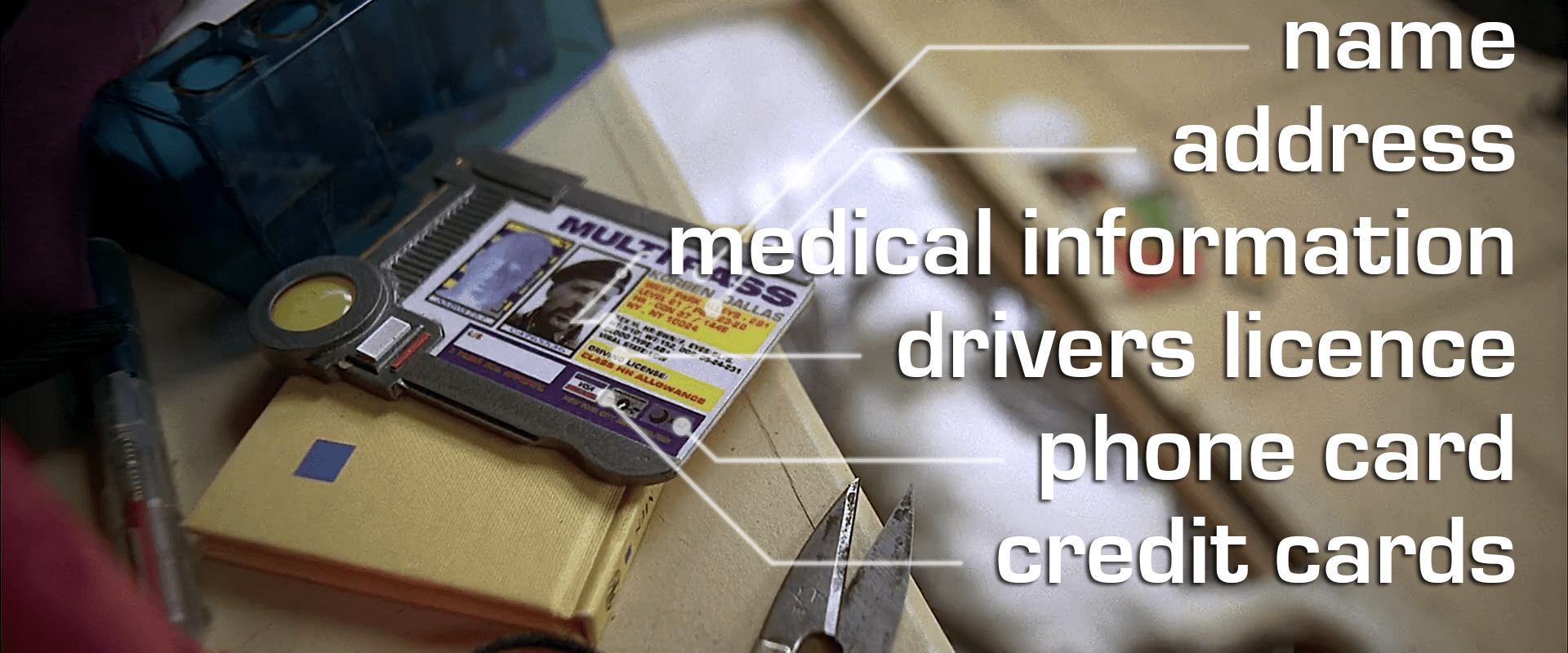
The multipass is the all-purpose card of 2263. It’s a driver’s license, work authorization record, proof of identity, emergency medical information, phone card, plus all your credit cards in one. There is a white rectangle and yellowish, rounded-bevel shape on the lower left, each of which may be a button, but that we don’t see in use.

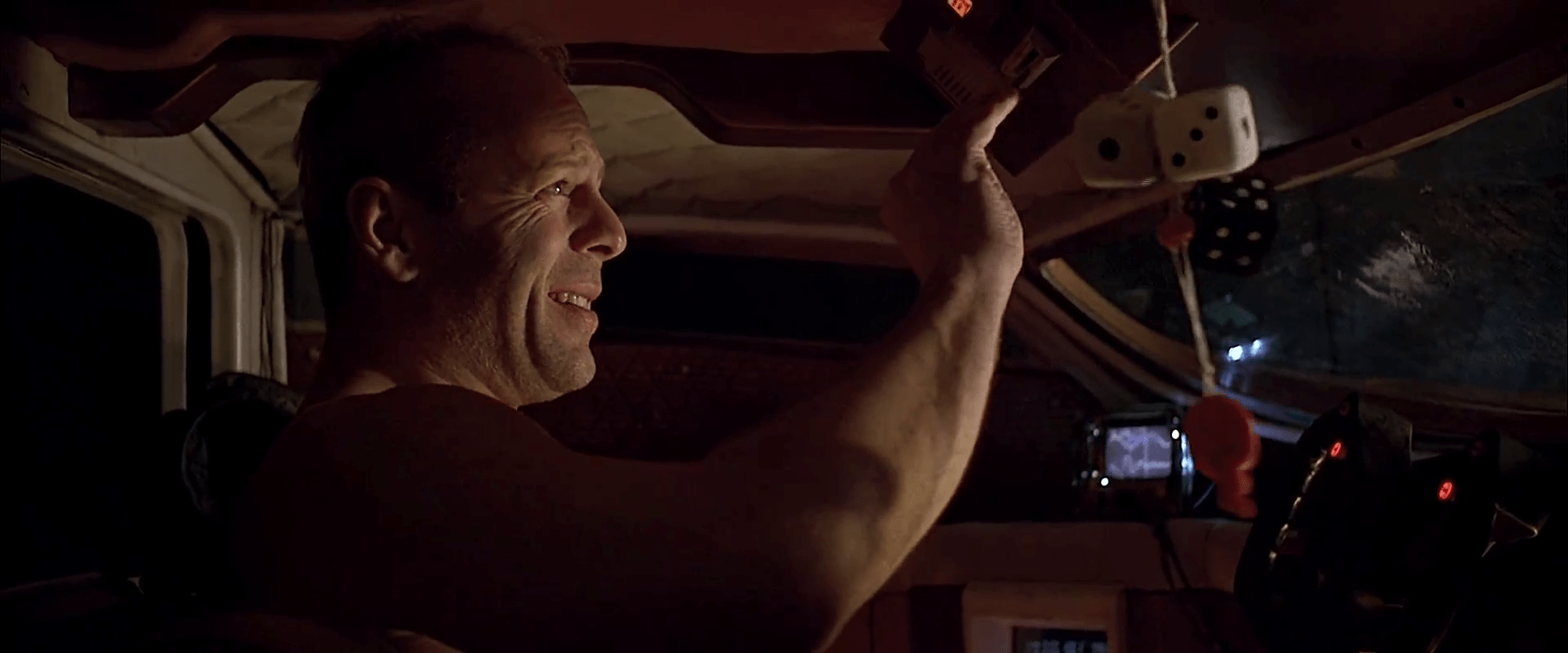
Often just showing it is enough for a human’s satisfaction, but sometimes it must be read by a machine. To do this, the holder inserts it into a slot, where the machine verifies its authenticity and registers the user locally. In Korben’s taxi, he has to leave it in as he operates the vehicle. At the Fhloston Paradise check-in booth, travelers dip it in and out of the reader.
TheFifthElement-multipass-014TheFifthElement-multipass-008

TheFifthElement-multipass-009

The act of inserting the card to authenticate may seem a bit old-fashioned in the days of RFID and read-at-a-distance technology, but it’s also nice to see that whatever agency was able to get the various corporations and government agencies to cooperate has also got privacy in mind. If it needs to be dipped to be read, maybe it can’t be read at a distance. That means the holder has more control over when and how it’s accessed.

As far as convenience, hot damn. It’s practically a wallet in and of itself. But there are security concerns to having all of this in one place. There are many cards that work like this in the world. Bus passes, skeeball tickets, gift cards. They’re generally low-cost. If you steal or forge Korben Dallas’ multipass, though, do you suddenly have his charge accounts, his taxi, and his phone card all at once? Seems high-cost, especially since the one forgery we see in the movie actually works.

This returns us, as so many things do, to multifactor authentication. This security philosophy requires that the user presents three factors: something they have, something they are, and something they know. The multipass covers only the first two.

  • The multipass itself is the thing they have.
  • The picture is something they are, i.e., what they look like.
  • It could be improved by requiring something they know, like a PIN or a password.

We don’t know what kind of power Cornelius’ order wielded in the world, but since it wasn’t enough to sway the president or purchase tickets to Paradise, let’s presume it wouldn’t have been enough to uncover Korben’s password, and in that case, the PIN would have foiled the attempted forgery.

TheFifthElement-multipass-002

Security and Control’s control

The mission is world-critical, so like a cockpit, the two who are ultimately in control are kept secure. The control room is accessible (to mere humans, anyway) only through a vault door with an armed guard. Hadley and Sitterson must present IDs to the guard before he grants them access.

Sitterson and Hadley pass security.

Truman, the guard, takes and swipes their cards through a groove in a hand-held device. We are not shown what is on the tiny screen, but we do hear the device’s quick chirps to confirm the positive identity. That sound means that Truman’s eyes aren’t tied to the screen. He can listen for confirmation and monitor the people in front of him for any sign of nervousness or subterfuge.

Hadley boots up the control room screens.

The room itself tells a rich story through its interfaces alone. The wooden panels at the back access Bronze Age technology with its wooden-handled gears, glass bowls, and mechanical devices that smash vials of blood. The massive panel at which they sit is full of Space Age pushbuttons, rheostats, and levers. On the walls behind them are banks of CRT screens. These are augmented with Digital Age, massive, flat panel displays and touch panel screens within easy reach on the console. This is a system that has grown and evolved for eons, with layers of technology that add up to a tangled but functional means of surveillance and control.

The interfaces hint at the great age of the operation.

Utter surveillance

In order for Control to do their job, they have to keep tabs on the victims at all times, even long before the event: Are the sacrifices conforming to archetype? Do they have a reason to head to the cabin?

The nest empties.

To these ends, there are field agents in the world reporting back by earpiece, and everything about the cabin is wired for video and audio: The rooms, the surrounding woods, even the nearby lake.

Once the ritual sacrifice begins, they have to keep an even tighter surveillance: Are they behaving according to trope? Do they realize the dark truth? Is the Virgin suffering but safe? A lot of the technology seen in the control room is dedicated to this core function of monitoring.

The stage managers monitor the victims.

There are huge screens at the front of the room. There are manual controls for these screens on the big panel. There is an array of CRTs on the far right.

The small digital screens can display anything, but a mode we often see is a split in quarters, showing four cameras in the area of the stage. For example, all the cameras fixed on the rooms are on one screen. This provides a very useful peripheral signal in Sitterson and Hadley’s visual field. As they monitor the scenario, motion will catch their eyes. If that motion is not on a monitor they expect it to be, they can check what’s happening quickly by turning their head and fixating. This helps keep them tightly attuned to what’s happening in the different areas on “stage.”

For internal security, the entire complex is also wired for video, including the holding cages for the nightmare monsters.

Sitterson looks for the escapees amongst the cubes.

The control room watches the bloody chaos spread.

One screen that kind of confuses us appears to be biometrics of the victims. Are the victims implanted with devices for measuring such things, or are sophisticated non-invasive environmental sensors involved? Regardless of the mechanisms, if Control has access to vital signs, how are they mistaken about Marty’s death? We only get a short glance at the screen, so maybe it’s not vital signs, but simple, static biometrics like height, and weight, even though the radiograph diagram suggests more.

Sitterson tries to avoid talking to Mordecai.

Communications

Sitterson and Hadley are managing a huge production. It involves departments as broad ranging as chemistry, maintenance, and demolitions. To coordinate and troubleshoot during the ritual, two other communications options are available beyond the monitors; land phone lines and direct-connection, push-to-talk microphones.

Hadley receives some bad news.