Remote Monitoring

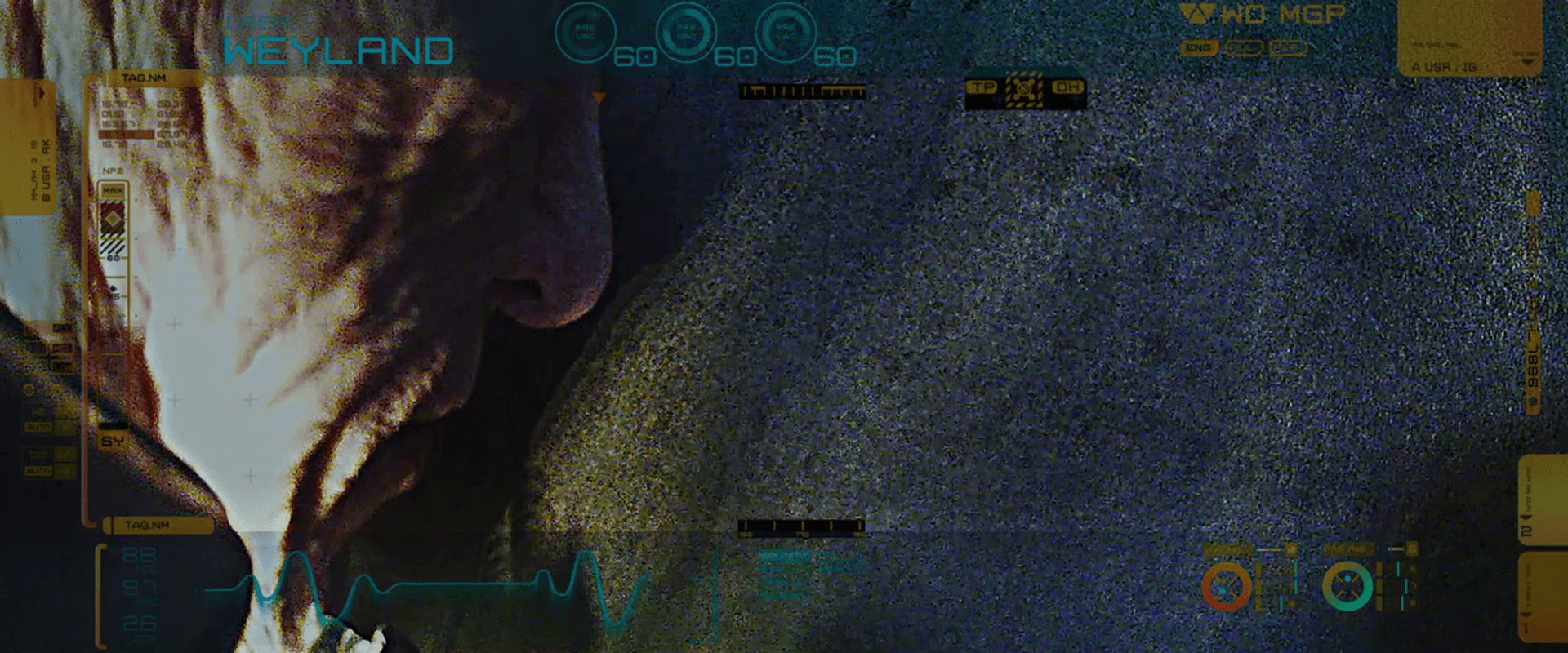
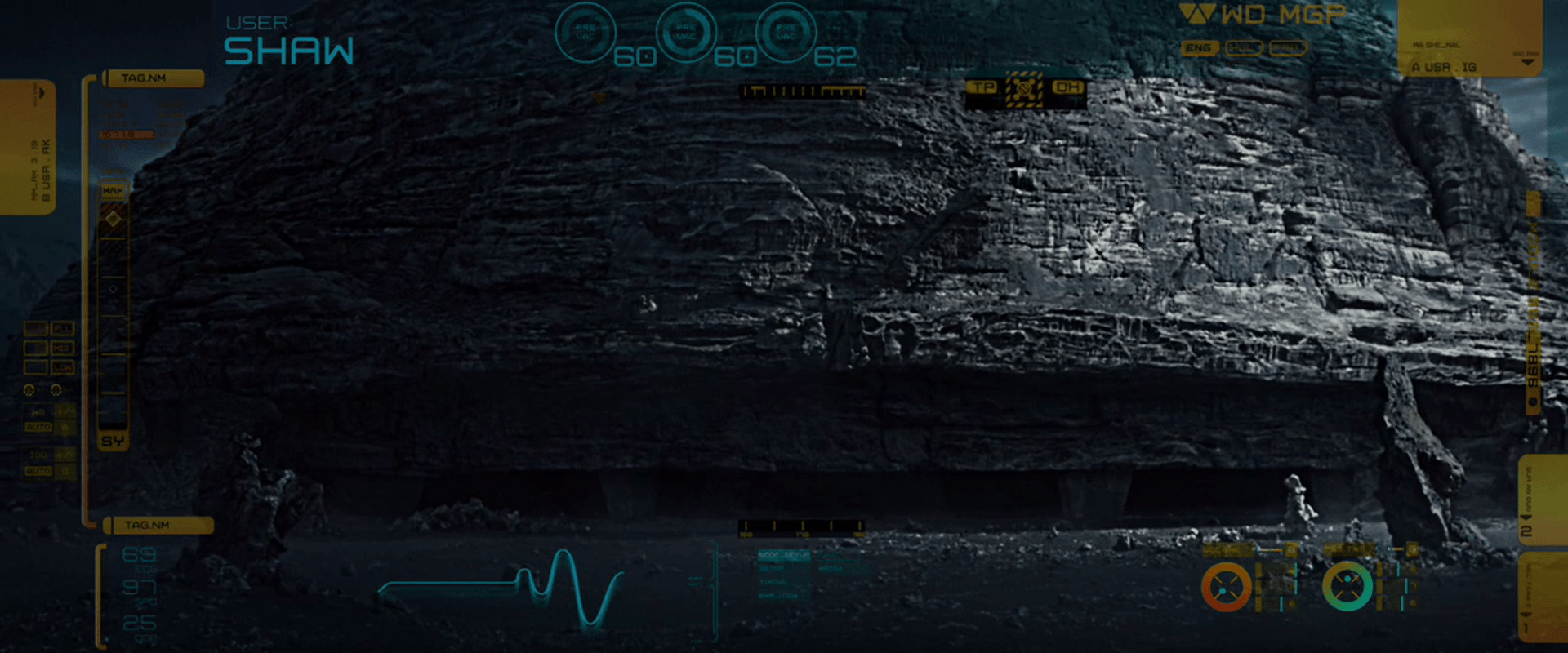
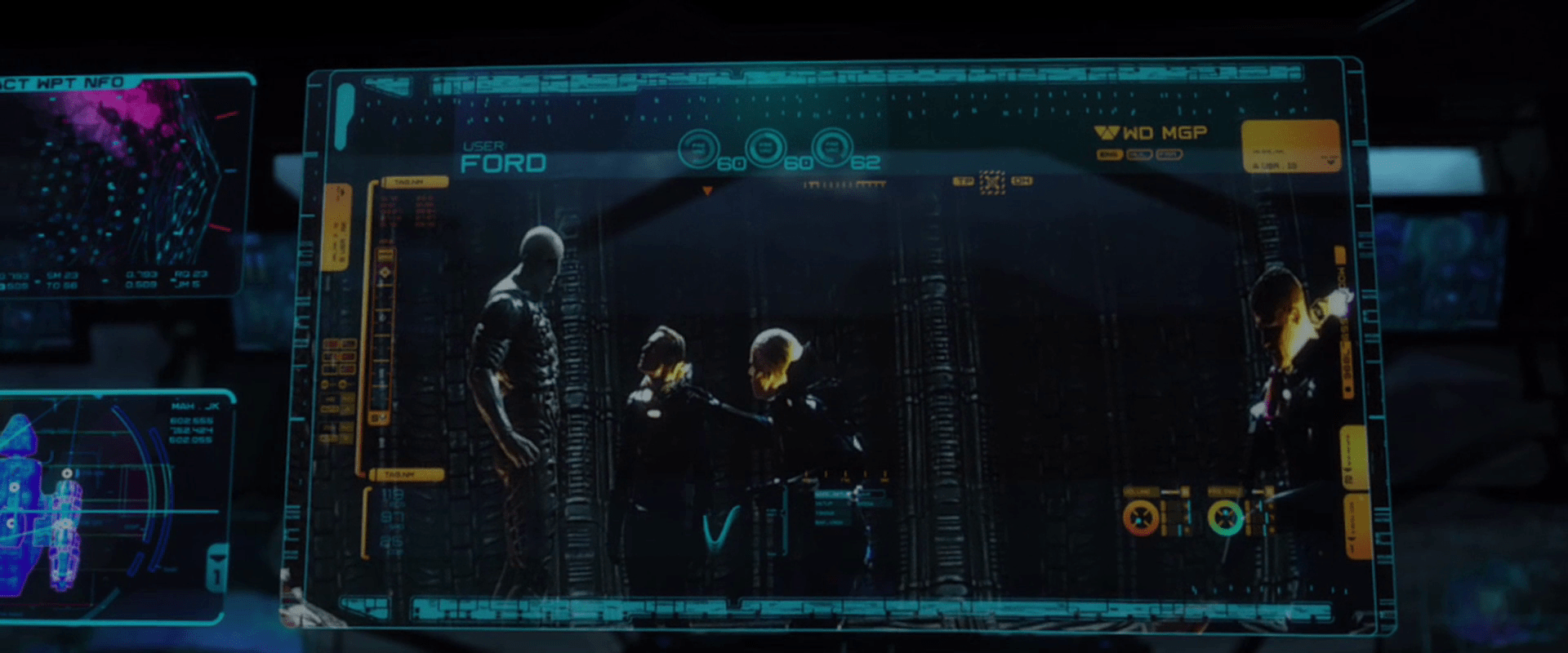
The Prometheus spacesuits feature an outward-facing camera on the chest, which broadcasts its feed back to the ship, where the video it overlaid with the current wearer’s name, and inscrutable iconographic and numerical data along the periphery. The suit also has biometric sensors, continuously sending it’s wearer’s vital signs back to the ship. On the monitoring screen, a waveform in the lower left appears is similar to a EKG, but is far too smooth and regular to be an actual one. It is more like an EKG icon. We only see it change shape or position along its bounding box once, to register that Weyland has died, when it turns to a flat line. This supports its being iconic rather than literal.

Prometheus-109

In addition to the iconic EKG, a red selection rectangle regularly changes across a list in the upper left hand corner of the monitor screens. One of three cyan numbers near the top occasionally changes. Otherwise the peripheral data on these monitoring screens does not change throughout the movie, making it difficult to evaluate its suitability.

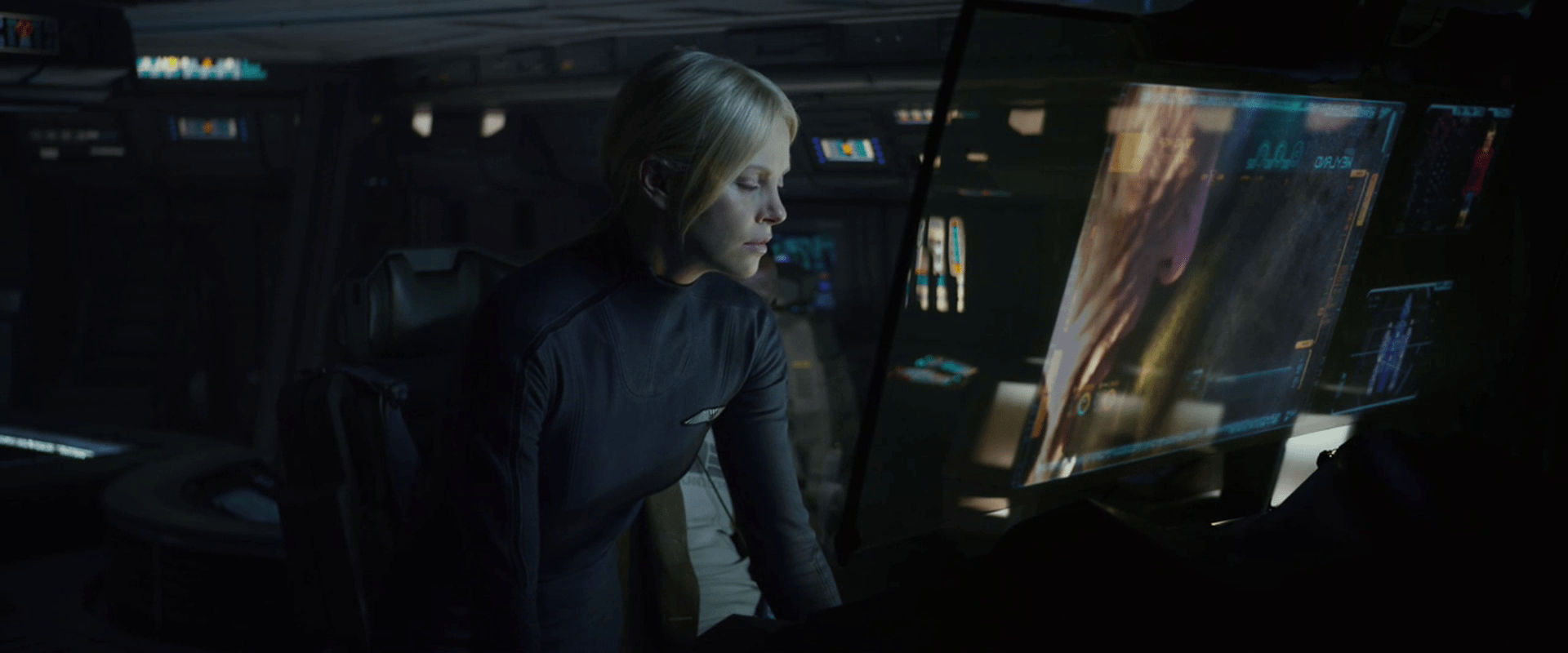
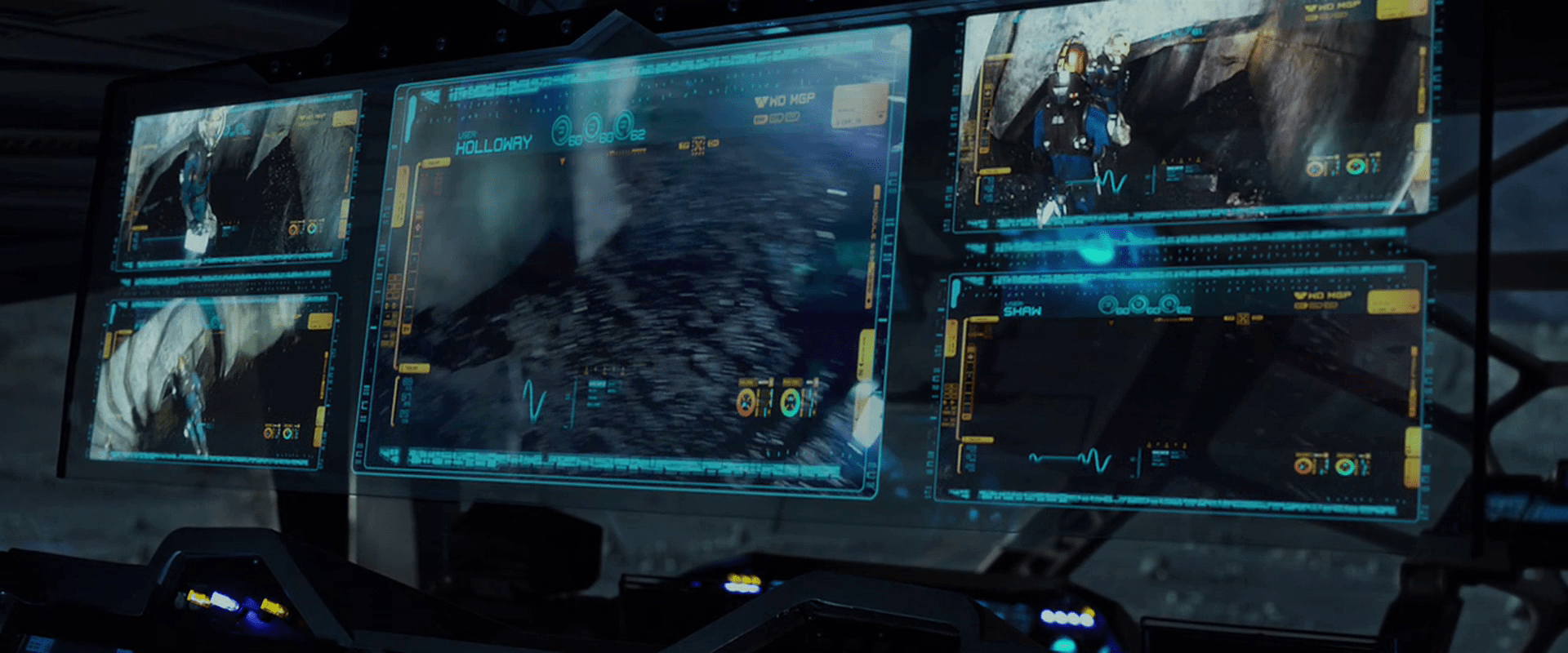
The monitoring panel on Prometheus features five of the monitoring feeds gathered on a single translucent screen. One of these feeds has the main focus, being placed in the center and scaled to double the size of the other monitors. How the monitoring crewperson selects which feed to act as the main focus is not apparent.

Prometheus-110

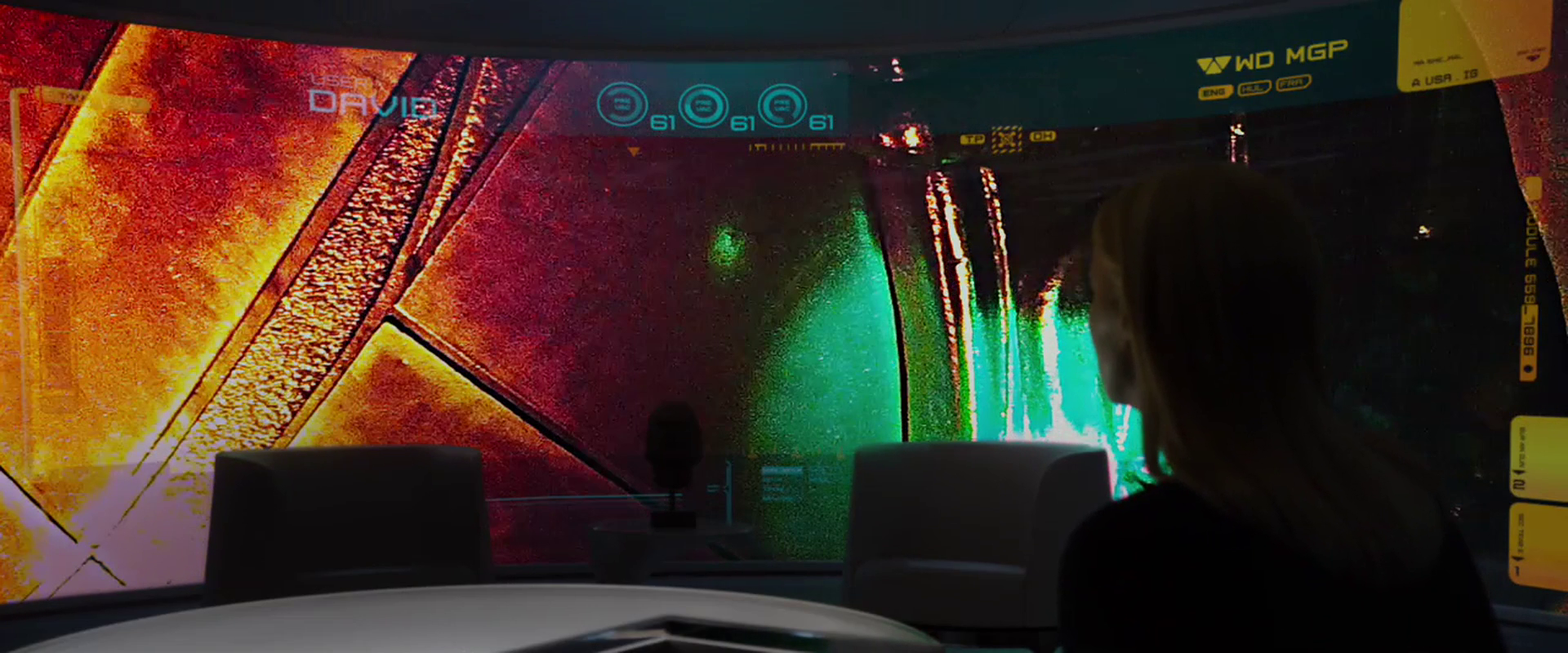
Vickers has a large, curved, wall-sized display on which she’s able to view David’s feed at one point, so these video feeds can be piped to anyone with authority.

Prometheus-203

David is able to turn off the suit camera at one point, which Vickers back on the Prometheus is unable to override. This does not make sense for a standard-issue suit supplied by Weyland, but it is conceivable that David has a special suit or has modified the one provided to him during transit to LV-223.

Human VPs

In the volumetric projection chapter of Make It So, we note that sci-fi makers take pains to distinguish the virtual from the real most often with a set of visual treatments derived from the “Pepper’s Ghost” parlor trick, augmented with additional technology cues: translucency, a blue tint, glowing whites, supersaturated colors for wireframed objects, clear pixels and/or flicker, with optional projection rays.

Prometheus has four types of VPs that adhere to this style in varying degrees. Individual displays (with their interactions) are discussed in other posts. This collection of posts compares their styles. This particular post describes the human VPs.

Prometheus-064

Blue-box displays

One type of human-technology VPs are the blue-box displays:

  • David’s language program
  • Halloway and Shaw’s mission briefing
  • The display in Shaw’s quarters

These adhere more closely to the Pepper’s Ghost style, being contained in a translucent blue cuboid with saturated surface graphics and a grid pattern on the sides.

Weyland-Yutani VP

The other type of human displays are the Weyland-Yutani VPs. These have translucency and supersaturated wireframes, but they do not have any of the other conventional Pepper’s Ghost cues. Instead they add two new visual cues to signal to the audience their virtualness: scaffolded transitions and edge embers.

When a Weyland-Yutani VP is turned on, it does not simply blink into view. It builds. First, shapes are described in space as a tessellated surface, made of yellow-green lines describing large triangles that roughly describe the forthcoming object or its extents. These triangles have a faint smoky-yellow pattern on their surface. Some of the lines have yellow clouds and bright red segments along their lengths. Additionally, a few new triangles extend to a point space where another piece of the projection is about to appear. Then the triangles disappear, replaced with a fully refined image of the 3D object. The refined image may flicker once or twice before settling into persistence. The whole scaffolding effect is staggered across time, providing an additional sense of flicker to the transition.

Prometheus-010

Motion in resolved parts of the VP begins immediately, even as other aspects of the VP are still transitioning on.

When a VP is turned off, this scaffolding happens in reverse, as elements decay into tessellated yellow wireframes before flickering out of existence.

Edge embers

A line of glowing, flickering, sliding, yellow-green points illustrates the extents of the VP area, where a continuous surface like flooring is clipped at the limits of the display. These continue across the duration of the playback.

A growing confidence in audiences

This slightly different strategy to distinguishing VPs from the real world indicates the filmmaker’s confidence that audiences are growing familiar enough with this trope that fewer cues are needed during the display. In this case the translucency and subtle edge embers are the only persistent cues, pushing the major signals of the scaffolding and surface flicker to the transitions.

If this trend continues and sci-fi makers become overconfident, it may confuse some audiences, but at the same time give the designers of the first real-world VPs more freedom with their appearance. They wouldn’t have to look like Star Wars’.

Something new: Projected Reflectance

One interesting detail is that when we see Vickers standing in the projection of Weyland’s office, she casts a slight reflection in the volumetric surface. It implies a technology capable of projecting not just luminance, but reflectivity as well. The ability to project volumetric mirrors hasn’t appeared before in the survey.

Prometheus_VP-0012

Lesson: Transition by importance

Another interesting detail is that when the introduction to the Mission briefing ends, the environment flickers out first, then the 2D background, then Weyland’s dog, then finally Weyland.

This order isn’t by position, brightness, motion, or even surface area (the dog confounds that.) It is by narrative importance: Foreground, background, tertiary character, primary character. The fact that the surrounding elements fade first keep your eyes glued onto the last motion (kind of like watching the last bit of sun at a sunset), which in this order is the most important thing in the feed, i.e. the human in view. If a staggered-element fade-out becomes a norm in the real world for video conferencing (or eventually VP conferencing), this cinematic order is worth remembering.
HYPSP>S020

In addition to the biometric readout at the foot of the hypersleep chamber, David can also check on the humans in hypersleep via direct visual contact. Though the walls of these chambers are ordinarily opaque, by placing his hand on a corner, David can cause the walls become translucent and the top becomes transparent. This allows him to directly view the body to check on a hypersleeper’s appearance, while maintaining some privacy for the hypersleeper from other straying eyes in the area.

The topmost surface of the chamber also has a translucent interface displaying such information as the sleeper’s name, labeled CRYO SLEEP; something called DREAM STATE, which is numerical (Shaw’s is 0560-09797?); and a few other pieces of inscrutable data.

There are a number of problems with this interface. The translucent interface might be a good idea because it would reduce the time between looking at abstractions of data and looking at a subject. But the data shown on the interface is not clearly biometric. (A solid argument can be made that it would be better to swap the data found on this screen and the data seen in the HYP.SL screen at the head of the bed.) In this case, since the data is not biometric, the overlay might actually occlude important outward signs and is therefore a bit misplaced.

Additionally, since the chambers are situated with their feet towards the wall, the orientation of the typography seems to have poor usability as well. For optimal reading in this portrait orientation, a viewer would have to go as far out of his way as possible in the space. This information should have been laid out along the landscape orientation of the pane, and the information moved to the edge such that an unhindered visual scan of the sleeper is possible.

I was at first confused about a feature of the chambers seen later in the movie, when David is surprised to find evidence that Meredith has exited her chamber and walked to her quarters, long ahead of the others. Why was he surprised? If you were designing a system for a caretaker, wouldn’t you want him to know when something as major as that occurs? Then I realized that Meredith outranks and is resentful of David, so it’s entirely likely that if she could, she would enjoy configuring her personal program to wake her ahead of the others and disable any notification that David would ordinarily receive.

The plastic educator

Dr. Morbius introduces the Krell “plastic educator,” saying, ““As far as I can make out, they used it to condition and test their young, in much the same way as we once employed finger painting among our kindergarten children.””

Morbius grasps the educator’s head mount.

The device is a station at which the learner sits. There is a large dashboard before him, in turn before a space enclosed in a tetrahedral encasement of plastic. To his right is a large column made of plastic with red and yellow graduations running up the side. Inside the column is a strange shape like a lathed accordion, terminating in a pulsing ring that indicates a level against the graduations. An arced panel hangs from the ceiling with other printed graduations with lines of light above and below. Blue neon squiggles blink randomly along the walls.

Morbius demonstrates proper placement of the educator interface.

To activate the station, the learner grasps a pair of curved metal arms, which are connected at a hinged base and tipped with crystal orbs. He leans forward, rests his forehead on a third arm, and pulls the pair of arms to rest on his temples. He turns a pair of dials on the dashboard before him, and the crystal orbs on all three arms glow, indicating that the headset is operational.

Morbius points to the intelligence indicator.

Adams and Doc try to guage their own IQs.

The device’’s immediate result is that the accordion shape inside the column rises such that the lit ring indicates the intelligence of the user. (To Adams’ and Doc’’s dismay, their readings are much lower than Morbius’.)

With the press of a lever Morbius manifests a thought visually.

The primary function of the device is for the user to make a thought of theirs manifest in the tetrahedral space. The user concentrates on the thing, and then pulls a lever at the base of the headset. A red ring at the base of the headset illuminates, and a material appears above a pedestal at the base of the tetrahedron. By concentrating, the user shapes this material into the desired thing. Morbius shapes it into an image of Alta. The image is a scaled, translucent, volumetric display of Alta, which moves and smiles just as she would.

The projection ceases immediately when the mechanism is removed.

To stop using the device and shut down the projection, the learner simply lifts the lever and removes the headset from contact, and the orbs, the red ring, and the volumetric projection all fade within moments.

Finished with his demonstration, Morbius turns the educator off.

Turning the dashboard off requires a user to turn two free-spinning dials that sit to each side of the headset inwards. The lights of the dashboard fade.