As this site nears its 5-year anniversary, it’s time to take a measure of who the hell you are out there, and what you dig/don’t dig/want on the site. It’s 18 questions, and at most 15 minutes of your time, and by gosh, I would appreciate it.
How could this work as technology instead of magic?
In the prior post I looked at the Cloak as a bit of wearable technology. Today let’s ask ourselves how possible this is in the real world.
The abilities of the Cloak listed in the first post imply a great deal of functionality: Situational awareness, lightning fast thinking, precision actuators throughout its fabric, gravity controls for itself and its wearer, goal awareness, knowledge of the world. Some of these aren’t going to happen, but some are conceivable over time.
Parts of it are conceivable over time
Some of those abilities make sense with what we know of the arc of technology.
Actuators
Technology keeps shrinking, so a fabric made of strong actuators might be conceivable. I’m not sure muscle wire will ever be this strong, but let’s presume generative design can discover a way to use its relatively weak strength for greater-than-human feats of strength, and that wires can be coordinated when woven into a fabric.
Sensors
The Cloak has complete situational awareness, but where are its sensors? It demonstrates field awareness. We don’t see sensors, but it has to be building this awareness from something. One possibility is that if it was able to connect to sensors around it, much like The Machine and Samaritan Super AIs from Person of Interest or Batman’s cellular panopticon. Alternately, the cape could be dotted with sensors that detect in the x-ray or infrared spectrums, so they can be hidden under the fabric. Let’s say this is pretty futuristic, but possible.
The Cloak’s AI
Yes we have crazy fast processors that seem to keep getting faster, so perhaps the processors could become embeddable in the cloth or perhaps the fibulae. And the amount of cloth in the Cloak is much more than most wearables, so sure, let’s say the computational power can be made this small and sartorial.
Writing this blog takes my vocabulary to some obscure places.
There is the problem of the AI. Some of the Cloak’s abilities imply general, rather than narrow, artificial intelligence. It has complete situation awareness, a clear theory of mind, and seems to learn. We’re not at general AI yet and at least according to Nick Bostrom’s poll, computer scientists are estimating it will be about another decade until we get there, if we can get there at all. Opinions are split as to whether it’s possible, but let’s go optimistic with this one and put it in the conceivable category, with the caveat that it may be wishful thinking.
But some parts break the laws of physics
But then there are a few things that just break the laws of physics, the first of which is flying.
There’s no evidence from other things in the scenes that it is employing a propellant of some kind to do this lifting. It just moves where it wants to. Cloak don’t give a shit. Add the fact that it can hang in place (see the vitrine gif, above) as if it can just ignore the Earth’s gravity, and we’ve got something that earns the Isaac Newton seal of WTF.
It also seems able to pull in any arbitrary direction in space with a great deal of force, as it does when it drags around one of the beefier zealots in a defend-the-master move that would make a Molossus war dog lower its head in respect. Flatworms are the closest thing to a muscled bit of fabric that evolution has come up with, and I don’t think physics would allow it to do this kind of maneuver, either.
Then, when Strange flies wearing it, it doesn’t seem to use its powers to carry him. That would look more like a hammock, or a flying carpet. Instead it somehow grants the power of arbitrary space positioning to him, and then it just gets to relax and ride along and concentrate on looking majestic.
So it can pull in any direction with no anchor, propellant, or regard for gravity; and grant this ability to someone on contact. Sorry, but I think we have to admit that these aspects of the Cloak are just wish fulfillment.
Even if flight could be overlooked, then there comes the question of where’s the power coming from? I don’t see much battery technology trending towards infinite especially when it has to be small enough to be wearable.
So while an engaging vision, we have to be quite careful about drawing design lessons from the Cloak. Enabling technology would be far in the future. And even though personal flight technology (ofsorts) exists, but we should take in mind their designs have to deal with the very real issues of thrust and power.
That’s enough for today. In the next post we’ll look at the intelligence and agency evident in the Cloak.
When Dr. Strange visits the New York Sanctum for the first time, he passes by a vitrine in which a lush red cape hovers in midair. It’s the Cloak of Levitation, and in this moment it chooses Strange. We see many of its functions throughout the movie.
Functions
When the glass of the vitrine is broken and Kaecilius stabs at Strange with a Soul Sword, the Cloak reaches out with a corner and stays Kaecilius’ hand to save Strange.
When Kaecilius knocks Strange down a stairwell, the Cloak chases him, catches him, and floats him back up to the fight. (See above.)
Attached by two fibulae to his surcoat, it can pull him, physically, and does so several times for different reasons:
to get him out of the first fight with Kaecilius
to help him dodge the soul sword
to keep him from grabbing ineffective weapons, pointing him instead to the more effective Crimson Bands of Cyttorak
Unbidden, the Cloak wraps itself around the head of one of Kaecilius’ zealots, drags him around, and slams his head into the walls and floor until the zealot is dead. (Even though, for the entire end of the fight, Strange is across town getting medical attention.) After the combat, the Cloak hovers next to the dead zealot, perhaps keeping watch.
After Strange tells Christine goodbye in the surgical prep room, the Cloak gently floats itself into place and uses the corner of its popped collar to remove blood from Strange’s face, to his annoyance. He tells it to, “Stop!” and it relaxes.
It pulls him out of the path of some flying debris while time is reversed before the Hong Kong Sanctum, and defends him from a punch later in the same sequence.
He uses it to fly through the portal into the Dark Dimension to face Dormammu.
It dons itself in the Kamar-Taj, brusquely enough to cause Strange to catch his balance.
The Cloak is like a guardian angel. Or maybe a super-familiar, in the wizard sense. It keeps an eye out for Strange. It is able to predict, protect, crudely inform, and, not least, fly. It acts as both an assistant and an agent. (More on this later)
Wearable Analysis
Let’s first look at it as a wearable. Turns out it fares well according to the wearable principles I laid out in the The Combadge & ideal Wearables post. Those principles are discussed individually below.
Sartorial? Yes.
The Cloak is literally a piece of clothing and quite inline with fashion trends of the sorcerous and superhero worlds. A dash of panache for the workday and a night flying above the town. I’m saying it looks quite in place for being a piece of tech.
Social? Yes, kind of.
The cape does not signal its cape-abilities (how many terrible puns will I allow myself, here? Time will tell…) and so might score low on its social aspect. But it is a unique mystical item. Those in the know, know. Its reputation conveys its abilities. To those who don’t know, its cape-ness grants an initial element of surprise, as we saw when it blocked Kaecilius’ stab the first and second time. The villain was as surprised as we. The Cloak is cloaked, but this is a feature.
Tough to accidentally activate? Yes.
To fly to the Dark Dimension, he places his hands in a “Devil sign,” with 1st and 4th fingers extended and the others bent down to the thumb. He points his hands towards his feet, and flies off in the opposite direction. This isn’t him casting a spell. It’s him telling the Cloak what he wants it to do. That’s hard to do by accident.
Apposite I/O? Yes.
For the most part, the Cloak acts of its own accord. Looking at the list above, the only times it acts under instruction is when Strange tells it to stop wiping his cheek and when he uses it to fly to the Dark Dimension. He uses speech for the former and finger-tutting for the latter.
The rest of its functionality (that is, most of it) is it acting on its own, which doesn’t befit an i/o mapping evaluation.
Easy to access and use? Yes, exceptionally.
Being a key part of Strange’s uniform, and able to both get out of the way and onto shoulders when it needs to, the Cloak is not just easy to use, but it makes itself easy to access and use, so it scores high here.
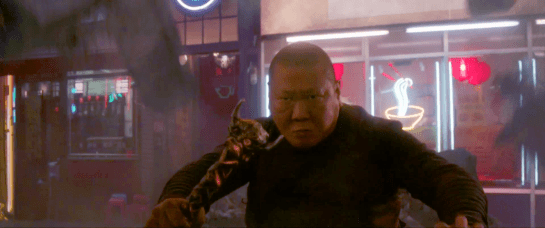
This staff appears to be made of wood and is approximately a meter long when in its normal form. When activated by Mordo it has several powers. With a strong pull on both ends, the staff expands into a jointed energy nunchaku. It can also extend to an even greater length like a bullwhip. When it impacts a solid object such as a floor, it seems to release a crack of loud energy. Too bad we only ever see it in demo mode.
How might this work as technology?
The staff is composed of concentric rings within rings of material similar to a collapsing travel cup. This allows the device to expand and contract in length. The handle would likely contain the artificial intelligence and a power source that activates when Mordo gives it a gestural command, or if we’re thinking far future, a mental one. There might also be an additional control for energy discharge.
In the movie, sadly, Mordo does not use the Staff to its best effect, especially when Kaecilius returns to the New York sanctum. Mordo could easily disrupt the spell being cast by the disciples using the staff like a whip, but instead he leaps off the balcony to physically attack them. Dude, you’re the franchise’s next Big Bad? But let’s put down the character’s missteps to look at the interface.
Mode switching and inline meta-signals
Any time you design a thing with modes, you have to design the state changes between those modes. Let’s look at how Mordo moves between staff, nunchaku, and whip in this short demonstration scene.
To go from staff to nunchaku, Mordo pulls it apart. It’s now in a dangerous state, so is there any authentication or safety switch here? It could be there, but all passive via contact sensors, which would be the best so it could be activated in a hurry. The film doesn’t give us any clue, really, so that’s an open question.
How does it know to go from nunchaku to whip? It sure would be crappy to bet on a disabling thwack against your opponent only to find it lazily draping over a shoulder instead. (Pere Perez might have advanced ideas, given his ideas on light saber tactics.) Again, this state change could be passive, detecting in real time the subtle gestural differences in a distal snap, which a bullwhip would need, and lateral force, which sets the nunchaku spinning, and adjust between the two accordingly. Gestural and predictive technologies are not particularly cinegenic, so let’s give it the benefit of the doubt and say that’s what’s happening.
A last mode is After Mordo cracks it against the ground, it retracts back to Staff form. This is the hardest one to buy. Certainly it’s a most dramatic ending for Mordo’s demonstration. But does it snap back automatically after it strikes a surface? Automation is not always the answer. Deliberate control would mean Mordo doesn’t have to waste time undoing unwanted automatic actions.
Critical systems must be extremely confident in their interpretations before automation is the right choice.
It might be that this particular gesture is a retraction signal, but how the Staff distinguishes this from a mid-combat strike is tricky. It would have to have sophisticated situational awareness to know the difference, and it doesn’t display this. Better backworlding would point at some subtle gestural signal from Mordo. A double-tightening of his grip, maybe. Or even a double-slight-release of his grip, since that’s something he’s quite unlikely to do in combat.
This is a broad pattern for designers to remember. Inline control signals should be simple-to-provide, but unlikely to occur in literal use. Imagine if the Winter Soldier’s Trigger Phrase wasn’t “Longing, rusted, 17, daybreak, furnace, 9, benign, homecoming, 1, freight car” but instead was the word “the.” He’d be berserking every few seconds. Unworkable. So, if you were designing the Staff’s retraction command gesture, you’d have to pick something he could remember and perform easily, and that would be difficult to accidentally provide.
If Mordo has the staff in the next film, I hope the control modes are clearer and of course well-designed.
“Any sufficiently advanced technology is indistinguishable from magic.”
You’ve no doubt opened up this review of Doctor Strange thinking “What sci-fi interfaces are in this movie? I don’t recall any.” And you’re right. There aren’t any. (Maybe the car, the hospital, but they’re not very sci-fi.) We’re going to take Clarke’s quote above and apply the same types of rigorous assessment to the magical interfaces and devices in the movie that we would for any sci-fi blockbuster.
Dr. Strange opens up a new chapter in the Marvel Cinematic Universe by introducing the concept of magic on Earth, that is both discoverable and learnable by humans. And here we thought it was just a something wielded by Loki and other Asgardians.
In Doctor Strange, Mordo informs Strange that magical relics exist and can be used by sorcerers. He explains that these relics have more power than people could possibly manage, and that many relics “choose their owner.” This is reminiscent of the wands in the Harry Potter books. Magical coincidence?
Subsequently in the movie we are introduced to a few named relics, such as…
The Eye of Agamoto
The Staff of the Living Tribunal
The Vaulting Boots of Valtor
The Cloak of Levitation
The Crimson Bands of Cyttorak
…(this last one, while not named specifically in the movie, is named in supporting materials). There are definitely other relics that the sorcerers arm themselves with. For example, in the Hong Kong scene Wong wields the Wand of Watoomb but it is not mentioned by name and he never uses it. Since we don’t see these relics in use we won’t review them.
Choosing an Owner
The implications of what Mordo tells Strange is profound because it means magical relics possess some kind of intelligence. That’s a weighty word, so In order to back this up, we need a common definition in place. Let’s ask Merriam-Webster.
Intelligence
a (1) : the ability to learn or understand or to deal with new or trying situations : reason; also : the skilled use of reason (2) : the ability to apply knowledge to manipulate one’s environment or to think abstractly as measured by objective criteria (as tests)
That gives us the foundation that we need. In order to choose their owner, these relics require a theory of mind, an ability to detect and perceive the individuals they meet, and they must possess a reasoning mechanism to decide that an individual is worthy or useful to them. That seems to satisfy both senses of that definition. For our purposes we’re going to think of this in terms of an artificial intelligence and review these relics as if they were a form of advanced technology. Thanks, Mr. Clarke.
We should take care, though. There are some narrative trappings for magic that can trip us up. Magic, for instance, doesn’t typically run out in these relics, but if they were technological, we would have to deal with issues of power, batteries or recharging. So for all their instructive power, we would have to deal with even greater complexity if they were real technology.
The AIs/Intelligences appear to vary in capabilities from narrow to general and are focused on their own specific purposes and “hardware.” In use, they primarily respond to the intentions and actions of the user. None of the objects seem to be able to speak directly, although the Cloak provides rudimentary directional guidance and responds to speech and emotions, so the connection varies from communication via touch to some form of remote telepathy.
Distance constraints
The initial awareness and selection by an relic for a sorcerer seems limited in range to a few meters. It’s almost like they need to meet their humans socially to determine if they are a match. But once an relic chooses a sorcerer, their interactions can occur more remotely. The Cloak, as we’ll see in that write-up, flies to save Strange from a fall and it fights for him in the Sanctum while he seeks medical attention across town at the hospital.
What’s the platform?
One question the diligent backworlder might seek to answer is how all of these unique relics—created as they were across different millennia, and realities and by different sources/sorcerers/beings—wound up with similar intelligence and imprinting features. The movie itself doesn’t provide an answer, so we’ll leave it to speculation, but it does imply some sort of shared provenance/source material/code base/relic-maker convention.
—
Ok. So we’re set with some understanding of how these things work and what they have in common. Next let’s dig into the big billowy one that should have gotten supporting actor credit in the film.
I saw Doctor Strange fairly close to opening weekend and was intrigued by much of what I saw there, especially the artifacts and the Cloak of Levitation. (It has some powerful agentive aspects, and given that that is the topic of my new book, I thought it would be fruitful to examine.)
But, awwww, that’s too bad. Doctor Strange deals in magic, not techn—Whatever.
Technology is just a black box in all but the hardest of sci-fi. Magic in this film performs much of the same role as technology in sci-fi, i.e., it’s the thing that allows characters to do cool stuff. Most importantly, the magic obeys rules, and has (mostly, as we’ll see) consistent inputs and outputs. And when you’re reviewing the interfaces, the actual technological/mystical underpinning doesn’t really matter anyway. As long as it’s consistent and rule-based, we can review it. So. Let’s review it.
Release Date: 04 November 2016 (USA)
Plot
As usual, beware all the spoilers.
Doctor Steven Strange is at the peak of his career as the world’s finest and most arrogant surgeon when an automobile accident destroys his hands. Medical science is unable to help, so he follows leads of a mystical cure to a place called Kamar-taj, in the mountains of Nepal near Kathmandu. There he is accepted as a student to the Masters of the Mystic Arts, studying under a powerful sorcerer known as the Ancient One. His eidetic memory makes him a fast study of their mystical awareness, combat training, astral projection, gesture-based spells, teleportation Sling Rings, unique powerful magical artifacts, and library of ancient tomes.
Strange’s hunger for mastery leads him to use a powerful forbidden artifact, the Eye of Agamoto, to repair a forbidden tome, the Book of Cagliostro, and study its lost pages. He learns of Dormammu, a great evil bent on drawing the Earth into his Dark Dimension, and of Kaecilius, a former student who is using the stolen pages to supplicate Dormammu, draw upon his dark power, wage war on the Masters of the Mystic Arts, sacrifice the Earth, and gain revenge on the Ancient One.
Flush with Dark Dimension power, Kaecilius and his zealots blast the London Sanctum Sanctorum, one of three such anchors of a mystical defense shield protecting the Earth. In the chaos of the attack, Strange stumbles through a portal to find himself in the New York Sanctum just as Kaecilius attacks it. In the Sanctum, an artifact called the Cloak of Levitation chooses Strange as its new master. It helps Strange survive the attack, but only just barely. The Cloak holds one of the zealots at bay while Strange teleports to his old hospital, where he astrally manages his own resuscitation.
Returning to the Sanctum, Strange regroups with the Ancient One, accusing her of drawing power from the Dark Dimension, but before that can be resolved, the next wave of attack begins. To save the Sanctum, Strange traps everyone in a trippy mirror dimension, where they fight, and the Ancient One takes a mortal wound. Strange escapes the mirror dimension to take her to his hospital, but is unable to save her.
Strange travels to the Hong Kong Sanctum, only to find that it is too late. The Sanctum is destroyed and a portal to the Dark Dimension has opened in the sky above it. Strange uses the Eye of Agamoto to set time in reverse, but Kaecilius and his zealots break from the reversing time stream to enjoin the sorcerers in more combat. Overwhelmed, Strange flies into the Dark Dimension to confront Dormammu directly. Using the Eye, Strange imprisons Dormammu in a time loop, agreeing to stop the loop only if he ends his assault on the Earth, never to return. Dormammu, maddened by the entrapment, agrees, taking his zealots with him, and the Earth is saved.
Strange returns home to restore the Eye of Agamotto to its holding place and ready defenses for an attack which—now that the Earth has no Sorcerer Supreme—must surely be coming.
In homage to the wrap of Children of Men, this post I’m sharing an interview with Mark Coleran, a sci-fi interface designer who worked on the film. He also coined the term FUI, which is no small feat. He’s had a fascinating trajectory from FUI, to real world design here in the Bay Area, and very soon, back to FUI again. Or maybe games.
I’d interviewed Mark way back in 2011 for a segment of the Make It So book that got edited out of the final book, so it’s great to be able to talk to him again for a forum where I know it will be published, scifiinterfaces.com.
This interview has been edited for clarity and length.
Tell us a bit about yourself.
So obviously my background is in sci-fi interfaces, the movies. I spent around 10 years doing that from 1997 to 2007. Worked on a variety of projects ranging from the first one, which was Tomb Raider, through to finishing off the last Bourne film, Bourne Ultimatum.
My experience of working in films has been coming at it from the angle of loving the technology, loving the way machines work. And trying to expose it, to make it quite genuine. That’s what I got a name for in the industry was to try and create a more realistic side of interfaces.
Why is it hard to create FUI that would also work in the real world?
It’s because most people have no idea what an interface is, or what it’s supposed to be. From the person watching, for the actor using, the person designing, the person writing, the person directing, they don’t really know why it is there. This is the fundamental problem of the idea of sci-fi interfaces, they’re not interfaces. What they are are plot visualizations. They’re there to illustrate, or demonstrate something happening, or something that has happened. Or connect two people together in space.
So the work of the FUI designer is, working quickly, to fulfill the script, the plot point. Secondarily you consider the style of set design, context, story segment, things like that. That’s not the way things get made in the real world. Film UX and film UI are very much two separate things.
Consider this. If we made things that worked for actors to use on set, the second that actor starts using something, they stop performing, they stop acting. So we can’t make something they actually use during filming. We have to play man behind the curtain, controlling the interface, matching their performance. That allows us to tell the actors, “Do not think about it, just do it. Just do your acting.” So when you see incoherent mashing on the keys and senseless clicking or mouse movement, it’s because we told them to do that.
Imagine how dull it would be to watch a film of a real person trying to figure out real software. There’s a line of realism you can’t cross. You don’t want a genuine database lookup of a police suspect. It’s a user experience problem wrapped in a user experience problem.
Let’s talk specifically about Children of Men. It’s now 10 years old. What do you think of when you look back on that work?
It was a really brief job, I only spent two weeks on the entire thing. It was a subcontract by a company called the Foreign Office. And the lead director was Frederick Norbeck, I think. So their commission was to design all of the advertisements in the film.
They did a lot of the backgrounding and the signage and they brought me in for the technology side of it, and also to create kind of brief world guide. For that I would just draw a timeline. Here’s what it’s like now, here’s where this unknown fertility event happens in five, six years time, and then the story in the film happens 20 years after that. Then I asked, “Okay, what is it like there? What were the systems like?”
As a result of the fertility event, all major technological advancement stops, so half the job was looking at just roughly where we’re gonna be in a couple of years and predicting how that technology will decay.
That’s why the paper has moving images, but they’ve got black lines and those things. It’s decaying.
In addition to the world book, I did a music player for the Forest House. I did all the office computers at the beginning. The signage for the Tate. And the game Kubris.
The step-through security gate & intuitive design
I liked the signage we did just for the step-through security gate. There’s a level of paranoia in that shot. On the side are four icons, like, “Radiation, weapons, explosives, biohazard.” Tiny, hard even to notice, but they tell of the scope of the problems they’re facing. Or expecting to face.
It gets at a larger issue with a lot of these things. When you and I first spoke [for the book Make It So], I was kind of dismissive about a lot of the background of what we do, and what I do. It’s just like, stuff, I’d said. Make It So made me stop and ask, “What am I doing in my design?” There’s not a lot of time in any of these jobs. You have to work with your intuitive sense of design, with your vision based on your experience. Everything you’ve ever played, everything you’ve ever watched. It all has to go in. You have time to reflect later.
The Kubris Game
There’s a great lack of reflection at the front edge really. With the Kubris game all I got was, “It’s a game in a cube.”
“Okay,” I thought, “It’s space, let’s have him manipulate the space of the cube.” Maybe he’s pulling it, and it’s tumbling. But why is it tumbling? “Okay, let’s have pieces sliding down and if they go too far they’ll slide off the face, so he has to keep all these more and more pieces moving, sliding.” At a certain point you feel, “Oh that could be an interesting little game.” And it would play well in the scene.
It took me two days to go from that idea to having it on screen.
What made that project particularly challenging and unique?
The vast majority of films are just reflections of what we have right now, but Children of Men actually felt like it was trying to step ahead and show how things might really be. The temptation in a lot of technology to do the shiny thing, and this world is anything but shiny. So how does this technology reflect this real environment. But in this film, the interfaces aren’t the focus of any scene. It’s all there, but it’s just low-key texture.
What’s the worst FUI trope?
I want to say translucent screens, but I see why that’s become a trope. Having them transparent makes them feel like they’re part of the scene, rather than an object on a desk. Plus you get to see the actor’s faces. There’s an interesting connection to your crossover concept here [that is, that sci-fi and the real world mutually influence each other, see the talk about it at the O’Reilly recording here, or the post about transparent screens]. About 2–3 years ago I started to see translucent screens on the market, and I suspect the idea to create them came from sci-fi. The problem is, none of them could do true black, so they never really looked right.
No, a true trope vortex are spinning 3D globes and “flying” to information. I remember the original Ghost in the Shell. When Togusa looks at section 9 security, he says, “Show me something.” In response you it takes like three seconds for this building to spin just to show him the thing he just asked for. I’m like, “Uh…WHY?” [laughter] And FUI designers just keep going back to it, building on it, making it worse every time. It’s like it’s faster, and faster, and faster, and it just breaks apart.
Going from FUI to real-world design and back again
I was called to do motion graphics and some interface work on…I’m not even gonna say which film it was. But I worked with through one of the most brilliant crews you can imagine. And despite all our incredible work, this film just…sucked, really bad. And I recall thinking, “It doesn’t matter who you are and what you do on a movie, you have no control whatsoever as to the outcome.”
So I thought I’d shift to work in the real world. Did some stuff in Canada, some really progressive stuff about file management and projects, how we visualize those things and work on them. Then I came to Silicon Valley, doing more work here, only to learn the lie of Silicon Valley: Designers believe they’re doing something positive and good. Really, you’re just subsuming whatever vision you have to somebody else’s idea of minimum viable product. Which in itself is fundamentally wrong, they should be minimum valuable product.
There’s also the horrible trade off between being an in-house designer, and having your ideas ignored by the higher ups, or being an external consultant, and having a very limited quality assurance in the execution of your ideas.
Hilariously, I once worked in-house on a TV project (again, I won’t mention names) and the team had some beautiful ideas. We presented them, and while we were waiting for the response of the higher ups, one of them decided “We need to get some external company to do this.” So they contacted an external firm, and two days later, I get a phone call from that company asking if I’m available to do the work as a subcontractor. It was very surreal. In reflecting on this I realized that I had a lot more influence on technology trends when I was working in the movies.
So now I’m heading back to that world.
What are your favorite Sci-Fi interfaces? Either that you or somebody else has created.
There’s a couple of them, one was the comlock from Space 1999. I loved the simplicity of that idea. It was a small thing, but it had an actual television screen, two inches wide. The characters pick it up off their belts, and look into it. So it all looks like they’re doing a kind of video karaoke. The best thing was it was all working display technology. They did some fancy camera work to hide the wires to the airstream next door with all the equipment that made these little things work. It was Graham Car’s work, and it was phenomenal.
Secondarily, I’d say the lap gun lasers from Aliens. [Seen in director’s cut, or unedited versions of the movie.] It’s just a laptop with a countdown of remaining ammunition. It was a simple, beautiful way of telling a piece of story. It was so elegantly done, and yet such attention to it. I really, really liked that.
One thing that stood in my mind recently, was Arrival. All the mundane use of technology was really nice. It’s still a background, a way characters are trying to tackle the problem, but it shows how they think. Like on the tablets, you draw or reselect pieces, build a structure from them. Beautifully done.
Then a surprising one is Assassin’s Creed.They changed the interface from the games. Look for the screens in the background, which are beautiful. Really different than a lot of people have done. Black and white. Very subtle in a lot of ways. There were all those little squares, doing things, very busy. It almost feels like it could’ve suddenly made something. It’s elegantly done.
If you could have any Sci-Fi tech made real, what would it be?
I want The Hitchhiker’s Guide to the Galaxy. I love the idea of having a guide for everything. A snarky guide for everything. It would probably get you into trouble, but at least make life interesting. Google Maps is just too damn good at what it does, it’s like, you need some variety in life. It’s the idea of an imperfect piece of technology could make your life interesting, or at least fun.
Depending on how you count, there are only 9 interfaces in Children of Men. This makes sense because it’s not one of those Gee-Whiz-Can-You-Believe-the-Future technofests like Forbidden Planet or Minority Report.Children of Men is a social story about the hopelessness of a world without children, so the small number of interfaces—and even the way they are underplayed—is wholly appropriate to the theme. Given such a small number, you would not expect them to be as spectacular as they are. Or maybe you would. I don’t know how you roll.
Sci: A (4 of 4) How believable are the interfaces?
The interfaces are wholly believable, given the diegesis. Technology is focused on security, transportation, and distracting entertainment, which is exactly what you’d expect. Nothing breaks physics or reason.
The only ding is that Quietus could have included some nod to its reimbursement promise, and that’s so minor it only reveals itself as a problem after deep consideration. It doesn’t break the flow of the film.
Fi: A (4 of 4) How well do the interfaces inform the narrative of the story?
All of the interfaces point back in some way to the world that created them and help move the story along. Security is everywhere. Jasper cobbles together technology to help his resistance. Suicide is a government-sanctioned option.
Interfaces: A- (4 of 4) How well do the interfaces equip the characters to achieve their goals?
Luke’s HUD is a little slow, considering that its job is to help avoid collisions.
Jasper’s Home Alarm could do more to help its occupants respond effectively to the alarm.
The Music Player isn’t very readable at a distance.
These are the main three issues that mar an otherwise very well-considered set of interfaces and technologies.
Final Grade A (12 of 12), Blockbuster.
It’s rare that a film’s interfaces get a full blockbuster rating on this site. The only other one at the time of publication is The Fifth Element. And while I take pains to rate the interfaces as distinct from the movie, I’m pleased when such a brilliant (yet, ironically, dark) film includes brilliant interfaces as well.
There are no more interfaces within the film to analyse. But before moving on to the grades, some final (and brief – I promise) discussion about cyberpunk and virtual reality.
As stated at the beginning, Johnny Mnemonic is a cyberpunk film, with the screenplay written by noted cyberpunk author William Gibson, loosely based on one of his short stories of the same name. Why would user interface designers care? Because the cyberpunk authors were the first to write extensively about personal computing technologies, world wide networks, 2D/3D GUIs, and AI. Cyberspace, both the idea and the word itself, comes from cyberpunk fiction. Just as Star Trek inspired NASA engineers and astronauts, the cyberspace depicted by the authors inspired virtual reality programmers and designers. In the first virtual reality wave of the mid to late 1990s, it seemed that everybody working in the field had read Neuromancer.
If you’ve never read any cyberpunk and are now curious, Neuromancer by William Gibson is still the classic work. For a visual interpretation, the most cyberpunk of all films, in style and tone rather than plot, is Blade Runner. Cyberpunk founder Bruce Sterling, who wrote the foreword for “Make It So”, often writes about design; and sometimes cyberpunk author Neal Stephenson has also written interesting and thought provoking non-fiction about computers and user experience. It’s beyond the scope of this post to outline all their ideas for you, but if you are interested start with:
Johnny Mnemonic also includes scenes set in virtual reality, a trend that began with Tron (although that particular film did not use the term). These virtual reality scenes with their colorful graphics were most likely included to make computer systems less boring and more comprehensible to a general audience. However, these films from Tron onwards have never been successful. (If you work around computer people you’ll hear otherwise from plenty of fans, but computer geeks are not a representative sample.)
In the more recent Iron Man films, Tony Stark in his workshop uses a gestural interface, voice commands, and large volumetric projections. This could easily have been depicted as a VR system, but wasn’t. Could there be a usability problem when virtual reality interfaces are used in film?
The most common reason given for not using VR is that such sequences remind the audience that they’re watching an artificial experience, thus breaking suspension of disbelief. Evidence for this is the one financially successful VR film, The Matrix, which very carefully made its virtual reality identical to the real world. The lesson is that in film, just like most fields, user interfaces should not draw too much attention to themselves.
Sci: B (3 of 4) How believable are the interfaces?
Johnny Mnemonic is a near-future film that takes itself seriously, comparable in intention if not result to Blade Runner. The title also identified it as a cyberpunk film, implying a background setting and technology for the tiny proportion of the audience who’d actually read anything by William Gibson. For those who hadn’t, the film opened with a lengthy crawl, typeset in dense caps/small caps text with red and white color shifting, which probably didn’t help.
The everyday electronics in Johnny Mnemonic include the hotel wall screen and remote, the image grabber, the fax machine. They’re all believable (we’ll pass judgement on those unmarked buttons later!) within the world depicted. The more specialised interfaces such as the motion detector, door bomb, and binoculars likewise fit the design aesthetic and style of technology used.
The airport security scanner without human staff present wasn’t very believable even in the more relaxed era of 1995, but for how it is used rather than what it does. As a scanner and projector it’s fine.
The most important interfaces in the film are the phone system, brain technology, and cyberspace.
Of these the phone system is almost always awesome, with visible cameras and familiar controls. The photorealistic puppet avatar used by Takahashi is a little beyond today’s capabilities, but not greatly so. And it’s nicely foreshadowed by the stylized image filter that Strike uses in the bulletin board conversation. Johnny hacking a phone booth with a swipe card is the one glaring exception to believability, but even here the only effect is that Johnny can talk to someone he otherwise would have trouble reaching. I would have been happier if he’d flipped up a panel to reveal a diagnostic port to hack, but it’s not a major problem.
The cyberspace sequence was awesome in 1995 and holds up well today. The datagloves look dated to someone like me who follows virtual reality technology, but I doubt they bother anyone else. The Johnny Mnemonic cyberspace has a lot of “flashy graphics” but these don’t seem to interfere with getting work done. At the time of writing Swiss Modern minimalism is the preferred style for user interfaces, but more playful and colorful graphics have been used in the past and no doubt will be again in the future.
Lastly we have the brain technology, which starts well. The MemDoubler and Johnny’s uploading kit both look like consumer electronic devices designed for a single function. Spider and the hospital have bigger and clunkier medical gear, but this fits with their need for scavenged and multifunction technology.
Johnny Mnemonic fails when we meet Jones the cyborg dolphin and the neural interface that Johnny uses to “hack his own brain.” Now, I found these believable when I saw the original release, and when I re-watched it on DVD, but that’s because I had read all the books. It’s only when I started writing this report card that I noticed there is absolutely no indication that such interfaces are even possible before this point in the film. Contrast this with Blade Runner, which as well as replicants was careful to show us an artificial owl, a forensic analyst who could identify an artificial snake scale, and a workshop where artificial eyes were designed. If neither the evil megacorporation nor the consumer electronics industry can build a neural interface in the world of Johnny Mnemonic, it’s hard to believe the LoTeks could get their hands on one.
For believability Johnny Mnemonic is mostly awesome, but let down by the neural interfaces. I’m therefore giving it a B.
Fi: D (1 of 4) How well do the interfaces inform the narrative of the story?
The interfaces in Johnny Mnemonic have varied roles within the story.
I’ll start with those that support the story by working as advertised. The video phone system, from the first hotel room call on, has the narrative function of allowing characters to communicate expressively with voice and facial expressions rather than, say, email. The phones works flawlessly without getting in the way.
The early brain technology devices also support the story. The MemDoubler explains what it does and its operation is clear. The data upload kit clearly shows the original data disk and the start, progress, and end of the upload process. The image grabber and fax machine, like the video phones, work without distracting the characters or audience.
The door bomb allows Johnny to escape from heavily armed thugs, using brains and technology rather than brute force. It fits well with his character.
The cyberspace search sequence serves two purposes. It shows Johnny being clever and figuring out where to go next, and it shows the audience that this is really a cyberpunk film with advanced computer technology. The interface performs both functions beautifully. Meanwhile the Pharmakom tracker who is also in cyberspace is performing the equivalent of “tracing the phone call” in a current day action film. His standing interface visually distinguishes him from Johnny.
However, the bulletin board conversation in cyberspace is not so good. Strike doesn’t have any useful information to give Johnny, and then he gets wiped out by a virus attack for no apparent reason as the Yakuza have already located where Johnny and Jane are.
The airport security scanner and the LoTek binoculars have the narrative function of telling us something about the characters being viewed rather than providing information to be acted on. The airport scanner and the first use of the LoTek binoculars remind us that Johnny has an implant which is important to the plot. These help the audience since said implant is otherwise invisible and rarely causes him any difficulty. The second use of the LoTek binoculars is to tell us that Street Preacher is dangerous, which we can already figure out from the trail of bodies he leaves behind him.
Themotion detector is the first of the interfaces which support the narrative by not working. If it had given the alarm, the access codes might have been saved and the scientists might escape or defend themselves. The scene is structured so that only Johnny gets away because he is in the bathroom, but it could just as easily have played out with the same results if the motion detector had been missing altogether.
The brain scanners at Spider’s place and then the hospital don’t work either. The intent is presumably to emphasise how difficult it is to retrieve “the data” and increase the tension as Johnny’s time runs out. The problem is that both scanners are very obviously cobbled together from ancient junk. Instead of impressing us with how fiendishly difficult it is to crack the encryption, these instead suggest that Johnny would be much better off getting help from someone else.
And lastly, the LoTek bug dropper again functions by being a terrible interface. Nearly killing the lead characters gives Johnny an excuse for an epic rant, and a reason for tension in the subsequent debate between Johnny and the LoTeks over the download. However, again I have to wonder why Johnny didn’t immediately head back into town. These people are meant to be the only hope against the evil corporate overlords? Seriously?
Overall, the interfaces in Johnny Mnemonic are a mixed bag when it comes to the narrative, from awesome to awful. I’m giving it a D.
Interfaces: A (4 of 4) How well do the interfaces equip the characters to achieve their goals?
While the interfaces in Johnny Mnemonic aren’t always good for story telling, they are mostly good models for real world design. I’ll go from worst to best for an upbeat ending.
Worst
The undisputed worst interface in the film is the LoTek bug dropper. Don’t do this.
The LoTek brain scanner and decryption hardware is clunky and difficult to use. So difficult in fact that it appears only Jones the cyborg dolphin can operate it successfully. Not at all ideal for a movement devoted to making information free and available to all. But as cryptography is not my field, I’m willing to accept that perhaps there is no better interface. (If the codebreaking division of the NSA is notorious for marine odours leaking into the air conditioning and suspiciously high levels of tuna consumption, please let us know via the comments.)
The motion detector has a simple interface, but the too quiet audio alarm makes it dangerously ineffective. Easily improved, but only if someone survives and is able to post a review. The watch triggered bomb is a useful starting point for thinking about controllers for real world devices.
Numerous electronic gadgets in Johnny Mnemonic have grids of unmarked buttons, which is horrible design for consumer electronics. Fortunately they are only briefly used and not important to the plot. That said, the image grabber used as part of the upload process, with labels added, would be great for writing SciFiInterfaces reviews.
The two different brain scanners used by Spider are difficult to judge, since they’re apparently designed for specialists rather than consumers. But like the MemDoubler and uploader we saw earlier, Spider can quickly perform a diagnostic and interpret the results.
The airport security scanner appears better suited to being used by actual human beings rather than by itself. The scanner is impressive, but suppose it did detect that Johnny was carrying an illegal weapon or device? If Johnny keeps walking, there’s no evidence that it could actually stop him.
The MemDoubler is a neat piece of electronics that does one job easily and efficiently. It’s a bit chatty for something that is possibly illegal and probably meant for covert use, but it was Johnny who decided that a hotel lift was the appropriate place to use it.
The New Darwin hotel room wall screen and remote are not intrusive, simple to use, and don’t require the guest to be fully attentive. Later the Beijing hotel wall screen is equally easy to use, and the bathroom shows off context awareness.
The data uploader, once assembled, has better labels than the consumer electronics. The controls are simple and allow a novice user to carry out the upload and access code generation without problems.
The LoTek binoculars are an excellent design for a group that needs to keep an eye on who is wandering around the neighbourhood.
The various video phones, from wall screen to portable, all Just Work. The various characters use them so effortlessly that it’s easy to overlook that this is in fact awesome.
Best
And finally the cyberspace interface was and remains my favourite, and an excellent model for any real world designers. (OK, the second layer of security that requires reshaping a pyramid could use a little work, but even that is not a bad interface.)
There are enough good designs here to outweigh the few disasters, so my rating is A.
Final Grade: B- (8 of 12)
Related lessons from the book
Zoomrects in the LoTek binoculars and the continuous perspective streaming of imagery during the data upload are both examples of using motion to create meaning (page 64)
Bright colors are used during the data upload and download, even for the presentation of scientific research and data, because Sci-Fi glows (page 40)
The data uploader gives off a regular chirping sound in addition to a numeric counter, conveying ambient system state with ambient sound (page 112)
The LoTek binoculars, and to a lesser extent the Yakuza binoculars too, place a visual signal in the user’s path (page 210) by directly overlaying text onto the image rather than having a separate display
Although the film does not use this excessively, the airport scanner and the brain scanner screens are mostly blue (page 42)
Surprisingly, the phone system mostly relies on numbers rather than names, even though the goal is to contact a person, not use an interface (page 207). Only Takahashi contacts someone by name
Takahashi is an example in the book of an interface that can handle emotional inputs (page 214), and we can add Johnny’s threatening gesture and Strike’s “retreat” during the bulletin board conversation
Takahashi is also an example of letting users alter their appearance (page 221), and we can add Jones the dolphin with a custom avatar in cyberspace
In the cyberspace of Johnny Mnemonic various areas and individual buildings have their own visual style, because the visual design is a fundamental part of the interface (page 31) and creative combinations of even common stylistic choices create a unique appearance (page 73)
Navigation within the three-dimensional cyberspace simulates physically flying to make use of users’ spatial memory (page 62), but allows “teleporting” directly to a desired location because being useful is more important than looking impressive (page 264)
The cyberspace interface for the hotel and copyshop both use gesture for simple, physical manipulations and use language for abstractions (page 104)
New lesson
Not everything in virtual reality needs to be three-dimensional
The cyberspace sequence shows windows, usually in full screen mode, with two dimensional spreadsheet interfaces for tabular data. There’s no need to represent these in 3D. This rule is a combination of build on what users already know (page 19) and don’t get caught up in the new for its own sake (page 25).
Jumping back in the film a bit, we’re going to visit the Ministry of Art. When Theo goes there to visit his brother, after the car pulls to the front of the secured building, Theo steps out and walks toward a metal-detector gate.
Its quite high, about 3 meters tall. The height helps to reinforce the notion that this is a public space.
This principle, that short ceilings are personal, and high ceilings are public, is I believe a well-established one in architectural design. Read the Alexandrian pattern if you’d like to read more about it.
Is it a public space? It is, since it’s a Ministry. But it isn’t, since he joins his brother in what looks like a rich person’s private dining room. I was always a bit confused by what this place was meant to be. Perhaps owning to The Dark Times, Nigel has cited Minister rights and cordoned off part of the Tate Modern to live in. If anyone can explain this, please speak up.
On the downside, the height makes the text more out of sight and harder to read by the people meant to be reading it.
The distance is balanced by the motion graphics of the translucent sign atop the gate. Animated red graphics point the direction of ingress, show a security stripe pattern, and provide text instructions.
Motion is a very strong attention-getting signal, and combined with the red colors, does all the attention-getting that the height risks. But even that’s not a critical issue, as there is of course a guard standing by to ensure his understanding and compliance.
Note that there is no interaction here (which is the usual filter for this blog), but since I’m publishing an interview with the designer of this and the Kubris interface soon, I thought I’d give it a quick nod.