Rebel videoscope

Talking to Luke

SWHS-rebelcomms-02

Hidden behind a bookshelf console is the family’s other comm device. When they first use it in the show, Malla and Itchy have a quick discussion and approach the console and slide two panels aside. The device is small and rectangular, like an oscilloscope, sitting on a shelf about eye level. It has a small, palm sized color cathode ray tube on the left. On the right is an LED display strip and an array of red buttons over an array of yellow buttons. Along the bottom are two dials.

SWHS-rebelcomms-03

Without any other interaction, the screen goes from static to a direct connection to a hangar where Luke Skywalker is working with R2-D2 to repair some mechanical part. He simply looks up to the camera, sees Malla and Itchy, and starts talking. He does nothing to accept the call or end it. Neither do they. Continue reading

Imperial-issue Media Console

SWHS-mediaconsole-01

When she wonders about Chewbacca’s whereabouts, Malla first turns to the Imperial-issue Media Console. The device sits in the living space, and consists of a personal console and a large wall display. The wall display mirrors the CRT on the console. The console has a QWERTY keyboard, four dials, two gauges, a sliding card reader, a few red and green lights on the side, and a row of randomly-blinking white lights along the front.

SWHS-mediaconsole-02

Public Service Requests

As Malla approaches it, it is displaying an 8-bit kaleidoscope pattern and playing a standard-issue “electronics” sound. Malla presses a handful of buttons—here it’s important to note the difficulty of knowing what is being pressed when the hand we’re watching is covered in a mop—and then moves through a confusing workflow, where…

  1. She presses five buttons
  2. She waits a few seconds
  3. As she is pressing four more buttons…
  4. …the screen displays a 22-character string (a password? A channel designation?) ↑***3-   ↓3&39÷   ↑%63&-:::↓
  5. A screen flashes YOU HAVE REACHED TRAFFIC CONTROL in black letters on a yellow background
  6. She presses a few more buttons, and another 23-character string appears on screen ↑***3-   XOXOO   OXOOX   XOOXO-↑ (Note that the first six characters are identical to the first six characters of the prior code. What’s that mean? And what’s with all the Xs and Os? Kisses and hugs? A binary? I checked. It seems meaningless.)
  7. An op-art psychedelic screen of orange waves on black for a few seconds
  8. A screen flashes NO STARSHIPS IN AREA
  9. Malla punches the air in frustration.

So the first string is, what, a channel? And how do the five buttons she pressed map to that 22 character string? A macro? Why drop to a semi-binary for one command? And are the hugs-and-kisses an instruction? Is that how you write Shyriiwook? Why would it be Latin letters and Unicode characters rather than, say, Aurebesh? Who designed this command language? This orthography? This interface? Maybe it was what this guy was assigned to do after he was relieved of duty.

Video calls

When technology fails to find her sweetheart, Malla turns to her social network. She first uses her Illegal Rebel Comms device to talk to Luke and R2-D2 (next post), and afterwards, returns to the Media Console, which is back to its crappy TSR-80 BASIC-coded screen saver mode.

  1. She taps a few keys (a macro?)
  2. A new code appears: ↑***C-   ↓&&&0-   446B°-   TP%C
  3. The display reads: SUB TERMINAL 4468 (or 446E or maybe 446B. It’s a square font and Malla’s hairy arm is in the way.)
  4. She presses a few more keys
  5. The screen displays STAND BY for a few seconds
  6. Then the word CONNECT flashes a few times
  7. She presses a single button
  8. TRADING POST WOOKIE PLANET C flashes
  9. A live camera feed displays of the trading post

So it’s actually nice to see the first 5 characters of the string be different since this is a different mode: public function (↑***3-) versus video phone (↑***C-). It made me wonder if the codes were some sort of four part IP address, but then I saw the traffic control command is only three lines, so it’s not a consistent enough pattern. So I was hoping to find some secret awesomeness, but no.

Here’s the flow chart as completed by the demoted Stormtrooper designer (translated from the Aurebesh).

Imperial-Workflow
SWHS-mediaconsole-21.jpg

Public Addresses

Not only is the interaction terrible, but it’s not really your device anyway. The Empire can take control of these screens for government business, like paging errant Stormtroopers. In these cases, an alarm sounds in the house, and then the Empire Video Feed comes online. No bizarre character strings. No flashing text. No arbitrary key presses.

SWHS-mediaconsole-21

After all that, an Easy Mode

As if that wasn’t enough, the thing works differently later in the show. After he returns to the tree house, Saun uses the system to call the Imperial Officer to cover Han and Chewie’s murderous tracks with a lie. To make the call, all Saun has to do is insert an identification card, press the same key on the keyboard six times, and with no weird codes or substation identification interstitials, he is connected immediately to the Imperial officer. After the officer terminates their call, Saun presses another button a few times and removes his card. That’s it. It was almost easy.

SWHS-mediaconsole-22

This tells us that the system can work fairly simply. If you’re calling the Empire. Or if you’re high enough social status and have the card to prove it. This technology just sucks. Maybe this is why the rebellion started.

The holocircus

To distract Lumpy while she tends to dinner, Malla sits him down at a holotable to watch a circus program. She leans down to one of the four control panels inset around the table’s edge, presses a few buttons, and the program begins.

SWHS-holotable02

In the program small volumetric projections of human (not Wookie) performers appear on the surface of the table and begin a dance and acrobatic performance to a soundtrack that is, frankly, ear-curdling.

Continue reading

The Star Wars Holiday Special (1978)

This week, to celebrate both the holiday and the release of a new film in the Star Wars, universe, we pause the ongoing review to return briefly to the interfaces of an old, wretched entry in this ongoing saga.

Release Date: 17 November 1978 (USA)

massive-spoilers_sign_color

Han and Chewbacca are flying back to the Wookie home world Kazook [sic] for Life Day (read: Christmas) but encounter some imperial trouble which delays them. Worried, Chewie’s wife Malla makes several video calls on an illegal and hidden rebel communication device to try and find his whereabouts, and receives assurances that they are on their way. Then she attempts to cook Bantha Surprise while watching a local-cable cooking show by the eccentric, four-armed Chef Gormaanda.

Family friend Saun Dann arrives with gifts for each of them—including an erotic VR brain implantation chair for Chewbacca’s father Itchy—even as the Empire declares martial law on the planet. Princess Leia and C-3PO contact Malla and ask Saun Dann to look after the family. Stormtroopers arrive at the door to search the place for Solo and Chewbacca. One of the Imperial officers inspects a hologram-box and spends a few minutes to enjoy a music video on it. Saun is coerced to leave.

Alone, the young Wookie named Lumpy proves to be a nuisance to the stormtroopers during their search, so the family distracts him by having him watch a cartoon of Boba Fett and Darth Vader. Finally satisfied that the rebels are not there, the stormtroopers leave and Lumpy finally checks out the video introduction to the electronics kit left him as a gift by Saun. He uses the kit to build a television and watch a live-broadcast local television program. The program is interrupted by the announcement of an Imperial curfew being imposed.

An individual stormtrooper, B4-7-11, returns to the home to threaten Lumpy, but is intercepted by Han and Chewie, who have finally arrived. They defeat him and Han leaves. Saun returns and answers a call from an Imperial officer, lying about the fate of B4-7-11 . Saun leaves, and the Wookies finally undertake their Life Day rituals.

The main ritual involves donning robes, passing into a ball of light that teleports them to the Tree of Life, where they are joined by other Wookies, as well as R2-D2, C-3PO, Han Solo, and Princess Leia, who have teleported here by some unknown means. The English-speaking characters make a speech before Leia sings a traditional song. This causes Chewbacca to go into a reverie, recalling his recent adventures with the Rebellion, always from odd out-of-body ,third-person perspectives, as if from camera droids littered about the galaxy.

After Chewbacca’s reverie, they return home, sit at the table for dinner, and bow their heads in reverent prayer.


On most overviews I include links to purchase or view the film. But as this entire film is available on YouTube, it is included, in full, below. Analyses follow.


Chat follow-up: Humanoid robots

The live chat of the O’Reilly webinar that Christopher delivered on 18 April 2013 had some great questions, but not all of them made it out of the chat room and onto the air. I’m taking a short break from the release of the sci-fi survey to answer some of those questions.

Q: Adrian Warman asks: Humanoid robots (android) are not as efficient mechanically, yet we ‘prefer’ them (C3PO v. R2D2?) Will our preferences always override efficiency?

SW4-001

A: I think it depends on the context of use. Humans are good at humans. So, when robots have social functions, it’s best that they appear humanoid, while avoiding the Uncanny Valley (or see page 183 in the book for more). They should stick to the Canny Rise, to coin a term. When they need to do other, non-social things for us, like build cars, or vaccuum our floors, or mine for rare earths in asteroid belts, they should be fit to task.

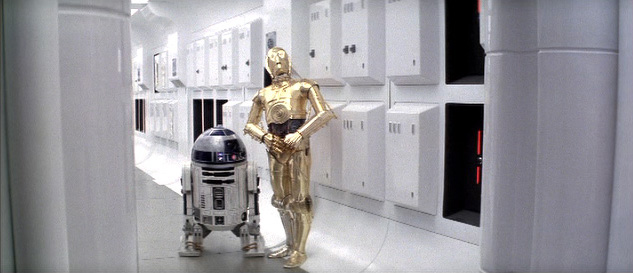
Giving credit where credit is due, this is exactly the case with the Star Wars robots. C-3PO’s a protocol droid, for “human-cyborg relations” and R2-D2 is ostensibly an astromech maintenance droid. Their appearances match their functions.