A mysterious alien artifact called the Tesseract summons the Asgardian god Loki to the Earth, where he uses a powerful staff to either kill or enthrall several S.H.I.E.L.D. operatives before stealing the Tesseract and making his escape with them. The head of S.H.I.E.L.D., Nick Fury, gains permission from a shadowy council to assemble a team of superheroes (Iron Man, Bruce Banner, Black Widow, and Captain America) code named The Avengers Initiative to help capture Loki and recover the Tesseract. They find and capture him in Berlin but his operatives get away with a cache of rare metals. Loki’s brother Thor shows up to claim him but after fighting Iron Man and Captain America, Thor agrees to let Loki remain captured in S.H.I.E.L.D.’s helicarrier.
Loki’s operatives trace him and sabotage the helicarrier to free him as Banner becomes the Hulk and goes on a rampage through the vessel. Through fierce combat and resourcefulness, the helicarrier is saved from crashing, but Loki escapes with his staff.
In New York City Loki’s operatives use the metals they stole and the Tesseract to create an interdimensional gate through which he summons an alien army. Though the Avengers mount a strong defense of the city, the shadowy council orders a nuclear strike on the city to destroy the alien army. Iron Man intercepts the missile, flies it through the portal into the alien mothership, disabling the invaders em masse before falling back through the portal to Earth.
At the resolution of the film, Thor returns to Asgard with Loki and the Tesseract and the staff remains on Earth. Also the team enjoys some shawarma.
The TET is far enough away from Earth that the crew goes into suspended animation for the initial travel to it. This initial travel is either automated or controlled from Earth. After waking up, the crew speak conversationally with their mission controller Sally.
This conversation between Jack, Vika, and [actual human] Sally happens over a small 2d video communication system. The panel in the middle of the Odyssey’s control panel shows Sally and a small section of Mission Control, presumably back on Earth. Sally confirms with Jack that the readings Earth is getting from the Odyssey remotely are what is actually happening on site.
Soon after, mission control is able to respond immediately to Jack’s initial OMS burn and let him know that he is over-stressing the ship trying to escape the TET. Jack is then able to make adjustments (cut thrust) before the stress damages the Odyssey.
FTL Communication
Communication between Odyssey and the Earth happens in real-time. When you look at the science of it all, this is more than a little surprising.
Vika tells Sally that the Odyssey was traveling for at least 39 days in suspended animation. We see in the same scene that the Odyssey’s engines are thrusting that whole time. Even the low thrust of an ion engine would send the Odyssey a long way out into the Solar System in 39 days.
Current communication technology in space relies on radio communication for voice and video. NASA is testing out laser-based signaling, which would provide higher bandwidth but doesn’t travel faster than the speed of light. Time lag is a constant in both technologies.
In space, real-time communication and measurable distance do not go together at all. There should be a lag, especially at the distances implied by the story.
How Far?
The engines on the Odyssey look a lot like NASA’s prototype ion engines. This would fit nicely with the compact nuclear reactor on board, which would be the perfect size for generating living power and engine power for low-thrust ion engines.
Ion engines don’t have the same thrust capacity as our current rockets, but have the advantage of constant thrust over long distances that chemical rockets can’t match. NASA’s Dawn probe has an acceleration of about 0.22m/s/s (very, very rough math). A quick run through a calculator at (http://www.cthreepo.com/lab/math1/) says that over 39 days (Odyssey’s travel time), they would go about 8 astronomical units (AUs). That is 8x the distance from the Earth to the Sun just with Dawn’s level of thrust. That is a low end calculation, and doesn’t factor in any thrust from a more traditional rocket on the Earth end, or any slingshot maneuvers to add speed.
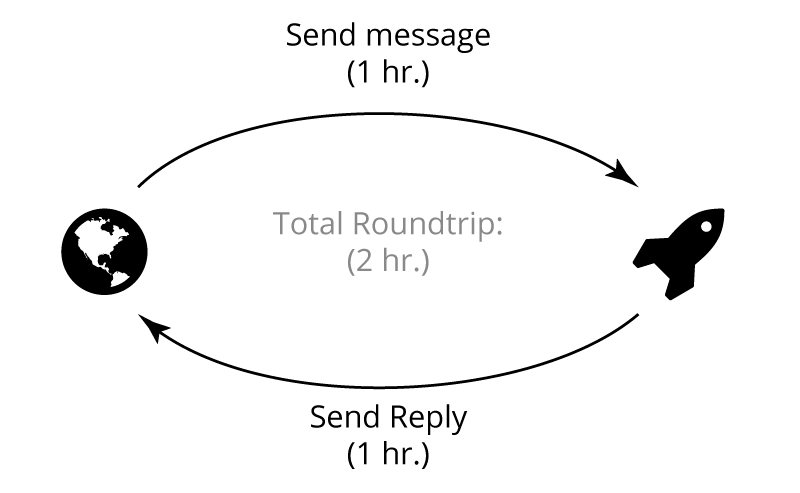
8 AUs would be more than an hour of light speed lag. That means that the Odyssey should take almost two hours to complete a single back-and-forth of a conversation.
If the compact nuclear reactor was actually able to produce thrust (unlikely, but possible), then in 39 days the Odyssey could have traveled even further.
At any distance beyond the Moon’s orbit, light-speed communication would become increasingly delayed. If the TET was even in a Mars orbit, it could take between 4 and 24 minutes for radio and video signals to go back and forth between Earth and the Odyssey. Further distances increase the lag time significantly.
This means that Humanity has…gasp…developed Faster-than-Light communications technologies by the time Oblivion occurs (and, yes, even before the TET could have provided the advanced alien tech to make it happen).
Despite this FTL comm system, as the Odyssey approaches, the TET is able to disrupt the comm signal and cut off Earth from Odyssey. Jack looks concerned by this (as well as Sally’s order to cut his thrust), and stops trying to fight being drawn into the TET.
An unanswerable question here is: what kind of technology from the TET would be able to disrupt an FTL signal? Wouldn’t that require them to be time travelers? Wouldn’t this be a different movie, then?
Don’t Trust New Technology
Neither Jack nor Vika interact with the communication system during the flight that we see besides talking to it. When the signal cuts out, neither of them rushes to check settings or flip switches to try and get the signal back. Instead, they go to a backup plan and focus on what they are able to do without help from Earth. The screen that held Sally’s image cuts over to a secondary information display as soon as it detects that the signal is gone.
This implies two things:
The crew were trained to not rely on the communication system
The communications system is a ‘black box’ to Jack and Vika: it either works or it doesn’t.
Given the previous realization that the comm system is built around an FTL link, both of these make sense. It is unlikely that a single person (or even two people) would be able to understand the equipment behind a new FTL system well enough to maintain it or fix it in an emergency. Similarly, the early Astronauts of NASA weren’t expected to maintain the advanced computers (for the time) on their ships.
If the FTL system was recently invented, and rushed through testing for this mission, it also makes sense that Jack and Vika don’t rely on it. NASA now is very careful about testing equipment to make sure that they will always work, or at least work well enough that they can be constantly relied on. (see the Kepler mission http://en.wikipedia.org/wiki/Kepler_(spacecraft) for what happens when a well-tested and critical component fails).
Jack and Vika reveal their training during the emergency situation: They have no time to think, so they fall back on memorized actions. The lack of interaction with the communications system implies that there was no training around trying to make it work.
Have a Backup Plan
Designers planning to introduce new and advanced technology into important situations should always be sure they have a backup plan for when that advanced technology fails. Likewise, if a highly efficient workflow has advanced technology introduced to improve that efficiency, make sure that failures in the new technology won’t make the workflow slower than before.
Technology should assist and improve, never impede users. And if it’s valuable enough to warrant the risk, give users a backup plan.
As with all overviews, ALL THE SPOILERS ahead. Some movies warrant just a few paragraphs, but it turns out this is a rather complicated plot.
Oblivion opens 50 years after an alien invasion, during which a great many things happened.
Aliens called “Scavs” hammered the moon into huge clustered fragments
(In turn) Doing massive ecological damage to the Earth
The humans retaliated with nuclear weapons
The Earth became contaminated with radiation
Most of humanity had to leave the planet to colonize Titan
Massive hydro-rigs were set up in the oceans that convert seawater into energy
Semi-autonomous flying robots called drones patrol and defend the hydro-rigs from the remaining Scavs, who attempt to destroy the drones and hydro-rigs
A massive tetrahedral spaceship called the Tet was put in orbit around the earth to serve as command and control for pairs of humans who live as a couple and work as a team in their section to monitor and protect both the hydro-rigs and the drones
One member of these teams stays in their sky home, called the Tower, to monitor activity and relay information to and from the Tet
The other member of these teams, the Tech, operates a “bubbleship” to patrol the sector to which they are assigned
One team, Victoria and Jack, are two weeks away from retirement when they are awoken one night by a massive explosion. It is one of their hydro-rigs, sabotaged by Scavs in their section. While investigating the wreckage, they detect a strange radio signal. Jack traces it to its source, discovering a repeater in the ruined Empire State Building broadcasting a set of coordinates off-planet. Later he spies a vessel landing at the broadcast coordinates. He visits the crashed vessel to find it is part of a pre-war human spacecraft, the sleeping pod of the Odyssey. Within are hibernation chambers, but only one crewmember is alive. Jack recovers it as drones show up to destroy them. At the Tower, Jack and Victoria revive its occupant, Julia. The next morning Julia travels with Jack back to the crash site to fetch the flight recorder, but both are taken captive by Scavs.
In captivity Jack learns the horrible truth…
The Scavs are actually the only humans left after the war
The Tet, drones, and hydro-rigs are the alien technology
Jack and Victoria are the tools of the aliens defending their tech from the rest of humanity
Scavs remote-controlled the Odyssey to crash in order to scavenge its nuclear fuel for a bomb to be delivered to the Tet in a captured Drone
Victoria, unaware, sends drones to save Jack, forcing the Scavs to release Jack and Julia. The leader Beech encourages Jack to visit the forbidden radiation zones to confirm the truth. Julie further reveals…
The Odyssey was originally en route to Titan when it was intercepted by the alien Tet
Jack and Victoria were once part of the Odyssey crew as well
Jack and Julia were husband and wife
Through a remote-controlled bubbleship camera, Victoria observes them kissing and this drives her to betray Jack and Julie to the Tet. The Tet activates a Drone and sends it to kill them all, but it only kills Victoria before Julia destroys it. Traveling to another sector, Jack sees a clone of himself appear in a similar bubbleship, to service a Drone. They fight and the clone is killed, and Julia is wounded in the melee. Jack gets into the clone’s bubbleship and travels to its Tower, where he meets a Victoria clone, and he realizes that the planet must be populated by huge numbers of these clones. He fetches a medkit and returns to Julia. He takes her to recover in a log cabin in a lush valley he has been keeping secret from Victoria for a long time. After she heals, he returns to the Scavs, and helps them reprogram their captured Drone, but the Scav enclave is largely destroyed by other drones sent by the Tet.
They load the bomb into a hibernation chamber, appear to seal Julia inside, load it onto a bubbleship, and fly to the Tet. En route he plays the flight recording from the Odyssey to learn…
When the Odyssey originally approached the Tet, Victoria and Jack were pilot and copilot
When they were caught in the Tet’s tractor beam, they ejected the sleeping pod with the remainder of the crew to protect them
Finally, in the bowels of the Tet, he…
Sees the clone vats where more Jacks and Victorias are being grown
Faces the horrible alien intelligence
Awakens the person in the hibernation chamber, which—surprise—is Beech, not Julia
Explodes the bomb, destroying the Tet
Back on Earth, Julia is awakes in a different hibernation chamber at the lush log cabin, as part of Jack’s duplicitous plan to save her. She gives birth to a daughter, and three years later is found by one of the Jack clones, accompanied by a group of the surviving Scavs.
One of the most unusual conceits of the movie is “Would you like to know more?” These consist of short video news sequences with overlaid graphics and narration. At the top of the screen the user can click one of three categories for different categories of video feed, and two functions. At the end of each video sequence the “user” is prompted to interact—should they want to learn more—by clicking the legend at the bottom of the screen.
The user here is ambiguous. It might be that the audience member is the user, but of course it’s not interactive. There’s probably room here for some other writer to investigate the narrative tactic/semiotics of using an interactive interface in a passive story.
At the top of the screen are menu headers labeled “FEDERAL,” “GALAXY,” “TOP NEWS," "ENLIST," and "EXIT." For the usability purist, the collection is problematic for a number of reasons.
The information categories aren’t parallel, and there’s no clear reason why they shouldn’t be. What’s the relationship between Galaxy and Federal?
The functions (enlist and exit) are not visually distinguished from content categories.
The current state of the interface is a mystery. Am I currently watching Top News or something else?
Why does the interface chrome persist? Aren’t they distractions from the content? Maybe they should appear just only for the few seconds it’s inviting the user to interact, and fade at other times.
While a fascist government would be happy to try and trick its users into clicking enlist, I can’t imagine what benefit they get from having them accidentally clicking exit to close the propaganda engine. These should not just be visually distinguished, but given different visual weight. They’d probably want enlist large and exit smaller, if there at all.
“Welp. All the links in Federal, Galaxy, and Top News are purple. I wonder what’s happening in ENLIST news? Oh hey, who’s that pounding on the door?”
The presence of the "EXIT" control implies that this is an application running in an operating system or media computer space. This opt-in news application with its small windows of time for interaction helps to paint a picture of a highly engaged and ready-to-respond audience, fitting for the mid-war society portrayed in the movie.
Only once do we see an unidentified and unseen "user" control a cursor to view more. In this sequence, he or she clicks on “more” after watching a clip on the bug homeworld Klendathu. (It’s worth noting/condemning that the clickable word “more” looks identical to the rest of the non-clickable text, offering no special affordance.) In response to the selection, the application shows a live video news feed from the conflict on Klendathu. Was it just good fortune that a live feed happened to be available at this moment? More likely the application and media coordination system are smart enough to know a live feed was coming up, and played the trailer in advance as an advertisement for the content, implying a well-coordinated propaganda/content management system.
In a self-contained hedonistic society, the enforced maximum age is 30. Lifeclocks implanted in citizens hands register their ages. Once their time is out and their lifeclocks are blinking, citizens are killed in a public ritual known as Carrousel, [sic] in which they hope to achieve “renewal,” a form of rebirth. Logan 5 is a Sandman, whose job is to catch runners, people who try and escape this fate.
On the body of one of the terminated runners, Logan encounters a mysterious ankh. When he reports this object to the central computer, the computer prematurely ages his lifeclock and sends him on a mission to learn more about an underground resistance movement and a mysterious place called sanctuary. Now a runner himself, Logan gains the trust of resistance member Jessica 6 and escapes the city and the pursuing Sandmen. At the edge of the city, they meet one of the robots that maintain life within the city, and beyond that, the ruins of Washington D.C. There in the outdoors they meet an old man and come to realize the possibility of a life beyond 30.
Returning to the city to try and share their message of liberation, Logan is captured instead. Hearing that Sanctuary does not exist, the computer suffers a meltdown and explodes, ruining the city in the process. Citizens escape to meet the outside world and a new future of age and liberation.
Five teenagers take a road trip on a long weekend to spend time at a cabin in the woods, only to stumble upon creepy and mysterious objects in the basement. Reading Latin found in an old diary, they unwittingly reanimate a family of pain-worshipping zombies, who immediately begin to assault and kill the teens one by one. Marty, one of the teens, escapes death and leads the only other survivor, Dana, into a hidden underground complex he has found. There they learn that their road trip experience has been engineered behind the scenes—and that they have been constantly and subtly manipulated—by an unnamed organization that annually perform this rite, causing archetypal victims to suffer and act as sacrifices that keep ancient evil beings, called the Old Ones, asleep. By releasing containment mechanisms that cage nightmarish monsters, Dana and Marty create gory chaos, allowing them to make their way to the heart of the complex, where they must choose to die for the world, or with it.