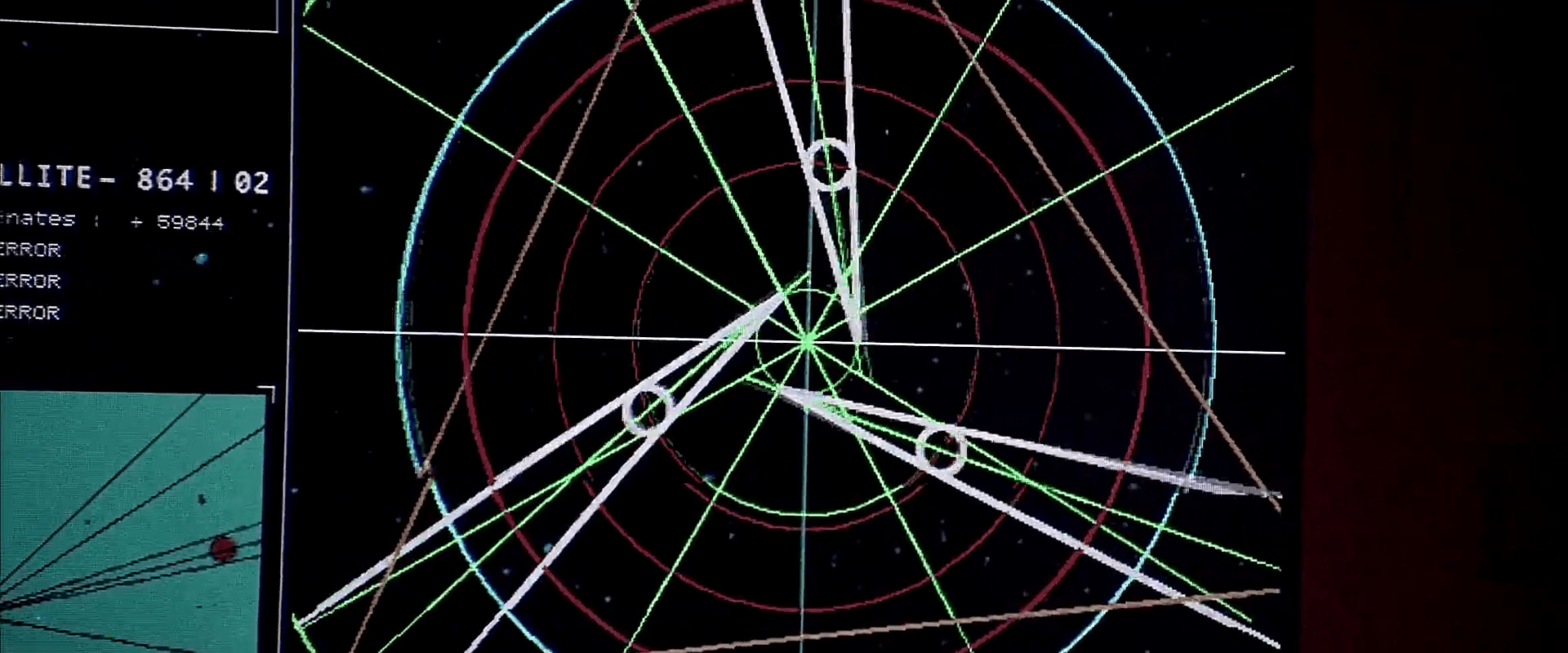
Gravity (?) Scan

FifthE-UFT001

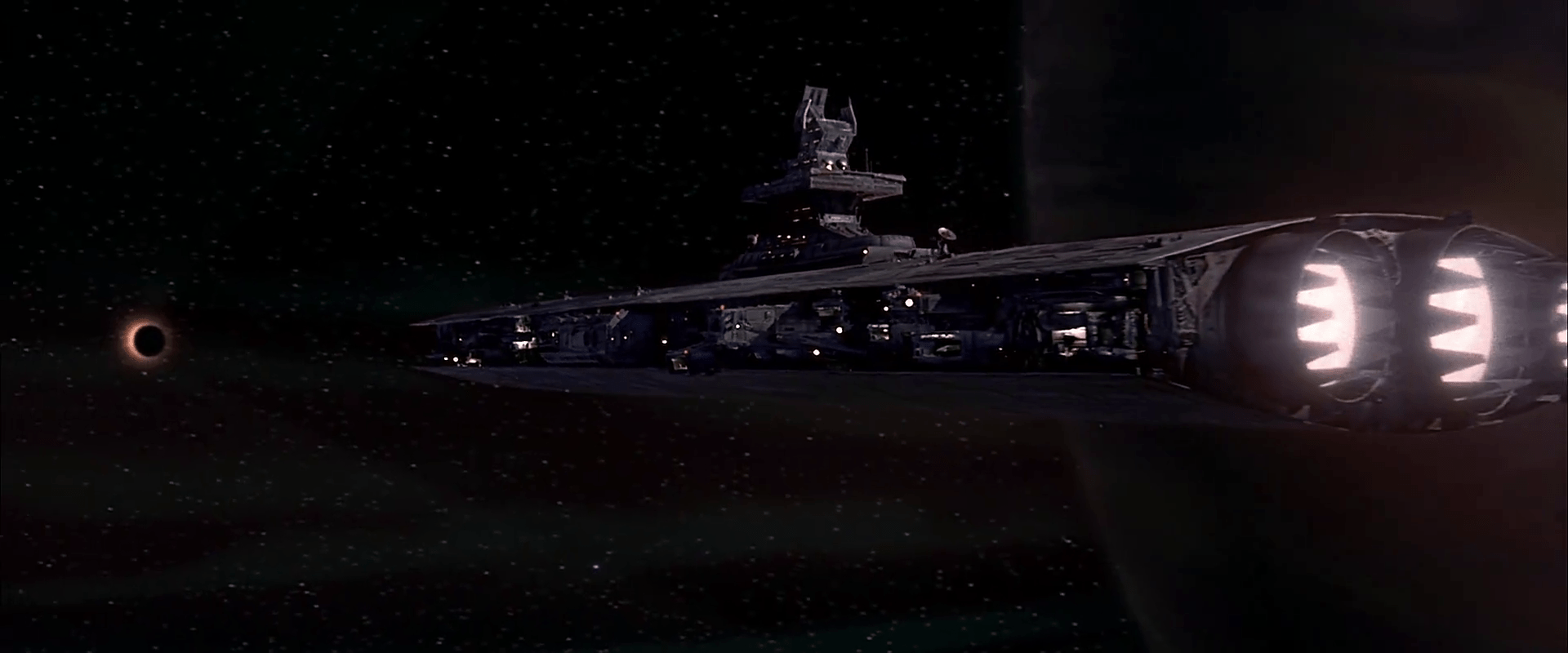
The first bit of human technology we see belongs to the Federation of Territories, as a spaceship engages the planet-sized object that is the Ultimate Evil. The interfaces are the screen-based systems that bridge crew use to scan the object and report back to General Staedert so he can make tactical decisions.
FifthE-UFT006

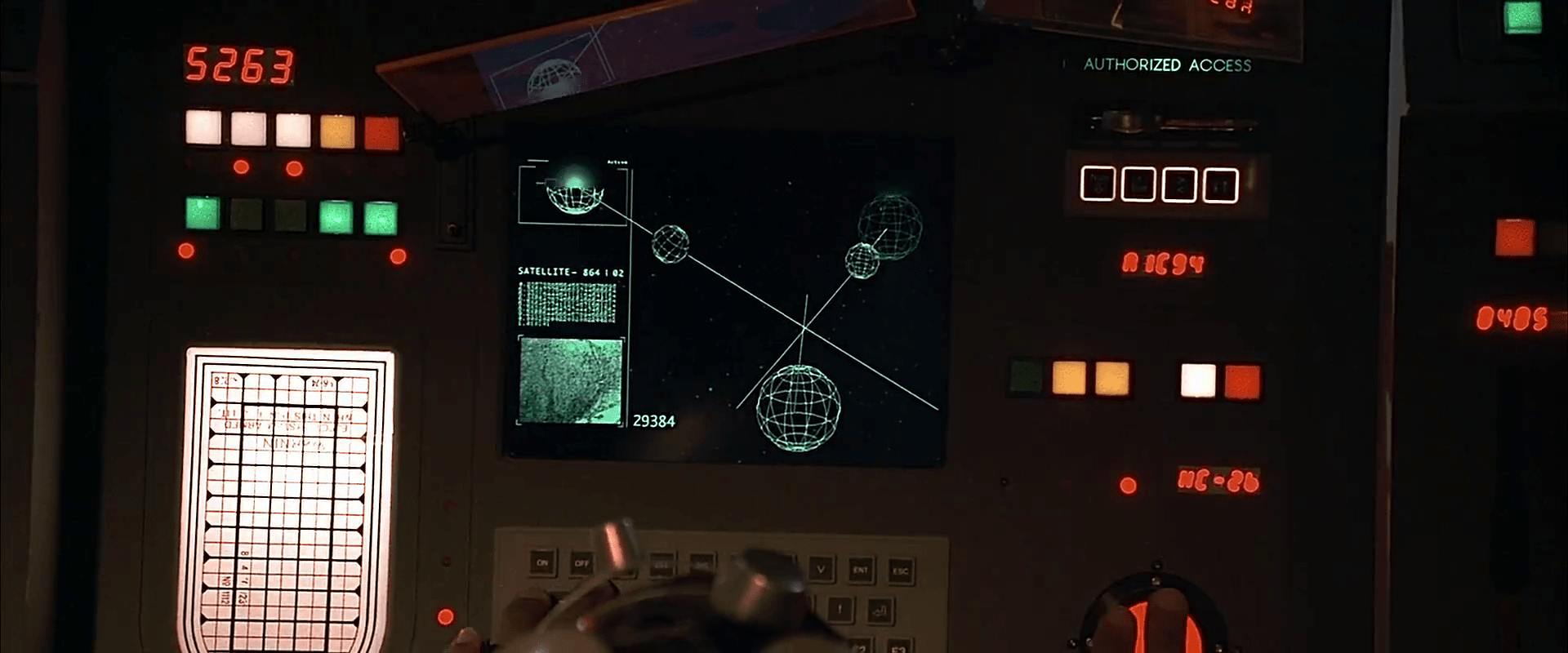
We see very few input mechanisms and very little interaction with the system. The screen includes a large image on the right hand side of the display and smaller detailed bits of information on the left. Inputs include

  • Rows of backlit modal pushbuttons adjacent to red LEDs
  • A few red 7-segment displays
  • An underlit trackball
  • A keyboard
  • An analog, underlit, grease-pencil plotting board.
    (Nine Inch Nails fans may be pleased to find that initialism written near the top.)

The operator of the first of these screens touches one of the pushbuttons to no results. He then scrolls the trackball downward, which scrolls the green text in the middle-left part of the screen as the graphics in the main section resolve from wireframes to photographic renderings of three stars, three planets, and the evil planet in the foreground, in blue.
FifthE-UFT008 FifthE-UFT014 FifthE-UFT010

The main challenge with the system is what the heck is being visualized? Professor Pacoli says in the beginning of the film that, “When the three planets are in eclipse, the black hole, like a door, is open.” This must refer to an unusual, trinary star system. But if that’s the case, the perspective is all wrong on screen.

Plus, the main sphere in the foreground is the evil planet, but it is resolved to a blue-tinted circle before the evil planet actually appears. So is it a measure of gravity and event horizons of the “black hole?” Then why are the others photo-real?

Where is the big red gas giant planet that the ship is currently orbiting? And where is the ship? As we know from racing game interfaces and first-person shooters, having an avatar representation of yourself is useful for orientation, and that’s missing.

And finally, why does the operator need to memorize what “Code 487” is? That places a burden on his memory that would be better used for other, more human-value things. This is something of a throw-away interface, meant only to show the high-tech nature of the Federated Territories and for an alternate view for the movie’s editor to show, but even still it presents a lot of problems.

The Fifth Element: Overview

Release Date: 7 May 1997, France

Title card for 'The Fifth Element' with a cosmic background featuring stars and space.

In 1914 an alien race called the Mondoshawan visit a pyramid in Egypt to retrieve and secure four sacred stones, which are part of a weapon to defeat Ultimate Evil. Jump forward to the year 2263, when the Ultimate Evil has formed again and comes to threaten the Earth, partly through coercion of an evil corporatist named Zorg, who is ordered to capture the stones and thereby disable the weapon. A Mondoshawan spaceship coming to help Earth crashes, killing all aboard. Federation scientists use some of the remains to reconstruct one of the aliens, to discover that it is a strikingly powerful and beautiful woman named Leeloo. She escapes the facility to crash into the taxi of Korben Dallas. At her request, he takes her to a priest named Cornelius who belongs to a sect that serves the Mondoshawans. Cornelius recognizes that she is a prophesized “promised one.” Leeloo tells the priest the whereabouts of the four stones.

Dallas accepts an undercover job from the Federation and flies with Leeloo to a vacation spaceship liner called Fhloston Paradise. There he defeats an uprising of Mangalore aliens and unlocks a mystery to find the four sacred stones in the abdomen of the Diva Plavalaguna. Zorg arrives to lay a bomb, attempt to destroy Leeloo, and steal the stones, but fails at all three, dying instead from a Mangalore bomb. Dallas and Leeloo escape back to Earth, where they discover how to use the stones and activate the Ultimate Weapon that destroys Ultimate Evil in the nick of time.

A glowing portal with vibrant colors emitting light, showing a figure appearing to be suspended or emerging from the center.

IMDB: https://www.imdb.com/title/tt0119116/Currently streaming on:

Chat follow-up: Ultimate Weapon Against Evil & Constraints

The live chat of the O’Reilly webinar that Christopher delivered on 18 April 2013 had some great questions, but not all of them made it out of the chat room and onto the air. I’m taking a short break from the release of the sci-fi survey to answer some of those questions.

Q: Dennis Ward asks: There’s a gaff in The Fifth Element scene referenced—Corbin Dallas places one of the stones upsidedown relative to the other three. Is that a constraint issue?

5E-up

Yes and no.

Yes, if the stones could be placed on their pedestals in the wrong way. You wouldn’t want to design the weapon such that that were possible. As we saw, seconds count, and the stakes are pretty high. (c.f. Ultimate Evil.) Constraints, as Don Norman defined them in The Design of Everyday Things, would be one way to fix that. For example, you could widen one end of the stones so they were too large to fit in the pedestal the wrong way.

But (and here’s the “no”) it turns out that in The Ultimate Weapon Against Evil, the stones work whichever way they’re inserted. Take a look at the scene and though the stones aren’t all oriented the same way, i.e. pattern- or smooth-side up, they all work. (There is a third possibility, that orientation does matter, but they just got lucky in orienting them correctly. The odds of getting this right the first time is just over 6%, so we can discount this.)

5E-down

This is a superior design solution since it eliminates the need for the user to worry about orientation. Let’s call the pattern Make Orientation a Non-Issue.

But wait, we’re not done. We shouldn’t disregard the fact that you perceived it as a gaff. The design of the object signaled to you that there was an orientation that mattered. So yes, let’s keep the stones the same basic shape such that orientation is a non-issue, but one small improvement would be to have the visual design match the interaction design: The patterns should be symmetrical, perhaps completely covering each long side of the stones. That way, anyone wondering how they fit the pedestals wouldn’t falsely perceive that there is an orientation issue when there really isn’t one.

Thanks for this question, by the way. The Fifth Element is one of the first I reviewed for the Make It So survey since it’s one of my favorite sci-fi movies of all time. It makes me want to post that one next. I’ve got other plans, though, so perhaps after that. 🙂

UPDATE ————————————–

Since writing this post, I’ve done deeper analysis on this topic. See the Pilot episode of Sci Fi University for an even better and more thorough answer to this question.