Me: Well…I like to think of myself as a design critic looking though the lens of–
The computer: “In your voice, I sense hesitance, would you agree with that?”
Me: Maybe, but I would frame it as a careful consider–
The computer: “How would you describe your relationship with Darth Vader?”
Me: It kind of depends. Do you mean in the first three films, or are we including those ridiculous–
The computer: Thank you, please wait as your individualized operating system is initialized to provide a review of OS1 in Spike Jonze’s Her.
A review of OS1 in Spike Jonze’s Her
Ordinarily I wait for a movie to make it to DVD before I review it, so I can watch it carefully, make screen caps of its interfaces, and pause to think about things and cross reference other scenes within the same film, or look something up on the internet.
The prior posts discussed the Star Trek combadge and the Minority Report forearm-comm. In the same of completeness, there are other wearable communications in the survey.
There are tons of communication headsets, such as those found in Aliens. These are mostly off-the-shelf varieties and don’t bear a deep investigation. (Though readers interested in the biometric display should check out the Medical Chapter in the book.)
Besides these there are three unusual ones in the survey worth noting. (Here we should give a shout out to Star Wars’Lobot, who might count except given the short scenes where he appears in Empire it appears he cannot remove these implants, so they’re more cybernetic enhancements than wearable technology.)
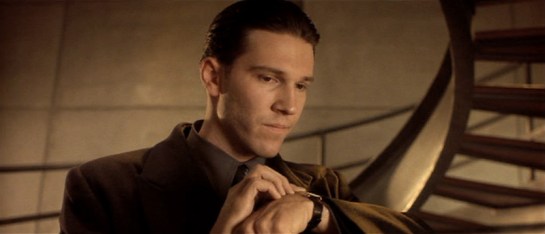
In Gattaca, Vincent and his brother Anton use wrist telephony. These are notable for their push-while-talking activation. Though it’s a pain for long conversations, it’s certainly a clear social signal that a microphone is on, it telegraphs the status of the speaker, and would make it somewhat difficult to accidentally activate.
In the Firefly episode “Trash”, the one-shot character Durran summons the police by pressing the side of a ring he wears on his finger. Though this exact mechanism is not given screen time, it has some challenging constraints. It’s a panic button and meant to be hidden-in-plain-sight most of the time. This is how it’s social. How does he avoid accidental activation? There could be some complicated tap or gesture, but I’d design it to require contact from the thumb for some duration, say three seconds. This would prevent accidental activation most of the time, and still not draw attention to itself. Adding an increasingly intense haptic feedback after a second of hold would confirm the process in intended activations and signal him to move his thumbs in unintended activations.
In Back to the Future, one member the gang of bullies that Marty encounters wears a plastic soundboard vest. (That’s him on the left, officer. His character name was Data.) To use the vest, he presses buttons to play prerecorded sounds. He emphasizes Future-Biff’s accusation of “chicken” with a quick cluck. Though this fails the sartorial criteria, being hard plastic, as a fashion choice it does fit the punk character type for being arresting and even uncomfortable, per the Handicap Principle.
There are certainly other wearable communications in the deep waters of sci-fi, so any additional examples are welcome.
Next up we’ll take a look at control panels on wearables.
What you see pictured is photographic evidence. Sharp-eyed readers have, since the publication of the book, identified several Errata where we’d gotten a fact wrong, or misspelled something, or misattributed a picture.
With the printing of our brand-spanking-new 2nd Edition, these mistakes have been corrected. If you’re the OCD type who really wants their sci-fi interface analysis books to be perfect, now’s your chance for an upgrade. If you were an early purchaser, keep those old copies on hand. Maybe they’ll be like 1969-S Lincoln Cent With a Doubled Die Obverse: crazy valuable exactly because of the mistakes. Maybe not. But in any case, now’s your chance to sift through and find any additional errata everyone else has missed.
And of course thanks to all the fans who got us to a second edition. Here’s to a third. 🙂
Though most everyone in the audience left Minority Report with the precrime scrubber interface burned into their minds (see Chapter 5 of the book for more on that interface), the film was loaded with lots of other interfaces to consider, not the least of which were the wearable devices.
Precrime forearm devices
These devices are worn when Anderton is in his field uniform while on duty, and are built into the material across the left forearm. On the anterior side just at the wrist is a microphone for communications with dispatch and other officers. By simply raising that side of his forearm near his mouth, Anderton opens the channel for communication. (See the image above.)
There is also a basic circular display in the middle of the posterior left forearm that displays a countdown for the current mission: The time remaining before the crime that was predicted to occur should take place. The text is large white characters against a dark background. Although the translucency provides some visual challenge to the noisy background of the watch (what is that in there, a Joule heating coil?), the jump-cut transitions of the seconds ticking by commands the user’s visual attention.
On the anterior forearm there are two visual output devices: one rectangular perpetrator information (and general display?) and one amber-colored circular one we never see up close. In the beginning of the film Anderton has a man pinned to the ground and scans his eyes with a handheld Eyedentiscan device. Through retinal biometrics, the pre-offender’s identity is confirmed and sent to the rectangular display, where Anderton can confirm that the man is a citizen named Howard Marks.
Wearable analysis
Checking these devices against the criteria established in the combadge writeup, it fares well. This is partially because it builds on a century of product evolution for the wristwatch.
It is sartorial, bearing displays that lay flat against the skin connected to soft parts that hold them in place.
They are social, being in a location other people are used to seeing similar technology.
It is easy to access and use for being along the forearm. Placing different kinds of information at different spots of the body means the officer can count on body memory to access particular data, e.g. Perp info is anterior middle forearm. That saves him the cognitive load of managing modes on the device.
The display size for this rectangle is smallish considering the amount of data being displayed, but being on the forearm means that Anderton can adjust its apparent size by bringing it closer or farther from his face. (Though we see no evidence of this in the film, it would be cool if the amount of information changed based on distance-to-the-observer’s face. Writing that distanceFromFace() algorithm might be tricky though.)
There might be some question about accidental activation, since Anderton could be shooting the breeze with his buddies while scratching his nose and mistakenly send a dirty joke to a dispatcher, but this seems like an unlikely and uncommon enough occurrence to simply not worry about it.
Using voice as the input is cinegenic, but especially in his line of work a subvocalization input would keep him more quiet—and therefore safer— in the field. Still, voice inputs are fast and intuitive, making for fairly apposite I/O. Ideally he might have some haptic augmentation of the countdown, and audio augmentation of the info so Anderton wouldn’t have to pull his arm and attention away from the perpetrator, but as long as the information is glanceable and Anderton is merely confirming data (rather than new information), recognition is a fast enough cognitive process that this isn’t too much of a problem.
All in all, not bad for a “throwaway” wearable technology.
There’s one wearable technology that, for sheer amount of time on screen and number of uses, eclipses all others, so let’s start with that. Star Trek: The Next Generation introduced a technology called a combadge. This communication device is a badge designed with the Starfleet insignia, roughly 10cm wide and tall, that affixes to the left breast of Starfleet uniforms. It grants its wearer a voice communication channel to other personnel as well as the ship’s computer. (And as Memory Alpha details, the device can also do so much more.)
Chapter 10 of Make It So: Interaction Design Lessons from Science Fiction covers the combadge as a communication device. But in this writeup we’ll consider it as a wearable technology.
How do you use it?
To activate it, the crewman reaches up with his right hand and taps the badge once. A small noise confirms that the channel has been opened and the crewman is free to speak. A small but powerful speaker provides output that can be heard against reasonable background noise, and even to announce an incoming call. To close the channel, the crewman reaches back up to the combadge and double-taps its surface. Alternately, the other party can just “hang up.”
This one device illustrates of the primary issues germane to wearable technology. It’s perfectly wearable, social, easy to access, prevents accidental activation, and utilizes apposite inputs and outputs.
Wearable
Sartorial
The combadge is light, thin, appropriately sized, and durable. It stays in place but is casually removable. There might be some question about its hard, pointy edges, but given its standard location on the left breast, this never presents a poking hazard.
Social
Wearable tech exists in our social space, and so has to fit into our social selves. The combadge is styled appropriately to work on a military uniform. It is sleek, sober, and dynamic. It could work as is, even without the functional aspects. That it is distributed to personnel and part of the uniform means it doesn’t suffer the vagaries of fashion, but it helps that it looks pretty cool.
As noted in the book, since it is a wireless microphone, it really should have some noticeable visual signal for others to know when it’s on, so they know that there might be an eavesdropper or when they might be recorded. Other than breaking this rule of politeness, the combadge suits Starfleet’s social requirements quite well.
When Riker encounters “Rice” in The Arsenal Of Freedom (S1E21), “Rice” isn’t aware that the combadge is recording. Sure, he was really a self-iterating hyper-intelligent weapon (decades before the Omnidroid) but it’s still the polite thing to do.
I don’t recall ever seeing scenes where multiple personnel try to use their combadges near each other at the same time and having trouble as a result. I don’t recall this from the show (and Memory-Alpha doesn’t mention it) but I presume the combadges are keyed to the voice of the user to help solve this sort of problem, so it can be used socially.
Technology
Easy to access and use
Being worn on the left breast of the uniform means that it’s in an ideal position to activate with a touch from the right hand (and only a little more difficult for lefties). The wearer almost doesn’t need to even move his shoulder. This low-resistance activation makes sense since it is likely to be accessed often, and often in urgent situations.
Tough to accidentally activate
In this location it’s also difficult to accidentally activate. It’s rare that other people’s hands are near there, and when they are, its close enough to the wearers face that they know it and can avoid it if they need to.
Apposite I/O
The surface of the body is a pretty crappy place to try and implement WIMP models of interface design. Using touch for activation/deactivation and voice for commands fit most common uses of the device. It’s easy to imagine scenarios where silence might be crucial. In these cases it would be awesome if the combadge could read the musculature of its wearer to register subvocalized commands and communication.
The fact that the combadge announces an incoming call with audio could prove problematic if the wearer is in a very noisy environment, is in the middle of a conversation, or in a situation where silence is critical. Rather than use an “ring” with an audio announcement, a better approach might build in intensity: a haptic vibration for the initial or first several “rings,” and adding the announcement only later. This gives the wearer an opportunity to notice it amidst noise, silence it if noise would be unwelcome, and still provide an audible signal that told others engaged with the wearer what’s happening and that he may need to excuse himself.
So, as far as wearable tech goes, not only is it the most familiar, but it’s pretty good, and pretty illustrative of the categories of analysis applicable to all wearable interfaces. Next we’ll take a look at other wearable communications technologies in the survey, using them to illustrate these concepts, and see what new things they add.
Recently I was interviewed for The Creators Project about wearable technologies for the Intel Make It Wearable Challenge, both for my (old) role as a designer and managing director at Cooper and in relation to sci-fi interfaces. In that interview I referenced a few technologies from the survey relevant to our conversation. Video is a medium constrained by time, so here on scifiinterfaces.com I hope to give the topic a more thorough consideration.
This is a different sort of post than I’ve put to the blog before, more akin to the chapters from the book. This won’t be about a single movie or television show as much as it is a cross-section from many shows.
Image courtesy of Creative Applications Network
Defining wearable
What counts? Fortunately we don’t have to work too hard on this definition. The name makes it pretty clear that these are technologies worn on the body, either directly or incorporated into clothing. But there’s two edge cases that might count, but I’ll call out as specifically not wearable.
Carryable technologies—like cell phones, most weapons, or even Ruby Rhod’s staff from The Fifth Element—aren’t quite the same thing. When in use, these technologies occupy one or both of the hands of its user. They also have to be holstered or manually put away when not in use. That introduces some different constraints, microinteractions, and ergonomic considerations. In contrast, wearable technologies don’t need to be fetched from storage. They’re just…there, usable at a moment’s notice. So for purposes of the sci-fi interfaces from the survey, I’m only looking at wearable technologies and not these carryable ones.
Perhaps more controversially, exosuits lie outside the definition. Certainly by definition exosuits are worn. Tony Stark’s Iron Man suit, the loader that Ripley wears in Aliens, or the APUs used to defend Zion in The Matrix: Revolutions are all worn by their users. But these technologies can’t really be donned or removed casually. Users climb into them and strap in, or as with Iron Man, are mechanically sealed inside. That breaks a connotation of the term “wearable” as its used today, and that is that wearable technology fits into our everyday lives. It’s thin, light, and flexible enough to let us ride the bus, have coffee with a friend, or attend to our jobs with little to no disruption. I can’t really see trying to use Ripley’s loader to grab hold of my espresso cup and ask someone about how their day’s gone, so exosuits are out. (Attentive readers note that exosuits are also called out as excluded from of gestural technologies in Chapter 5 of the book. Fans of these cool interfaces must still wait, but someday these devices will get their due attention.)
Catch me soon if I’m wrong in excluding these two categories of tech from wearables, because the remainder of the writeups are based on this boundary.
Even excluding these two, we’re left with quite a bit to consider, reaching almost back to the beginning of cinema. The first sci-fi film, La Voyage Dans La Lune, had nothing we’d recognize as an interface, so of course that’s off the hook. The second, Metropolis, for all of its prescience, puts technology in the furniture and walls of its Upper City, as monstrous edifices in the Lower City, or as the wicked robot Maria.
But the next thing in the survey is the Buck Rogers serials from the 1930s, and there we see a few technologies that are worn. Since then, we’ve seen devices for communication, mind control, biometrics, fashion, gaming, tracking, plus a few nifty one-offs. Of course the survey is just that, the catalog of interfaces captured and documented so far. Sci-fi is vast and has continued since the book was published. If you see any missing by the time I wrap these up, please let me know.
With this introduction complete, the next several posts we’ll look at several examples in details. But the first one is the big one, and that’s the Star Trekcombadge.
Now this this exciting. Scifiinterface.com’s first guest review begins this week! That’s right, someone took a look at the terrifying Contribute! page, and stepped up to the sci-fi plate! So with no further ado, let me introduce Clayton Beese, and share his answers to a few questions I posed to him.
Hi there. Tell us a bit about yourself. What’s your name, where are you from, how do you spend your time?
Hi! I’m Clayton Beese, a User Experience designer from Overland Park, Kansas, and I’m someone who is drawn to the idea of storytelling as a very basic human activity. Outside of work I bike, I’m an amateur writer, I am usually the designated photographer on family trips, and I like taking random classes in things like rock climbing, blacksmithing, and Tai Chi to see what they’re like. Science fiction has always captured my interest because it asks questions about our needs as people, and what we want to see out of our future.
What are some of your favorite sci-fi interfaces (Other than in Wall-E)? (And why.)
For our purposes, Dome City is a service. Provided by the city’s ancestors to provide a “good life” for their cloned descendants in a sustainable way, i.e., a way that does not risk the problems of overpopulation. The “good life” in this case is a particular hedonistic vision full of fashion, time at the spa, and easy casual sex.
There’s an ethical, philosophical, and anthropological question on whether this is the “right” sort of life one would want to structure a service around. I suspect it’s a good conversation that will last at least a few beers. Fascinating as that question may be, looking into the interaction design requires us to accept those as a given and see how well the touchpoints help these personas address their goal in this framework.
Sci: F (0 of 4) How believable are the interfaces?
The Fade Out drug is the only, only interface that’s perfectly believable. And while I can make up some reasons the Clean Up Rig is cool, that’s clearly what I’m bringing to it, and the rest of the bunch, to an interface, has massive problems with fundamental believability and usability. Seriously, the movie is a study in bad design.
Fi: A (4 of 4)
How well do the interfaces inform the narrative of the story?
Here the interfaces are fine. The Lifeclock tells us of their forced life limit. The Circuit tells us of the easy sex. Fade Out tells of easy inebriation. New You of easy physical changes.
The interfaces help tell the story of this bizarre dystopia, help paint the “vast, silly spectacle” that Roger Ebert criticized when he write his original review in 1976.
Other interfaces help move the plot along in effective, if sometimes ham-handed ways, like the SandPhone and Aesculator Mark III. So even when they’re background tech, they help. Full marks.
Interfaces: D (1 of 4) How well do the interfaces equip the characters to achieve their goals?
Sure, if you ignore all the usability problems and handwaving the movie does, the characters are getting what they want on a surface level. But ultimately, the service design of Dome City fails for every reason it could fail.
The (entirely questionable) tendency towards punctuated serial monogamy in pair bonds
A desire for self-determination
Basic self-preservation.
If you don’t understand the goals of your users, you really have no hope of designing for them. And if you’re designing an entire, all-consuming world for those same users, misjudging the human universals puts your entire project—and their world—at risk.
The Übercomputer’s all caps and fixed-width evoke “that look” of early computer interfaces (page 33), as does its OCR sans-serif typeface (page 37) and blue color (page 42).
The SandPhone would have been much more useful as Augmented Reality (chapter 8, page 157)
The Aesculaptor could use a complete revamp from the Medical Chapter (chapter 9, page 258), most notably using waveforms (page 263) and making it feel humane (page 281).
The Evidence Tray reminds us of multifactor authentication (page 118).
Of course The Circuit appears in the Sex chapter (chapter 13, page 293) and as my redesign showed, needed to modernize its matchmaking (page 295) use more subtle cues (page 301). Certainly Jessica-5 could have used a safeword (page 303).
New lessons
The Lifeclock reminds us to keep meaningful colors distinguishable.
The Circuit shows why a serial presentation democritizes options.
The Circuit also shows us that matchmaking must account for compatability, availability, and interest.
The Aesculaptor tells why a system should never fail into a worse state.
Carrousel implies that we don’t hide the worst of a system, but instead cover it in a dazzle pattern.
The improvements I suggested for the SandPhone imply that solving problems higher up the goal chain are much harder but more disruptive.
The Evidence Tray gives us the opposite of the “small interfaces” lesson (page 296), too large an interface can overpromise for small interactions.
I grew up in Texas, and had the chance to visit the Fort Worth Water Gardens and Market Center where some of the scenes were shot. So I have a weirdly personal connection to this movie. Despite that, on review, the interfaces just suck, bless their little interactive hearts. Use them as fodder for apologetics and perhaps as a cautionary tale, but little, little else.
Such a cool collection of interactive voice response systems, with high fives out to everyone who thought up great (and ofttimes obscure) “talkie computers” from decades of sci-fi from the 1950s to the 2000-teens. By name…
kedamono x7
Joe Bloch x10
dhwood
Burning x4
Kelley Strang
dhwood
brightrock
Clayton
Pixel I/O
pavellishin x2
Clayton
@CarsTheElectric
Steve Silvas x2
Matt Sheehe
Ben
Matt Sheehe
Joe Bloch
pavellishin
Matt Sheehe x2
Lela x2
NP
Clayton x2
The list of talkie computers we collected is “Robby the Robot, Adam Link, Jupiter 2, Landru, M-5, Nomad probe, The Oracle, Beta-V, HAL, Colossus, BOXX, Thermostellar Triggering Device, IRAC, the Übercomputer, C-3PO, Alex 7000, Proteus IV, Zen, Orac, Slave, V-Ger, Artificial persons, Dr. Theopolis and TWKE-4, MU-TH-UR 6000, KITT, Replicants, Image Machine, MCP, SAL, Max, Holly, Kryten!, L7, 790, Sphere, Ship [sic], AMEE, Ship, Andromeda Ascendant, Zero, S.A.R.A.H., Andy the Deputy AI, Icarus, KITT, Otto, Gerty, and Jarvis.” Think you could name the movies and TV shows these are from just from these names?
The next step is to build a collection of the scripts of these interactions, since we’ll be analyzing any peculiar, non-standard-English that we find. I’m down to provide these scripts myself, but it would be easier if we crowdsource it. If you’re up to it, head to the following form to add the metadata and line-by-line script of the interaction. You can often find the scripts with a simple Google Search, or by (popping in the VHS/DVD/Blu-Ray you own, finding a video of the scene on some online video service and transcribing it from there. We are interested in word-perfect transcriptions. Don’t sweat it if you don’t have the time yourself. As of Thanksgiving weekend, I’ll manually complete any unfinished ones that I find.